

A nightcap isn't a sleep solution. It may make your eyelids heavy and shorten the time it takes to fall asleep, but that early sedation can hide a more disruptive pattern later: less restorative sleep, altered sleep stages, more awakenings, and poorer overnight recovery. The important question isn't only, “Did alcohol help me fall asleep?” It's, “What happened to my sleep after I stopped noticing it?”
Alcohol and sleep quality are connected through several systems at once. Alcohol changes sleep architecture, can destabilize breathing, and may leave the cardiovascular system working harder overnight. Once you understand those mechanisms, practical choices become clearer, from moving drinks earlier to supporting nasal breathing and building a consistent wind-down routine.
Why Alcohol Feels Like a Sleep Aid but Isn't
The nightcap myth starts with a real observation: alcohol can make you feel sleepy quickly. As a central nervous system depressant, it enhances inhibitory signaling and dampens some of the brain activity associated with alertness. That heavy-lidded feeling is genuine, but sedation isn't the same as natural, well-organized sleep.
Natural sleep develops through coordinated changes in sleep pressure, brain activity, body temperature, and circadian timing. Alcohol pushes the brain toward drowsiness through pharmacological effects. You may fall asleep faster, yet the resulting sleep can follow a less stable pattern once your body begins processing the alcohol.
The first-half benefit hides a second-half problem
Human sleep research consistently describes this sequence: alcohol can reduce sleep-onset latency, then produce more disruption during the second half of the night and a delayed first REM period. The effect can feel like a shortcut at bedtime, followed by waking, restlessness, or an unrefreshed morning.
That creates a misleading personal experiment. You drink, fall asleep faster, and conclude that the drink worked. You may not connect the later awakening at an early morning hour, vivid dreams, dry mouth, or morning fog with the same drink because the initial sedative sensation happened hours earlier.
Practical rule: Judge a nightcap by the entire night, not by the first few minutes in bed.
The distinction matters beyond sleep terminology. REM sleep supports memory, mood regulation, and restoration, so a drink that helps you become unconscious sooner can still reduce the quality of the sleep your brain and body need. A clear overview of how sedating substances affect the nervous system appears in this guide to depressant drugs from Nexus Recovery Centers.
If you rely on alcohol repeatedly, tolerance can also change the experience. The same amount may feel less sedating, while the sleep disruption remains. That's why the most useful question isn't whether alcohol makes you tired. It's whether it preserves the sequence and stability of sleep that help you wake restored.
How Alcohol Rewires Your Sleep Architecture
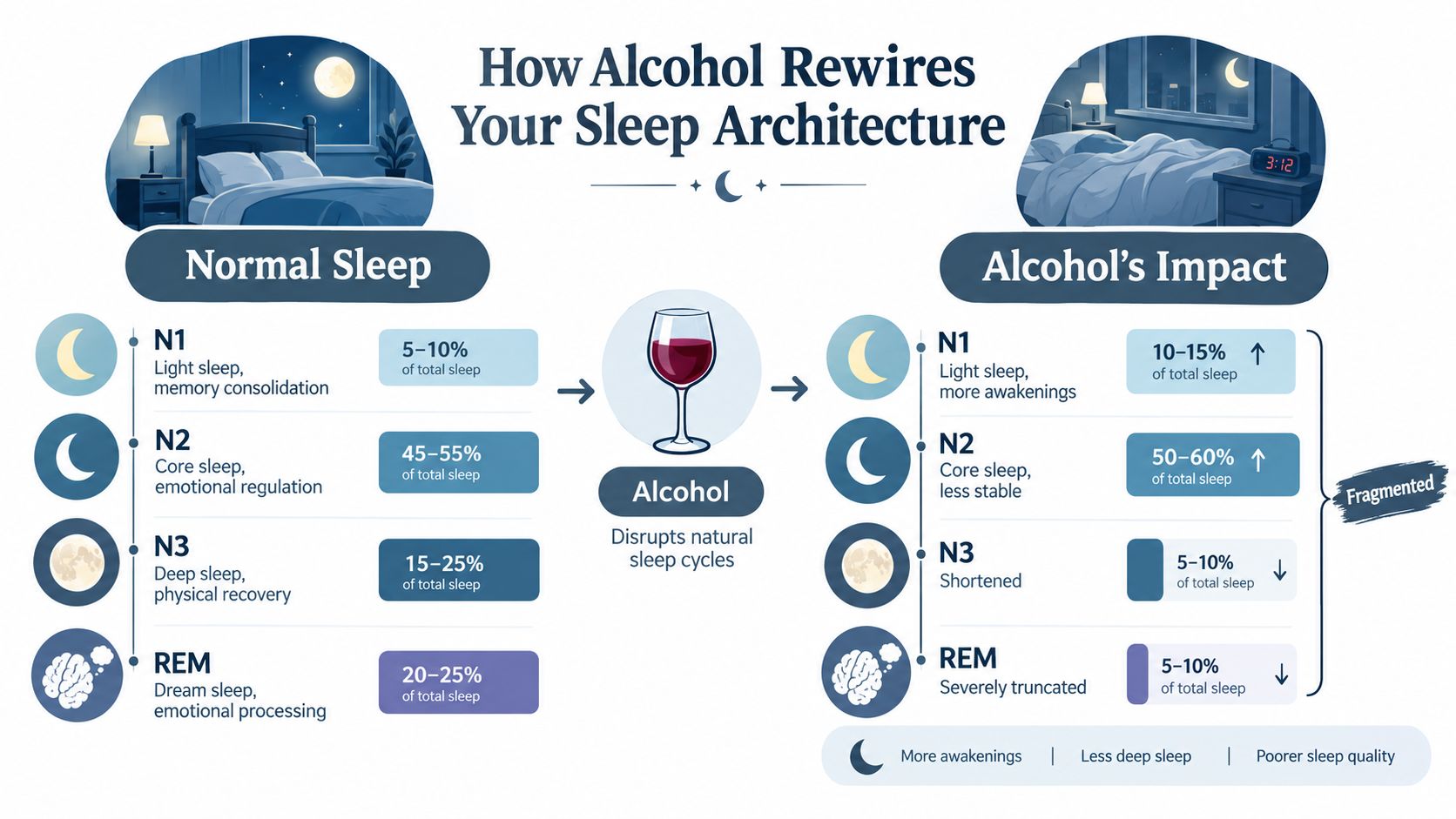
Sleep isn't one uniform state. It cycles through N1, N2, N3, and REM, with each stage contributing something different.
- N1 is light sleep, the transition out of wakefulness.
- N2 provides a more stable sleep state and contributes to memory processing.
- N3 is slow-wave sleep, associated with deep physical recovery.
- REM is the stage most closely linked with vivid dreaming, memory processing, and emotional regulation.
A useful mental model is to treat alcohol like a phase-distorting filter. It doesn't turn sleep up or down. It changes when certain stages appear and how much of the night they occupy.
Early slow-wave sleep, reduced REM
Research summarized in an NIH review found that alcohol before bed can increase slow-wave sleep accumulation early in the night while decreasing REM accumulation at the start of sleep and reducing total REM overall. That can make the first part of the night seem unusually deep, but the apparent benefit doesn't last.
REM normally becomes more prominent later in the sleep period. When alcohol suppresses or delays it early, the later part of the night can become less orderly. As alcohol levels fall, the brain and autonomic nervous system can move toward rebound arousal, with lighter sleep and more awakenings. A broader explanation of recovery and sleep quality can help connect sleep staging with the demands placed on the body during recovery.
The result is rearrangement, not just reduction. Alcohol can front-load some deep sleep while taking away from later REM, then contribute to a more fragmented second half. You might spend many hours in bed, yet the timing of those stages no longer matches the pattern your body uses for restoration.
For a deeper explanation of the normal sequence, see this resource on sleep architecture. If you prefer a non-melatonin option as part of a consistent wind-down routine, Restore+ Magnesium Sleep Aid is described as a magnesium drink containing L-theanine, tart cherry, lemon balm, and glycine, with ingredients intended to support an evening routine, healthy circulation, and the body's natural rhythm.
Dose and Timing Effects on REM and Deep Sleep
Alcohol's sleep effects follow a dose-response pattern, but the pattern isn't as simple as “more alcohol equals more sleep.” A 2025 systematic review found that even low doses, defined as ≤0.50 g/kg and roughly two standard drinks, delayed REM onset and reduced REM duration. Higher doses, defined as ≥0.85 g/kg and roughly five drinks, also shortened sleep-onset latency and reduced the time needed to reach deep N3 sleep. The review found substantial uncertainty around total sleep time, sleep efficiency, and wake after sleep onset, which means altered staging is the clearest recurring effect.
A dose-response trial reported that alcohol delayed REM onset by 18 minutes versus control, while each 1 g/kg increase in dose delayed REM onset by an additional 30.1 minutes and reduced REM duration by 40.4 minutes. Those figures come from the trial report summarized by Rheumatology Advisor.
Why timing changes the experience
Drinking close to bedtime leaves more alcohol-related activity present during the early sleep cycles. Drinking earlier gives the body more time to process alcohol before sleep begins, although it doesn't guarantee a normal night. Timing changes exposure during sleep, not the fact that alcohol can alter architecture.
| Dose | Timing Before Bed | REM Impact | Slow-Wave Sleep | Sleep Efficiency |
|---|---|---|---|---|
| ≤0.50 g/kg, roughly two standard drinks | Earlier in the evening | REM onset is delayed and REM duration is reduced | Early-night slow-wave accumulation may increase | Evidence is uncertain |
| ≤0.50 g/kg, roughly two standard drinks | Close to bedtime | The early sleep period is more likely to overlap with alcohol's effects | Deep sleep may be shifted earlier | Evidence is uncertain |
| ≥0.85 g/kg, roughly five drinks | Close to bedtime | Stronger REM disruption as dose rises | Latency to N3 is reduced, with altered staging | Evidence is uncertain |
The practical conclusion is narrower than many drinking rules. Earlier is generally less disruptive than immediately before bed, but alcohol remains a poor sleep aid even when it feels calming. The 2025 review's findings are also summarized in this sleep-medicine review.
Alcohol, Snoring, and the Breathing Connection
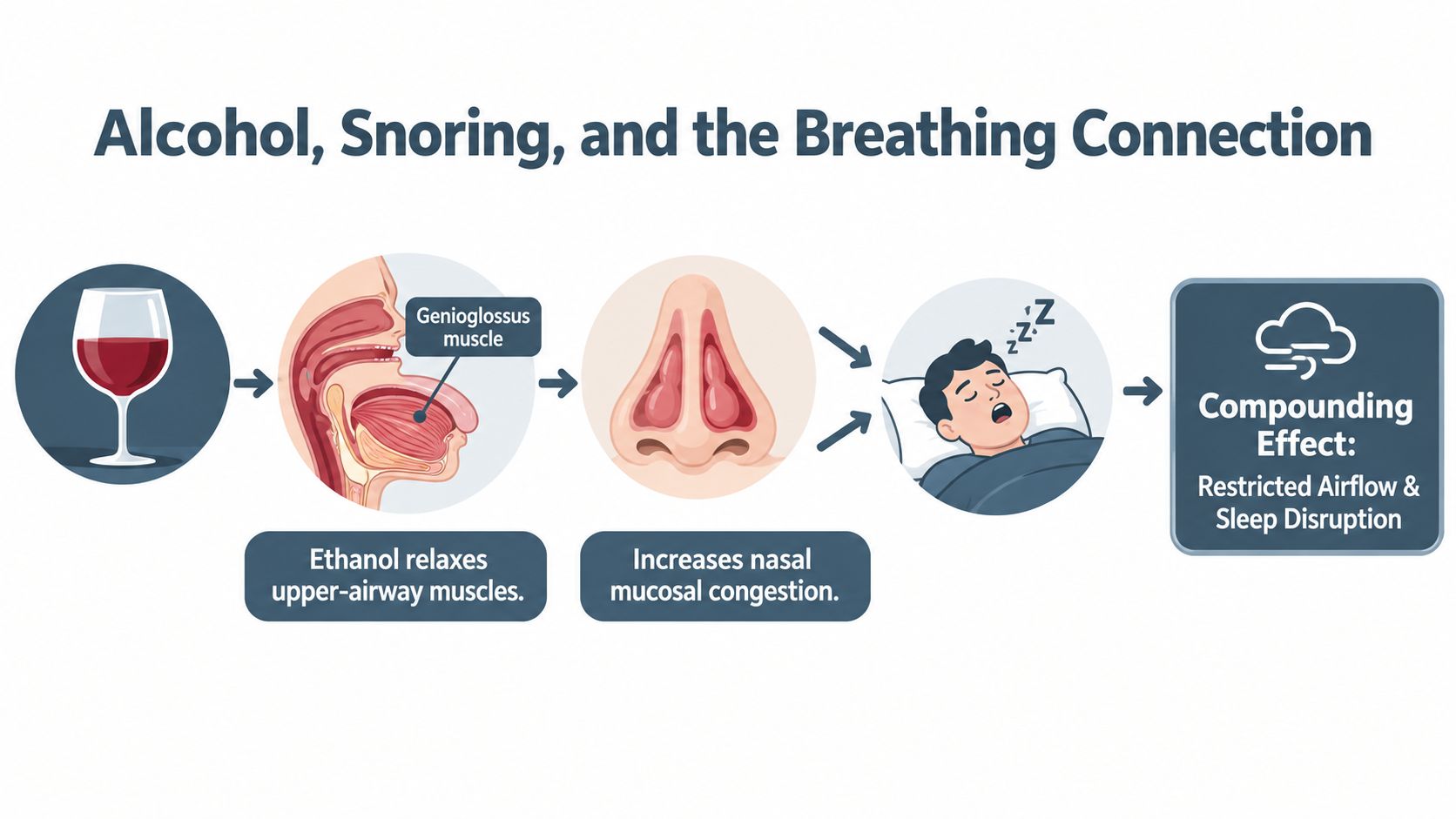
Alcohol affects sleep through the airway as well as the brain. It relaxes upper-airway muscles that help keep the throat open, and it can contribute to nasal congestion. When those effects occur together, airflow becomes more restricted, especially in people who already snore, mouth-breathe, or have a tendency toward obstructive sleep apnea.
A quiet sleeper may become noticeably louder after drinking because the relaxed tissues vibrate more easily as air passes through a narrowed airway. Someone who normally breathes through the nose may switch to mouth breathing, which can dry the mouth and further disturb sleep. The person may not remember each brief arousal, but the repeated interruptions can leave them tired by morning.
What happens during a breathing event
The sequence is straightforward:
- Upper-airway muscles relax. The throat has less muscular support.
- The passage narrows. Airflow becomes turbulent, producing snoring.
- Breathing becomes unstable. In susceptible people, partial or complete obstruction can occur.
- The brain arouses the sleeper. Sleep becomes lighter so breathing can resume.
- The cycle repeats. Sleep continuity and oxygenation suffer.
A meta-analysis of 11 cohort studies found that general alcohol drinking was associated with a higher incidence of sleep disorder, with an odds ratio of 1.37 and a 95% confidence interval of 1.22 to 1.54. A separate analysis covering 13 studies found an increase in the apnea-hypopnea index of 3.98 events per hour and a reduction in the lowest oxygen saturation of 2.72 percentage points. These findings are reported in the sleep-disorder meta-analysis.
If you're trying to understand why snoring appears or worsens at night, this guide to what causes snoring at night offers useful context. Eucalyptus Nasal Strips are another non-drug tool intended to support easier nasal airflow and nasal-breathing habits, though they shouldn't replace medical evaluation for gasping, witnessed breathing pauses, or suspected sleep apnea.
The Hidden Recovery Cost Most People Miss
Falling asleep quickly can create a false sense of recovery. Your body may remain physiologically activated even while your subjective experience says you slept well.
Recent research found that moderate alcohol intake transiently increased nocturnal resting heart rate without changing sleep architecture, while people still reported worse sleep quality. That finding matters because standard sleep-stage measurements don't capture every aspect of recovery. A night can look relatively ordinary on a sleep tracker while the cardiovascular system shows signs of greater strain.
Why recovery can decline without obvious awakenings
Alcohol's effects can reach beyond sleep staging. Changes in autonomic activity may leave the heart rate raised while reducing the body's ability to shift into a calm, restorative state. If breathing also becomes unstable, the body must repeatedly respond to changes in airflow and oxygenation.
For athletes, that distinction changes the question. The concern isn't merely whether alcohol delays sleep onset. It's whether the body spends the night repairing tissue, regulating emotion, and restoring readiness, or whether it keeps responding to metabolic and respiratory stress.
A fast transition into sleep doesn't prove that the night supported recovery.
The same principle applies to shift workers and busy professionals. If you already sleep at an inconvenient biological time, alcohol's sedative effect may feel useful, but the resulting sleep can remain fragmented. Morning grogginess, reduced concentration, and a feeling of being “tired but wired” may reflect disrupted recovery rather than insufficient time in bed.
Alcohol therefore belongs in the category of recovery disruptors, not just sleep-onset aids that sometimes misfire. If your sleep tracker shows a normal-looking night but you feel less recovered, that mismatch deserves attention rather than dismissal.
Acute vs Chronic Use and the Sleep Damage Curve
One night of drinking and repeated drinking don't produce identical patterns. Acute use can shorten sleep onset and disturb the latter part of that night. Repeated use adds persistence, because the brain adapts to alcohol's sedative effects while the disruption to sleep and breathing can continue.
Reviews of people with alcohol dependence report insomnia prevalence estimates ranging from 36% to 91%, compared with about 10% in the general population. In one NIH-linked study of actively drinking alcohol-dependent subjects, 75% had insomnia, and 61% of those cases were moderate to severe. A community-based study of problem drinkers reported sleep disturbance in 76% of participants. These findings are summarized in this review of alcohol dependence and insomnia.
| Metric | Acute Use, 1 to 2 Nights | Chronic Use, Regular |
|---|---|---|
| Sleep onset | May become faster | Sedation may become less reliable as tolerance develops |
| REM sleep | Delayed or reduced, especially later in the night | Disruption can become persistent |
| Second-half sleep | More awakenings and lighter sleep may occur | Fragmentation may become a recurring baseline pattern |
| Breathing | Snoring and obstructive events can worsen | Ongoing use can compound sleep-disordered breathing |
| Insomnia risk | May produce short-term restless sleep | Poor sleep becomes much more common as alcohol use becomes heavier or chronic |
| Recovery | A later alcohol-free night may feel better | Repeated disruption can make restorative sleep harder to regain |
The trajectory isn't identical for everyone. Stress, existing insomnia, body position, airway anatomy, and drinking pattern all matter. Still, the direction is clear: using alcohol to manage poor sleep can turn a temporary sleep problem into a self-reinforcing cycle, where unrestful nights encourage another sedating drink.
An Evidence-Based Evening Routine That Minimizes Harm
The safest way to protect sleep is to avoid alcohol, particularly near bedtime. If you do drink, use a routine that reduces overlapping stressors rather than pretending hydration or supplements can cancel alcohol's effects.
Start with timing and hydration
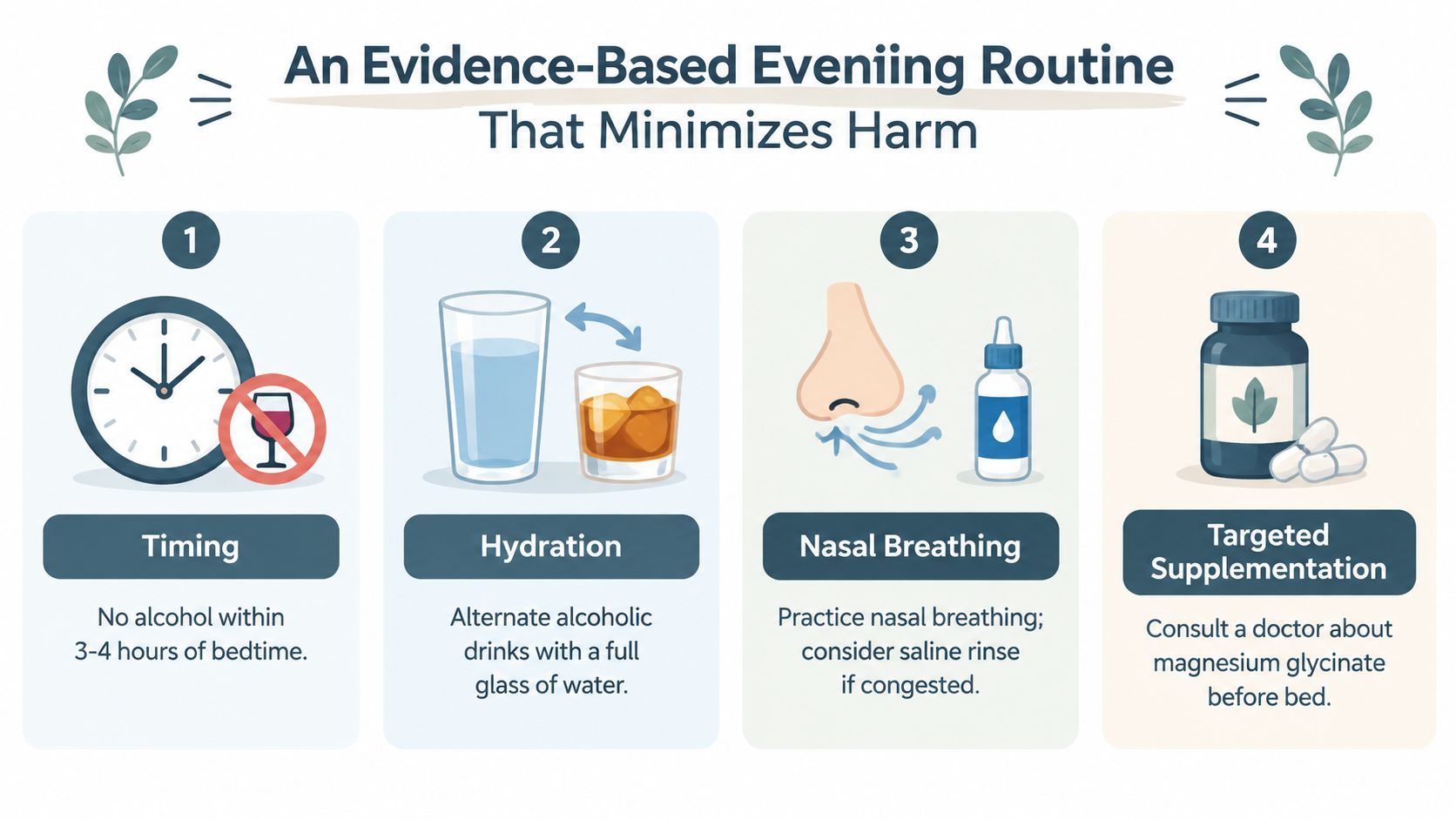
Stop drinking at least three to four hours before bed. This gives your body more time before sleep begins, though individual metabolism varies and earlier drinking doesn't eliminate architecture changes.
Alternate alcoholic drinks with a full glass of water. This can support hydration, but it shouldn't be described as a way to prevent sleep disruption. Alcohol can still affect REM sleep, breathing, and recovery after you've had water.
A practical sequence looks like this:
- Set a stopping point. Choose your final drink time before the evening begins.
- Drink water alongside alcohol. Use a full glass rather than a small sip.
- Avoid adding stimulation late at night. Keep the final part of the evening quiet and low light.
- Protect your sleep environment. Use a cool, dark room and keep your wake time consistent.
Make nasal breathing easy
If congestion or mouth breathing contributes to restless sleep, spend part of your wind-down practicing gentle nasal breathing. A 30-minute period of quiet nasal breathing can include slow breathing, box-breathing patterns, or physiological sighs, provided the technique feels comfortable and doesn't create dizziness.
The goal isn't to force air through a blocked nose. Address congestion first, and never use mouth tape if you can't breathe freely through your nose or if you have unexplained breathing problems. People with loud snoring, gasping, or suspected apnea should seek clinical assessment rather than relying on breathing exercises alone.
Use supplements carefully
Some people consider magnesium glycinate or magnesium threonate 60 to 90 minutes before sleep as part of a wind-down routine. Magnesium may support muscle relaxation and a calmer evening transition, but it doesn't reproduce natural sleep pressure and shouldn't be treated as an antidote to alcohol.
Check with a doctor or pharmacist before using magnesium, particularly if you have kidney disease, take medications, or are pregnant. A broader sleep guide from Addiction Resource Center also discusses restorative strategies for people trying to reset nighttime habits.
For additional context on why a nightcap can backfire, see this guide to a nightcap for sleeping. The core routine is simple: move alcohol earlier, drink water, make nasal breathing comfortable, dim the room, reduce screens, and keep your wake time stable.
Common Sleep and Alcohol Myths Worth Retiring
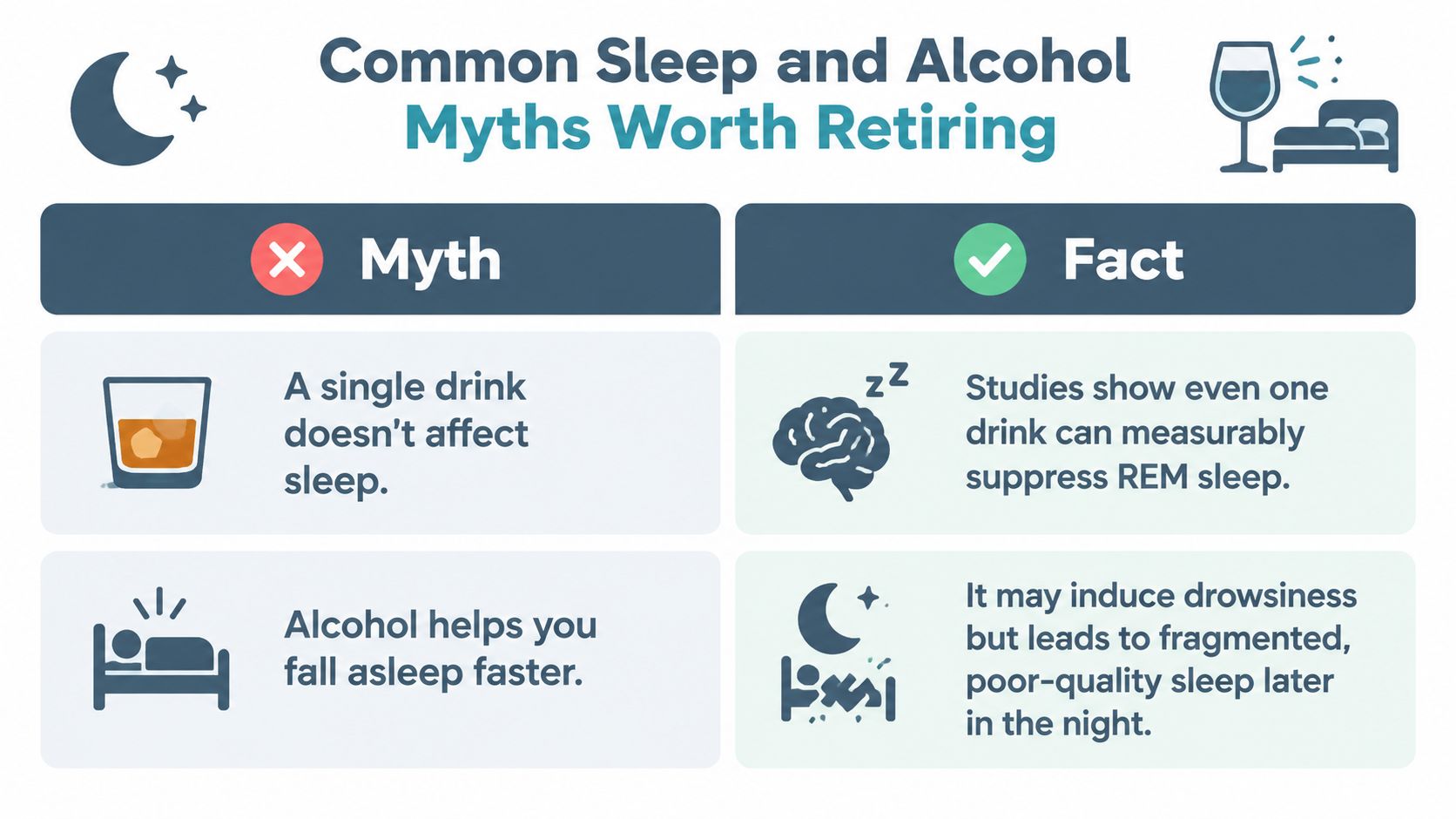
Myth one, one drink can't affect sleep
The amount matters, but “one drink” isn't automatically sleep-neutral. The 2025 systematic review found that even low doses of ≤0.50 g/kg, roughly two standard drinks, delayed REM onset and reduced REM duration. The reasoning error is treating a small subjective effect as no physiological effect.
Myth two, falling asleep faster means sleeping better
Alcohol can shorten sleep-onset latency, but reviews of human studies report more disruption during the second half of sleep and a delayed first REM period at tested doses. Speed at the start of the night tells you almost nothing about the stability and restorative value of the remaining sleep.
Myth three, alcohol improves deep sleep
Alcohol can increase slow-wave sleep accumulation early in the night, but that doesn't mean the entire night contains better recovery. The same research found reduced REM accumulation at the start of the night and reduced total REM, so the apparent increase in one stage can coexist with a harmful rearrangement of the overall sequence.
Myth four, beer is safer than spirits for sleep
Sleep responds to the alcohol dose, not the drink's branding or color. A beer may be served differently from a spirit, but the relevant question is how much alcohol reaches your system and how close it is to bedtime.
Myth five, sleeping it off fixes everything
A later night of sleep may feel better, but alcohol-related disruption can involve more than sleepiness. Breathing instability, altered REM timing, and a higher nocturnal heart rate can make the body less recovered even when you remain in bed for a normal period.
The useful habit is to test advice by asking what it measures. “I fell asleep quickly” measures sleep onset. It doesn't measure REM continuity, breathing quality, autonomic recovery, or how you feel after waking.
SleepHabits offers melatonin-free options and practical tools focused on nighttime breathing and restorative sleep, including a magnesium wind-down drink and nasal-breathing supports. Visit SleepHabits to explore those tools and build an evening routine that supports recovery without relying on a nightcap.