

You wake with your lips stuck together, your throat rough, and the vague sense that sleep happened to you rather than restored you. Your partner may have nudged you during the night because the snoring grew louder, while you remember none of the brief arousals that kept your sleep shallow. If you're trying to understand the benefits of nasal breathing during sleep, start with the mechanics, not the marketing.
The Night You Stop Snoring Through Your Nose
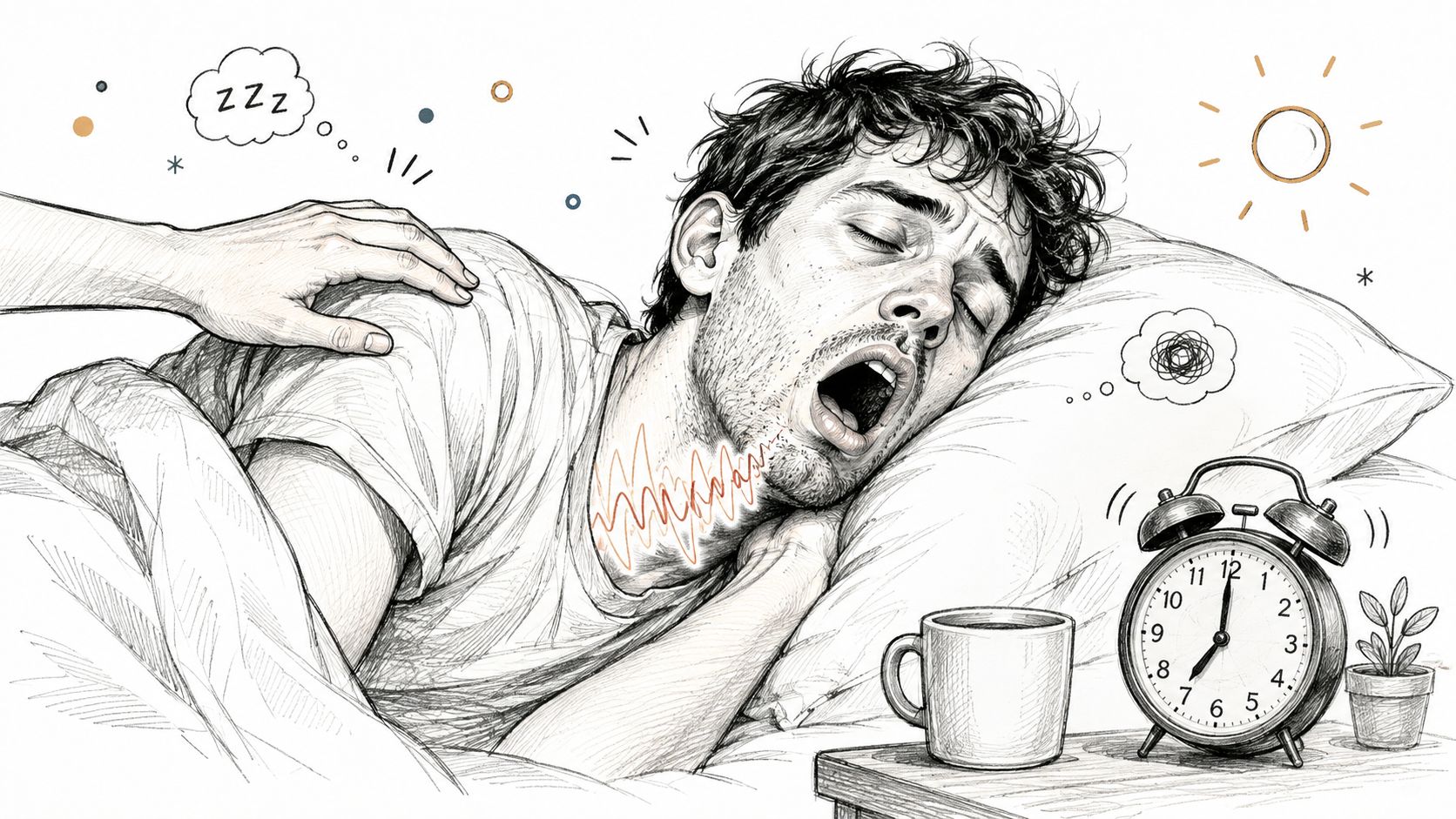
You wake midway through the night with your jaw slack, lips dry, and a low rattle each time air passes the soft palate. Your partner touches your shoulder. You turn, breathe more softly for a while, then roll back and begin snoring again.
By morning, your tongue feels coated, your throat is sore, and your head feels heavy. A full night in bed does not guarantee continuous sleep. Snoring may occur alongside repeated partial arousals, while noisy mouth breathing can leave the night feeling broken into fragments.
What changes when the mouth opens
Mouth breathing bypasses the nose's filtering and conditioning functions. Air also moves across the soft palate and pharynx without the same nasal resistance, which can make narrowed tissues more likely to vibrate during sleep. That combination may produce louder snoring, dry oral tissues, and less comfortable breathing.
Snoring alone does not establish sleep apnea. Sleep apnea involves repeated reductions or interruptions in breathing, so anyone considering home experiments should first understand what is sleep apnea and seek appropriate assessment when symptoms suggest more than ordinary snoring.
Nasal breathing changes the airflow before it reaches the lower airway. The nose warms, humidifies, filters, and shapes each incoming breath, while the sinuses contribute nitric oxide to inhaled air. The nose functions as the body's built-in climate-control system and chemistry lab, rather than a decorative alternative to the mouth.
Nasal breathing can support quieter, more comfortable airflow, but it cannot correct every cause of snoring. In obstructive sleep apnea, the throat may repeatedly narrow or close during sleep. Improving nasal airflow may reduce one source of resistance, yet it should not replace evaluation or treatment for breathing interruptions.
How the Nose Is Built to Power Sleep
Each breath passes through a complex organ that filters, conditions, and chemically modifies incoming air before it reaches the lungs. Those functions matter more during sleep, when reduced muscle tone can make the upper airway easier to narrow.
Four jobs in one passage
First, the nose filters. Hair, mucus, and the curved surfaces inside the nasal cavity catch airborne material before it travels deeper. Second, it humidifies and warms air. This limits the drying effect of repeated inhalation on the delicate lining of the lower airways.
Third, it regulates resistance. The turbinates create a narrower, shaped route than an open mouth. A wide-mouthed shower loses pressure and scatters water, while a fine sprinkler directs water in a steadier stream. Nasal airflow follows a similar principle. Its resistance shapes the breath and can make airflow more organized rather than just more open.
Fourth, it releases nitric oxide. The paranasal sinuses contribute this gas to inhaled air. Nitric oxide helps widen pulmonary blood vessels and may support the matching of ventilation with blood flow. It also has mild antimicrobial activity. While nasal breathing has these properties, it cannot replace treatment for infection or airway disease.
The turbinates swell and relax as part of the nasal cycle, so one side may feel more open while the other carries less airflow. That alternating pattern is normal. Persistent blockage is different. It can drive mouth breathing and deserves assessment rather than forceful “training” through a closed nose.
Why resistance can help
The easiest route is not always the most stable one during sleep. A completely unrestricted mouth opening can encourage a less controlled airflow pattern and allow the jaw to drop. Nasal resistance shapes each breath and may support the muscles that help keep the upper airway open.
The nose also brings inhaled air closer to the humidity needed by the lower respiratory tract. Dry, unconditioned airflow can irritate tissues, which helps explain why mouth breathing may feel harsher by morning.
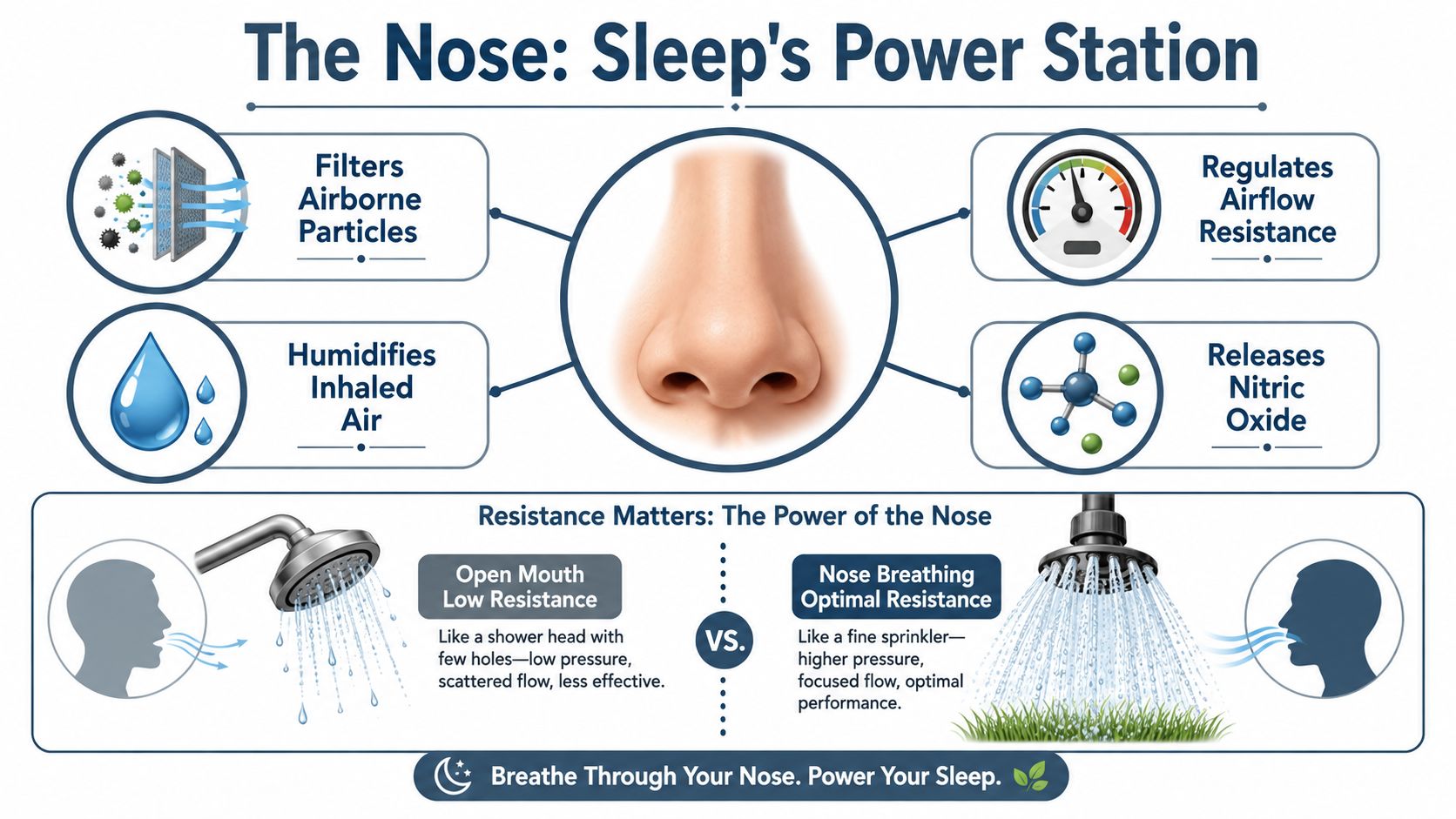
The practical takeaway is clear: the nose is an active respiratory organ. It filters, conditions, regulates, and chemically modifies every breath before sleep-related changes in muscle tone leave the upper airway more vulnerable. These functions can support breathing comfort, but they do not remove every cause of snoring or obstructive sleep apnea.
What the Research Actually Shows
The clearest evidence comes from studies that measured airway resistance and sleep rather than relying only on how comfortable participants felt. A 2003 sleep physiology study measured upper-airway resistance at 5.65 cmH2O·L−1·s−1 during nasal breathing, compared with 14.9 cmH2O·L−1·s−1 during oral breathing, a reduction of about 62% during nasal airflow. The same study recorded longer total sleep time during nasal breathing, 97.5 ± 6 minutes versus 69.4 ± 9 minutes, and found no meaningful difference in time spent lying supine, which makes body position an unlikely explanation for the result. The study's full report provides the physiological details.
These results don't prove that every person who switches to nasal breathing will sleep longer. They do show that breathing route can influence airway stability and sleep continuity. A separate polysomnography study found that left-sided nasal obstruction increased the apnea-hypopnea index, oxygen desaturation, and periodic limb movements, while right-nostril-dominant breathing was associated with better sleep efficiency, more NREM stage III, and longer total sleep duration. The clinical study record supports the importance of preserving nasal patency.
What patient reports add
A 2000 clinical series involving 49 patients treated to improve nasal breathing found that 98% reported better nasal airflow, 34% said snoring decreased or disappeared, and 78% reported more daytime energy. The same paper connected improved nasal breathing with better sleep-apnea-related outcomes, while later review evidence described nasal obstruction as common in obstructive sleep apnea and a factor that can interfere with CPAP or oral appliance tolerance. The clinical series is useful, but its patient-reported design means it shouldn't be treated as proof of a universal cure.
| Metric | Mouth Breathing | Nasal Breathing |
|---|---|---|
| Upper-airway resistance during sleep | Higher in the 2003 physiology study | Lower in the 2003 physiology study |
| Total sleep time in that study | 69.4 ± 9 minutes | 97.5 ± 6 minutes |
| Oral dryness | More likely because air bypasses nasal conditioning | Less likely when the lips remain closed |
| Snoring mechanism | Open-mouth airflow can promote tissue vibration | A shaped nasal stream may support a more stable airway |
| Sleep-apnea treatment role | Doesn't address obstruction by itself | May support airflow and treatment tolerance, but isn't a stand-alone cure |
The data support less snoring and better sleep continuity in selected people, particularly habitual mouth-breathers and some mild cases. They don't support replacing evaluation or established treatment for moderate or severe sleep apnea with nasal breathing alone.
The Nitric Oxide and Recovery Connection
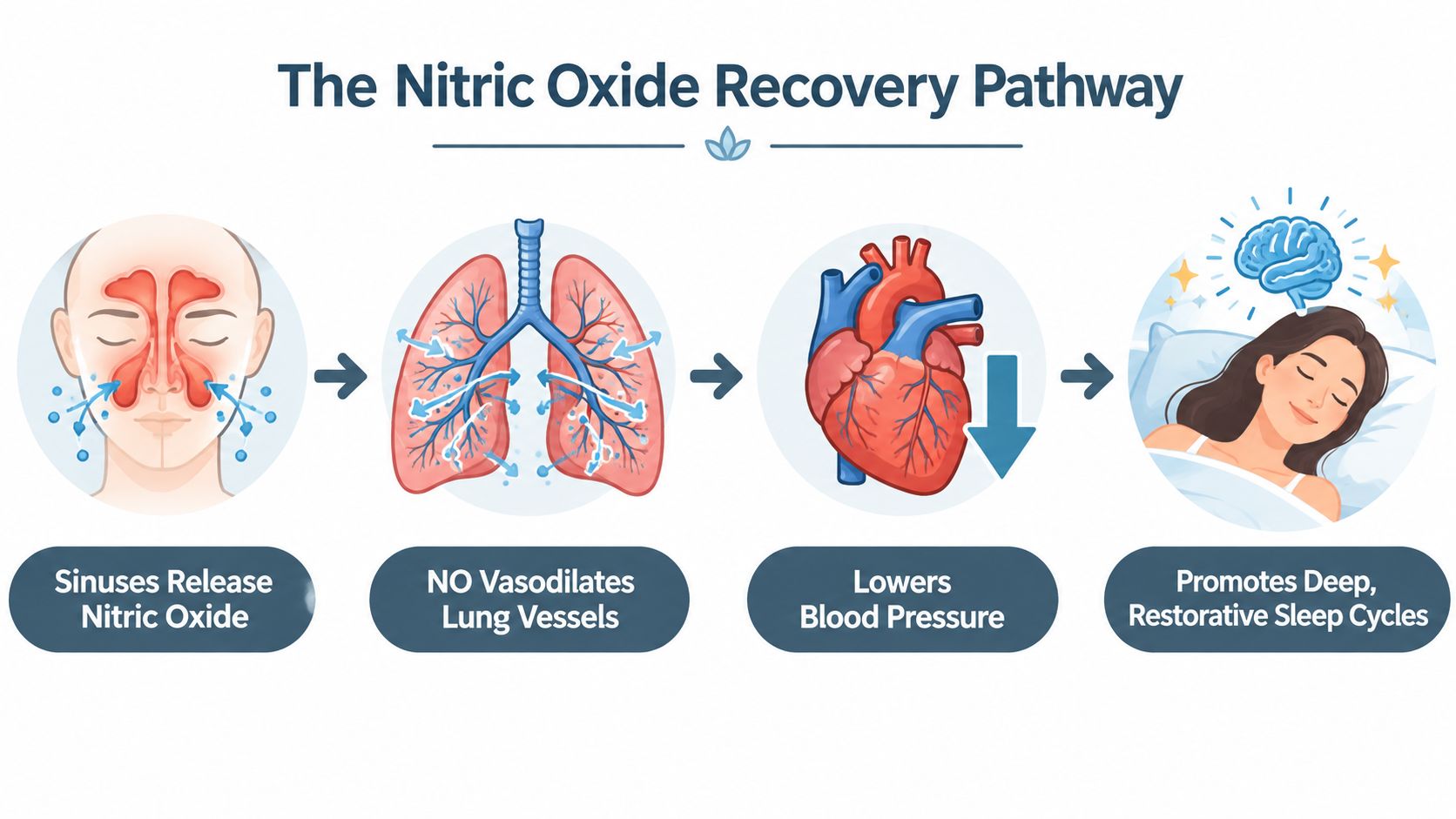
You may fall asleep with your lips closed yet wake feeling unrefreshed. Nasal breathing can influence that experience because the nose modifies incoming air before it reaches the lungs. Nitric oxide produced in the sinus region travels with inhaled air and can widen pulmonary blood vessels, helping ventilation and blood flow work together more efficiently. This creates a plausible link with oxygen handling, not a promise of dramatic recovery for every sleeper.
Breathing rhythm adds another pathway. Quiet nasal breathing, especially with a gentle, longer exhalation, can reduce respiratory urgency and support a calmer autonomic state. The diaphragm does not need to drive forceful airflow, which may make it easier to settle into sleep. These effects can support relaxation, but they cannot overcome anatomical narrowing or untreated apnea.
A useful recovery chain
The proposed sequence is straightforward:
- Nasal airflow conditions the breath and carries sinus-derived nitric oxide.
- Pulmonary blood vessels respond to nitric oxide's vasodilating effect.
- A slower breathing rhythm reduces unnecessary respiratory effort.
- A calmer body is better positioned for continuous sleep.
- More continuous sleep supports normal overnight recovery processes.
The last step needs careful interpretation. Nasal breathing may improve the conditions for sleep, much like clearing a road can make travel easier, but it does not guarantee deeper slow-wave sleep, lower morning blood pressure, or a particular hormone response. Those outcomes also depend on airway anatomy, sleep duration, medications, illness, stress, and diagnosed sleep disorders.
For more context on the relationship between this gas and sleep physiology, read this guide to nitric oxide and sleep. A melatonin-free evening product such as Restore+ Magnesium Sleep Aid is described by its manufacturer as a wind-down drink containing magnesium, L-theanine, tart cherry, lemon balm, glycine, and nitric oxide-supporting ingredients. It may fit within a consistent bedtime routine, but it should not replace evaluation for breathing interruptions.
Where Nasal Breathing Hits Its Limits
Nasal breathing can reduce mouth dryness, discourage some soft-palate vibration, and make sleep feel less fragmented for selected snorers. It reaches a clear ceiling when the problem involves substantial collapse or narrowing deeper in the upper airway.
A blocked nose can be part of the problem, but it may not be the whole problem. A deviated septum, enlarged nasal tissue, jaw structure, obesity, or severe obstructive sleep apnea can continue to restrict airflow even when the lips stay closed. In those situations, nasal breathing may improve comfort or support treatment, while the underlying obstruction still requires clinical management.
What it can and cannot do
| Condition or Symptom | Nasal Breathing Alone | Standard Medical Treatment |
|---|---|---|
| Dry mouth from open-mouth sleep | May reduce it if nasal airflow is adequate | Addresses the contributing disorder when one is identified |
| Soft snoring from mouth airflow | May lessen vibration in selected people | May use positional therapy, an oral appliance, surgery, or other care |
| Witnessed breathing pauses | Doesn't reliably eliminate them | Requires diagnostic evaluation and disorder-specific treatment |
| Oxygen desaturation from obstructive events | May not resolve the events | CPAP and other prescribed options target airway obstruction |
| Poor CPAP tolerance caused by nasal blockage | Improving nasal patency may help tolerance | A clinician can adjust equipment and treat the obstruction |
A 2026 systematic review of 63 studies found that better nasal patency was associated with greater CPAP tolerance and longer nightly use, while improved airflow reduced oral airflow, shortened desaturation events, and improved sleep architecture. The review also emphasized that benefits were often limited and didn't fully resolve obstructive sleep apnea. Read the systematic review for that broader assessment.
In severe nasal obstruction, treatment reduced nasal resistance and lowered the oral fraction of ventilation during sleep by a mean absolute 30%, with a 95% confidence interval of 12% to 49%, but it didn't effectively eliminate obstructive sleep apnea. The study summary makes the distinction clear.
If you have witnessed apneas, morning headaches, or loud persistent snoring, arrange a sleep evaluation. You can also use mattress buying tips for apnea sufferers to think about comfort and positioning, but a mattress can't diagnose or treat airway obstruction.
Training Yourself to Breathe Through Your Nose at Night
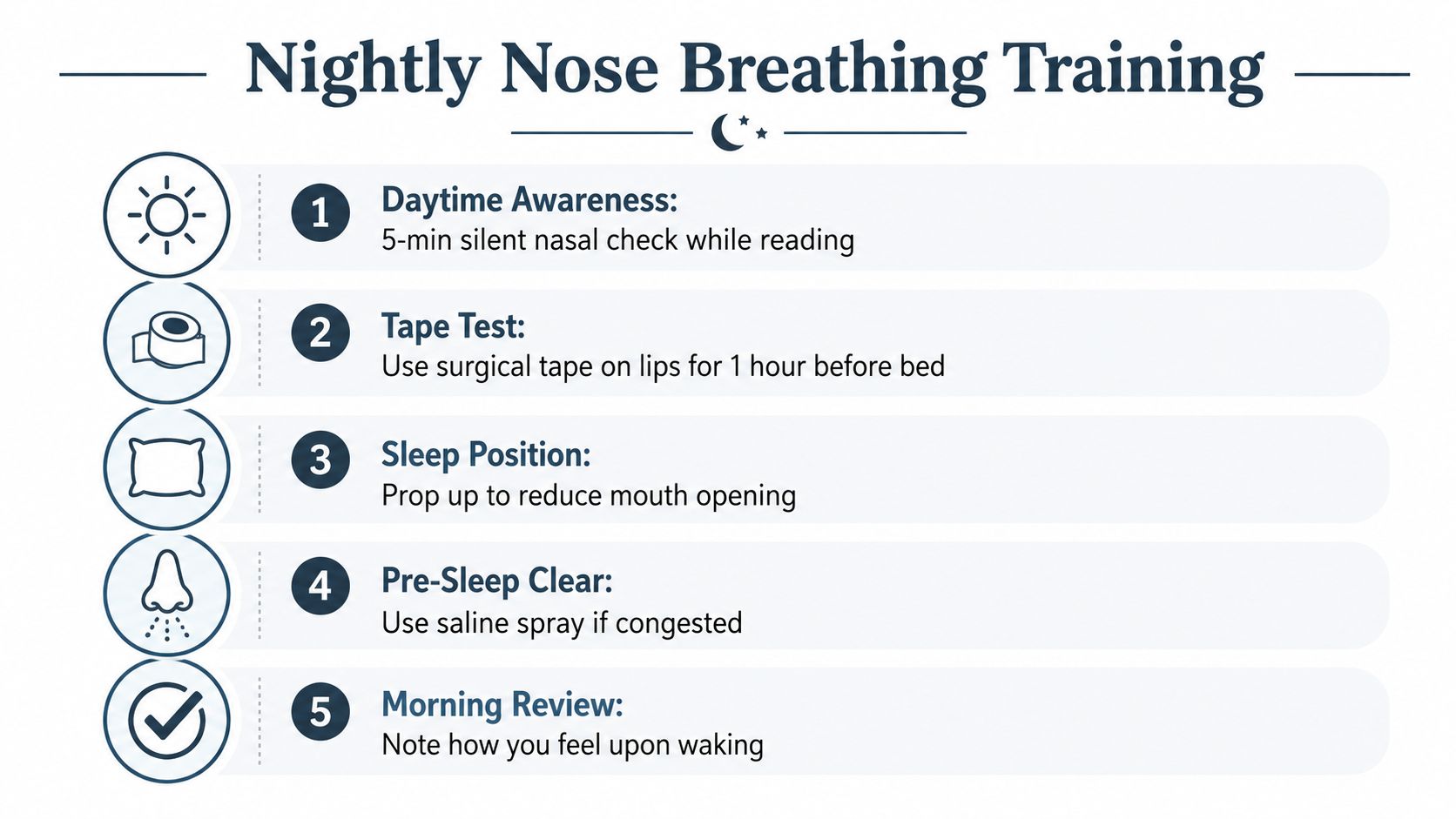
Begin while you're awake. Sit comfortably and read for five quiet minutes, keeping your lips together and allowing the breath to move gently through the nose. Don't force a large inhale. The purpose is to notice whether the nose can handle relaxed breathing and to identify congestion before bedtime.
If the nose feels clear, add ten minutes of slow nasal inhalation and nasal exhalation before sleep. Keep the rhythm comfortable rather than chasing a particular depth. If you feel air hunger, dizziness, or panic, stop and return to normal breathing.
Build the routine in layers
- Clear the passage. Use a saline rinse or saline spray according to the product directions. A rinse can help remove mucus and dried material, while a spray is easier when you need a quick moisture boost. Avoid forcing fluid through a completely blocked passage.
- Check the cause. Seasonal allergies, chronic congestion, or a structural blockage can defeat willpower. Persistent obstruction deserves a conversation with a clinician.
- Add gentle external support. Nasal strips can lift the skin around the nasal valve. They won't open a collapsed throat, but they may make nasal breathing more comfortable for someone whose restriction is near the front of the nose.
- Consider lip-seal training only later. Mouth tape should never be the first response to an unknown breathing problem. Don't use it if you can't breathe freely through your nose, or if you have suspected or untreated sleep apnea without professional guidance.
You'll find more breathing exercises in nasal breathing techniques. If your nasal breathing is already comfortable and a clinician has ruled out a relevant airway disorder, Hydrating Mouth Tape is one product option described for supporting lip seal, quieter nights, oral comfort, and nose-focused breathing.
Safety checkpoint: Never use mouth tape to conceal snoring, witnessed pauses, or a blocked nose. Those signs call for evaluation, not stronger restraint of the mouth.
Adding the Right Tools to Your Bedtime Routine
Choose tools according to the location of the problem. If mucus or dryness blocks the front of the nose, start with saline. If the nasal valve feels narrow during inhalation, an external strip may offer more relevant mechanical support. If the obstruction feels deeper or remains persistent, stop experimenting and seek an assessment.
Saline rinses and sprays support clearance and moisture. Use sterile, distilled, or appropriately prepared water for a rinse, and follow the instructions supplied with the device. A spray is less involved and may suit mild dryness or congestion.
External nasal strips pull gently on the skin around the nasal valve. They don't change the throat, tongue, or soft palate, so their value depends on whether the nasal valve is limiting airflow. Internal nasal dilators provide another approach, sitting inside the nostrils to support the passage from within.
Where mouth tape belongs
Breathable mouth tape is a lip-seal aid, not an apnea treatment. It may discourage the jaw from falling open after you've established comfortable nasal breathing, but it shouldn't be used when nasal obstruction forces you to mouth-breathe.
SleepHabits describes its Transparent Nasal Strips as a tool intended to improve nighttime airflow, support nasal breathing habits, and pair with mouth tape. Treat those statements as product positioning, not as evidence that strips resolve sleep apnea.
The nasal strips for snoring guide can help you compare placement and expectations. People with untreated obstructive sleep apnea, substantial nasal obstruction, or unexplained nighttime breathing difficulty should speak with a clinician before using mouth tape.
Your First Seven Nights and Common Questions
Keep the first week deliberately simple. Change one thing at a time so your morning notes can tell you what helped.
- Night 1: Use a nasal saline rinse before bed, if your nose isn't completely blocked.
- Night 2: Add ten minutes of quiet nasal breathing while reading.
- Night 3: Place an external nasal strip over the nasal valve.
- Night 4: Try side sleeping with a pillow that helps you remain comfortable.
- Night 5: At lights-out, use a gentle four-second nasal inhale and six-second nasal exhale, stopping if it feels strained.
- Night 6: Consider mouth tape only if nasal breathing feels easy and you have no warning signs of sleep apnea.
- Night 7: Review wake-ups, dry mouth, snoring feedback, and daytime energy in a short morning log.
Common questions
How long before results show? Some people notice comfort or dry-mouth changes quickly, while snoring patterns can vary from night to night. Use the log rather than judging one morning.
Will nasal breathing stop snoring completely? It may reduce snoring when mouth opening and nasal airflow contribute to the sound. It won't reliably stop snoring caused by deeper airway obstruction.
Is it safe during a cold? Don't tape your mouth or force nasal breathing when congestion makes nasal airflow difficult. Use comfort measures and wait until you can breathe freely, or ask a clinician for advice.
What if my nose stays blocked? Look for the cause, including allergies, chronic inflammation, or structural narrowing. Persistent blockage is a reason to seek medical guidance, especially if snoring or daytime sleepiness continues.
A simple record of wake-ups, dry mouth, partner-reported snoring, and daytime energy turns a vague experiment into a measurable personal check.
SleepHabits offers nasal strips, mouth tape, educational breathing resources, and a melatonin-free Restore+ magnesium wind-down drink for people building a consistent nighttime routine. Visit SleepHabits to explore tools that support nasal airflow and more deliberate sleep habits, while seeking clinical care for suspected sleep apnea.