

You board a red-eye already tired. The cabin lights dim, then someone across the aisle turns on a reading lamp. The person in front reclines halfway into your knees. You lean toward the window, pull on a cheap sleep mask, and immediately find the usual problems. Light leaks in around the nose. The elastic tugs at your ears. The fabric presses on your eyelids every time you blink.
That's why the best eye mask travel choice isn't the prettiest one or the softest one in your hand. It's the one that still works when you're upright, cramped, warm, and shifting positions every few minutes.
A lot of travelers still treat eye masks like throw-in accessories. That's outdated. The category has become far more specialized, and the key differentiator now is not just darkness. It's whether the mask stays comfortable when your head is tilted against a window, packed in a carry-on, and reused across flights, hotels, trains, and bright mornings.
Why Your Travel Eye Mask Matters More Than You Think
Most bad in-flight sleep gets blamed on the plane. Some of that is fair. Cabins are noisy, seats are narrow, and airline pillows seem designed by people who don't sleep on planes.
But gear causes a lot of the problem too.
A poor mask creates new issues while trying to solve light exposure. It leaks from the bottom edge. It shifts when you turn your head. It creates temple pressure when you rest against the window. On a long flight, those failures matter more than whether the outer fabric feels luxurious for the first five minutes.
The category has changed
Sleep masks used to sit in the same mental bucket as neck pillows and disposable earplugs. That has changed. The sleep-mask category has moved from a niche travel accessory into a mainstream sleep aid, with Consumer Reports publishing an expert-tested roundup in 2026, a sign that shoppers now look for blackout performance, pressure relief, and side-sleeping comfort rather than basic light blocking alone, according to Consumer Reports' 2026 sleep mask roundup.
That shift matters because travelers are no longer choosing between “mask” and “no mask.” They're choosing between designs built for different jobs.
A mask that works in a dark bedroom can still fail badly in seat 27A.
Travel changes the rules
At home, you can adjust your pillow, dim the room, and lie flat. On a plane, your sleep position is compromised from the start. Even in a hotel, you're dealing with curtain gaps, hallway light, blinking thermostats, and unfamiliar pillows.
That's why the right mask has to do more than block light. It has to support the kind of sleep you're getting on the road. If you're working on better sleep habits overall, it helps to understand what restorative sleep looks like in practice. Darkness is part of that, but comfort and stability matter just as much.
What most rankings miss
Most “best eye mask” lists still rank masks as if every user sleeps flat on their back in a quiet room. Travelers don't.
For travel, these questions matter more:
- Can you side-sleep in it: A mask that feels fine while upright can dig into your face once your head leans sideways.
- Does it stay sealed when you move: Small leaks become annoying fast in a cabin with overhead lighting.
- Can you pack it without babying it: If it needs its own protected real estate in your bag, that's a trade-off.
- Does it create eye pressure over time: Even a good blackout seal isn't worth it if your eyelids feel compressed.
The best choice is rarely the most glamorous one. It's the one that disappears on your face and keeps working when the trip gets uncomfortable.
The Anatomy of a Perfect Blackout Mask
Blackout isn't just about dark fabric. It's about shape.
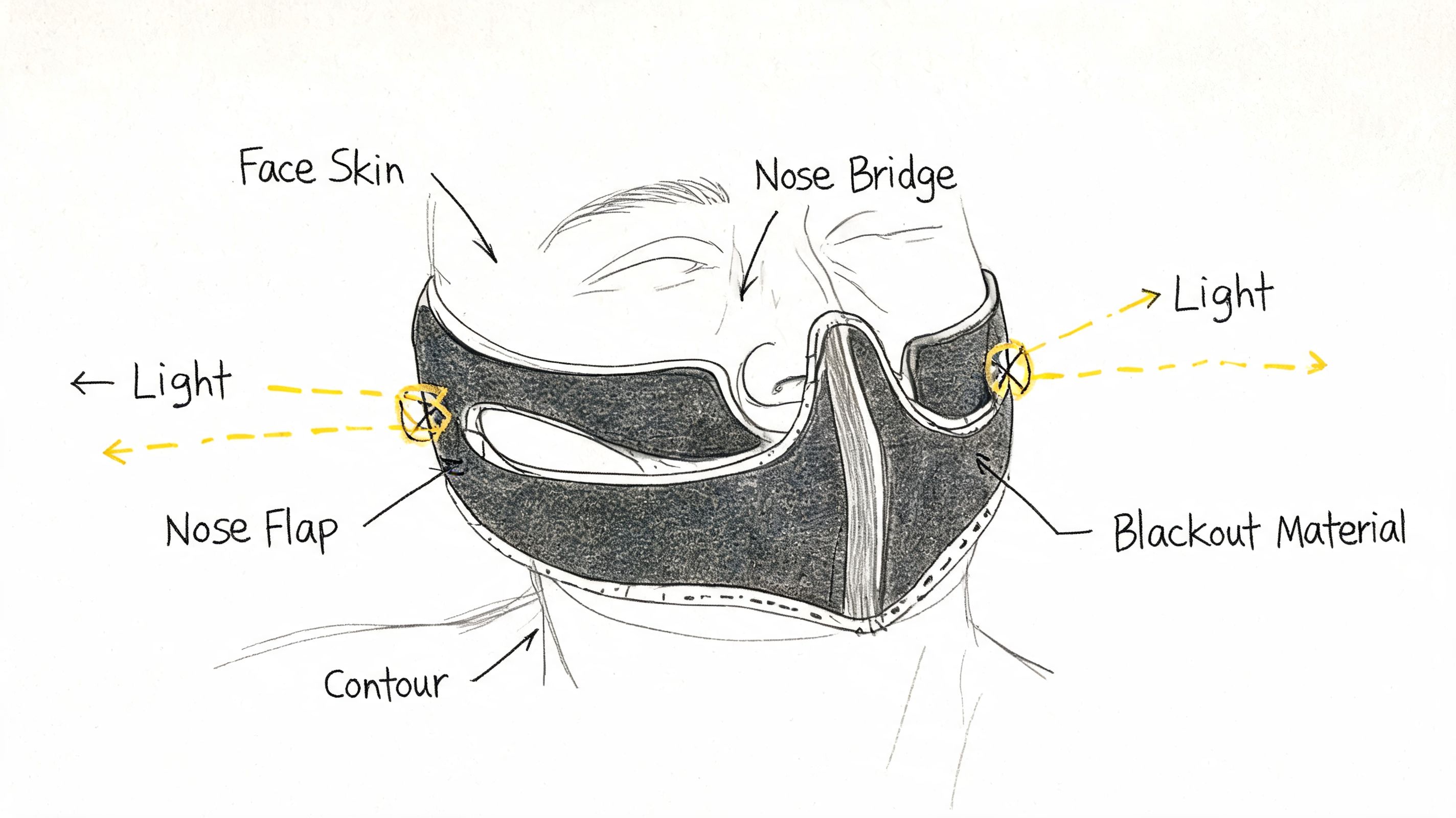
A flat mask works like hanging a sheet over a window. It blocks some light, but gaps at the edges ruin the result. A contoured mask works more like fitted blackout shades. It creates structure, seals contact points, and leaves space where your eyes need it.
Contour beats fabric alone
The most effective travel masks are usually contoured rather than flat. A product like the MZOO Sleep Eye Mask is described as forming a cup around the eyes to maintain complete darkness without pressing on the eyelids, which is why this design is the stronger benchmark for real travel blackout, as noted in ABC News' roundup on plane sleep masks.
That eye-cup design solves two problems at once. It reduces direct eyelid pressure, and it gives the mask a better chance of sealing around the face instead of collapsing inward.
The three failure points
When a mask leaks, it usually fails in one of three places.
- Under the nose This is the most common leak zone on planes. Light from seatback screens, aisle movement, and sunrise through the window often sneaks in from below.
- At the temples A mask can look fully sealed in the mirror but lift slightly when your face presses into a neck pillow or seat wall.
- Along the strap tension line If the strap is too loose, the mask shifts. If it's too tight, the mask presses inward and creates discomfort that wakes you up anyway.
What to inspect before you buy
A strong blackout design usually includes:
- Raised eye cups: These create a pocket so your lashes and lids aren't under constant contact.
- Shaped nose area: This reduces the open gap where most light intrusion starts.
- Adjustable strap: Fine-tuning fit is part of blackout. A fixed fit often means either slippage or pressure.
- Stable side profile: The mask should hold its shape without creating hard edges.
Practical rule: If you can feel the mask pressing directly on your eyelids while you're sitting still, it usually gets worse once you lean sideways.
Why flat silk masks struggle in transit
Flat masks can feel nice at first. They're soft, simple, and often easy to pack. But for true blackout in travel conditions, they have a structural disadvantage. They depend heavily on compression to stay in place, and compression is exactly what creates pressure points and lash contact.
That doesn't mean flat masks are useless. It means they're usually better for low-movement situations than for red-eyes, bright hotel rooms, and awkward side-sleeping angles.
Choosing Your Mask Material and Design
Material changes more than feel. It affects heat, slippage, skin contact, cleaning, and how much structure the mask can hold after being jammed into a carry-on.
For travel, I don't think in terms of “luxury” or “budget” first. I think in terms of failure mode. What is most likely to annoy you after two hours in a seat you can't escape?
Silk, cotton, and foam all solve different problems
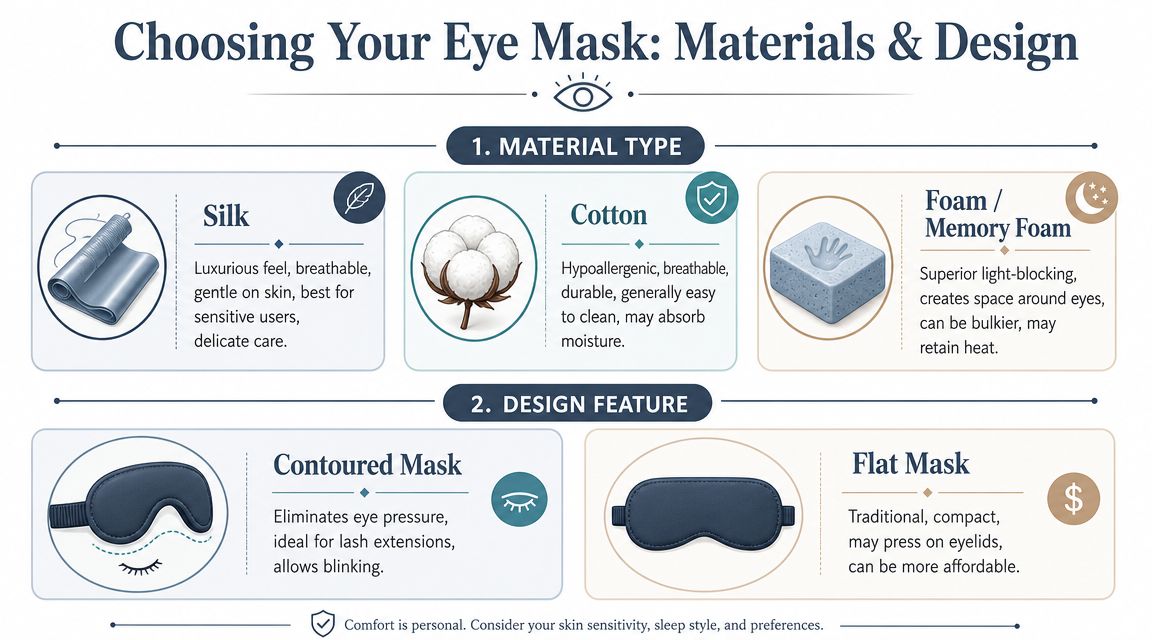
Silk is popular because it feels gentle on skin and hair. That's a real benefit, especially if you dislike textured fabrics around the face. The downside is structural. Most silk masks are flat, so they can slip and press directly on the lids.
Cotton sits in the middle. It's breathable, easy to live with, and often simpler to wash. It's usually less slippery than silk. But unless the design is engineered well, cotton alone won't guarantee a strong blackout seal.
Foam and memory foam usually perform best for travel blackout because they can support a contoured shape. That added structure gives you space around the eyes and helps the mask hold a seal. The trade-off is bulk and warmth. Some foam masks feel great for the first hour, then start feeling too warm on a long-haul flight.
Design matters as much as fabric
The more useful comparison is often not silk versus foam. It's flat versus contoured.
A contoured foam mask often wins for planes because it reduces direct pressure and improves darkness. A flat silk mask may win for someone who wants minimal bulk and mostly uses it in hotels or at home.
Here's the practical version:
- Choose silk if skin feel is your top priority and you can tolerate some movement.
- Choose cotton if you want a basic, breathable mask that's easy to maintain.
- Choose foam or memory foam if blackout and eye clearance matter more than compactness.
Price tiers are now clear
The market has settled into recognizable bands. Budget options sit under $15, mainstream favorites like the MZOO mask are around $20, and premium masks like the Manta Sleep Max Pro reach about $100, creating a roughly 5x price gap between standard and high-end choices, according to Pack Hacker's sleep mask guide.
That spread tells you something useful. More money usually buys you better fit engineering, adjustability, or premium materials. It does not guarantee that the mask will suit your travel style.
A premium mask can still be the wrong mask if it's too bulky for side-sleeping or annoying to pack.
Eye Mask Material Comparison for Travelers
| Material | Breathability | Pressure Relief | Hygiene | Best For |
|---|---|---|---|---|
| Silk | Good | Low to moderate, depends on design | Needs gentler care | Sensitive skin, light packers, hotel use |
| Cotton | Good | Moderate, depends on padding | Usually straightforward to clean | General travel, hostels, simple routines |
| Foam or Memory Foam | Moderate | High when contoured well | Often needs more careful drying and storage | Red-eyes, blackout-focused travelers, long flights |
The best material isn't universal. It depends on whether you hate heat, hate pressure, or hate light leaks most.
A simple buying filter
If you're stuck between options, narrow it down this way:
- Frequent flyer in economy: prioritize contour, stable strap placement, and a side profile that won't jab the temple.
- Minimalist carry-on traveler: prioritize thinness and crush resistance.
- Hotel-heavy traveler: prioritize blackout seal and comfort over tiny packed size.
- Sensitive-skin user: prioritize fabric feel first, then look for the most structured design available in that category.
That framework gets you closer to the best eye mask travel pick for your real trips, not an imaginary bedroom test.
Key Features for Stress-Free Travel
For flights, the little things matter more than brand reputation. A mask can look excellent on a product page and still fail in a cramped seat because it's too bulky at the sides, too fussy to adjust, or too awkward to pack quickly during boarding.
The first feature I check is profile. Not softness. Not color. Profile.
Low profile beats bulky on planes
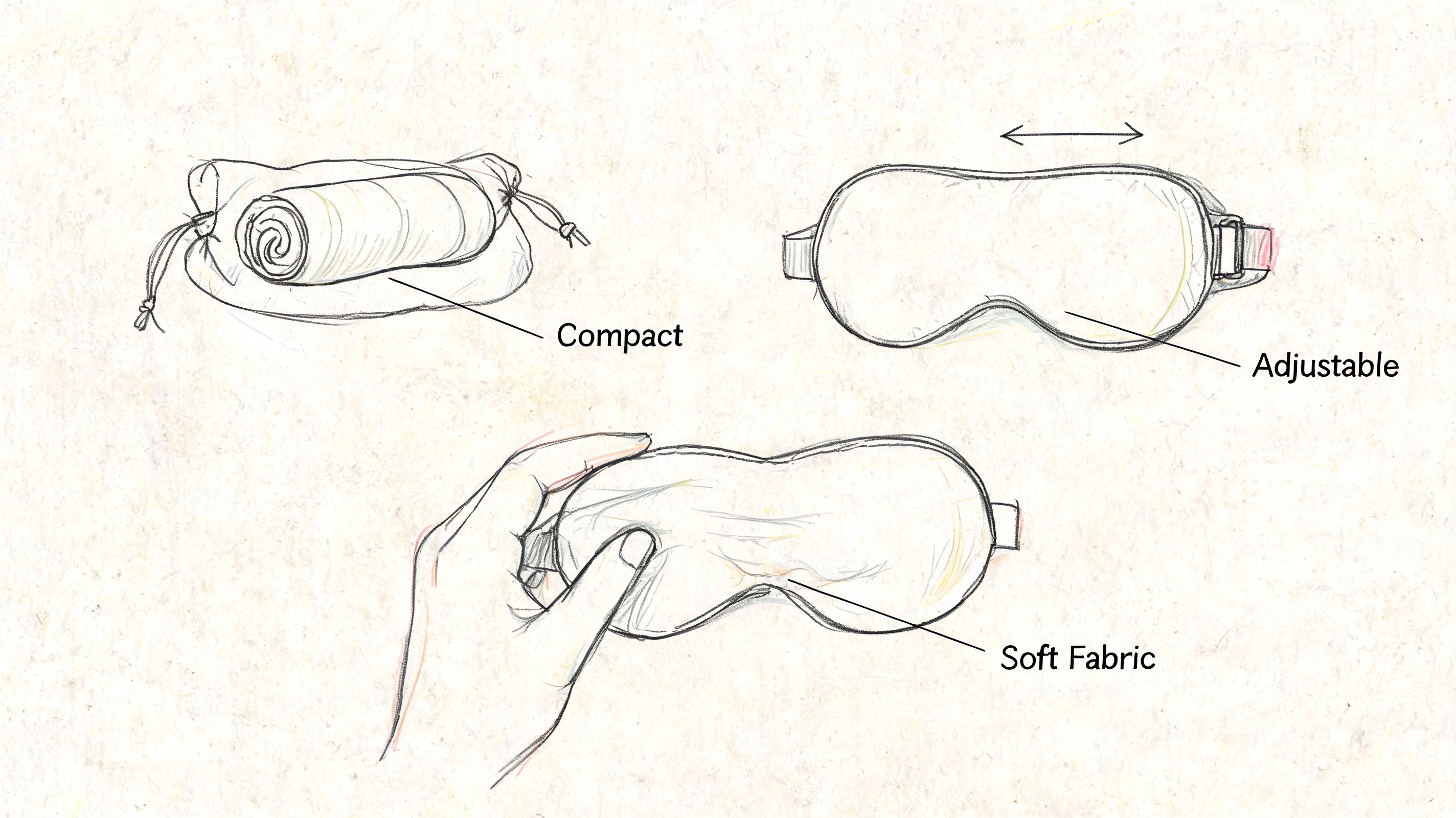
For travel, mass and thickness directly affect facial pressure. A useful benchmark is the Sea to Summit Ultra-Sil Eye Shade at 23 g (0.8 oz) with a packed profile of about 0.5 cm, a thin setup that reduces bulk at the temples and nose bridge and makes it more suitable for side-sleepers than thicker foam masks, according to Sea to Summit's product specs for the Ultra-Sil Eye Shade.
That doesn't mean thinner is always better. It means thickness has a cost.
Every extra bit of bulk becomes noticeable when your head presses sideways into a seat, hoodie, or travel pillow. I've seen plenty of masks that offer excellent darkness while sitting upright, then become irritating the moment side pressure enters the equation.
Strap design decides whether a mask stays usable
The second feature is strap layout. This gets overlooked, but it often decides whether the mask keeps working after the first adjustment.
What to watch for:
- Buckles at the back of the head: These can become pressure points against a seat headrest.
- Wide closures: These can improve stability but may feel bulky if you shift around.
- Thin elastic bands: These pack well, but some slip more easily and can pull hair.
- Velcro systems: These give adjustability, though some people dislike the feel and noise when readjusting.
A good strap should disappear once set. You shouldn't have to negotiate with it mid-flight.
Packability is not the same as crushability
Some masks are light but fragile. Others are bulky but resilient. The trick is knowing what kind of traveler you are.
If you like to keep your mask in a seat pocket, jacket pocket, or quick-access pouch, a simpler low-profile design often wins. If you don't mind giving the mask its own small case, a more structured contoured model can be worth the space.
For travelers refining a full comfort kit, it's worth looking at other packable gear for comfortable flights. Eye masks work better when they fit into a system instead of becoming one more awkward item loose in your bag.
Side-sleeper checklist
If you sleep leaning into the window or curling against a neck pillow, use this filter before buying:
- Look at side thickness: Thick side panels often create temple pain.
- Check where the strap hardware sits: Anything rigid near the back or side of the head can become obvious in a seat.
- Consider edge softness: Hard seams can be just as annoying as thick foam.
- Think about quick deployment: The best flight mask is the one you can put on fast when the cabin suddenly brightens.
A short visual demo can also help you notice fit details most shoppers miss.
What usually works and what usually doesn't
What works well on planes is surprisingly consistent. A mask with a modest profile, stable fit, and no direct eye pressure tends to outperform masks that chase extra features.
What usually doesn't work is overbuilt design. Bulky cups, stiff edges, and hardware-heavy straps can feel impressive in hand and annoying in use.
If your mask makes you aware of your face the whole time, it's not helping you sleep.
Beyond the Plane Adapting Your Mask for Any Environment
A good travel mask shouldn't be a one-flight specialist. It should handle the messy range of places people actually try to sleep.
Hotel rooms with bad curtains
Such circumstances highlight the value of stronger blackout design. Many hotel rooms have one weak spot. A curtain gap, an alarm clock glow, a blinking smoke detector, or hallway light under the door.
In that environment, I'd rather have a mask with a reliable seal than the softest fabric in the drawer. If a room is bright at the edges, softness stops mattering quickly.
Day trains and moving transit
Train naps are different from plane naps. You're usually more upright, the light changes constantly, and movement can cause the mask to shift.
What helps here is stability. A mask that stays put without frequent readjustment matters more than one that looks sleek on a bedside table. Daytime transit also exposes slippage fast. If the mask creeps upward every time you lift your head, it's not a travel mask. It's a home accessory.
Hostels and shared spaces
In hostels or shared apartments, the problem isn't always bright light. It's interrupted light. Someone turns on a bathroom lamp. A roommate opens the curtains early. A phone screen flashes in the dark.
For that use case, easy cleaning and durable construction matter. You're using the mask repeatedly in less controlled environments, sometimes with inconsistent storage. If you're also working on airflow and comfort at night, it's useful to understand when nasal strips work alongside a mask in shared or dry indoor environments.
Camping and rougher travel
Camping changes the trade-offs again. You may want something durable, simple, and easy to rinse or wipe down. The softest luxury option often isn't the smartest pick here.
A few practical matches:
- Bright hotel stays: choose the strongest blackout geometry you can comfortably wear.
- Train or bus naps: choose a stable strap and a mask that doesn't drift when your posture changes.
- Hostels: choose something easy to clean and easy to stash.
- Camping: choose durability and low-maintenance materials over delicate finish.
The best travel gear earns space in your bag by working in more than one setting. Eye masks are no different.
Care, Cleaning, and Packing Your Eye Mask
Travel masks sit on skin, pick up facial oils, and get stuffed into bags. If you don't clean and store them well, even a good mask gets unpleasant fast.
Clean based on material
Use the care method the mask can tolerate.
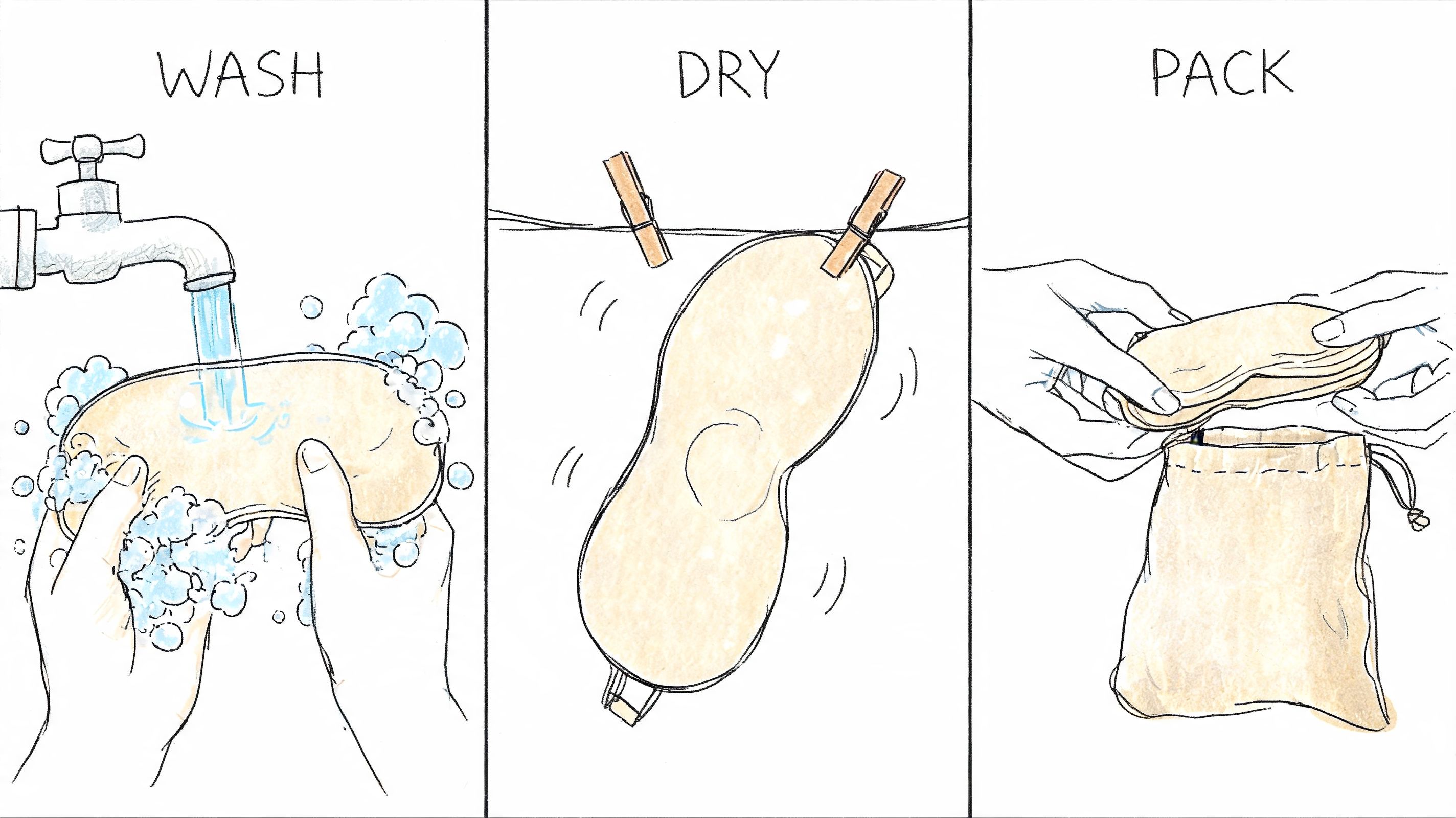
- Silk masks: hand-wash gently in cool water with a mild cleanser, then lay flat or hang to air dry.
- Cotton masks: these are often easier to wash, but it's still smart to use a gentle cycle or hand-wash if the padding is delicate.
- Foam or contoured masks: spot-clean carefully, avoid soaking if the structure could deform, and let them dry fully before packing.
Wash your mask like something that touches your face for hours at a time, because that's exactly what it does.
Pack it so it keeps its shape
A lot of masks get ruined in transit, not in use.
Here's the smart approach:
- Use the pouch if it came with one.
- Keep it away from leaks and loose toiletries.
- Don't crush contoured cups under chargers, shoes, or hard cases.
- Store straps neatly so they don't stretch or tangle.
If you use a structured mask, give it a dedicated spot in your bag. If you use a thin mask, keep it in a small clean pouch so it doesn't end up pressed against whatever was at the bottom of your backpack.
Replace performance, not just appearance
If the strap won't hold, the seal is gone. If the contour collapses, eye pressure returns. If the fabric smells off or never feels clean, stop convincing yourself it's fine.
A travel mask is small gear, but it affects a big part of the trip. Treat it accordingly.
Building Your Ultimate Travel Sleep Ritual
The mask is the final layer, not the whole system.
People often search for the best eye mask travel option as if the product alone will solve airplane sleep. It won't. A great mask helps most when it's part of a repeatable routine that tells your body sleep is coming, even when you're nowhere near your own bed.
Build a repeatable sequence
Travel sleep gets easier when the routine stays familiar.
A practical ritual looks like this:
- dim your screen and stop doom-scrolling before you expect to sleep
- settle your breathing instead of waiting to “feel tired”
- get your nose clear if dry cabin air or congestion is part of your problem
- put the mask on only when you're ready to stay still and rest
That sequence matters because consistency lowers friction. The body responds well to repeated cues, even in changing environments. If you want a stronger framework for that wind-down, this guide to a nighttime routine for better sleep is worth reading.
The mask should finish the ritual
The best masks create a clean handoff from “still awake and traveling” to “shut out the environment and rest.” That's why fit matters so much. If the mask needs constant adjusting, it interrupts the ritual it's supposed to complete.
A useful travel setup is simple:
- a breathing routine you can do in any seat or bed
- one or two comfort tools you'll use
- a mask that creates darkness without becoming another annoyance
Keep it boring and repeatable
The ideal routine is not elaborate. It's dependable.
If your pre-sleep process takes too many steps, you'll skip it on the nights you need it most. But if your routine is compact and familiar, you're far more likely to use it on red-eyes, in noisy hotels, and during awkward mid-afternoon recovery naps after arrival.
A strong eye mask earns its place because it closes out visual noise fast. That's what makes it valuable. Not luxury branding. Not trendiness. Just reliable function, over and over, in places where sleep is otherwise hard to get.
If you want to turn a good eye mask into a full sleep setup, SleepHabits offers tools that support nighttime breathing and more consistent rest, including nasal strips, mouth tape, and melatonin-free sleep support designed to fit into a practical wind-down routine at home or while traveling.