

You're lying awake, shoulders lifted, jaw tight, and breathing faster than you realize. The more you try to take a “deep breath,” the larger and more effortful each inhale becomes, yet your mind stays alert. Learning how to breathe slowly starts with a simpler skill: giving your breath a steady rhythm that feels controlled, quiet, and easy enough to repeat.
Slow breathing can support calm and sleep, but it isn't a magic switch. The most useful approach is measurable practice, gentle technique, and consistency over time. You'll learn why rate matters, how to coordinate the diaphragm, how to work toward the 6-breaths-per-minute resonance zone, and how to build a routine that still works when your attention wanders.
Why Breathing Rate Matters More Than Deep Breaths
You can take a large breath and still breathe too quickly. For how to breathe slowly, the pace is the clearer starting point. Major medical guidance places normal adult resting breathing at about 12 to 20 breaths per minute (American Lung Association). Slow-breathing protocols generally use 4 to 10 breaths per minute, with many studies focusing on 6 to 10 breaths per minute (review of controlled slow breathing).
At 6 breaths per minute, one complete breath takes about 10 seconds. At a normal resting rate, a breath may arrive every 3 to 5 seconds. The difference is easy to feel: you are creating more space between breaths while keeping each inhale and exhale quiet, comfortable, and controlled.
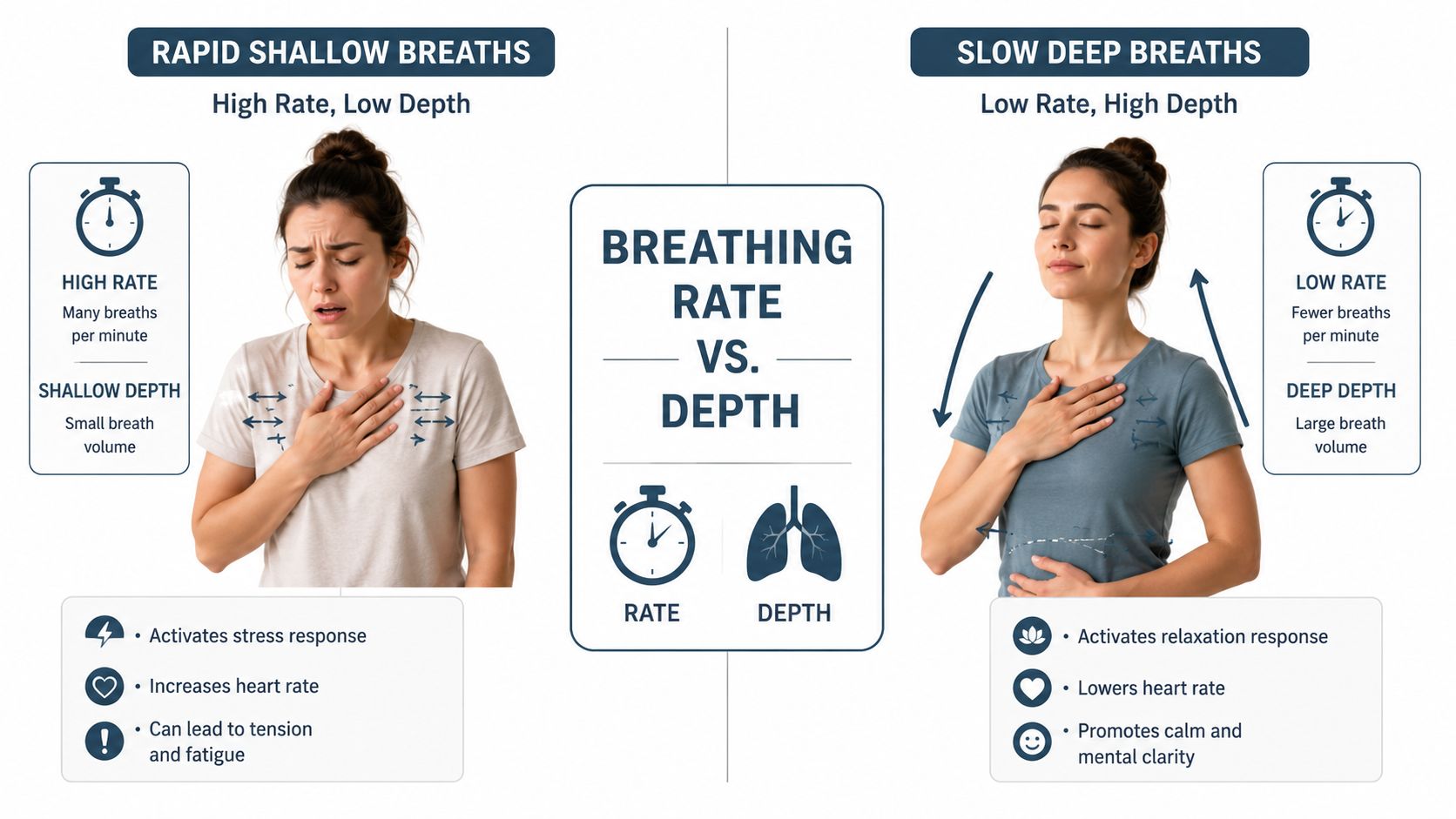
Rate and depth do different jobs
Depth describes how much air moves. Rate describes how often the cycle repeats. A deep breath can still be fast, forceful, and driven mainly by the upper chest. Repeating that pattern may increase muscular effort and leave you feeling as though you are working to breathe.
Slow breathing changes the timing first. Like lowering the tempo of music, it gives the inhale, exhale, and brief transitions room to coordinate. Around 6 breaths per minute, controlled breathing is associated with larger fluctuations in cardiovascular and autonomic measures, including activity involving the baroreceptor reflex, which helps regulate blood pressure as pressure changes in the blood vessels. The controlled-breathing review examines this relationship in healthy-human studies (review of controlled slow breathing).
The goal is a rhythm you can repeat for weeks, not a single impressive breath. Start with a pace that feels smooth, then gradually approach the 6-breaths-per-minute resonance zone without forcing the volume of air.
Practical rule: If “deep” makes you tense, make the breath smaller first. A quiet, slower breath is more useful than a large breath you have to force.
For sleep, breathing through the nose can support a broader wind-down habit. This guide to breathing through the nose provides additional context. During the first week, counting may feel mechanical, attention may wander, and the slower pace may feel unfamiliar. Keep returning to an easy rhythm. Consistency matters more than perfect timing.
Box Breathing for Beginners
Box breathing gives your attention four equal sides to follow. The pattern is inhale for 4 seconds, hold for 4, exhale for 4, and hold for 4 again, repeated for 4 to 6 rounds. Public-health breathing guidance also presents this equal-count structure as a simple controlled-breathing example (Better Health Channel).
Sit with your feet flat and your spine comfortably tall. Let your tongue rest naturally rather than pressing hard against the roof of your mouth, and keep your jaw loose. Place one hand over your belly so you can feel whether the breath is moving low and evenly.
Follow the four sides
Begin with a gentle nasal inhale while counting, “one, two, three, four.” Hold without clenching. Exhale smoothly for the same count, then pause with empty lungs without squeezing your throat or pulling your shoulders upward.
Equal counts work well at first because they provide an uncomplicated anchor. You don't need to decide whether the inhale or exhale should be longer, and the repeated shape gives your mind one task. A timer can help, but don't let the timer dictate a breath that feels strained. A 4-minute timer app is enough for a short practice, followed by about 30 seconds of natural breathing so you can notice how your body feels without immediately changing it.
The session may unfold gradually:
- First round: The holds may feel stiff, and you may count too quickly.
- Second round: Your jaw may soften as you stop trying to perform the breath.
- Around minute three: Your shoulders may settle lower, with less movement in the upper chest.
- Around minute five: The chest may feel more open, even though the breath remains quiet.
Use physical feedback rather than chasing a dramatic sensation. Notice the hand on your belly, the temperature of the air around your nostrils, and whether your palms feel cooler as your body settles. If the posture feels unstable, solid wood yoga furniture can provide a firm, supportive setting for seated practice.

If nasal airflow feels limited at night, Transparent Nasal Strips are described as supporting easier nighttime airflow, reducing congestion from colds, allergies, or dry air, and encouraging nasal-breathing habits. They can be considered separately from the breathing count, not as a substitute for treating a breathing disorder.
Building a Diaphragmatic Breathing Foundation
The diaphragm is a dome-shaped muscle beneath the lungs. When it contracts during an inhale, it descends and creates room for the lungs to expand. A useful diaphragmatic pattern lets the belly move outward gently, rather than making the upper chest and shoulders do most of the work.
Start with a simple self-test. Place one hand on your upper chest and the other just below your rib cage, then breathe normally. If the upper hand moves more than the lower one, you're relying mainly on chest breathing at that moment. Neck tension, shallow rib movement, frequent sighing, and habitual mouth breathing can also suggest that the pattern is effortful or upper-body dominant.
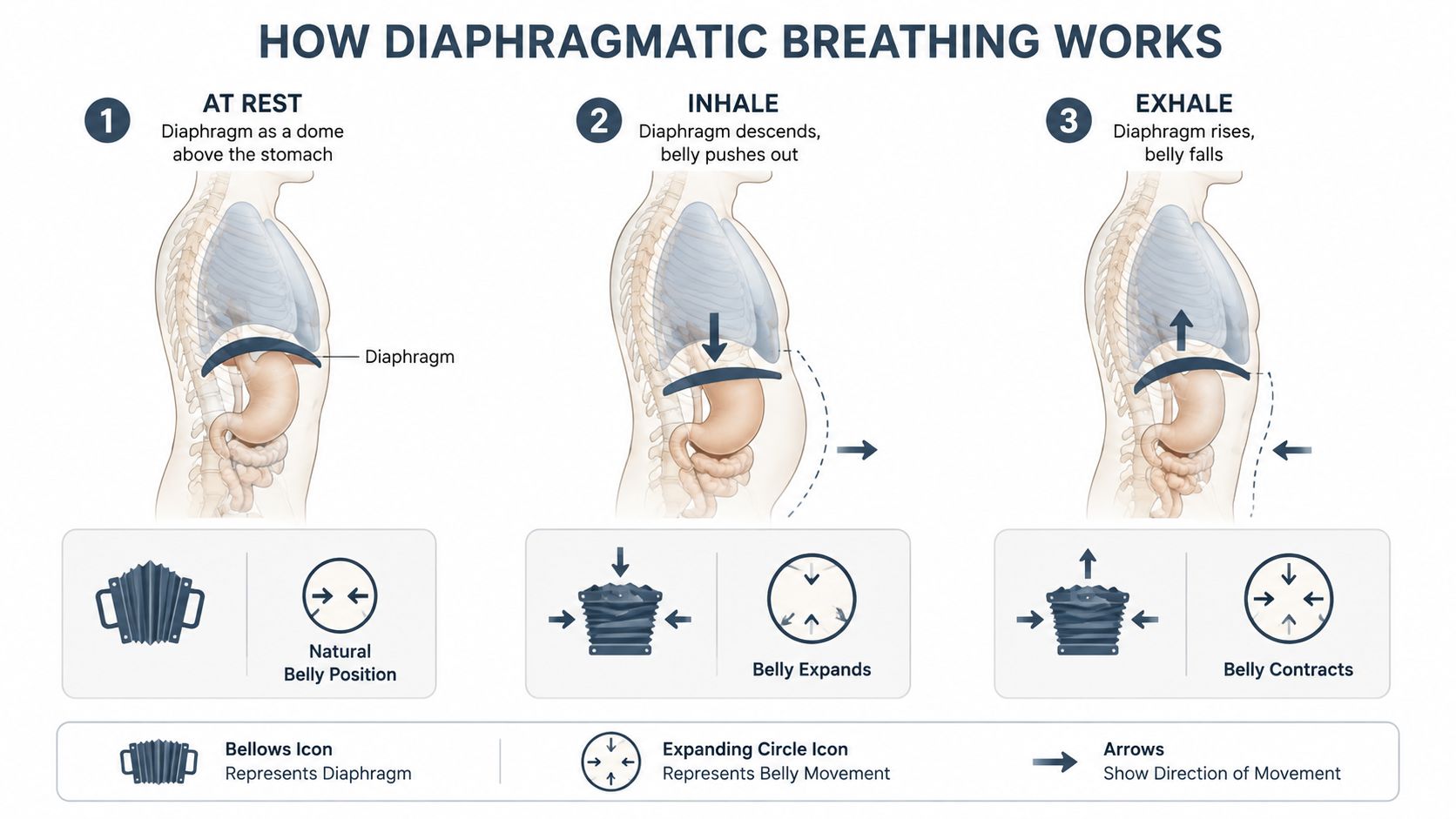
Retrain the movement gently
Lie on your back with your knees supported and place a light book over your belly. Let the book rise slightly as you inhale and lower as you exhale. The purpose isn't to push the book upward. It's to notice whether your abdomen can respond to the diaphragm's movement without muscular strain.
Begin by exhaling comfortably. Once the lungs feel naturally less full, allow the next inhale to arrive rather than pulling it in aggressively. This small change often reduces shoulder lifting and gives the lower ribs and belly more room to move.
Practice lying down for the first three days, then try the same pattern while seated and standing. Diaphragmatic breathing gives slower pacing a stable mechanical base, because you can reduce the rate without turning every breath into a chest-expansion exercise. Guidance on nasal breathing techniques can help you explore how the airway and breathing pattern work together.
Let the inhale be invited, not grabbed. The exhale should release rather than collapse.
A consistent evening routine may also include a non-breathing wind-down choice. Restore+ Magnesium Sleep Aid is described as a melatonin-free magnesium drink containing magnesium, L-theanine, tart cherry, lemon balm, and glycine, with nitric-oxide-supporting ingredients. It belongs beside, not inside, your breathing practice, and it shouldn't replace medical care for persistent sleep problems.
The 6 Breaths-Per-Minute Resonance Practice
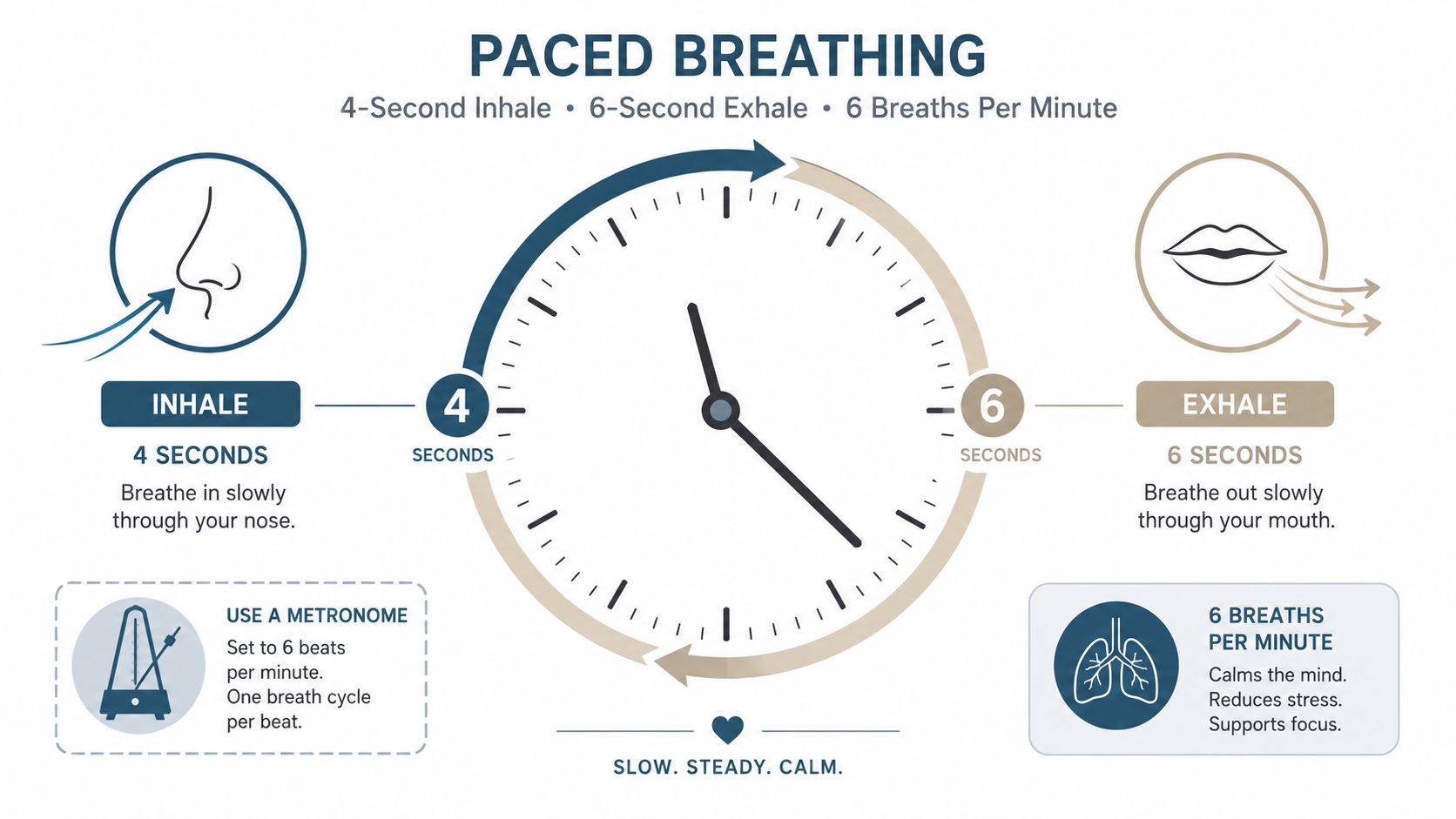
After a busy evening, your breathing may feel deep but still move too quickly. Slow breathing works through its rate as much as its size. Research commonly places the resonance or coherent-breathing range around 4.5 to 6.5 breaths per minute, a zone that may support a steadier balance between sympathetic and parasympathetic activity (slow-breathing review). Six breaths per minute is a practical starting point because each cycle lasts about 10 seconds.
Use this pattern:
- Inhale gently through your nose for about 4 seconds.
- Exhale through your nose for about 6 seconds.
- Begin the next inhale without forcing a pause.
- Repeat one cycle every 10 seconds.
Count four light taps for the inhale and six for the exhale. A quiet app can provide an external cue, while tapping a finger against your leg works without a device. One breath every 10 seconds creates six cycles in a minute, giving your attention a steady rail to follow while your breathing gradually settles.
Make the exhale longer, not harder
A longer exhale can encourage a slower heart rate and a calmer parasympathetic response. Let the air leave smoothly, as though warm air were fading from a window. The abdomen can soften downward while the shoulders remain quiet.
Keep the jaw loose and the tongue relaxed. Let the nostrils carry the airflow gently. If 4 seconds in and 6 seconds out feels strained, shorten both phases while keeping the exhale a little longer, then work toward the full timing as comfort improves. Short sets of 2 to 5 minutes provide a manageable starting point.
Comfort is the guide. The goal is a rhythm you can repeat, not a score you must achieve.
A controlled hypertension study compared breathing at 8 and 16 breaths per minute among 60 people with essential hypertension and 60 healthy controls. The slower condition was associated with lower heart rate and blood pressure, along with heart-rate-variability changes consistent with stronger vagal activity. This supports the value of testing a slower pace, while it does not mean every person should force the same count.
A visual demonstration can make the timing easier to follow:
For related context, explore how nitric oxide relates to breathing, especially if nasal airflow is part of your nighttime routine.
A Two-Week Daily Practice Plan
The first practice may happen after a restless evening. You have brushed your teeth, your mind is still reviewing work, and the inhale feels larger than expected. The count may vanish halfway through. Sit on the edge of the bed and practice for 2 to 3 minutes. The appointment matters more than a perfect session.
During week one, choose two cues: after work and before sleep. Keep both sessions short, breathe through the nose if it feels comfortable, and let the exhale run slightly longer than the inhale. Sit or lie down, whichever helps your face, shoulders, and belly stay loose. If one session disappears, use the next cue. Do not try to make up for it with a harder practice.
Week two adds regularity, not strain. Keep the bedtime session connected to putting on pajamas or dimming the lights, then add a midday reset when your schedule allows. You may let the holds become slightly longer if they remain easy, but the main skill is returning to the chosen rhythm whenever attention wanders.
| Week | Best Time | Duration | Technique | Anchor Cue |
|---|---|---|---|---|
| Week one | After work and before sleep | 2 to 3 minutes | Nasal breathing with a longer exhale | Sitting down after work, brushing teeth |
| Week two | Midday and before sleep | Slightly longer than week one | Paced breathing, with comfortable holds | Putting on pajamas, dimming lights |
Mark completed practices on a calendar, or use a breath app that records sessions. Instant calm is not the test. A session counts when you practice the intended rhythm, notice that your attention has drifted, and return without forcing the breath.
The six-breaths-per-minute pace gives this plan a clear target once the basic rhythm feels comfortable. A three-month study of slow breathing at 6 breaths per minute found statistically significant reductions in heart rate and spontaneous respiratory rate. The finding suggests that repeated practice may involve measurable autonomic adaptation, rather than only a short-lived feeling of relaxation (Cleveland Clinic respiratory-rate guidance).
Sleep reviews report improved self-reported sleep duration and quality when slow breathing at 10 breaths per minute or fewer is practiced regularly for about 4 weeks. Objective sleep findings remain mixed, so treat the routine as a skill to observe over time, not a promise of immediate results (Frontiers sleep review).
Troubleshooting Slow Breathing Sessions
If a slow-breathing session leaves you tense, the problem is often too much air rather than too little. Reduce the inhale instead of pulling harder. Make it quiet and modest, then give the exhale more time.
Forced breathing creates tension of its own. If your shoulders lift, your neck tightens, or your chest feels pressurized, pause and breathe normally. Begin again with less volume, allowing the belly to move without pushing it outward.
Match the problem to the correction
- Fast counting: Use a timer or gentle finger tap. Keep an even pace instead of rushing through each number.
- Chest breathing: Put one hand on your upper chest and the other on your belly. Let the top hand stay relatively still while the lower hand moves gently.
- Dizziness: Stop and return to normal breathing. Over-breathing can cause dizziness, so treat the symptom as a signal to reduce effort, not something to push through.
- Mouth breathing: Dry lips, an open mouth, or snoring can reveal the pattern. Return to nasal breathing only while airflow feels comfortable. If the nose is blocked, do not force it.
- Racing thoughts: Keep your eyes open and pair the count with a finger tap. Success means returning to the next inhale, not removing every thought.
A useful adjustment is to preserve the slow rate while making each breath smaller. The goal is a steady rhythm that you can repeat for weeks, not one impressive session that leaves you strained.
Nasal breathing during drawn-out breathing has been associated with lower heart rate and blood pressure, but it does not suit every situation. Congestion, structural obstruction, respiratory illness, and sleep-disordered breathing call for caution and, when needed, professional guidance.
Sleep position and physical support may also affect how comfortable breathing feels at night. This Grants Pass sleep apnea bed guide offers a practical angle for people reviewing those factors. Hydrating Mouth Tape is described as supporting quieter nights, tongue posture, and nasal-breathing habits. Mouth tape should never force the mouth closed when nasal airflow is poor or sleep apnea is suspected.
Fitting Slow Breathing Into Your Night Routine and FAQs
Use slow breathing as a bridge from ordinary evening habits into sleep. Dim the lights, put your phone away, and lie on your back with one hand on your belly. Settle into a 5-minute cycle at 6 breaths per minute. When the timer ends, allow your breathing to return to its usual rhythm, then roll onto your side if that is how you normally sleep.
A cool bedroom, nasal strips, magnesium glycinate, or gentle mouth-taping may support the setting around sleep. Mouth-taping is appropriate only when nasal airflow is reliably open. These choices do not make slow breathing a guaranteed treatment. A sleep research review found that people's reported sleep may improve, while actigraphy and polysomnography results remain inconclusive. Objective benefits therefore need stronger, longer research (Frontiers sleep review).
Frequently asked questions
How long until I notice results?
Some people feel calmer in the first session. Others need repeated practice before the rhythm feels familiar. Regular training may produce measurable changes, and sleep-focused research has discussed improvements after about 4 weeks of consistent practice. Your response may differ, so judge progress by comfort, steadiness, and whether the rhythm fits your evening rather than by one unusually strong session.
Should I practice sitting up or lying down?
Choose the position that keeps your jaw, shoulders, and abdomen relaxed. Lying down makes abdominal movement easier to observe. Sitting can help you remain alert and use the same rhythm during the day.
What if my sinuses block nasal breathing?
Do not force nasal breathing through severe congestion. Address the cause, choose a comfortable position, and seek medical advice if the obstruction persists. Nasal breathing may help some people with snoring or CPAP tolerance, but it does not reliably resolve obstructive sleep apnea by itself (PubMed discussion of nasal breathing and sleep-disordered breathing).
Is slow breathing safe during pregnancy or with a respiratory condition?
Keep each breath gentle and unforced. Avoid prolonged holds unless a qualified clinician has said they are appropriate. Pregnant readers and people with asthma, chronic lung disease, unexplained breathlessness, or another respiratory condition should ask a healthcare professional how to adapt the practice. Stop for chest pain, severe breathlessness, faintness, or persistent dizziness.
Does humming count as slow breathing?
Humming can lengthen the exhale. It counts only when the overall respiratory rate remains slow and comfortable. Use it as an optional sound on the exhale, not as a substitute for a steady rhythm.
Snoring, witnessed pauses, gasping, or ongoing daytime sleepiness warrant evaluation rather than delayed care. A sleep apnea treatment comparison explains how different clinical approaches may be considered, while diagnosis and treatment decisions belong with a qualified healthcare professional.
Start tonight with one hand on your belly, a quiet nasal inhale, and an easy exhale that lasts slightly longer. SleepHabits provides breathing-focused education and nighttime tools, including melatonin-free wind-down options and products designed to support nasal-breathing habits. Visit SleepHabits to explore practical support for a calmer night.