

Eight hours in bed isn't the same as eight hours of restorative sleep. Your body doesn't recover because the clock says you've allowed enough time. It needs intact sleep cycles, sufficient slow-wave sleep, stable breathing, and an environment that doesn't repeatedly push your nervous system back toward wakefulness.
That distinction matters because more than half of people report getting a good night's sleep only four nights a week or less. Stress or anxiety, work, and screen use before bed are among the leading barriers reported in the ResMed sleep survey. The practical question isn't only how to get restorative sleep. It's how to create the physiological conditions that let restoration happen consistently.
Why More Hours in Bed Does Not Guarantee Restorative Sleep
Sleep architecture matters more than time under the covers
Restorative sleep depends on sleep architecture, the organized sequence of stages your brain and body pass through overnight. Clinical guidance describes wakefulness, N1, N2, N3, and REM, with sleep cycling from lighter NREM stages into deep N3, back toward N2, and then REM. Sleep is therefore an active biological process, not one uniform state. Clinical sleep-stage guidance explains how these stages progress and differ in function.
Slow-wave sleep, or N3, is the deepest NREM stage and is closely tied to physical restoration. A typical adult night contains about four to five cycles, each lasting roughly 90 to 110 minutes. NREM sleep makes up about 75% to 80% of total sleep, while REM accounts for about 20% to 25%. In young adults, N1 represents about 4% to 9%, N2 about 45% to 60%, and slow-wave sleep about 10% to 25%, depending on scoring method and age, as outlined in the same clinical reference.
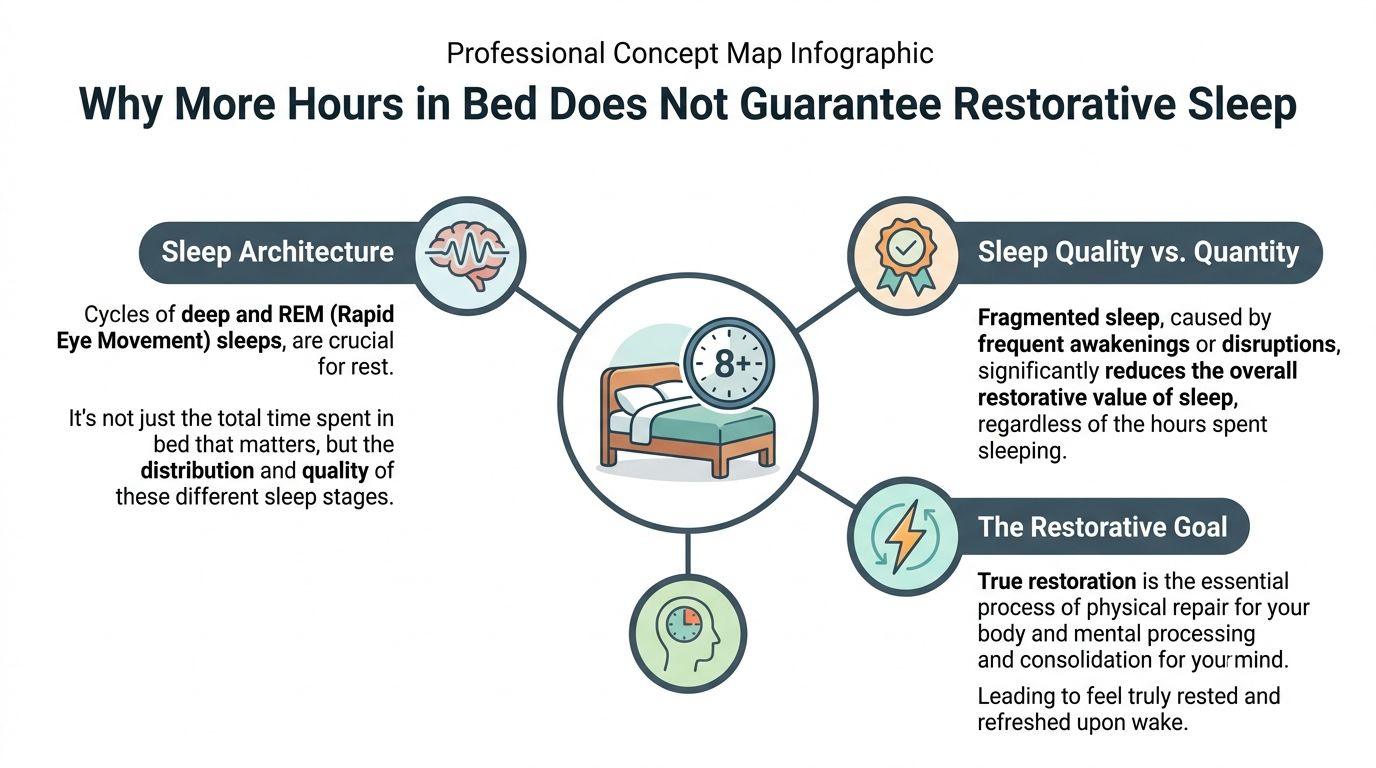
Deep sleep is concentrated in the first half of the night. Protecting a complete seven to eight hour sleep opportunity therefore matters more than assuming a late morning lie-in can fully repair a shortened or disrupted night. Extra sleep may help, but adding time at the end does not reliably recreate the same architecture.
Practical rule: Protect the beginning of your sleep window, not only the time you hope to wake up.
Quantity and quality can separate
A client may report spending a long night in bed, then describe waking several times, breathing through the mouth, or lying alert between cycles. The clock records time, but the body experiences fragmented sleep. Repeated awakenings, shallow transitions, breathing interruptions, and mental alertness can prevent smooth progression through restorative stages.
The distinction appears in research, not only in morning impressions. In a nationally representative U.S. sample, only 28.1% of adults scored high on a validated restorative sleep measure, according to the PubMed-indexed study on restorative sleep. Waking tired after a full night can therefore point to disrupted sleep quality rather than a simple need to stay in bed longer.
When clients say they are “sleeping enough” but remain unrefreshed, I examine consistency and interruption before recommending supplements. A steady wake time and protected early-night sleep help preserve slow-wave sleep. I also check whether nasal breathing is comfortable, since persistent congestion or mouth breathing can add arousals and reduce continuity. These physiological details often matter more than chasing a perfect wearable score.
Nitric oxide produced in the nasal passages supports efficient airway function and circulation, so nasal breathing is relevant to restoration, not merely comfort. The goal is quiet, stable breathing that does not repeatedly pull the nervous system toward wakefulness.
Your sleep surface can contribute to the problem. A sagging or overly firm mattress may create pressure and repeated position changes, interrupting otherwise stable sleep. If that fits your situation, browse our mattress collection to compare support options for spinal alignment before attributing every poor night to stress or biology.
Optimizing Your Sleep Environment and Light Exposure
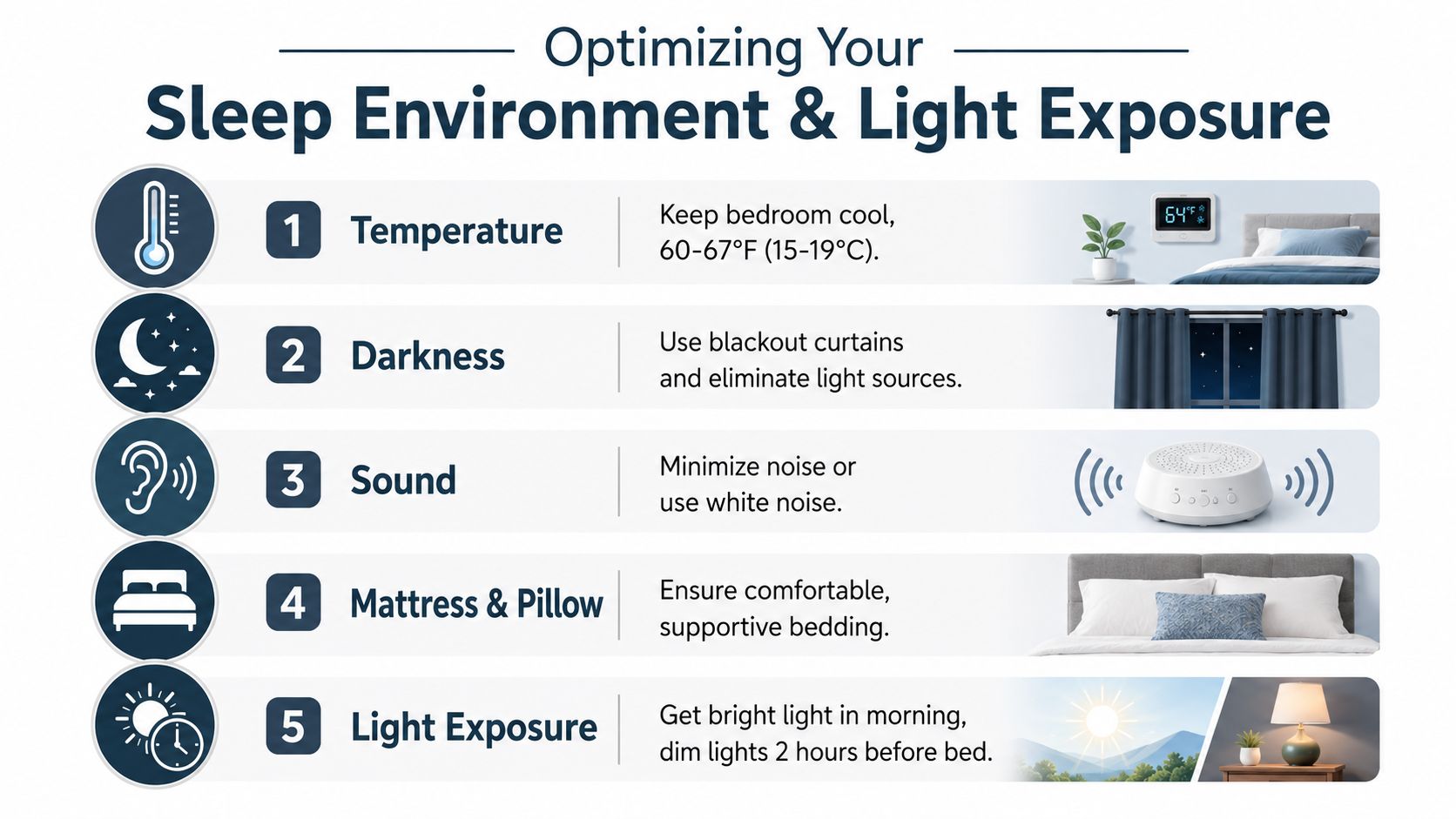
The bedroom should reduce stimulation, not merely look attractive. A cool, dark, quiet room limits the environmental signals that can keep the brain alert or trigger brief awakenings. Practical sleep-hygiene guidance also recommends avoiding caffeine, alcohol, and heavy meals close to bedtime, while limiting screen exposure in the hour before sleep. Baylor Scott & White's sleep-hygiene guide offers a useful overview of these fundamentals.
Build the room around fewer interruptions
Start with the obvious physical irritants. Use blackout curtains or an eye mask if outdoor light reaches the bed, cover bright device indicators, and address recurring noise with earplugs or steady white noise. Your pillow should keep your neck neutral rather than forcing your head forward or sideways, and your mattress should allow you to settle without constant pressure or repositioning.
Temperature deserves a practical, personal approach. A room that feels cool enough to support sleep is usually preferable to one that feels warm and stagnant, but comfort varies with bedding, clothing, humidity, and individual sensitivity. If you wake hot, remove layers or improve airflow before changing several other variables at once.
Humidity can matter when dry air irritates the nose or throat. For a deeper look at how humidifier use may fit into a sleep environment, see the Covenant Aire Solutions sleep guide. The aim isn't to create a complicated bedroom laboratory. It's to remove the conditions that repeatedly disturb sleep.
Treat light as a timing tool
Evening light affects sleep biology, not just bedtime mood. A systematic review found that two hours of evening blue-light exposure suppresses melatonin, with the strongest suppression at shorter wavelengths around 424 nanometers. In a college-student study, two hours of LED tablet use reduced melatonin by 55% and delayed melatonin onset by about 1.5 hours. These findings are summarized in the PubMed review of evening blue light and sleep.
That doesn't mean you need to fear every screen. It means late, bright, close-range exposure deserves a deliberate boundary. Dim overhead lighting, move screens farther away, activate night settings, and choose an offline activity when possible. This guide to screen time before bed can help you audit the specific habits that keep extending your evening alertness.
Morning light works in the opposite direction for people whose sleep timing runs late. A home-based study found that 30 minutes of morning blue-light exposure advanced melatonin rhythm by 84 minutes on average, compared with 48 minutes in the amber-light group. The study on morning light and circadian timing provides the relevant findings.
Get outdoor light soon after waking when practical. In the evening, dim the house before you feel sleepy, because the goal is to support the biological transition rather than force relaxation once you're already overtired. If you're testing a melatonin-free wind-down drink, Restore+ Magnesium Sleep Aid combines magnesium, L-theanine, tart cherry, lemon balm, and glycine with nitric oxide-supporting ingredients as part of an evening routine.
The Breathing Mechanics That Determine Sleep Depth
Many sleep routines focus on light and temperature while ignoring the airway. That's a mistake, especially if you wake with a dry mouth, notice nasal blockage, snore, or feel tired despite apparently adequate sleep.
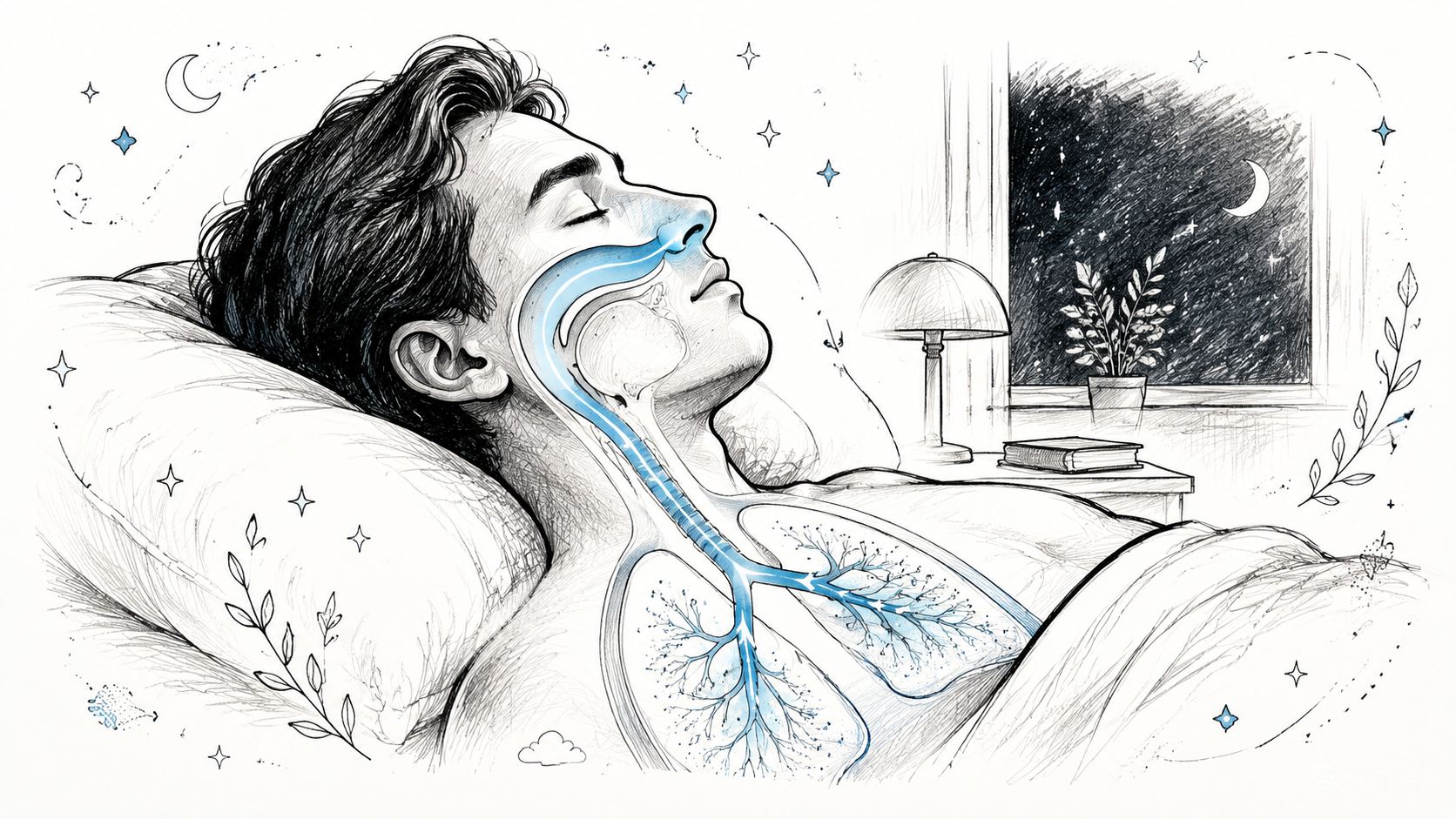
Nasal breathing warms, filters, and humidifies incoming air. It also supports nitric oxide production in the nasal passages, which is relevant to circulation and oxygen delivery. Mouth breathing bypasses those nasal functions and can increase airway dryness and instability, particularly when congestion, relaxed jaw muscles, or an unfavorable sleeping position narrows the upper airway.
Start by identifying your breathing pattern
Nasal breathing has lower upper-airway resistance during sleep than mouth breathing. One review notes that oral breathing during sleep normally drops from 7.6% to 4.3%, while self-reported nocturnal nasal congestion was associated with a threefold increased incidence of snoring and daytime sleepiness in 1,032 healthy volunteers. Those findings are reported in the review of nasal and oral breathing during sleep.
You don't need to diagnose yourself from one rough morning. Look for patterns instead:
- Dry mouth: Waking with a parched mouth can suggest that your lips are opening during sleep.
- Nasal blockage: Congestion may force mouth breathing even when your daytime breathing feels normal.
- Snoring: Repeated vibration often indicates turbulent airflow and deserves more attention than embarrassment.
- Daytime sleepiness: Poor daytime function, especially alongside loud snoring or witnessed pauses, warrants clinical evaluation.
Mouth tape and nasal strips serve different purposes. Nasal strips mechanically widen the outer nasal passages and can help when the main limitation is nasal valve narrowing. Mouth tape encourages lip closure, but it should only be considered when you can breathe comfortably through your nose and you don't have unexplained breathing pauses, significant congestion, or suspected sleep apnea.
Read a practical explanation of the mechanics in this resource on breathing through the nose. Don't tape over a problem that needs assessment. If you struggle to breathe through your nose while awake, solve congestion first with guidance from a qualified clinician.
Use tools as supports, not substitutes
For people who already breathe comfortably through the nose, Hydrating Mouth Tape is designed to support lip closure, quieter nights, oral care, tongue posture, and nitric oxide-supportive breathing. Its role is behavioral and mechanical. It isn't a treatment for sleep-disordered breathing.
I recommend testing one change at a time. Try improving nasal airflow first, then observe whether your mouth is still opening. Keep notes on morning dryness, snoring feedback, awakenings, and daytime alertness. A tool that makes you anxious, restricts comfortable breathing, or masks worsening symptoms doesn't belong in the protocol.
Seek professional evaluation for loud habitual snoring, witnessed breathing pauses, gasping, morning headaches, or persistent daytime sleepiness. Restorative sleep requires a stable airway, and suspected obstruction shouldn't be managed with consumer tools alone.
Building Your Evidence-Based Wind-Down Protocol
A wind-down routine works best when it's a sequence your body recognizes, not a collection of products you use only after a bad night. The following protocol reduces light, lowers cognitive load, and gives breathing and relaxation a defined place.
Use the same sequence most nights
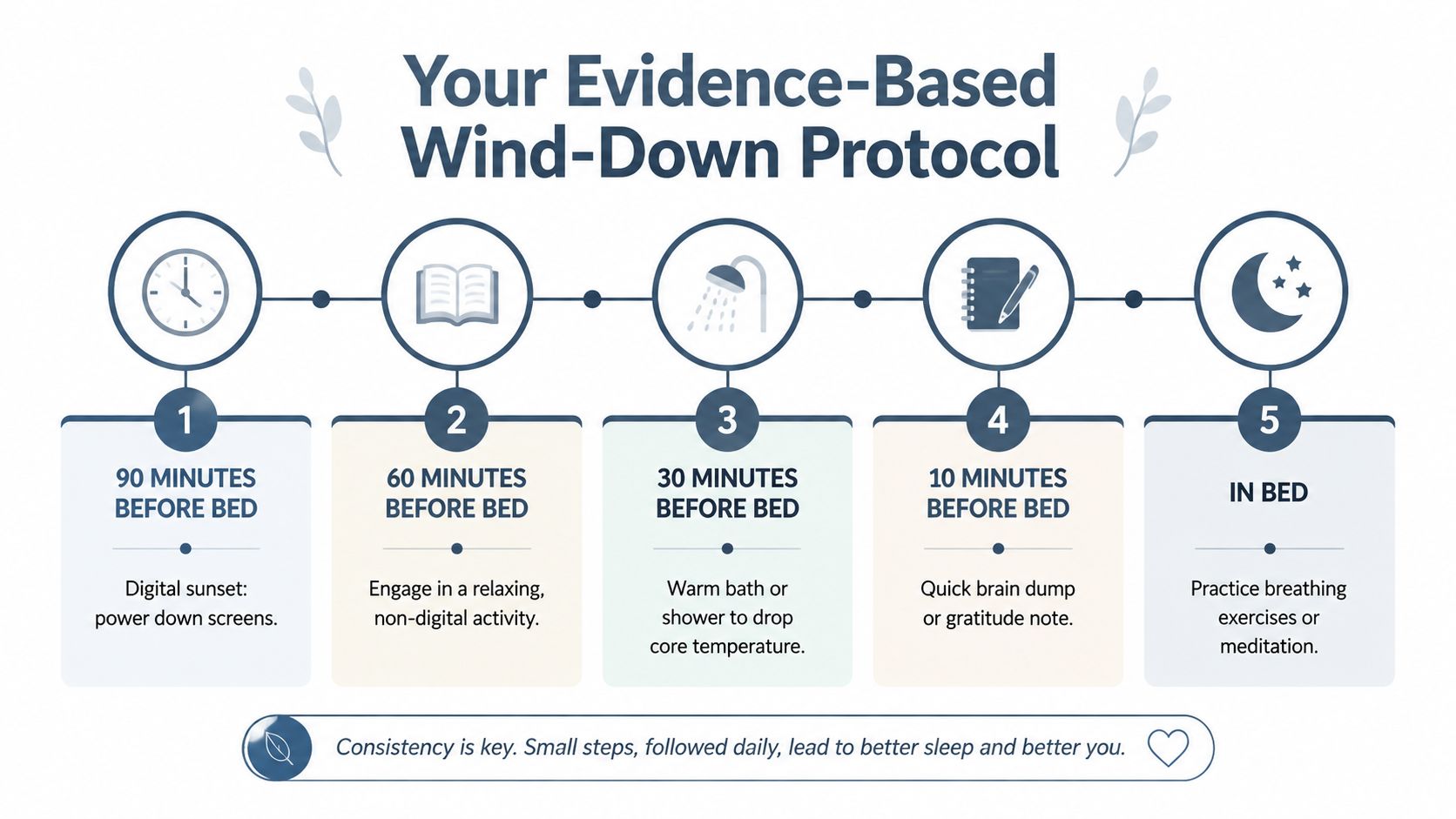
Ninety minutes before bed, begin a digital sunset. Stop work messages, lower household lighting, and move stimulating content away from the bed. If you must use a device, reduce brightness and keep it at a distance. The purpose is to reduce incoming stimulation before your brain expects sleep.
Sixty minutes before bed, choose one quiet, non-digital activity. Read a paper book, stretch gently, prepare clothing for tomorrow, or take a warm shower. Don't turn the routine into another performance task. Repetition matters more than finding a perfect activity.
Thirty minutes before bed, finish the practical tasks that otherwise keep you mentally active. A warm bath or shower can become a reliable transition cue, while a short journal entry can move unfinished thoughts out of working memory.
Give your mind a physical off-ramp
Ten minutes before bed, write a brief brain dump. List tomorrow's tasks, one concern you can't solve tonight, and the first action you'll take in the morning. This doesn't eliminate stress, but it gives your mind a boundary.
In bed, use slow breathing rather than forcing sleep. Try inhaling gently through the nose for four counts, then exhaling for six counts, repeating for several minutes. The longer exhale can feel calming, but stop if you feel light-headed or strained. Quiet, comfortable breathing matters more than hitting an exact count.
A melatonin-free drink can fit naturally between the practical steps and bed. Restore+, described earlier, uses a warm drink format with magnesium, L-theanine, tart cherry, lemon balm, and glycine, alongside nitric oxide-supporting ingredients. That format can help because the act of preparing and sipping it becomes a repeatable cue, not because a single beverage can compensate for an irregular schedule.
For a fuller routine framework, use this nighttime routine for better sleep. Keep caffeine, alcohol, and heavy meals away from the bedtime window, and avoid treating alcohol as a relaxation strategy. It may make you drowsy, but drowsiness isn't the same as stable sleep architecture.
Tonight's experiment: Keep the wake time fixed, dim the lights early, write down tomorrow's concerns, and practice nasal breathing with an easy longer exhale.
Troubleshooting Common Barriers to Restorative Sleep
A good routine can fail when the barrier is misidentified. Racing thoughts, rotating shifts, and snoring need different solutions, so applying the same sleep-hygiene checklist to all three wastes time.
When insomnia keeps the brain switched on
For insomnia, consistency usually beats novelty. A 2025 systematic review and meta-analysis of 42 randomized controlled trials involving 4,245 adults with insomnia found that sleep-hygiene education produced a short-term improvement in Insomnia Severity Index scores, with a pooled pre-to-post change of 3.4 points, and a 95% confidence interval of 2.08 to 4.64. The findings are available in the PubMed-indexed meta-analysis of sleep hygiene education.
The effective version isn't a poster of disconnected tips. It's a repeated protocol involving a consistent wake time, regular time in bed, stimulant timing control, and evening light reduction. Track whether you follow the plan instead of judging each night emotionally.
Sleep hygiene is a foundation, not a guaranteed cure for chronic insomnia. If difficulty sleeping persists, structured behavioral treatment is generally more intensive and should be discussed with a qualified healthcare professional.
When shift work disrupts timing
Shift workers can't always protect a conventional bedtime, but they can protect a stable sleep opportunity within each schedule block. Use darkness during daytime sleep, reduce noise, keep light exposure strategic, and avoid swinging unpredictably between radically different sleep times when your roster allows consistency.
Morning light is useful for advancing a late schedule, but shift workers need to time light according to their intended sleep and wake period. Bright light at the wrong biological time can make adjustment harder, so rotating workers may benefit from individualized circadian guidance rather than copying a standard morning routine.
When snoring points to airway trouble
For occasional snoring linked to congestion or sleeping position, nasal airflow support, side sleeping, and humidity management may help. Mouth tape should never be used to conceal possible obstruction.
A combined sleep-focused behavioral trial found that PSQI scores decreased by 1.0 point in the intervention group while increasing by 0.9 points in the control group, producing a between-group difference of 1.9 points, with a 95% confidence interval of 0.6 to 3.4. A separate trial found that daily hypnotic use fell from 25.4% to 18.6% in a self-help book group, while it increased from 21.2% to 22.7% in the sleep-hygiene-only group. These results are reported in the clinical trial comparison of behavioral sleep approaches.
The lesson is clear. Generic advice can help, but a defined protocol with adherence tracking is more dependable. Seek assessment for witnessed pauses, gasping, persistent sleepiness, or loud habitual snoring.
Tracking and Verifying Your Sleep Improvements
A restorative-sleep plan needs feedback. Counting hours is useful, but it won't tell you whether your sleep was fragmented, whether your breathing improved, or whether you're functioning better during the day.
Track a small set of signals for two to four weeks, rather than changing your routine every night:
- Sleep opportunity: Record when you got into bed, when you tried to sleep, and when you got up.
- Consistency: Note whether your wake time stayed stable across workdays and days off.
- Continuity: Mark awakenings, long periods of wakefulness, and obvious disruptions.
- Morning function: Rate energy, mood, focus, and physical readiness in simple words such as low, moderate, or strong.
- Breathing clues: Record dry mouth, nasal congestion, snoring feedback, headaches, or gasping.
- Protocol adherence: Note whether you dimmed lights, completed the brain dump, and practiced breathing.
Wearables can provide useful trend data, but their stage estimates aren't a clinical diagnosis. Treat changes in deep-sleep scores as clues, not verdicts. The strongest evidence of improvement is a consistent pattern of easier sleep, fewer awakenings, better morning function, and less reliance on emergency fixes.
A larger restorative sleep gap has been associated with poorer sleep quality, greater anxiety, higher burnout, and lower command satisfaction in recent U.S. Navy research, even after accounting for demographic and shipboard factors. The findings are described in the PubMed record for the restorative sleep gap study. That work reinforces an important point: sleep quantity can look acceptable while recovery remains poor.
Measure recovery, not just duration. If you're sleeping enough but functioning badly, investigate breathing, timing, fragmentation, stress, medication effects, and the possibility of a sleep disorder.
Change one major variable at a time. If earlier light exposure improves your schedule but a new supplement makes mornings worse, you'll know where to look. If nasal breathing improves dryness and snoring feedback without changing total sleep time, that still counts as meaningful progress.
After your tracking period, keep the changes that improve both nighttime continuity and daytime function. Take persistent symptoms to a healthcare professional rather than endlessly optimizing your bedroom.
SleepHabits offers melatonin-free options and breathing-focused tools that can complement a consistent restorative-sleep routine, including magnesium-based wind-down support and products designed to encourage nasal breathing. Visit SleepHabits to explore the educational resources and practical tools, then choose the smallest protocol change you can repeat tonight.