

You fall asleep fine, then wake up at 2:47 a.m. with a hot chest, a dry mouth, and a mind that suddenly won't stay quiet. You check the clock, roll over, and start negotiating with the rest of the night. That pattern feels personal, but it's usually a sleep-maintenance problem with a few common drivers, and one of the most missed is how you're breathing while you sleep.
Why You Keep Waking Up at Night
A lot of people assume they're the only one staring at the ceiling in the middle of the night, but that's not how this works. More than 35% of people wake up during the night at least three times per week, and over 40% of that group have trouble falling back asleep, which is the part that turns a brief arousal into a miserable night (Sleep Foundation). Brief awakenings themselves aren't the enemy. It's common to wake 5 to 15 times per night without noticing it, so the goal is to reduce the awakenings that stick.
Practical rule: a short wake-up isn't the problem. A wake-up that turns into alertness, frustration, or clock-watching is the problem.
A typical pattern looks like this. You wake, notice your mouth is open, your body feels a little keyed up, and then your brain tries to explain the moment. That explanation can be stress, temperature, a bathroom trip, or a bed that now feels too familiar as a place to be awake. The experience is common enough that it shouldn't be treated like a personal flaw.
For some people, the reason is straightforward sleep fragmentation. For others, it's a breathing problem that never gets named. If you snore, mouth-breathe, or wake with a dry throat, the issue may not be “bad sleep habits” alone. Resources on sleep apnea's impact on oral health are useful here because oral signs often show up before people connect the dots to the airway.
The best mindset shift is simple. Stop asking, “Why am I broken?” Start asking, “What keeps interrupting my ability to stay asleep and resettle?” That question leads to fixes that fit the cause.
Understanding the Triggers Behind Your Wake-Ups
Your night is not one long stretch of identical sleep. It moves through lighter and deeper periods, and the lighter transitions are where awakenings happen most easily. That's why a person can sleep “poorly” without remembering dozens of tiny arousals, because some are so brief they never reach full awareness. A recurring wake-up at the same time often means your sleep is becoming vulnerable at a predictable point, not that your body is failing.
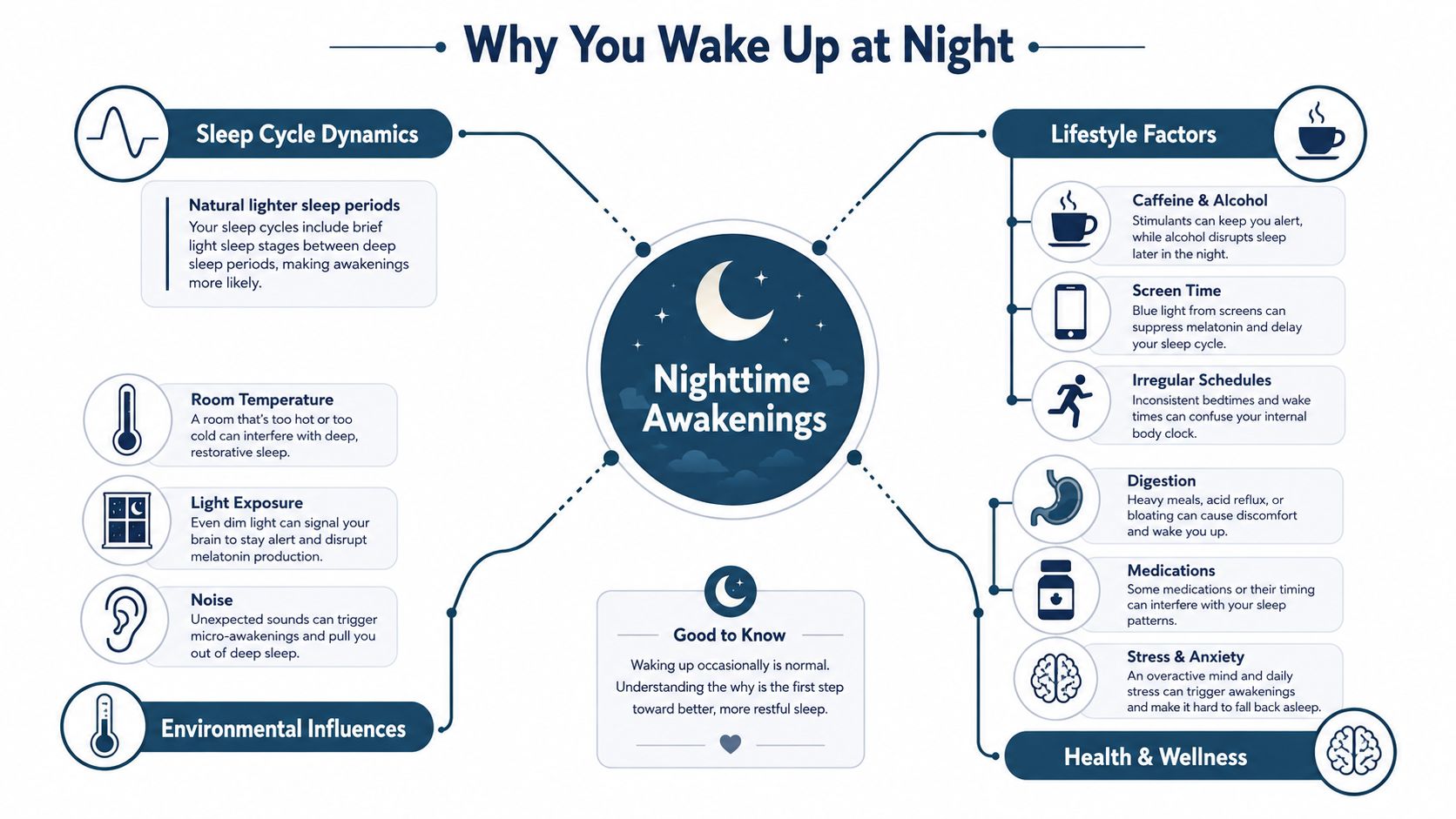
The most common trigger buckets
A good way to think about wake-ups is by category:
- Sleep cycle dynamics: lighter stages make you easier to wake, especially in the second half of the night.
- Environmental influences: heat, light, and noise can nudge the brain toward alertness.
- Lifestyle factors: caffeine, alcohol, nicotine, screens, and irregular timing can fragment sleep continuity.
- Health and wellness factors: stress, digestion, medications, and bathroom trips can all create repeated arousals.
That framework matters because the fix depends on the trigger. A person waking from a hot room needs something different from someone waking because alcohol wore off or because anxiety spiked at 4 a.m.
The breathing piece deserves special attention. A major underserved cause of night wakings is sleep-disordered breathing and nasal obstruction, because mouth breathing and snoring often overlap with fragmented sleep (Medical News Today). If your nose feels blocked at night, or your jaw falls open as you sleep, the body may work harder to move air, and that extra effort can create micro-arousals you barely remember. That's why some people keep trying generic sleep hygiene while the underlying issue sits in the airway.
A simple tool like Eucalyptus Nasal Strips can fit into that picture when nasal flow is part of the problem. Its listed purpose is to improve airflow, reduce congestion from colds, allergies, or dry air, and support nasal breathing habits. If breathing is smoother, the body has fewer reasons to keep nudging you awake.
Building a Wind-Down Routine That Actually Works
A real wind-down routine starts before the bed, not after you're already frustrated in it. Light, stimulation, and unfinished thoughts all keep the nervous system too active to settle cleanly. The goal is to lower input from every direction, then make breathing as easy as possible before sleep pressure takes over.
Start with the room itself. Dim lights earlier than you think you need to, keep the bedroom cool and dark, and stop using the bed as a place to problem-solve. If your mind races, jotting down a few lines in a notebook can help move unfinished thoughts out of working memory and into something concrete. That small act often calms the loop that turns a normal night arousal into a long awake stretch.
A quieter body at bedtime usually comes from fewer signals, not more effort.
The next layer is airway preparation. If you tend to wake with a dry mouth or stuffy nose, use the evening to support nasal breathing, not fight against it. A saline rinse, a nasal strip, or reducing dry air in the room can make the first part of the night less reactive. That matters because the body often wakes when breathing becomes inefficient, not just when the mind is busy.
For readers looking into treating insomnia naturally, the useful thread is consistency. Natural approaches work best when they reduce stimulation and support repeatable cues, not when they pile on more rituals. A supplement may help the body settle, but it won't override an overstimulated evening.
An option some people use in a habit-based routine is Restore+ Magnesium Sleep Aid, a melatonin-free magnesium drink built around magnesium, L-theanine, tart cherry, lemon balm, and glycine. It's positioned as part of an evening wind-down rather than a knockout formula, which fits a routine that's meant to calm the body before it gets overtired.
The internal lesson is simple. Stop chasing a perfect bedtime routine and build one that reliably lowers arousal, supports nasal breathing, and makes it easier to drift through the night without repeated alarms.
For a related breakdown of nightly habits, see the guide to nighttime routine for better sleep.
In-the-Moment Fixes for Middle-of-the-Night Wakefulness
The worst move at 3 a.m. is to lie there and wrestle with sleep. That teaches your brain that bed is a place for alertness and frustration, which is exactly what you don't want. The cleaner response is to interrupt the pattern quickly before the wake-up becomes a prolonged episode.
The most reliable approach is the 15 to 20 minute rule. If you're not sleepy after that window, get out of bed, keep the lights low, and do something quiet until drowsiness returns (Johns Hopkins Medicine). That break matters because it prevents a conditioned association between bed and wakefulness. The point isn't to “try harder” to sleep, it's to stop training your brain to stay alert in bed.
What to do instead
- Read something dull in very low light: this keeps stimulation down without letting your mind spiral.
- Try slow breathing: box breathing or another calm rhythm can reduce the sense of urgency that follows a wake-up.
- Keep your wake time fixed the next morning: consistency helps preserve sleep drive.
- Return only when drowsy: going back too early usually resets the same wake cycle.
The things to avoid are just as important. Don't check your phone, don't turn on bright lights, and don't start solving tomorrow's problems. Those actions signal daytime to the nervous system, and they can make it harder to fall back asleep than the original wake-up did.
A short, practical read on the same tactic lives in how to fall back asleep quickly. The main principle matches the clinical guidance, don't stay in bed awake longer than you need to.
Non-Melatonin Aids to Support Sleep Continuity
Not every sleep aid should be a sedative, and not every solution should be a pill. If your wake-ups come from tension, mouth breathing, or a restless airway, the better tools are often the ones that change how your body behaves while you sleep. That's why non-melatonin support can be useful when it's used for the right reason.
Magnesium gets attention because it can support relaxation and muscle calm without forcing sleep. In a routine built around continuity rather than sedation, that can matter a lot. A formula like Restore+ fits that model because it's melatonin-free and built around a nightly wind-down drink instead of a hard sleep override.

Tools that match the cause
Nasal support is one of the most overlooked categories. If your nose closes off at night, airflow changes, the mouth opens, and sleep becomes more fragmented. That's where a product like Hydrating Mouth Tape can be relevant when used appropriately, because it's designed to support quieter nights, oral care, tongue posture, and nose-breathing habits. It won't solve a blocked airway by itself, but it can reinforce the breathing pattern that helps reduce mouth breathing.
The same logic applies to nasal strips. They're not magical, and they don't replace medical care, but they can reduce one of the small physical barriers that keeps sleep from staying smooth. If a person snores, wakes dry-mouthed, or feels air-starved at night, smoother nasal breathing is worth addressing before reaching for stronger interventions.
For a broader look at options beyond melatonin, see alternatives to melatonin for sleep.
A safety note that matters
Any supplement or breathing aid should be chosen with judgment. If you take medications, have a health condition, or suspect sleep apnea, talk with a clinician before starting something new. Tools help most when they match the underlying problem, and they're least useful when they're used to mask a disorder that needs evaluation.
When Your Nightly Wake-Ups Need a Professional Look
Some wake-up patterns point to a simple habit issue. Others point to a body problem that needs a proper workup. If you keep waking around the same time, the pattern can still be useful, because repeated timing often reflects a trigger that's tied to breathing, temperature, digestion, or stress physiology. The job is to notice the pattern without turning it into a guess.

Patterns that deserve attention
Waking early in the second half of the night can sometimes reflect environmental or routine issues, while repeated awakenings with snoring, gasping, or a dry mouth raise more concern for an airway issue. If the wake-ups come with a racing heart, repeated bathroom trips, or a sense that breathing feels off, the problem may be bigger than sleep hygiene. That's where structured treatment beats trial and error.
Obstructive sleep apnea affects 2% to 9% of adults and is a common medical cause of fragmented sleep, and when awakenings persist despite behavioral changes, a medical evaluation is the standard next step (National Sleep Foundation). That matters because people often keep adding routines when they need diagnosis. Persistent loud snoring, gasping, or daytime fatigue aren't quirks to ignore.
If the night wakings keep repeating after you've cleaned up the basics, the next move is evaluation, not more guessing.
For people who want a practical treatment path, oral appliance therapy with Dr. Powless is one example of the kind of airway-focused care that can be relevant when sleep-disordered breathing is part of the picture. That kind of support is different from generic sleep advice because it addresses the mechanics of breathing, not just bedtime habits.
Sleep gets better fastest when the fix matches the cause. If your nights are being disrupted by breathing, mouth opening, or a pattern that keeps repeating no matter how careful you are with bedtime, don't keep treating it like a mystery.
If you're ready to get more control over broken sleep, explore the breathing-focused tools and habit support at SleepHabits. You'll find melatonin-free options, nasal and mouth-breathing support, and practical sleep routines built for people who want steadier nights without overcomplicating bedtime.