

Magnesium is often presented as the answer to poor sleep: take it before bed, relax, and wake up restored. That advice is too broad. Magnesium sleep quality depends less on the mineral's reputation than on the person taking it, the problem being targeted, and the outcome being measured. Someone with low magnesium intake and restless, fragmented sleep may respond differently from a well-nourished sleeper whose main problem is late-night screen exposure or untreated sleep apnea.
The more useful question isn't, “Does magnesium improve sleep?” It's who benefits, and how can you tell feeling calmer from sleeping better? That distinction matters because a supplement may make bedtime feel easier without changing sleep architecture in a meaningful way.
Why Magnesium Is Not a Universal Sleep Shortcut
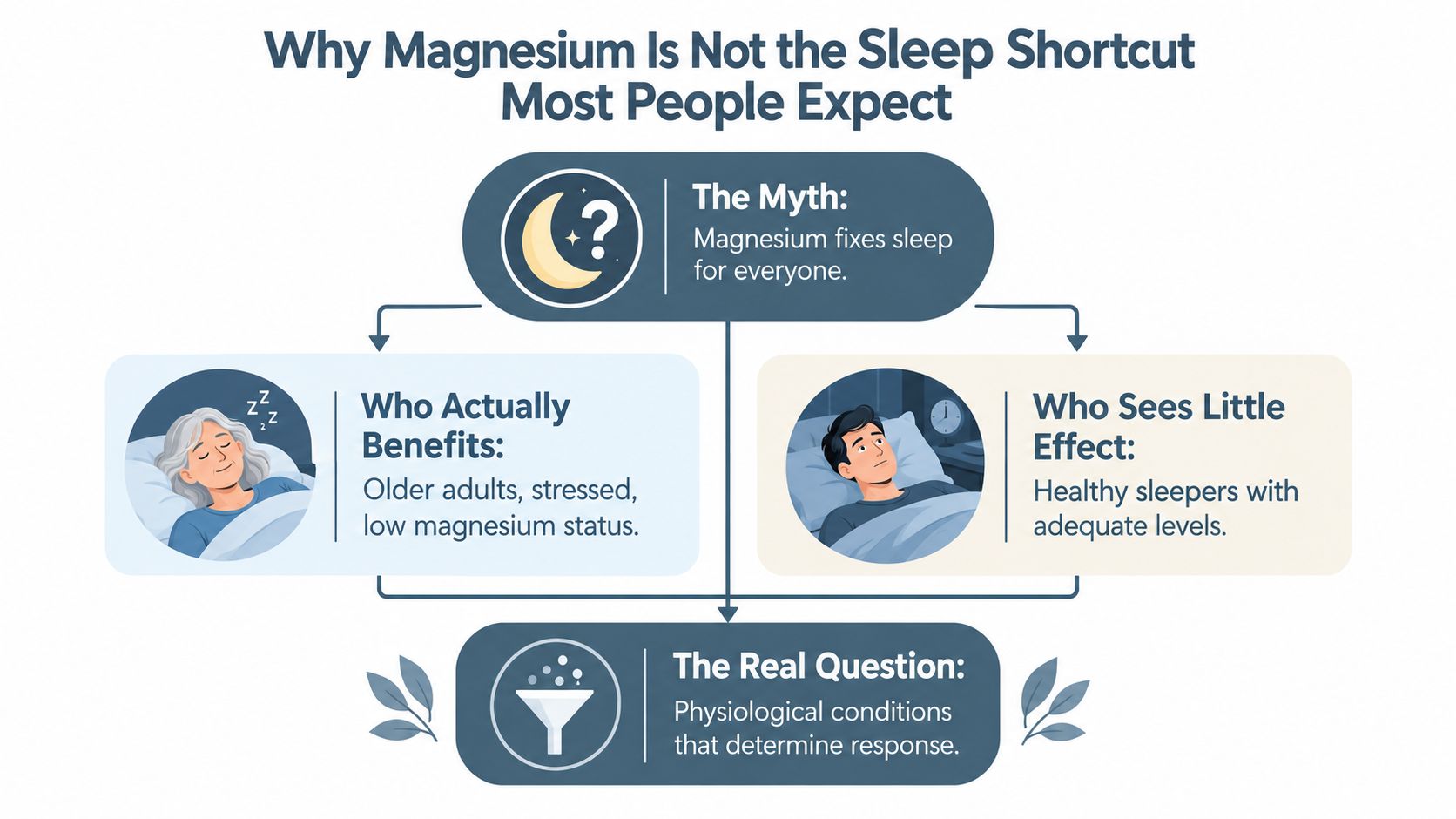
Magnesium does not work like a single sleep switch. A capsule may affect nervous-system excitability, muscle comfort, or stress regulation, yet those effects do not guarantee longer, deeper, or more continuous sleep. The useful question is not whether magnesium improves sleep. It is who has a plausible reason to benefit, and whether the change is genuine sleep improvement or only a calmer bedtime experience.
Three profiles make that distinction clearer:
- Adults with low magnesium status and clear sleep symptoms may have more room to benefit, particularly when muscle tension, restlessness, or difficulty settling down occurs alongside poor dietary intake.
- Mildly anxious sleepers may feel calmer and find sleep onset less effortful, even when objective sleep stages change little.
- Well-nourished optimizers may notice no meaningful difference because magnesium is not addressing the main bottleneck in their sleep.
The same supplement can therefore feel useful to one person and irrelevant to another. Feeling less keyed up is a real experience, but it does not by itself show that sleep became deeper or more restorative. A sleep diary can track bedtime, estimated sleep onset, awakenings, and morning alertness, while objective sleep staging requires measurement beyond personal impression.
A 2021 systematic review identified three randomized controlled trials involving 151 older adults across three countries. Its pooled result found that magnesium shortened sleep onset latency by 17.36 minutes compared with placebo, while total sleep time increased by 16.06 minutes without statistical significance. The authors also rated the trials as having moderate-to-high risk of bias and the overall certainty of evidence as low to very low. The finding is a signal, not a universal prescription (2021 systematic review of oral magnesium for insomnia).
Practical rule: Correcting a genuine nutritional shortfall is a different goal from chasing a subtle calming sensation.
A soothing evening environment can still support the experiment. A resource on vegan night cream with purple carrot may fit alongside dim lighting and reduced stimulation, but skincare is not a treatment for insomnia.
How Magnesium Actually Works in the Nervous System
Magnesium doesn't act like a conventional sedative. A better analogy is a set of biological gatekeepers that help prevent the nervous system from responding too intensely at the wrong time.
The excitatory brake
NMDA receptors help transmit signals driven by glutamate, the brain's main excitatory neurotransmitter. At resting membrane voltage, magnesium sits inside the NMDA channel like a removable plug. When the neuron becomes sufficiently activated, the plug can move and allow signaling to continue. This voltage-dependent blockade helps keep background excitation from becoming uncontrolled firing.
That doesn't mean magnesium shuts the brain down. It helps regulate the threshold at which excitatory messages pass through. For a person whose bedtime problem feels like mental overdrive, that regulation may translate into fewer racing thoughts or an easier transition into sleep.
The inhibitory volume knob
Magnesium also interacts with inhibitory signaling involving GABA-A receptors. The practical analogy is a volume knob, not an off switch. GABA is part of the nervous system's braking network, and stronger inhibitory tone can make the shift from alertness to rest feel smoother.
The result may be most noticeable subjectively. A sleeper might feel less keyed up, less physically tense, or less preoccupied with the clock. That experience can support sleep onset, but it doesn't prove that deep sleep or REM sleep has increased.
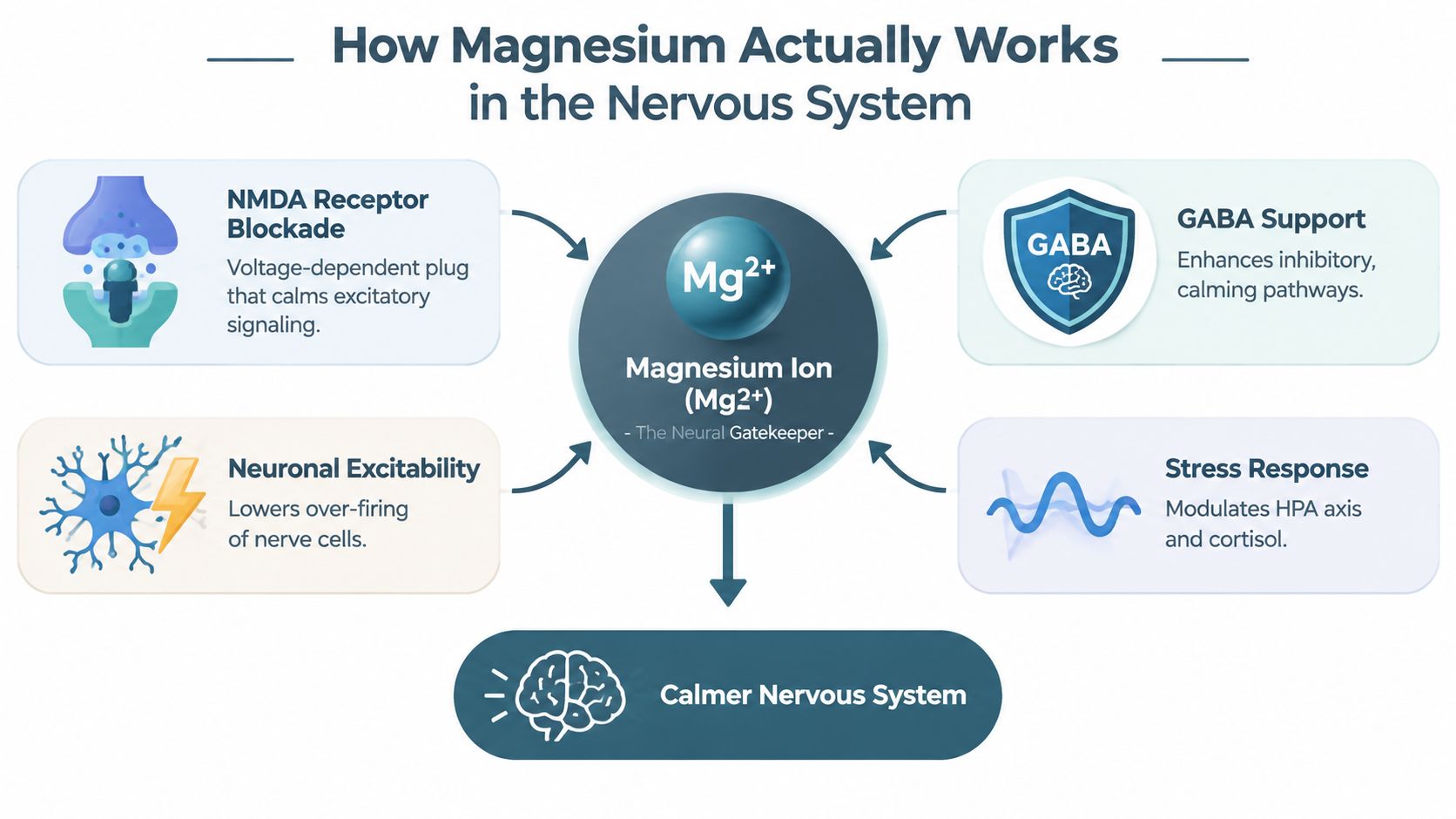
Reduced intracellular calcium signaling and changes in adrenaline-related activity may also support a shift toward parasympathetic, or “rest and digest,” physiology. In plain language, magnesium can help reduce some of the signals that keep the body prepared for action. That may matter for nighttime awakenings driven by tension, although it won't remove environmental noise, airway obstruction, pain, or an irregular sleep schedule.
Magnesium also participates in pathways related to melatonin production, but that isn't the same as directly delivering a sleep hormone. Its role is better understood as part of the body's sleep-regulation machinery rather than a guaranteed hormonal surge.
For people comparing combination products, Restore+ Magnesium Sleep Aid is described as a melatonin-free magnesium wind-down drink containing magnesium, L-theanine, tart cherry, lemon balm, and glycine. Its ingredient list illustrates a broader formulation strategy, but the presence of several ingredients doesn't by itself establish that the product will improve an individual's sleep.
Comparing Magnesium Forms and What the Evidence Favors
The label's magnesium form matters, but marketing often gives shoppers more confidence than the clinical evidence deserves. Glycinate, citrate, L-threonate, and oxide differ in absorption, digestive tolerance, and the amount of elemental magnesium they provide. Direct sleep research also remains uneven, so a form with an appealing mechanism isn't automatically a proven sleep treatment.
| Form | Elemental Mg % | Bioavailability | Sleep Evidence | Best Use Case |
|---|---|---|---|---|
| Glycinate | Varies by compound | Generally considered well tolerated and reasonably absorbed | A 2025 randomized trial found a modest improvement in insomnia severity with magnesium bisglycinate | Bedtime relaxation when digestive tolerance matters |
| Citrate | Varies by compound | Generally well absorbed | Direct sleep evidence is limited and mixed | A practical general-purpose option, especially when constipation is also relevant |
| L-threonate | Varies by compound | Marketed for brain availability, but product comparisons remain difficult | A 2026 randomized trial found better self-reported sleep-related impairment, without significant overall differences in sleep disturbances, restorative sleep, or general well-being | People interested in cognitive and subjective sleep outcomes, with cautious expectations |
| Oxide | Relatively high magnesium by compound weight | Poorer absorption than several other commonly used forms | Limited rationale for choosing it specifically for sleep | Constipation support rather than a first choice for sleep |
The most useful distinction on any label is elemental magnesium, not the total weight of the magnesium compound. Two products can display similar capsule weights while delivering different amounts of usable magnesium. If a blend doesn't clearly disclose elemental content, comparison becomes guesswork.
Glycinate is popular because the attached glycine may complement a calming bedtime routine, but that doesn't make every glycinate product clinically equivalent. Citrate can be reasonable when absorption and bowel regularity both matter, although loose stools can undermine sleep. L-threonate has a brain-focused rationale, yet the trial evidence remains more supportive of subjective improvement than a reliable change in objective sleep depth.
A cautious form-selection overview is available through magnesium for better sleep, while this magnesium glycinate versus citrate comparison can help readers examine the two most common bedtime choices. The decision rule is simple: choose a tolerable form with transparent elemental labeling, match it to the symptom pattern, and judge the outcome rather than the marketing story.
Clinical Dosing, Timing, and Realistic Expectations
Dose discussions become confusing because supplement labels may list the weight of a magnesium salt rather than the elemental magnesium inside it. Clinical discussions commonly use elemental magnesium, and the older-adult insomnia trial used 500 mg per day of elemental magnesium for eight weeks, with sleep onset latency 17.36 minutes shorter than placebo (older-adult magnesium trial). That study provides a benchmark, not a universal dose for self-treatment.
For a cautious personal trial, many clinicians would start below the amounts used in research and follow the product label, particularly if the person has a sensitive stomach. A starter dose of 100 to 150 mg of elemental magnesium can reveal whether diarrhea, cramping, nausea, or morning sluggishness develops before someone considers increasing it.
| Parameter | Guideline | Notes |
|---|---|---|
| Label reading | Identify elemental magnesium | Compound weight isn't the same as elemental content |
| Timing | Take it near the evening wind-down | A practical window is roughly 30 to 60 minutes before bed |
| Titration | Begin conservatively | Increase only if tolerated and if symptoms justify a trial |
| First review | Assess around 28 days | Look for easier sleep onset, fewer awakenings, and morning alertness |
| Later review | Reassess around eight weeks | Stop escalating if there's no meaningful benefit or tolerability is poor |
Food timing usually matters less than whether the supplement fits comfortably into the sleep window. Taking it with dinner or a small snack may reduce stomach discomfort. Splitting a dose between dinner and bedtime can also be useful for sensitive people, although it isn't a guarantee against next-morning grogginess.
A plateau is informative. If the dose is tolerated but sleep remains fragmented, or if the only change is a vague sense of calm without better functioning, magnesium may not be the limiting factor. Review caffeine, alcohol, light exposure, airway symptoms, medications, pain, and bedtime consistency instead of treating a disappointing response as a reason to keep increasing the dose. A more detailed discussion of how much magnesium to take for sleep can help with label interpretation and conservative planning.
Why Magnesium Rarely Works Alone and What to Pair It With
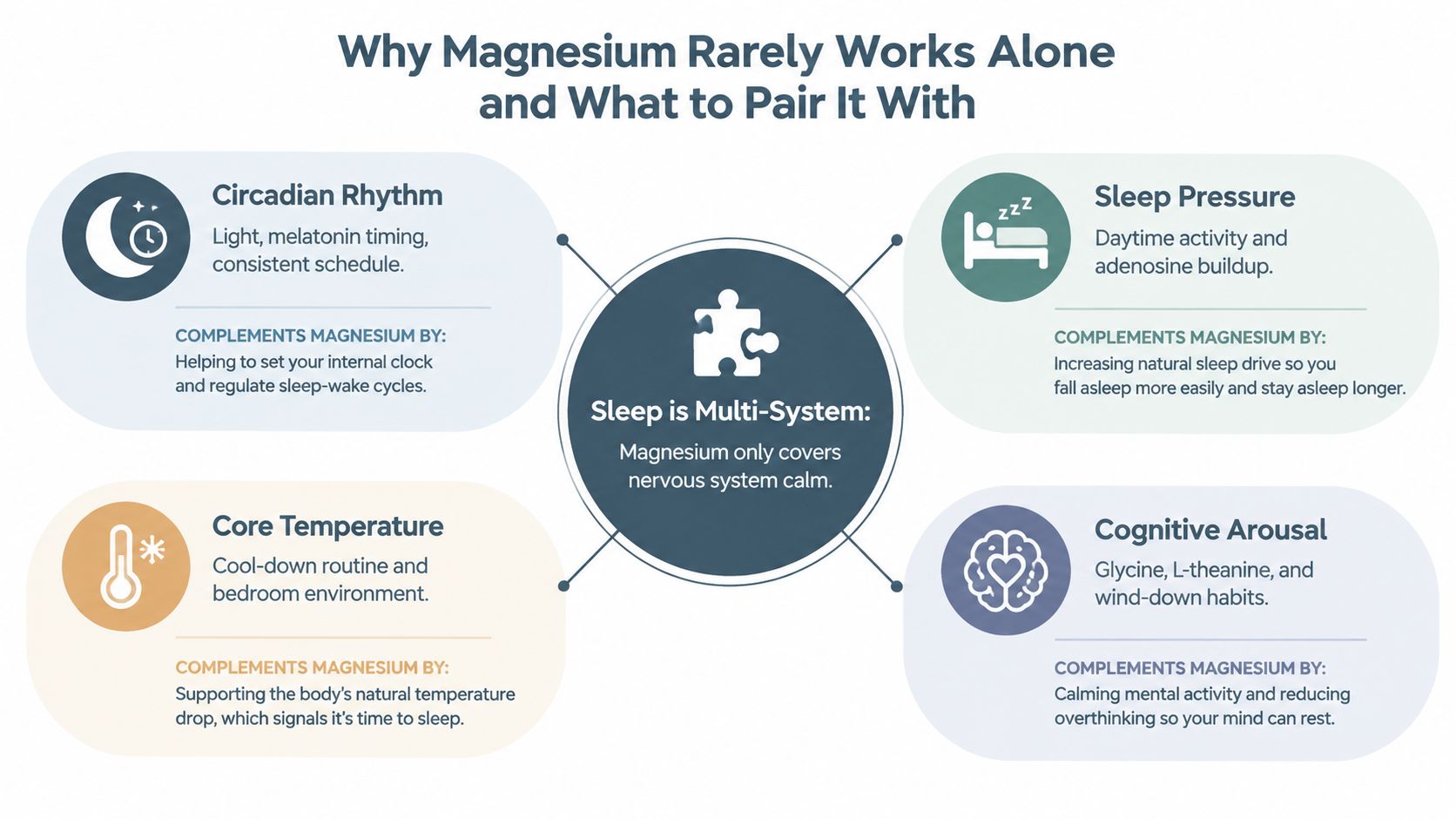
Sleep depends on several systems operating on a predictable schedule. Magnesium mainly addresses one slice, nervous-system excitability and relaxation. If the bottleneck is a delayed body clock, excessive daytime sleep, a warm bedroom, or cognitive arousal, adding more magnesium won't solve the mismatch.
Different bottlenecks need different levers
L-theanine may complement a wind-down routine by supporting a calmer mental state. Glycine has its own relationship with NMDA signaling and may participate in the body's nighttime temperature drop. Tart cherry is often used in products aimed at circadian support because it contains compounds related to melatonin pathways and anthocyanins associated with antioxidant activity. Nitric oxide support from beets or selected amino acids is intended to support blood flow, which may be relevant when physical relaxation and nighttime recovery are part of the goal.
These ingredients shouldn't be treated as a guaranteed biochemical team. A combination can make sense because each component targets a different possible obstacle, not because a formula automatically produces synergy.
Pair supplements with behavior
A formula works inside a routine, not instead of one. Consistent wake time, morning light, daytime movement, lower evening stimulation, and a bedroom that supports sleep address bottlenecks magnesium cannot reach. Readers looking for a broader checklist can review these lifestyle changes for restful nights.
The same logic applies to GABA-related calming claims. Magnesium may support inhibitory tone, but behavioral cues determine whether the brain receives a repeated signal that the day is ending. A deeper explanation of magnesium and GABA is useful for readers who want the physiology without assuming that a supplement creates sedation.
A combination is only as strong as the weakest unresolved sleep problem.
Feeling Calmer Is Not the Same as Sleeping Deeper
A calmer bedtime can be valuable, but it answers a different question from whether sleep architecture changed. Someone may stop checking the clock, fall asleep with less anxiety, and wake feeling more positive without spending more time in slow-wave sleep.
The 2023 systematic review included 7,582 subjects across nine studies and found that observational research linked magnesium status with several better sleep-related outcomes, including daytime falling asleep, sleepiness, snoring, and sleep duration. Randomized clinical trials, however, showed an uncertain relationship between magnesium supplementation and sleep disorders, so population associations don't establish that supplements cause better sleep (2023 systematic review of magnesium and sleep health).
What wearables can and can't tell you
Wearables may help track trends in resting heart rate, heart-rate variability, sleep duration, and estimated deep sleep. They can show whether your nights look more stable over time, but their sleep-stage estimates aren't the same as a sleep laboratory measurement.
An EEG-based sleep study records electrical brain activity and can identify changes in sleep stages more directly. That distinction matters because a 2026 randomized magnesium L-threonate trial found better self-reported sleep-related impairment, while overall differences in sleep disturbances, restorative sleep, and general well-being were not significant; a more severe subgroup showed a signal for sleep disturbances (magnesium L-threonate randomized trial).
Think of magnesium as potentially quieting the mental runway before takeoff. It may reduce the friction involved in falling asleep, but it doesn't necessarily change the flight path once you're airborne. The broader 2026 systematic review concluded that oral magnesium shouldn't be used as a routine insomnia treatment because findings were inconsistent across subjective measures, EEG, actigraphy, and wearable-derived metrics, with low to very low certainty (2026 systematic review).
If you feel calmer but see no sustained improvement in morning function, awakenings, or consistent sleep patterns after a reasonable trial, don't keep raising the dose automatically. Look for the unresolved cause.
A Practical Wind-Down Routine That Puts Magnesium to Work
Treat magnesium as a cue within a predictable evening sequence, not as an instant sleep switch. A useful routine might look like this:
- Start the transition 60 to 90 minutes before bed. Dim overhead lights, reduce screen brightness, and finish strenuous exercise and dinner early enough that digestion isn't competing with sleep.
- Take the selected magnesium form near the wind-down window. Use the elemental amount shown on the label, and add a small snack if taking it on an empty stomach causes discomfort.
- Use slower breathing for five minutes. If nasal breathing feels clear, breathe in for about four seconds and out for about six seconds. Stop if you feel light-headed.
- Keep airway tools conservative. Transparent Nasal Strips are described as helping improve airflow, reduce nasal congestion from colds, allergies, or dry air, and support nasal breathing habits. Mouth taping should never force airflow through an obstructed nose. Test it while awake first, and avoid it with congestion, respiratory disease, reflux, or significant anxiety.
- Make the bedroom boring. Keep it cool, dark, and quiet. Put the phone beyond easy reach so checking the time doesn't become part of the ritual.
- Track only useful signals. During the first week, record bedtime, magnesium dose, awakenings, and morning alertness. Don't turn the log into a new source of sleep anxiety.
A person with racing thoughts might take magnesium with a small evening snack, dim the lights, complete five minutes of longer-exhale breathing, and read away from the phone. A person with repeated awakenings should also review alcohol, caffeine timing, snoring, restless legs, medications, and bedroom conditions rather than assuming the supplement is failing.
Consistent sleep timing remains the foundation. The routine should repeat the same cues, reduced light, predictable movement, and calmer breathing, without encouraging someone to stay in bed longer than planned or repeatedly inspect sleep scores. Magnesium can support that transition, but it can't compensate for an obstructed airway or a schedule that changes constantly.
Safety, Interactions, and Common Questions Answered
More magnesium is not automatically better. Magnesium from food generally has a low toxicity risk because healthy kidneys regulate absorption and excretion. Supplements can cause diarrhea, cramping, nausea, or abdominal pain. Reduced kidney function can allow magnesium to accumulate, so medical guidance is appropriate before supplementation.
The NIH supplemental upper limit for adults is 350 mg of elemental magnesium daily from supplements and medications, excluding magnesium from food (NIH magnesium fact sheet). This limit does not replace the context of clinical trials or product labels, but it makes elemental-magnesium math important. Anyone who is pregnant, has kidney or heart disease, or takes several medicines should consult a clinician before starting.
Magnesium can interfere with tetracycline or quinolone antibiotics, bisphosphonates, levothyroxine, and other medicines. Separation timing depends on the prescription. A pharmacist can provide instructions for a specific medication, so a generic timing rule is not enough.
Common questions
Is magnesium a sedative? No. It may support relaxation and reduce some nervous-system excitability, but it is not a conventional sedative. Sleepiness is not a reliable result for everyone.
Who seems most likely to benefit? Benefits are more plausible for people with low magnesium status, older adults, or sleep disruption marked by tension and difficulty settling. A calmer evening does not prove that sleep became deeper, and healthy sleepers should not assume they will notice a meaningful effect.
Does it reliably increase deep sleep? No. Faster sleep onset or greater subjective calm can occur without a clear change in deep sleep or REM duration. Morning alertness and repeated awakenings may offer more useful clues than a single sleep score.
When should someone seek an evaluation instead? Persistent insomnia, loud snoring, witnessed breathing pauses, severe restless legs, depression, or pain deserves assessment for an underlying cause. Stop supplementation and seek care for severe weakness, confusion, faintness, or persistent diarrhea.
SleepHabits provides educational sleep resources, breathing tools, and a melatonin-free Restore+ routine. Explore the routine and breathing tools to test whether a structured wind-down changes your morning alertness over the next 28 days, while treating magnesium as one part of the experiment rather than the explanation for every sleep problem.