

Using a magnesium supplement for sleep is one of the most reliable ways to quiet your mind and body, paving the way for deeper, more restorative rest. This essential mineral works as a natural relaxant, helping to calm the very neurotransmitters that can keep you tossing and turning. If you're tired of lying awake, magnesium offers a gentle, non-habit-forming path toward waking up feeling genuinely refreshed.
Why Magnesium Is Your Ally for Better Sleep
That feeling of staring at the ceiling at 2 AM is more than just frustrating; it's a signal that your body's internal sleep systems are out of sync. This is where magnesium can make a real difference. Think of it less as a supplement and more as a key that unlocks your body's own ability to rest and recover. Millions of people feel this way, with minds that seem to race just when they need to power down.

This widespread struggle has fueled a massive demand for natural solutions that actually work. The global market for sleep food supplements is valued at $7.6 billion and is projected to hit $11.6 billion by 2032. This isn't just a passing trend; it's driven by health-conscious adults who are actively moving away from melatonin and looking for evidence-based alternatives like magnesium. With an estimated 54% of people battling poor sleep every single week, the need for a reliable solution has never been clearer. You can explore more data on the sleep supplement market to see how magnesium is leading the charge.
Understanding the Magnesium-Sleep Connection
So, how does this one mineral do so much? Magnesium is a workhorse, involved in over 300 biochemical reactions in your body—many of which are directly tied to relaxation and sleep. When your magnesium levels are where they should be, your entire nervous system is better equipped to handle stress and shift smoothly into a restful state.
The problem is, a huge portion of the population—somewhere between 10-20%—is running on a magnesium deficit, which can throw those sleep-regulating pathways into chaos. This deficiency often shows up in ways that directly sabotage your rest:
- A Racing Mind: You just can't seem to shut off your thoughts at night. For example, replaying a conversation from work or worrying about tomorrow's to-do list.
- Physical Tension: You might experience annoying muscle cramps in your calves at night or a general feeling of restlessness in your legs.
- Frequent Waking: You fall asleep okay but find yourself wide awake at 3 AM, unable to get back to sleep.
By addressing a potential mineral deficiency, a magnesium supplement for sleep doesn't just put a band-aid on the problem. It helps restore the natural balance your body needs to achieve deep, rejuvenating rest. It’s a foundational approach to improving your sleep quality from the inside out. This guide will walk you through exactly how it works.
How Magnesium Quiets Your Mind and Body for Sleep
Ever crawl into bed, exhausted, only to find your mind is running a marathon? It’s a common frustration, and it usually means your nervous system is stuck in the "on" position. Think of magnesium as a master dimmer switch, gently turning down the neurological noise and physical tension that are keeping you from drifting off.
Your nervous system is a bit like a car. Excitatory neurotransmitters are the accelerator, pushing your brain and body to "go, go, go." Inhibitory neurotransmitters, on the other hand, are the brakes, signaling that it’s time to slow down and rest. Magnesium's job is to help apply those brakes.
Turning Down the Volume on Your Brain
One of the most important ways magnesium brings on a sense of calm is by working with a neurotransmitter called gamma-aminobutyric acid (GABA). GABA is your body's primary "calm and connect" messenger, and its main job is to quiet down nerve activity. When GABA latches onto its receptors in the brain, it has a tranquilizing effect, dialing back anxiety and silencing those racing thoughts.
Magnesium gives this whole process a major boost in two ways:
- It increases available GABA: Magnesium can help raise GABA levels in the brain.
- It makes GABA receptors more sensitive: It helps those receptors become more receptive, so the "slow down" message comes through loud and clear.
In other words, magnesium doesn't just send a calming signal—it makes sure that signal is actually received and acted upon. This is a big reason why a quality magnesium supplement can be so effective at helping you transition from a state of mental alertness to one of deep relaxation.
Without enough magnesium, your brain's "accelerator" can get stuck, leaving you feeling wired and anxious right when you want to be winding down. By supporting GABA, magnesium helps restore that delicate balance, allowing your mind to naturally power down for the night.
Putting the Brakes on Stress Hormones
Magnesium also plays the role of a gatekeeper, protecting you from overstimulation. It helps block the activity of more stimulating neurotransmitters while also helping to regulate the release of stress hormones like cortisol. We know that high cortisol levels at night are a classic sleep-wrecker, often causing that frustrating jolt awake in the middle of the night.
For example, if a stressful day at work leaves your cortisol elevated, magnesium can help buffer that response, preventing your body from slipping into a state of high alert when it should be powering down. This creates a much more stable internal environment, one that’s ideal for falling asleep and—just as importantly—staying asleep. For a deeper dive into this, you can learn more about regulating stress and anxiety for sleep in our detailed guide.
Releasing Physical Tension for Deeper Rest
The quieting effects of magnesium aren't just limited to your brain; they extend throughout your entire body. This mineral is absolutely essential for muscle relaxation. While calcium is the mineral that tells your muscles to contract, it’s magnesium that gives them the signal to release.
If you’ve ever felt restless, had muscle cramps, or just couldn't shake that feeling of being physically tense, it might be because your muscles are getting a constant, low-level signal to tighten up. Imagine your shoulder muscles are still clenched from hunching over a computer all day. Magnesium steps in and counteracts this by competing with calcium, ensuring your muscles can finally let go of that accumulated tension. This physical release is a critical step in preparing your body for deep, restorative rest.
This triple-action effect—calming the mind, regulating stress, and relaxing the body—is what makes magnesium such a powerful and reliable tool. It works with your body's own natural chemistry to create the ideal conditions for great sleep, addressing the root causes of restlessness instead of just trying to mask the symptoms.
Choosing the Right Type of Magnesium for Your Sleep Goals
Walk into the supplement aisle, and you'll see a dozen different bottles of magnesium. It can feel like trying to decipher a secret code. The key thing to understand is that magnesium is always bound to another molecule to keep it stable, and that "partner" molecule changes everything—how it's absorbed, what it does in your body, and whether it will help you sleep or just send you running to the bathroom.
Picking the right magnesium supplement for sleep is about matching the form to your specific needs. You wouldn't take a sports car off-roading, and you wouldn't use a slow-moving tractor for a highway race. In the same way, different forms of magnesium are built for different jobs, whether that’s calming a racing mind, relaxing tense muscles, or supporting your gut.
This flowchart breaks down the simple path magnesium creates from a state of stress to a state of calm.
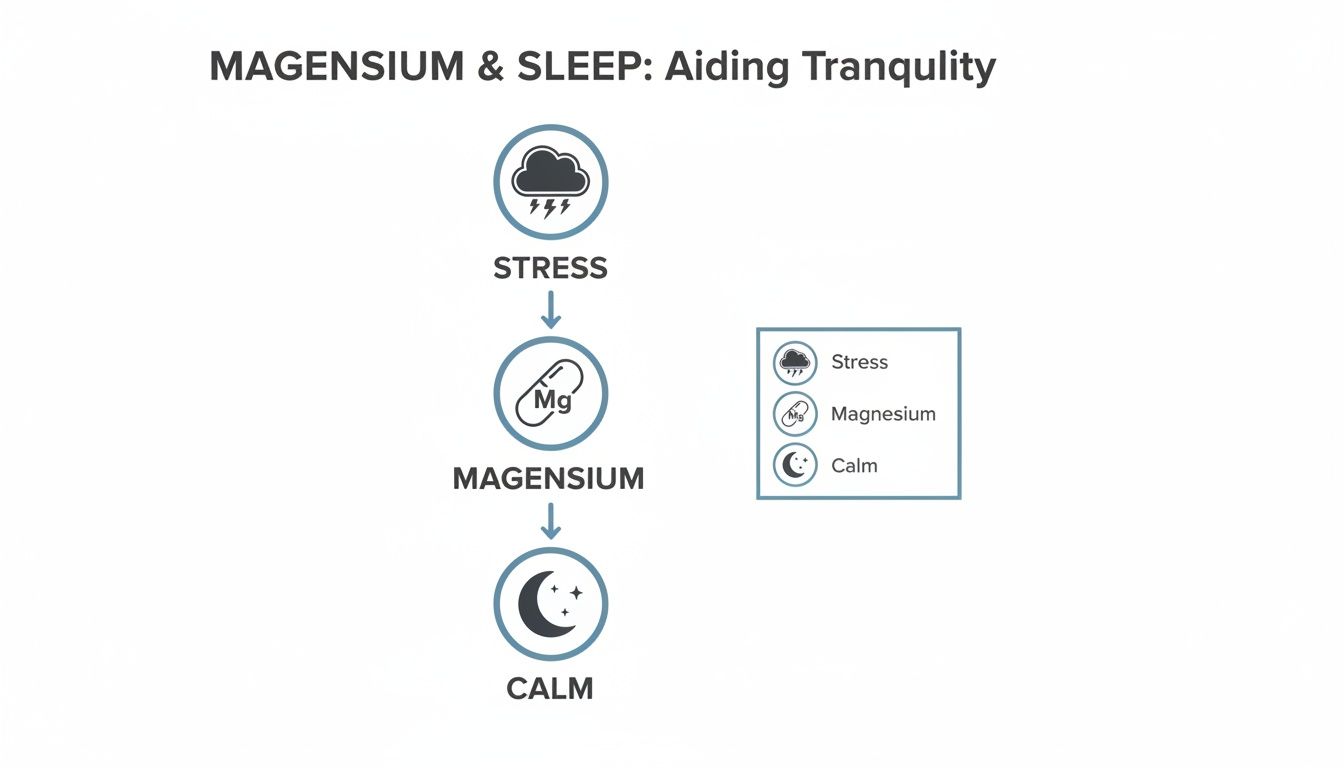
As you can see, magnesium acts as the bridge that interrupts the stress cycle, guiding your nervous system toward the tranquility that's absolutely essential for deep, restorative sleep.
Comparing Popular Magnesium Forms for Sleep
When your goal is better sleep, bioavailability—how easily your body can absorb and actually use the mineral—is everything. Some forms are brilliant for sleep, while others are better suited for different purposes entirely. Let’s break down the most common options you’ll find.
| Magnesium Form | Primary Benefit for Sleep | Bioavailability | Best For |
|---|---|---|---|
| Magnesium Glycinate | High-absorption calming for mind and body | Excellent | Those seeking deep relaxation and improved sleep quality without digestive side effects. |
| Magnesium L-Threonate | Brain-calming and cognitive support | Excellent | Individuals whose racing thoughts interfere with sleep or those looking to support brain health. |
| Magnesium Citrate | General magnesium support and muscle relaxation | Good | People who need to raise magnesium levels and might also benefit from its mild laxative effect. |
| Magnesium Oxide | Primarily a laxative | Very Poor (~4%) | Used for short-term constipation relief, not recommended as a sleep aid. |
| Magnesium Sulfate | Muscle soothing (topical) | N/A (oral) | Relaxing Epsom salt baths; not meant to be ingested for sleep. |
This table makes the choice much clearer. For sleep, you want a form that your body can easily absorb to calm the nervous system, not one that passes right through you.
The Best Forms of Magnesium for Sleep
- Magnesium Glycinate: This is often called the gold standard for sleep, and for good reason. It's bound to glycine, an amino acid that has calming properties of its own. This duo is highly bioavailable and famously gentle on the stomach, offering a powerful one-two punch for relaxation.
- Magnesium L-Threonate: This is a fascinating newer form known for its unique ability to cross the blood-brain barrier. That makes it incredibly effective for supporting cognitive function, but its direct calming effects on the brain also make it a fantastic choice for sleep.
The demand for effective, gentle forms has exploded. It's no wonder, given that 20% of women and 10% of men don't get enough daily magnesium, and 63% of consumers prefer natural supplements. People are actively seeking better ways to support the 300+ biochemical reactions this mineral governs.
Forms of Magnesium to Approach with Caution for Sleep
While still beneficial for the body in some ways, certain forms just aren't optimized for sleep and can even cause unwanted side effects that disrupt your rest.
- Magnesium Oxide: This is one of the most common and cheapest forms you'll find on store shelves. The problem? It has terrible bioavailability (around 4%), meaning your body absorbs almost none of it. It’s far more likely to have a strong laxative effect, making it a poor choice if your goal is a peaceful night.
- Magnesium Sulfate: You probably know this as Epsom salts. While it's fantastic for a relaxing bath to soothe sore muscles, it's not meant for oral use and can cause serious digestive distress if you drink it.
The bottom line is simple: for sleep, you need a form your body can absorb and use to quiet the nervous system. Magnesium Glycinate and L-Threonate are top-tier choices because they deliver the mineral efficiently without causing gut problems.
In SleepHabits Restore+, we intentionally chose Magnesium Glycinate for its superior absorption and gentle, calming properties, ensuring it works with your body to promote deep, restorative rest. This approach aligns with a broader movement toward choosing natural sleep supplements without melatonin, a topic we cover extensively in our complete guide.
Finding Your Ideal Dosage and Timing
Once you’ve picked the right form of magnesium, the next puzzle is figuring out exactly how much to take and when. There's no magic number that works for everyone. It’s more like tuning a guitar—a small adjustment can make all the difference, and the goal is to find what sounds right for your body.
Getting the dose and timing dialed in is what really unlocks magnesium's potential for sleep. When you get it right, it syncs up with your body's natural rhythm and becomes a clear signal that it's time to wind down.
Starting with the Right Dose
For most adults trying to improve their sleep, a good range for supplemental magnesium is between 200-400 milligrams per day. The key is to always start on the low end of that spectrum, especially if you're new to taking it. This lets you see how your body responds without overdoing it.
Starting with a lower dose, like 200mg, helps you sidestep the main side effect: digestive upset. Taking too much too soon can send you running for the bathroom, which is the opposite of a relaxing evening. Give it about a week at this initial dose and see how you feel. If you’re sleeping better and waking up refreshed, you might have already found your sweet spot.
Here’s a practical, step-by-step example for finding your dose:
- Week 1 (Start Low): Take 200mg every night. In a notebook, rate your sleep quality from 1-5. Did you fall asleep faster? Did you wake up fewer times?
- Week 2 (Assess): If your sleep score is consistently a 4 or 5, you've likely found your dose. If it's still a 2 or 3, it's time to adjust.
- Week 3 (Adjust Slowly): Increase the dose to 300mg. Continue to track your sleep quality.
- Find Your Ceiling: Your ideal dose is the amount that gives you the best sleep benefits without any next-day grogginess or digestive issues. For many people, this lands somewhere between 300mg and 350mg.
This "start low and go slow" method is the safest and most effective way to personalize your routine. It ensures the magnesium works with your body, not against it.
Perfecting Your Timing
When you take your magnesium is just as critical as how much you take. You want its calming effects to peak right as you’re getting ready for bed. Take it too early in the evening, and you might feel sleepy hours before you plan to turn in. Take it too late, and it won’t have enough time to work its magic.
The sweet spot for taking a magnesium supplement for sleep is usually 30 to 60 minutes before your intended bedtime. This gives the mineral enough time to be absorbed and start quieting your nervous system and relaxing your muscles.
Here's a practical example: If you want to be asleep by 10:30 PM, set a recurring phone reminder for 9:45 PM labeled "Time to relax." This is your cue to mix your magnesium drink. This simple trigger helps make it an automatic part of your wind-down ritual. As you're sipping it, the magnesium is already in the background, preparing your mind and body for a night of deep rest.
By syncing your supplement with your body’s internal clock, you create a powerful and consistent cue for sleep. Over time, your body learns to recognize that when you take your magnesium, the journey to a peaceful night has officially begun.
Building a Powerful Wind-Down Routine with Magnesium
A magnesium supplement is a fantastic tool for better sleep, but it works best when it's part of a consistent evening ritual. Think of it this way: magnesium is the main event, but the opening acts are what really set the stage for a great performance. Building a simple, repeatable wind-down routine around your magnesium drink can amplify its benefits, signaling to your brain and body that the journey to deep sleep has officially begun.
This isn't about adding a dozen complicated steps to your night. It's about layering a few high-impact, science-backed habits that work together to calm your entire system. The goal is to shift your routine from a simple checklist into a powerful, holistic strategy for consistently great sleep.

Step 1: Start with a Calming Drink
About 30-60 minutes before bed, make a warm, calming drink the anchor of your routine. This is where your magnesium supplement shines. Mixing a high-quality powder like SleepHabits Restore+ into warm water or caffeine-free tea creates a soothing ritual you can actually look forward to.
Actionable Tip: Keep your magnesium powder, your favorite mug, and a non-caffeinated herbal tea (like chamomile or peppermint) together in one spot in your kitchen. This "sleep station" makes the process effortless and removes any friction.
Step 2: Create a Low-Light Environment
As you enjoy your magnesium drink, start dimming the lights. Bright overhead lights, especially the blue-hued light from screens, send a strong "daytime" signal to your brain. This can slam the brakes on the production of melatonin, your body's own sleep hormone.
Actionable Tip: Install dimmer switches in your bedroom and living room, or simply switch to low-wattage, warm-toned lamps for the evening. This simple environmental cue is one of the most effective ways to support your body's natural circadian rhythm.
Step 3: Unload Your Mind with Journaling
After finishing your drink, take just five minutes to journal. This doesn't need to be a long, elaborate diary entry. The goal is to perform a "brain dump"—get any lingering worries, to-do lists for tomorrow, or random thoughts out of your head and onto paper.
Actionable Tip: Use a simple two-column method. On the left, write down "Worries & Tasks." On the right, write "Things I'm Grateful For." This balances the release of anxiety with a dose of positivity before bed, providing a sense of closure to the day.
Step 4: Encourage Restorative Nasal Breathing
The final step is to prepare your body for optimal breathing while you sleep. Mouth breathing can lead to snoring, a dry mouth, and less efficient oxygen exchange, which results in lighter, more fragmented sleep. Using simple tools like hydrating mouth tape encourages your body to default to the far superior method: nasal breathing.
Actionable Tip: Practice a simple nasal breathing exercise right before bed. Close your mouth, inhale through your nose for a count of four, hold for four, and exhale through your nose for a count of six. Do this five times to calm your nervous system. You can dive deeper into creating a sleep-conducive environment by checking out our comprehensive guide to healthy sleep habits.
This kind of routine is catching on as more people search for natural sleep solutions that actually work. In fact, the global sleep aid supplement market has soared to a value of $6.8 billion and is projected to hit $11.8 billion. This growth reflects a global sleep crisis, with millions struggling nightly. SleepHabits' Restore+, with its thoughtful blend of magnesium, nitric oxide boosters, and superfoods, directly addresses this need for over 82,000 satisfied users.
Common Questions About Magnesium and Sleep
Jumping into a new supplement always comes with a few practical questions. You might be wondering if it's okay to take long-term, how fast you'll actually feel a difference, or whether you can just get the same results from food. Let's clear up the most common questions about using magnesium for sleep so you can move forward with confidence.
Think of this as sorting out the final details. We've already covered how magnesium works, the best forms to look for, and how to build it into your evening. Now, let’s tackle those lingering "what-ifs" so you feel completely ready.
Can I Take a Magnesium Supplement for Sleep Every Night?
Yes, for most healthy adults, taking a magnesium supplement every night is generally safe, especially when you stick to the recommended dose. Unlike some sleep aids that can cause dependency or lose their effectiveness over time, magnesium is an essential mineral your body needs every single day for hundreds of biological processes.
Daily use helps maintain optimal magnesium levels, supporting your body's natural sleep-regulating pathways rather than forcing a sedative effect. This consistency is particularly helpful if your diet isn't always perfect or if chronic stress is burning through your mineral stores.
That said, it’s always smart to listen to your body. If you have any underlying health issues, particularly kidney problems, or you’re taking other medications, it’s a good idea to chat with your healthcare provider first. They can help you figure out if daily magnesium is the right long-term move for your specific health situation.
How Long Does It Take for a Magnesium Supplement to Work?
How quickly you feel the effects of magnesium can really vary. Some people are highly sensitive to its calming properties and report sleeping better the very first night. They might fall asleep faster or notice they aren't tossing and turning as much right away.
For others, the benefits build up more gradually. It might take several days or even a full week of consistent use to notice a real shift. This is often the case if you're correcting a deficiency that's been around for a while—it simply takes time to replenish your body's stores to a level where you can feel the positive impact on your sleep.
The form of magnesium you're taking matters a lot here. Highly bioavailable forms like magnesium glycinate are absorbed much more efficiently, which can lead to faster results than less absorbable forms like magnesium oxide. The real key is consistency. Make it a non-negotiable part of your nightly wind-down routine to give your body the best chance to respond.
Will a Magnesium Supplement Make Me Feel Groggy in the Morning?
One of the best things about using magnesium for sleep is that it typically does not cause morning grogginess. This is a major difference compared to many other sleep aids, including some prescription meds and even melatonin, which can sometimes leave you with that foggy, "hungover" feeling.
Magnesium isn't a powerful sedative. It works by supporting your body’s natural relaxation and sleep processes. It helps you get into deeper, more restorative sleep cycles, which means you're far more likely to wake up feeling clear-headed and ready to go.
If you do happen to feel a bit groggy, it's a strong sign your dose might be too high for your body. The fix is usually simple: just reduce the amount you're taking and see if that feeling goes away. Finding your personal sweet spot is key to waking up revitalized.
Can I Get Enough Magnesium for Sleep from Diet Alone?
In a perfect world, we'd all get the magnesium we need from food. A diet packed with leafy greens like spinach, nuts like almonds, and seeds like pumpkin seeds definitely contributes to healthy magnesium levels. However, getting enough from your diet to specifically improve sleep has become a real challenge for a few reasons:
- Soil Depletion: Modern farming has stripped many minerals, including magnesium, from the soil. This means that today's "magnesium-rich" foods often contain less of the mineral than they did decades ago.
- Food Processing: When whole foods are processed—like refining grains to make white flour—a huge portion of their original magnesium content gets removed.
- Lifestyle Factors: Chronic stress is a notorious magnesium-depleter. The more stressed you are, the faster your body burns through its magnesium reserves, making it tough to keep your levels where they need to be.
Because of this, many people have suboptimal magnesium levels and don't even know it. A high-quality magnesium supplement for sleep acts as a reliable insurance policy. It closes that potential nutritional gap, ensuring your body has what it needs to calm your nervous system and prepare for a night of deep rest.
Ready to experience the deep, restorative sleep you deserve? SleepHabits has crafted Restore+, a clinically dosed magnesium sleep aid designed with sleep doctors to calm your mind and relax your body. Join over 82,000 others who have transformed their nights and awakened their best days.
Written with Outrank