

In a 2003 sleep-physiology study, median upper-airway resistance during supine stage-2 sleep measured 12.4 cmH2O·L-1·s-1 with oral breathing, compared with 5.2 cmH2O·L-1·s-1 with nasal breathing. In the reported values, breathing through the mouth produced roughly 138% higher resistance than breathing through the nose (European Respiratory Journal study).
That contrast gives the phrase mouth breathing before and after a more useful meaning. The “after” isn't just a closed mouth or a better-looking sleep photograph. It may involve easier airflow, less dry mouth, improved oxygenation, and a calmer respiratory pattern. But those changes depend on why the mouth opened in the first place. A habit, blocked nasal passage, allergy, or obstructive sleep apnea needs a different response.
The safest approach is to treat mouth breathing as a physiological clue, not a cosmetic flaw. Track what changes, identify what doesn't, and avoid forcing nasal breathing when your nose can't reliably provide enough airflow.
What Mouth Breathing Does to Your Body
Your nose and mouth provide different routes into the respiratory system. Nasal breathing filters, warms, and humidifies incoming air before it reaches the throat. Oral breathing takes a shorter route, so it bypasses much of that conditioning.
That route can alter sleep mechanics. The 2003 study cited earlier found substantially higher upper-airway resistance during oral breathing, while nasal breathing was associated with lower resistance and a lower tendency toward obstructive sleep apnea (sleep-airway mechanics research). An airway behaves like a flexible tube: as resistance rises, the muscles and pressure system must work harder to move the same air through it.
Changes you may notice first
Mouth breathing also exposes the throat and lower airway to more cool, dry, and unfiltered air. The nasal passages and sinuses contribute nitric oxide, a gas associated with airway function and oxygen exchange. A practical explanation of nasal and oral breathing covers the nose's roles in filtration, warming, humidification, and nitric oxide support (nasal breathing and sleep physiology).
Common nighttime clues include:
- Dry mouth and sore throat: Continuous airflow across oral tissues can remove moisture.
- Snoring: An open mouth can change the shape and stability of the upper airway.
- Restless sleep: Greater breathing effort may contribute to arousals and fragmented sleep.
- Morning fatigue: Sleep that is less restorative can leave you tired despite enough time in bed.
- Lower exercise comfort: A blocked nose may make oral breathing feel like the only practical route during activity.
These signs suggest possibilities, not a diagnosis. Allergies can narrow the nasal passage and make mouth breathing more likely, so an allergy sleep guide may help you review bedroom irritants and nighttime congestion. You can also compare your symptoms with the broader side effects of mouth breathing, then record patterns in a sleep diary.
The useful “before and after” question is therefore specific: did your mouth close because nasal airflow improved, or did you force a new position while the underlying blockage remained? Separate habit from anatomy and possible sleep-disordered breathing before treating the symptom alone.
Why Your Nose Is Built for the Job
The nose works like a respiratory conditioning system. Its internal shape creates turbulent airflow, while nasal hairs and the moist lining help trap particles before they travel farther into the airway. The mouth offers a more direct passage, but it doesn't provide the same combination of filtering, moisture, temperature regulation, and sinus-derived nitric oxide.
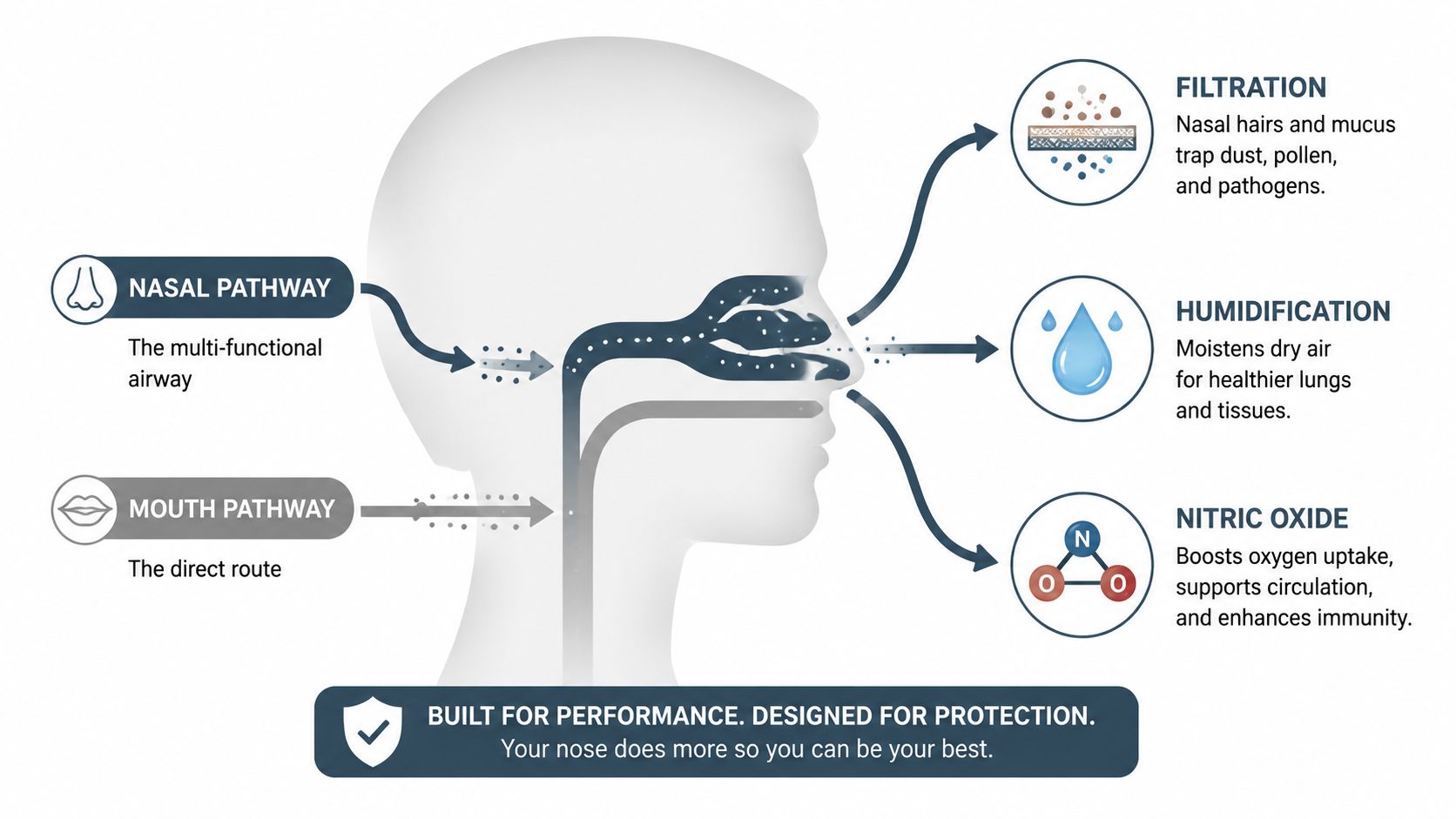
Three jobs happen before air reaches the lungs
Filtration is the first job. The nasal hairs and lining catch larger particles, while the curved passages slow and redirect airflow. Smaller particles can still pass through, but nasal breathing gives the respiratory tract an early defense that mouth breathing largely skips.
Humidification and warming come next. The nasal lining adds moisture and helps bring inhaled air closer to the conditions preferred by the lower airway. This matters during sleep, when prolonged exposure to dry room air can aggravate the throat and make morning discomfort more noticeable.
The third job involves nitric oxide produced in the nasal passages and paranasal sinuses. Nitric oxide supports blood-vessel relaxation and oxygen exchange, and it has antimicrobial properties. That doesn't mean nasal breathing cures infection or sleep apnea. It means the nose contributes useful physiology before air reaches the lungs.
The nasal cycle isn't a defect
Nasal airflow naturally shifts between sides as tissue inside the nose changes its level of congestion. This nasal cycle is normal, but allergies, a deviated septum, enlarged turbinates, or nasal-valve narrowing can make the less-open side feel unusable. If the nose is mechanically restricted, telling yourself to “just breathe through your nose” ignores the physical problem.
For a practical explanation of how to encourage nasal airflow, see the power of nasal breathing. The key principle is simple: make nasal breathing possible before trying to make it automatic.
The Evidence Behind the Before and After
The strongest before-and-after evidence measures airway mechanics, oxygenation, sleep quality, and cardiovascular responses. These findings show that breathing route can change measurable physiology, while leaving popular promises about mouth taping or nasal retraining unproven.
A controlled study of children aged 6 to 12 years compared mouth breathers with nasal-breathing controls. Mean sleep-quality scores were 6.8 ± 1.1 versus 2.3 ± 0.9. Overnight oxygen saturation averaged 93.6% ± 2.4 versus 96.8% ± 1.8, a 3.2 percentage-point difference. Lower oxygen saturation also had a moderate correlation with poorer sleep quality, r = 0.64 (pediatric sleep and oxygenation study).
| Outcome | Typical Before | Typical After | Time Horizon | Evidence Strength |
|---|---|---|---|---|
| Upper-airway resistance | Oral breathing, median 12.4 cmH2O·L-1·s-1 | Nasal breathing, median 5.2 cmH2O·L-1·s-1 | During measured sleep | Direct physiological evidence |
| Sleep quality in children | Mean score 6.8 ± 1.1 | Mean score 2.3 ± 0.9 | Overnight study comparison | Controlled pediatric evidence |
| Oxygen saturation in children | 93.6% ± 2.4 | 96.8% ± 1.8 | Overnight study comparison | Controlled pediatric evidence |
| Diastolic blood pressure at rest | Higher with oral breathing | Lower with nasal breathing | Immediate resting condition | Physiological study evidence |
| Mouth-breathing time in OSA | Higher at baseline | Significantly lower after treatment | At 8 weeks in a treatment study | Clinical cohort evidence |
The resistance comparison and the OSA treatment result describe measured changes, not a guarantee that every person will experience the same result. Sleep-disordered breathing, nasal obstruction, and anatomy can alter the outcome.
A 2024 study of healthy volunteers found lower diastolic blood pressure during nasal breathing than during mouth breathing at rest. Participants also reported a lower perceived rate of exertion in that resting condition (nose-breathing cardiovascular response). The result supports an immediate physiological difference, not a treatment claim for hypertension.
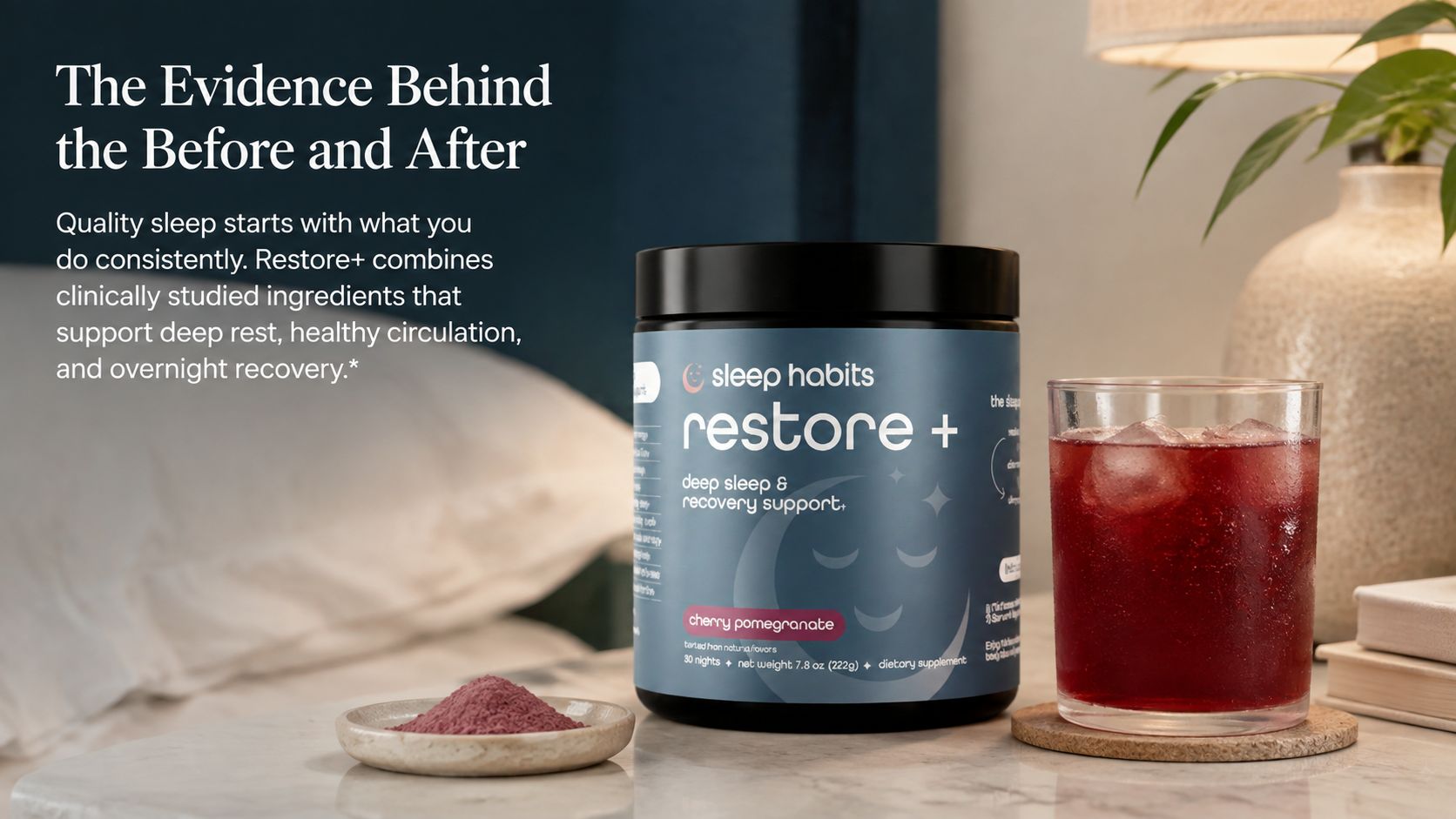
For an evening routine, Restore+ Magnesium Sleep Aid is a melatonin-free magnesium drink containing magnesium, L-theanine, tart cherry, lemon balm, glycine, and nitric oxide-supporting ingredients. It may complement regular sleep habits, but it does not treat airway obstruction or replace evaluation for sleep-disordered breathing.
When Mouth Breathing Is a Symptom, Not the Cause
Nasal breathing isn't a universal fix. Sometimes the mouth opens because the nose can't provide a comfortable route. Chronic nasal obstruction, allergic rhinitis, a deviated septum, enlarged turbinates, or enlarged adenoids and tonsils can all push breathing toward the mouth.
A classic PubMed-indexed study illustrates the role of anatomy. 97% of subjects with a nasal airway size under 0.4 cm² were mouth breathers to some extent, while about 12% of people with an adequate airway were still habitual mouth breathers (nasal airway size and mouth breathing). Anatomy is a major driver, but it isn't the only one.
Practical rule: If your nose can't stay open comfortably, retraining the habit should come after investigating the obstruction.
Use this comparison to organize your first observations:
| Signal | Habit-Driven | Symptom-Driven |
|---|---|---|
| Daytime breathing | Often nasal and comfortable | Frequently restricted or effortful |
| Night pattern | Mouth opens during relaxation or sleep | Mouth opens when congestion worsens or airflow narrows |
| Nasal symptoms | Few persistent symptoms | Blockage, one-sided congestion, itching, drainage, or pressure |
| Snoring | May lessen with position or habit changes | May persist even when the nose feels clear |
| Best next step | Gentle daytime retraining | Nasal, allergy, ENT, or sleep evaluation |
The first clinical question is usually: Why can't you maintain comfortable nasal airflow? A study of severe nasal obstruction found that treating the obstruction reduced oral breathing during sleep by about 30 percentage points on average, but it didn't effectively resolve obstructive sleep apnea (nasal obstruction treatment and oral breathing). That distinction matters. Mouth breathing can be a downstream sign of a larger airway disorder.
In an OSA cohort, an oral appliance combined with a mouth shield reduced mouth-breathing time at 8 weeks, and oral-appliance treatment alone also reduced mouth-breathing minutes. Respiratory event and hypopnea indices improved as well, suggesting that the intervention addressed sleep-disordered breathing rather than merely changing lip position (OSA mouth-breathing treatment study).
A Clinician-Informed Plan to Switch to Nasal Breathing
Start with the airway, not the tape. A layered plan reduces the chance that you'll mistake forced mouth closure for successful nasal breathing.
- Clear the nasal passage. Saline rinses can remove irritants and loosen mucus. Steam, a humidifier, and appropriate allergy management may also make the nose more usable. Persistent congestion deserves medical guidance rather than indefinite self-treatment.
- Practice while awake. During calm periods, breathe lightly and slowly through the nose with a relaxed diaphragm. A Buteyko-style approach emphasizes quiet breathing and brief, comfortable pauses, not stressful breath-holding or deliberate air hunger. Stop if you feel panicked, dizzy, or unable to recover easily.
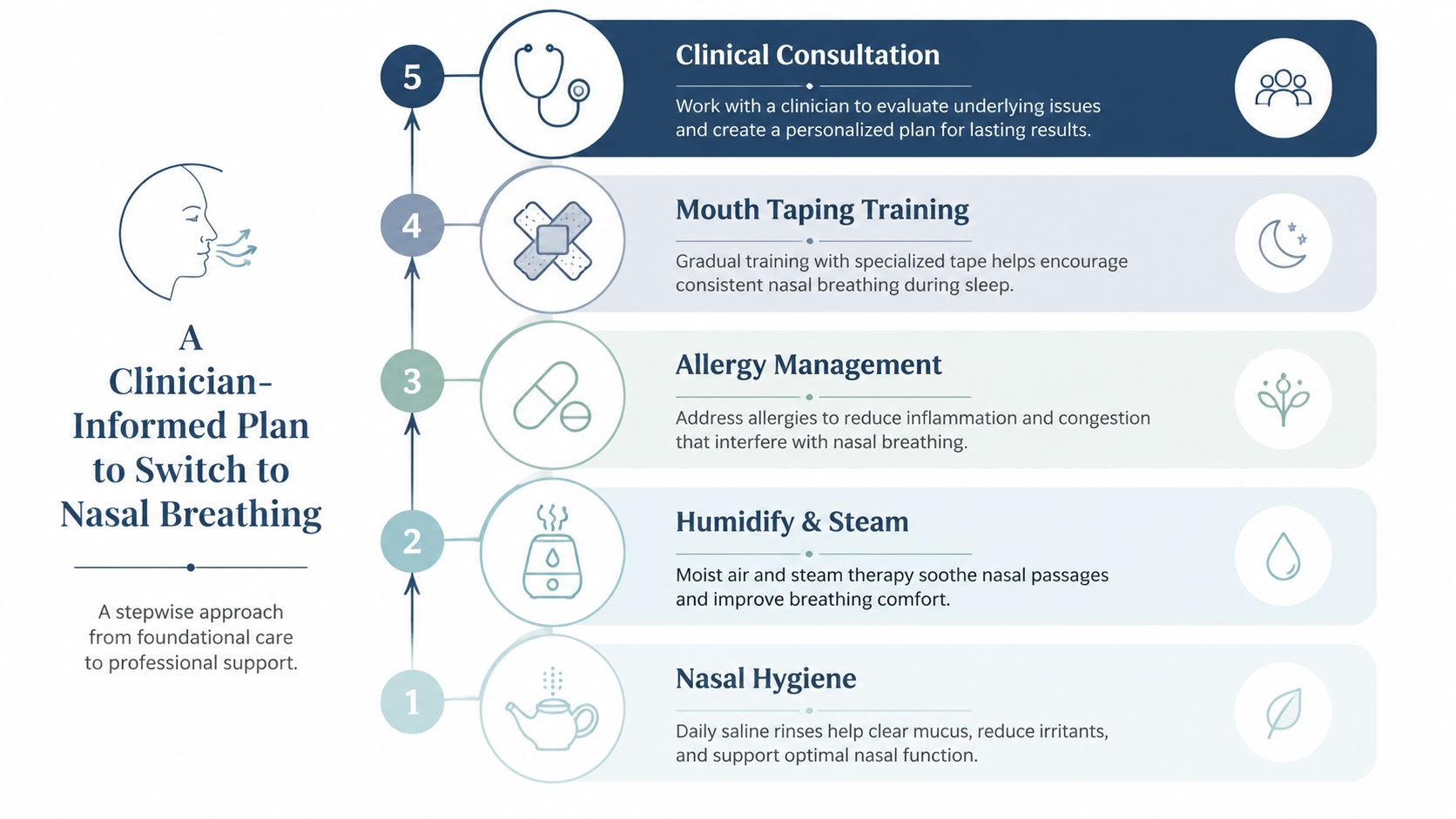
- Support the nose during sleep. Nasal dilator strips can help when the nasal valve narrows or collapses during inhalation. Side sleeping or modest head elevation may also reduce the tendency to sleep with the mouth open, though neither approach treats every cause of snoring or apnea.
- Use mouth tape only selectively. Mouth taping evidence remains limited outside selected cases of mild OSA, and a systematic review warns that people with nasal obstruction may face serious harm if taping forces the mouth closed (systematic review of mouth taping). Never use it if you can't breathe freely through your nose, and don't use it when OSA is suspected without medical clearance. Hydrating Mouth Tape is one product option described for quieter nights, oral care, tongue posture, and nasal-breathing support, but those product descriptions don't replace clinical screening.
- Build a calmer pre-bed baseline. Dim lights, reduce stimulating screen exposure, keep a consistent wind-down routine, and use comfortable room humidity. These steps won't open a blocked airway, but they can make breathing practice easier to repeat.
Troubleshoot one variable at a time. If tape makes you feel trapped, remove it. If congestion worsens, address the nose. If anxiety leads to rapid breathing, return to ordinary comfortable breathing rather than pushing through distress. Practical nasal breathing techniques work best when they remain gentle and repeatable.
What a Realistic Before and After Timeline Looks Like
A healthy adult whose mouth breathing is mainly habitual may notice little on the first night. The unfamiliar sensation can make sleep feel more conscious, especially if the person starts with tape before learning to breathe comfortably through the nose while awake.
By the first week or two, the most believable changes are ordinary ones: less morning dryness, fewer throat complaints, or a clearer sense of how congestion affects sleep. Snoring may change modestly, but it can also remain if the main vibration comes from the soft palate or another part of the airway.
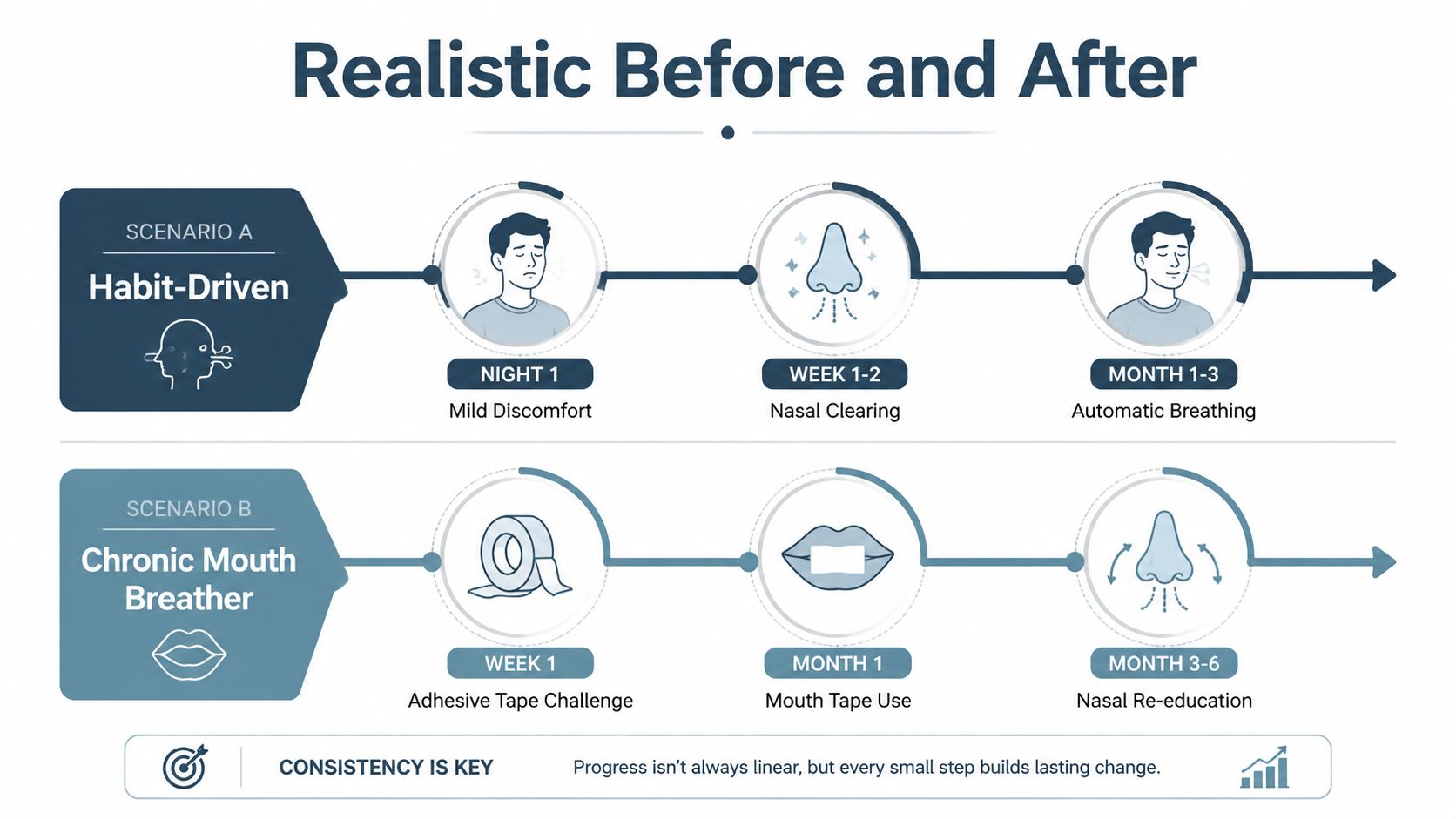
Two paths can look completely different
Scenario A, habit-driven breathing: Daytime nasal practice feels manageable, the nose stays open, and sleep gradually becomes more nasal-dominant. Energy may feel steadier as sleep becomes less disrupted, but a symptom diary is more useful than a dramatic visual comparison.
Scenario B, anatomical or sleep-disordered breathing: Nasal congestion persists, tape causes distress, snoring remains loud, or sleep becomes worse. Those results aren't evidence that you need stronger tape or longer breath holds. They're reasons to investigate nasal obstruction or sleep apnea.
Illness, allergies, alcohol, and stress can all reopen oral breathing temporarily. A setback doesn't erase progress, but repeated setbacks should prompt a review of the underlying cause.
A before-and-after photo usually can't show airway resistance, oxygen saturation, or sleep fragmentation. In children, facial and dental development can change over years when chronic breathing patterns persist, but adults shouldn't expect facial structure to transform over a short retraining period.
When to Stop Self-Treating and See a Clinician
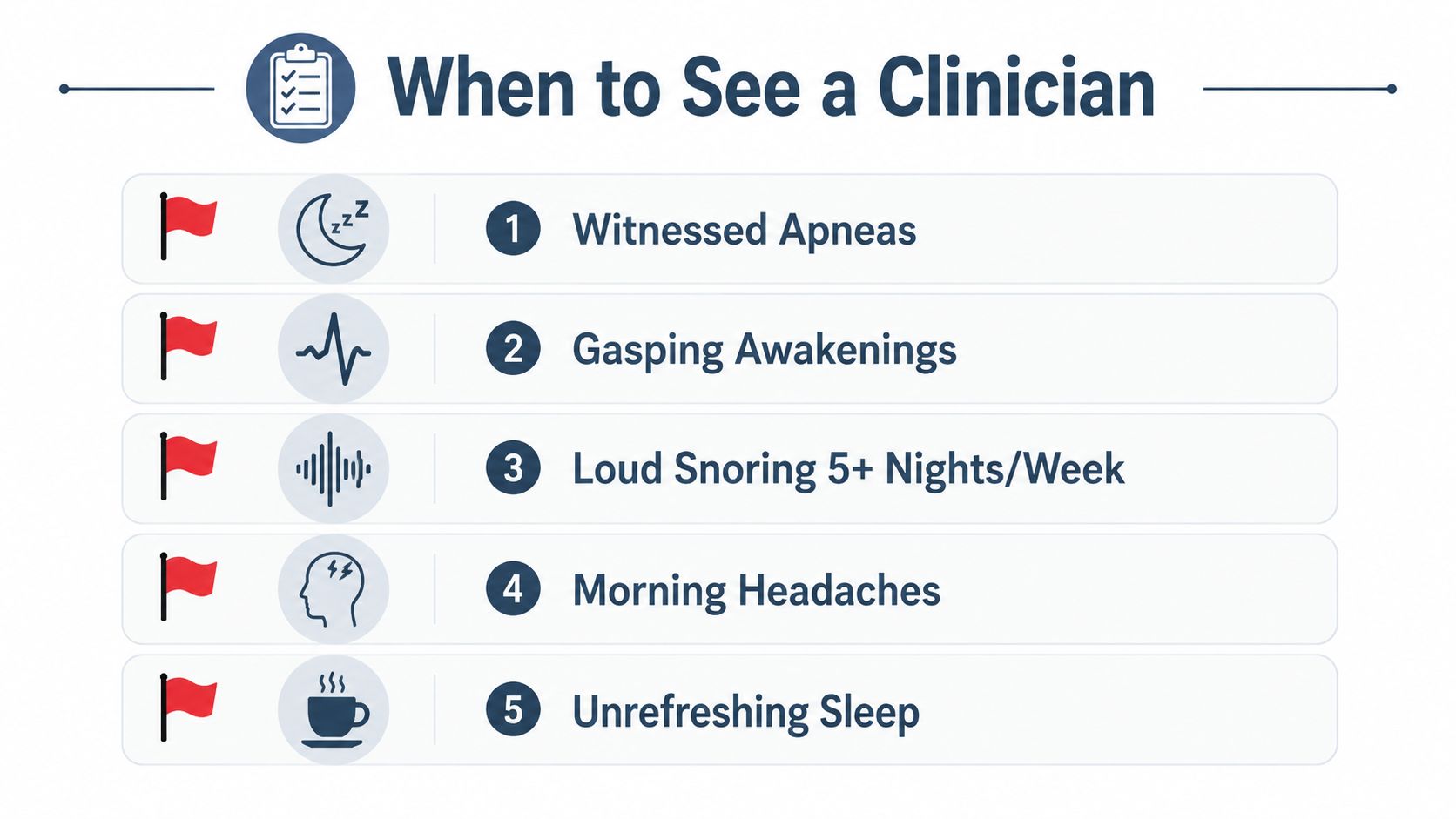
Self-care is reasonable for mild, occasional mouth breathing with an open nose and no signs of sleep-disordered breathing. It becomes the wrong lane when another person witnesses breathing pauses, you wake gasping, or you remain unrefreshed despite spending 7 to 9 hours in bed. Loud snoring on 5 or more nights a week, morning headaches, daytime sleepiness with an Epworth Sleepiness Scale score above 10, or difficult-to-control hypertension also deserve evaluation.
An examination may look for septal deviation, turbinate enlargement, enlarged tonsils, a high-arched palate, or retrognathia. These structural factors can narrow the available route for air, so breathing retraining alone won't correct them. Untreated obstructive sleep apnea can also raise blood pressure independently of whether the person mainly breathes through the mouth or nose.
A referral might include a focused ear, nose, and throat examination, an allergy workup, or a home sleep apnea test. If OSA is confirmed, treatment may involve CPAP or an oral appliance, depending on the clinical findings.
Stop using mouth tape, chin straps, or nasal dilators immediately if they cause anxiety, claustrophobia, disrupted sleep, or worsening congestion. Anyone with suspected OSA should never tape the mouth closed without medical clearance.
Putting It All Together for Better Nights
Use a four-part framework rather than chasing a dramatic overnight transformation.
First, identify the pattern. Keep a short morning diary. Record dry mouth, sore throat, headaches, snoring reports, awakenings, congestion, and daytime alertness. During the day, notice whether your tongue rests comfortably against the palate while your lips remain closed and your nasal breathing stays easy. This doesn't diagnose a disorder, but it helps distinguish a habit from a persistent airway limitation.
Second, clear what can be cleared. Use appropriate saline care, manage known allergies, and improve bedroom humidity if dry air irritates your nose. If one side remains blocked or congestion continues despite sensible measures, arrange an evaluation instead of increasing pressure to breathe nasally.
Third, retrain while awake. Practice relaxed, light nose-only breathing during calm activities. Keep the effort low. Nasal strips, humidifiers, and breathing trainers can support the routine, but they don't replace assessment of a deviated septum, swollen turbinates, nasal-valve collapse, or OSA.
Fourth, layer nighttime supports carefully. Try side sleeping, a consistent wind-down routine, and a comfortable head position. Consider mouth taping only when nasal breathing is already reliable during waking hours and a clinician has ruled out reasons that mouth closure could be unsafe.
The evidence supports a practical conclusion. Nasal breathing can reduce upper-airway resistance, improve sleep-related oxygenation in some groups, and lower resting diastolic blood pressure in a controlled physiology setting. It can't guarantee better sleep for everyone, and it won't remove a structural obstruction or cure OSA by itself.
Start tonight with the diary, nasal comfort, and gentle daytime practice. Give the process time to reveal its pattern, and escalate to a clinician when symptoms persist, worsen, or point toward sleep apnea.
SleepHabits offers educational resources and tools focused on nighttime breathing, including melatonin-free wind-down support, nasal strips, and mouth-breathing aids. Visit SleepHabits to explore options that can complement a clinician-informed plan for calmer breathing and more restorative sleep.