

Mouth taping sleep is not an evidence-backed clinical treatment for sleep-disordered breathing, but a 2022 study of 20 mouth-breathers with mild obstructive sleep apnea did show short-term improvement, including a 47% reduction in median apnea-hypopnea index, and 13 patients, or 65%, had a good response. The key question is less “does it work for everyone?” and more “who is this safe for?”
That distinction matters because social media has turned a narrow breathing habit into a universal fix. Reputable health institutions are much more cautious, and the most recent reviews are still saying the evidence is small, mixed, and risky for the wrong person.
The Mouth-Taping Trend Meets the Science
The social feed version of mouth taping is easy to sell. Tape the lips, sleep through the night, wake up with less snoring and a drier mouth, then post the result. That message spreads fast on TikTok and Instagram because it looks like a low-effort fix for a problem that usually takes patience, testing, and sometimes medical care.
The clinical version is more restrained. Cleveland Clinic says nasal breathing can help with dry mouth and snoring, but there is still not enough scientific evidence to show that mouth taping works as a treatment for snoring, and the topic remains under-researched because there are so few studies. Henry Ford Health is similarly cautious, noting that the evidence remains inconclusive and that mouth taping may carry a risk of impaired breathing, disrupted sleep, and lower oxygen levels.
The main conflict
The gap between viral enthusiasm and clinical caution is what distorts the conversation. People hear that nasal breathing is beneficial and assume sealing the mouth must be beneficial too. A healthy breathing route only helps if it stays open.
Practical rule: mouth taping can only be considered if nasal airflow is already comfortable and reliable.
That is the lens that makes the topic useful. The question is not whether the trend is fashionable. The question is whether it fits a person who can breathe well through the nose, does not have an underlying sleep-breathing disorder, and wants a cautious experiment rather than a cure.
That is a more measured stance than the social media pitch, and it should be. The trend deserves neither blind trust nor reflexive dismissal.
What the Research Shows
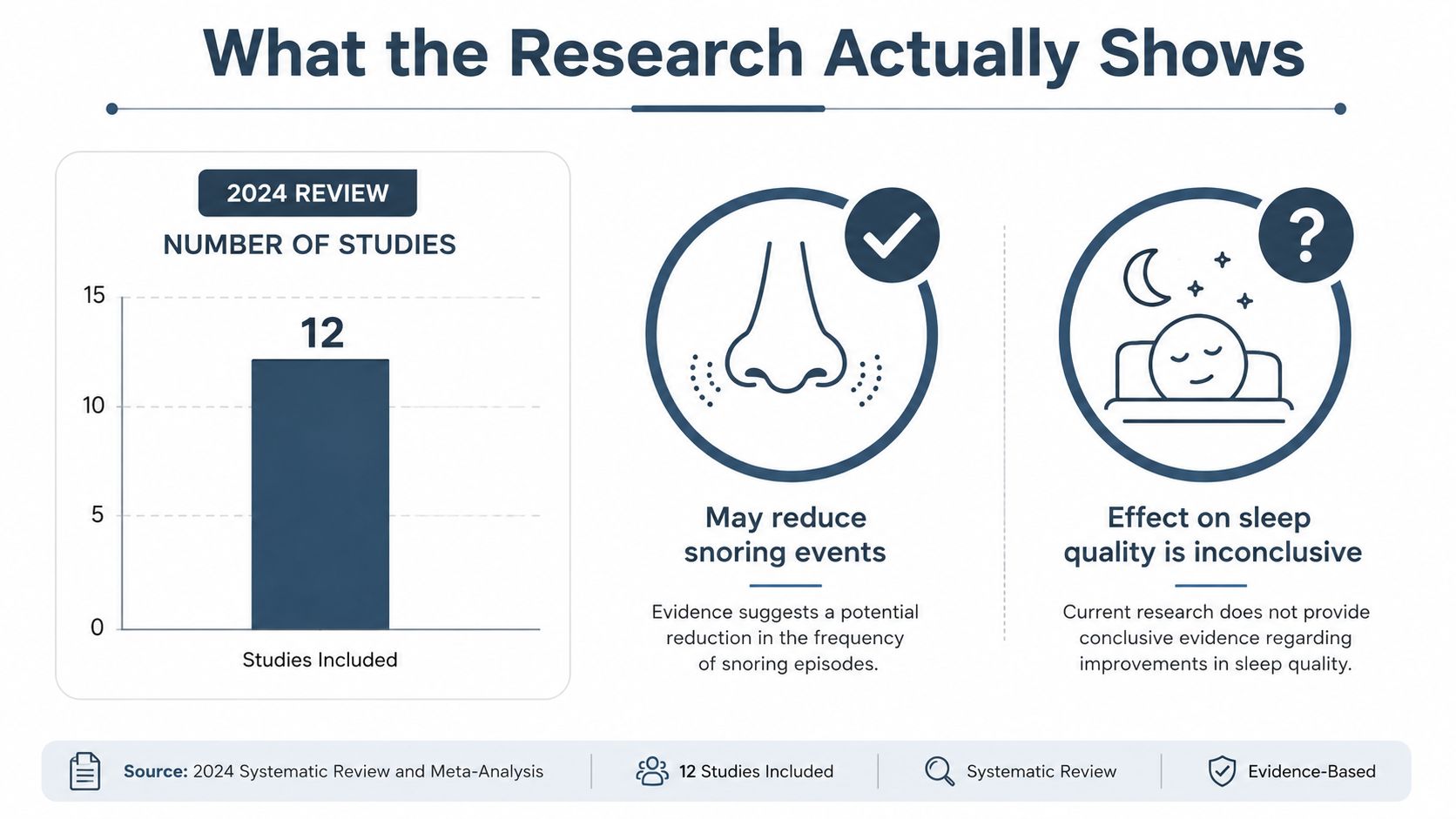
The evidence base is still too small to treat mouth taping as a settled sleep intervention. A 2024 systematic review found only 9 studies published between 2019 and 2024, including 4 randomized controlled trials, and concluded that the evidence was minimal for most populations and did not support mouth taping as a sound clinical intervention for the general sleep-disordered-breathing population.
A broader 2025 systematic and scoping review reached the same overall conclusion. It identified 177 unique studies but found only nine that met inclusion criteria, then concluded that the available data do not support mouth taping as a sound clinical intervention for the general population with sleep-disordered breathing. The review also warned that mouth sealing can be risky when nasal airflow is compromised, with the potential to worsen respiratory stress or create a suffocation hazard.
Where the signal appears
One study still stands out because it shows why the answer depends on the patient, not the trend. In a 2022 study of 20 mouth-breathers with mild obstructive sleep apnea, mouth taping produced measurable short-term improvement. 13 patients, or 65%, had a good response, the median apnea-hypopnea index dropped from 8.3 to 4.7 events per hour, and the supine apnea-hypopnea index improved from 9.4 to 5.5 events per hour.
That finding matters, but only in context. A positive result in a small, specific group is not the same thing as a general recommendation, and it does not show that a quieter night, a different feeling in the morning, or a better-looking wearable readout means the airway is safer.
A practical consumer rule is to pair any sleep routine with low-friction supports rather than betting on one behavior alone. For some people, a wind-down drink such as Restore+ Magnesium Sleep Aid fits that broader routine because it is a melatonin-free magnesium drink built around nitric-oxide-supporting ingredients, but it does not replace a breathing evaluation when symptoms point to a sleep disorder.
The honest takeaway
Mouth taping sits in a gray zone. The data are thin, mixed, and concentrated in mild cases, so the useful question is not whether it works in theory. The useful question is whether the person in front of you looks like the narrow group that may benefit, or like someone who should not try it at all.
That is why the decision should be screened like a safety issue first, not marketed like a fix. If you want a clear patient-friendly comparison of the two breathing patterns, the article on nasal breathing vs. mouth breathing is a useful companion read, and Eric Wiitala DDS sleep breathing treatment is another clinical resource for people whose snoring may point to a bigger airway problem.
Why Nasal Breathing Matters at Night
The appeal of mouth taping starts with a real physiologic idea. The nose isn't just an air hole. It warms and humidifies incoming air, filters out particles, and helps regulate airflow so breathing is less harsh on the airway. Nasal breathing also supports the natural production of nitric oxide, which helps with vessel dilation and oxygen delivery.
That's one reason mouth breathing often feels rough the next morning. Air bypasses the nose, hits the throat dry and cold, and can irritate tissue that's already prone to vibration and snoring. The mouth gets dry, breath can worsen, and some people wake feeling as if they never really settled into sleep.
Why the mouth changes the equation
When someone breathes through the mouth all night, the body loses the nose's built-in conditioning system. The air is less filtered and less humidified, and the oral cavity dries out more quickly. Over time, that can show up as bad breath, disrupted sleep, and a higher burden on the teeth and gums because the mouth spends the night without its usual protective moisture.
There's also a simple mechanical point. Mouth breathing can become a faster, shallower pattern, which changes how efficiently air moves through the upper airway. For some people, that pattern is part of the snoring problem rather than just a symptom of it.
If you want a clear, patient-friendly comparison of the two breathing patterns, the article on nasal breathing vs. mouth breathing lays out the basics in plain language. For a related clinical perspective on airway care, Eric Wiitala DDS sleep breathing treatment is also worth looking at if snoring or suspected apnea is part of the picture.
The nose is the body's airway filter, humidifier, and airflow manager. The mouth is the backup route, not the ideal one.
That doesn't make mouth taping automatically smart, but it does explain why people reach for it. They're trying to restore a breathing route the body is built to use.
A related tool some people use is Transparent Nasal Strips, which are designed to improve airflow, reduce congestion from colds, allergies, or dry air, and support nasal breathing without any adhesion near the mouth. For the right person, that's a more direct way to address the airflow problem itself.
Who Should Avoid Mouth Taping Entirely
The main error in viral advice is treating mouth taping as harmless for everyone. It is not. The bigger risk is not mild discomfort, it is blocked backup breathing when the nose does not work well enough overnight.
Recent systematic reviews concluded that the evidence is limited outside mild OSA, and that sealing the mouth can be harmful when nasal airflow is already compromised, as noted in the PLOS One review and summarized by Pulmonology Advisor. That makes screening more important than enthusiasm.
A practical screening checklist
- Significant nasal congestion: If allergies, a cold, a deviated septum, or chronic blockage make nasal breathing unreliable, mouth taping is a poor fit.
- Known or suspected sleep apnea: Loud snoring, choking, gasping, or unexplained daytime sleepiness should be evaluated before any experiment. For a broader clinical overview, OneTwenty sleep apnea insights can help frame why these symptoms matter.
- Uncontrolled asthma or breathing instability: Anything that already makes nighttime breathing feel uncertain deserves medical guidance first.
- Nighttime reflux or vomiting risk: If you're prone to reflux or may need to vomit in the night, sealing the mouth can create a dangerous aspiration situation.
- High anxiety around breathing sensations: If feeling “trapped” tends to escalate panic, mouth taping can make sleep worse rather than better.
A useful rule of thumb is simple. If your nose is even occasionally not dependable, do not block your mouth and hope for the best.
The sleep apnea tape resource should be read in that same cautious light. It can be part of a thoughtful discussion, but it is not a reason to ignore warning signs or skip a real evaluation.
If you can't trust your nose all night, mouth taping is the wrong experiment.
That warning matters most for people who wake with a dry mouth because their nose is partly blocked. In that situation, the practice can hide the clue that should have triggered proper assessment.
How to Try Mouth Taping Safely
If someone has good nasal airflow, no signs of sleep apnea, and still wants to test mouth taping, the goal is a gentle cue, not a tight seal. Start with a product made for overnight use rather than generic tape. A product such as Hydrating Mouth Tape is positioned for quieter nights, reduced snoring, oral care, proper tongue posture, and nitric oxide-supportive breathing.
Set up the experiment correctly
Clean and dry the skin around the lips first. If the tape does not adhere well, people tend to use more of it, which is exactly what you do not want. The application should feel like a reminder, not a restraint.
Use a small amount at first, centered across the lips. Leave enough edge slack that you could open your mouth if you needed to. The point is to reduce unconscious mouth breathing, not create an airtight seal.
Practical rule: if the tape makes you feel trapped, it is too much tape.
Use the first nights as a test, not a verdict
Watch for a simple pattern. If you wake up calm, breathe comfortably through your nose, and feel no sense of alarm, that is encouraging. If you wake up gasping, anxious, or annoyed, stop.
If the tape is still on in the morning, remove it slowly. That is normal and not a failure. The key is not ignoring discomfort because the trend promised a cleaner result.
A few supportive habits can make the test more informative. Saline rinses can help when the nose feels dry or mildly congested, and a nasal support tool can make airflow easier before you tape. A calming routine also matters because the nervous system is less likely to resist sleep when the body already feels safe.
When to stop
- You feel panic or breathlessness.
- Your nose clogs up during the night.
- You wake up more, not less.
- Your sleep feels forced instead of restful.
If you want a companion product that fits into a wind-down routine rather than a breathing experiment, the SleepHabits alternatives guide centers on melatonin-free support, nasal-breathing tools, and habit-based sleep habits. That is a useful frame because mouth taping, when it belongs at all, is only one piece of the night.
Alternatives and Complementary Approaches
Mouth taping is only one way to address open-mouth sleep, and it is often not the first thing I would reach for. The more practical choice depends on what is driving the mouth breathing, because the fix changes if the problem is congestion, posture, habit, or arousal.
If the nose is the bottleneck, start with mechanical support. Nasal strips can widen the outside of the nose without covering the mouth, which makes them a cleaner option for congestion, narrow nasal valves, or dry-air irritation. Internal nasal dilators do something similar from inside the nostrils, and some people tolerate those better than external adhesive.
Compare the main options
- Nasal strips: Useful when congestion or narrow nasal passages are the main issue.
- Nasal dilators: Better if you want internal support instead of something applied across the bridge of the nose.
- Breathing retraining: Useful for people who need nasal breathing to become more automatic during the day so it carries into sleep.
- Positional therapy: Helpful when back sleeping makes snoring or breathing worse, which matches the study pattern that mouth taping seemed to help more in the supine position.
- Wind-down support: A calm evening routine can lower overall arousal, which may reduce the urge to mouth-breathe.
For some people, the most workable answer is a combination. A nasal strip can improve airflow, breathing retraining can make nasal breathing feel more natural, and a consistent evening routine can help the body settle before bed. That is usually more realistic than expecting one product to fix every part of sleep.
The internal support side matters too. If you want to compare sleep aids that fit a habit-based routine, the mouth taping alternatives guide lays out melatonin-free options, nasal-breathing tools, and other sleep habits. That kind of framing is useful because mouth taping, when it belongs at all, is only one piece of the night.
What to choose when
If breathing feels mechanically difficult, start with airflow support. If the problem is habit or posture, use retraining. If sleep feels wired, use calming routines. If apnea is possible, stop experimenting and get evaluated.
The most useful question is not, “What product fixes mouth breathing?” It is, “What combination gives this person safer, easier nasal sleep?”
Making the Decision That Fits Your Sleep
The question is not whether mouth taping is trending. The question is whether it is safe enough for the person considering it. The evidence points in a narrow direction. Mouth taping is not a proven treatment for sleep-disordered breathing, the nasal breathing rationale is plausible, and the safety screen matters more than the buzz around it. If it helps at all, it is most likely to help someone with good nasal airflow, no signs of apnea, and a limited goal such as reducing habitual mouth breathing.
A practical decision framework is more useful than hype. If the nose is blocked, address that first. If snoring comes with gasping, choking, or daytime fatigue, get evaluated for sleep apnea. If the only reason to try mouth taping is that it went viral, disappointment is more likely than a meaningful sleep change.
There is also a trade-off people should hear plainly. A low-risk habit can still be the wrong choice if it masks a breathing problem that deserves attention. Mouth taping should be treated as a cautious experiment for the right person, and a poor fit for the wrong one.
SleepHabits offers tools that fit a grounded approach to sleep, including melatonin-free wind-down support, mouth tape, and nasal strips that encourage nasal breathing without turning one trend into the whole plan. If you want to build a safer nighttime routine around airflow, relaxation, and recovery, visit SleepHabits and choose the options that match your breathing, not the internet's latest shortcut.