

You wake up with a dry mouth, a scratchy throat, and a partner who says you snored again. That's usually the moment people start looking for nasal breathing aids, because the problem feels small but the sleep loss feels real. A nose that doesn't move air well can turn into a mouth-open night, and that can make the whole next day feel heavier than it should.
The tricky part is that the aisle is crowded with products that look similar but work in different ways. Some help when the nasal valve collapses, some help when congestion is the issue, and some are meant to support CPAP comfort or sleep habits, not solve every airway problem. If you want a grounded overview, it helps to start with how nasal breathing works in the first place, as outlined in this plain-language guide to breathing through the nose.
Why the Way You Breathe at Night Matters More Than You Think
You might not notice your breathing pattern until the morning tells on you. A dry mouth, a sore throat, or a groggy feeling after “a full night” often points to the same thing, your nose didn't do enough of the work, so your mouth picked up the slack. That shift matters because the upper airway is narrow by design, and when airflow gets harder, sleep can become lighter and more fragmented.
The nose isn't just a tube for air
Nasal breathing does more than move oxygen in and out. It conditions air, adds resistance that can help slow breathing, and supports the pattern your body uses when it settles into sleep. Mouth breathing can make the night feel noisier and drier, while easier nasal airflow can make it simpler to stay relaxed through the throat and jaw.
That's why the category of nasal breathing aids exists at all. These products are usually not trying to “cure” sleep problems, they're trying to bridge a gap between a nose that feels blocked and the kind of airflow your body prefers at night. In that sense, they're practical tools, not miracle devices.
Practical rule: if your nose feels closed but you're otherwise healthy, a small mechanical change may matter more than a dramatic new product.
The reason this category grew so quickly is simple. A MIT-linked fact sheet says over 40 million Americans have nasal airway obstruction from structural causes, while only about 125,000 U.S. patients per year undergo nasal reconstruction to permanently open the airway, and slight dilation can reverse symptoms in 89% of those affected (MIT fact sheet). That gap explains why low-cost, non-drug aids became popular long before most buyers understood the anatomy.
The main takeaway is direct. If the night starts with bad airflow through the nose, the rest of sleep often has to compensate. A breathing aid can help with that first bottleneck, but the right one depends on why the bottleneck exists.
What Counts as a Nasal Breathing Aid and How Each Type Works
A nasal breathing aid is any product that helps air move more easily through the nose by opening the nostrils, reducing swelling, or supporting a nasal breathing habit during sleep. The category is broader than most store shelves suggest, and the differences matter because each type addresses a different airflow problem.
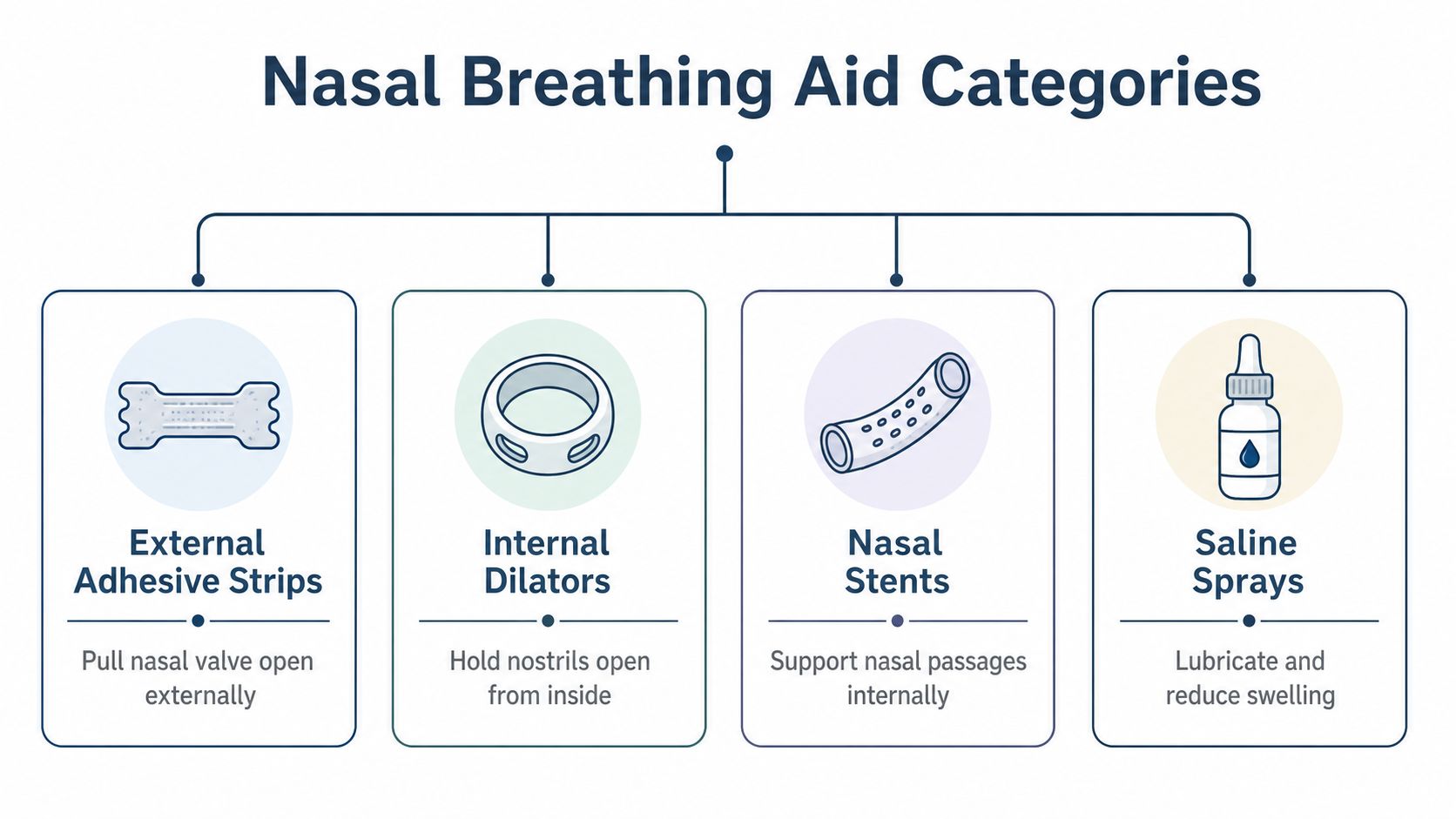
A person who feels air get blocked right at the front of the nose may need a very different product from someone whose problem is dryness, congestion, or pressure from CPAP therapy. That is why the aisle can feel confusing at first. The label on the package often says “nasal support,” but the mechanism underneath may be doing something quite specific.
The four main families
External adhesive strips sit across the bridge of the nose and pull the nasal valve outward. They are a reasonable fit when the complaint is “my nose feels pinched shut,” especially near the front of the airway. The mechanism is simple, they resist lateral collapse. If you want a plain-language example of how these products are discussed for snoring, see this explanation of nasal strips for snoring. For a product example in this category, Transparent Nasal Strips are described as helping airflow and reducing congestion from colds, allergies, or dry air, which makes them a straightforward external-strip option.
Internal dilators sit inside the nostrils and hold the passages open from within. These are often chosen when the issue is internal valve narrowing or structural collapse that an outside strip cannot reach well. A widely used internal-dilator product spec says this type of device can increase the nose's air channel by up to 58% (product specification).
Nasal stents are a broader internal-support idea, and they work by keeping passages propped open from the inside. The goal is airflow support, not drug delivery. People tend to try them when they want a more structural solution than a strip can offer, especially if the nose feels narrow deeper inside rather than just at the surface.
Saline sprays and humectants do not force the nose open, they help by lubricating the lining and reducing dryness or swelling. That makes them useful when congestion, dry air, or irritation is part of the problem. They are often the quietest members of the category, but they can matter a lot if the nose is inflamed or uncomfortable enough to interrupt breathing.
The supporting tools people forget
Some products are not nasal aids on their own, but they help protect nasal breathing. Mouth tape, chin straps, and CPAP interfaces can reduce mouth opening or improve nighttime airflow patterns. If you use CPAP, technical specs commonly target 4 to 20 cmH2O with humidification and leak-compensation features, because stable pressure and adequate moisture help keep the airway open and improve tolerance (CPAP technical specs).
One product that fits the airflow-support conversation naturally is Transparent Nasal Strips. The listed product snapshot describes it as a strip meant to improve airflow, reduce congestion from colds, allergies, or dry air, and pair with mouth tape for fuller upper-airway support, which makes it a straightforward example of the external-strip family.
If you are trying to match a product to a real problem, start with the cause of the blockage. A narrow valve, irritated lining, dry air, and CPAP discomfort all call for different tools, even if the packages look similar. The category makes more sense once you sort products by what part of breathing they help.
What the Evidence Says About Sleep and Snoring
Marketing often makes nasal aids sound more powerful than they are. The evidence is more restrained, and that helps readers set expectations before they spend money or build a nightly routine around one product.
Sleep quality and apnea are not the same thing
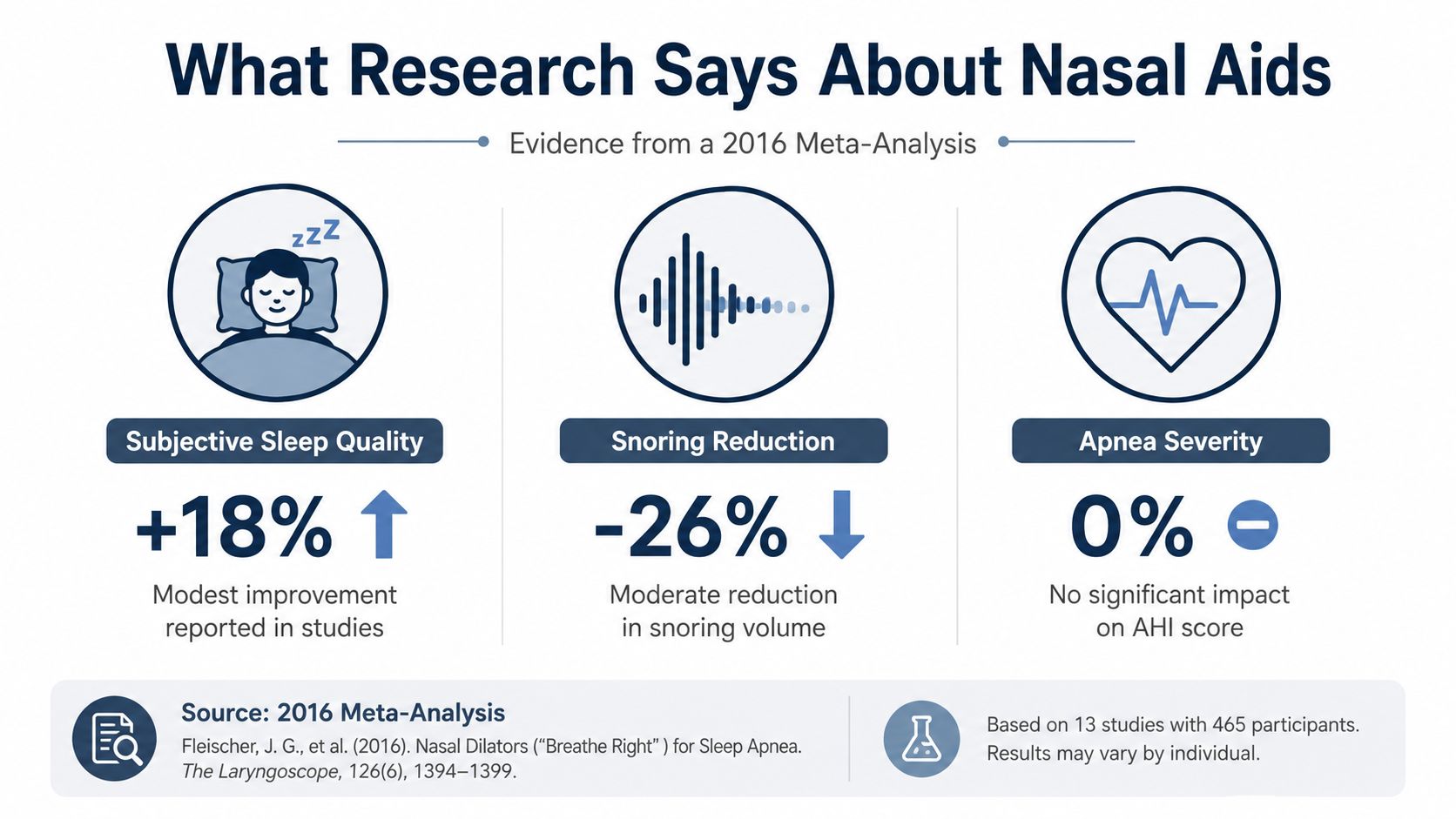
A 2016 systematic review looked at 10 studies with 190 patients and found no statistically significant overall improvement in apnea-hypopnea index, or AHI. In that review, the mean AHI changed from 23.4 ± 25.7 to 21.0 ± 20.3 events/hour with p = 0.31. The same review also included another analysis of 147 patients, where AHI changed from 28.7 ± 24.0 to 27.4 ± 23.3 events/hour with p = 0.64.
That distinction matters because a person can breathe more comfortably through the nose without changing the deeper breathing disruption that drives sleep apnea. The review found internal dilators had only a small apnea-index reduction of -4.87 events/hour, while external strips had minimal effect on those objective outcomes.
A 2023 evidence-based guide reached a similar practical conclusion. It said nasal dilators may improve perceptions of nasal breathing and subjective sleep quality, but they are unlikely to change objective markers of obstructive sleep apnea, and the evidence on snoring frequency and duration is equivocal (2023 evidence-based guide).
Snoring results depend on who's using them
That mixed picture also shows up in smaller strip studies. One randomized study of Breathe Right strips in people with chronic nocturnal congestion found no significant improvement in subjective sleep quality or nasal congestion over 14 nights compared with placebo strips (study on strips and congestion). Another exploratory study found that both an asymmetric butterfly prototype and the marketed strip improved some subjective measures versus placebo in people with moderate to severe congestion and sleep difficulties.
That is why product fit matters more than the packaging. A strip can help one person who feels pinched at the nostrils and do very little for someone whose snoring comes from throat collapse, mouth opening, or sleep-disordered breathing.
If you want a practical reminder that sleep setup shapes results too, Suburban Furniture snoring tips are a useful example of how the mattress and bedroom environment can affect nighttime comfort.
For readers who want a broader overview of the category, SleepHabits' guide to snoring sleep aids gives a useful side-by-side look at common options.
Bottom line: nasal aids can make the nose feel more open and sometimes make sleep feel better, but they do not reliably treat obstructive sleep apnea.
That boundary is what makes the category easier to use well. These tools help most when the problem starts at the nose, not deeper in the throat.
Matching the Right Aid to Your Specific Airflow Problem
The fastest way to choose is to stop thinking in brand names and start thinking in causes. A valve-collapse problem calls for a different tool than dry-air congestion, and both are different from CPAP mask comfort or athletic breathing demand.
Use case by use case
If the nose pinches shut at the nostrils, external strips are usually the first thing people try because they lift the valve from the outside. If the collapse is more internal, internal dilators or stents are often a better fit because they support the passage from within. That's the main mechanical distinction.
Congestion is a different story. When the lining is swollen or dry, saline sprays and humectants can make the nose more usable, and strips can be layered in when the valve also feels narrow. CPAP users usually need a sealed interface and humidity more than they need a trendy strip, because comfort and leak control shape whether they can tolerate the machine.
For exercise, the evidence is more cautious than the ads. A 2023 guide said nasal breathing may be feasible during submaximal and even maximal exercise after habituation, but there's little-to-no evidence that it improves exercise capacity in healthy people (2023 evidence-based guide). That means an internal support device may help airflow comfort during movement, but it's not a performance shortcut.
| Aid type | Best for | Evidence strength | Main limitation |
|---|---|---|---|
| External adhesive strips | Nasal valve collapse, mild nighttime snoring, temporary congestion | Moderate for perceived airflow, limited for objective sleep outcomes | Can irritate skin and may not reach internal narrowing |
| Internal dilators | Internal valve narrowing, structural collapse, some CPAP comfort use | Limited, with small subgroup benefits in some studies | Fit matters, and some people dislike the sensation |
| Nasal stents | Internal passage support | Limited and highly device-specific | Comfort and cleaning can be a hurdle |
| Saline sprays and humectants | Dryness, irritation, congestion | Supportive, not a stand-alone sleep treatment | Don't mechanically open a collapsed valve |
A simple way to narrow the choice
Ask three questions. Is the issue collapse, congestion, or support for another tool like CPAP? Does the nose feel blocked at the bridge, inside the nostrils, or just dry? And do you want a nightly habit, a temporary fix, or a comfort aid during exercise?
For a more general comparison of sleep products, this overview of snoring sleep aids can help you keep the category straight. The goal is not to buy the strongest device. It's to buy the one that fits the actual problem.
A Practical Buying Checklist for First-Time Buyers
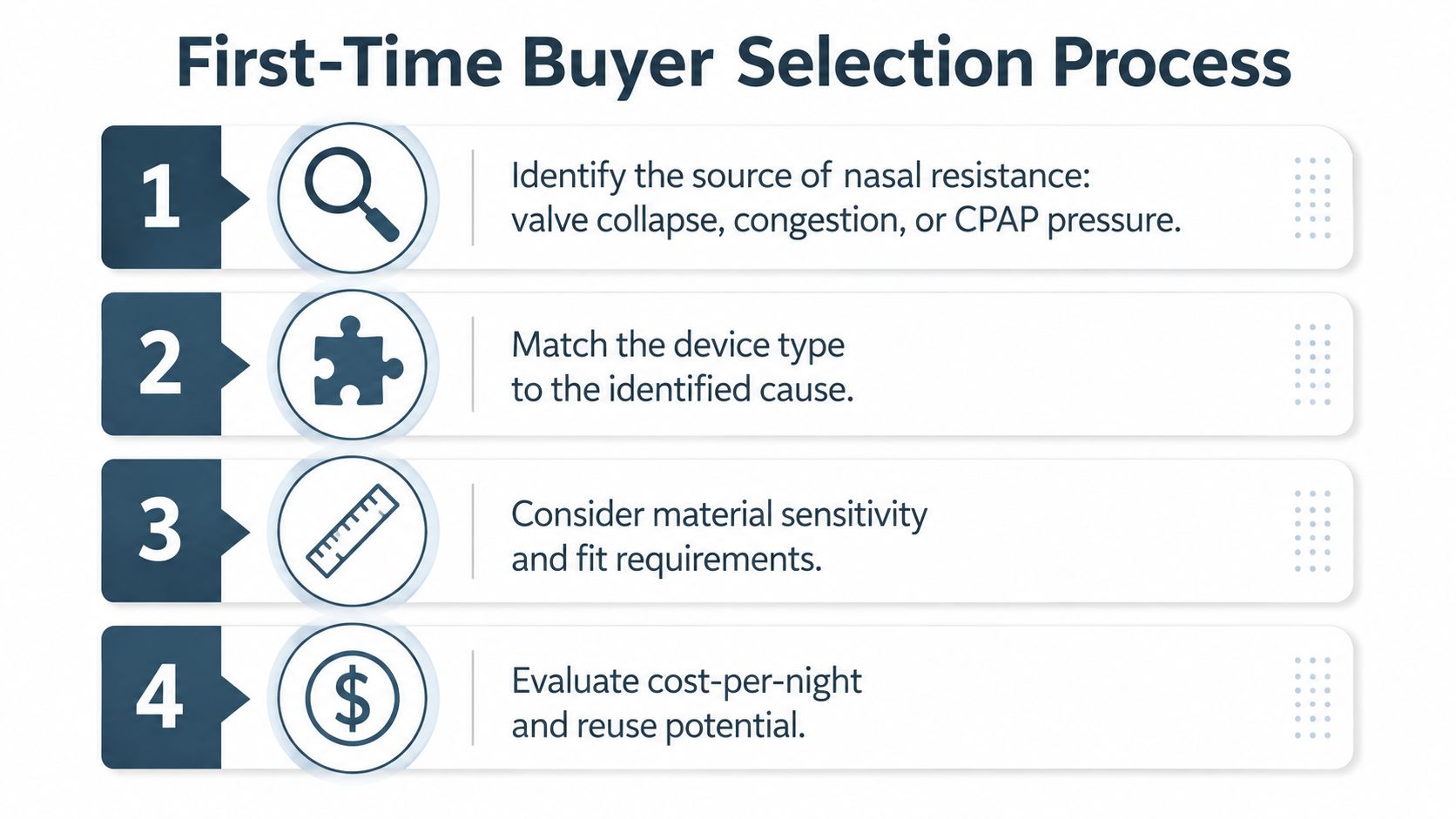
Start with the cause, not the packaging. Most buyers do better when they decide whether they're dealing with valve collapse, congestion, CPAP pressure, or exercise demand before they look at size or style. That one choice prevents a lot of trial and error.
A four-step filter that keeps shopping sane
- Identify the source of resistance. If the blockage feels like the nostrils cave in, think valve collapse. If the nose feels swollen or dry, think congestion.
- Match the device to that cause. Strips, internal dilators, saline, or CPAP comfort tools each solve a different part of the problem.
- Check fit and materials. Sensitive skin usually changes the choice more than people expect, and internal devices need the right size to avoid pressure spots.
- Think about wear time and reuse. A strip that's easy for one night may be less practical than a reusable internal device if you plan to use it often.
Buying rule: the most aggressive product isn't automatically the most effective one.
That matters for sensitive noses. Someone with mild congestion may do better with a gentler approach than with a stronger adhesive strip, while someone with structural narrowing may need the opposite. The right answer depends on what the airway needs, not on how forceful the product feels in hand.
What to check before you click buy
- Bridge fit: Make sure an external strip will land on clean, dry skin where the nasal valve sits, not too high on the forehead or too low on soft tissue.
- Nostril comfort: If you choose an internal device, it should feel snug, not pinching.
- Skin tolerance: If adhesives have irritated you before, start conservatively.
- Cleaning routine: Reusable internal devices need a cleanup habit, or they become annoying fast.
- Symptom severity: If you're waking gasping, choking, or still exhausted despite trying simple aids, that's not a shopping problem, that's a medical-evaluation problem.
The most important trap is assuming every blocked nose is the same. It isn't. The right first purchase is the one that matches the reason you can't breathe well, not the one with the loudest label.
How to Use Nasal Breathing Aids and Fold Them Into a Wind-Down Routine
A well-placed strip or dilator should feel boring after the first minute. If it's drawing attention to itself all night, the sizing, placement, or timing probably needs adjustment. The routine around it matters as much as the product.
Placement and timing matter
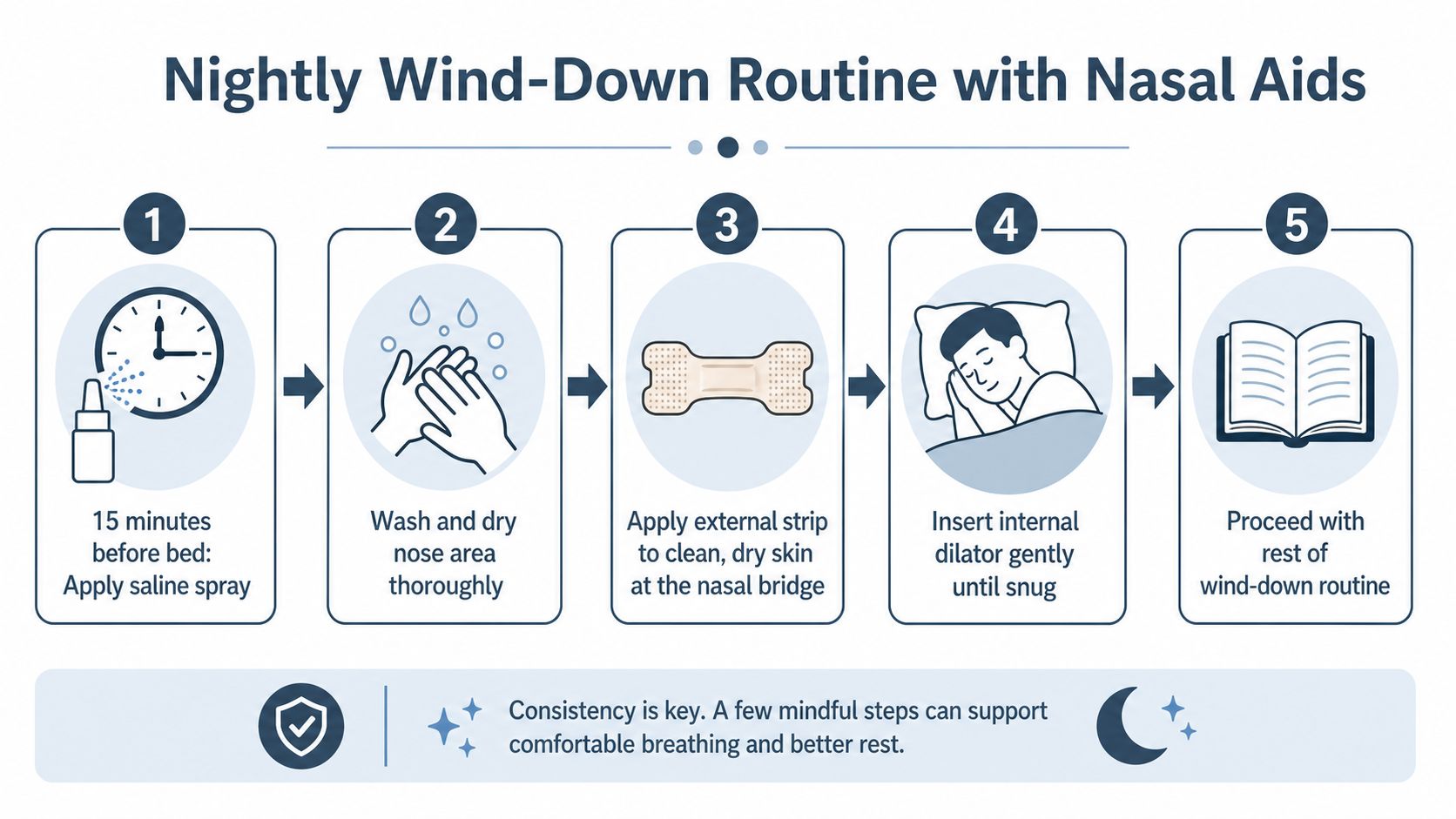
External strips work best on clean, dry skin across the nasal bridge, where they can lift the valve without slipping. If you add saline spray, use it first and give the nose time to settle before the adhesive goes on. Internal dilators should be inserted gently until snug, because too much pressure turns a support device into an irritation source.
If you want a full evening routine, this guide to build a calming sleep routine offers a useful framework for making the night feel less reactive and more repeatable. That's the right mindset for airway tools too, because they work better when they're part of a pattern, not a last-minute fix.
A simple night sequence
- Dim screens and slow down.
- Use saline if the nose feels dry or congested.
- Apply the strip or insert the dilator.
- Add mouth tape or a chin strap only if you already tolerate them and they suit your situation.
- Settle into bed and let the tool do its job without fussing.
A product like Hydrating Mouth Tape fits that last step for people who are trying to reduce mouth opening and support quieter breathing, though it isn't the first move for every sleeper. The point is to support nasal breathing, not force it.
If adhesive lifts halfway through the night, the usual problem is moisture or oils on the skin. If an internal dilator shifts, sizing is often the issue, not the concept. Skin irritation usually means you need a gentler adhesive or a different device family altogether.
The best routine feels calm and repeatable. Once it's set up correctly, the aid should support your sleep, not become the reason you keep waking up.
Realistic Expectations and When to Skip the Aisle Entirely
The people most likely to benefit are the ones whose problem is local and mechanical. Light snorers, people with nasal valve collapse, CPAP users who need better mask comfort, and athletes practicing nasal breathing all have a reason to try these tools. In those cases, the device can help airflow feel easier, even if it doesn't rewrite the whole sleep picture.
The people who should be more cautious are the ones with signs of a deeper airway problem. If you suspect moderate-to-severe sleep apnea, have chronic sinus disease, or know you have structural obstruction that needs evaluation, a strip or dilator is a complement, not a solution. The same goes for anyone whose snoring comes with gasping, choking, or obvious breathing pauses.
That doesn't make the category unhelpful. It just puts it in its proper place. A nasal aid is one part of a broader sleep and airway routine, alongside sleep position, hydration, slow breathing drills, and a steadier wind-down.
Use the tool for the bottleneck you actually have.
If the nose is the bottleneck, support the nose. If the problem is lower in the airway, don't expect a strip to do the job of a medical treatment.
The clearest verdict is this. Nasal breathing aids can be useful, practical, and worth trying when nasal airflow is the main issue. They're much less useful when they're asked to stand in for diagnosis, airway treatment, or a full sleep plan.
If you're trying to sort out which nasal breathing aid fits your nights, SleepHabits has simple tools and educational resources built around nasal breathing, mouth breathing reduction, and better sleep routines. Visit SleepHabits to compare the options and build a calmer, more workable wind-down routine.