

You wake to the alarm, take a first breath, and discover that one or both nostrils are nearly closed. Before your feet touch the floor, you're reaching for a tissue, swallowing through a dry throat, or wondering why your nose works during the day but seems to quit overnight.
Nasal congestion in the morning often has a logical pattern. Your nose changes airflow while you sleep, gravity alters drainage, and your bedroom may expose you to dust, pet dander, mold, smoke, or dry air for hours. Allergic rhinitis can make the timing especially clear. In a 1,000-patient internet survey, 83% reported morning symptoms, 49% said symptoms were worst in the morning, and 85% of those with symptoms on waking identified nasal congestion as the most common wake-up symptom (PubMed).
The useful question isn't only, “How do I clear my nose right now?” It's, “What is my nose reacting to overnight?” The answer may point to a bedroom trigger, chronic inflammation, sleep position, or a structural narrowing. The guide below helps you read those clues, try sensible relief, and recognize when a clinician should take a closer look.
Waking Up Stuffy Every Morning
The alarm rings, you take a first breath, and one nostril feels sealed shut. You roll over, reach for a tissue, and repeat the routine you may have stopped questioning: blow your nose, sip water, and wait for breathing to return.
By breakfast, the blockage is often less noticeable. That change is useful information. A nose that opens after you get upright or leave the bedroom may be reacting to overnight conditions, rather than staying equally congested throughout the day. Morning symptoms are often a timing clue.
As noted earlier, 83% of people with allergic rhinitis report morning symptoms, and 49% say those symptoms are worst then (PubMed). That same review found roughly 70% of sufferers experience worse sneezing, blockage, and runny nose in the morning (PMC review). These patterns do not prove that allergies are the cause of every stuffy morning. They show why the timing deserves attention.
Start with the overnight question
Rather than treating each morning as a separate cold, track what changes between bedtime and breakfast:
- One side or both: Does one nostril stay blocked, or do the sides alternate?
- Bedroom connection: Does congestion ease after you leave the room?
- Inflammation clues: Do sneezing, itching, watery eyes, or a runny nose occur with the blockage?
- Sleep clues: Do you snore, wake with a dry mouth, gasp, or feel unrefreshed?
A single pattern can point in more than one direction. Congestion that improves after leaving the bedroom raises suspicion of an environmental trigger. Itching, sneezing, and watery eyes fit rhinitis more closely, while persistent one-sided blockage may suggest a structural narrowing. Snoring, gasping, or an unrefreshed morning adds a sleep and airway concern.
The goal is not to diagnose yourself from a checklist. It is to describe what your nose does overnight, then use that pattern to decide whether the bedroom, nasal inflammation, anatomy, or sleep deserves closer attention.
What Your Nose Is Doing While You Sleep
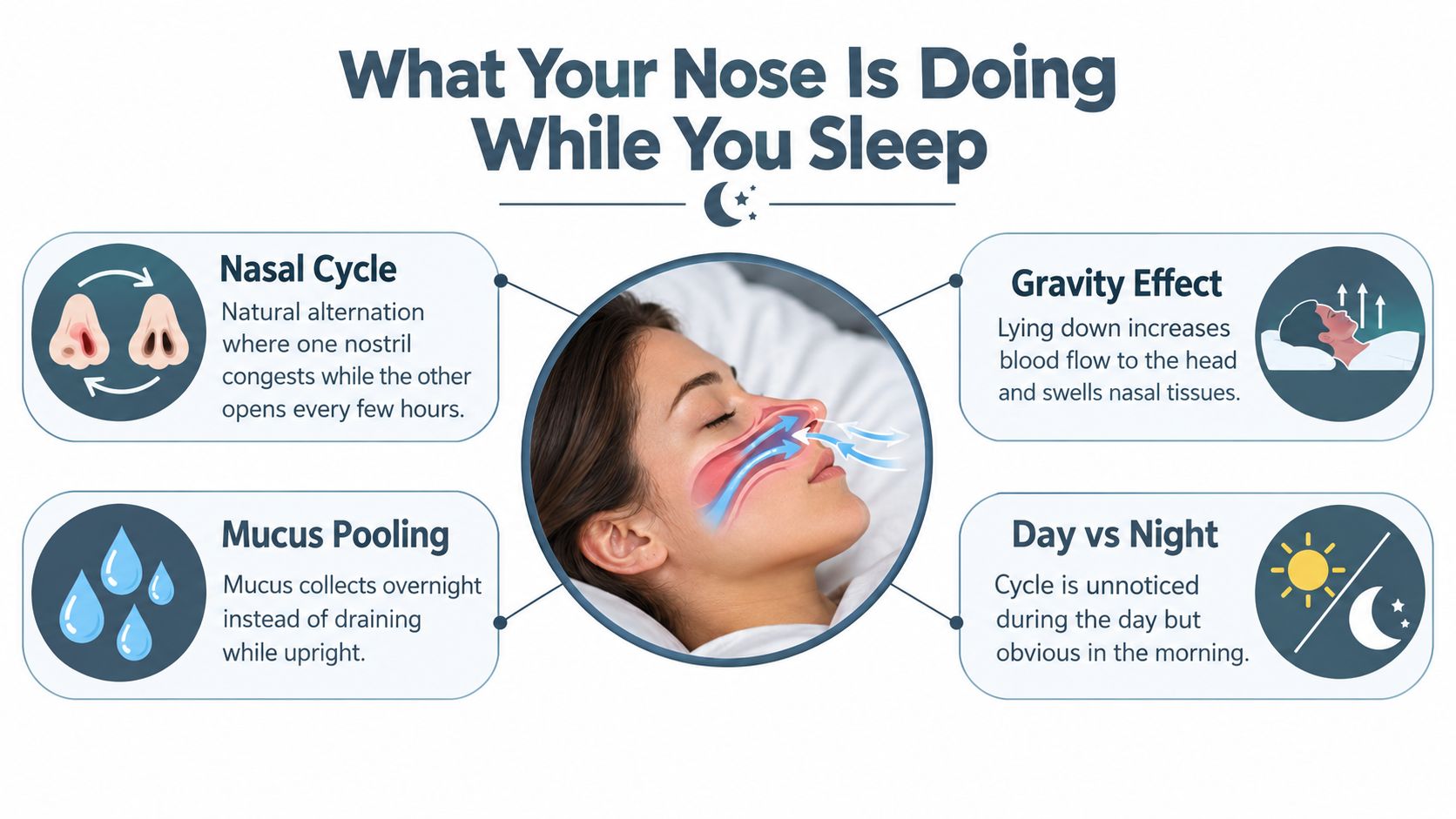
Your nose isn't a fixed pipe. It continually adjusts the amount of air moving through each side in a normal rhythm called the nasal cycle. Venous sinuses in the nasal turbinates periodically swell and settle, so one nostril becomes relatively more congested while the other opens. The sides then alternate.
During the day, movement and an upright posture make this cycle easy to ignore. In bed, the same small change can feel dramatic. Think of your nostrils as two traffic lanes. One lane briefly narrows while the other carries more airflow. If both lanes are already narrowed by inflammation, dry air, or anatomy, the slower lane can feel closed when you wake.
Why lying flat changes the experience
When you're upright, gravity helps secretions move away from the nasal passages. Lying flat removes that advantage. Blood flow and tissue swelling in the nasal lining can become more noticeable, while mucus can remain in place instead of clearing as easily. The difference between nasal breathing and mouth breathing becomes especially apparent when a blocked nose pushes you toward open-mouth breathing.
Sleep position can add a side-specific effect. The lower side of the nose may feel fuller when you sleep on your side, especially if the nasal cycle is already favoring congestion on that side. If a deviated septum, enlarged turbinates, or nasal polyps narrow the airway, the ordinary cycle has less room to operate.
The morning “first breath”
That first breath through a congested nose is the combined result of several hours of position, airflow, mucus, and tissue behavior. It doesn't automatically mean infection, and it doesn't automatically mean allergies. It means the nasal passage is offering more resistance at the exact moment you become aware of breathing.
The next step is to identify what amplifies the normal overnight process. Bedroom allergens, temperature changes, reflux, and persistent inflammation can each make the morning blockage more pronounced.
The Most Common Morning Congestion Triggers
Morning congestion usually has more than one possible contributor, but the pattern often points toward a leading one. A bedroom may expose you to dust mites or pet dander, while lying flat intensifies swelling that was already present. Other people notice symptoms after temperature changes, dry air, smoke, or reflux.
Allergic and nonallergic irritation
Dust mites can collect in bedding, pillows, and mattresses. Pet dander may remain on sheets and clothing even when a pet doesn't sleep in the room. Mold, smoke, and dry or cold air can also irritate the nasal lining, as noted in Mayo Clinic's overview of nasal congestion causes.
Sneezing, itching, watery eyes, and a runny nose make allergic rhinitis more likely. Congestion without itching, especially after a temperature shift, fragrance, or dry air exposure, can fit a nonallergic or vasomotor pattern.
Position, reflux, and anatomy
Reflux can irritate the upper airway when you're lying down, particularly if morning congestion arrives with throat clearing, hoarseness, sour taste, or a sensation of mucus at the back of the throat. A deviated septum may make one side consistently narrower, so ordinary nighttime tissue swelling has a larger effect.
Pregnancy and alcohol use can also contribute to nighttime nasal swelling. The practical clue is timing. If blockage follows a particular situation and eases when that situation changes, the trigger deserves attention.
Medication-related swelling
Topical decongestant sprays can shrink swollen tissue quickly, but using them repeatedly or longer than the product or clinician recommends can cause rebound congestion. The result is a frustrating loop, spray for relief, swelling returns, spray again. If you need a decongestant spray to sleep, discuss that pattern with a healthcare professional instead of increasing use.
For people comparing moisture control with particle filtration, a practical explanation of dehumidifier or air purifier for Florida homes can help clarify which bedroom problem each device addresses. An air purifier targets airborne particles, while humidity control addresses moisture conditions. Neither replaces evaluation of persistent nasal disease.
| Trigger | What happens overnight | Morning clue |
|---|---|---|
| Dust mites or pet dander | Irritants remain close to the nose for hours | Sneezing, itching, watery eyes, or symptoms tied to bedding |
| Dry or cold air | The nasal lining becomes irritated and mucus may feel thicker | Dry throat, crusting, or congestion that improves with moisture |
| Reflux | Irritation increases while lying flat | Throat clearing, hoarseness, sour taste, or morning cough |
| Deviated septum or enlarged tissue | A narrow passage has less space when tissues swell | Repeated one-sided blockage or difficulty breathing on one side |
| Decongestant spray overuse | Rebound swelling maintains the blockage | Temporary relief followed by recurring or worse congestion |
Is It Your Bedroom, Your Nose, or Something Else
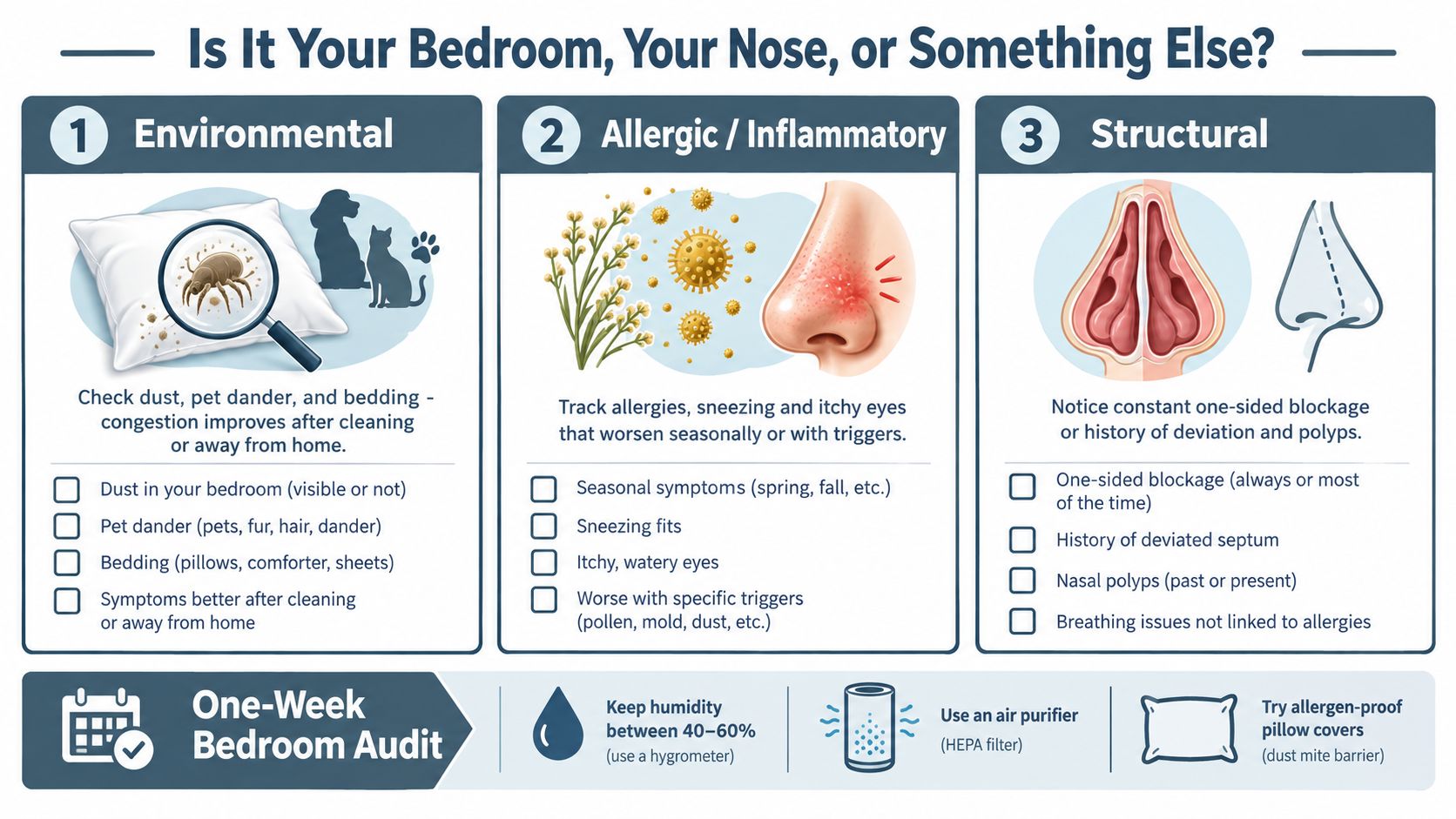
A short self-check can help you decide what to change first. Treat it as preparation for a clinical conversation, not a diagnosis. The goal is to compare your environment with your symptoms instead of trying five remedies at once and losing track of what helped.
Run a one-week bedroom audit
For several mornings, record what was different the night before. Note bedding changes, visible dust, pet access, open windows, fragrance products, smoke exposure, heating or cooling, and whether the room feels unusually dry or damp. If you use an air purifier, review the best GrifGlo air filter guide for general filter considerations, then keep your notes focused on your own room and symptoms.
At the same time, record the nose itself:
- Duration: How long does blockage last after getting up?
- Laterality: Is it always one side, or does it alternate?
- Seasonality: Does it follow pollen, heating, cooling, or weather changes?
- Companions: Are sneezing, itchy eyes, facial pressure, throat irritation, or reduced smell present?
Read the pattern, not one morning
Bilateral congestion that improves after leaving the bedroom raises the environmental question. Congestion paired with sneezing or itchy eyes points more toward allergic inflammation, while symptoms after temperature or fragrance exposure can fit nonallergic irritation.
Persistent one-sided obstruction deserves a different conversation, particularly with snoring, a history of nasal trauma, or known polyps. A useful bedroom may also need appropriate moisture, but a humidifier can add problems if it isn't maintained. Guidance on a humidifier for better sleep is most useful when paired with regular cleaning and attention to how your nose responds.
Use the audit to ask better questions. “My left side is blocked every morning” gives a clinician more direction than “I feel stuffy sometimes.”
Quick Relief When You Are Already Congested
You don't need to begin with the most complicated option. Start by loosening and hydrating what has collected overnight, then move toward flushing irritants or reducing swelling if the pattern calls for it.
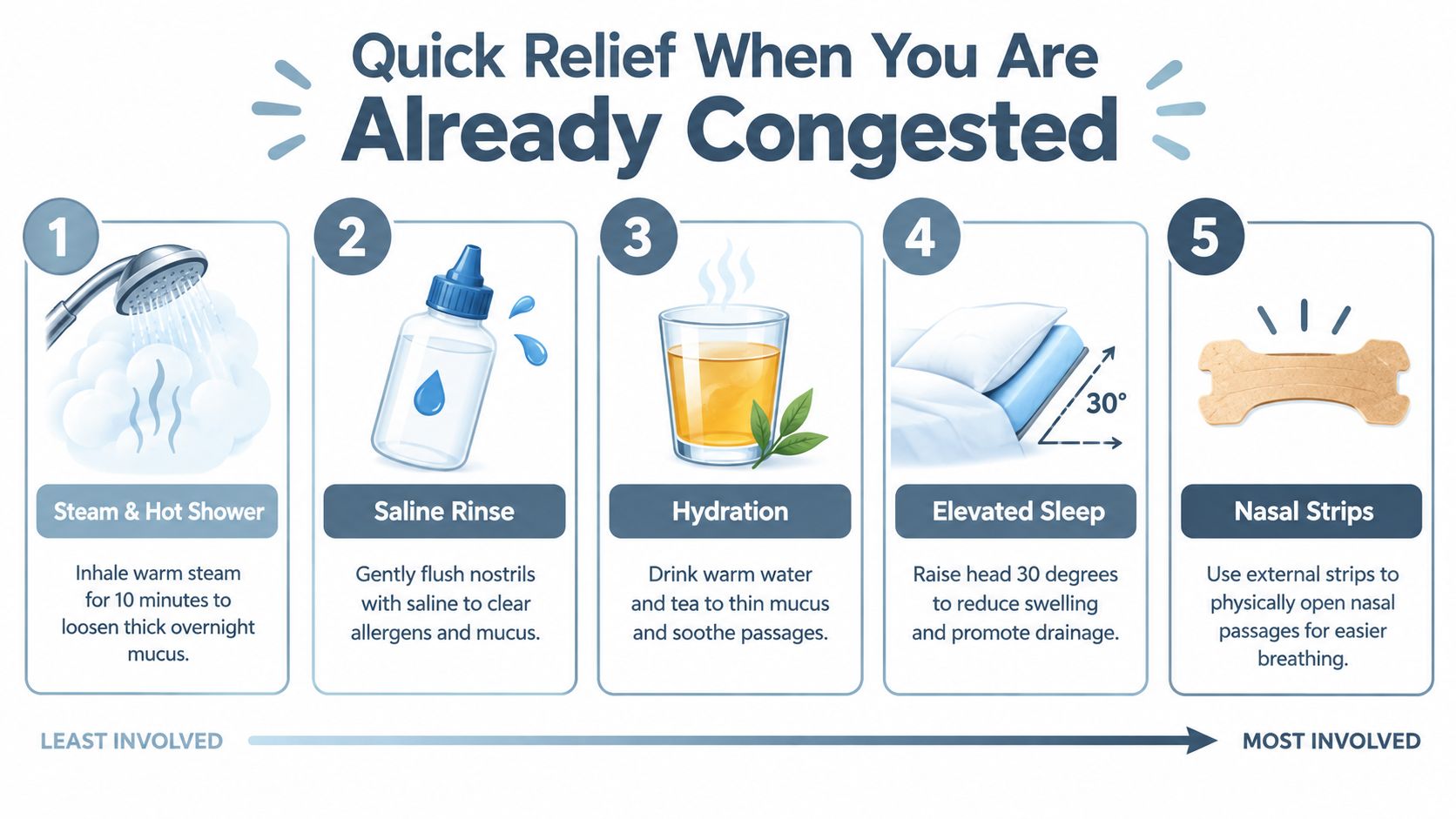
- Warm moisture: A hot shower or careful steam exposure can soften thick mucus and make blowing your nose easier. Avoid burns, and don't treat steam as a cure for underlying inflammation.
- Saline spray or rinse: Saline moisturizes the nasal lining and helps wash away mucus and irritants. If you use a squeeze bottle or neti pot, use distilled water or water that has been boiled and cooled, and follow the device instructions. The Cleveland Clinic guidance on nasal congestion also emphasizes saline and fluids as practical measures.
- Fluids: Water or a warm drink supports hydration and may help thin mucus. It won't mechanically open a narrowed nasal passage, but it can make secretions less stubborn.
- Gentle massage: Light pressure along the bridge of the nose and the upper cheeks may feel soothing. Stop if it causes pain, and don't press hard over tender or swollen areas.
- External support: Nasal strips can physically widen the area around the nasal valve. They won't remove mucus or treat allergy inflammation, but they may help when the outer nasal passage contributes to the blocked sensation.
Here is a short visual walkthrough of simple congestion-relief techniques:
For allergy-related congestion, treatment is different from instant mechanical relief. Clinical guidance identifies intranasal corticosteroids as first-line treatment for allergic rhinitis, with an oral antihistamine sometimes combined with an intranasal corticosteroid for seasonal symptoms (AAFP guideline). Ask a pharmacist or clinician which option fits your health history. Be especially cautious with topical decongestant sprays, because repeated use can produce rebound swelling.
If you want to test an external strip, Eucalyptus Nasal Strips are described in the product snapshot as supporting easier nighttime airflow and nasal breathing. Use them as a mechanical aid, not as a substitute for investigating persistent blockage.
A Nighttime Routine for Clearer Mornings
The morning is often when you notice the problem, but the useful decisions happen earlier. A simple evening routine reduces the number of irritants and mechanical disadvantages your nose has to manage during sleep.
Remove the day's exposure
If you've spent time around pollen, dust, smoke, or animals, wash your face and consider a saline rinse before bed. A final saline spray or rinse can remove remaining mucus and irritants, but it should be gentle. For people with allergic rhinitis, a clinician may recommend an intranasal corticosteroid as part of a consistent treatment plan rather than an occasional emergency measure.
Keep bedroom air comfortable rather than aggressively damp. A humidifier may help when dryness irritates your nose, but aim for humidity around 40 to 50 percent, and clean the device often to prevent mold. A hygrometer can help you observe the room instead of guessing from how your throat feels.
Make the airway's job easier
Side-sleeping may reduce the sensation of drainage pooling for some people, while slight head elevation can change the position of the upper airway and support drainage. Adjust one factor at a time so you can tell whether it helps. If a particular side always produces blockage on the lower nostril, try the other side and record the result.
Nasal strips can widen the nasal valve without medication. They may be reasonable for external narrowing, but they won't resolve swelling deeper inside the nose. Mouth taping requires more caution. Don't use it if you can't breathe comfortably through your nose, and seek professional advice if you have significant congestion, suspected sleep apnea, vomiting risk, or another condition that could make it unsafe.
Hydrating Mouth Tape is described in its product snapshot as supporting quieter nights, oral care, tongue posture, and nose-focused breathing. Those descriptions don't change the safety rule: mouth taping should only be considered when nasal breathing is already mostly clear and the approach is appropriate for you.
Build the routine around the cause. Moisture may help dryness, filtration may help airborne irritants, and a nasal strip may help external narrowing. One tool can't correct every type of obstruction.
When Morning Congestion Deserves a Clinician
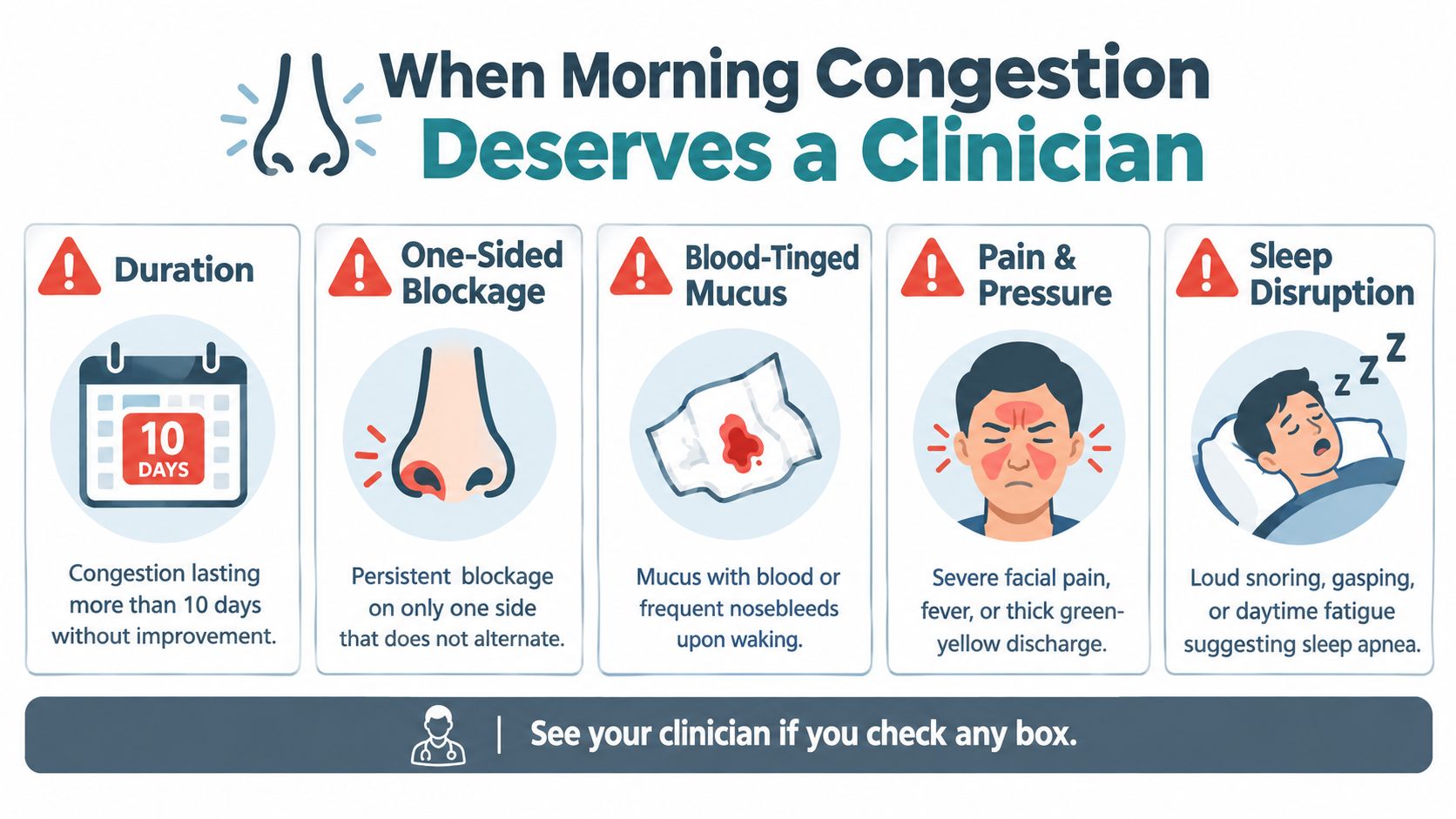
Morning stuffiness deserves medical attention when it stops behaving like a brief, explainable response to sleep. Arrange an evaluation if congestion lasts more than ten days without improvement, or if the symptom repeatedly interferes with sleep and daytime functioning.
Use these red flags as a triage checklist
- Persistent one-sided blockage: One nostril stays obstructed and doesn't alternate.
- Blood-tinged mucus: You notice blood in mucus or frequent nosebleeds on waking.
- Facial symptoms: Facial pain, pressure, fever, or thick discharge accompanies the blockage.
- Recurring illness: Sinus infections return or symptoms never fully clear.
- Smell changes: Your sense of smell is reduced or absent.
- Sleep disruption: Loud snoring, gasping, witnessed breathing pauses, or daytime fatigue raises concern about sleep apnea.
- Injury history: Symptoms began after a head injury or nasal trauma.
A clinician will usually begin with your timeline, triggers, medications, sleep symptoms, and examination of the nasal passages. Depending on the pattern, they may consider allergy testing, nasal endoscopy, or imaging. Possible next steps include prescription nasal treatment, antihistamines, assessment for a deviated septum or polyps, or referral to a sleep specialist.
Bring your one-week notes. Tell the clinician whether the blockage is bilateral or one-sided, whether it improves outside the bedroom, and whether you rely on decongestant spray. Those details can shorten the path from “I wake up blocked” to a more targeted plan.
Putting It All Together for Better Nights and Mornings
Morning nasal congestion is rarely random. It often reflects the interaction between the nasal cycle, lying flat, bedroom exposures, and the condition of the nasal lining. Once you identify the pattern, you can make small changes without treating every morning as an emergency.
Try this evening sequence:
- Prepare the room: Keep irritants low, avoid smoke and strong fragrance, and monitor humidity rather than guessing.
- Clear exposure: Use a gentle saline rinse after a day around allergens, then use a saline spray or rinse before bed if it suits you.
- Support airflow: Apply a nasal strip if external narrowing seems relevant.
- Change position: Try side-sleeping or modest head elevation, especially if lying flat worsens the blockage.
- Check nasal breathing: Before considering mouth tape, confirm that you can breathe comfortably through both sides and address any persistent obstruction first.
In the morning, take a short reset. Use a warm shower or gentle steam, saline mist if needed, and a glass of water. Then check whether you can breathe through your nose before reaching for caffeine or starting the day.
Keep the habits that reveal a clear benefit, such as bedding care, appropriate humidity, saline, or a sleep-position change. Drop the habits that create a rebound cycle, especially repeated decongestant spray use without clinical guidance. If one-sided blockage, bleeding, facial pain, loss of smell, or disrupted breathing persists, take your notes to a clinician rather than trying to outlast the symptom.
SleepHabits offers educational guidance and nighttime breathing tools, including nasal strips and mouth tape, for adults working on clearer nasal breathing and more restorative sleep. Visit SleepHabits to explore practical wind-down resources and choose tools that fit your breathing pattern, while seeking clinical care for persistent or concerning congestion.