

The most popular advice about nasal strips is also the least precise: put one across your nose and expect snoring, poor sleep, or even sleep apnea to improve. The evidence supports a narrower conclusion. Nasal strips can make nasal breathing easier and may reduce snoring loudness for some people, but they don't correct the throat collapse that defines obstructive sleep apnea.
That distinction matters because a subjective improvement can feel convincing. If your nose opens and breathing feels smoother, you may sleep more comfortably. But easier airflow through the nose isn't the same as improved oxygen saturation, a lower apnea-hypopnea index, or treatment for a sleep disorder. The most useful question isn't whether nasal strips work. It's whether your breathing problem begins at the nose, and whether your baseline nasal resistance is high enough for a mechanical aid to matter.
What Nasal Strips Actually Do and What They Don't
Nasal strips are external nasal dilators, not treatments for every breathing problem during sleep. They lift and stabilize the outer nasal walls, creating more room around the nasal valve. For someone whose nose feels narrow or blocked at night, that mechanical change can make nasal breathing feel easier and may reduce the urge to breathe through the mouth.
The clearest benefit concerns nasal patency, the openness of the nasal passage and the effort required to move air through it. In an exploratory sleep study of people with chronic nasal congestion, participants reported easier breathing and improvements in perceived sleep quality, staying asleep, and morning refreshment. Objective sleep changes were limited, however. The finding supports a narrower conclusion: strips can improve the nasal part of breathing without substantially changing the underlying pattern of sleep.
The response also depends on starting conditions. A strip has more room to help when baseline nasal resistance is high, because opening a relatively restricted nasal passage can produce a noticeable change in airflow. Someone with little nasal obstruction may feel little difference. This selection rule is more useful than treating nasal strips as a universal snoring solution.
Snoring can improve when nasal blockage contributes to mouth breathing or turbulent airflow. The effect is less predictable when the sound comes mainly from vibration of the soft palate, tongue, throat, or other structures farther down the upper airway.
The practical distinction: A nasal strip can improve the route through the nose. It cannot prevent the sleeping throat from collapsing.
That boundary matters for sleep apnea. A person may feel that breathing is smoother while the obstructive events that interrupt airflow continue. Reviews of randomized and crossover studies found no meaningful improvement in objective obstructive sleep apnea outcomes, including the apnea-hypopnea index, oxygen saturation, or sleep architecture, even when nasal breathing felt easier (review of nasal dilators for snoring and obstructive sleep apnea).
The honest summary of nasal strips benefits is therefore specific: better nasal airflow, possible reduction in snoring loudness, and no credible basis for calling them a stand-alone apnea treatment.
How a Nasal Strip Mechanically Opens the Nose
Think of the nasal valve as a partially pinched garden hose. If the walls bend inward, you can increase effort without getting much more air through. A nasal strip works from the outside, using flexible bands that pull the sides of the nose slightly outward and resist inward narrowing.
Most consumer strips sit across the bridge and upper sidewalls of the nose. When positioned correctly, they create a small lifting force over the nasal valve, the narrowest region of the nasal airway. The device doesn't contain a decongestant and doesn't dissolve mucus. It changes the shape and stability of the outer nasal passage.
External and internal dilators use different routes to reach a similar goal. External strips pull the nasal sidewalls outward from the skin. Internal dilators sit inside the nostrils and push the passage open from within. The external option is usually easier to apply and doesn't place an object inside the nose, while internal devices may feel more intrusive.
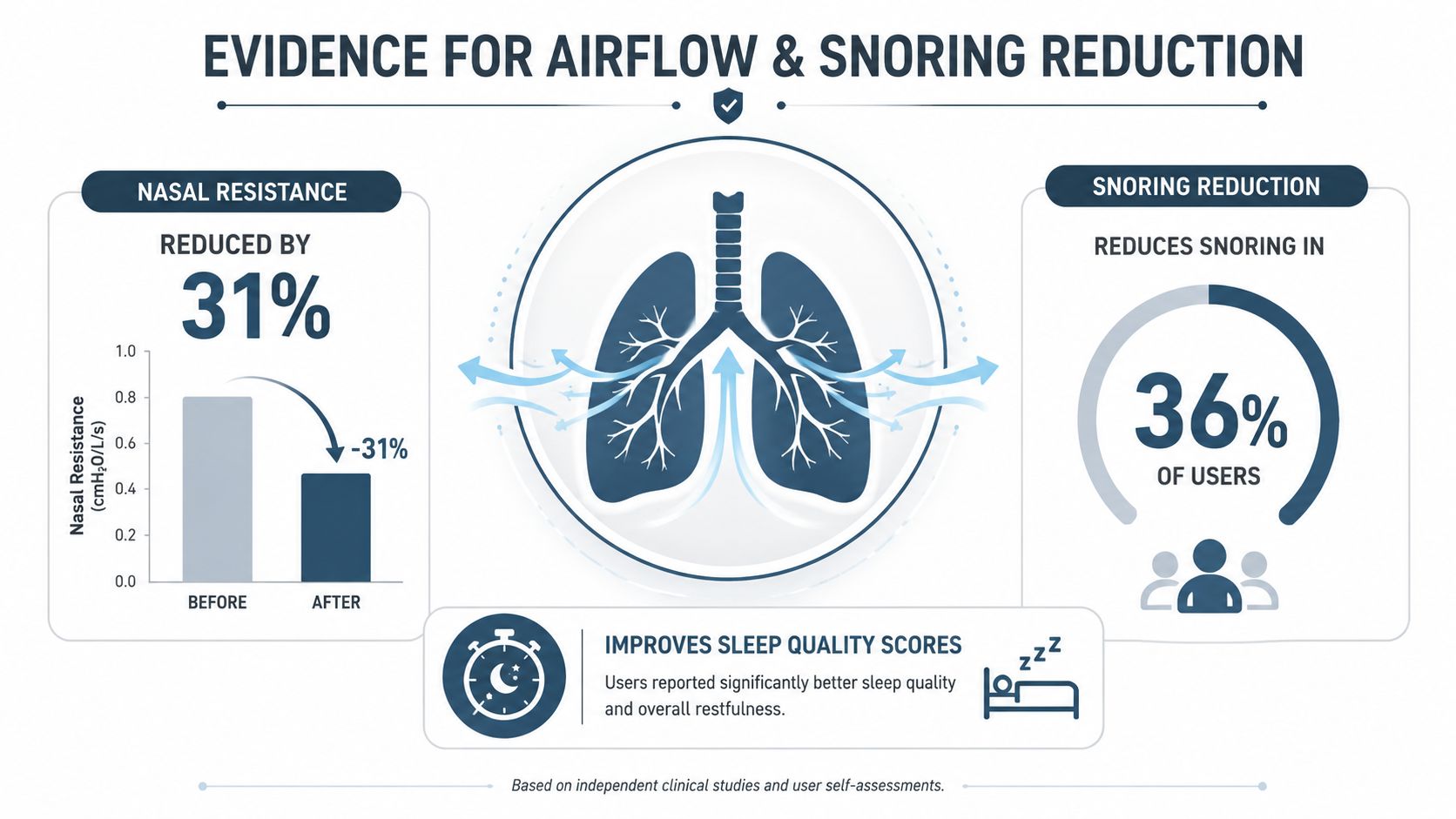
The measured effect is real, but it shouldn't be inflated. A physiologic study found that external nasal dilator strips reduced nasal airflow resistance by about 0.5 cm H2O/L/s from a baseline of 5.5 cm H2O/L/s, with the effect present during both inhalation and exhalation (physiologic study of external nasal dilators). In practical terms, the strip creates more room at a known bottleneck. That explains why someone with a stuffy or structurally narrow nose may notice a difference, while someone with an already-open nose may not.
For readers comparing formats, Transparent Nasal Strips are described in the catalog as supporting easier nighttime breathing, nasal breathing habits, and use alongside mouth tape. Those are product-positioning details, not proof that a strip treats sleep apnea or changes oxygenation.
The following video can help illustrate the application concept and the intended placement:
The Strongest Evidence for Better Airflow and Snoring
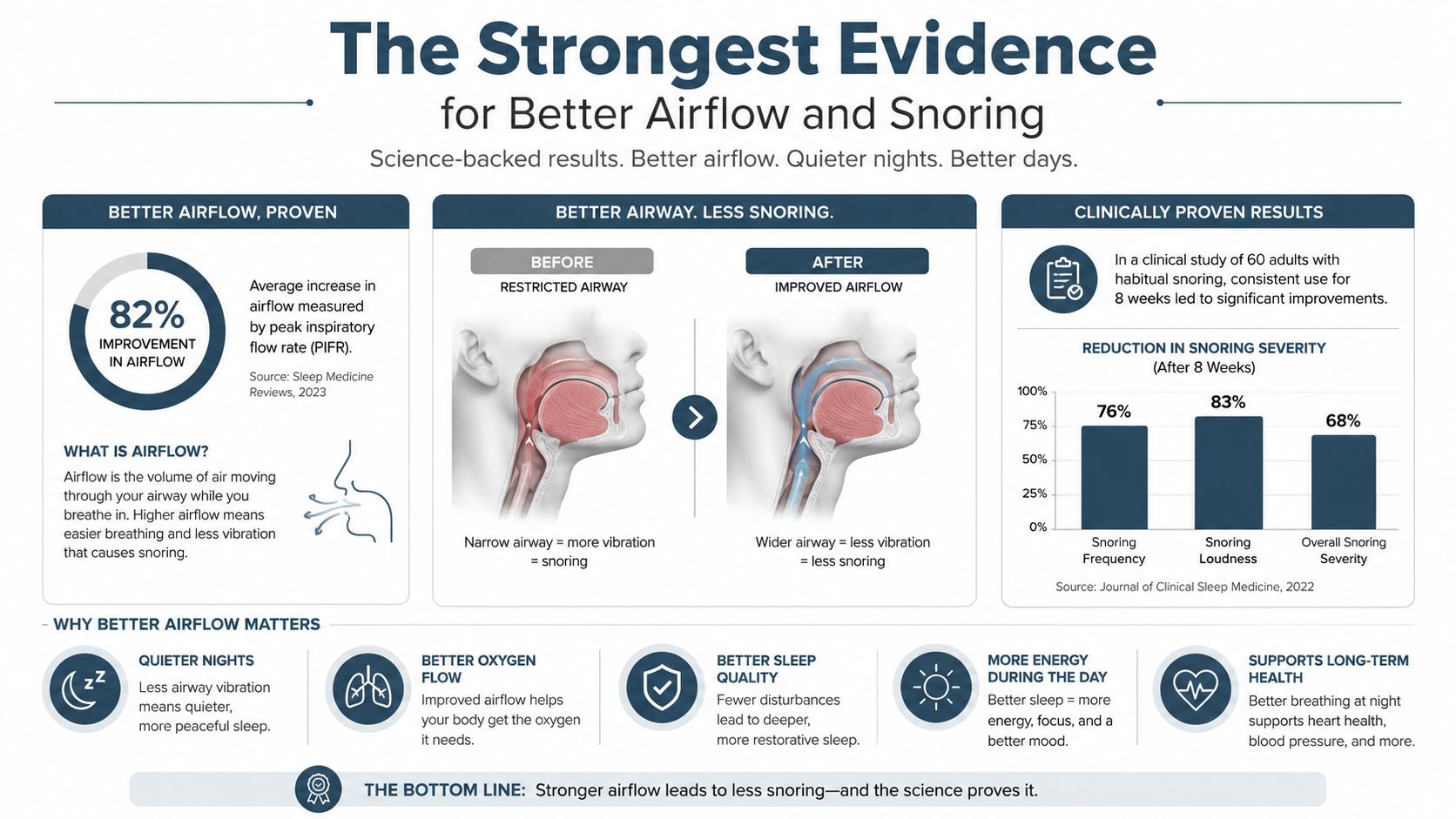
Nasal strips can make breathing feel easier without correcting every cause of snoring. Their clearest measurable effect is mechanical: they reduce resistance to airflow through the nose. The strongest response is therefore expected when baseline nasal resistance is high, such as with chronic congestion or a narrow nasal passage. People with an already-open nose have less resistance available to reduce.
In an exploratory sleep study of people with chronic nasal congestion, the strip improved perceived breathing, sleep quality, sleep continuity, and morning refreshment. Objective sleep measures changed little. The result separates comfort from disease treatment: a user may sleep more comfortably even when the underlying pattern of sleep-related obstruction remains.
What the snoring trial showed
A 1998 study enrolled 30 snorers. On the second treatment night, maximum snoring intensity fell in 22 of 30 participants, and the snoring index for sounds louder than 20 dB also decreased significantly, with p = 0.02 (1998 sleep study of external nasal strips).
The trial also found less mouth dryness, with p = 0.025, and lower Epworth Sleepiness Scale scores, with p = 0.001. If nasal blockage was promoting mouth breathing, opening the nose could explain both findings. These results support quieter snoring and greater comfort, but they do not establish that breathing interruptions were eliminated.
Readers comparing non-surgical options can review information about ways to reduce snoring with Nightlase, which belongs to a different treatment category from an adhesive nasal dilator. A strip changes nasal airflow resistance. Other approaches may target tissue vibration or airway anatomy, so their mechanisms and expected results differ.
For practical guidance, see this explanation of nasal strips for snoring. The useful selection rule is simple: strips are most plausible when nasal resistance is part of the problem. Snoring may become quieter, but a quieter bedroom alone does not show that sleep-related breathing interruptions have stopped.
Why the Benefits Do Not Extend to Sleep Apnea
Nasal resistance and obstructive sleep apnea are related, but they aren't the same problem. Nasal resistance describes how difficult it is for air to move through the nose. Obstructive sleep apnea involves repeated narrowing or collapse of the upper airway during sleep, commonly at levels beyond the nasal passage.
That difference explains the apparently conflicting results. A person may feel a more open nose and breathe more comfortably, yet still experience obstruction in the throat. Reviews of nasal dilators found no significant overall change in apnea-hypopnea index, lowest oxygen saturation, or snoring index among people with obstructive sleep apnea (review of nasal dilators in snoring and OSA).
A separate systematic review and meta-analysis likewise found no significant differences versus control in apnea-hypopnea index, apnea index, hypopnea index, snoring index, sleep time, sleep architecture, REM latency, oxygen saturation, or nasal airway resistance. Its conclusion was direct: nasal dilators shouldn't be considered an effective stand-alone therapy for obstructive sleep apnea (systematic review and meta-analysis of nasal dilators).
| Outcome | Evidence | Typical result |
|---|---|---|
| Nasal airflow | Strongest mechanical evidence | Nasal breathing may feel easier |
| Nasal resistance | Measurable reduction in several studies | Benefit is more likely when baseline resistance is high |
| Snoring loudness | Some positive trials | Snoring may become quieter for selected users |
| Apnea-hypopnea index | No meaningful overall improvement | Not an apnea treatment |
| Oxygen saturation | No meaningful overall improvement in OSA studies | Don't use strips to protect against oxygen drops |
| Sleep architecture | Little or no meaningful change | Comfort doesn't equal normalized sleep structure |
Daytime sleepiness deserves careful attention. It may have many causes, including sleep disorders and mental health concerns, so people looking for information about sleep disorder psychiatric help should treat persistent symptoms as a reason for professional assessment, not as a cue to keep adding nasal products.
If you suspect apnea, discuss symptoms with a clinician and consider a sleep evaluation. Loud snoring, witnessed pauses, gasping, or persistent daytime sleepiness require a diagnostic approach. A strip can be a comfort aid for nasal restriction, but it shouldn't replace CPAP, an oral appliance, weight-related care, surgery, or other treatment recommended after evaluation. More detail is available in this explanation of whether nasal strips help sleep apnea.
Who Gets the Most Out of Wearing Them
The most actionable selection rule comes from nasal airflow dynamics, not advertising: strips are more likely to help when resting nasal resistance is already high. In a study of nasal airflow, only 9 subjects were identified as clear physiologic responders during tidal breathing, and the authors concluded that external nasal dilators may work better in people with higher baseline resistance (study of nasal airflow dynamics and external dilators).
That gives you a practical test. If your nose feels clear in bed and you breathe comfortably through it, a strip may produce little noticeable change. If one or both nostrils feel restricted, especially when you lie down, you're a more plausible responder.
Four situations where the fit is strongest
- A habitual mouth breather wakes with a dry mouth and notices that nasal breathing feels limited at night. The strip may help if nasal narrowing is driving the switch to mouth breathing. It won't solve mouth breathing caused by throat obstruction or a separate sleep disorder.
- A person with allergy-related congestion may find that the nose feels narrow during certain seasons or after exposure to an irritant. A strip can provide external support while the underlying allergy is addressed, but it doesn't replace appropriate allergy care.
- An athlete with restricted nasal airflow may notice greater comfort during warmups, steady exercise, or recovery. The mechanical benefit is most plausible when nasal breathing is limited at baseline, not when the athlete already has unobstructed nasal airflow.
- An adult with mild, uncomplicated snoring may try a strip when a partner reports loud breathing but there are no signs of repeated pauses, gasping, or severe daytime sleepiness. A reduction in loudness can improve the bedroom environment, but it shouldn't be interpreted as proof that sleep-disordered breathing is absent.
Shift workers deserve the same caution as everyone else. Irregular schedules can make fatigue harder to interpret, so a strip shouldn't be used to explain away persistent sleepiness. Ask what the nose feels like before sleep, then judge the product by nasal comfort rather than by an expectation of guaranteed silence.

Safety, Side Effects, and When to Skip the Strip
Nasal strips are non-invasive, but “simple” doesn't mean universally suitable. The adhesive can irritate sensitive skin, and some users experience pressure, pulling, or discomfort across the bridge of the nose. A reaction can occur even when the mechanical idea is appropriate, so remove the strip if burning, marked redness, swelling, or worsening discomfort develops.
Application affects both comfort and performance. Place the strip on clean, dry, intact skin, and avoid putting it over a cut, rash, sunburn, or other damaged area. Anyone with a known adhesive sensitivity should check the product materials and consider professional advice before use.
Situations that call for caution
Severe congestion from an active sinus infection may overwhelm the benefit of an external lift. The strip can widen the nasal valve, but it can't clear deep inflammation or replace treatment for infection. Allergies also need their own management if they are persistent or interfere with daily function.
Avoid experimenting over very recent facial surgery unless the treating clinician has approved it. Changes in nasal anatomy, healing tissue, and skin sensitivity make ordinary product instructions less important than surgical guidance.
The most serious mistake is using the strip to postpone an evaluation. Nasal strips can support nasal airflow, but they aren't a substitute for assessment of suspected apnea, persistent daytime sleepiness, or chronic nasal obstruction. A practical overview of nasal strip side effects can help you distinguish ordinary adhesive discomfort from a reason to stop.
If the strip improves breathing but snoring remains loud, or if someone observes pauses and gasping, treat the nasal response as useful diagnostic information. It suggests the nose may be part of the problem, not that the entire airway problem has been solved.
How to Use Nasal Strips in a Full Sleep Routine
A nasal strip works best as one small part of a routine, not as a substitute for diagnosing the reason you sleep poorly. Start with the mechanics, then add habits that make nasal breathing easier to maintain.
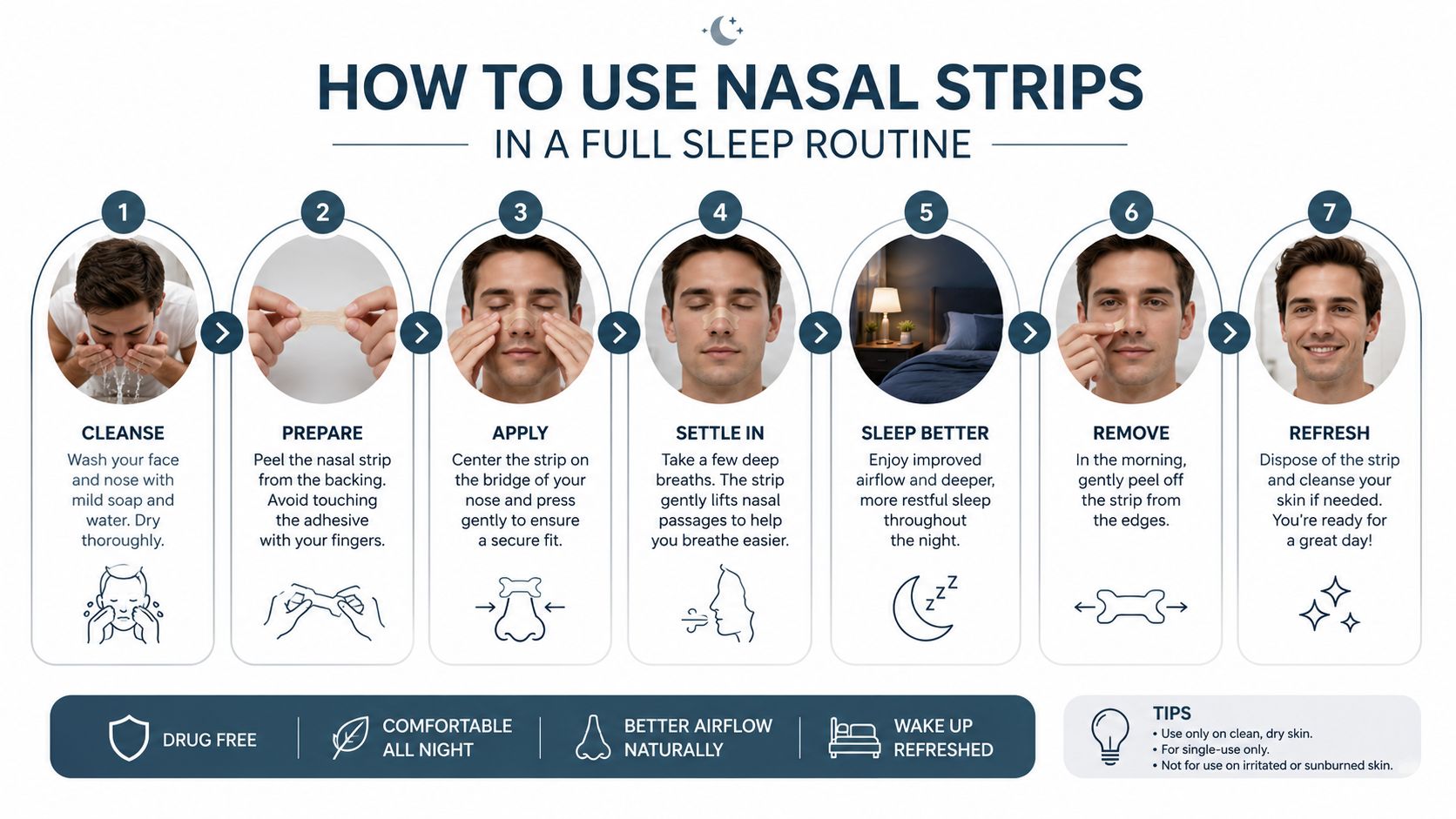
- Clean the skin. Wash away oil, moisturizer, and sweat, then dry the nose completely. Adhesive needs a clean, dry surface, and damaged skin isn't a suitable application site.
- Place the strip across the nasal valve. Follow the product directions and position it across the bridge and sidewalls rather than too high on the bony bridge. Press the ends down so the lifting bands can support the outer nose.
- Test the sensation before lights out. The strip should feel supportive, not painful or excessively tight. If the skin begins to sting, remove it instead of trying to tolerate the reaction.
- Use mouth tape only when nasal breathing is comfortable. Some people pair a nasal strip with mouth tape to encourage closed-mouth nasal breathing. Never use mouth tape as a way to force nasal breathing through a blocked nose, and don't treat the combination as protection against sleep apnea.
- Choose a calm wind-down drink if it already fits your routine. Restore+ Magnesium Sleep Aid is described in the catalog as a melatonin-free magnesium drink containing magnesium, L-theanine, tart cherry, lemon balm, and glycine, with nitric oxide-supporting ingredients. Those product details don't establish that it treats apnea, but a consistent, non-stimulating evening ritual can make the routine easier to repeat.
- Dim light and screens. Give your brain a predictable transition into bed rather than relying on the strip alone to create sleepiness.
- Journal briefly and review the outcome. Record whether your nose felt clearer, whether mouth dryness changed, and whether your partner noticed a change in snoring. Don't judge success only by how the strip feels. If daytime sleepiness, gasping, or witnessed breathing pauses persist, seek clinical assessment.
The mechanical rationale is straightforward. External nasal dilators reduced average nasal resistance by 0.5 cm H2O/Lps from a baseline of 5.5 cm H2O/Lps, with similar effects during inhalation and exhalation in a physiologic study (study of nasal resistance during inhalation and exhalation). A routine built around that limited but real function should aim for easier nasal breathing, not a promise of corrected sleep-disordered breathing.
Frequently Asked Questions About Nasal Strips
Do nasal strips actually stop snoring?
They can make snoring quieter when nasal obstruction contributes to it, but they do not address every cause. Their clearest role is lowering nasal resistance and making breathing feel easier. Reviews find no meaningful improvement in objective apnea-hypopnea index, oxygen saturation, or sleep architecture, so comfort should not be confused with sleep apnea treatment, as summarized in the evidence review of nasal strips and OSA metrics.
How quickly do they work?
The effect starts after correct placement and firm adhesion. You are more likely to notice it when baseline nasal resistance is high.
Can I wear them during exercise?
They may make nasal airflow feel easier during exercise, especially if your nose feels restricted. Evidence does not show a universal performance benefit.
When should I see a sleep doctor?
Seek assessment for witnessed breathing pauses, gasping, persistent excessive daytime sleepiness, or disruptive snoring that continues despite clearer nasal airflow. A strip cannot diagnose or exclude apnea.
SleepHabits offers nasal strips, mouth tape, and a melatonin-free magnesium wind-down product for a consistent nighttime breathing routine. Visit SleepHabits to compare these tools and learn about easier nasal breathing without treating a strip as apnea therapy.