

You know the feeling. It's 2 AM, your phone is face down, the room is dark, and your brain is still replaying one awkward email, one unfinished task, and one random memory from three years ago. That's the moment many reach for natural sleep music, not because it's trendy, but because they need something steady enough to interrupt the loop without waking them up further.
Done well, it can be one of the most practical non-drug sleep tools available. Done badly, it's just extra noise with a pretty playlist name.
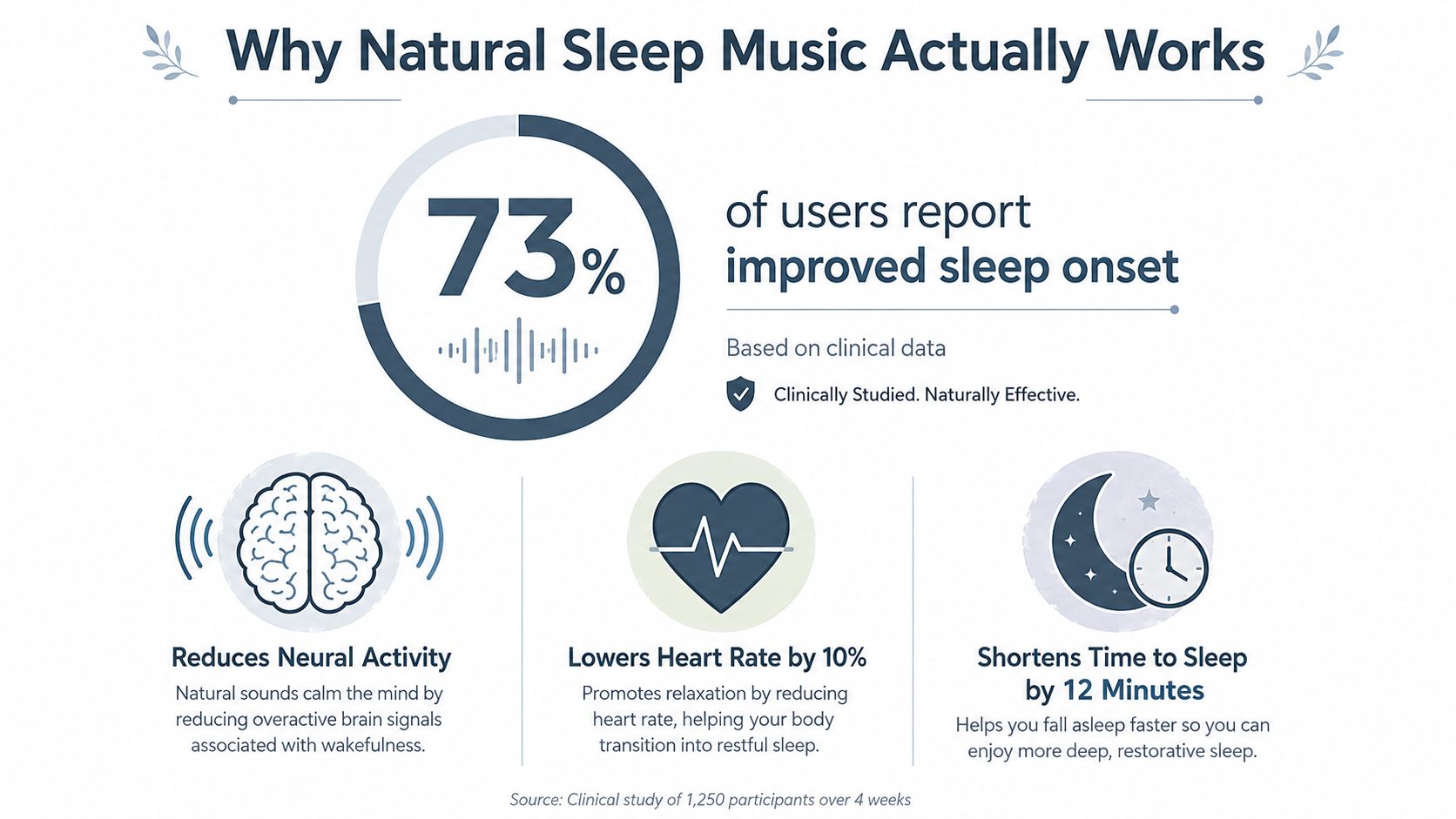
Why Natural Sleep Music Works
Lying awake at 2 AM, you do not need another “relaxing” idea that sounds fine in daylight and falls apart in the dark. You need a sound cue that lowers mental friction, keeps attention from snapping back to worry, and stays predictable long enough for sleep pressure to take over. That is where natural sleep music earns its place.
Clinical evidence is no longer thin or anecdotal. A 2015 Cochrane review found that listening to music improved sleep quality in adults with insomnia symptoms, with a pooled mean difference of -2.80 on the Pittsburgh Sleep Quality Index, based on trials with more than 270 participants in the key sleep-quality analyses and benefits seen whether the music was researcher-selected or participant-selected, as summarized in the Cochrane review. A later 2023 AAFP summary reported improvement in sleep quality in 10 studies with 708 participants, with a standardized mean difference of -2.79, which keeps music listening in recognized sleep intervention territory rather than the wellness fringe.
What changes in the body
Slow, soft music does not knock you out. It gives the nervous system fewer reasons to stay alert. When tempo is restrained and the arrangement is simple, the brain has less to track, which supports the shift toward parasympathetic dominance and makes it easier to drift off instead of monitoring the room for danger.
Practical rule: if a track makes you lean in, anticipate the next change, or tap along, it is probably doing too much for bedtime.
That matters because sleep music works as a non-drug intervention, not a sedative replacement. If you want a broader bedtime stack, pair it with other proven techniques for restful sleep from Tip Top Furniture & Mattresses, then keep the audio itself boring in the best possible way.
For deeper context on how music relates to sleep architecture, the science behind deep sleep is useful background. The short version is simple, natural sleep music helps best when it reduces stimulation instead of trying to entertain you into unconsciousness.
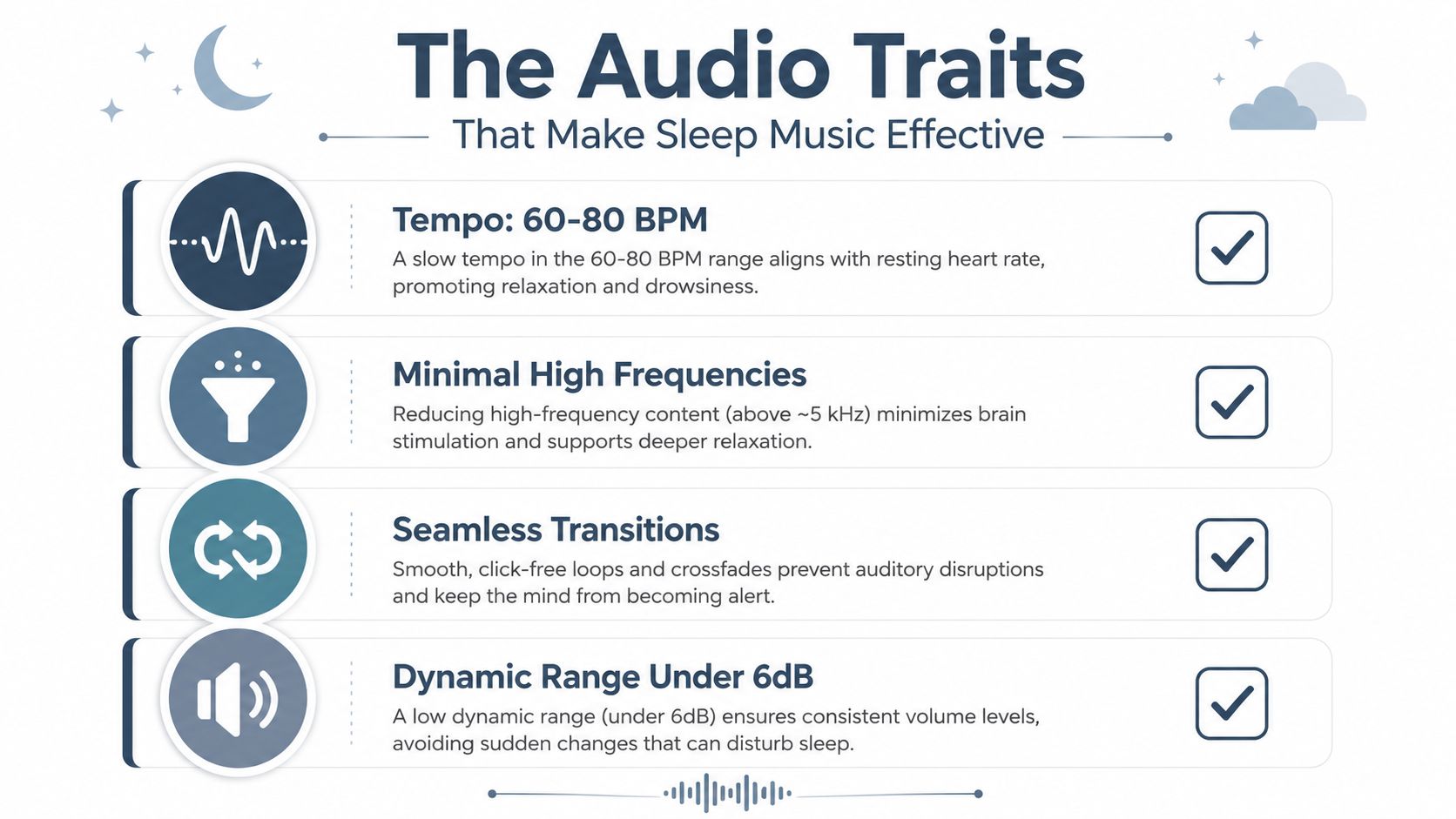
The Audio Traits That Make Sleep Music Effective
A playlist can sound gentle and still be wrong for sleep. The difference usually sits in the measurable details, tempo, frequency range, texture, and how much the track asks your brain to follow. Once you know what to listen for, you can sort useful sleep music from generic calm music in a few seconds.
Tempo, density, and texture
Tempo is the easiest place to start. Sleep-oriented tracks usually sit in a slow range, with simple structure, soft melodies, and very little rhythmic pressure. Reviews of sleep music point to slow tempi of 60 to 80 BPM, middle-to-low frequency register, legato articulation, major mode, and soft playback at 60 dB or below with no abrupt dynamic shifts, as outlined in the sleep-music review.
That profile matters because it leaves the mind with less to sort through. Lyrics add semantic work, and busy percussion pushes attention back toward prediction. The large-scale audio-feature analysis of sleep-tagged tracks found sleep music to be consistently slower, quieter, and lower-energy than general music, with a higher likelihood of being acoustic, as reported in the track analysis. In practical terms, the track should feel flat in a good way, with fewer sharp transients, fewer sudden drops, and fewer changes that pull you back into alertness.
If a sleep playlist keeps changing character every track, it is not a sleep tool, it is a mini concert.
What to avoid at bedtime
Choose tracks you can ignore. Familiar songs can trigger memory, prediction, or nostalgia, and those responses keep the mind active at the wrong time. Music with dense arrangement, strong rhythmic variation, or dramatic volume swings does the same, even if it is labeled relaxing.
Playback quality also matters more than people expect. Clean, low-distortion sound is easier to tolerate at bedtime, especially when you are already sensitive to every small noise in the room, and guidance on how to improve audio quality is useful for that reason. Clarity, stable playback, and controlled volume matter more here than polish for casual listening. A quiet, well-behaved signal beats a loud compressed file every time.
If you need a practical test, listen for whether the track disappears into the room or keeps announcing itself. The best sleep audio does not ask for attention, it reduces the amount of attention left to give.
The setup around the sound matters too. If outside noise keeps breaking through, a pair of soft ear plugs for sleep can lower the background noise enough that the music stays gentle instead of fighting the room. That combination works best when the track stays soft, the tone stays even, and the whole thing blends into the rest of the wind-down routine rather than becoming another task to manage at midnight.
Building Your Nightly Sleep Audio Setup
The track matters, but the setup decides whether it helps for ten minutes or starts to annoy you by midnight. I've seen people choose the right audio and still undermine it with a bright speaker, poor placement, or a volume setting that creeps up after they fall asleep. Sleep audio should feel like part of the room, not another task to manage.
Start with the room, then the device
Use the quietest practical playback path you have. A bedside speaker usually works better than headphones for many people because it avoids pressure on the ears and lets the sound sit in the room instead of inside the head. If outside noise keeps breaking through, a pair of soft ear plugs for sleep can lower the background level enough that the music stays gentle instead of competing with the room.
Keep playback at or below 60 dB. That threshold matches the sleep-focused guidance noted in the review above, and in real bedrooms it usually leaves enough room for the audio to stay present without becoming intrusive. If you use a phone speaker, turn off notifications, disable autoplay, and use a dedicated sleep app rather than a general music player so an unrelated track does not blast in at 1:47 AM.
Placement matters too. Put the speaker where the sound reaches you evenly, not right next to your ear or across the room where it has to be turned up to compensate. I've tested plenty of routines that failed because the sound field was uneven, even though the track itself was fine.
Layer the audio with a wind-down ritual
One pairing that fits naturally here is Restore+ Magnesium Sleep Aid, a melatonin-free magnesium wind-down drink built around nitric oxide supporting ingredients and combined with magnesium, L-theanine, tart cherry, lemon balm, and glycine to support an evening routine. Used as part of a steady habit, it follows the same logic as sleep music, reduce stimulation and make the body easier to settle.
I would keep the rest of the routine plain and repeatable. Slow breathing, dim lights, and a timer that fades the music out before morning all help reduce overnight wake-ups. The point is not to stay entertained until you fall asleep, it is to build a clean runway into sleep.
If you use mouth tape, place it in the same category as the audio. It works best as a quiet physical cue, not a dramatic intervention, and it should never be added if you have nasal congestion or any reason breathing through the nose may be unreliable. The same practical rule applies to magnesium, ear plugs, and sleep music, each tool should lower friction, not add another decision at bedtime.
Practical rule: if you need to change the volume after you've already gotten into bed, the setup is probably too loud.
Nature Sounds Versus Ambient Music Versus Binaural Beats
These formats solve different problems, and treating them as interchangeable is where a lot of people waste time. Nature sounds are often best for masking, ambient music is usually better for emotional downshifting, and binaural beats sit in a narrower, more experimental lane. The right choice depends on what is keeping you awake.
| Sleep Audio Format Comparison | Best For | Sleep Onset | Deep Sleep | Noise Masking |
|---|---|---|---|---|
| Nature sounds | Environmental noise, a busy room, anxious listening | Often useful because the sound is steady and non-demanding | Can help by maintaining a stable background | Strong |
| Ambient music | Racing thoughts, bedtime tension, people who dislike repetitive noise | Useful when the arrangement is soft and sparse | Can support relaxation if it stays simple | Moderate |
| Binaural beats | Curious testers, people who like structured audio experiments | Mixed, because the effect can feel too “active” for some listeners | Unclear for most users in everyday use | Weak to moderate |
Nature sounds, especially rain or ocean textures, work well when the room itself is the problem. They're less about beauty and more about consistency. If your partner snores, traffic leaks through the window, or the neighbor's dog starts its midnight routine, that kind of predictable wash can make the environment feel less jagged.
Ambient music is better when the issue is mental noise rather than external noise. It gives the mind something soft to follow without asking for attention the way lyrics or dramatic chord changes do. The caution is that some ambient tracks still have bright timbres or unexpected swells, which can be more alerting than people expect, especially if the playlist was built for “relaxation” rather than sleep.
Binaural beats are a different case. They can be appealing because they sound technical, but a lot of users notice that the tonal pulsing becomes the thing they focus on. For light sleepers, and for people who prefer a more natural-feeling audio bed, that focus can be counterproductive.
If you need support for nighttime breathing while you test formats, Transparent Nasal Strips can help keep airflow more comfortable without adding another sound layer. That matters for people whose sleep challenge is partly physical, not just cognitive.
Troubleshooting Common Sleep Music Problems
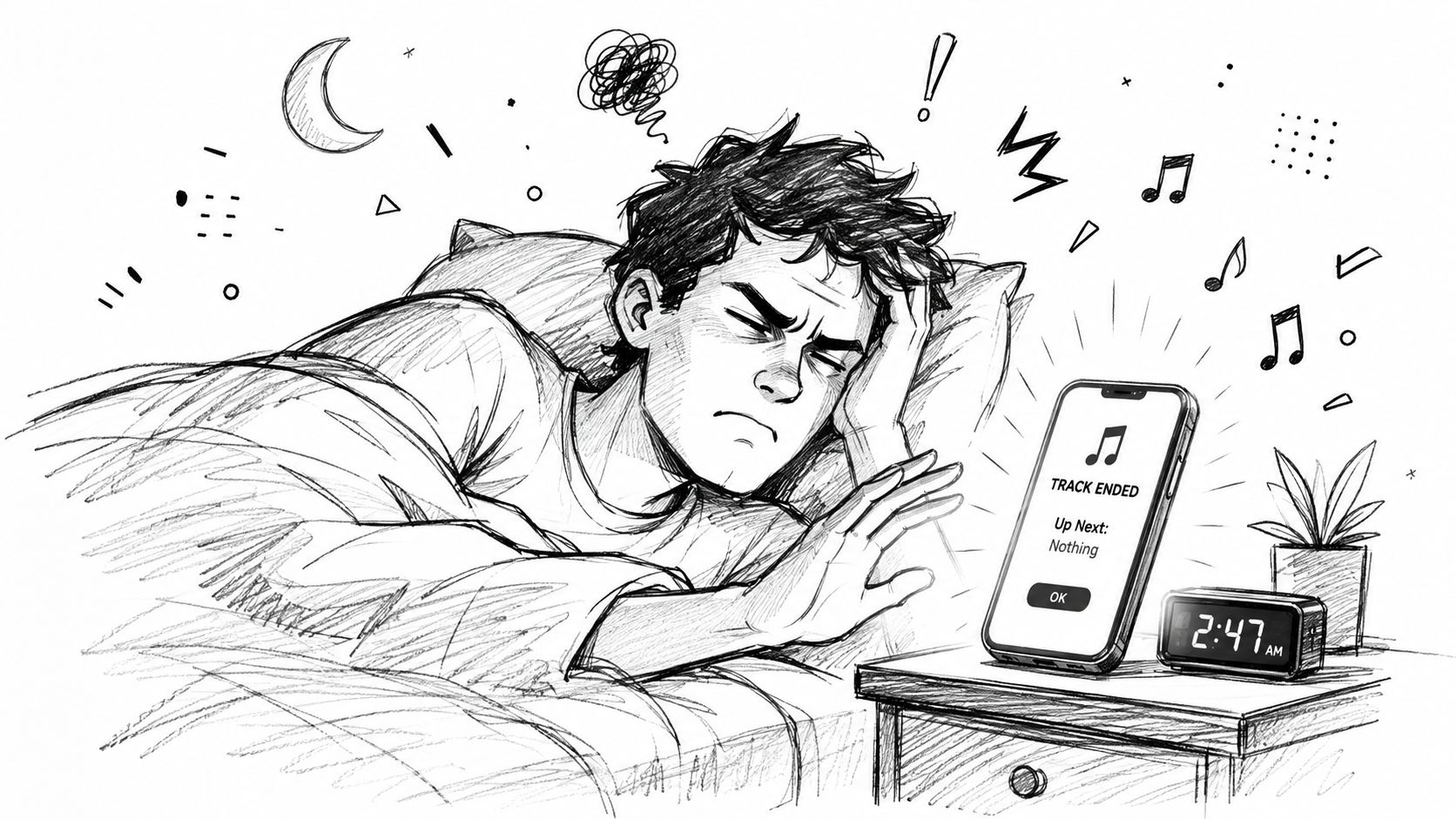
Sleep music often fails for reasons that have nothing to do with the song selection. The track ends, the volume creeps up, the same playlist stops feeling calming, or the audio begins to mask noise without helping you stay asleep. Those are fixable problems, and you don't need to abandon the whole approach because one setting is off.
Fix the most common failure points
If you wake up when a track changes, use crossfade or a continuous ambient loop so the brain doesn't catch the seam between songs. If the same playlist stops working after a while, rotate material instead of forcing familiarity to do the job forever. The point is to keep the sound predictable without making it stale enough that your brain starts editing it out.
Volume creep is another common trap. People start low, then slowly turn it up because they're trying to overcome room noise, and by the time they fall asleep the audio has become stimulation instead of shelter. Set a hard ceiling before bed and leave it there.
- Track transitions: Use crossfade or one long mix so you don't wake on the handoff.
- Habituation: Swap playlists or sound types when the routine starts feeling too familiar.
- Volume drift: Pick one low setting and keep it fixed for the whole night.
- Noise masking overuse: If you're using audio to cover snoring or traffic, pair it with physical fixes instead of turning it louder.
When the issue is waking up after initial success, the fix often isn't more music. It's a tighter bedtime routine and fewer competing cues in the room. How to fall back asleep quickly is a useful companion read if you tend to wake in the middle of the night and need a reset plan.
If the music starts to feel like a dependency, pause it for a few nights and rebuild the cue from scratch.
Customizing Sleep Audio for Your Specific Needs
Different sleepers need different audio strategies. A chronic insomniac, a shift worker, and an athlete all use the same bedtime hours differently, and a mouth-breather has a separate set of issues altogether. The best results come from matching the format and timing to the sleep problem, not the other way around.
Match the sound to the sleeper
For adults with chronic insomnia, longer wind-downs tend to work better than a quick toggle from silence to sleep. Daily listening over 14 to 90 days was associated with better subjective sleep quality in the 2019 systematic review, as reported in the meta-analysis. That makes consistency more important than novelty, especially if bedtime anxiety is part of the pattern.
Shift workers usually need the fastest possible downshift after a late or irregular day. Low-tempo ambient tracks can help create a repeatable cue even when the clock is inconsistent, but the timing matters more than the genre. Keep the routine identical before daytime sleep or post-shift sleep so the body gets one stable signal instead of a different ritual every day.
Athletes often do better with quieter, simpler audio because recovery is already being pushed by training load, travel, and pre-competition nerves. A soft track can help them disconnect without adding cognitive input. For mouth-breathers and snorers, audio is only part of the solution, because the airway still needs support.
That's where Hydrating Mouth Tape can fit into a broader routine, since it's designed to support quieter nights with reduced snoring, promote proper tongue posture, and encourage nitric oxide-supportive breathing. If chronic tinnitus is also part of the picture, support for chronic tinnitus symptoms may matter more than the playlist itself, because constant internal noise changes how any audio routine feels.
The best routine is the one you can repeat without negotiating with it at bedtime.
For people who want one evening stack instead of a dozen disconnected habits, SleepHabits focuses on melatonin-free wind-down tools, nasal breathing support, and sleep education that fits a habit-based routine. It's a practical model for anyone trying to pair audio with breathing cues rather than relying on sound alone.
If you want a cleaner sleep routine, start with one track, one volume setting, and one bedtime cue, then keep them consistent for a week. SleepHabits brings together sleep audio thinking, nasal breathing tools, and melatonin-free support in a way that fits real nights, not perfect ones. Visit SleepHabits and build a calmer wind-down that you can repeat tonight.