

If you're struggling with a CPAP machine, you're not alone. The good news is that there are many other effective sleep apnea treatments other than the CPAP, from custom-fit oral devices and implantable tech to smart lifestyle changes. This guide will walk you through these powerful alternatives so you can find a practical solution that actually works for you.
Exploring Effective CPAP Alternatives
Getting diagnosed with obstructive sleep apnea (OSA) means understanding just how critical treatment is. But for many, the so-called gold standard—Continuous Positive Airway Pressure (CPAP)—is just too difficult to tolerate. The mask, the hose, the noise... it's a lot. Thankfully, there are plenty of other science-backed options available, so you don't have to choose between effective treatment and a comfortable night's sleep.
This guide is designed to give you a complete picture of your options. We'll break down and compare the leading CPAP alternatives to help you go into a conversation with your doctor feeling prepared and confident. Just remember, the best solution is always personal. For example, if your apnea is severe when you sleep on your back but disappears on your side, a simple positional therapy device might be all you need. The goal is to match the treatment to your specific type of sleep apnea, anatomy, and lifestyle.
Why Finding the Right Treatment Matters
Leaving sleep apnea untreated is linked to some serious health risks, but finding a treatment you can actually stick with makes a huge difference. In fact, one study showed that patients who used their CPAP consistently had a 37% reduced risk of dying from any cause compared to those who didn't. This just underscores how important it is to find a therapy that works for you long-term, even if it’s not CPAP.
Beyond CPAP, a number of different approaches can get your sleep apnea under control. Below is a quick look at the treatments we'll be comparing in this guide. You can also learn more about comprehensive sleep apnea treatment options from providers who specialize in this area.
Overview of CPAP Alternatives
| Treatment Category | Examples | Primary Goal |
|---|---|---|
| Oral Appliance Therapy | Mandibular Advancement Devices (MADs) | Physically repositions the lower jaw or tongue to keep the airway open. |
| Surgical Interventions | UPPP, Nasal Surgery, Jaw Advancement | Removes or modifies anatomical obstructions that block the airway during sleep. |
| Implantable Devices | Hypoglossal Nerve Stimulation (Inspire) | Stimulates key throat muscles to prevent airway collapse during inhalation. |
| Positional Therapy | Wearable sensors, specialized pillows | Trains you to avoid sleeping on your back, where airway collapse is more likely. |
| Lifestyle Adjustments | Weight management, exercise, alcohol reduction | Addresses root causes and contributing factors like excess weight and muscle laxity. |
Each of these paths offers a different way to manage OSA. And for those just looking to support better breathing, even simple tools can help. Check out our guide on how nasal strips for snoring can be a great addition to your primary therapy. Our goal is to give you the knowledge to find a path toward healthier, more restorative sleep.
A Detailed Look at Oral Appliance Therapy
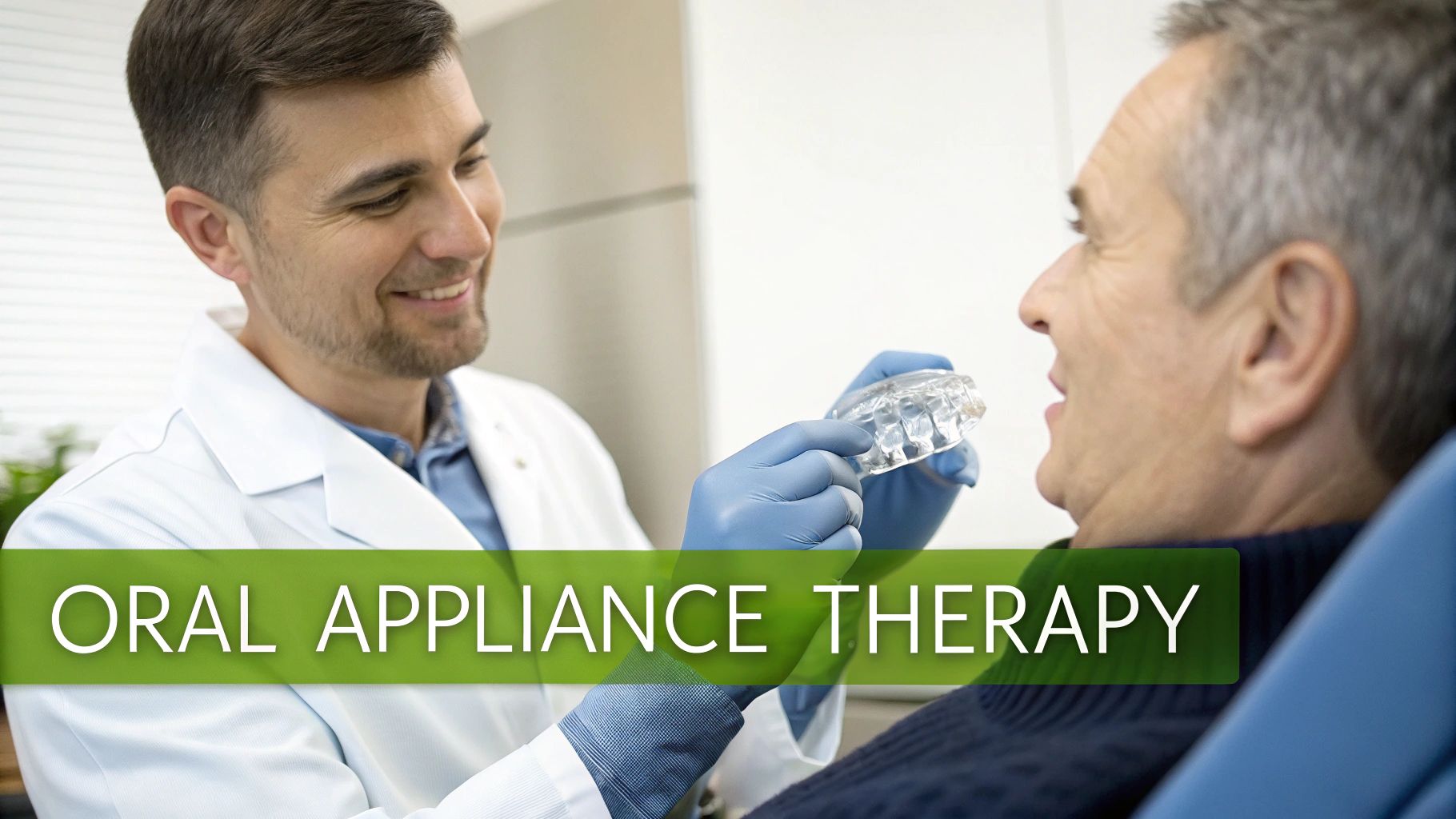
For anyone looking for effective sleep apnea treatments beyond CPAP, oral appliance therapy is often one of the first and best options to consider. These custom-fitted devices, which look a lot like a sports mouthguard or a clear orthodontic retainer, are a comfortable and low-profile way to keep your airway open while you sleep. No masks, no hoses, no electricity—for many people, they are a complete game-changer.
The therapy generally relies on two kinds of devices. The most common is the Mandibular Advancement Device (MAD), which works by gently shifting your lower jaw forward by just a few millimeters. This subtle repositioning is enough to keep the tongue and soft tissues in your throat from collapsing and blocking your airway. A less common type is the Tongue-Retaining Device (TRD), which uses mild suction to hold the tongue in a forward position.
Who Is the Ideal Candidate for Oral Appliances?
This approach isn't for everyone, but it’s remarkably effective for specific profiles. Your sleep specialist can tell you for sure, but oral appliances are often a great fit for:
- Individuals with mild to moderate obstructive sleep apnea. For this group, a well-made oral appliance can be just as effective as a CPAP machine.
- CPAP-intolerant patients. If you've tried CPAP and just can't get used to it—due to claustrophobia, noise, or mask leaks—an oral appliance offers a much more comfortable and viable alternative.
- Frequent travelers. A practical example: if you travel for work, an oral appliance fits in your pocket, requires no power, and passes through airport security with ease, unlike a bulky CPAP.
- Primary snorers. Even if you don't have diagnosed OSA, these appliances are highly effective at reducing or even stopping snoring, which means quieter nights for you and your partner.
The effectiveness of oral appliances is well-documented. For a long time, the question was whether they could truly compete with the "gold standard" of CPAP. Today, the evidence is clear that for the right patient, they absolutely can.
The research really backs this up. In a comprehensive 2-year randomized trial with 103 patients who had mild to severe obstructive sleep apnea, scientists found no statistical difference in success rates between oral appliances and CPAP. Both treatments were equally effective at lowering AHI scores and improving daytime sleepiness.
Navigating the Treatment Process and Costs
Getting started with an oral appliance is pretty straightforward, and it all begins with your sleep doctor. If they think you're a good candidate, you'll get a referral to a dentist who specializes in sleep medicine. You can learn more about this growing field from practices focused on Dental Sleep Medicine.
Here’s what the process usually looks like:
- Consultation: The dentist will examine your teeth, jaw, and airway to confirm that an appliance is right for you. They'll check for things like loose teeth or TMJ issues that might be a concern.
- Impressions: They'll take precise digital scans or physical molds of your teeth to create a custom device that fits perfectly. Actionable Tip: Avoid over-the-counter "boil-and-bite" guards. They are not designed for OSA and can even make your apnea worse or cause jaw problems.
- Fitting and Adjustment: Once your appliance is fabricated, you'll go back for a fitting. The dentist will make the initial adjustments and show you exactly how to wear and care for it.
- Follow-up: You'll have regular follow-up appointments to fine-tune the appliance for maximum comfort and effectiveness and to check for any side effects.
While most people tolerate them extremely well, some potential side effects include temporary jaw soreness, tooth tenderness, or minor shifts in your bite. These issues are usually manageable and often disappear as your body adjusts to the device.
Custom-made appliances typically cost between $1,500 and $3,000, but the good news is that many medical insurance plans, including Medicare, will cover a significant portion of the cost when it's deemed medically necessary.
Comparing Surgical and Implantable Device Solutions
When lifestyle changes and oral appliances don’t get you across the finish line, it might be time to look at more permanent solutions. Surgical and implantable devices are serious options for people whose sleep apnea is caused by specific anatomical issues—think of it as addressing the root physical problem rather than just managing the symptoms.
These aren't temporary fixes. They're designed to physically alter or support the airway to keep it open. A practical example: if your tonsils are so large they nearly touch, removing them can create a permanently wider airway, potentially resolving the apnea entirely. This is very different from an oral appliance, which only works when you wear it.
Unpacking Surgical Options for Airway Correction
Traditional surgery for sleep apnea is all about creating more space. It involves an ENT (Ear, Nose, and Throat) specialist removing or repositioning tissue that's causing the obstruction. But they don't just go in blindly. The specific procedure is tailored to where your airway is collapsing, something that's often pinpointed with a diagnostic exam called a drug-induced sleep endoscopy (DISE). This lets your surgeon see exactly what’s happening while you're asleep.
A few common procedures you might discuss are:
- Uvulopalatopharyngoplasty (UPPP): This is one of the most frequently performed procedures. The surgeon removes extra tissue from your soft palate and uvula to open up the back of your throat.
- Nasal Surgery: Sometimes the problem starts in the nose. For example, if you have a severely deviated septum, a septoplasty can straighten it and dramatically improve airflow. While often not a complete cure for OSA on its own, it can significantly lower apnea severity and make other treatments far more effective.
- Maxillomandibular Advancement (MMA): This is a more intensive surgery that physically moves both the upper and lower jaws forward. It's one of the most effective surgical options out there, but it comes with a much more involved recovery.
The ideal candidate for surgery is someone with a clear, correctable anatomical blockage. For instance, a person with massive tonsils and a floppy soft palate would likely be a great fit for a UPPP. Success rates vary a lot based on the procedure and the patient, which is why a thorough evaluation with a specialist is non-negotiable.
The Rise of Hypoglossal Nerve Stimulation
A huge leap forward in this space is hypoglossal nerve stimulation, with the most well-known system being Inspire. This isn't surgery to remove tissue. Instead, it’s an implantable device that works with your body's own breathing rhythm. It's essentially a pacemaker for your tongue.
The system has three parts implanted under the skin in the upper chest: a small generator, a breathing sensor, and a stimulation lead. When you take a breath, the sensor detects it and tells the generator to send a tiny, gentle electrical pulse to the hypoglossal nerve, which controls tongue movement. This nudge pushes your tongue forward just enough to keep it from falling back and blocking your airway.
Hypoglossal nerve stimulation represents a shift from structurally altering the airway to dynamically supporting it during sleep. It addresses the muscle relaxation that causes collapse without removing any tissue, offering a less invasive yet highly effective solution for the right patient.
This treatment is FDA-approved for people with moderate to severe obstructive sleep apnea who just can't tolerate CPAP. You also have to meet specific criteria for your BMI and the pattern of your airway collapse. The procedure itself is outpatient, recovery is usually quick, and you control the device with a small remote you turn on before bed.
While Inspire is a game-changer for many, potential side effects can include temporary tongue soreness or weakness and some discomfort around the implant site. The cost is significant, but it's now covered by many insurance plans, including Medicare, for eligible patients.
Positional Therapy and Lifestyle Adjustments
Sometimes, the simplest solutions are the most effective. For many people with mild or position-dependent obstructive sleep apnea, the most powerful alternatives to CPAP aren't complex machines but practical adjustments to how they sleep and live.
If your sleep study shows your AHI is 30 when you sleep on your back but only 4 when you're on your side, you have positional OSA. The goal is simple: train yourself to stay off your back.

Training Your Body with Positional Therapy
This is where positional therapy shines. It’s all about training your body to sleep on its side. While the old-school trick was sewing a tennis ball to the back of a t-shirt, today’s options are far more comfortable and sophisticated.
Modern positional therapy devices include:
- Wearable Sensors: A practical example is a small pod that you stick to your chest. When you roll onto your back, it vibrates gently—enough to prompt you to change position without fully waking you up.
- Specialized Pillows: Contoured body pillows are designed to support your body in a way that makes side-sleeping feel more natural and secure, physically discouraging you from rolling over.
- Bumper Belts: Worn around the waist, these belts have a firm cushion on the back that makes lying flat on your back physically uncomfortable or impossible.
If your sleep study shows a much higher AHI when you’re on your back, positional therapy is an excellent, non-invasive option worth discussing with your doctor. It has minimal side effects and can easily be used alongside other treatments.
High-Impact Lifestyle Changes for Lasting Improvement
While devices manage symptoms, lifestyle adjustments can fundamentally change the severity of your sleep apnea. These are the changes that empower you to take control and often lead to dramatic, lasting improvements.
Structured Weight Management Excess weight, particularly around the neck, is one of the biggest risk factors for OSA. Even a small amount of weight loss can make a huge difference in opening up your airway.
A core principle in sleep medicine is that a 10% reduction in body weight can slash your Apnea-Hypopnea Index (AHI) by 25% or more. This makes weight management one of the most powerful long-term strategies you can pursue.
Practical Steps:
- Set a Realistic Goal: For a 200-pound person, a 10% goal is 20 pounds. Aim for a healthy loss of 1-2 pounds per week.
- Focus on Nutrition: A practical change is swapping sugary sodas for water and adding a vegetable to every meal. Small, consistent changes are more sustainable than drastic diets.
- Seek Support: Work with a doctor or dietitian to create a plan that's both effective and sustainable for you.
Embracing Regular Exercise Physical activity is crucial for weight loss, but it also directly benefits your airway by improving muscle tone in your throat, making it less prone to collapse. Aim for at least 150 minutes of moderate-intensity activity each week, like brisk walking, cycling, or swimming.
Reducing Alcohol and Sedative Use Alcohol and certain medications like muscle relaxants or sedatives cause your throat muscles to become overly relaxed during sleep. Actionable Tip: If you enjoy an evening drink, try to have it at least four hours before bedtime to give your body time to metabolize it. This simple timing change can significantly reduce its impact on your breathing.
Quitting Smoking for Clearer Airways Smoking irritates and inflames your upper airway, causing swelling that narrows the passage. Quitting is one of the best things you can do for your sleep apnea and overall health. As the inflammation subsides, you'll likely notice a real reduction in both snoring and apnea events.
Improving your breathing patterns is another key step. If you're a mouth breather, you're not getting the full benefits of stabilized airflow. Our guide on how to stop mouth breathing offers practical tips to make the switch.
Research has backed up these simpler strategies. One study showed positional therapy reduced sleep apnea by an average of 7.4 events per hour, and patients stuck with it for 2.5 hours longer per night than they did with CPAP. It’s a safe, effective, and often more tolerable option for the right person.
Comparing Non-CPAP Sleep Apnea Treatments
With so many alternatives to CPAP, it can be tough to know where to start. This table breaks down the most common options to help you see how they stack up against each other and have a more informed conversation with your healthcare provider.
| Treatment Type | How It Works | Ideal Candidate Profile | Potential Effectiveness (AHI Reduction) | Key Considerations (Cost, Comfort, Invasiveness) |
|---|---|---|---|---|
| Oral Appliances | A custom-fit mouthguard holds the lower jaw forward, opening the airway. | Mild to moderate OSA, especially for those who can't tolerate CPAP. Not ideal for severe central sleep apnea. | 50-70% reduction in AHI is common. | Low invasiveness. Cost: $1,500-$3,500. Can cause jaw soreness or tooth movement. |
| Positional Therapy | Devices train or prevent you from sleeping on your back, where OSA is often worse. | People with confirmed positional OSA (AHI significantly higher when supine). | Varies widely; can normalize AHI in ideal candidates (up to 80-90% reduction). | Non-invasive. Cost: $100-$500. May take time to adapt. |
| Weight Management | Reducing excess body weight, especially around the neck, decreases airway compression. | Overweight or obese individuals with any level of OSA severity. | A 10% weight loss can reduce AHI by 25% or more. | Non-invasive but requires significant lifestyle change. Cost varies (diet plans, gym). |
| Hypoglossal Nerve Stimulation | An implanted device (like Inspire) stimulates the nerve controlling the tongue, moving it forward to open the airway. | Moderate to severe OSA, CPAP-intolerant, specific airway anatomy, and BMI under 32-35. | Can reduce AHI by 70-90%. | Surgical and invasive. Cost: $50,000+. Requires recovery and device activation. |
| Upper Airway Surgery | Procedures like UPPP or TORS remove or reposition tissue in the throat to enlarge the airway. | Individuals with specific anatomical blockages who have not responded to other treatments. | Highly variable success rates (40-60%). | Invasive, significant recovery time. Risks of pain, bleeding, changes in voice. |
Each of these treatments has its place. The key is matching the right therapy to your specific diagnosis, anatomy, and lifestyle. An open discussion with a sleep specialist is the best way to determine which path is right for you.
Emerging and Complementary Therapies
As our understanding of sleep medicine grows, so do the options for managing obstructive sleep apnea. The world beyond CPAP is expanding, offering new hope for people with complex conditions or those just looking to make their current plan work even better. From smarter air pressure devices to targeted muscle exercises, this is the frontier of sleep apnea care.
These approaches acknowledge a simple truth: effective management often requires more than one tool in the toolbox. For some, that might mean a more sophisticated version of PAP therapy. For others, it means fundamentally strengthening the airway itself. This forward-thinking perspective is driving the field toward more personalized and comfortable sleep apnea treatments.
Nuanced Alternatives to Standard CPAP
While the goal is to find non-CPAP solutions, it's worth knowing that not all Positive Airway Pressure (PAP) machines are created equal. If you've struggled with the constant, fixed pressure of a standard CPAP, there are more responsive alternatives that can feel much more natural.
- APAP (Automatic Positive Airway Pressure): Think of this as a "smart" CPAP. Instead of blasting you with one fixed pressure all night, an APAP machine uses algorithms to sense your breathing in real-time. It automatically dials the pressure up when it detects an obstruction and eases off when your airway is stable, giving you only the minimum support needed at any given moment.
- BPAP (Bilevel Positive Airway Pressure): A BPAP machine offers two distinct pressure settings—a higher pressure for your inhale and a lower pressure for your exhale. This makes breathing out feel much less forceful, which is a common complaint with standard CPAP. BPAP is often the go-to for patients with more complex breathing disorders or those who simply can't tolerate high CPAP pressures.
These devices bridge a critical gap for people who need air pressure support but find the traditional CPAP experience too difficult. They offer a more tailored approach that can make a world of difference for comfort and consistency.
Myofunctional Therapy: Strengthening Airway Muscles
One of the most empowering complementary therapies is orofacial myofunctional therapy. At its core, this is physical therapy for the muscles of your tongue, throat, and face. The idea is simple: weak, poorly toned muscles are more likely to relax and collapse during sleep, blocking your airway.
Myofunctional therapy is a structured program of specific exercises prescribed by a trained therapist. The goal isn't just to do exercises; it's to retrain these muscles to function correctly, improving your tongue's resting posture and strengthening the very tissues that keep your airway open.
Myofunctional therapy shifts the focus from propping the airway open to fundamentally strengthening it. By improving muscle tone and resting tongue position, it addresses one of the root causes of airway collapse, offering a proactive way to manage symptoms.
A simple example of an exercise is pressing the tip of your tongue firmly against the ridge behind your upper front teeth for 10 seconds, then relaxing. A therapist would guide you through a daily routine of these targeted movements. It requires commitment—daily practice is essential—but studies have shown it can slash AHI scores, often by as much as 50% in adults. It's most effective when paired with a primary treatment like an oral appliance or positional therapy. If snoring is also a concern, you might want to look into herbal ways to stop snoring as another supportive measure.
Supplemental Oxygen and Emerging Technologies
For a small group of patients, especially those with complex sleep apnea or other respiratory conditions, a doctor might prescribe supplemental oxygen therapy. This involves wearing a thin tube called a nasal cannula to deliver a low flow of oxygen during sleep. It's important to understand that this doesn't stop the apnea events from happening. What it does do is ensure your blood oxygen levels don't drop to dangerous levels when those pauses in breathing occur. It’s almost always used alongside another primary therapy.
Looking ahead, new ideas are constantly bubbling up. One interesting innovation is continuous Negative External Pressure (cNEP). Instead of forcing air in like a CPAP, a cNEP device is a soft collar that applies gentle, continuous suction to the outside of the neck. This negative pressure helps pull the soft tissues forward, preventing the airway from collapsing from the outside in. While still relatively new, it’s a perfect example of the creative thinking that’s shaping the future of sleep apnea treatment.
Making an Informed Decision with Your Doctor
You've explored the world of sleep apnea treatments beyond the CPAP machine, and now you have a much clearer map of the territory. The next, most important step is bringing this knowledge into a real conversation with your doctor. Your specific diagnosis, anatomy, and lifestyle are the final pieces that will point you toward the best path forward.
Remember, the goal isn't just to find any alternative; it's to find the right one for you. This is a team effort. When you walk into your appointment prepared and informed, you become an active partner in your own care, helping select a therapy you can actually live with for the long haul.
Preparing for Your Consultation
A little prep work can make your appointment exponentially more productive. Your doctor needs specific details to give you the best advice, and having them ready makes for a much smoother, more effective discussion.
Before your visit, create a simple list or "symptom diary":
- Your CPAP Story: Be specific. For example: "The mask makes me claustrophobic," or "I keep waking up because the mask seal breaks when I turn on my side."
- Your Symptoms: List out how sleep apnea impacts your day. Note specific examples like, "I fall asleep during meetings at 3 PM," or "I wake up with a headache at least four times a week."
- Your Medical History: Make sure to include other health conditions like high blood pressure, diabetes, or any TMJ issues. These can absolutely influence which treatments are a good fit.
This information gives your doctor the context they need to start filtering the options. Your real-world experience is just as valuable as the data from your sleep study.
The best treatment outcomes always happen when the patient is an active part of the decision. Your input on what feels comfortable, convenient, and truly sustainable isn't just helpful—it's essential.
Key Questions to Ask Your Sleep Specialist
Once you're talking with your specialist, a few targeted questions can ensure you leave with a clear action plan. This is your chance to really dig into the treatments that seem like the best fit for your unique situation.
Try asking some of these:
- Looking at my sleep study and my anatomy, what do you think is the main reason my airway is collapsing? Is it my tongue, my palate, or something else?
- Which non-CPAP options do you believe would work best for my type and severity of sleep apnea?
- For a patient like me, what is the practical, day-to-day experience with [oral appliance/Inspire/etc.]? What are the common complaints you hear?
- What does the process look like to get started with something like an oral appliance? What kind of follow-up is needed?
- How will we measure success? Will I need another sleep study, or can we track progress with a home sleep test?
These questions help pivot the conversation from a general overview to a personalized game plan. The answers will help you weigh the pros and cons of each option with your own life in mind.
This decision tree can help visualize how different factors might point toward certain sleep apnea treatments other than the CPAP.
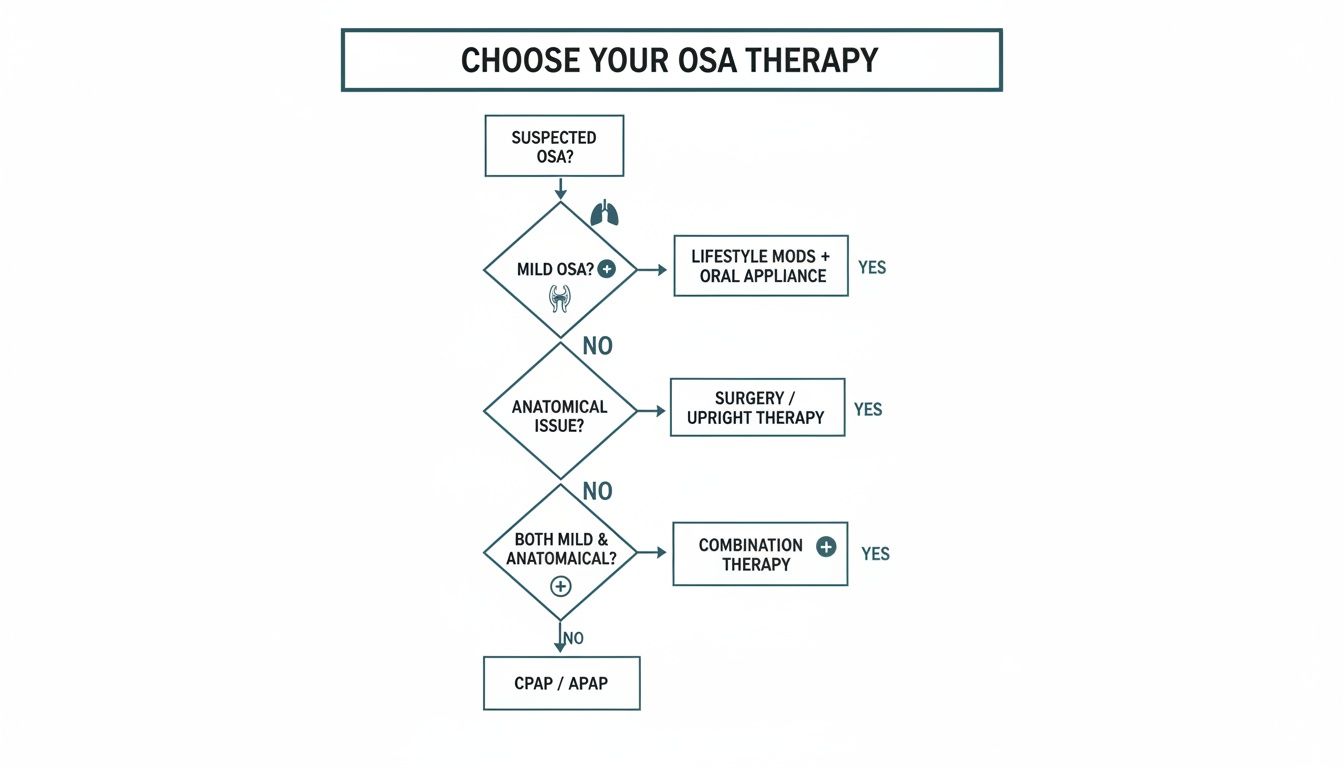
As the visual shows, the right path really depends on whether your OSA is mild, primarily anatomical, or a mix of factors, which helps focus the discussion with your doctor.
Can Sleep Apnea Be Cured Without a CPAP?
It's a common question. While some treatments can get your symptoms down to a sub-clinical level (AHI < 5), a true "cure" depends on the root cause. For example, some people find their OSA resolves after significant weight loss. Surgery can also offer a permanent fix for specific anatomical blockages.
For most people, though, sleep apnea is a chronic condition that needs lifelong management. The goal of non-CPAP treatments is to get the condition under control, eliminate the serious health risks, and give you your quality of life back.
Are Over-the-Counter Snoring Devices Safe for Sleep Apnea?
This is critical: simple snoring is not the same as sleep apnea. Many over-the-counter (OTC) devices might quiet your snoring, but they are absolutely not designed or approved to treat OSA.
Sleep apnea is a serious medical condition where you literally stop breathing. Using an unproven device gives you a false sense of security while leaving the dangerous health consequences completely unaddressed. You should always work with a medical professional and only use FDA-approved treatments.
Your journey to better sleep doesn’t end with a diagnosis—it starts there. Armed with good information and a clear plan, you can confidently explore the many effective sleep apnea treatments other than the CPAP and find the one that finally delivers the restorative rest you deserve.
At SleepHabits, we believe that better nights lead to better days. Our science-backed solutions, from our Restore+ sleep aid to our nasal strips and mouth tape, are designed to support deeper, more efficient rest without melatonin. Discover how you can improve your nighttime breathing and wake up refreshed by exploring our products at https://sleephabits.com.