

You wake up thirsty, your tongue feels coated, and your throat is scratchy. Your partner may mention that you snored, or you may notice that you slept with your mouth open even though you went to bed breathing normally through your nose.
That pattern can be frustrating, but it also provides useful information. Nighttime mouth breathing is usually a symptom, not a bad habit. Your body is trying to keep air moving when nasal breathing becomes difficult.
The cause usually falls into one of three groups: temporary congestion, structural blockage, or sleep-disordered breathing and related airway habits. Once you identify the likely group, the next step becomes clearer. A congestion problem calls for nasal care, while persistent one-sided blockage or signs of sleep apnea deserve professional assessment.
By the end, you'll know which simple checks you can try at home, which natural fixes match each cause, and when an ENT or sleep specialist should examine your airway.
Your mouth opens at night because your nose couldn't keep up.
Why You Wake Up With a Dry Mouth
Saliva normally keeps the mouth comfortable and helps wash away food particles. When you sleep with your mouth open, air passes directly across the tongue, lips, and throat for hours. You may wake with cotton mouth, cracked lips, bad breath, or a parched throat, even if you drank enough water before bed.
Consider two different mornings. After a spring night, you wake congested, sneezy, and dry mouthed. On another morning, you feel the same dryness every day, with one nostril blocked whenever you lie on your side. The first pattern points toward a temporary nasal problem. The second raises more concern about anatomy or a persistent airway issue.
Nighttime mouth breathing matters because it can reflect increased nasal airflow resistance. Allergies, a cold, sinus inflammation, a deviated septum, enlarged tissue, or sleep-disordered breathing can make the nose feel like a narrowed doorway. During sleep, your body chooses the easier route, even if that route dries the mouth and changes how the throat behaves.
The useful question isn't, “How do I keep my lips closed?” Ask instead, “Why is nasal breathing difficult after I fall asleep?” That question prevents you from covering up a blocked airway with a short-term trick.
The rest of the answer depends on timing and pattern. Does the problem appear only during allergy season? Is one nostril always worse? Does your partner hear loud snoring, pauses, or gasping? Those clues help separate a passing obstruction from a problem that needs evaluation.
How Nasal Breathing Is Supposed to Work
Your nose works like a built-in HVAC system for the respiratory tract. Before air reaches the throat and lungs, the nasal passages prepare it for the journey.
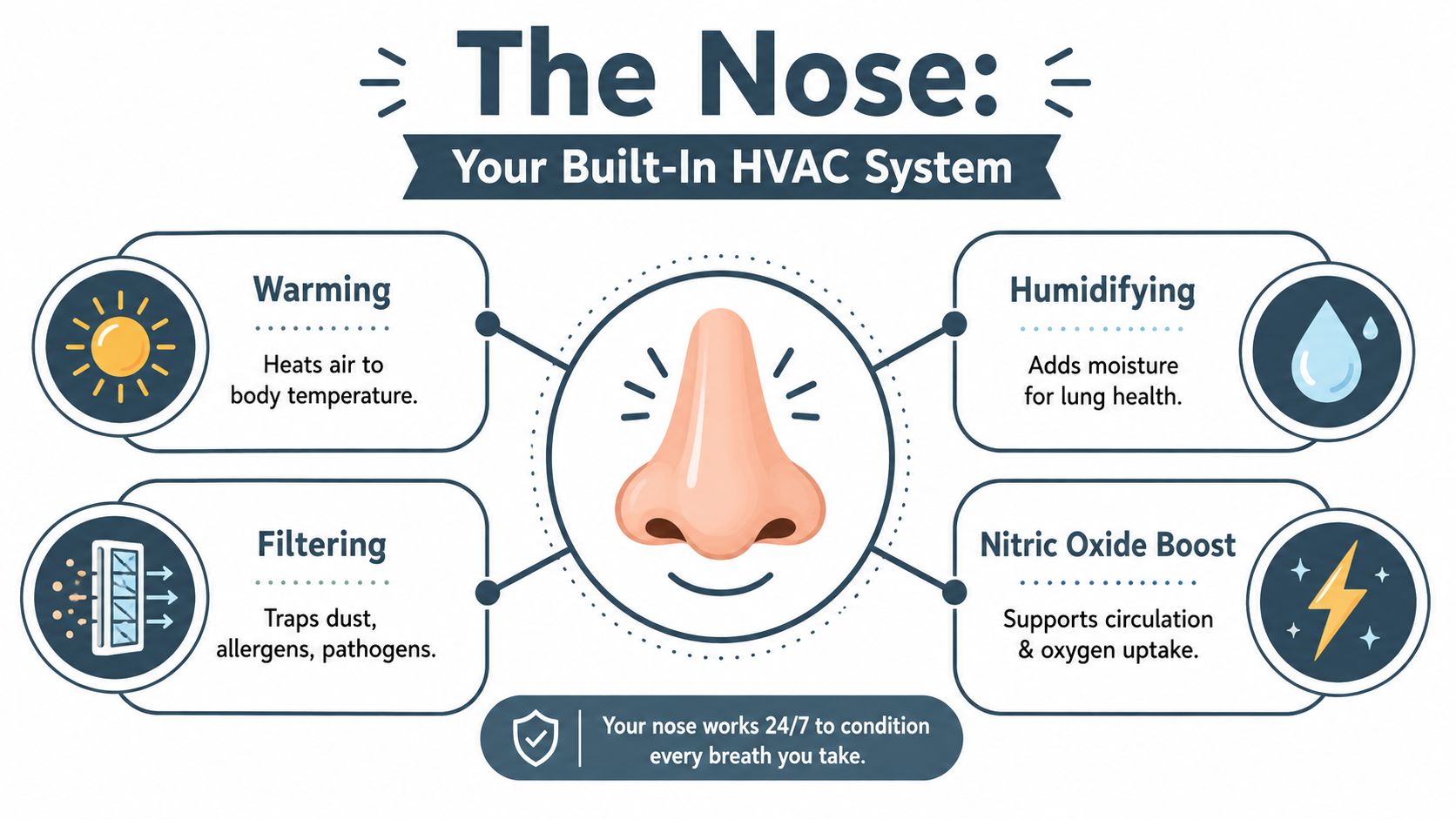
The nose warms incoming air and humidifies it, reducing irritation to delicate airway tissue. Small structures inside the nasal passages help filter dust and other particles. Nasal breathing also adds nitric oxide to inhaled air, a molecule involved in circulation and oxygen delivery.
The mouth does not provide the same preparation. It acts more like an emergency side entrance. If the main entrance becomes crowded, air uses the route that remains open.
Why the body chooses the mouth
Air follows the path of least resistance. This shift does not require conscious choice, and you do not need to train yourself to remember every breath. As nasal resistance rises, the body can redirect airflow through the mouth to maintain ventilation.
Sleep makes that switch more likely. Lying down can increase the sense of nasal fullness, while relaxed throat muscles offer less support around the airway. A nose that feels open at two in the afternoon may become harder to use at two in the morning because the conditions have changed.
That pattern helps explain why nighttime mouth breathing can have different roots. A short-lived blockage may behave like a temporarily crowded highway. A persistently narrow nasal passage creates a more regular detour, while sleep-disordered breathing can add changes farther down the airway. The right self-check depends on the pattern: compare nights during and outside allergy symptoms, notice whether the same nostril stays difficult, and ask a bed partner about snoring, pauses, or gasping.
The airway is a connected passage
The nose, mouth, tongue, jaw, throat, and lungs function as one connected route rather than isolated parts. A change at the entrance can affect the shape and stability of the passage farther down. That connection is why better nasal airflow may matter even when the symptom you notice is dry mouth or snoring.
For a practical comparison of the two breathing routes, see this guide to nasal breathing versus mouth breathing. The practical aim is restore the nasal route when possible, rather than forcing the mouth to compensate indefinitely. Persistent one-sided blockage or signs of disturbed breathing call for assessment by an ENT or sleep specialist.
The Common Causes of Nighttime Mouth Breathing
You may breathe comfortably through your nose at bedtime, then wake with your mouth open and no clear explanation. The cause is often easier to identify when you separate it into three groups: temporary congestion, structural obstruction, and sleep-disordered breathing.
Temporary congestion
Allergies, colds, sinus infections, and short-lived inflammation can narrow the nasal passages for a limited period. Someone with spring allergies may breathe normally during the day, then become congested after lying down in a bedroom containing pollen, dust, or pet dander.
The useful clue is variation. Notice whether mouth breathing appears during a particular season, after exposure to an irritant, or while you are ill, then eases when that trigger settles. Comparing nights with and without symptoms can point toward a temporary cause.
Structural obstruction
A deviated septum can narrow one or both nasal passages. If the right nostril feels blocked on most nights, especially when you lie on your right side, anatomy may be contributing. Enlarged turbinates and nasal polyps can also reduce the space available for airflow.
Children have another possible source of obstruction: enlarged adenoids. Clinical literature identifies adenoid hypertrophy as a common cause of nasopharyngeal obstruction in children. A pediatric review reported a prevalence of about 34% in the general pediatric population, with higher rates in clinic-referred groups, as described in the pediatric review of adenoid obstruction. The same study listed allergic rhinitis, enlarged adenoids, enlarged tonsils, and obstructive septal deviation among causes of mouth breathing, with allergic rhinitis and adenoid enlargement appearing most often in its sample.
A persistent or side-specific blockage fits this category more closely than congestion that changes from night to night. An ENT can examine the nasal passage, turbinates, septum, and, in children, the adenoids and tonsils.
| Cause Type | Common Examples | Typical Pattern | First Move |
|---|---|---|---|
| Temporary | Allergies, colds, sinus infections | Comes and goes with triggers or illness | Reduce triggers and support nasal moisture |
| Structural | Deviated septum, turbinates, polyps, adenoids, tonsils | Persistent or side-specific blockage | Arrange an ENT assessment if it continues |
| Sleep-disordered | Sleep apnea, airway collapse, open-mouth posture | Snoring, pauses, gasping, unrestful sleep | Discuss evaluation with a sleep professional |
Sleep-disordered breathing and habits
Sleep apnea can interrupt airflow when the throat narrows or closes during sleep. Jaw and tongue position may further reduce airway space. Over time, an open-mouth posture can become the body's familiar response, much like taking a recurring detour when the main road feels blocked.
A childhood sleep study found that “always” mouth breathing increased from 2.1% at 0.5 years to 7.6% at 4.75 years, with a doubling between ages 3.5 and 4.75 years, according to the childhood sleep study. Repeated colds or persistent adenoid enlargement may help establish the pattern, so ongoing symptoms deserve assessment.
Snoring, breathing pauses, gasping, or restless sleep shift attention from the nose alone to the whole airway. A guide on how to diagnose sleep apnea can explain the questions clinicians typically ask, but it cannot replace an examination or sleep evaluation.
What Mouth Breathing Does to Your Sleep and Health
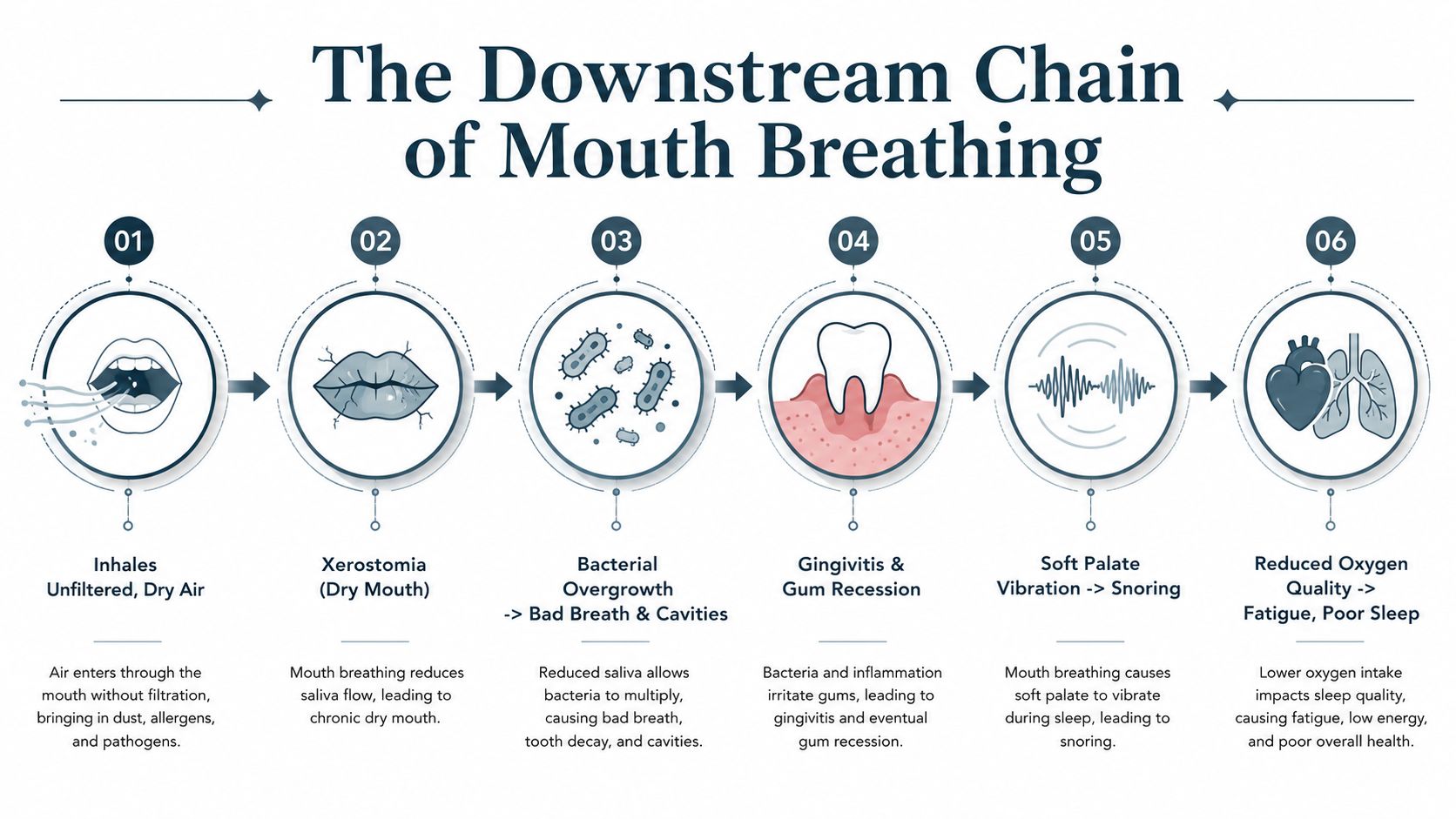
The effects usually unfold as a chain reaction. Air enters through the mouth, which leaves the tongue, lips, and throat exposed to drier airflow. That exposure contributes to dry mouth, morning breath, and irritated oral tissue.
With less moisture, the mouth can feel sticky and uncomfortable. Gum irritation may become more noticeable, particularly if mouth breathing continues night after night. Snoring can develop when airflow causes the soft palate and nearby tissues to vibrate.
The airway mechanics behind the symptom
The more important effect occurs deeper in the airway. Oronasal breathing can lower ventilatory drive, increase upper-airway resistance, and move the jaw and tongue downward and backward. That positioning leaves the throat more vulnerable to narrowing under the negative pressure created during inhalation.
This creates a two-way relationship. Nasal obstruction pushes you toward mouth breathing, then mouth breathing can make the upper airway more collapsible. The result may be louder snoring, restless sleep, repeated arousals, or sleep-disordered breathing.
Practical rule: Treat persistent mouth breathing as an airflow clue, not merely a mouth-care problem.
The pattern is measurable in adults with sleep-related breathing disorders. In a PubMed-indexed study, reported mouth breathing during sleep varied by severity: 9.8% among patients without sleep-related breathing disorders, 16.4% in mild cases, 11.9% in moderate cases, and 4.5% in severe cases, as reported in the sleep-breathing study. These figures don't let you diagnose yourself, but they show why mouth breathing belongs in a broader sleep assessment.
For a concise overview of the practical effects, read about mouth-breathing side effects.
This video offers another visual explanation of how nighttime mouth breathing can affect the airway and sleep:
How to Tell Which Cause Applies to You
You can narrow the possibilities tonight without pretending to diagnose yourself. The aim is to observe patterns, not to prove that you have a particular condition.
Start with the nose
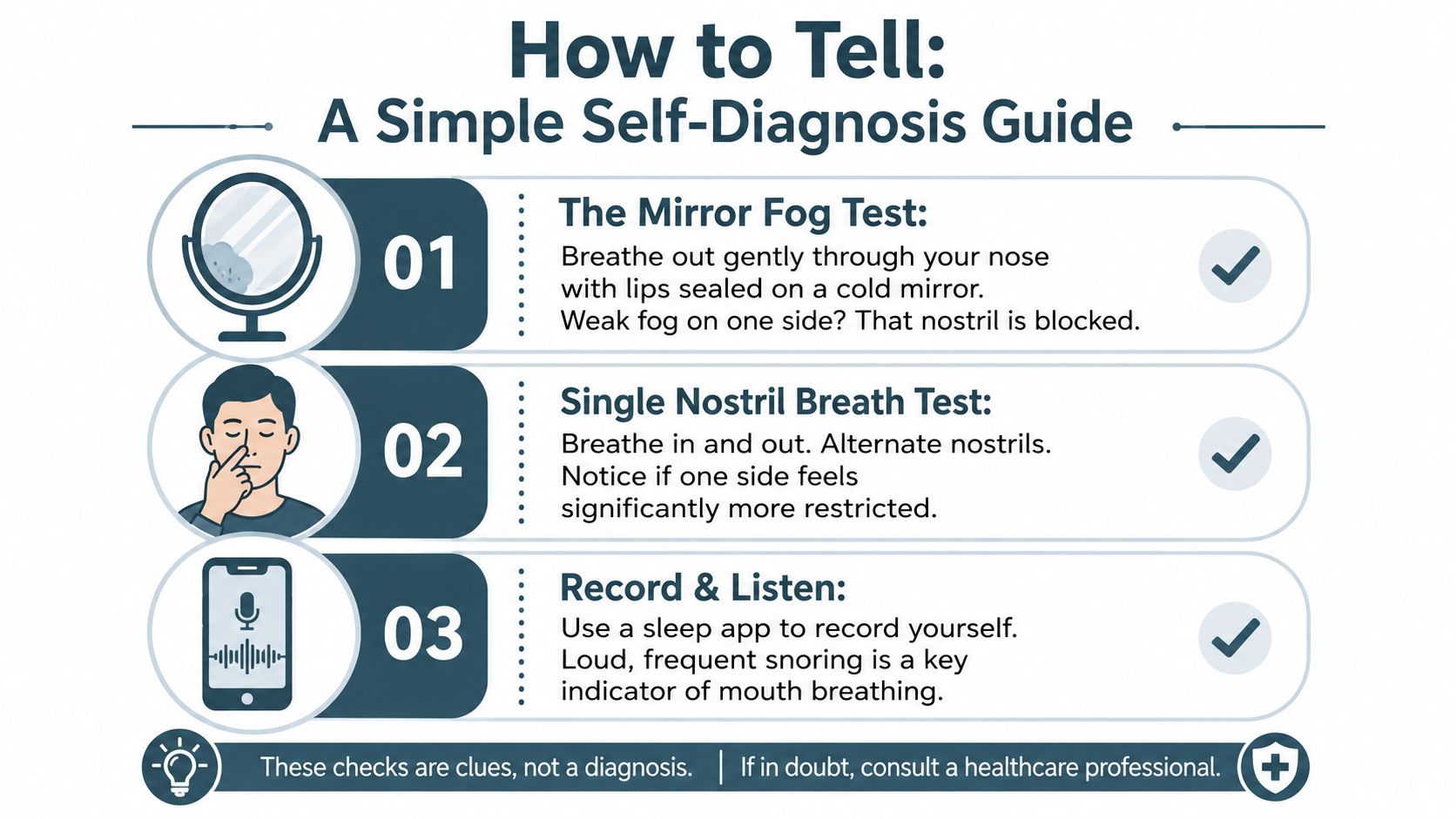
Stand in front of a cool mirror and keep your lips gently sealed. Breathe out through your nose. Notice whether both sides fog evenly or whether one side produces a much weaker patch.
Then test each nostril separately. Close one side gently, breathe in and out through the other, and switch. A large difference between sides, especially when it repeats, makes a structural issue more plausible than a brief cold.
Don't force the breath or insert anything into the nose. This is an observation, not a medical test.
Compare time and position
Keep a short note for several nights. Record whether the problem appears during allergy season, after exposure to dust or pets, or only while you're ill. A pattern that disappears when the trigger disappears points toward temporary congestion.
Also compare sleeping positions. If mouth opening and snoring are worse on your back, relaxed jaw and tongue position may be contributing. If one side feels blocked whenever you lie on that side, nasal anatomy or tissue swelling may be involved.
Listen for sleep clues
Ask your partner what they hear. Loud snoring, repeated pauses, choking sounds, or gasping deserve more attention than an occasional open mouth. If you sleep alone, use a recording app to listen for recurring snoring and abrupt changes in breathing.
Write down how you feel in the morning too. Waking unrefreshed after what seems like a full night can support the case for a sleep evaluation, particularly when it occurs alongside snoring or witnessed pauses.
These checks narrow the field. They don't replace an ENT examination or a sleep study.
Natural Fixes That Address Each Root Cause
The right tool depends on the blockage. A strip, rinse, breathing exercise, or mouth tape can't solve every reason your mouth opens at night.
If congestion is temporary
Use a saline nasal rinse or spray before bed, following safe preparation and device-cleaning guidance. Steam may feel soothing, while a bedroom routine that reduces dust, pet dander, smoke, and other personal triggers can lower the chance of nighttime blockage.
Treat air dryness as part of the environment. Gentle humidity support may help irritated nasal tissue, but keep any humidifying device clean. If allergy symptoms persist, ask a healthcare professional which treatment is appropriate rather than guessing from a product label.
If the passage needs mechanical support
Nasal strips can help widen the external nasal valve for people whose nostrils narrow during sleep. They won't correct a severely deviated septum, polyps, or enlarged adenoids, but they can be a reasonable low-risk experiment when the issue feels close to the front of the nose.
Mouth tape is different. It encourages the lips to stay together and can support a nasal-breathing routine, but it isn't appropriate for a severely blocked nose, unexplained nighttime gasping, or suspected untreated sleep apnea. Never use it to force your mouth closed when you can't breathe comfortably through your nose.
SleepHabits offers hydrating mouth tape and nasal strips as tools within a melatonin-free wind-down routine. For breathing practice, use these nasal breathing techniques during the day first, when you can stop easily if you feel uncomfortable.
If habit and position are involved
Try side sleeping, especially if back sleeping increases snoring or mouth opening. During the day, practice slow nasal breathing with relaxed lips and the tongue resting gently against the roof of the mouth. The purpose isn't to take large breaths. It's to make quiet nasal breathing feel familiar again.
A consistent wind-down can also reduce the urge to chase sleep with complicated fixes. Dim the lights, put screens away, journal briefly, and choose a calming drink if it suits you. Restore+ Magnesium Sleep Aid is a melatonin-free magnesium wind-down drink containing magnesium, L-theanine, tart cherry, lemon balm, glycine, and nitric oxide-supporting ingredients.

Match one intervention to one suspected cause. If your nose is blocked from allergies, start with nasal care. If the nose is open but your mouth falls open during relaxed sleep, position and breathing practice may be more relevant. If you hear pauses or gasping, skip experimentation and arrange an evaluation.
When to See an ENT or Sleep Specialist
Home checks are useful when symptoms are mild and occasional. They shouldn't delay care when mouth breathing is persistent, severe, or paired with signs of airway obstruction.
Arrange an ENT assessment for constant one-sided blockage, especially when the same nostril remains difficult to use night after night. An ENT may inspect the nasal passages, assess the septum and surrounding structures, and use nasal endoscopy when a closer view is needed.
A sleep specialist becomes more important when the issue includes:
- Loud snoring with pauses: Witnessed breathing interruptions, choking, or gasping can point toward sleep-disordered breathing.
- Unrefreshing sleep: Waking tired despite spending a full night in bed deserves attention, particularly with morning headaches, poor concentration, or daytime sleepiness.
- Persistent childhood mouth breathing: Mouth breathing that continues beyond colds can reflect enlarged adenoids or tonsils and should be assessed rather than treated as a harmless posture.
- Progressive symptoms: Increasing congestion, worsening snoring, or repeated awakenings calls for a broader review.
A sleep evaluation may involve an overnight sleep study or a home-based study, depending on your symptoms and clinical setting. The test looks beyond the open mouth and examines breathing interruptions, airflow, oxygen patterns, and sleep-related events.
Use a simple first-week plan:
- Run the mirror and single-nostril checks.
- Note whether symptoms change with seasons, illness, or sleeping position.
- Start one congestion measure, such as saline care or bedroom allergen reduction.
- Add one gentle breathing or position change.
- Reassess after seven nights, sooner if you wake gasping or feel unsafe.
Most nighttime mouth breathing becomes easier to address once you identify the source of nasal resistance or airway instability. The goal isn't to force your mouth shut. It's to make the nasal route open, comfortable, and reliable.
SleepHabits offers melatonin-free wind-down support, nasal strips, and hydrating mouth tape for people building a consistent nighttime breathing routine. Visit SleepHabits to explore those tools alongside practical education on nasal breathing and restorative sleep.