

You wake after a night of turning from one side to the other. The sheets are tangled, your pillow is on the floor, and although you spent what felt like enough time in bed, you still feel as if you barely rested. You may remember several awakenings, a racing mind, an uncomfortable urge to move, or nothing specific at all. By morning, the only clear fact is that your sleep didn't feel restorative.
So, what is restless sleep? Restless sleep is a description of disrupted or non-restorative sleep, not a diagnosis by itself. That distinction matters because the right solution depends on what keeps interrupting your sleep, whether it's breathing instability, uncomfortable leg sensations, an inconsistent body clock, pain, or difficulty returning to sleep.
Understanding Restless Sleep Beyond the Tossing and Turning
Consider someone who goes to bed tired but changes position repeatedly throughout the night. They might pull the covers off, put them back on, check the clock, wake briefly after a dream, or notice that their partner says they moved or made unusual breathing sounds. Another person may lie still but wake repeatedly and feel just as exhausted. Both may describe the experience as restless sleep, even though the underlying causes could be very different.
Researchers often capture restless sleep through related terms such as trouble falling asleep, trouble staying asleep, or sleep disturbance. In the United States, the CDC reported that 14.5% of adults had trouble falling asleep most days or every day in the previous 30 days, while 17.8% had trouble staying asleep in 2020 (CDC sleep data). These figures describe specific sleep problems rather than a formal restless-sleep category, but they show why so many people recognize the pattern.
A symptom, not a root cause
A single poor night doesn't necessarily indicate a sleep disorder. Travel, stress, illness, a noisy room, or an uncomfortable mattress can disturb anyone's sleep temporarily. Restless sleep becomes more meaningful when the pattern repeats, affects daytime alertness, or comes with a recognizable symptom such as gasping, leg discomfort, or repeated awakenings.
Practical rule: Don't ask only, “How many hours did I sleep?” Ask, “What kept interrupting my sleep, and how do I feel when I wake?”
The experience can take several forms:
- Frequent movement: You change position often because your body can't settle.
- Repeated awakenings: You wake throughout the night, sometimes without knowing why.
- Unrefreshing sleep: You spend sufficient time in bed but wake foggy, heavy, or unusually tired.
- Difficulty returning to sleep: A brief awakening turns into long periods of wakefulness.
- Nighttime symptoms: Snoring, choking, pain, uncomfortable legs, sweating, or a strong urge to move point toward possible causes.
The label helps you describe the problem, but it doesn't tell you what to treat. If the main issue is an urge to move your legs that improves when you walk, the next step differs from the next step for someone who wakes gasping. Treating both with generic advice alone can delay useful evaluation.
The Science of Sleep Fragmentation and Why It Matters
You can spend a full night in bed and still wake feeling as though sleep never settled. One explanation is sleep fragmentation, repeated brief arousals or awakenings that interrupt the normal continuity of sleep. Some arousals leave no clear memory. The brain may shift into lighter sleep or become briefly alert, then return to sleep before morning.
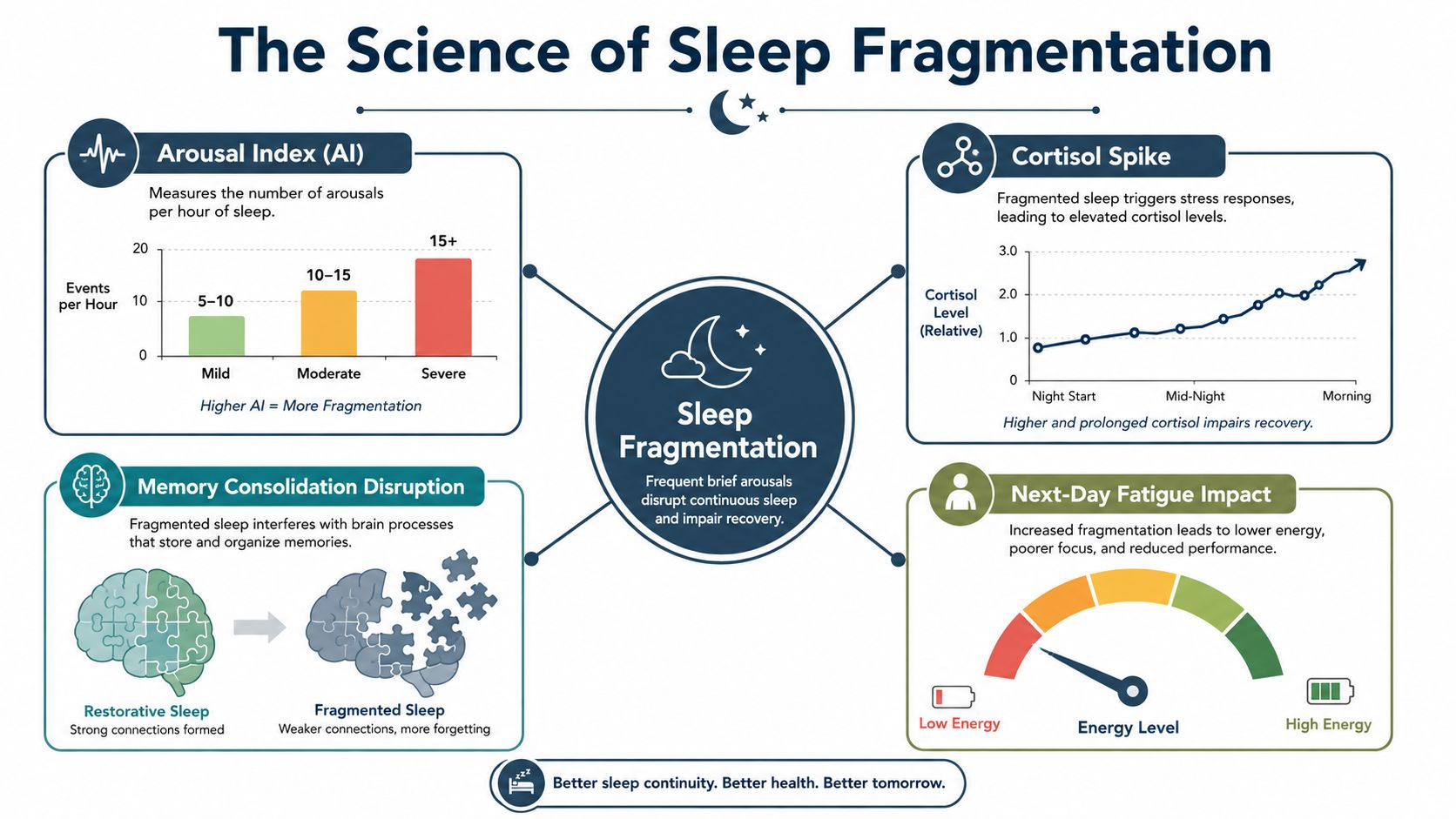
Sleep specialists can measure part of this pattern with the arousal index, the number of EEG-detected arousals per hour of sleep. A clinical review reports that values above 32 events per hour have been associated with higher coronary plaque risk compared with controls (clinical review of sleep arousals). This association does not mean restless sleep itself proves cardiovascular disease. It shows why recurring arousals deserve assessment rather than being dismissed as ordinary tossing and turning.
Why stage-specific disruption matters
Controlled sleep-fragmentation experiments found that mild fragmentation reduced arousability during stage 2 and early REM sleep, while stage 3 and 4 sleep were less affected. Sleep stages therefore do not respond to disruption in exactly the same way.
That distinction explains why time in bed alone can mislead you. Someone may remain in bed for a long night while moving between stages, waking briefly, or losing the continuous pattern that supports recovery. The experience differs from going to bed late. The clock records bed time, but it cannot show whether sleep stayed stable.
Temperature can be one source of disruption. Heat may increase movement or trigger awakenings for some sleepers, although it is only one possible contributor. If your pattern seems temperature-related, these practical tips for sleeping cooler cover bedding, airflow, and bedroom conditions.
Track what happens after you first fall asleep. Repeated periods of wakefulness are often described as wake after sleep onset, and recording their timing can make a clinical conversation more precise. This wake-after-sleep-onset guide can help you note when awakenings occur, how long they seem to last, and whether a symptom preceded them. Those details help separate a general symptom from a breathing, movement, environmental, or schedule-related cause.
Identifying Your Root Cause of Restlessness
Because restless sleep isn't a formal diagnosis, a symptom list alone isn't enough. The Sleep Foundation's explanation of restless sleep emphasizes that the phrase can overlap with sleep-maintenance insomnia, obstructive sleep apnea, restless legs syndrome, and circadian disruption. A practical way to narrow the possibilities is to identify what happens immediately before or during each disruption.
Start with the pattern
Ask yourself these questions for several nights:
- Do you snore loudly, wake choking, or notice pauses in breathing?
- Do your legs feel uncomfortable at rest, with an urge to move that improves temporarily when you move?
- Do you wake at a predictable biological time because your schedule doesn't match when you need to sleep?
- Do you wake without an obvious physical symptom and struggle to return to sleep?
- Does pain, itching, temperature, noise, or light repeatedly wake you?
Your answers create a useful starting map. Breathing symptoms call for medical assessment rather than relying on bedroom changes alone. A strong movement urge points toward a movement-related problem. A consistent mismatch between desired sleep and your work or travel schedule suggests circadian misalignment. Repeated wakefulness without another clear trigger can fit sleep-maintenance insomnia, though a clinician should help rule out other causes.
| Condition | Key symptoms | When to see a doctor |
|---|---|---|
| Sleep-disordered breathing | Loud snoring, gasping, choking, witnessed breathing pauses, morning headache, or persistent daytime tiredness | Seek evaluation when breathing interruptions or marked daytime impairment occur |
| Restless legs syndrome | Uncomfortable leg sensations and an urge to move, usually during rest or at night, with temporary relief from movement | Arrange an assessment when symptoms repeatedly delay sleep or disrupt the night |
| Circadian misalignment | Sleepiness and alertness occur at inconvenient times because work, travel, or daily obligations conflict with your internal rhythm | Ask for guidance when the pattern persists or makes work, driving, or daily functioning difficult |
| Sleep-maintenance insomnia | Repeated awakenings or long periods awake after initially falling asleep, without a clear single trigger | Discuss persistent symptoms with a healthcare professional, especially when daytime function suffers |
| Environmental or physical discomfort | Heat, noise, light, an uncomfortable sleep surface, congestion, or pain repeatedly prompts movement or awakening | Seek care when pain, breathing difficulty, or another physical symptom is persistent or worsening |
An anxious mind can also keep a person alert after an otherwise normal awakening. If worry is the dominant feature, these practical resources on how to stop overthinking and worrying may complement, but not replace, professional care when anxiety is severe.
For a focused look at repeated awakenings, review this guide on why you may be waking up at night. Keep a short record of bedtime, awakenings, symptoms, and morning energy. You don't need perfect detail. You need enough information to spot whether your restlessness follows breathing, movement, timing, or an apparently unexplained pattern.
Evidence-Based Interventions for Better Sleep Quality
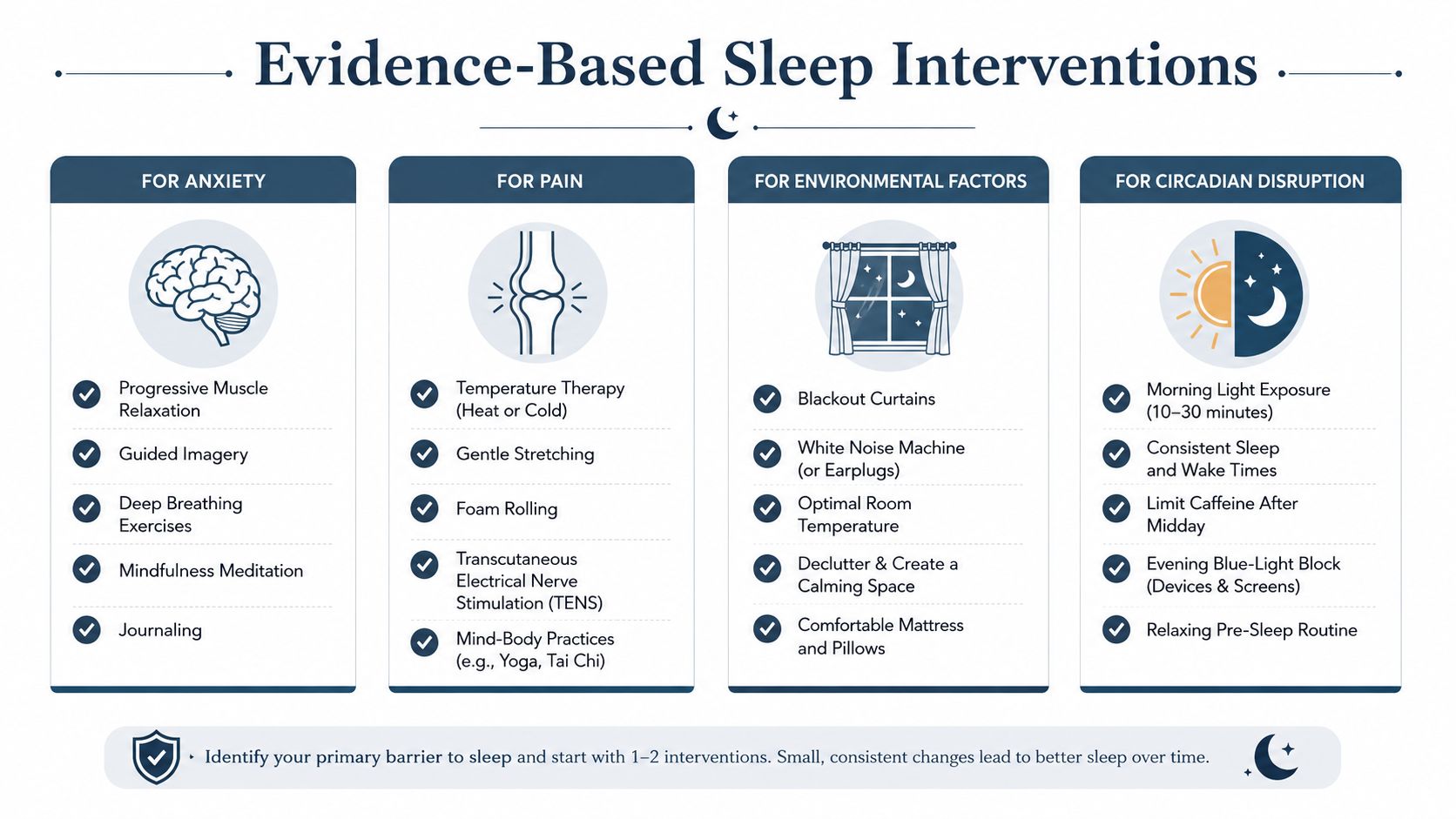
Restless sleep is a symptom, so the useful question is not how to sleep more soundly. Ask what keeps interrupting sleep, then match the response to that clue. An irregular schedule calls for a different plan than nighttime gasping, while uncomfortable legs need a different assessment from general difficulty settling.
Match the intervention to the clue
Breathing-related clues deserve evaluation first. Heavy snoring, waking with choking, or witnessed breathing pauses justify a clinical assessment. Nasal breathing practices, congestion management, and a comfortable sleep position may support airflow, but they cannot replace evaluation for possible obstructive sleep apnea.
Movement-related clues need a movement-focused conversation. Describe the sensation precisely. An urge to move that appears during rest and improves with movement gives a clinician more useful information than saying your legs feel “restless.” The assessment may consider medication effects, neurological factors, and other contributors.
Circadian problems respond to timing. Keep your wake time consistent, seek regular morning light, and avoid large shifts from one day to the next. Night work and rotating shifts may require an individualized schedule rather than an attempt to force a conventional bedtime.
Unexplained awakenings benefit from stimulus control. If you remain awake after around 20 minutes, leave the bed for a quiet activity, such as reading in another room, and return when sleepy, following NHS stimulus-control guidance. The aim is to reconnect the bed with sleep instead of frustration.
Remove common disruptors
Irregular bed and wake times, daytime naps, intense activity before bed, an uncomfortable sleep environment, and stimulants such as caffeine, nicotine, and alcohol can worsen sleep quality, according to Mayo Clinic insomnia guidance.
Use a few targeted adjustments:
- Set a stable wake time before trying to perfect bedtime.
- Keep the room dark, quiet, comfortable, and at a suitable temperature.
- Finish vigorous activity well before you try to settle.
- Track whether caffeine, nicotine, or alcohol regularly precedes a poor night.
- Reserve the bed for sleep and sex, rather than prolonged scrolling, worrying, or work.
Allow 1 to 1.5 hours for a calming wind-down with activities such as reading or listening to audio. Avoiding bright light, electronics, caffeine, alcohol, nicotine, and heavy or sugary foods about 4 to 6 hours before bed may reduce competing sleep signals, as described in NHS sleep-hygiene guidance. These are practical conditions, not rigid guarantees.
A melatonin-free option is Restore+ Magnesium Sleep Aid, described as a magnesium wind-down drink containing L-theanine, tart cherry, lemon balm, and glycine. Treat it as one part of a consistent routine, and ask a healthcare professional before using supplements if you have a medical condition or take medication.
The Health Impact of Chronic Sleep Fragmentation
A restless night can leave you irritable and unfocused, but repeated fragmentation deserves a broader view. Frequent arousals interrupt the continuity that allows the brain and body to move through normal sleep stages, which can affect how recovered you feel the next day even when your time in bed appears adequate.
Recent research has also begun examining effects beyond morning fatigue. A 2025 Sunnybrook report linked more fragmented sleep, described as sleeping restlessly and waking often at night, with changes in brain blood-vessel cells involved in blood flow and transport across the blood-brain barrier (Sunnybrook report on sleep disruption). This is emerging evidence, not proof that restless sleep directly causes dementia or another specific disease. It does reinforce the value of taking recurring disruption seriously.
Quantity isn't the whole story
Two people can spend a similar amount of time in bed and wake with very different levels of function. One may sleep in longer, continuous stretches. The other may experience repeated arousals caused by breathing instability, movement, pain, or environmental discomfort. Their clocks may show a similar duration, but their nights aren't physiologically identical.
A 2025 review of sleep-related movement disorders also highlighted emerging evidence connecting large-muscle movements during sleep with lower total sleep time, lower sleep efficiency, more awakenings, and less restorative sleep. The relevance extends beyond children because similar movement patterns can occur in adults, making nighttime motion worth discussing when it is persistent or pronounced.
Restless sleep isn't automatically dangerous, but persistent fragmentation is information. Use it to identify what keeps interrupting recovery.
You don't need to become alarmed by every difficult night. Instead, look for persistence, daytime consequences, and specific warning signs. Gasping, severe sleepiness, painful symptoms, unusual movements, or a pattern that interferes with work and safety all justify professional evaluation.
Your Practical Wind-Down Routine for Deeper Sleep
A wind-down routine works best when it gives your brain repeated, predictable signals that the day is ending. NHS guidance supports allowing 1 to 1.5 hours for this transition and using calming activities while limiting bright light, electronics, stimulants, alcohol, nicotine, and heavy or sugary foods near bedtime (NHS wind-down recommendations).
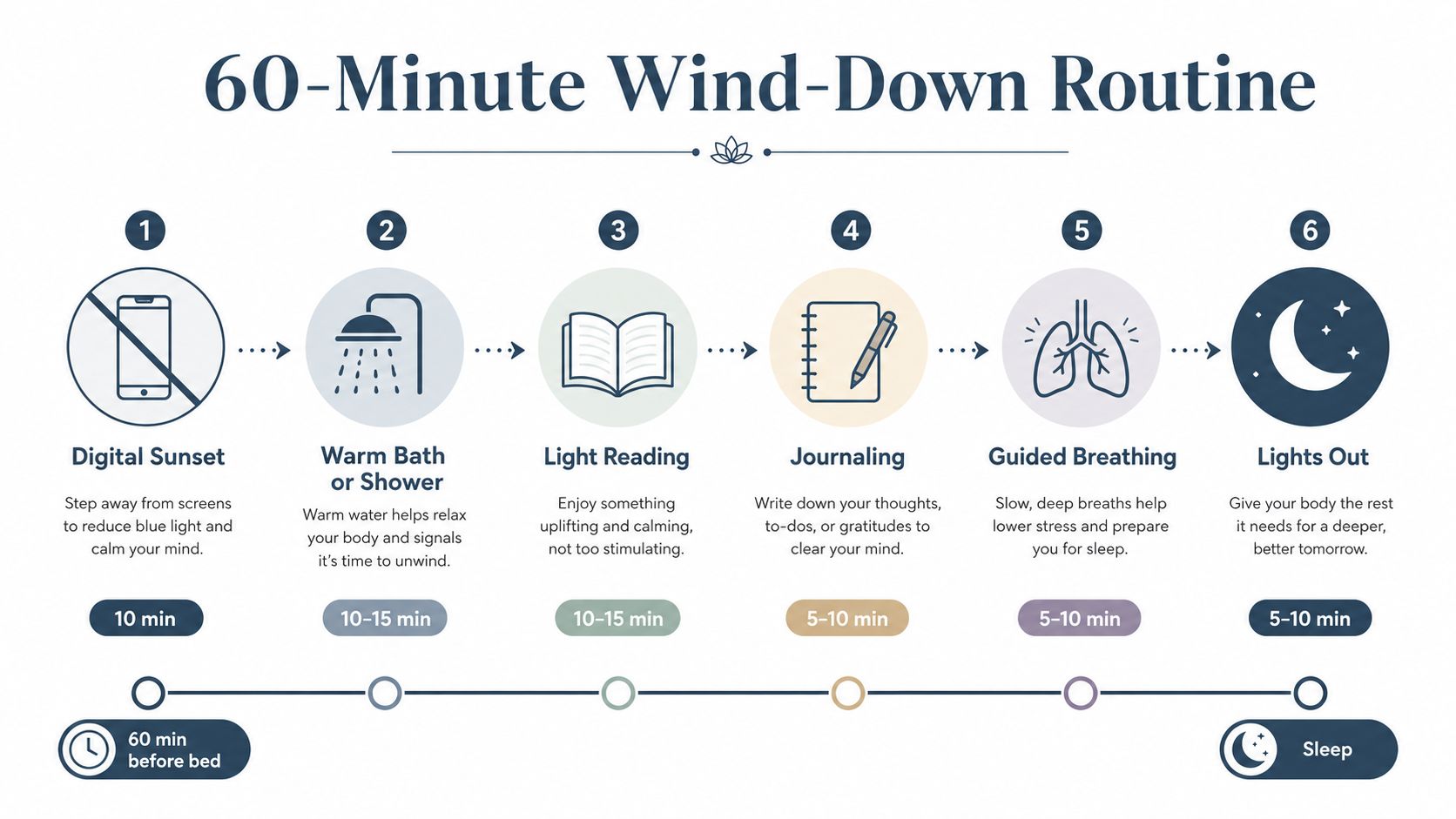
Try this sequence tonight:
- Begin 60 minutes before bed. Dim the lights, put your phone away, and finish tasks that require alert thinking.
- Use the next 10 to 15 minutes for comfort. Take a warm shower, adjust the room temperature, and prepare bedding so you won't need to problem-solve later.
- Read or listen to calm audio. Choose something absorbing but not stimulating.
- Write down unfinished thoughts. A short list can keep planning out of bed.
- Practice slow breathing. Let the exhale become gentle and unforced rather than trying to control every breath.
- If you're awake after around 20 minutes, leave the bed. Read in another room and return only when sleepy.
If repeated early-morning waking is your main concern, especially during hormonal changes, this guide on how to stop waking at 3 a m in may offer additional context. For a broader evening sequence, use this nighttime routine for better sleep.
For people exploring nasal-breathing tools, Hydrating Mouth Tape is described as supporting quieter nights, oral care, tongue posture, and nitric oxide-supportive breathing. Don't use mouth tape to mask possible breathing problems, and seek evaluation first if you snore heavily, gasp, or suspect sleep apnea.
SleepHabits offers educational sleep resources and melatonin-free tools focused on evening routines, nighttime breathing, and more restorative rest. Visit SleepHabits to explore practical guidance and products that can fit a consistent plan for addressing restless sleep.