

What's counterintuitive about slow-wave sleep is that the most restorative part of the night is also the quietest. Your brain isn't firing up vivid dreams or easy wakefulness, it's shifting into a near-silent rhythm where large groups of neurons move together, the body lowers its arousal level, and recovery work gets priority over awareness. That's why the phase often called deep sleep can leave you feeling more repaired than the dream-heavy hours that get most of the attention.
The Quiet Repair Shift Your Brain Runs Every Night
What is slow wave sleep? It's the deepest stage of non-REM sleep, and in modern EEG scoring it's defined by 0.5 to 2.0 Hz slow waves with at least 75 μV amplitude, occupying at least 20% of a 30-second epoch, while slow-wave activity is usually tracked in the 0.75 to 4.5 Hz band (AASM guidance). That sounds technical, but the plain-language version is simple, your brain enters a synchronized state that helps set up physical recovery.
Why this stage matters tonight
The fastest way to understand SWS is to stop thinking of sleep as one flat state. Instead, think of it as a sequence of different jobs, and SWS is the one where the body's repair systems get the clearest signal to run. It's also the stage that's hardest to preserve when sleep is fragmented, breathing is noisy, or the night is cut short.
A useful resource if you're recovering from a head injury is the sleep after concussion guide, because post-injury sleep questions often get tangled up with worries about deep sleep. The practical takeaway is the same either way, protect the conditions that let your brain stay in one stable sleep state long enough to do its work.
Practical rule: if sleep feels “light” all night, the issue is often continuity and breathing quality, not just total hours in bed.
By the end of this article, you'll be able to tell SWS apart from REM and light sleep, understand why wearables can misread it, and use that homeostatic model to make smarter choices before bed. You won't just know that deep sleep matters, you'll know what helps it happen.
The Brainwave Mechanics Behind Slow Wave Sleep
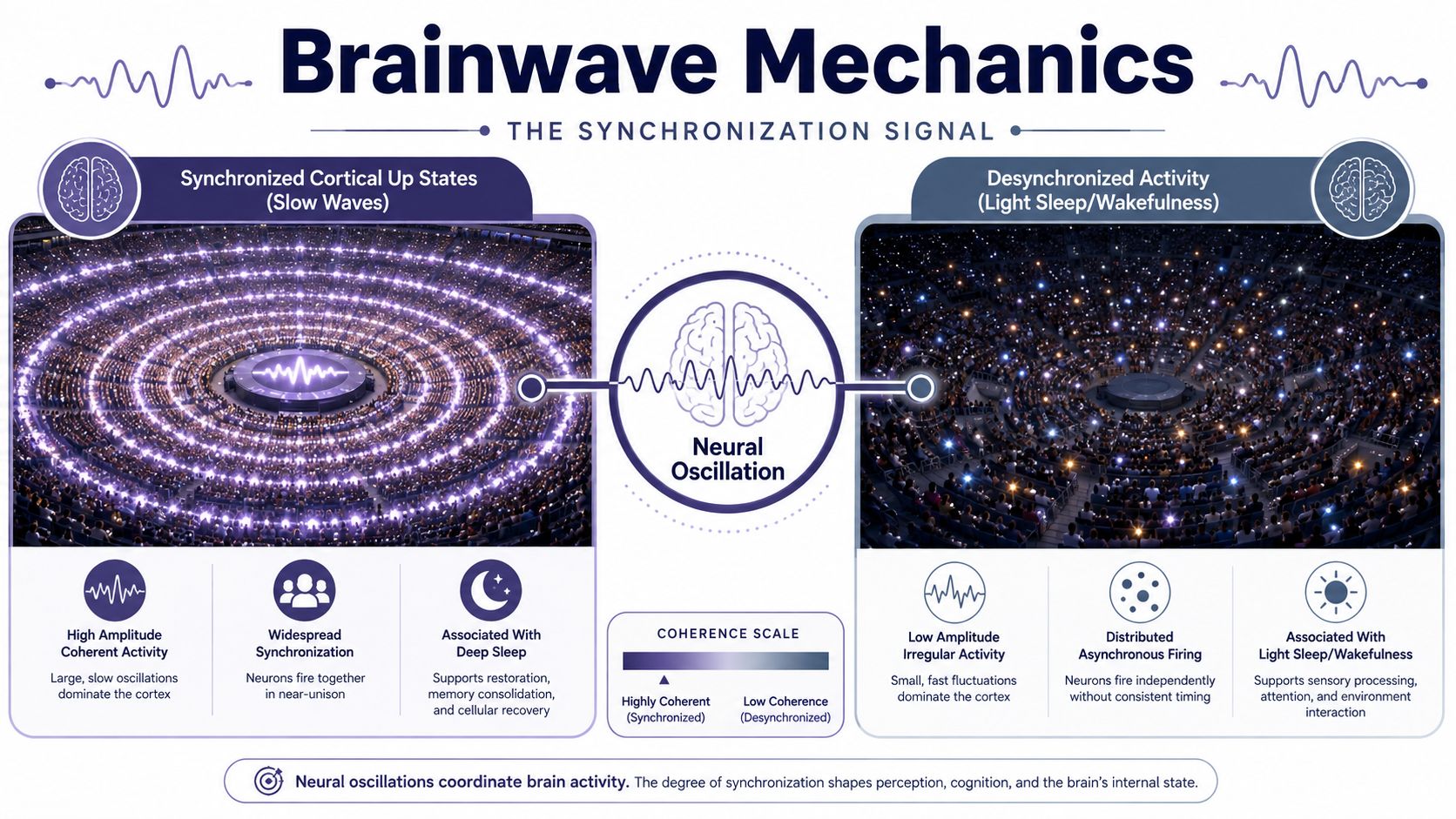
Slow wave sleep is the point in the night when the cortex stops acting like a room full of separate conversations and starts moving in one shared rhythm. Neurons swing together between up states and down states, meaning they alternate between brief periods of firing and periods of quieter activity. On EEG, that creates slow oscillations in the less than 1 Hz range, which is why the signal looks broad and slow rather than busy and jagged. A helpful overview of how sleep stages are grouped in the broader sleep cycle is in this sleep architecture guide, and the physiology of these slow oscillations is described in a mechanistic review.
The key idea is synchrony. During wakefulness, different brain regions can be active at different times, but in slow wave sleep many neurons begin to shift together, almost like a crowd following the same beat. That shared timing is what gives this stage its distinctive EEG shape and also explains why it feels so different from lighter sleep.
Why you're harder to wake from it
A synchronized cortex is less responsive to outside input. The brain is still active, but it is less willing to hand attention back to the room, so the arousal threshold rises and brief noises or movements are less likely to break sleep. Slow wave sleep also tends to come with low eye movement, reduced muscle tone, and lower heart and respiratory rates, which fits the same quieted state described in the mechanistic review.
That is why waking from deep sleep can feel heavy and disorienting. The brain is moving from a highly coordinated internal pattern to alertness, and that transition can leave you groggy or briefly unsure of where you are. The feeling is not a sign that sleep was “bad.” It is often a sign that the brain was fully committed to its low-responsiveness state.
How the EEG definition fits the feeling
EEG staging helps explain why this stage feels so different from light sleep, but the label alone can be misleading. Stage N3 is scored when slow waves take up enough of the epoch, yet the core story is the degree of synchronization underneath that score. It is the difference between a room where each person talks separately and a room where one rhythm has taken over.
That is also why wearable sleep scores can be tricky to read. A device may estimate deep sleep from movement or heart signals, but it cannot directly see the full cortical pattern that EEG captures. If you want a broader sense of how stages fit together, the testosterone sleep restoration guide can help frame why adults often notice sleep quality in terms of recovery rather than labels on a tracker.
The body is not “off” in slow wave sleep. It is coordinated, quiet, and less likely to react.
This stage is also where the 2024 debate about “slow wave sleep without slow waves” becomes relevant. Some wearable reports may label a night as deep sleep even when the brain's electrical pattern has not been measured directly, which is why the number on a screen can sound more certain than the physiology behind it. The useful question is not only how much SWS a device estimates, but whether sleep stayed stable enough for the cortex to keep that synchronized rhythm in place.
Why Slow Wave Sleep Matters for Memory Recovery and Hormones
Slow-wave sleep works like an overnight maintenance window. During this stage, the brain is more likely to strengthen declarative memory, coordinate slow oscillations with sleep spindles, and support the release of growth hormone and other restorative processes. That is why a night with stable deep sleep can feel very different from a night with the same hours but broken continuity.
What the brain is doing while you're asleep
When slow oscillations line up with spindles, the brain has a better chance to stabilize new information from the day. That helps explain why people often wake with clearer recall after solid sleep. Sleep does not magically store everything. It gives the brain time to organize what matters and quiet some of the noise. The same logic helps explain why an athlete who sleeps well after practice can feel more fluid the next morning than one who slept the same number of hours but woke repeatedly.
The hormonal side matters too. Deep sleep is the main time for the large growth hormone surge that supports repair processes across adulthood, not just in childhood. For readers who want a broader frame for that repair shift, the what is restorative sleep guide connects the physiology of sleep with the body's recovery language. It also fits with broader hormone questions, including the testosterone sleep restoration guide, which helps explain why disrupted sleep can show up as a recovery problem rather than a simple hours-in-bed problem.
A concrete example
A runner who goes to bed, stays asleep, and keeps breathing smoothly through the first part of the night is more likely to retain motor learning from training and wake with less heaviness in the legs. The same runner can spend the same total hours in bed after a fragmented night and still feel flat, because the recovery window was broken into pieces. That is the key point, SWS is about continuity and pressure release, not just clock time.
SleepHabits' Restore+ Magnesium Sleep Aid is a melatonin-free magnesium wind-down drink built around a habit-based evening routine, with magnesium, L-theanine, tart cherry, lemon balm, and glycine in a formula designed to support relaxation and the body's natural rhythm. It is one tool among several, not a shortcut, but it fits the idea that better sleep often starts with smoother transitions into the night.
Slow Wave Sleep vs REM and Light Sleep
SWS, REM, and light NREM do very different jobs, and trackers often blur them together. If you wake exhausted, the issue isn't always missing REM, it may be that light sleep and micro-arousals kept you from staying in the deeper stages long enough to recover properly.
| Feature | Slow Wave Sleep | REM Sleep | Light NREM |
|---|---|---|---|
| Brain activity | Highly synchronized, slow oscillations | More wake-like, active brain patterns | Less synchronized than SWS |
| Eye movement | Low | Rapid eye movement | Low |
| Muscle tone | Reduced | Very low | Present but relaxed |
| Arousal threshold | Highest | Lower than SWS | Easier to wake from |
| Main role | Physical restoration, recovery, memory support | Dreaming, emotional processing, cognitive integration | Transition and lighter maintenance sleep |
| Usual timing | More concentrated earlier in the night | More concentrated later in the night | Present across much of the night |
In young adults, stage 1 accounts for about 4% to 9% of total sleep, stage 2 for 45% to 60%, and SWS for 10% to 25% (sleep architecture review). That makes deep sleep a measurable part of the night, not just a feeling of “I slept well.”
How to read your sleep report without overthinking it
REM can feel important because it's vivid and easier to remember, but SWS is the stage most closely tied to the body's heavy repair shift. Light sleep sits in between, and it's often where noise, stress, and breathing problems do the most damage. If your tracker gives you a low “deep sleep” number one night, don't panic, look at the pattern across several nights and compare it with how you feel.
The practical distinction matters because each stage changes for a different reason. If you're sleeping through the night but still waking unrefreshed, a fragmented first half of the night is often a bigger clue than dream loss in the morning hours.
The New Science Debate About Defining SWS
Consumer sleep content still treats SWS as if it were a fixed box, but experts are reassessing that assumption. A 2024 article titled “Defining slow wave sleep without slow waves” signals that researchers are questioning whether the term maps cleanly onto one brain state, especially as wearables increasingly automate staging (2024 review signal).
Why your wearable might disagree with another one
Wearables do not measure EEG the way a sleep lab does, so they rely on proprietary algorithms that infer stages from movement, heart rate, and other signals. That means two devices can score the same night differently, even if you slept the same way. The number on the dashboard is useful as a trend, but it isn't the same thing as a clinical stage score.
The safest way to use wearable data is to compare weeks, not single nights. If your reported deep sleep falls after late nights, alcohol, stress, or breathing disruption, that pattern is more valuable than obsessing over one short night. Subjective restoration still matters more than a percentage.
Bottom line: the number on your app is a hint, not a verdict.
This debate is important because it protects people from turning sleep into a scoreboard. If a device says you “lost” deep sleep, that doesn't automatically mean your brain failed to recover. It may mean the algorithm read your night differently than a clinical EEG would have.
Common Causes of Reduced Slow Wave Sleep
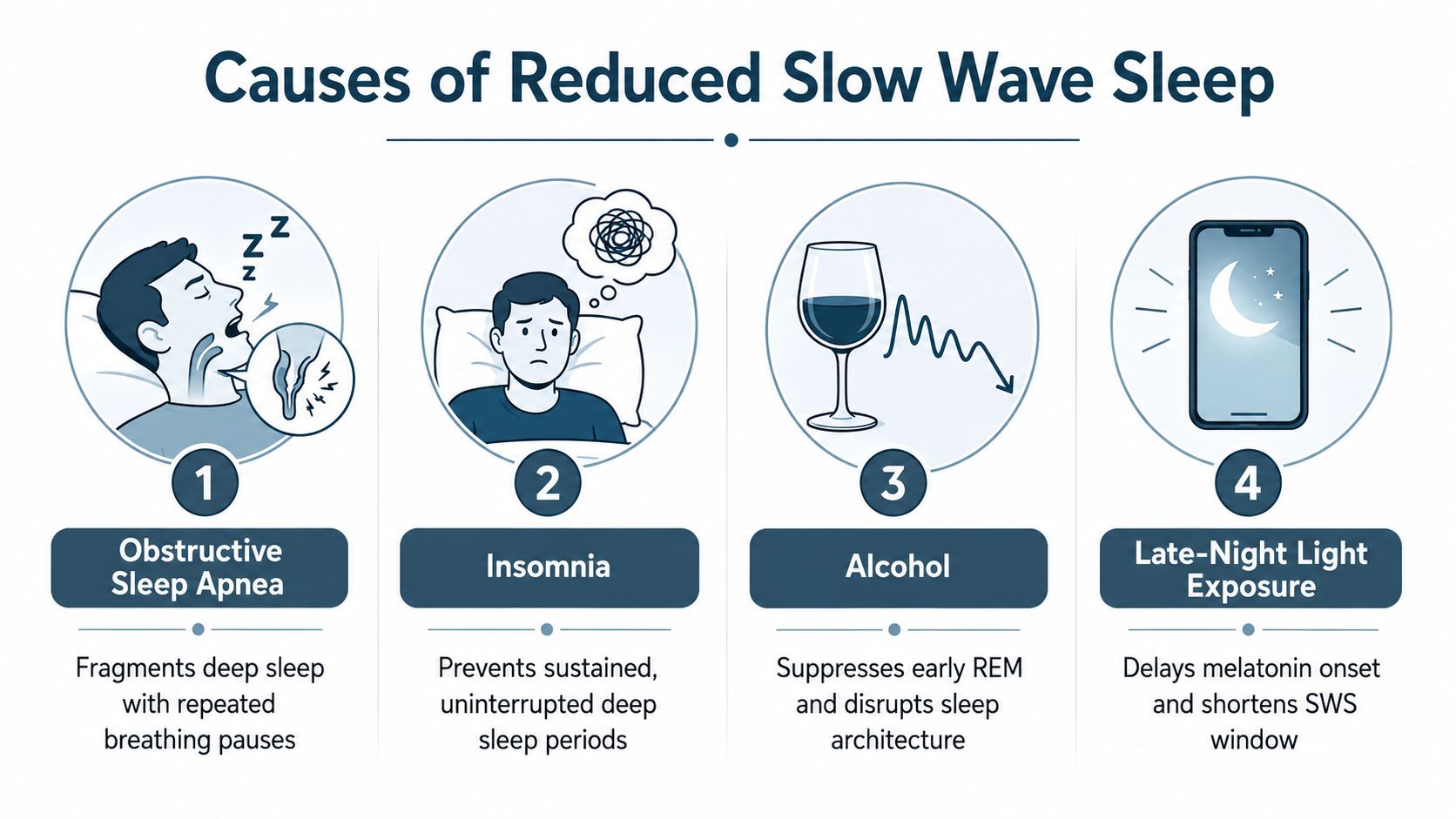
Several everyday factors can shrink SWS by breaking the continuity it depends on. Slow-wave activity rises after sleep deprivation and falls after naps, which shows how strongly it tracks prior wakefulness and why fragmented sleep blunts the drive for deep sleep in the next night (homeostatic review).
The most common patterns people miss
Obstructive sleep apnea is a major one, because repeated breathing pauses fragment sleep and force the brain to keep reorienting. Insomnia does something different, it keeps you from sustaining the long uninterrupted periods where SWS normally builds. Aging also matters, because deep sleep naturally becomes less prominent over time.
Alcohol can distort sleep architecture, especially early in the night, and many people notice that the first part of sleep feels heavy at first but turns lighter later on. Mouth breathing can also be a clue that the airway is working harder than it should, which increases the chance of arousals and a dry mouth in the morning.
If stress and insomnia are blending together, the distinguishing stress from disorder guide is useful because it separates normal tension from something that needs more than a few lifestyle changes. The same logic applies in adults, persistent sleep disruption deserves a closer look when it keeps repeating.
Hydrating Mouth Tape is one practical tool some people use to encourage nasal breathing and reduce snoring, and its stated goals include quieter nights, better oral care, and more supportive breathing habits. It isn't a cure for airway problems, but it can fit into a broader breathing-first routine when mouth breathing is the main issue.
If your mouth is dry when you wake up, that's a clue, not a coincidence.
The bigger model here is simple. SWS is a pressure-release valve, so anything that caps sleep pressure build-up, or keeps breaking the night apart, can reduce the amount of deep recovery you get.
Evidence-Based Ways to Increase Slow Wave Sleep
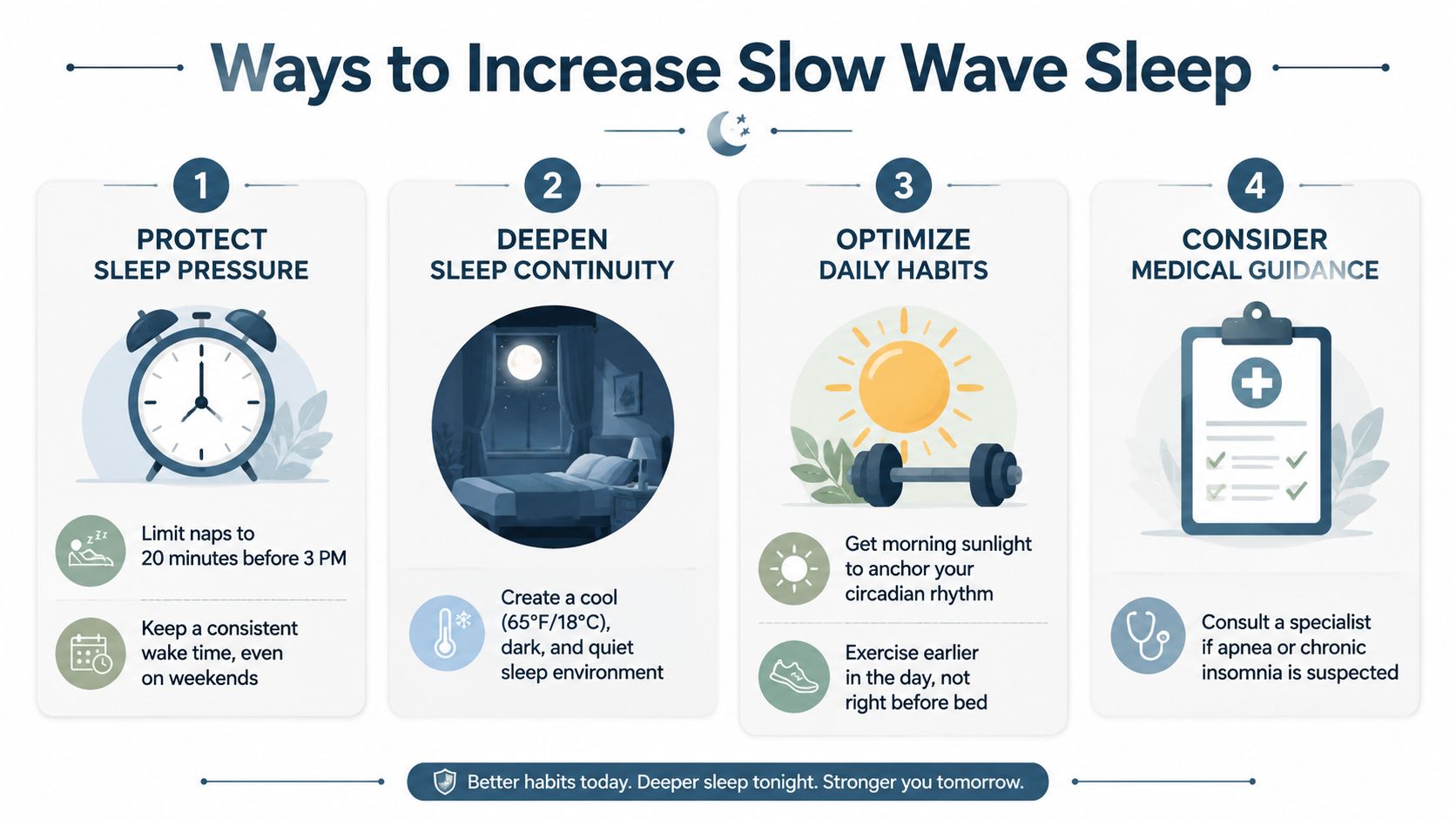
A review of slow-wave sleep emphasizes that it's a homeostatic marker of sleep need, and that many of its functions are still being studied, so the goal is to support sleep continuity and breathing quality rather than chase a guaranteed SWS boost (slow-wave sleep overview). That's the right mindset for real life, because the habits that help most are usually the ones that reduce friction around falling asleep and staying asleep.
Four levers that actually make sense
Protect sleep pressure. Keep a consistent wake time, even after a rough night, and avoid late naps that steal from the evening buildup of sleep pressure. This is the most direct way to help the brain arrive at bedtime with enough drive to enter deeper sleep earlier.
Deepen continuity. A cool, dark, quiet room lowers the odds that the brain will keep checking the environment. A wind-down ritual also matters because it gives your body a repeatable cue that the active day is over.
Support nasal breathing. Transparent Nasal Strips are designed to improve airflow and make nighttime breathing easier, which can be useful when congestion or resistance keeps nudging you toward arousal. Some people pair that approach with mouth tape as part of a broader upper-airway support routine, especially when snoring or mouth breathing is part of the picture.
Use supplements as support, not rescue. Magnesium, tart cherry, glycine, and L-theanine may fit into a calming evening routine, but they shouldn't be treated like magic. The useful question is whether they help you relax, stay consistent, and keep the night more continuous.
SleepHabits' supplement and breathing tools fit naturally into that framework, because the point is not to force sleep, it's to remove the small obstacles that keep the brain from settling into its deepest rhythm. That approach also aligns with the best supplements for deep sleep guide, which helps separate supportive ingredients from hype.
A simple rule helps here, if a habit makes the night calmer, steadier, and easier to breathe through, it's probably working with sleep pressure instead of fighting it.
When to Seek Professional Help for SWS Concerns
Persistent loud snoring, witnessed breathing pauses, or waking unrefreshed even after enough time in bed are signs to stop experimenting and get evaluated. Excessive daytime sleepiness, morning headaches, or a sense that you're never fully restored also justify a sleep study or airway assessment.
Some problems aren't about lifestyle at all. Sleep apnea, upper airway resistance, and certain hormonal issues can all interfere with deep sleep, which is why another supplement isn't the right next step when the pattern is clear.
The cleanest mental model is this. SWS is the pressure-release outcome of long, continuous, nasal-breathed sleep, so the most impactful habit is whichever part of that chain is currently broken. If the issue is breathing, fix breathing. If it's continuity, protect continuity. If it's sleep pressure, stop scattering it with late naps and irregular schedules.
If you want a practical next step, start with the one change that most obviously improves your sleep continuity tonight, then build from there. Visit SleepHabits to explore habit-based tools for breathing, wind-down, and recovery, and use them as part of a calmer routine that gives slow-wave sleep a better chance to do its job.