

The most popular advice about the best stop snoring solution is usually wrong. A nasal strip won't fix a tongue that falls backward, mouth tape won't treat every obstructed airway, and a costly gadget can't tell ordinary snoring from obstructive sleep apnea.
The smarter approach starts with identification. Your snoring may come mainly from nasal resistance, mouth breathing, sleeping on your back, soft-palate vibration, or airway collapse. Match the intervention to that pattern, test one change at a time, and stop treating a medical warning sign like a shopping problem.
| Snoring pattern | First option worth trying | When to escalate |
|---|---|---|
| Worse with congestion or nasal breathing difficulty | External strip or internal nasal dilator | Persistent obstruction, recurrent nosebleeds, or no improvement |
| Mainly on your back | Side-sleeping support or positional therapy | Snoring continues in every position |
| Open-mouth breathing without warning signs | Nasal care, breathing practice, cautious mouth-taping discussion | Nasal blockage, gasping, or suspected sleep apnea |
| Loud snoring with witnessed pauses or gasps | Medical evaluation and sleep testing | Promptly, rather than another gadget |
| Persistent snoring with daytime impairment | Clinician assessment | Especially with headaches, sleepiness, or blood-pressure concerns |
Why There Is No Single Best Stop Snoring Product
Snoring is a sound, not a diagnosis. It happens when relaxed tissues near a narrowed upper airway vibrate, but the narrowing can occur in different places. Nasal obstruction creates resistance before air reaches the throat. The tongue base can move backward during sleep. The soft palate can flutter, while sleeping supine can let gravity compress the airway. Weight-related tissue bulk can add another layer of restriction.
That makes product rankings misleading. A strip that gently lifts the sides of the nose may help a nose-dominant snorer, but it can't address tongue-base collapse. A mandibular advancement device moves the lower jaw forward, yet it won't correct a severely blocked nasal passage or every structural problem. The right treatment follows the mechanism, not the product category.
Clinical guidance also treats snoring according to its cause and severity. Management may include lifestyle changes, nasal obstruction treatment, oral appliances, surgery, or CPAP, depending on the underlying problem, as outlined in BMJ Best Practice's guidance on snoring. Consumer lists that rank brands without explaining those distinctions encourage expensive trial and error.
Practical rule: If you can't describe what your snoring changes with, don't buy the most expensive device first.
The questions that matter
Ask three basic questions before choosing anything:
- Does it worsen through your nose or mouth? Congestion, allergies, a blocked nostril, or waking with a dry mouth point toward different starting strategies.
- Does position change it? Snoring that appears mainly on your back is a different target from snoring that continues on your side.
- Is it rhythmic, or does it stop and restart? Regular sawing sounds may reflect tissue vibration. Silence followed by choking, gasping, or a forceful breath raises concern for obstructive events.
The goal isn't to label yourself with certainty. It's to choose a sensible first experiment and recognize when self-treatment isn't enough. Your next step is a simple set of observations you can make tonight, with help from a bedpartner or a phone recording.
How to Identify Your Snoring Type
You don't need medical jargon to find useful clues. Run three quick checks, then compare what you notice with your partner's observations.
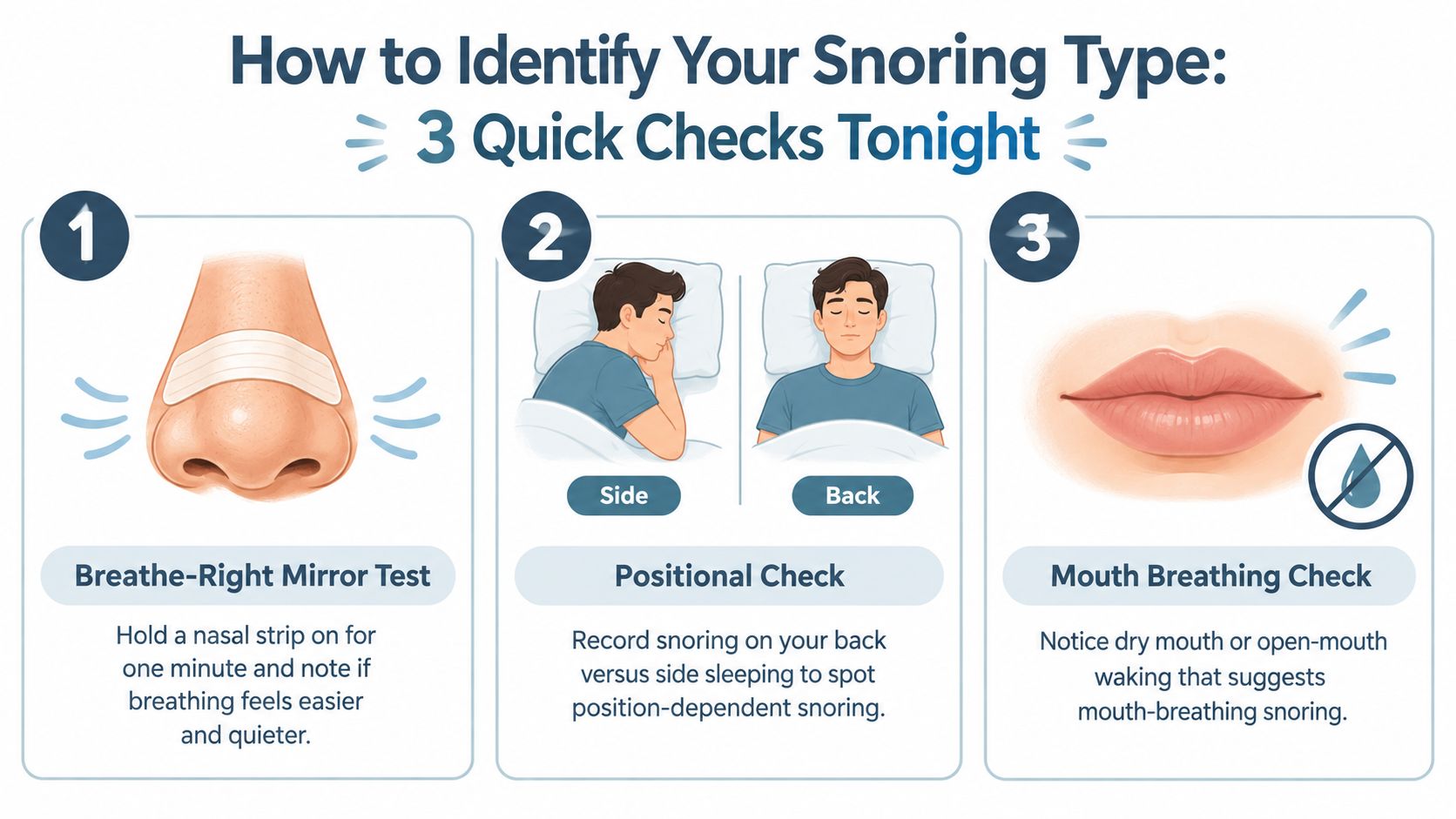
Check one, nasal breathing
Place an external nasal strip across the bridge of your nose while you're awake. Spend about a minute breathing normally, then notice whether airflow feels easier, quieter, or less restricted. This isn't a diagnosis, but a clear change suggests that nasal resistance may be contributing.
Congestion from a cold, allergies, or dry air can make mouth breathing more likely. If you wake with a dry mouth, stuffy nose, or one nostril that feels consistently blocked, nasal care deserves attention. A product such as Transparent Nasal Strips can serve as a straightforward airflow experiment, but it won't address obstruction deeper in the throat.
For a plain-language explanation of possible causes, see what causes snoring at night.
Check two, body position
Record or ask your partner to compare a period on your back with a period on your side. If the noise is noticeably worse on your back and eases when you turn, gravity and position are likely important contributors. That pattern makes positional therapy a more logical first choice than mouth tape or a dental device.
Check three, the audio pattern
Rhythmic sawing usually sounds continuous, even if it's loud and irritating. Silence followed by a gasp, choke, snort, or abrupt restart is more concerning because it may indicate breathing interruptions. A partner should note whether the snoring starts immediately, appears after alcohol, follows a congested night, or happens regardless of circumstances.
Don't treat gasping or witnessed pauses with a gadget. Those signs warrant medical evaluation for possible obstructive sleep apnea.
Your observations create a useful map. Nasal improvement points toward nasal dilators, position-dependent noise points toward side-sleeping support, and open-mouth breathing may justify nasal treatment before any discussion of tape. Gasping, pauses, or all-night loud snoring move the conversation toward a clinician.
Nasal Strips and Internal Dilators
The right first test for a nose-dominant snorer is usually nasal dilation, not mouth tape or a dental device. If congestion or a narrow nasal valve matches your snoring pattern, start here. These products widen the front of the nose. They do not stop the tongue or soft palate from collapsing farther back.
External adhesive strips, including Breathe Right-style products, lift the skin around the nasal valve with spring-like tension. In a clinical trial of habitual snorers, bedpartners reported a significant reduction in snoring after fourteen nights, and 52% of participants, 16 of 31, showed reduced snoring (Rhinology trial PDF). Separate objective sleep research found fewer spontaneous arousals during nasal-resistance conditions, 7.0 versus 8.7 arousals per hour with a strip compared with nights without one (nasal dilator sleep study).
The limit is clear. Nasal strips are not an apnea treatment. A 2016 systematic review covering 14 eligible studies found no significant change in apnea-hypopnea index, lowest oxygen saturation, or snoring index among people with obstructive sleep apnea. Pooled AHI changed from 28.7 ± 24.0 to 27.4 ± 23.3 events per hour, p=0.64 (systematic review of nasal dilators). Use strips to address noise linked to nasal resistance, not to assume that deeper airway collapse has been solved.
External versus internal geometry
Internal dilators such as Mute, Rhinomed Turbine, and NozBreath sit inside the nostrils. Cones or stents push the tissue outward, while designs such as Rhinomed Turbine also engage the turbinate region. They can feel intrusive initially, but they are a reasonable choice when an external strip does not provide enough support.
| Feature | External nasal strips | Internal nasal dilators |
|---|---|---|
| How they work | Lift the nasal valve from outside | Hold the nasal passage open from within |
| Comfort | Usually easier to tolerate | Initial insertion can feel intrusive |
| Reuse | Generally single-use | Many designs are reusable |
| Best fit | Mild nasal resistance or congestion | Narrow nasal valve requiring internal support |
| Main limitation | Won't treat throat-level collapse | Won't treat tongue-based collapse or apnea |
The review found a small apnea-index improvement in a subgroup using internal dilators. That subgroup saw a decrease of 4.87 events per hour, while external dilators showed an increase of 0.64 events per hour. The finding suggests that internal and external designs can perform differently, but it does not predict results for every user or replace sleep testing.
For practical guidance, nasal strips for snoring covers how to use this category. If you are comparing bite-related devices, information about custom night guards at Ultra Smile DentalSpa helps distinguish ordinary guards from fitted oral appliances.
Avoid adhesive strips on broken or irritated skin, and skip internal devices during active nosebleeds. My recommendation is direct: test nasal dilation when your pattern points to a nasal problem. Stop expecting it to fix collapse in the throat.
Mouth Tape and Mouth-Breathing Fixes
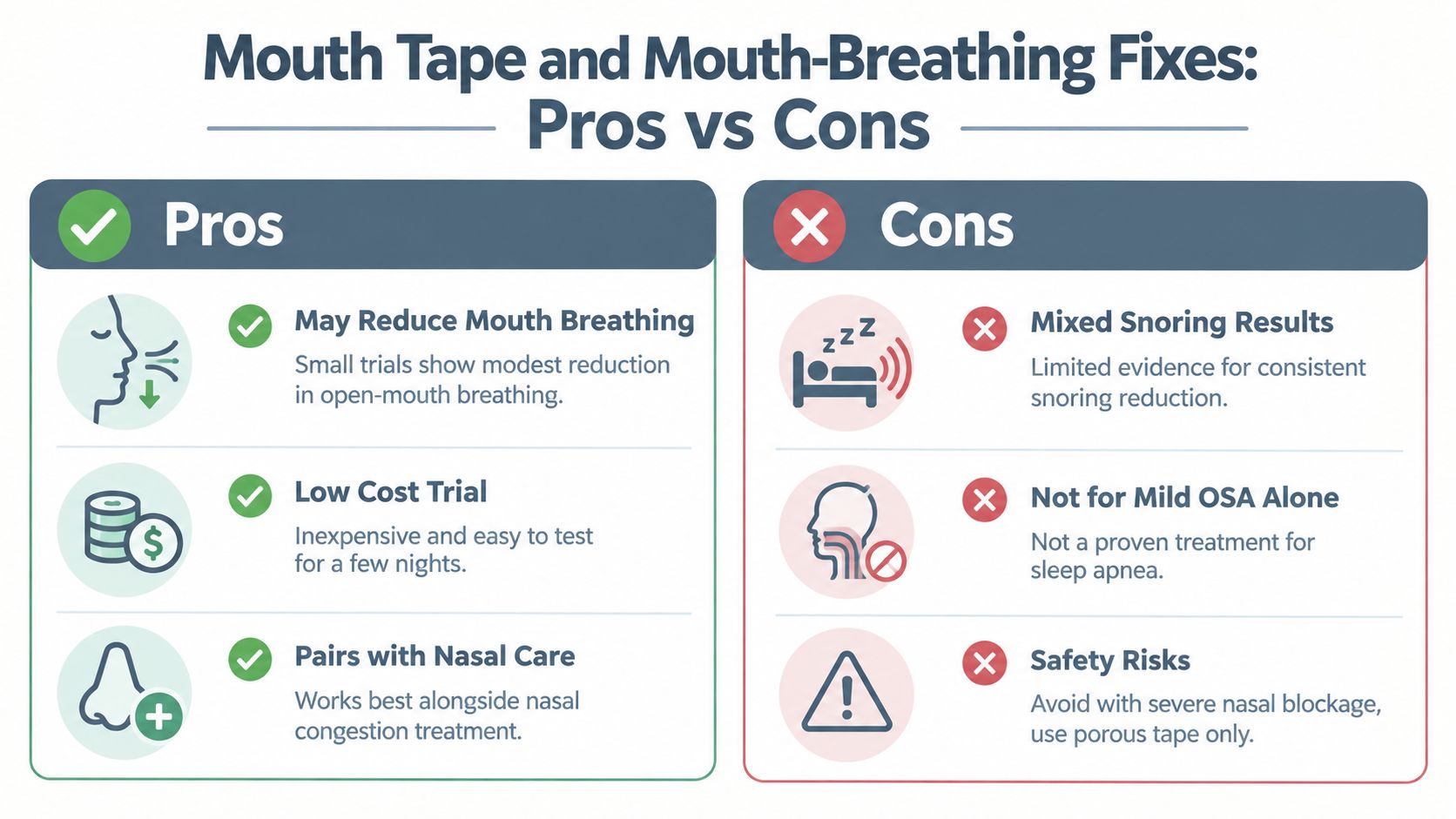
Mouth tape is a poor default answer to snoring. It may help a narrow group of people who breathe through the mouth, have a usable nasal airway, and have mild obstructive sleep apnea. A 2025 systematic review found that the overall evidence remains weak and generally not clinically significant for mouth breathing, sleep-disordered breathing, or obstructive sleep apnea, especially beyond mild OSA populations (2025 systematic review on mouth taping).
One clinical study identified that narrower use case. Among mouth-breathers with mild obstructive sleep apnea, mouth taping reduced AHI from 8.3 to 4.7 events per hour, while the snoring index fell by 47%, from 303.8 to 121.1 events per hour (clinical mouth-taping study). That supports nasal-only breathing for selected users. It does not make mouth tape a general treatment for sleep apnea or throat collapse.
What to try before sealing your lips
Start by identifying why your mouth opens at night:
- Clear the nose first. Saline rinses, allergy management, humidity control, or a nasal dilator can make nasal breathing easier.
- Practice gentle nasal breathing while awake. Let the tongue rest comfortably against the palate and breathe slowly, without forcing deep breaths.
- Use a chin strap cautiously. It may support jaw position, but it cannot open a blocked nose or stabilize a collapsing throat.
- Train the airway muscles for a separate goal. Oropharyngeal exercises have better benchmark evidence for snoring than occlusive mouth-closure approaches. In a randomized trial, the snore index fell from 99.5 to 48.2 snores above 36 dB per hour, P=.017, while total snore power fell from 60.4 to 31.0 per hour, P=.033. The exercise trial is distinct from the mouth-taping evidence reviewed above.
If you consider a product such as Hydrating Mouth Tape, treat it as a mouth-breathing aid, not proven apnea therapy. Porous surgical paper or hypoallergenic tape is preferable to airtight material, and you must be able to remove it immediately. For practical product considerations, see this guide to mouth tape for sleeping.
Do not use mouth tape with severe OSA, severe nasal obstruction, obesity hypoventilation, or a history of nocturnal vomiting. If you gasp, choke, or cannot breathe comfortably through your nose while awake, keep your mouth untaped.
The practical verdict is simple: mouth tape can be a carefully selected experiment for nasal breathers. Its broad online reputation is ahead of its evidence.
Oral Appliances, Positional Therapy, Lifestyle, and CPAP
These options solve different problems, so comparing them as if they're competing gadgets misses the point. A mandibular advancement device is aimed at jaw and tongue position. Positional therapy limits back sleeping. Lifestyle changes remove triggers. CPAP uses prescribed positive airway pressure to keep an obstructed airway open.
| Solution | Best for | Evidence strength | Cost range | Drawbacks |
|---|---|---|---|---|
| Custom mandibular advancement device | Persistent snoring or suitable mild to moderate OSA | Strong conservative option when properly fitted | From moderate to high | Jaw discomfort, dental movement, bite changes |
| Boil-and-bite oral guard | Short-term exploration when professional fitting isn't available | Less dependable than a custom device | Low to moderate | Poor fit, discomfort, limited adjustment |
| Positional therapy | Snoring that worsens on the back | Strong when the pattern is clearly positional | Low to moderate | Can be difficult to maintain all night |
| Lifestyle changes | Alcohol-related, weight-related, or habit-related triggers | Strong foundation, variable individual response | Low | Requires consistency and may not solve anatomy |
| CPAP | Confirmed obstructive sleep apnea | Gold-standard medical treatment for OSA-driven snoring | High or insurance-dependent | Mask comfort, maintenance, and adherence challenges |
Custom mandibular advancement devices should be fitted and monitored by a qualified dental professional, particularly if you have dental disease, jaw pain, or temporomandibular-joint symptoms. Store-bought boil-and-bite guards can help you explore the concept, but a generic night guard isn't the same as a purpose-built advancement device. Oral appliances may also cause jaw discomfort or changes in the bite, so don't keep pushing through pain.
Positional therapy is the cleanest choice when your pillow-rotation test shows a strong back-sleeping effect. Options include a tennis-ball vest, a vibrating positional belt, or a wedge pillow. A wedge can also feel more natural than a wearable device, though its effect depends on whether elevation changes your airway.
Match the intervention to the problem
Use the practical ranking below:
- Mild, occasional snoring: Start with side sleeping, congestion control, alcohol avoidance near bedtime, and a nasal aid if the nose is clearly involved.
- Persistent snoring without obvious pauses: Consider a professionally assessed mandibular advancement device, especially when positional and nasal measures haven't helped.
- Loud snoring with possible apnea: Skip product experimentation and seek testing. CPAP is designed for diagnosed obstructive sleep apnea, not ordinary snoring.
Weight management, smoking cessation, and avoiding alcohol before sleep can reduce airway vulnerability, but they aren't guaranteed cures. For bedroom-level changes, a guide to snoring solutions from Lucas Furniture offers context on mattress and sleep-position considerations. The best intervention is the least intensive one that addresses your actual pattern, provided it doesn't delay medical care.
Building Your Personal Stop Snoring Stack
Don't stack five interventions on the same night. If the noise improves, you won't know why. If it worsens, you won't know what caused it. Build from low-risk observations toward targeted aids, then escalate when the pattern demands it.
Step one, audit the night
Keep a one-week sleep diary. Record whether you drank alcohol, ate a late meal, went to bed overtired, had allergy symptoms, or spent much of the night on your back. Ask your partner to rate the noise in simple terms, or use a snoring app as a consistent tracking tool rather than treating its output as a medical diagnosis.
The diary matters because triggers can be obvious in retrospect but invisible at bedtime. If congestion and mouth breathing appear together, start with nasal hygiene. If snoring follows back sleeping, prioritize position. If it occurs every night in every position, move faster toward assessment.
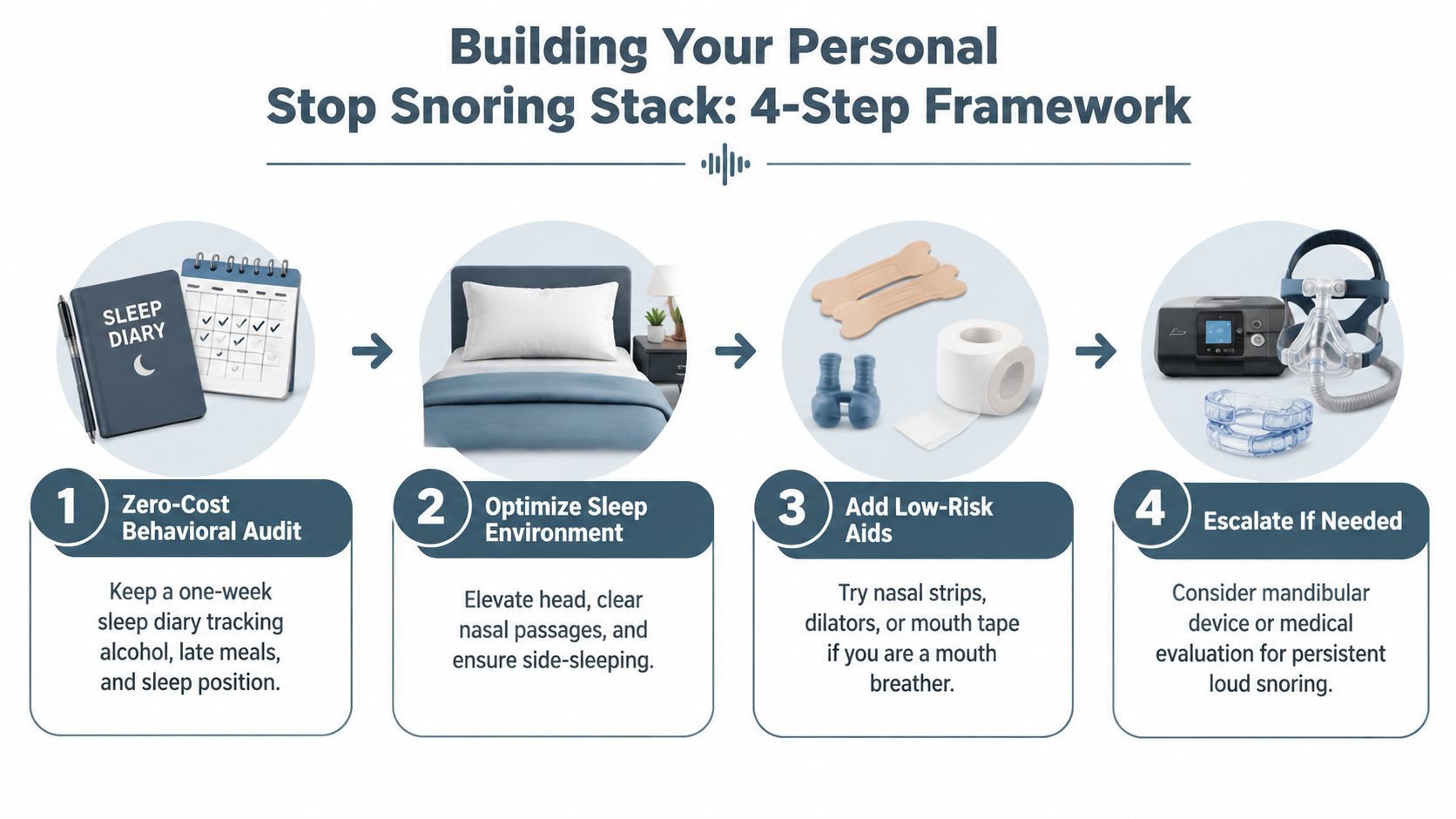
Step two, add one passive aid
Choose the aid that matches your diary:
- Nasal pattern: Try an external strip, then consider an internal dilator if the strip improves airflow but doesn't feel sufficient.
- Positional pattern: Use a side-sleeping pillow, wedge, or positional trainer.
- Mouth-breathing pattern: Improve nasal comfort first. Only consider cautious mouth taping when you can breathe freely through your nose and have no warning signs.
Give each change enough nights to judge consistently, while tracking both sound and sleep quality. A quieter partner report is useful, but waking refreshed and avoiding breathing alarms matter more.
Step three, move to active treatment
If simple aids underperform, discuss a custom mandibular advancement device with a dentist trained in sleep-related breathing care. Prescription devices, fitted oral appliances, and clinical options belong here, not in the same bucket as adhesive strips.
Budget realistically. Lifestyle changes can cost nothing, while clinical evaluation and fitted devices can reach $1,000-plus depending on care and coverage. Don't assume the cheapest product is the best value if repeated failed trials leave the underlying problem untouched.
Step four, escalate for red flags
Home sleep testing can help evaluate suspected OSA, while CPAP or another medical treatment may be appropriate after diagnosis. Escalate sooner if your partner reports pauses, gasps, or choking, or if you have significant daytime sleepiness.
Test one variable at a time, but don't test forever. Persistent loud snoring deserves an explanation, not an endless rotation of accessories.
When Snoring Means You Need a Doctor
Snoring isn't automatically dangerous. Loud, frequent snoring combined with breathing interruptions or daytime symptoms is different, and another gadget isn't the right response.
Seek medical evaluation if someone observes repeated breathing pauses, choking, or gasping during sleep. Morning headaches, persistent daytime sleepiness, impaired concentration, irritability, high blood pressure, nighttime chest pain, unexplained weight changes, or very long pauses between breaths also deserve attention.
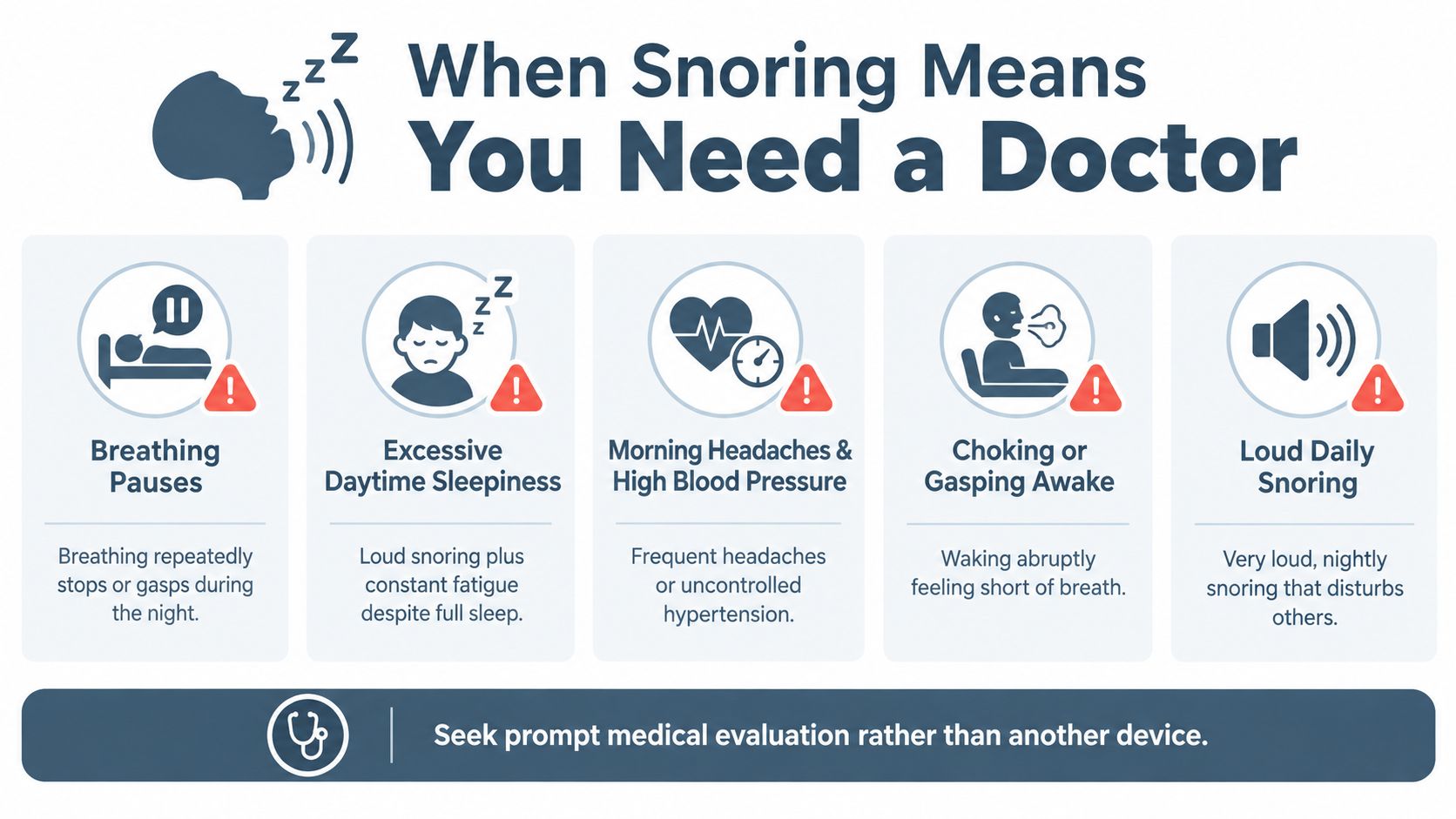
Situations that raise the stakes
Ask a clinician about obstructive sleep apnea testing after a stroke, with heart disease, or when blood-pressure control is worsening. A clinician may use a symptom questionnaire, examine your airway, check blood pressure, and arrange a home or laboratory sleep study. That evaluation separates positional snoring from airway obstruction that needs CPAP or a fitted oral appliance.
Children need their own threshold for assessment. A child who snores most nights, breathes through the mouth, pauses during sleep, wets the bed, or struggles at school should be assessed for sleep-disordered breathing and possible enlarged tonsils or adenoids. Children's symptoms shouldn't be managed with an adult's tape, strip, or dental device.
Discuss breathing problems, nasal obstruction, dental disease, or temporomandibular-joint pain before trying mouth tape or a mandibular advancement device. Sedating medication and over-the-counter sleep aids can also complicate nighttime breathing, so speak with a clinician before using them as a sleep shortcut.
The practical line is clear: ordinary, position-dependent snoring can justify a structured home experiment. Gasping, witnessed pauses, severe fatigue, or persistent nightly noise justify medical evaluation. A diagnosis tells you whether positional training is enough, whether a fitted oral appliance is appropriate, or whether CPAP is the safer and more effective route.
SleepHabits offers educational guidance on nasal versus mouth breathing alongside tools such as hydrating mouth tape and transparent nasal strips for people testing targeted breathing habits. Visit SleepHabits to compare those options, review the sleep resources, and build a measured plan that fits your snoring pattern.