

Mouth tape for sleeping is often presented as a universal upgrade: apply a strip, force nasal breathing, and wake up with quieter, deeper sleep. That advice skips the question that matters most. Why are you breathing through your mouth at night?
Mouth opening can reflect a simple habit, but it can also signal nasal obstruction, reflux, asthma, untreated sleep apnea, or another breathing problem. Closing the mouth before identifying the cause may reduce a symptom for some low-risk adults, while making airflow less secure for others. The practical position is narrower than the social-media version: mouth tape may be a behavioral cue for selected people with clear nasal airflow, but it isn't a general treatment for snoring or sleep-disordered breathing.
Why Mouth Tape for Sleeping Is Suddenly Everywhere
Mouth taping has moved from specialist conversations about oral posture and myofunctional therapy into mainstream wellness content. Podcast discussions, short-form videos, and personal snoring testimonials have made the practice look simple and universal. The appeal is obvious: a small adhesive strip seems to offer a cheap, drug-free way to encourage nasal breathing without a machine, prescription, or complicated routine.
The promise is attractive. If mouth opening contributes to noisy airflow or morning dryness, keeping the lips gently together might appear to solve the visible problem. Online demonstrations often reduce the practice to a product choice and a placement technique, while leaving out the diagnostic step that determines whether the nose can support breathing throughout sleep.
That omission matters. A person with a clear nasal passage may be experimenting with a behavioral prompt. A person with congestion, a deviated septum, nasal polyps, reflux, asthma, or unrecognized apnea may be removing a natural backup route for air.
The social-media version leaves out the screening
The strongest recent review found only 10 published studies on mouth taping and related mouth-occlusion methods. Of those, only 2 suggested benefit for people with mild sleep apnea, while 4 warned of serious risks such as asphyxiation when nasal airflow is impaired, as reported in the 2025 systematic review in PLOS One. Another scoping review identified 177 unique records but only 9 that met inclusion criteria, which shows how small the usable evidence base remains.
Practical rule: Don't place anything over your lips until you know that nasal breathing is reliable when you're awake, congested, tired, and lying down.
Mouth tape does have a legitimate, narrow use case. It may help a carefully screened adult reduce mouth leak or mild snoring when the nasal airway is open and no breathing disorder is suspected. It shouldn't be used to silence warning signs, replace a sleep evaluation, or create the impression that apnea has been treated.
Nasal Breathing and Mouth Breathing at a Glance
Think of the nose as a climate-controlled airlock and the mouth as an open window. The nasal passages filter particulates, humidify incoming air, warm it toward body temperature, and contribute nitric oxide to inhaled airflow. The mouth provides a wider, less regulated opening, which can make breathing feel easier when the nose is blocked, but it doesn't perform those same conditioning functions.
Nasal breathing also supports a quieter, more controlled airflow pattern. The lips, tongue, palate, and diaphragm work within a relatively stable pressure system, while mouth breathing can dry the throat and increase turbulent airflow across relaxed tissues. That turbulence is one reason mouth opening often appears alongside snoring, although snoring itself has multiple possible causes.
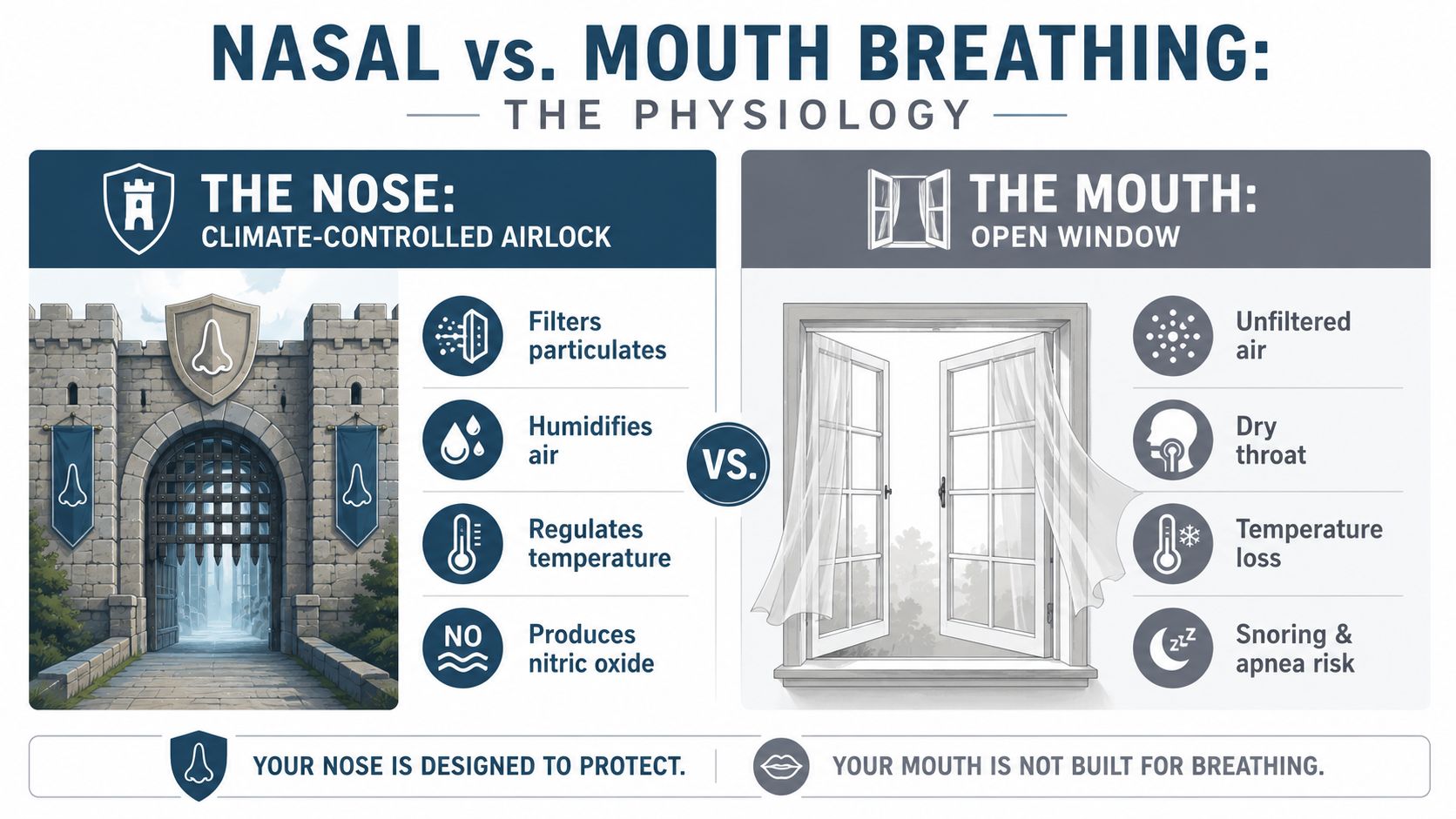
Why the nose is usually the preferred sleep pathway
During sleep, the body generally benefits from a stable route that filters and conditions air without requiring large mouth movements. Nasal airflow can feel quieter and less drying, while chronic mouth breathing commonly leaves people with a dry mouth, irritated throat, or a sense that sleep was not restorative. Those experiences are clues, not diagnoses.
A useful comparison of the mechanics appears in this guide to nasal breathing versus mouth breathing. People who want to address persistent mouth breathing may also benefit from professional therapy for better sleep quality when tongue posture, oral function, or airway coordination needs assessment.
Mouth breathing can be an adaptive response. If allergies swell the nasal lining, a structural narrowing limits airflow, or reflux causes discomfort, the mouth becomes the body's emergency access point. Tape doesn't correct those causes. It only changes what happens at the lips, which is why screening the nasal route must come first.
What the Evidence Actually Says About Mouth Tape
The published evidence is much narrower than the marketing language. A 2022 clinical study of 30 mouth-breathers with mild obstructive sleep apnea found that mouth taping improved snoring and reduced sleep-apnea severity, with both the apnea-hypopnea index and snoring index falling by about half, according to the study published in the National Library of Medicine. That result is important, but it doesn't turn mouth tape into a broadly validated apnea treatment.
The study involved a small, specific group. It can support further investigation into selected patients, not a general recommendation for anyone who snores. The broader review evidence remains limited, uneven, and concerned about safety when nasal airflow is impaired.
What the findings support, and what they don't
The most defensible interpretation is that mouth tape may reduce mouth leak and snoring in some low-risk adults who can breathe comfortably through the nose. It doesn't establish that taping improves restorative sleep, daytime functioning, asthma control, facial structure, or long-term cardiovascular outcomes. It also shouldn't replace CPAP or a properly fitted oral appliance for diagnosed sleep apnea.
| Claimed Benefit | Evidence Type | Realistic Take |
|---|---|---|
| Less snoring | Small clinical studies, including the 2022 trial | Possible for selected people when the nasal airway is open |
| Better sleep quality | Mostly subjective reports and limited research | Uncertain, especially beyond perceived quietness |
| Fewer apnea events | Early interventional evidence in a narrow group | Not enough to treat diagnosed apnea or replace prescribed therapy |
| Better oral health | Physiological rationale around reduced mouth dryness | Not established as a clinical outcome |
| Improved breathing efficiency | Mechanistic theory about nasal breathing | A cue may help behavior, but it doesn't repair obstruction |
The 2025 review of mouth taping evidence reinforces the central limitation: the literature is tiny and inconsistent, and only a small portion of reviewed studies showed significant improvement in obstructive sleep apnea metrics. My clinical position is straightforward. Mouth tape is a low-cost behavioral nudge, not a clinical therapy.
How to Try Mouth Tape Safely on Night One
Treat a first trial like any other new sleep intervention. Screen first, test gradually, and preserve an easy way to remove the tape. Don't start on a night when you're ill, congested, nauseated, unusually sedated, or unable to pay attention to your breathing.
Begin with a 24-hour patch test on the cheek, not the lips. Remove it slowly and check for redness, itching, swelling, burning, or a rash. A negative test doesn't guarantee that the lips won't react, but it reduces the chance of discovering an adhesive sensitivity during sleep.
A cautious first-night sequence
- Check nasal airflow while awake. Sit, close your lips without forcing them, and breathe through your nose. Repeat while lying down. If you feel air hunger, panic, significant resistance, or the need to open your mouth, stop the experiment and investigate the cause.
- Choose skin-friendly tape. Use hypoallergenic, porous tape intended for skin. Avoid household tape, tightly occlusive materials, and any design that wraps around the jaw or chin.
- Start with a small vertical strip. Place it across the center of relaxed, closed lips. The goal is a gentle reminder, not a forceful seal. You should be able to remove it quickly and without pain.
- Test the seal before bed. A light exhale should not create pressure, discomfort, or a trapped sensation. If the tape pulls the lips, wrinkles the skin, or makes speaking difficult before sleep, reposition it or remove it.
- Use a short window first. Try two to three hours rather than committing immediately to a full night. Keep a partner nearby if possible, and remove the tape at once if breathing feels strained, anxious, or unfamiliar.
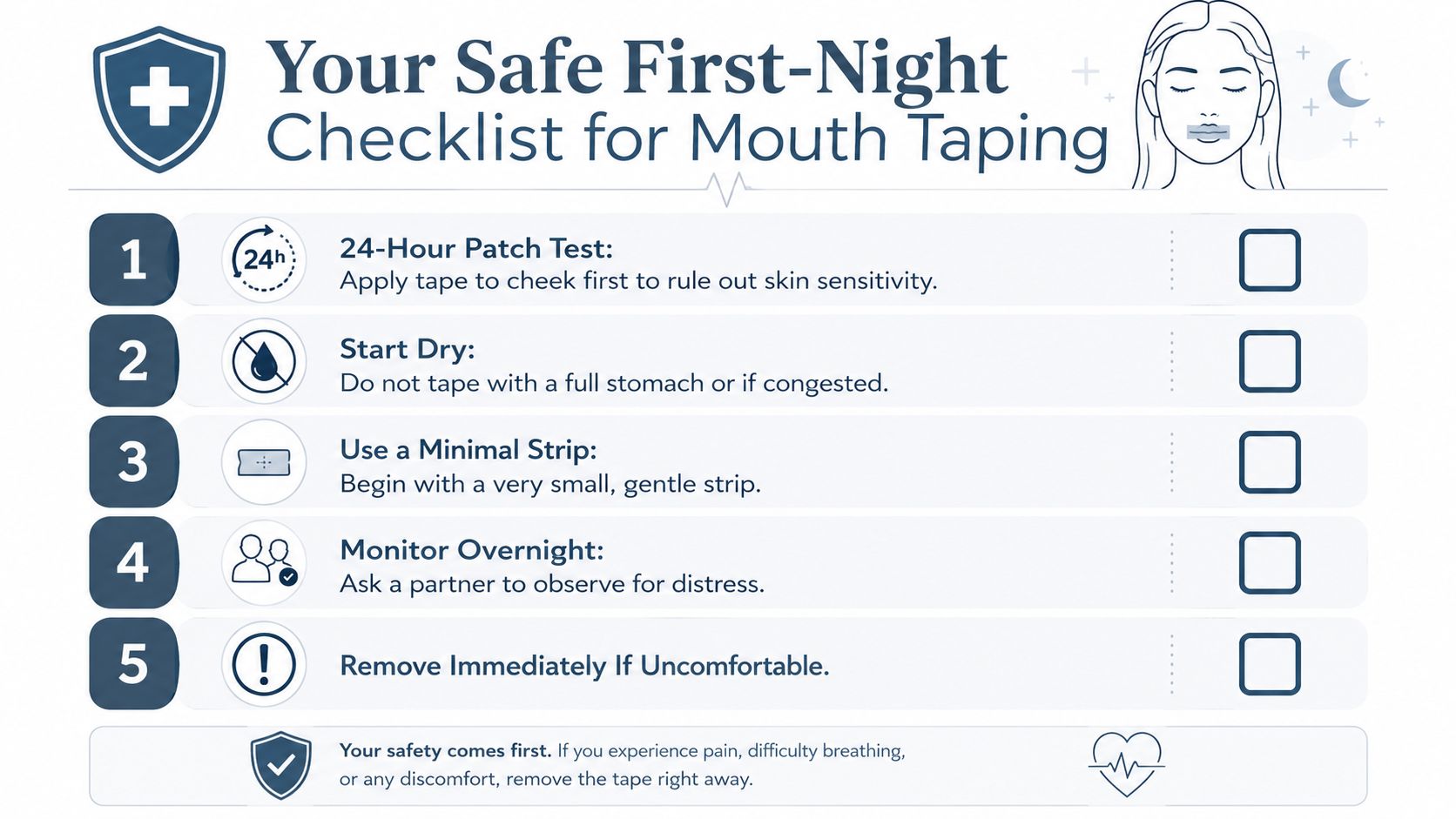
Before bed, clear the nose with a saline rinse if that's already appropriate for you, keep bedroom humidity in the 40 to 60% range, and consider modest head-of-bed elevation. If you're comparing products, Hydrating Mouth Tape is one cataloged option described for quieter nights, oral care, tongue posture, and nasal-breathing support. Those descriptions are product positioning, not proof of clinical benefit.
On waking, remove the tape gently with warm water if it has shifted or adhered firmly. Record whether you experienced panic, nasal blockage, disrupted sleep, increased dryness, or unusual morning fatigue. A negative experience is useful information, not a reason to apply more tape or use a stronger adhesive.
Who Should Not Use Mouth Tape for Sleeping
Mouth tape is a targeted tool, not a universal sleep fix. The main risk is straightforward: if nasal airflow becomes inadequate, taping removes the mouth's backup route. Possible problems include difficult breathing, skin irritation, allergic reactions, anxiety, and disrupted sleep, as outlined by the Cleveland Clinic.
Do not use it with nasal obstruction or chronic congestion, including suspected polyps, a deviated septum, enlarged turbinates, enlarged adenoids, or symptoms that remain unresolved after sinus surgery. Avoid self-experimentation with untreated sleep apnea, asthma that worsens at night, chronic obstructive pulmonary disease, reflux disease, or another heart or lung condition. Houston Methodist's medical guidance cautions against taping when nasal breathing is impaired or regurgitation is possible.
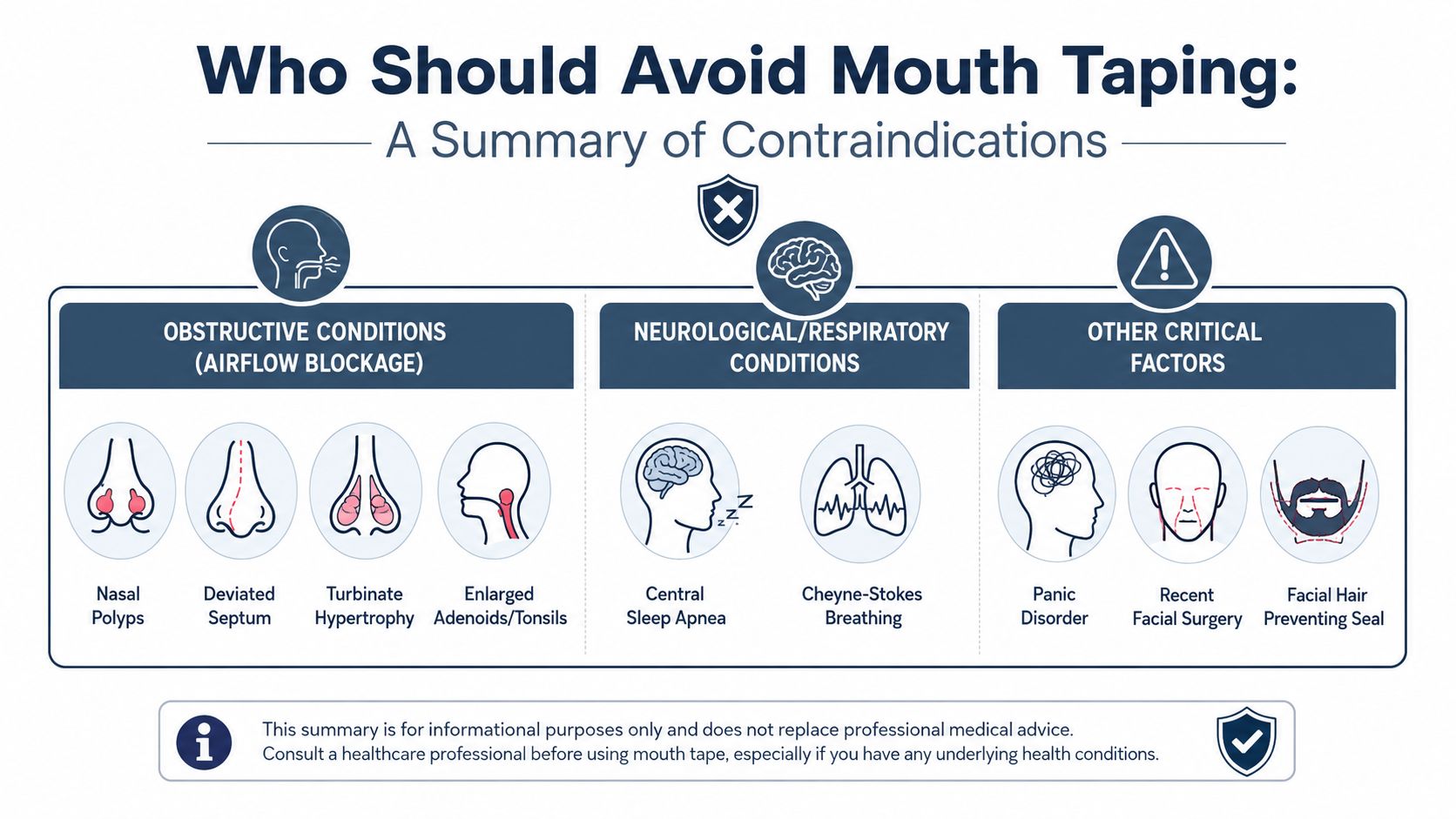
Situations self-screening often misses
Medication and timing also affect the decision. Sedatives, opioids, muscle relaxants, and alcohol near bedtime can change arousal or airway muscle tone. Some antihistamines may thicken secretions or make the nose feel less usable, creating a poor setting for a taped mouth.
Children need direct medical guidance before using mouth tape. Clinician input also makes sense for anyone with panic symptoms around restricted breathing, fragile or inflamed skin near the lips, facial hair that prevents a predictable seal, recent facial procedures, or pregnancy-related nasal symptoms.
Stop experimenting and seek evaluation if you snore loudly, wake gasping, have witnessed breathing pauses, develop morning headaches, or remain unrefreshed despite sleeping through the night. Persistent dry mouth after taping also calls for reassessment. An overview of sleep-disordered breathing may help identify concerning patterns, but suspected apnea requires clinical assessment and, when appropriate, a sleep study.
Choosing the Right Tape and Pairing It With Other Tools
Tape format should match skin tolerance, ease of removal, and the reason you're trying it, not the most dramatic marketing promise. Pre-cut lip strips are usually simple to apply and remove. Short vertical pieces of hypoallergenic surgical tape offer a moderate hold, while specialty patches with a central vent may feel less restrictive.
The table below compares formats qualitatively. Exact prices vary by product and location, so a reliable cost-per-night figure can't be assigned without a specific pack and usage pattern.
| Format | Hold Strength | Breathability | Best For | Approx. Cost/Night |
|---|---|---|---|---|
| Pre-cut lip strips | Lower to moderate | Depends on design | Beginners who prioritize easy removal | Varies by product |
| Short vertical surgical tape | Moderate | Porous when designed for skin | People testing a minimal strip | Varies by product |
| Specialty vented patches | Moderate | Central vent can improve comfort | Users who tolerate adhesive and want less occlusion | Varies by product |
For nasal narrowing, external dilator strips can support the nose without sealing the mouth. Saline irrigation may help when irritants or thick mucus contribute to congestion, while a clinician-directed nasal spray may be appropriate for inflammation. Myofunctional or Buteyko-style exercises can address daytime breathing habits and tongue posture, but they shouldn't be treated as substitutes for an airway evaluation.
A product such as Transparent Nasal Strips is cataloged for easier nighttime breathing, congestion support, and pairing with mouth tape. Those are listed product purposes, not a guarantee that the strip will correct structural obstruction or apnea.
For a broader product comparison, review this guide to the best mouth tape for sleeping. The sequencing rule remains more important than the brand: clear the nose, support the nasal passage, train the breathing pattern, and only then consider tape as a cue.
Building a Safer Mouth Taping Routine
Use a simple decision tree before every trial. If congestion, reflux, suspected apnea, asthma symptoms, sedating substances, skin irritation, or breathing anxiety is present, stop and choose evaluation or a non-occlusive alternative. If none applies and nasal breathing feels easy while awake and lying down, proceed with a conservative routine.
Start 60 to 90 minutes before bed. Address allergy or congestion treatment according to the directions from your clinician or product label, allowing time for it to take effect. Clean and dry the skin, then use a nasal dilator if structural narrowing appears to be part of the problem. Apply mouth tape last, with a single gentle strip rather than a tight or broad seal.
What to monitor
For the first two weeks, keep the log practical:
- Snoring intensity: Note whether a partner reports quieter breathing, but don't treat silence as proof that apnea has improved.
- Morning mouth dryness: Record whether dryness changes, stays the same, or worsens.
- Restorative sleep: Describe how refreshed you feel rather than assuming a quiet night was a healthy night.
- Breathing comfort: Write down any panic, air hunger, repeated awakenings, or nasal blockage.
A backup timer can help you test a short window, but it isn't a safety device and shouldn't replace screening. A partner can observe distress during the early trials, yet an observer also can't diagnose apnea from sound alone.
Repeat the screening if you develop a cold, seasonal congestion, new reflux, medication changes, or a change in snoring. Switch to a nasal strip, saline routine, positional adjustment, or professional assessment when the tape feels necessary to tolerate rather than easy to forget. Persistent fatigue, morning headaches, gasping, or unrefreshing sleep should move the decision from self-experimentation to clinical review.
Common Questions About Mouth Tape for Sleeping
Mouth tape is a targeted experiment, not a general treatment for snoring or poor sleep. Its suitability depends on nasal airflow, jaw function, dental history, and possible sleep-disordered breathing. Comfort during the first few minutes does not establish that it is safe overnight.
| Question | Direct Answer | When to Escalate |
|---|---|---|
| Can mouth tape shift jaw alignment? | A gentle lip strip should not reposition the jaw, but discomfort or clenching can change how you hold your mouth. | Ask a dentist or orthodontist about jaw pain, bite changes, or persistent clenching. |
| Can it affect dental work? | Adhesive can irritate the lips or nearby skin. It also does not protect crowns, braces, or restorations from grinding or reflux. | Contact your dentist if tape catches on an appliance, causes sores, or symptoms follow dental treatment. |
| Can I use it with CPAP? | Do not add mouth tape to CPAP without guidance. Mask type, air leaks, pressure settings, and your ability to remove the tape all matter. | Speak with your sleep specialist before changing mouth management during CPAP. |
| What about an oral appliance? | Tape does not replace a mandibular advancement device or show that the appliance is working. | Ask the prescribing dentist or sleep clinician if snoring or fatigue continues. |
| Can children use it? | Children need assessment for enlarged tonsils or adenoids, nasal obstruction, and sleep-disordered breathing before any lip seal is considered. | Seek pediatric or ENT guidance first. |
| Can pregnant people use it? | New congestion, reflux, and breathing changes make unsupervised experimentation a poor default, particularly later in pregnancy. | Discuss it with the prenatal clinician if sleep or breathing has changed. |
| What if I grind my teeth or have reflux? | Tape addresses neither mechanism. Reflux or nausea also makes a sealed mouth less appropriate. | Stop and involve a dentist, primary clinician, or sleep specialist. |
| What if my nose clogs overnight? | Remove the tape immediately. Do not restart until the obstruction's cause is understood. | Arrange an ENT or sleep evaluation for repeated blockage or nighttime breathing distress. |
Skin reactions, anxiety, and breathing difficulty are valid reasons to stop, as noted in Cleveland Clinic's guidance on mouth taping. The same applies if you wake with new snoring, headaches, choking sensations, or worse sleep. A quiet night alone does not show that breathing problems have improved.
SleepHabits provides educational guidance and nighttime breathing tools, including mouth tape and nasal strips, for people creating a structured wind-down routine. Visit SleepHabits to compare those options and review the educational resources before deciding whether a nasal-breathing experiment is appropriate.