

You're halfway through a workday when the screen glare starts to feel sharp. Pressure builds behind one eye, ordinary room light becomes intrusive, and you find yourself wondering whether blue light blocking glasses for migraines could prevent the next attack or at least make the current one easier to tolerate.
The short answer is conditional. Some migraine patients may benefit from light-filtering eyewear, but generic blue-blocking lenses and migraine-specific tints aren't the same product. The wavelength a lens filters, the way it fits your symptoms, and how consistently you use it matter more than the label on the packaging.
Why Light Can Feel Like an Attack Trigger
During a migraine, a laptop screen can stop feeling like a neutral object. The white background seems to flare, reflections from a window become distracting, and even a modest increase in brightness can intensify discomfort. You might lower the display, close one eye, or move into a darker room, not because you're being overly sensitive, but because your nervous system is processing light differently.
Photophobia, the clinical term for light sensitivity, is a common migraine symptom. It can occur before the pain, during the attack, or while you're recovering from it. Light doesn't necessarily create the entire migraine by itself. Instead, it can act as a trigger, amplifier, or source of additional stress once the migraine pathway is already active.
Why the response feels neurological
Your eyes collect light, but the experience of pain involves communication between the visual system and pain-processing networks. During migraine, signals from the eye can interact with the trigeminal system, a major pathway involved in head and facial pain. That's why the discomfort may feel deeper than ordinary eye fatigue.
A person with simple visual strain might feel dryness after prolonged screen use. Someone with migraine-related photophobia may experience light as painful, nauseating, or intolerably intrusive. The two experiences can overlap, but they aren't interchangeable.
Practical rule: Treat your light sensitivity as useful information. Notice whether screens, outdoor glare, overhead lighting, or post-attack exposure causes the strongest reaction.
Can glasses change that response?
They may, but only if the lenses reduce the wavelengths that aggravate your symptoms. A lens that blocks some violet or blue light may feel comfortable for screen use without meaningfully targeting the wavelengths involved in migraine photophobia.
That distinction explains why one person may feel better in tinted eyewear while another notices no difference from a clear “blue-light” coating. Darkness isn't the same as precision filtering. A heavily tinted lens may reduce overall brightness, yet a lighter, wavelength-specific lens may be more comfortable if it filters the right part of the spectrum without making the world unnecessarily dim.
Your symptom pattern can help guide the choice. Screen glare may point you toward testing a migraine-specific lens during computer work. Outdoor light sensitivity may require broader environmental changes, such as a hat, glare reduction, or a tint designed for photophobia rather than a standard office coating.
The Light-to-Pain Pathway Explained Simply
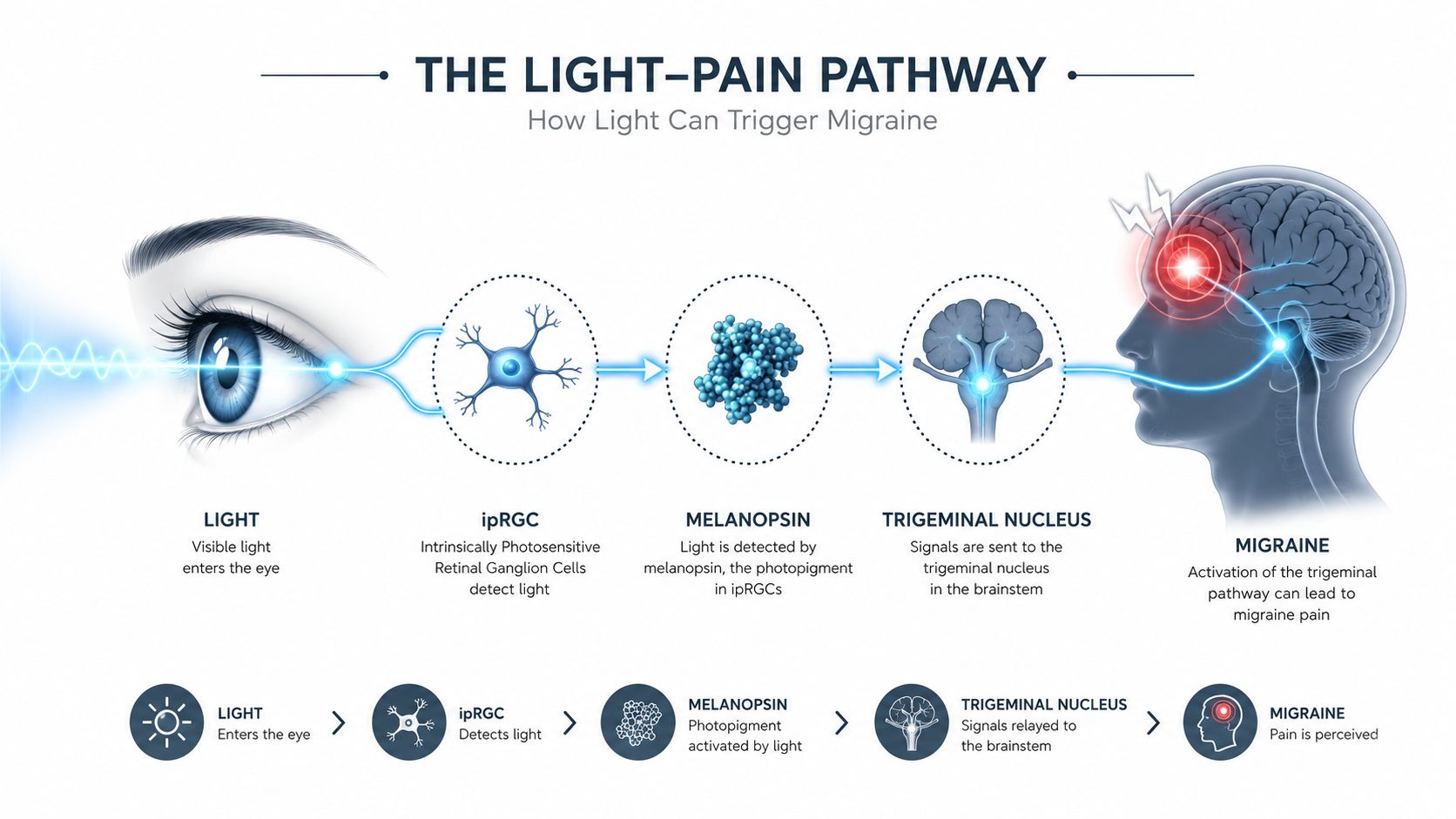
Think of your retina as having more than one kind of light sensor. Cones help you see color and detail. Another group, called intrinsically photosensitive retinal ganglion cells, or ipRGCs, helps the brain interpret the overall presence and intensity of light.
A useful analogy is to think of ipRGCs as the building's light alarm. Cones help you read the sign on the wall, while ipRGCs report how much light is entering the room. They use a light-sensitive molecule called melanopsin and connect with brain systems involved in alertness, circadian timing, and, in migraine, light-related discomfort.
Why roughly 480 nanometers matters
The visible spectrum contains different wavelengths, and the migraine brain may not respond to all of them equally. Research into optical tints has focused on light around 480 nanometers, because that range can stimulate the melanopsin pathway associated with ipRGC activity.
That doesn't mean every migraine is a “blue-light migraine.” It means that a lens designed around a specific wavelength may have a different purpose from a broad, general-purpose blue-blocking lens. A clear lens can still filter selected wavelengths if its optical design is precise, while an amber lens may block a broader range without matching your particular sensitivity.
Wavelength matters more than darkness
A darker lens reduces the amount of light reaching your eyes. That can be useful in bright conditions, but darkness alone doesn't reveal which wavelengths the lens removes. Two pairs can look similarly tinted while producing very different filtering patterns.
Before buying, look for technical information about the lens rather than relying only on phrases such as “blue light protection,” “screen glasses,” or “computer eyewear.” Ask whether the product is a generic blue blocker, an FL-41-style tint, or a 480 nm notch filter. Those terms describe different design goals, and the distinction is central to choosing blue light blocking glasses for migraines.
If the product page doesn't explain its target wavelengths or migraine-specific purpose, treat its migraine claims cautiously. Comfort is worth testing, but comfort during screen use isn't proof that a lens prevents migraine attacks.
What the Research Actually Shows
Research does not support treating every blue-blocking lens as a migraine treatment. The evidence has moved from broad colored lenses toward more selective filters, but those approaches are not interchangeable. A lens made for general screen comfort may differ from a wavelength-specific migraine tint in both design and expected benefit.
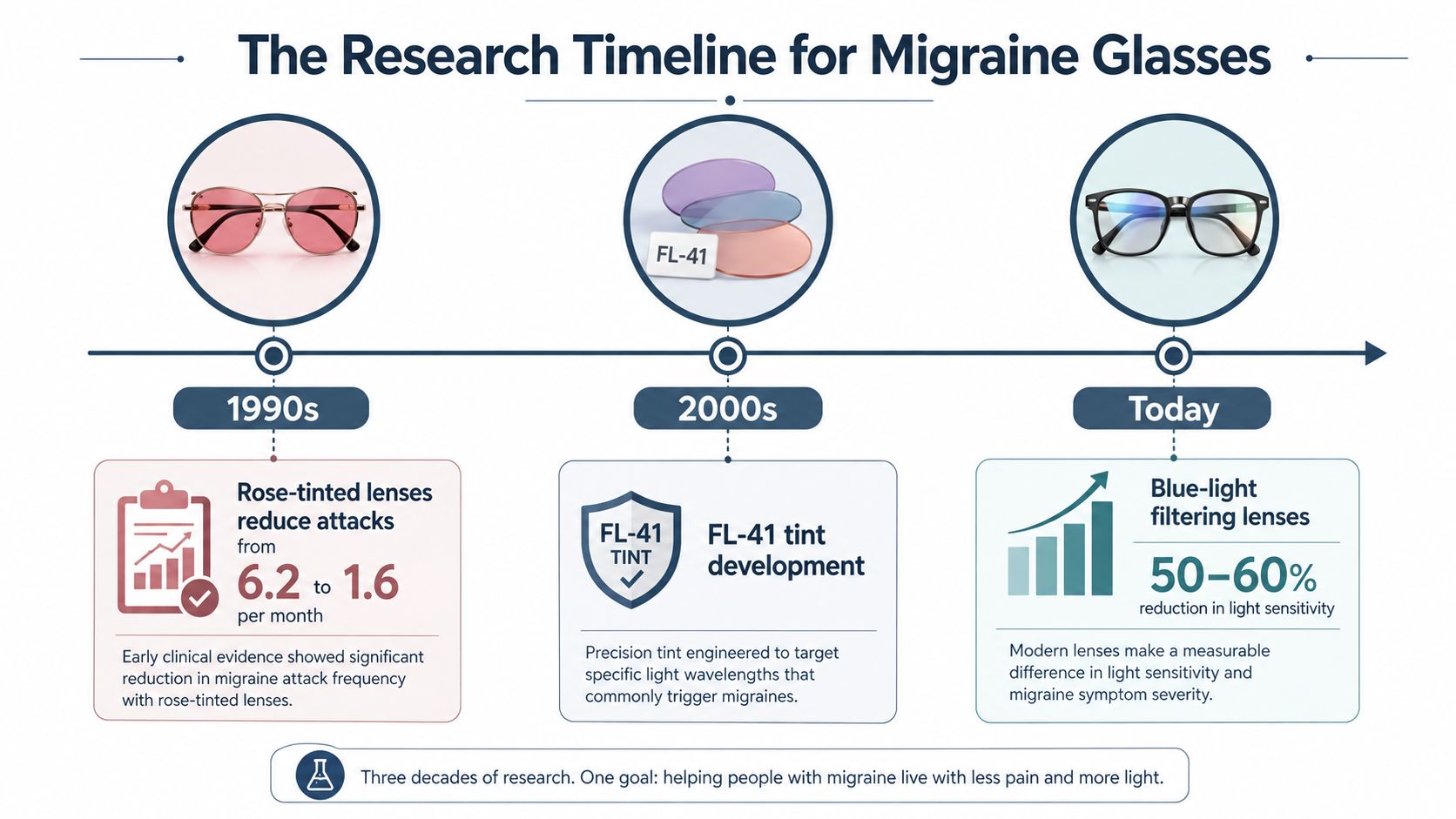
An early study of 20 children with clinically diagnosed migraine compared rose-colored and blue-colored lenses over four months. Among the children who continued using the rose tint, mean headache frequency fell from 6.2 attacks per month to 1.6 attacks per month. The blue tint did not produce an overall improvement. The result is historically useful, yet the study was small and focused on children who remained with the tint, so it cannot show that every rose lens will work the same way. (Read the historical pediatric study)
FL-41 became associated with migraine care as researchers and clinicians recognized that photophobia cannot be reduced to one universally harmful “blue” wavelength. A review describes a 2010 finding in which blue, red, and amber light worsened sensitivity for some participants, while green light felt soothing to some. A 2011 patent from Moran Eye Center also reflected the move toward more targeted wavelength filtering. The same review discusses later evidence on light-filtering technologies and migraine tints. (Review of light-filtering technologies and migraine tints)
What newer trials add
A 2023 non-randomized clinical trial from Japan followed 10 people with migraine who wore blue-cut nocturnal glasses for four weeks. Average headache days decreased from 8.7 ± 5.03 before the intervention to 7.0 ± 4.37 during the four-week period, and no side effects were reported. Photophobia intensity also decreased across daytime, nighttime, and indoor settings. The trial and its clinical details are reported together here. (Read the 2023 Japanese clinical trial)
That equals roughly 1.7 fewer headache days over a month on average, but the small sample and non-randomized design limit confidence. It is an encouraging signal, not a general prescription.
A controlled study of 78 subjects found no significant overall difference in pain reduction at two and four hours compared with controls. Post-hoc analyses found clinically and statistically significant pain reduction among participants whose baseline pain was at least 2, along with fewer reports of light sensitivity at two hours. This pattern suggests that benefit may depend on migraine phenotype and symptom severity. (Study summary and clinical discussion)
For a plain-language explanation of the difference between general headache eyewear and migraine-focused lenses, see this guide to blue-light glasses for headaches. The practical conclusion is measured: evidence is mixed, conditional, and highly dependent on the lens design and the person wearing it.
Generic Blue Blockers vs Migraine-Specific Tints
A label that says “blue-light glasses” does not identify one single type of lens. Generic blue-light blockers usually aim to improve screen comfort, support evening light management, or reduce broad blue-violet exposure. Migraine-specific tints are designed around photophobia, using selective filtering such as FL-41-style rose lenses or 480 nm notch filters.
The appearance can mislead you. A generic pair may be clear with a coating, or amber enough to change the color of nearby objects. A migraine tint may look rose-colored, lightly tinted, or nearly subtle. Darkness alone does not show whether a lens is addressing the wavelengths involved in migraine-related light sensitivity. The spectral design matters more than the color or product name.
| Criterion | Generic Blue Blockers | Migraine-Specific Tints, FL-41 / 480 nm notch |
|---|---|---|
| Primary purpose | Screen comfort, general blue-light filtering, or evening light reduction | Photophobia and migraine-related light sensitivity |
| Target approach | Broad or limited blue-violet filtering, depending on the product | Wavelength-selective filtering, including FL-41-style or 480 nm-focused designs |
| Evidence for migraine relief | Limited and not strong as a category | More promising, but still mixed and conditional |
| Best use case | A person seeking general screen comfort who doesn't need migraine-specific filtering | A person whose migraine symptoms include pronounced light sensitivity |
| Main trade-off | May not target the wavelengths that bother you | May cost more, alter color perception, or require a careful fit and trial |
How to read a product page
Check four details before buying:
- Lens category: Does the description name a migraine tint, or only say “blue light glasses”?
- Spectral information: Does it identify the wavelengths filtered by the lens?
- Color experience: Could the tint affect design work, driving, photography, or other color-sensitive tasks?
- Return policy: Can you wear the lenses consistently and return them if they increase discomfort?
Match the lens to the symptom pattern. Mild screen fatigue without photophobia may justify a generic pair as a comfort experiment. Pain from overhead lighting, daylight, or screen glare during migraine points more logically toward a wavelength-specific tint.
The trade-off is straightforward. Generic blockers may be easier to find and less disruptive to color perception, but their filtering may not match the light that bothers you. Migraine-specific designs offer a more targeted approach, though the response can vary and the tint may take time to assess in daily settings.
Evidence reviews distinguish generic blue-light filters from migraine-focused technologies. Generic lenses have limited support for migraine relief, while selective tints aimed at relevant pathways appear more promising, with results still dependent on the lens design and the individual wearing it.
When and How to Wear Them for the Best Results
A lens can't help while it's sitting in a drawer. The most practical approach is preventive and consistent use during predictable high-risk periods, rather than waiting until light sensitivity has already escalated.
Build a simple wearing rhythm
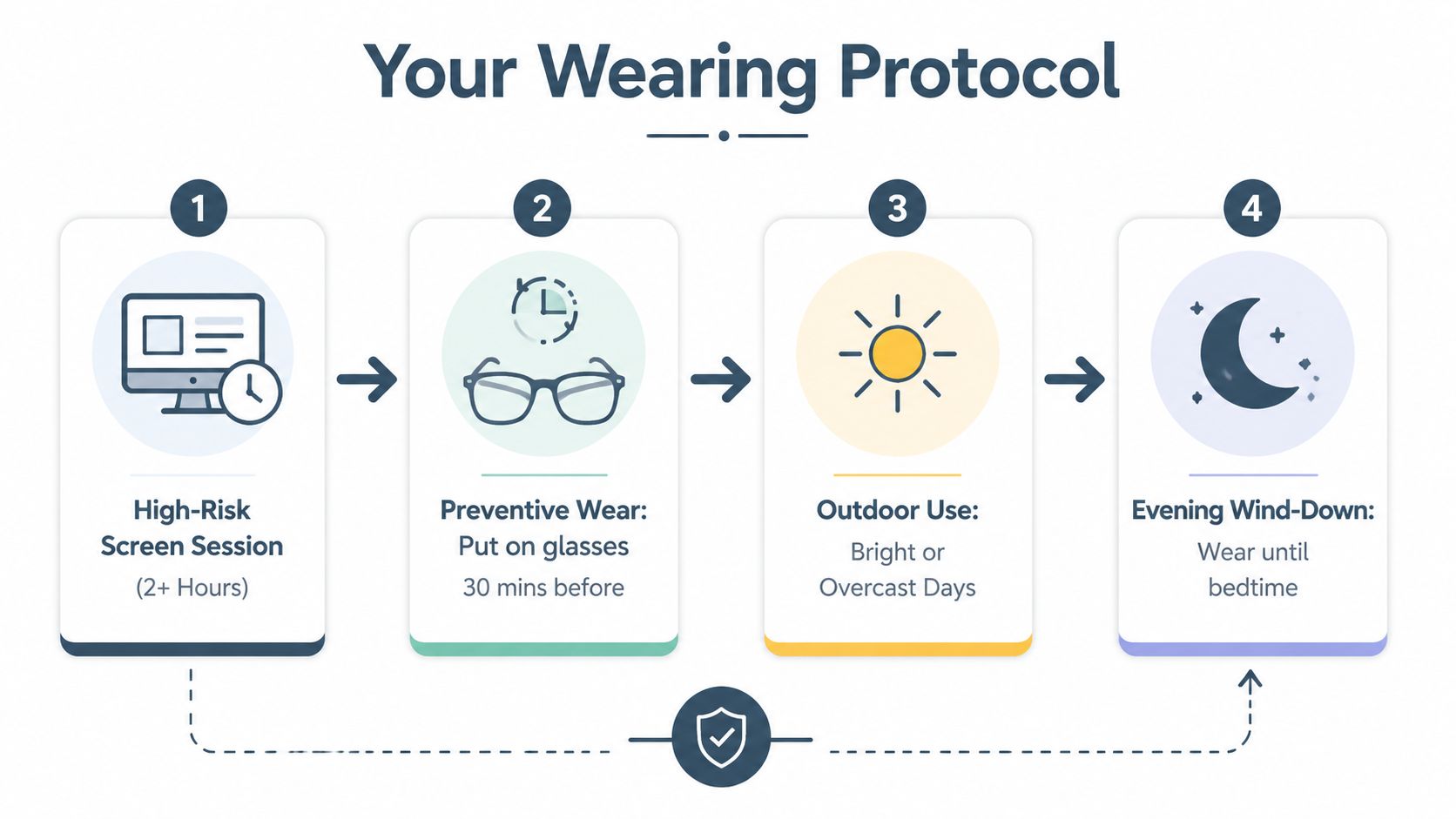
For a focused screen session lasting two or more hours, put the glasses on before the glare becomes uncomfortable. The supplied wearing protocol suggests putting them on 30 minutes before a high-risk session, but treat that as a practical experiment rather than a proven universal timing rule.
Use them outdoors when bright or overcast conditions make you squint or develop discomfort. Overcast skies can still create broad, diffuse glare, and a migraine-specific tint may feel different from ordinary sunglasses. For driving, choose lenses that preserve safe visual clarity and check local requirements before using any tint behind the wheel.
After an attack, residual photophobia can linger. Wearing comfortable lenses during the postdrome may reduce sensory load while you return to normal activity, but don't stay in increasingly dark environments all day if that makes ordinary light harder to tolerate later.
Make the environment do less work
Glasses work better as part of a stack. Lower the screen brightness so it matches the room, enable a warmer night mode, reduce reflections, and take regular visual breaks. If the frames pinch, slide down, or leave large gaps at the temples, you'll probably remove them before they have a fair trial.
Night use deserves a separate decision. Amber lenses may reduce evening light exposure, but the migraine purpose and sleep purpose aren't identical. If you're testing them at night, judge whether they help you wind down without interfering with reading, navigation, or comfortable vision. The sleep-focused discussion of blue-light glasses can help you separate those goals.
A consistent evening routine may also include Transparent Nasal Strips, which are described as supporting easier nighttime breathing and reducing nasal congestion from colds, allergies, or dry air. Keep that separate from the migraine lens decision. Better airflow may support a wind-down routine, but it isn't evidence that nasal strips treat migraine.
Common Mistakes That Make Them Feel Useless
The first mistake is assuming that any amber lens equals an FL-41 lens. Color can give you a clue, but it doesn't reveal the precise transmission profile. A cheap amber pair may reduce brightness and make screens feel warmer while failing to target the wavelengths that provoke your photophobia.
The second mistake is using the glasses only once an attack has become severe. Some people may prefer that approach, but if your main triggers are predictable, test the lenses before and during those exposures. Waiting until pain, nausea, and light sensitivity are already intense makes it harder to judge whether the eyewear is helping.
Troubleshoot the setup, not just the lens
- Check display brightness: A bright screen in a dim room creates a sharp contrast that can feel harsher than a balanced display.
- Use night mode: Warmer color settings can reduce the visual intensity of evening screens, although they don't replace migraine-specific filtering.
- Control reflections: Move the screen away from windows, change the angle, or use a matte screen surface.
- Inspect the fit: Light entering around the sides can undermine a lens that otherwise feels comfortable.
- Allow a fair trial: The Japanese trial evaluated blue-cut nocturnal glasses over four weeks, so judging a pair after one brief session won't tell you how consistent use affects your pattern. (Clinical trial details)
A useful test: Change one variable at a time. Keep your usual screen settings, add the glasses, and record discomfort, headache days, and tolerance for ordinary light.
Another failure is expecting eyewear to compensate for every light problem. Flickering LEDs, harsh overhead fixtures, glare from polished surfaces, missed meals, poor sleep, and long uninterrupted work can all remain in the environment. If you use contact lenses, review practical considerations in this guide to wearing blue-light glasses with contacts, especially around fit, dryness, and comfort.
Building a Migraine-Friendly Wind-Down Routine
A screen lens is one dial, not the whole instrument panel. Evening sensory load can come from the display in front of you, bright ceiling lights, irregular sleep timing, nasal congestion, and the effort of trying to recover while your nervous system remains stimulated.
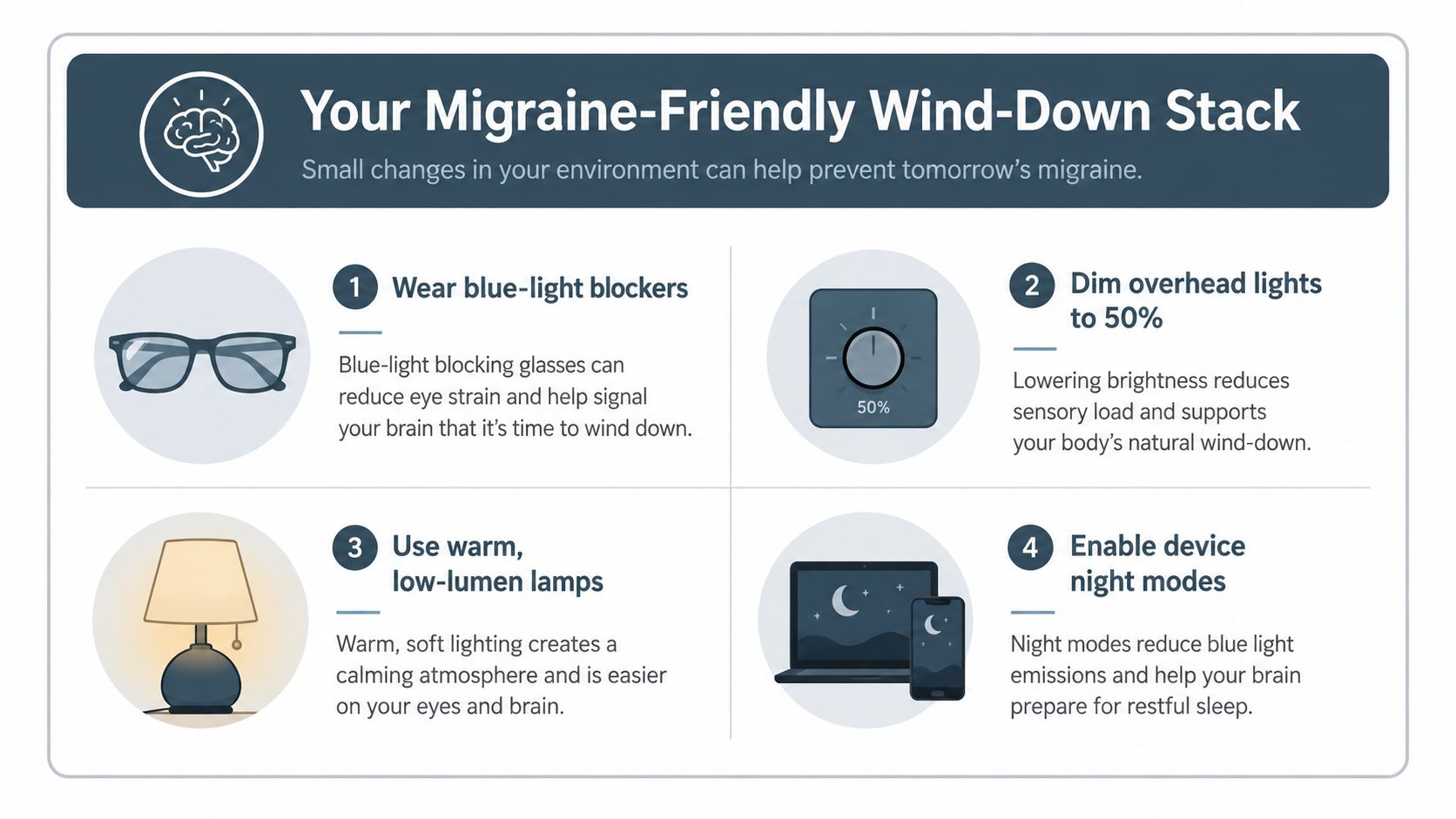
Start by lowering the room's intensity. Dim overhead lights, use warm, low-lumen lamps, and switch devices to night modes after sunset. These changes won't prove that a migraine is caused by blue light, but they can make the environment less demanding when your eyes and brain already feel vulnerable.
Treat breathing and sleep as connected variables
Nasal breathing can become harder when congestion, allergies, dry air, or habitual mouth breathing disrupt the night. Supporting easier nasal airflow may help you build a steadier bedtime routine, but persistent snoring, gasping, or fragmented sleep deserves medical evaluation rather than a product-only solution.
A consistent wind-down can include journaling, slow breathing, gentle stretching, and a fixed sequence that doesn't require much decision-making. For people who prefer a melatonin-free option, Restore+ Magnesium Sleep Aid is described as a magnesium wind-down drink containing L-theanine, tart cherry, lemon balm, glycine, and nitric oxide-supporting ingredients. Those product details describe its formulation and intended routine use, not a treatment for migraine.
Keep the routine realistic
Don't turn recovery into another demanding project. Put the glasses beside your keyboard, set the warmer display mode before evening work begins, and keep the lighting change simple enough to repeat. If you're testing several interventions at once, you won't know which one affects your symptoms.
Your aim is a calmer sensory transition into sleep. Better light management may support that transition, while breathing habits and a consistent bedtime address other sources of nighttime strain. None of these steps replaces migraine diagnosis, preventive treatment, or care for a sleep disorder.
Your Quick Decision Checklist and When to See a Doctor
Choose lenses according to the light pattern that troubles you, rather than treating every pair of blue-light glasses as equivalent. Generic blue-blocking lenses may suit screen discomfort, while migraine-specific tints, such as FL-41 or wavelength-specific filters, are designed for different sensitivity patterns.
Use this checklist:
- Screen-triggered symptoms: Test migraine-specific eyewear during predictable computer sessions, while lowering brightness and reducing glare.
- Outdoor sensitivity: Choose a tint that stays comfortable in daylight and does not interfere with safe walking or driving.
- Post-attack sensitivity: Wear the lenses while gradually returning to ordinary light. They do not replace acute migraine treatment.
- Trial period: Use one pair consistently for four weeks, then review headache days, light sensitivity, and comfort. The period matches the small Japanese trial described earlier, but does not guarantee benefit.
Keep a diary recording exposure, lens type, wearing time, symptoms, and other relevant factors. If weather or seasonal changes seem connected to attacks, weather and pollen migraine insights may help you separate environmental patterns from lens effects.
Arrange medical care for a new aura pattern, headache frequency above four headache days a month, new neurological symptoms, or visual changes that persist after removing the glasses. Sudden or severe neurological or visual symptoms require prompt care.
SleepHabits offers melatonin-free sleep and nighttime breathing tools, including Restore+ and nasal-breathing accessories, that can accompany a migraine-friendly wind-down. Visit SleepHabits for practical routine ideas.