

Can a pair of amber lenses buy you a better night, or only make it feel better? In healthy adults, the glasses can make falling asleep feel slightly easier and the night seem less broken, while measured sleep time stays stubbornly unchanged.
That gap matters. A tracker counts minutes; your body reports how rested you feel. The useful question is who is wearing the glasses and whether those evening hours land before the bedtime they are trying to protect.
Do Blue Light Glasses Help You Fall Asleep?
Can glasses make bedtime feel easier without giving you more sleep? In a small trial of healthy adults, the difference in reported time to fall asleep was only a few minutes, and measured sleep time did not increase.
A 2021 randomized trial of 20 healthy adults found that participants reported falling asleep after 21 ± 28 minutes with blue-light-blocking glasses, compared with 24 ± 21 minutes with control lenses (P = .033). They also reported 1.6 ± 1.0 awakenings with blocking lenses versus 2.2 ± 1.0 with controls (P = .019). These small self-reported differences may affect how the night feels, but they do not show that people slept longer.
| Outcome | Result with blue-blocking glasses | Evidence strength |
|---|---|---|
| Time to fall asleep | 21 vs 24 minutes in a 2021 randomized trial (P = .033) | Weak: self-reported |
| Awakenings per night | 1.6 vs 2.2 in a 2021 randomized trial (P = .019) | Weak: self-reported |
| Measured total sleep time | 433 vs 449 minutes in a 2021 randomized trial (P = .075) | No significant increase |
| Sleep efficiency | Pooled change of −0.61 percentage points in three double-blind crossover trials, not significant | No measurable benefit |
| Insomnia symptoms (self-report) | High-blocking lenses scored 0.80 points higher on a 10-point scale than low-blocking lenses in a review of filtering lenses | Modest: small trials |
The results can differ by group. A review of filtering lenses found that people reporting insomnia rated high-blocking lenses 0.80 points better than low-blocking lenses on a 10-point scale (95% confidence interval 0.17 to 1.43). The review found no similar difference among participants without insomnia symptoms.
Practical rule: Treat blue-light glasses as an optional aid, not a way to add sleep time. The reported benefit may feel more relevant to people with insomnia than to healthy sleepers.
A change in bedtime can also affect how rested you feel, regardless of glasses. These daylight saving tips from SouthShore Fine Linens offer another way to think about shifts in your evening schedule.
How Blue Light Shifts Your Body Clock
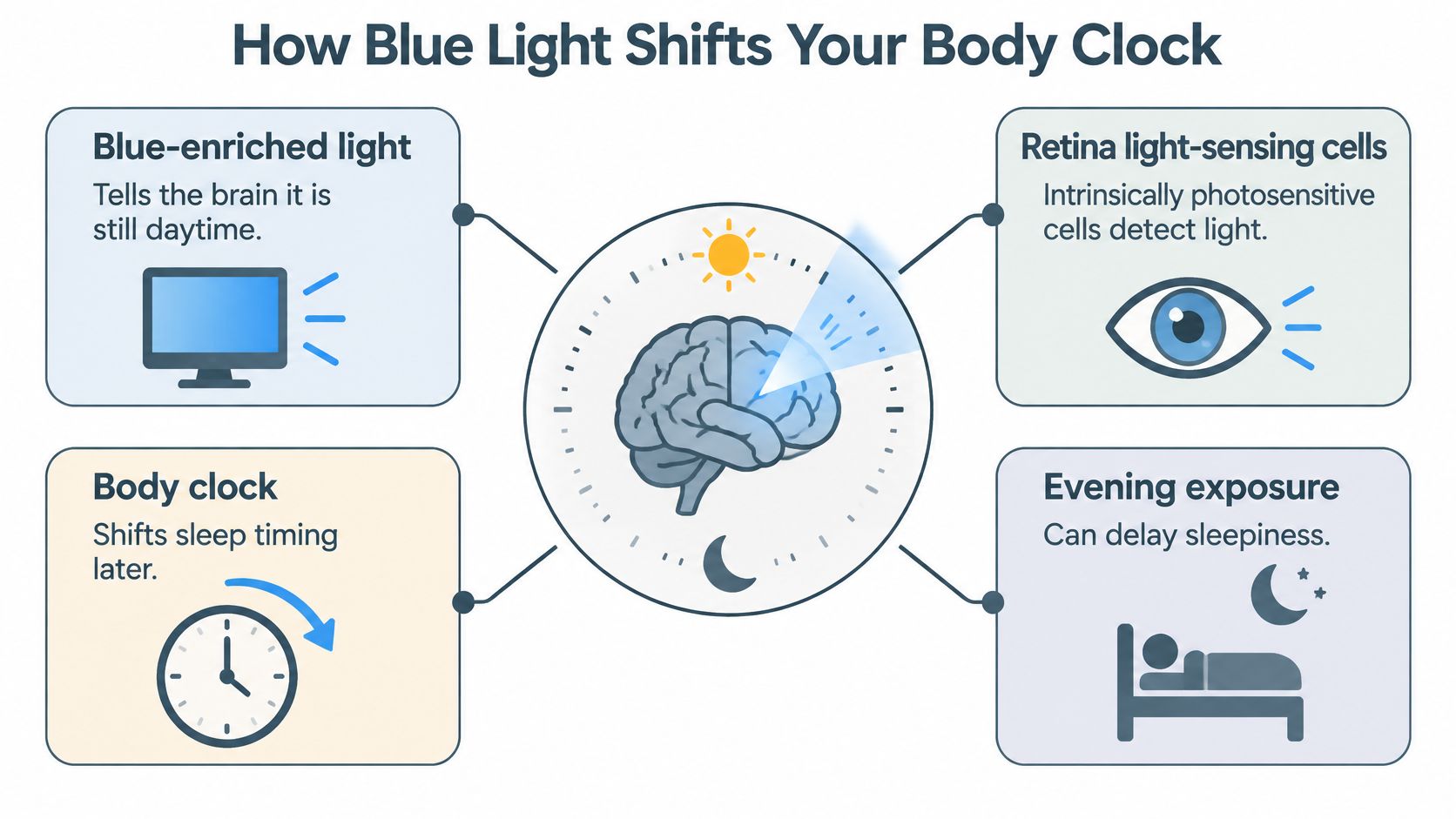
Blue-enriched light delivers a "still daytime" message to the brain even when the wall clock says 10 p.m. What evening lenses can move is that timing, so the mechanism is worth understanding before judging any pair of glasses.
From the retina to melatonin
Intrinsically photosensitive retinal ganglion cells sit in the retina and respond strongly to short-wavelength light. They don't build the picture you see. They send a brightness-and-color timing signal to the suprachiasmatic nucleus, the brain's master clock, which tells the pineal gland when to release melatonin, the hormone that marks night. Evening blue light can suppress or delay that release, so sleepiness arrives later than planned. Cover the signal in the hours when the night signal should be starting, and the delay shrinks.
An 11 p.m. bedtime under living-room lights that stay bright until 10:30 keeps the daytime cue running late. Amber or red lenses worn across those last bright hours pull the cue earlier, so the body starts releasing melatonin sooner. What changes is timing: the onset of the night signal moves forward to match the bedtime someone intends to keep.
What one evening-wear trial found
In a randomized trial of healthy nulliparous pregnant women, the blue-blocking group advanced melatonin onset by 43 minutes from baseline against an 11-minute advance with gray control glasses, and after treatment onset sat 28 minutes earlier than the control condition (p = 0.019) with higher melatonin at 8:00, 9:00, and 10:00 p.m.
That is a circadian timing effect in one specific group. Pregnancy already reshapes sleep, so the minute counts don't copy over to a different life. The person asking "will I feel drowsy earlier?" is asking the question this trial answered. The person asking "will I sleep longer?" is asking a different one.
The right lenses, worn for the several hours before a planned bedtime, pull the evening signal earlier. A bright, busy room can still overwhelm them.
If the whole schedule has drifted, a circadian rhythm reset is the bigger job, and lenses are only one piece of it. Light is only one part of the room, too. You can create a restful sleep sanctuary by pairing dimmer evening light with a cooler bedroom and bedding that doesn't keep you fidgeting. The glasses do their clearest work in the two to three hours before the bedtime you mean to keep.
Feeling Rested Is Not the Same as Sleeping Longer
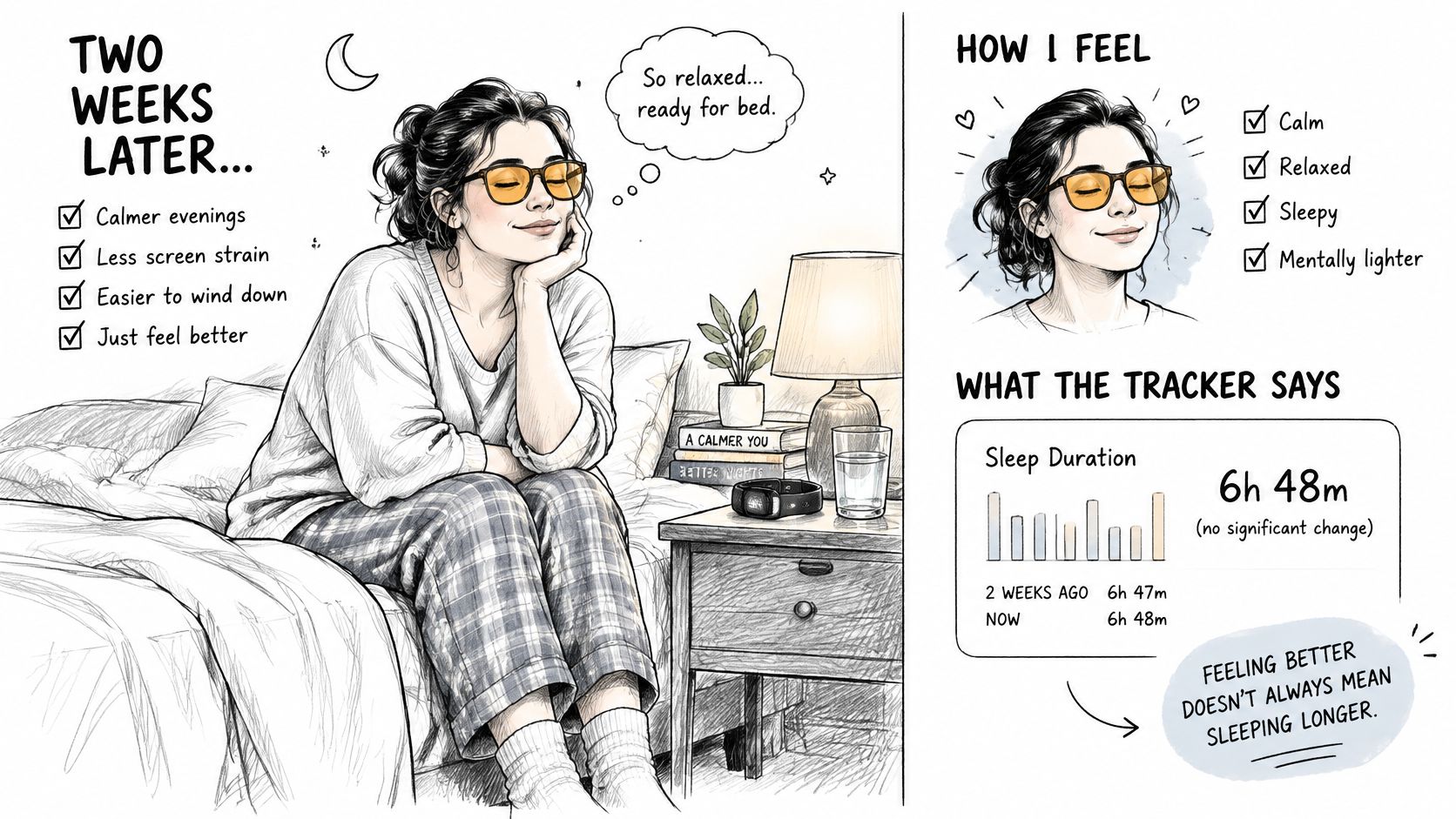
A tracker can look unchanged while the night feels different. That gap is the measurement problem at the center of this question.
Self-report captures how sleep felt: how easily you drifted off, how sound it seemed, how often you remember waking. Actigraphy records movement and estimates time asleep. Polysomnography records brain activity and sleep stages. A calmer evening can lift the first measure while the second and third stay nearly flat.
The pooled evidence points the same way. A 2025 systematic review of three double-blind crossover trials with only 49 participants estimated sleep onset as 4.86 minutes shorter on average, with a confidence interval running from a 20.23-minute improvement to a 10.52-minute worsening. The same analysis found no statistically significant change in sleep-onset latency, total sleep time, sleep efficiency, or wake-after-sleep-onset. The average looks tidy. The uncertainty is huge.
A confidence interval that wide works like a bathroom scale that can read “down a little” or “up a little” depending on the morning. It argues against a blanket promise of longer sleep.
Why the night can feel better anyway
- Placebo expectation: You bought a sleep tool, so you notice the nights that go well.
- Less visual discomfort: A warmer tint can make a bright screen less harsh, which can lift comfort even when sleep length stays put.
- Lower evening stimulation: Dimming the blue cast often arrives with a quieter room.
- A bedtime ritual: Putting the glasses on is a cue that the day is over, the way a book or a lamp can be.
Amber lenses can still be worth trying, with the right scorecard. Judge them by sleep quality and how you feel at lights-out, then check whether total sleep moves. If comfort rises and duration stays put, you have learned something useful: the pair helped the evening experience more than the clock. The answer also depends on the sleeper and the timing, which is why the same glasses can seem obvious to one person and irrelevant to another.
Video walkthrough: blue light, melatonin, and sleep timing
Who Gets the Most Benefit From Blue Light Glasses
Whether these glasses do anything for you depends less on the lenses than on who is wearing them. The clearest positive findings come from small studies of people with insomnia symptoms, and even there the benefit is uneven.
A 2018 randomized crossover study enrolled 14 adults with insomnia symptoms, 8 women, mean age 46.6 ± 11.5 years. They wore amber blocking lenses or clear placebo lenses for 2 hours before bed across 7 nights, then took a 4-week washout. Under amber lenses they reported better sleep quality, soundness, and subjective total sleep time (P < 0.05). Actigraphy also recorded more total sleep time (P = .035). A trial run inside group cognitive behavioral therapy for insomnia found a larger subjective sleep-time gain and shorter sleep latency with filtering glasses than with placebo glasses, while measured sleep duration still did not improve. The effect resembles a dimmer switch more than an on-off one: participants felt the difference more often than the devices confirmed it. Small samples and short runs keep these glasses in optional-hygiene territory, a companion to treatment and never the treatment itself.
| Group | Evidence level | Suggested use |
|---|---|---|
| Adults with insomnia symptoms | Most positive small trials | Test 2 hours before bed, alongside CBT-I |
| Healthy adults without sleep complaints | No reliable objective gain | Optional; expect comfort rather than longer sleep |
| Delayed sleep timing (late sleepers) | Circadian shift in evening-use studies | Wear in the evening before the target bedtime |
| Jet lag travelers | Limited but plausible | Wear in the evening of the destination time zone |
| Shift workers on rotating schedules | Mixed; not clearly better than red-light glasses | Plan light exposure, not glasses alone |
| Children and teens | Sparse early data | Discuss with a clinician before use |
Different schedules, different bets
Late sleepers and jet-lag travelers make the next most plausible case, because evening wear lines up with a clock the wearer wants to pull earlier. Shift work is the weak case. A 2024 field study found blue-filtering glasses were not clearly better than ordinary dark-red glasses for the downsides of night work. Stronger filtering only shifts timing when the wearer is also cutting bright light.
Healthy adults without a sleep complaint sit at the bottom of the table for a reason. If your clock already lands where you want it and you fall asleep on time, the glasses have little left to move. The same pair can feel useful to one person and do nothing measurable for another, so the honest answer to "do they work" is really two questions: who is asking, and when are they wearing them.
Choosing Lens Type and Wear Timing
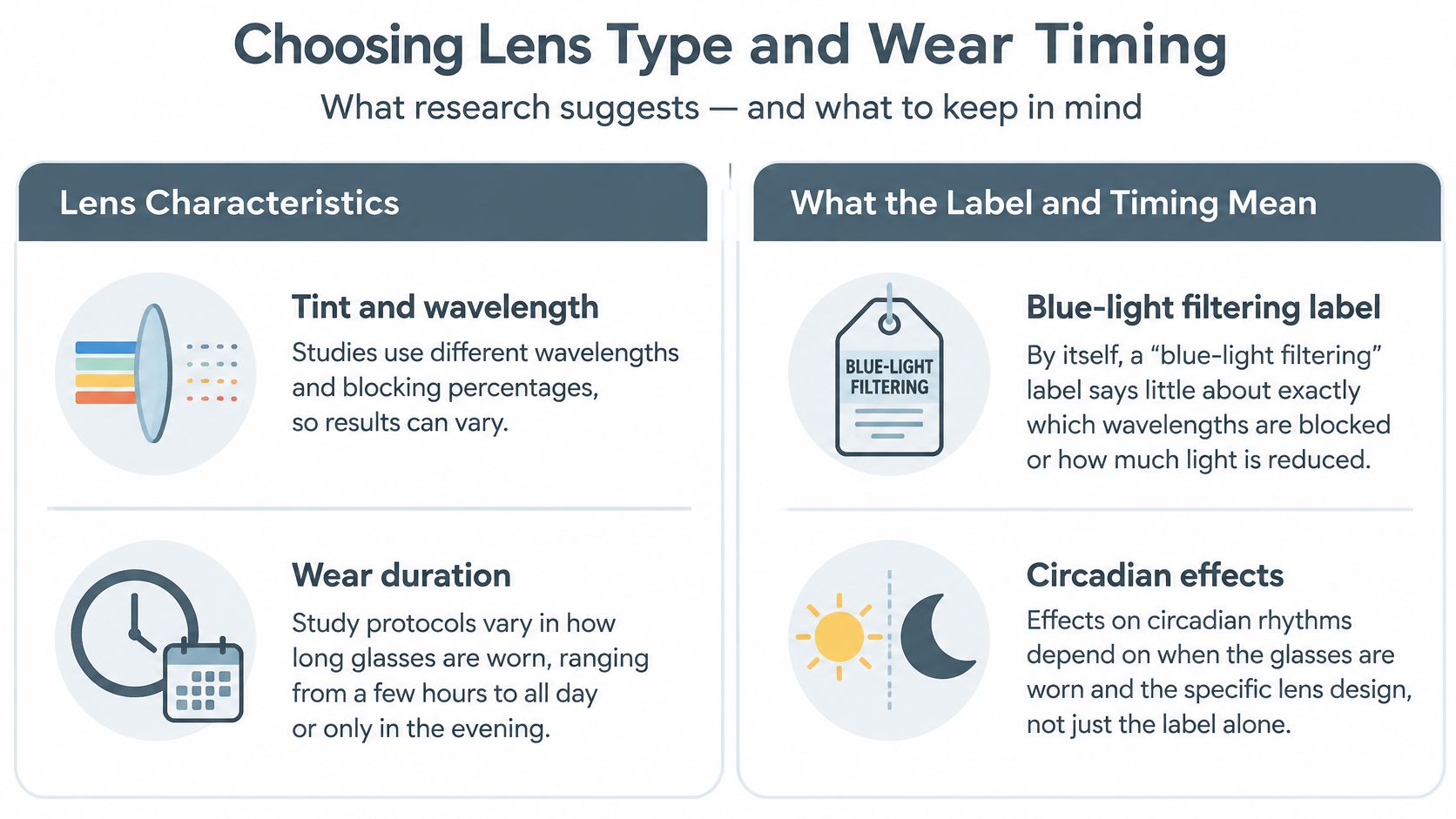
A label that only says "blue-light filtering" doesn't tell you how much light is blocked, or at which wavelengths. Trials use different spectra, blocking levels, and wear times, so two amber-looking pairs can behave differently.
Circadian effects depend on lens spectrum, optical density, how bright the room is, and when you put the glasses on. A trial of 60 healthy pregnant women found evening blue-blocking glasses came with significantly higher melatonin at 20:00, 21:00, and 22:00 than partially blocking control lenses. That's a timing effect tied to a defined lens, not a promise that any tint deepens sleep.
| Lens type | Best use | What to check on the label |
|---|---|---|
| Amber or orange-tinted lenses | Evening use 2–3 hours before bed | Disclosed blue-light blocking percentage and wavelength range |
| Clear blue-blocking coatings | Screen-heavy evenings where color accuracy matters | Transmission data; blocking is often lower than amber |
| Red-tinted lenses | Night shifts or dark-room use | Whether the tint blocks short wavelengths as stated |
| Plain gray or tinted control lenses | Comparison only; not a sleep aid | None; these were the control condition in trials |
| Prescription blue-blocking lenses | People who already need glasses | Lens prescription, coating and blocking specification |
A short label check
Before you pay, look for three things and skip the pair if they're missing.
- Wavelength attenuation or transmission data, not only a tint name.
- A blocking percentage you can compare with another product.
- Prescription compatibility if you already wear glasses, including the coating spec.
Wear them for the two to three hours before the target bedtime, and turn room and screen brightness down at the same time. They won't fully offset a bright, stimulating evening.
Where Blue Light Glasses Fall Short
A bright room can overwhelm the tint. In a controlled exposure test in adults, light around 2,000 lux suppressed melatonin by 87.3% on average, while the same bright light plus blocking glasses suppressed it by 19.2%, close to dim light below 5 lux and statistically indistinguishable from it. A study that small is mechanistic evidence, not a sleep guarantee. The practical reading still holds. The lens lowers one channel of the light reaching your eyes, like a single fader on a mixing board, while the overall volume of the room stays up. Dimming the overheads, lowering the screen, and leaving brightly lit rooms before bed are what bring that volume down.
A 2023 Cochrane review of six randomized trials and 148 participants split down the middle: three trials found a significant sleep improvement, and three found no significant difference. That even split is the pattern across the evidence, so a pair that helps you is plausible and far from guaranteed.
Three claims that don't hold
"Glasses fix insomnia." Thoughts, habits, and an irregular wake time keep insomnia going after the tint is on, so glasses belong beside treatment rather than in place of it.
"Darker means better." Night-shift comparisons haven't shown blue-filter lenses beating a simple red tint, so paying more for a darker or more specialized lens buys little on the evidence so far.
"Lenses make late screens harmless." Emotional arousal, notifications, and a pushed bedtime delay sleep whether the lenses are on or off. The glasses can sit on your face while the show keeps you up.
The limits that matter are small samples, short trials, and outcomes that are mostly how people say they slept rather than how long they actually slept.
Alternatives That Do More for Sleep
Glasses are one small lever. Stronger options go after the reasons sleep stays poor, which is why they outrank a tint when you have to pick where to spend effort.
| Option | What it targets | Evidence base |
|---|---|---|
| CBT for insomnia (CBT-I) | Thoughts and habits that sustain insomnia | Strongest clinical evidence |
| Consistent wake time | Body clock anchoring | Core recommendation in sleep medicine |
| Stimulus control | Linking the bed with wakefulness | Established CBT-I component |
| Dimming overhead lights and screens | Overall evening brightness | Supported by bright-light suppression research |
| Blue-light glasses | Blue component of evening light | Mixed; small benefit for some people |
CBT-I is first because it changes the loop that keeps insomnia in place, including the 2019 patients who used filtering glasses inside group therapy rather than instead of it. A fixed wake time, including weekends, anchors the clock the lenses only nudge. Stimulus control means the bed is for sleep, so long awake stretches happen in another room. Dimming hits the brightness problem the seven-person light test made obvious. Glasses come last, as a small add-on for the blue slice of that light.
One evening you can copy
Dim the overheads at dusk. Cut screen brightness and stop the shows that wind you up, which is the point of limiting screen time before bed. Put the glasses on about two hours before the target bedtime, and stay out of bright rooms. Keep tomorrow's wake time fixed. A short journal note can park tomorrow's tasks so they aren't still running at lights-out. The simple nighttime habits to unwind fit in that same window if a shower or a quiet ritual helps you switch off.
If the night still doesn't feel restorative, breathing and recovery are a separate lever from light. Restore+ Sleep Aid is a melatonin-free option developed with sleep and airway doctors to support nitric oxide, nervous system regulation, and overnight oxygen delivery. It doesn't replace the schedule above.
Run a Two-Week Glasses Test Before You Buy
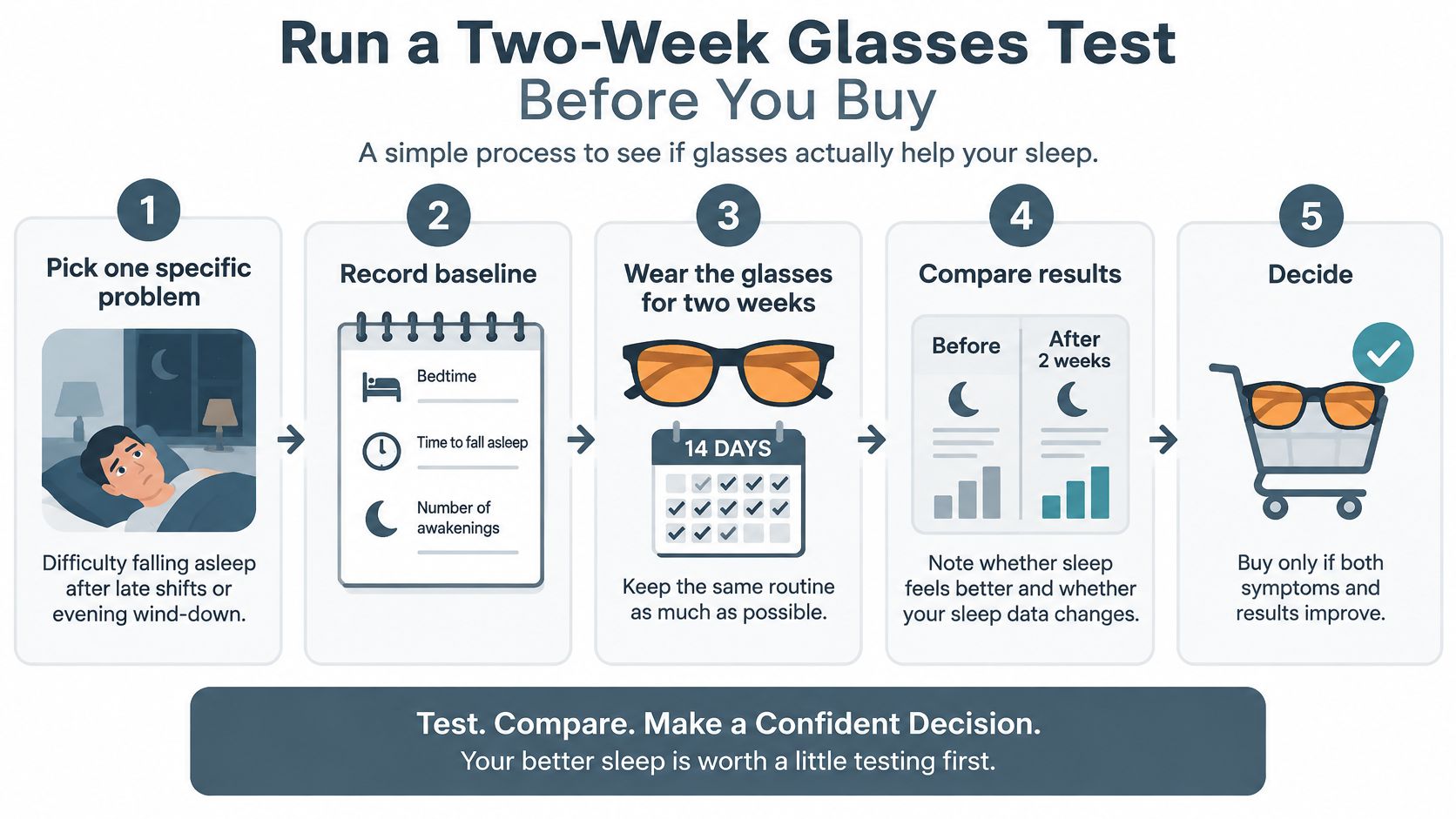
Don't buy on a single cozy evening. Run one problem for two weeks, then keep the pair only if the log moves. The sleep hygiene rules are the backdrop, so the glasses aren't the only thing changing.
- Pick one problem, such as trouble falling asleep after late shifts.
- For three nights, log bedtime, minutes to fall asleep, wake-ups, and next-day alertness.
- Wear the glasses two to three hours before the target bedtime, with room and screen brightness down.
- Keep wake time fixed, including weekends.
- Log the same four measures for 14 nights.
- Compare averages. Keep them only if onset or wake-ups clearly improve and alertness holds.
- If nothing changes, stop and move to CBT-I or a clinician. The tint is unlikely to fix the cause.
Buy only lenses that disclose blocking data, and treat any gain as a practical benefit rather than proof you slept longer.
SleepHabits publishes practical, evidence-based guidance on wind-down routines, evening light, and what changes a restless night. If you want the next step after this glasses verdict, visit SleepHabits for melatonin-free recovery tools and clear habits you can test the same way you tested the lenses.