

You're awake again because your partner has nudged you at 2 a.m. Your mouth feels dry, your tongue seems stuck to the roof of your mouth, and turning onto your side has only quieted the snoring for a few breaths. That's the moment many people start wondering whether a small strip of tape over the lips could solve the problem.
Mouth taping means placing a porous strip over closed lips during sleep to encourage breathing through the nose. The idea has a plausible physiological basis, but it isn't a universal snoring treatment, and it can be unsafe when nasal airflow is restricted or a breathing disorder is present.
The practical question isn't “Does mouth tape help snoring?” It's, which type of snoring might respond, and who should avoid the practice altogether? The answer depends on nasal patency, airway anatomy, sleep-apnea risk, and the reason your mouth opens at night.
The Night You Woke Up Snoring Again
Snoring happens when air moves through a narrowed upper airway and causes relaxed tissues to vibrate. For some people, an open mouth contributes to that narrowing. For others, mouth breathing is a response to a blocked nose, sleep apnea, reflux, asthma, or another problem that tape can't fix.
Mouth tape tries to change the route of airflow. A small, porous strip placed over the center of the closed lips may act as a physical reminder to keep the mouth shut while allowing the nose to do the work. It doesn't open the nasal passages, reposition the jaw, remove enlarged tissue, or treat obstructive sleep apnea.
That distinction matters. If your nose is clear and your snoring appears mainly when you sleep on your back with your mouth open, encouraging nasal breathing may be reasonable to discuss with a clinician. If you're congested, wake gasping, or have witnessed breathing pauses, taping could conceal the need for proper evaluation.
Start with the cause, not the trend
A dry mouth and noisy breathing can feel like proof that your mouth is the problem. They're not. The mouth may be the visible part of a larger breathing pattern, while the underlying issue sits in the nose or throat.
This guide separates the theory from the evidence, explains the safety threshold, and compares mouth tape with alternatives such as nasal strips, positional therapy, dilators, dental devices, and breathing exercises. It also gives you a practical nasal-breathing check before you consider trying it.
The useful question: Is mouth taping addressing your snoring pattern, or is it blocking the backup route your body relies on to breathe?
Why Mouth Breathing Makes Snoring Worse
Think of airflow like water moving through a hose. Nasal breathing is closer to a calm garden hose, with a relatively controlled stream passing through a structured passage. Open-mouth breathing can behave more like a kinked, turbulent fire hose. The flow becomes less organized, and the surrounding soft tissues face stronger vibration.
During sleep, the muscles supporting the tongue, soft palate, jaw, and throat relax. If the mouth falls open, the lower jaw can drop and the tongue can shift backward. That reduces the space available for air, creating a soft, collapsible passage that may flutter as each breath moves through it.
The nose also conditions incoming air by filtering and humidifying it. That doesn't mean nasal breathing guarantees quiet sleep. It means the nose provides a different airflow route, and keeping the lips together may reduce the jaw drop and tissue movement associated with mouth breathing in some sleepers. You can explore the distinction between these patterns in this guide to nasal breathing versus mouth breathing.
What tape changes, and what it doesn't
Sealing the lips doesn't mechanically widen the nose. It removes the easiest alternate route, encouraging air to pass through the nasal passages. If those passages are open enough, the change may support a more stable position for the tongue and soft palate.
If the nose is blocked, however, the same mechanism becomes a liability. The body may open the mouth because it needs another route for air, so blocking that route can make breathing more difficult. A saline nasal spray, such as buy Sterimar Breathe Easy spray, may be relevant for people managing ordinary nasal dryness or congestion, but it isn't a substitute for assessing persistent obstruction.
A nasal strip works from the outside of the nose rather than covering the lips. For example, Transparent Nasal Strips are described as supporting easier nighttime airflow, reducing congestion linked to colds, allergies, or dry air, and encouraging nasal-breathing habits. The basic physiological theory behind taping is sensible, but it remains a theory until it matches your actual breathing pattern.
Here's a short visual explanation of how nasal and mouth breathing differ during sleep:
What the Research Actually Shows
The strongest directly relevant evidence comes from a 2022 clinical study of 20 mouth-breathers with mild obstructive sleep apnea. In that specific group, mouth taping reduced the median apnea-hypopnea index, or AHI, from 8.3 to 4.7 events per hour, a 47% drop. The median snoring index fell from 303.8 to 121.1 events per hour, also about a 47% reduction. The authors concluded that taping improved snoring and sleep-apnea severity in this population, with the clearest relevance to mild OSA rather than snoring in general. (Read the clinical study)
Those findings are meaningful because the researchers measured breathing events and snoring rather than relying only on a partner's impression. They still don't establish that mouth tape works for everyone. The participants belonged to a narrow subgroup, and a result in mild OSA can't automatically be applied to people with ordinary snoring, nasal obstruction, or more severe breathing disease.
The evidence in one view
| Study | Sample | Duration | Snoring Outcome | AHI / Breathing Result |
|---|---|---|---|---|
| 2022 clinical study | 20 mouth-breathers with mild OSA | Not stated in the verified data | Median snoring index fell from 303.8 to 121.1 events per hour, about 47% | Median AHI fell from 8.3 to 4.7 events per hour, a 47% drop |
A 2025 systematic review reached a more cautious conclusion. It found that mouth taping may help a particular subgroup with mild obstructive sleep apnea, but the overall evidence remains narrow and doesn't strongly support the practice for individuals with snoring, mouth breathing, or sleep-disordered breathing. Some studies reported lower snoring indices after mouth taping or chinstraps, while other groups showed little benefit or possible risk. (Read the 2025 systematic review)
That is the right way to interpret products such as Hydrating Mouth Tape. Its catalog description presents it as a tool associated with quieter nights, oral care, tongue posture, and nasal breathing, but product positioning isn't the same as clinical proof. The research supports a cautious experiment only for carefully selected people, not a blanket recommendation.
Where the Evidence Breaks Down
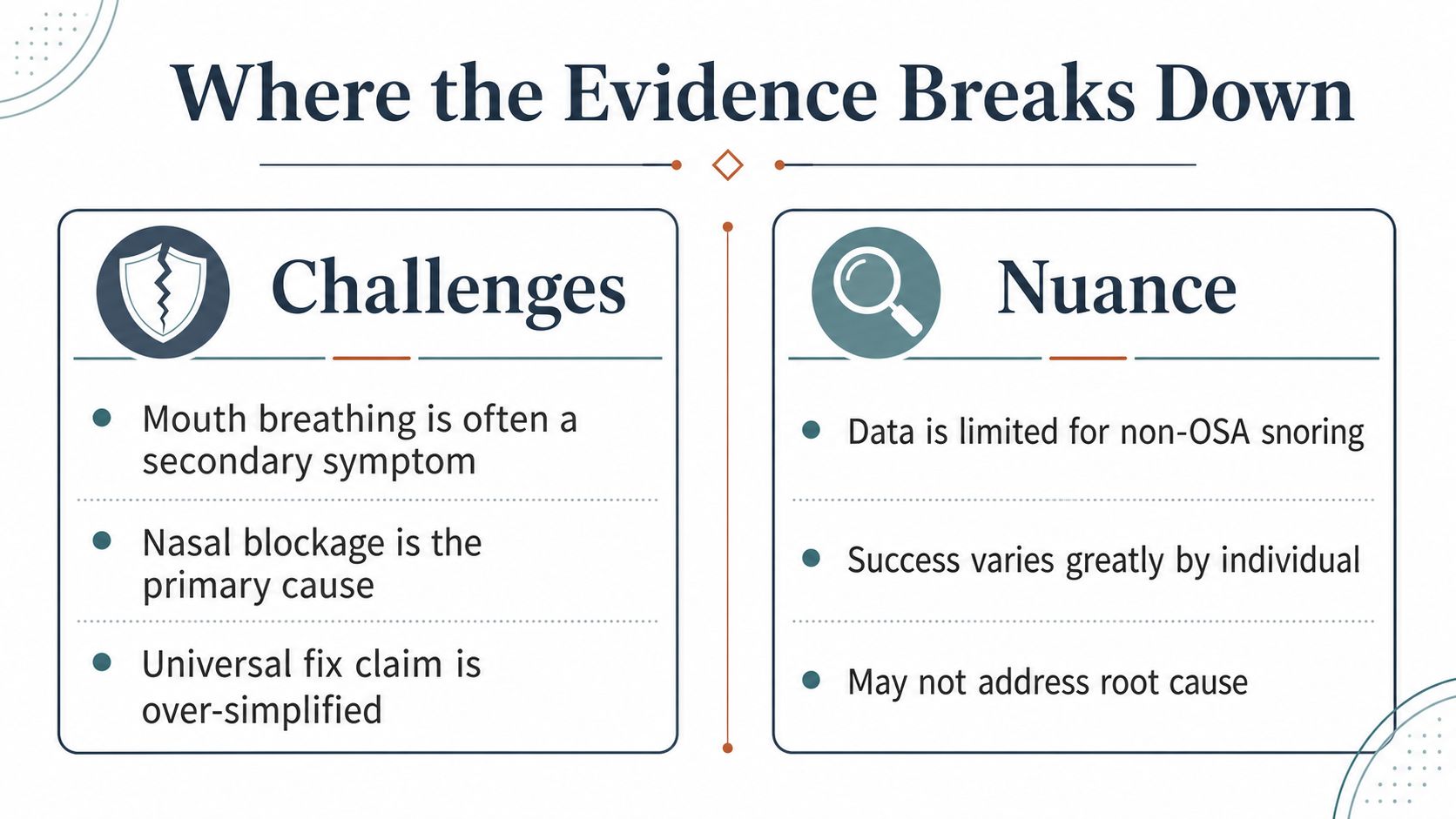
The popular version of mouth taping often assumes that mouth breathing causes snoring in every case. In practice, mouth breathing can be a secondary symptom. A person may breathe through the mouth because allergies, a cold, structural narrowing, enlarged throat tissue, or sleep-disordered breathing has already made nasal breathing difficult.
Tape can't remove a deviated septum, reduce inflamed nasal tissue, or treat obstructive sleep apnea. It may change the sound while leaving the upstream problem untouched. That's why a quieter night doesn't automatically mean safer or healthier breathing.
Why promising results stay narrow
The available research has a limited evidence base. The 2025 review found that mouth taping may help a specific mild-OSA subgroup, but the wider data don't support its use for the general population with snoring or sleep-disordered breathing. Cleveland Clinic likewise states that there isn't enough scientific evidence to show mouth taping works as a way to stop snoring, and describes the available research as small and mixed. (Cleveland Clinic's medical guidance)
That uncertainty matters for people whose snoring has a different origin. Someone with chronic congestion may need nasal treatment. Someone with significant throat narrowing may need a sleep assessment. Someone who snores only on their back may respond more directly to positional changes than to restricting mouth opening.
A quieter recording isn't a diagnosis. If the tape changes snoring but you still wake unrefreshed, gasp, or experience breathing pauses, the underlying concern remains.
Social media self-experiments can also distort expectations. People who feel a benefit are more likely to post about it, while people who stop because of discomfort or congestion may disappear from the conversation. Mouth taping is best viewed as a situational tool with uncertain general usefulness, not a cure for snoring.
Who Should Not Try Mouth Taping
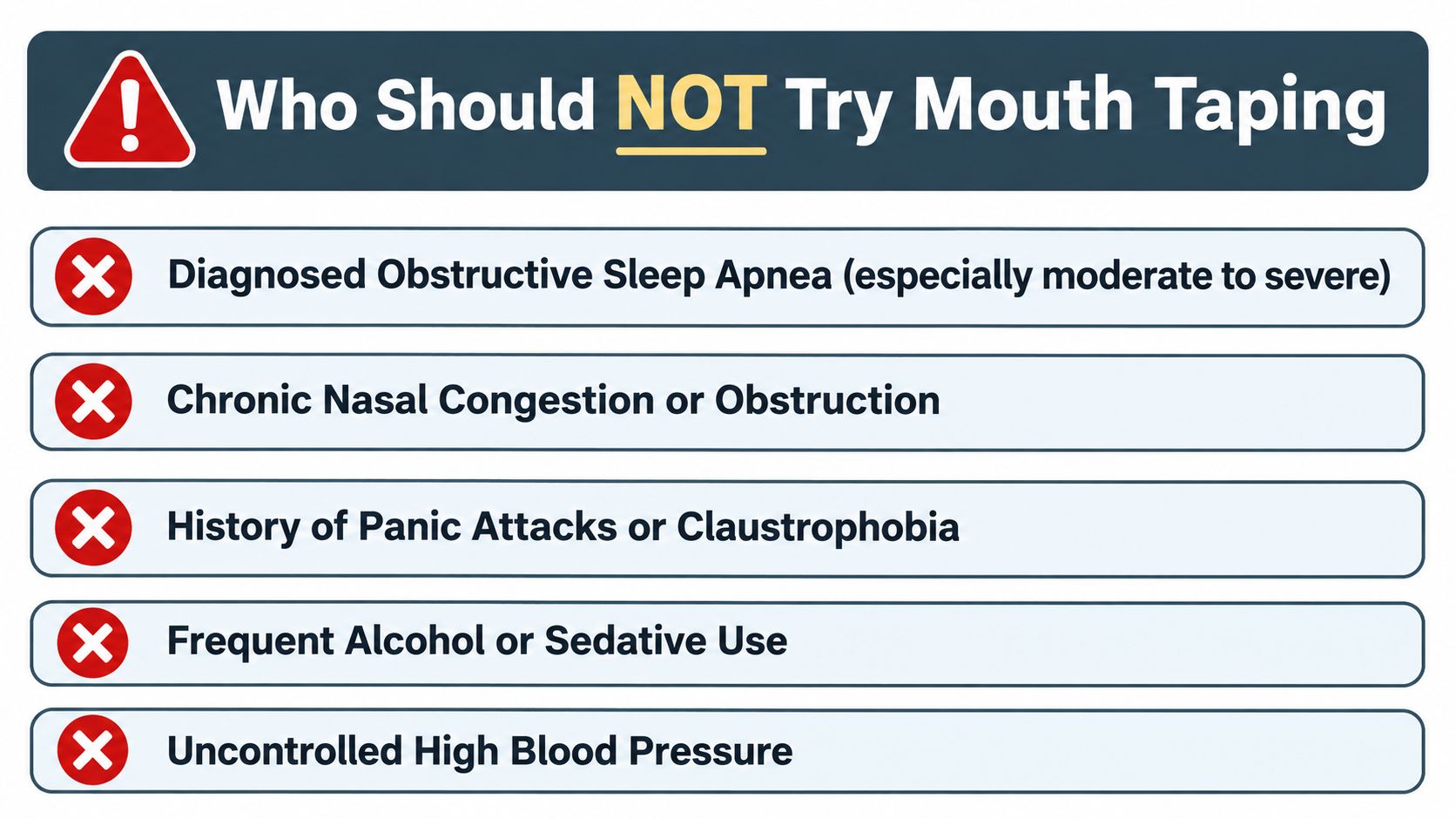
Safety comes before experimentation. Houston Methodist advises against mouth taping for people with nasal obstruction, sleep apnea, gastroesophageal reflux disease, chronic congestion, asthma, or other heart and lung conditions. It also warns that occluding the mouth may lead to asphyxiation if nasal obstruction or regurgitation occurs. (Houston Methodist safety guidance)
Avoid mouth taping if any of these situations applies:
- Your nose is blocked: This includes chronic congestion, active allergies, a cold, or a structural obstruction such as a deviated septum.
- You have diagnosed or suspected sleep apnea: Don't use tape as a substitute for diagnosis or established treatment.
- You have a respiratory or heart condition: Asthma, chronic obstructive pulmonary disease, and other cardiopulmonary conditions require individualized medical advice.
- You may regurgitate or vomit during sleep: Reflux and other vomiting risks make blocking the mouth particularly concerning.
- You panic when enclosed: The sensation of sealed lips can trigger distress, anxiety, or a panic response.
- You recently had nasal surgery: Wait for direct clearance from the clinician managing your recovery.
- You use alcohol or sedatives at night: Reduced awareness can make it harder to respond to breathing difficulty or remove the tape.
- You have warning symptoms: Daytime sleepiness, witnessed apneas, morning headaches, choking, or gasping deserve a sleep evaluation.
The University of Colorado Anschutz summary adds an important physiological warning: mouth taping may help some people with mild airflow limitation, while people with the worst airflow can worsen when the mouth is occluded. Nasal patency is therefore a decision point, not a minor detail. (University of Colorado Anschutz summary)
Adhesive also creates practical problems. Skin irritation, redness, allergic reactions, and painful removal can occur, particularly around facial hair or sensitive skin. Don't treat a warning sign as something to push through.
How to Try Mouth Tape Safely
Only people who have no relevant medical warning signs and can breathe comfortably through the nose should consider a cautious trial. Even then, the aim is to test a breathing habit, not to force the airway closed.
Check the nose before the lips
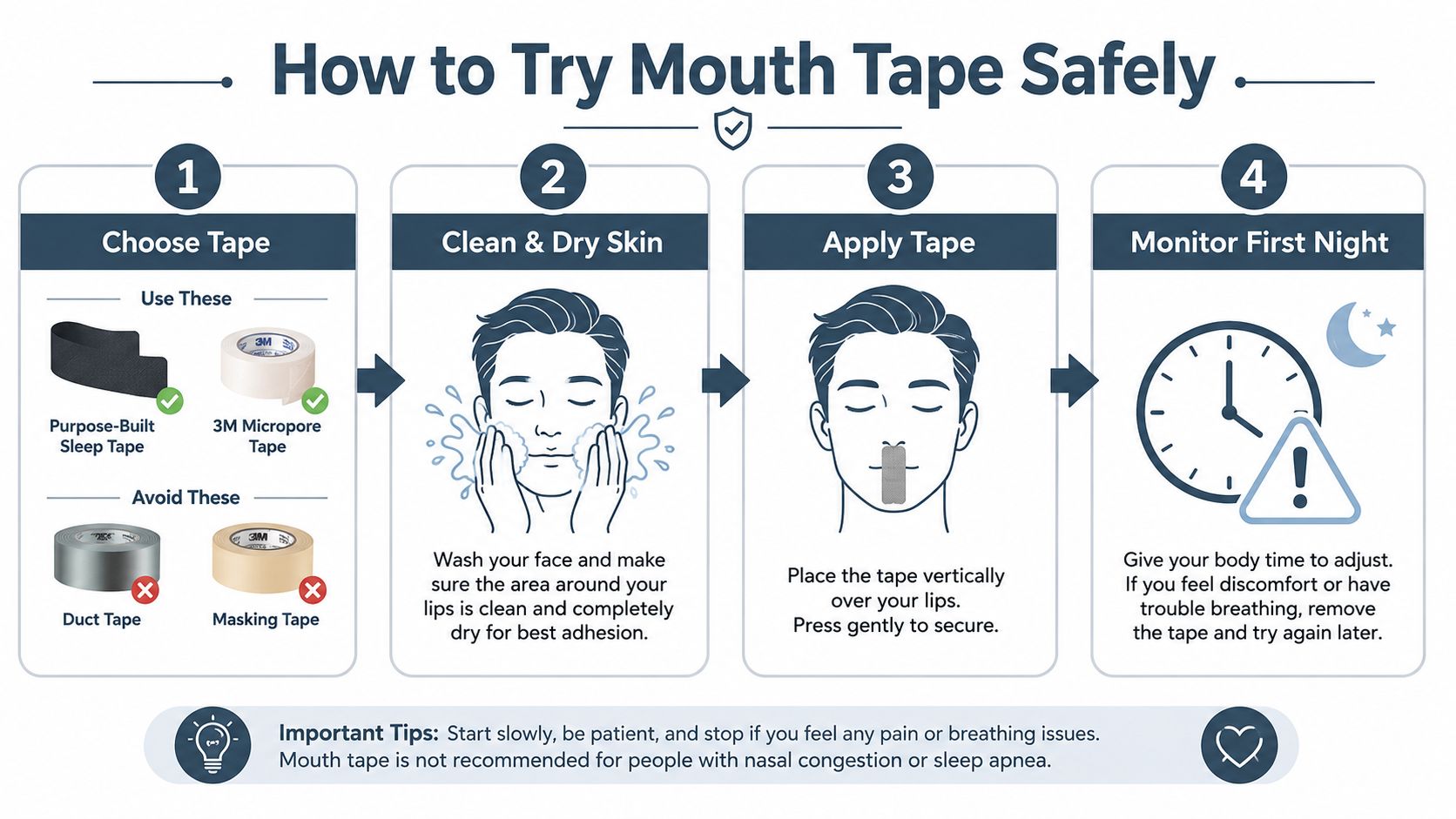
- Choose skin-safe tape. Use tape made for sleep or porous surgical tape such as 3M Micropore. Don't use duct tape, masking tape, or painter's tape. A porous, hypoallergenic material is less likely to create avoidable airflow and skin problems.
- Prepare the skin. Wash around the mouth with mild soap, dry thoroughly, remove lip balm, and trim coarse facial hair if removal would tug.
- Test nasal breathing while awake. Keep your lips closed and breathe only through your nose for two minutes, first upright and then lying down. If you repeatedly open your mouth, feel air hunger, or struggle to maintain the position, stop. Your nose isn't ready for an overnight trial.
- Apply a small strip. Place it across the center of closed lips, leaving enough freedom for the mouth to open if needed. Don't cover the entire area around the mouth.
- Use a gentle wind-down routine. Humidification, a suitable saline rinse, and side sleeping may make nasal breathing more comfortable, but they don't override the avoidance conditions above.
- Monitor the first attempt. Try it when you can respond easily, keep scissors beside the bed, and remove it immediately for anxiety, congestion, nausea, breathing difficulty, or skin discomfort.
You'll find a more detailed discussion of the practice in this guide to mouth tape for sleeping. A daytime test can reveal whether the sensation feels tolerable, but it can't prove that your airway will remain open throughout sleep.
Alternatives Worth Considering
Mouth tape is only one way to influence nighttime breathing, and it may not be the most direct option for your snoring pattern. The right choice depends on whether the main problem is nasal resistance, back sleeping, jaw position, or reduced upper-airway muscle support.
| Method | Ease of First Use | Typical Monthly Cost | Best Fit For |
|---|---|---|---|
| Mouth tape | Simple for some, uncomfortable for others | Varies by product and frequency of use | Carefully screened mouth-breathers with a clear nose |
| Adhesive nasal strips | Easy | Varies by product and frequency of use | People whose nasal passages feel narrow |
| Internal nasal dilators | Moderate, because insertion can feel unfamiliar | Varies by product and frequency of use | People seeking a stronger mechanical opening of the nostrils |
| Side sleeping or positional therapy | Easy to start, harder to maintain | No required product cost, though pillows or supports may add cost | Back-position snorers |
| Mandibular advancement device | Requires fitting and adjustment | Higher than simple strips or tape | People with appropriate mild OSA or jaw-related airway narrowing |
| Myofunctional therapy or breathing retraining | Easy to begin, demanding to sustain | Varies by provider or program | People willing to work on tongue, jaw, and soft-palate control |
Nasal strips widen the external nasal passage and may suit a person who can breathe through the nose but feels restricted around the nostrils. Internal dilators work inside the nose and can provide a more noticeable mechanical change, although the fit may take adjustment. Neither option addresses snoring caused mainly by throat collapse.
Positional therapy is a different kind of intervention. If you snore mostly on your back, a side-sleeping pillow or position cue may address the trigger without changing your breathing route. A supportive mattress for snoring relief can also help you maintain a comfortable side position, although bedding won't diagnose or treat sleep apnea.
A dentist-fitted mandibular advancement device moves the lower jaw forward to enlarge the space behind the tongue. Myofunctional therapy and breathing retraining take longer to practice but aim at tongue and soft-palate control rather than relying on adhesive. Combining approaches can make sense, such as a nasal strip with positional therapy, but adding tools shouldn't replace a clinical assessment when warning symptoms are present. More options are outlined in this guide to mouth-taping alternatives.
Your Decision Framework for Tonight
Start with three questions:
- Does the snoring happen mainly when you sleep on your back?
- Does your mouth fall open while your nose remains clear?
- Can you breathe comfortably through your nose while lying down with your lips closed?
If you answer yes to all three, mouth taping may be a reasonable low-risk experiment, provided you don't have any condition on the avoidance list. Treat the trial as a way to observe a specific pattern, not as proof that you've solved the cause of snoring.
If your nose is congested, your allergies are active, or you have asthma, reflux, heart or lung disease, suspected sleep apnea, or a history of panic with restricted breathing, skip the tape. Address the nasal issue or arrange professional advice instead. The University of Colorado Anschutz guidance makes the key point clear: people with more severe airflow limitation can worsen when the mouth is occluded.
Three actions for tonight
- Run a nasal check: Sit and lie down, close your lips, and breathe through your nose for a short period. Stop if you feel air hunger or repeatedly need to open your mouth.
- Choose one comparison option: Try side sleeping, a nasal strip, or another suitable alternative instead of layering several new interventions at once.
- Track the pattern: Record whether snoring occurs, whether you wake gasping or congested, and how rested you feel. Look for a consistent pattern over two weeks before deciding whether a tool helps.
The goal is not to find a universal fix. It's to match the tool to the snorer, while treating noisy breathing and daytime symptoms as possible signs that deserve more than a home experiment.
SleepHabits offers educational resources on nighttime breathing alongside tools such as hydrating mouth tape, nasal strips, and melatonin-free sleep support. Visit SleepHabits to compare practical breathing strategies and build a wind-down routine that fits your specific snoring pattern.