

Snoring is a common symptom of obstructive sleep apnea, but it isn't a diagnosis on its own, because about half of people who snore loudly have obstructive sleep apnea and the other half typically don't. That's the part that surprises many. The sound that keeps a partner awake can come from a safe, open airway, and a much quieter night can hide repeated breathing pauses. So asking is snoring a sign of sleep apnea is a good first question, but it can't be the last one. What matters is the company snoring keeps. You're learning to read a pattern, not judge a noise. Once you know which accompanying signs clinicians look for, you'll know when snoring looks like a nuisance and when it looks like a reason to book an evaluation.
Snoring and Sleep Apnea Explained Simply
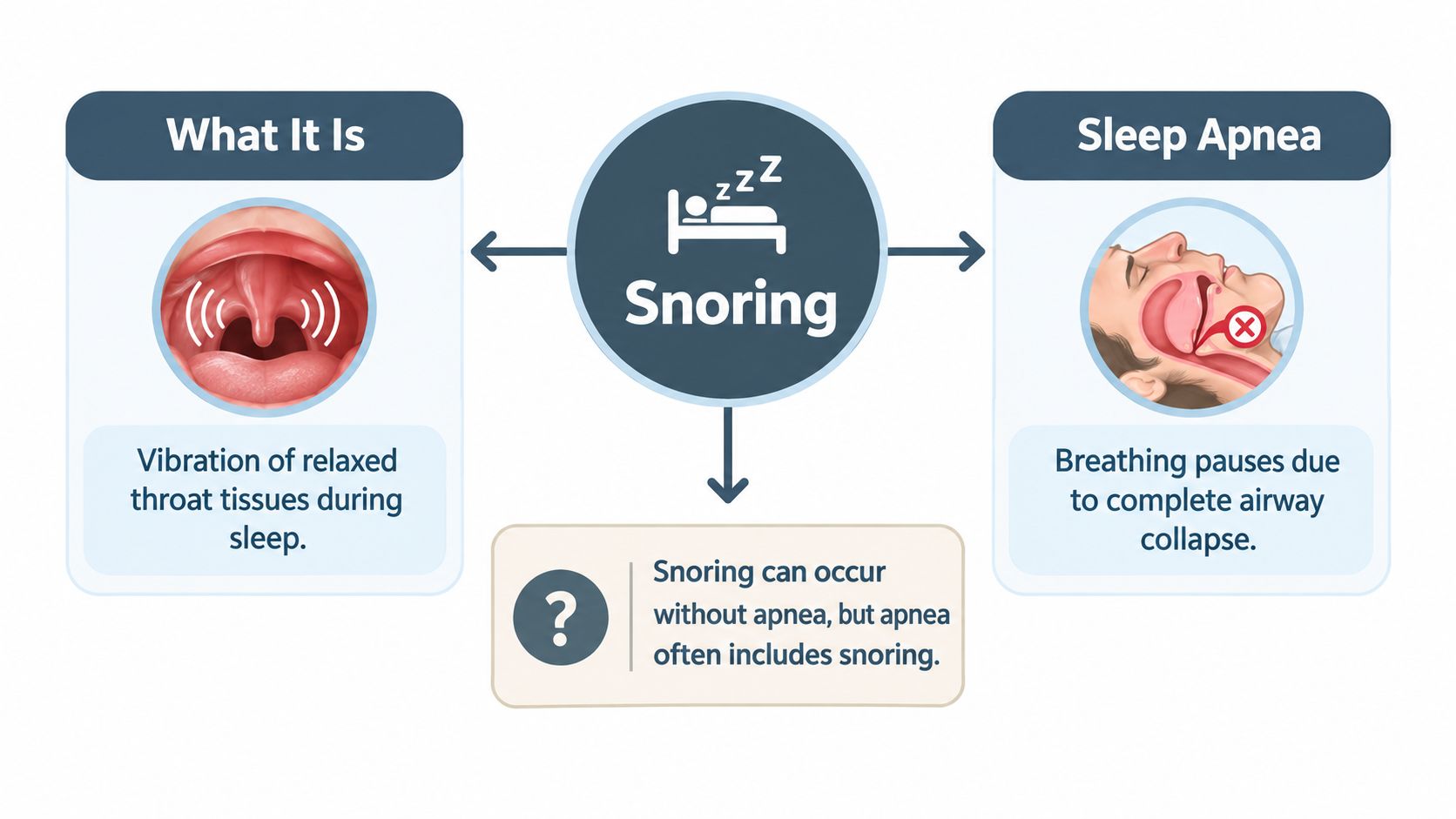
Snoring is a risk signal, not a verdict. Think of your airway during sleep like a straw you're breathing through. If the straw is slightly pinched, air squeezes past and makes the sides flutter. That's snoring, a vibration of relaxed throat tissues as air moves through a narrowed space. If the straw pinches shut completely or almost completely, airflow stops or drops sharply. That's the territory of obstructive sleep apnea, often shortened to OSA.
The distinction matters because one is mostly about sound and the other is about breathing. In OSA, partial or intermittent collapse of the upper airway increases turbulence first, then complete or near complete obstruction can cause apneas or hypopneas, oxygen desaturation, and brief arousals from sleep. You may not remember those arousals. Your body does.
Why Relaxation Changes the Airway
When you're awake, muscle tone helps hold your throat open. During sleep, those muscles relax, the tongue and soft palate settle back, and the passage gets narrower for everyone to some degree. Congestion, back sleeping, alcohol close to bed, and individual anatomy can narrow it further. A narrower passage means faster, more turbulent airflow, and turbulent air makes tissue vibrate loudly.
That vibration alone doesn't tell you whether the passage ever closes. Two people can produce a similar racket for different reasons. One has a stuffy nose and sleeps on their back. The other has an airway that repeatedly collapses. From the doorway, a partner hears volume. A clinician asks about airflow.
Sleep apnea is a breathing during sleep disorder, not a sound during sleep problem. Judge the airflow, not just the volume.
Snoring is also extremely common, which is why it can't sort people by itself. In the United States, about 90 million people report snoring at least occasionally and roughly 37 million report regular snoring, according to American Medical Association guidance on what doctors want patients to know about snoring. A symptom shared by that many people will overlap with a serious condition and also occur without it.
If you want the broader category these conditions sit under, this overview of what sleep disordered breathing includes is a useful next read. For now, hold onto one practical idea. Snoring tells you the airway is narrowed enough to vibrate. It doesn't tell you whether breathing pauses, oxygen drops, or sleep fragments. Those are separate questions, and they need different evidence.
Why Snoring Alone Does Not Confirm Sleep Apnea
Here's where probability helps more than intuition. Many people with OSA snore, so snoring catches a lot of true cases. But many people who snore don't have OSA, so it also flags a lot of people who are fine. Clinicians call that pattern high sensitivity and low specificity.
In plain language, snoring is a wide net. A systematic review found approximately 90% sensitivity but only 19% specificity for snoring when detecting OSA at an apnea-hypopnea index above 10 to 15 events per hour, as summarized in research on the predictive value of snoring in different populations. A wide net is good for not missing cases. It's poor at confirming them.
What Snoring Can and Cannot Tell You
| What snoring suggests | What snoring cannot confirm |
|---|---|
| Airway narrowing during sleep, enough to make tissue vibrate | Whether breathing actually stops or drops repeatedly |
| A reason to ask about pauses, gasping, and daytime sleepiness | Your apnea-hypopnea index or disease severity |
| Higher concern when it's habitual and loud | Whether oxygen levels fall during the night |
| A clue worth reporting accurately to a clinician | That quieter snoring means lower risk |
Population also changes what the same sound means. In a sleep clinic, people are already referred because something looks concerning, so testing finds OSA far more often in that group than it would in snorers picked at random from the general public. That's not a contradiction. It's how screening works. The starting risk of the group changes the meaning of the symptom.
Consider two neighbors. Marcus has snored like a freight train for twenty years, wakes clear headed, has normal blood pressure, and his wife has never heard a pause. Priya snores only sometimes, but she wakes with headaches and nods off reading to her kids. If you ranked them by volume, you'd worry about Marcus. If you ranked them the way a clinician does, by symptom combination, Priya moves to the front of the line.
Practical rule: Treat loud snoring as a prompt to ask three follow up questions about pauses, gasping, and how you function during the day. Don't treat it as an answer.
That's also why a person who snores but has no daytime symptoms or cardiovascular risk factors may not need an extensive apnea evaluation, while someone with significant risk factors may warrant assessment even if snoring isn't reported. Objective testing exists precisely because individual impressions, including a partner's, are unreliable. Sound raises the question. It doesn't settle it.
Warning Signs That Make Snoring More Serious
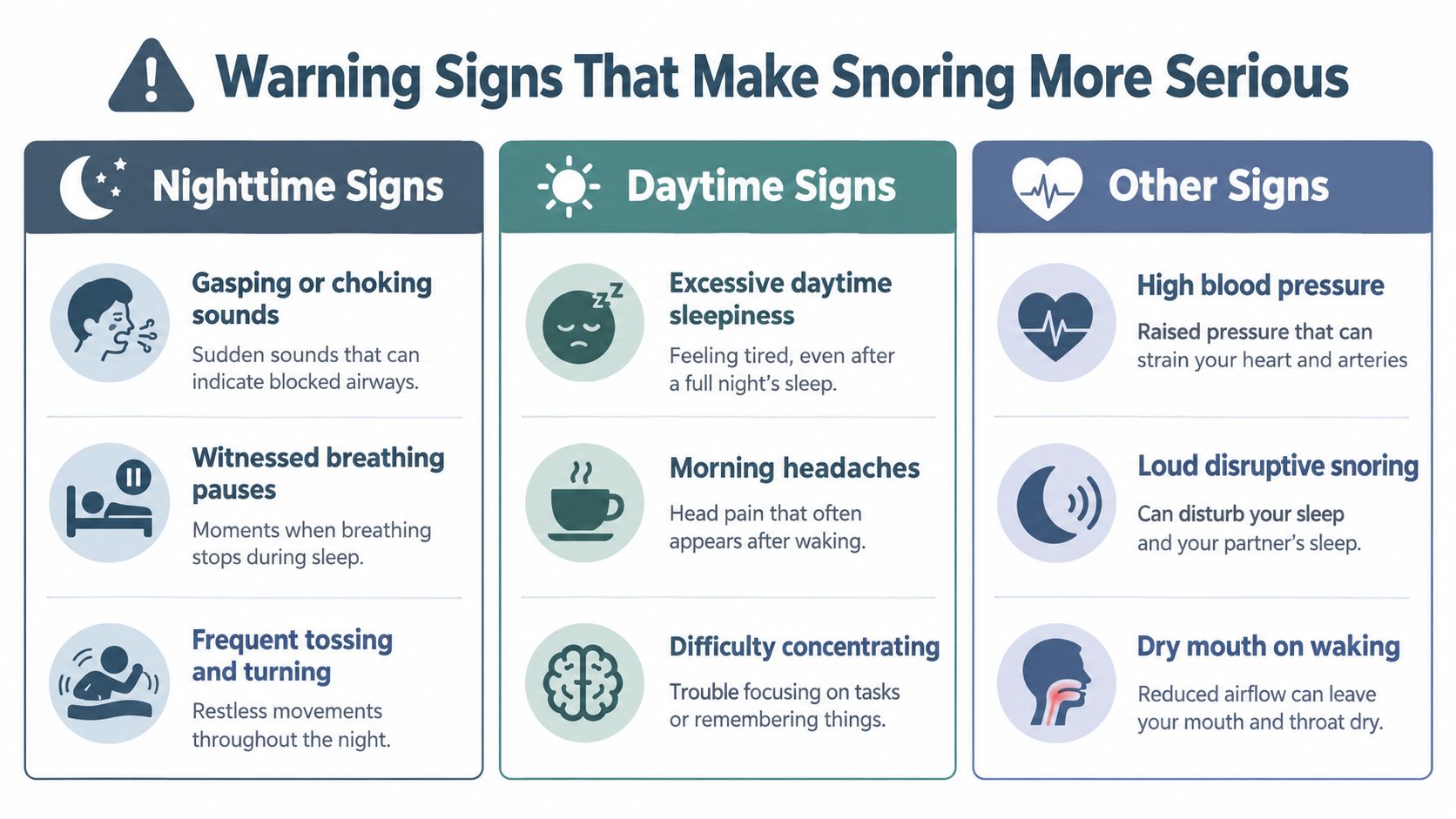
Clinicians don't listen for snoring in isolation. They look for a cluster. The American Academy of Sleep Medicine identifies habitual loud snoring as one of three key clinical features, alongside witnessed breathing interruptions or gasping and choking and diagnosed hypertension, that when combined with excessive daytime sleepiness indicates increased risk of moderate to severe OSA, a combination described in National Heart, Lung, and Blood Institute information on sleep apnea symptoms.
Read that as a recipe. One ingredient is interesting. Several together change the dish.
Nighttime Signs a Partner May Notice First
- Silent pauses followed by a choke or gasp: Your partner hears snoring, then nothing, then a sudden snort as breathing restarts. That silence is more informative than the loud part.
- Snoring loud enough to disturb others: Volume matters mainly when it's habitual and disruptive, not occasional after a cold.
- Restless, unrefreshing sleep: Frequent tossing, waking with a sore throat, or feeling as if you barely slept despite enough hours in bed.
These nighttime observations connect directly to common symptoms of airway obstruction during sleep, which helps you describe them precisely instead of just saying you snore.
Daytime Signs You Notice Yourself
- Excessive daytime sleepiness: Falling asleep while working, watching television, or driving isn't a nuisance symptom. It's an impairment, and the driving example should prompt prompt attention.
- Morning headaches: Waking with a headache that fades as the day goes on is a pattern worth reporting.
- Trouble concentrating: Impaired attention, foggy thinking, or irritability that you can't explain by a short night.
Mayo Clinic lists witnessed breathing pauses, nighttime gasping or choking, excessive daytime sleepiness, morning headaches, difficulty concentrating, and high blood pressure among the warning signs that make snoring more concerning, in its overview of snoring symptoms and causes.
Medical History Signs That Raise the Stakes
Resistant hypertension, meaning blood pressure that stays high despite treatment, carries particular weight, as do atrial fibrillation and a history of stroke. These don't prove apnea either. They lower the threshold for testing because the cost of missing it is higher.
Tonight, run a simple check. Ask a partner to note pauses or gasping rather than volume. In the morning, note headaches, dry mouth, and how sleepy you feel by mid afternoon. If snoring sits beside witnessed pauses and daytime sleepiness, that's not a combination to sleep through. Book the appointment and bring the notes.
When Quiet Snorers Can Still Have Sleep Apnea
The loudest sleeper in the house isn't always the person most at risk. That idea feels wrong because we equate noise with severity. Breathing doesn't work that way.
The illustration below captures the contrast that confuses so many couples.
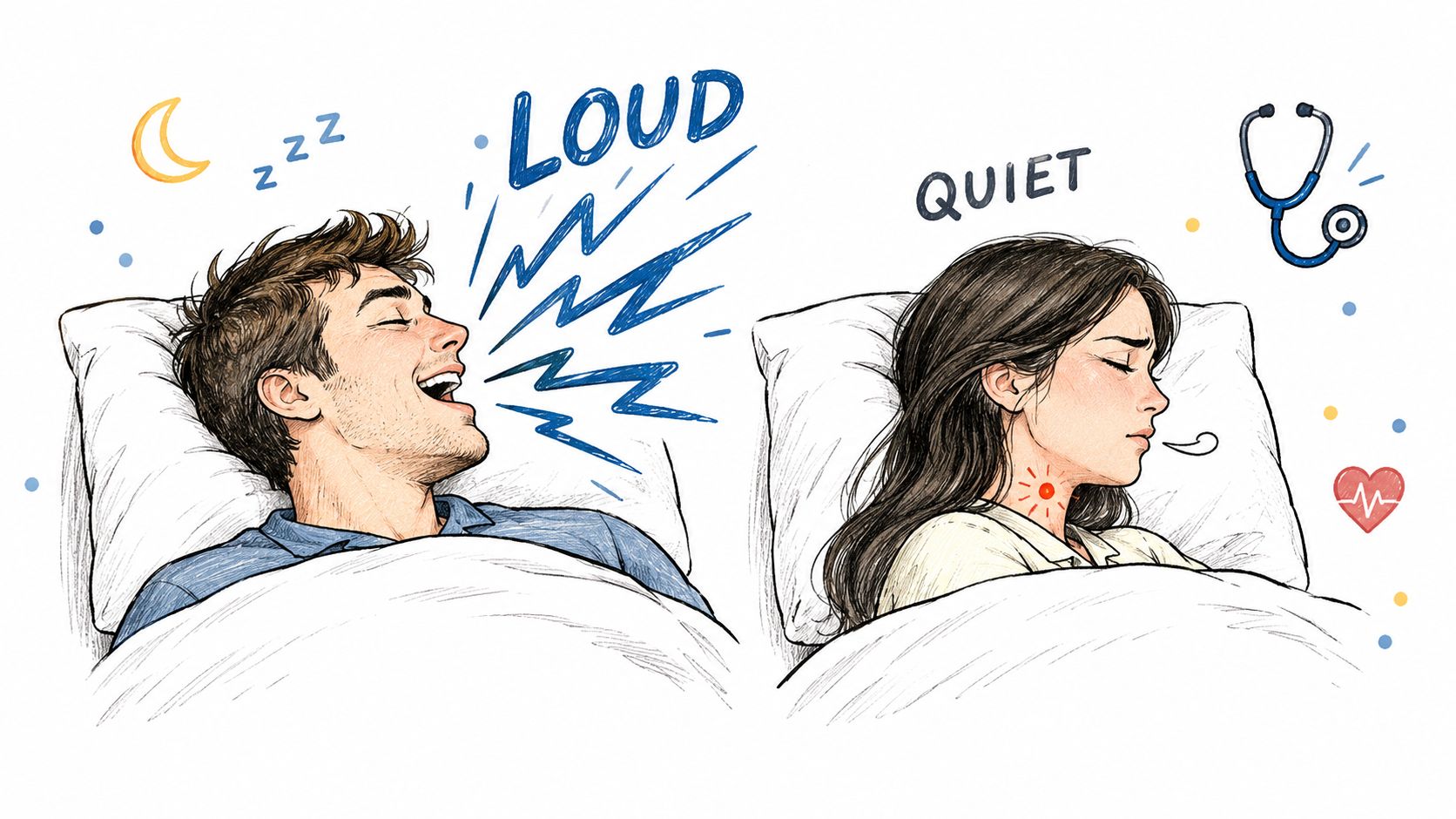
Meet two composite sleepers. Daniel rattles the windows, but his sleep study shows airflow that never meaningfully drops. He's a thunderous snorer without OSA. Elena barely makes a sound, sleeps alone, and assumes she's fine because nobody complains. She wakes at 3 a.m. feeling breathless, gets morning headaches, and her blood pressure won't budge. Her quiet nights hide repeated airflow interruptions.
Mayo Clinic notes that loud snoring is common in obstructive sleep apnea, yet not everyone with sleep apnea snores, and central sleep apnea can involve breathing pauses with less noticeable snoring than obstructive apnea, so unexplained daytime fatigue or recurrent nighttime breathlessness should still trigger evaluation according to its guide to sleep apnea symptoms and causes.
Why Partner Reports Miss Cases
Bed partner observations are imperfect for ordinary reasons. Partners sleep through pauses, mistake a position change for a gasp, or move to another room and stop observing altogether. People who sleep alone have no observer at all, so the absence of a report means very little. If you've been told you don't snore yet you feel exhausted, you haven't been ruled out. You've been under observed.
This short video walks through how apnea can present beyond obvious snoring.
So, can you have sleep apnea if you don't snore, or if nobody has noticed pauses? Yes. And does quieter or intermittent snoring mean lower risk? Not reliably, because snoring volume doesn't establish apnea severity. Daytime symptoms and medical risk factors sometimes carry more weight than anything heard from the next pillow. Absence of snoring is mildly reassuring. It is never proof of safety.
What Sleep Apnea Testing Actually Measures
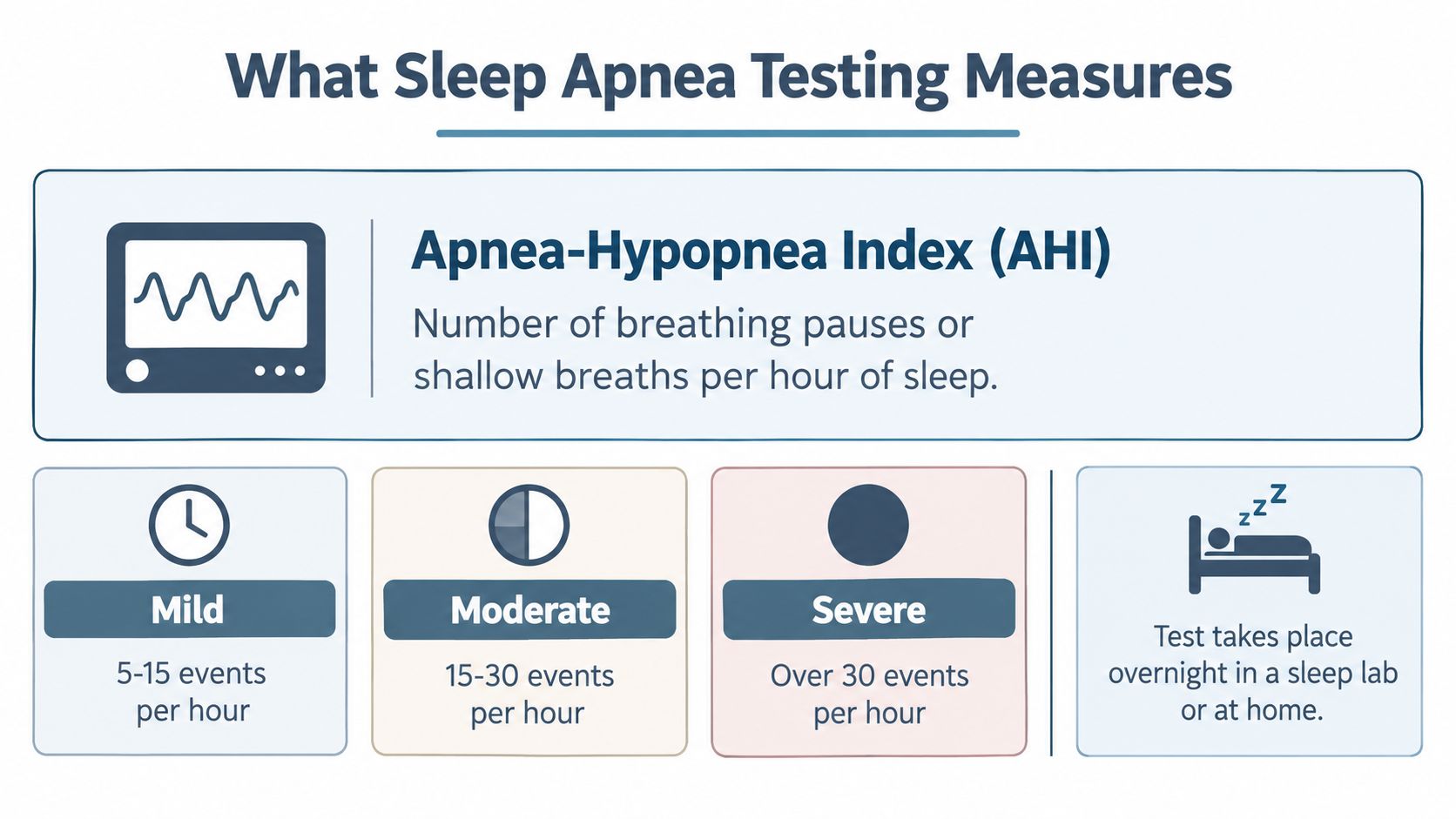
A sleep study doesn't grade your snore. It counts breathing events. The headline number is the apnea-hypopnea index, or AHI, which averages the number of complete pauses, called apneas, plus partial reductions, called hypopneas, per hour of sleep.
The American Academy of Sleep Medicine states that polysomnography is the standard diagnostic test for adults suspected of having OSA, using an AHI of at least 5 as a clinically relevant threshold, at least 15 as a higher level of abnormality, and at least 30 as more severe, in its diagnostic testing guideline for adult obstructive sleep apnea.
Reading the AHI Without a Medical Degree
- At least 5 events per hour: Clinically relevant when it occurs with compatible symptoms or related conditions.
- At least 15 events per hour: A higher level of abnormality, and enough to establish OSA even without additional features.
- At least 30 events per hour: Severe range, meaning breathing is disrupted very frequently across the night.
Use an everyday example. Quiet snoring with repeated airflow interruptions can produce a high AHI and be medically significant. Loud snoring with no abnormal events can produce a low AHI and not meet OSA criteria. The number describes breathing, which is exactly what your ears can't measure.
Home Testing Versus a Sleep Lab
A home sleep apnea test is an option for uncomplicated adults whose risk already looks higher. It's convenient and captures breathing related signals in your own bed. Polysomnography happens attended in a sleep lab and captures more, including detailed sleep data alongside breathing and oxygen related physiology.
A negative home test isn't always the final word. If it's negative, inconclusive, or technically inadequate, attended polysomnography should follow, because home testing can miss disease, particularly when it overestimates how long you actually slept.
That follow up matters more when other sleep disorders are possible or when significant conditions coexist, such as cardiovascular disease, neuromuscular disease, opioid use, or suspected hypoventilation. In those situations a clinician may go straight to the lab study.
Neither a partner, a phone recording, nor a snoring app can produce an AHI. They can document sound and timing, which is useful history to share. Diagnosis is a measurement taken during actual sleep and interpreted by a qualified clinician. That's the step that turns suspicion into a yes or no you can act on.
Practical Habits That Support Better Nighttime Breathing
You don't have to wait for an appointment to breathe more comfortably tonight. You do need to keep the scope honest. These habits can reduce snoring sound and improve sleep quality. They don't prove airway obstruction has resolved, and quieter isn't the same as safer.
Position and Bedroom Setup
Side sleeping is the simplest mechanical fix. On your back, gravity pulls the tongue and soft tissues backward into the airway. On your side, that pull lessens. Elevating the head of the bed can help some people for the same reason, since it reduces the backward settle of tissue. If mattress choice and bed angle are part of your setup, the Lucas Furniture & Mattress snoring guide from Lucas Furniture & Mattress covers practical adjustments worth considering alongside position changes.
Help Air Move Through Your Nose
Your nose filters, humidifies, and regulates airflow before it reaches your lungs. When allergies or congestion block it, you're pushed toward mouth breathing, which can contribute to snoring and restless sleep. External options such as Nasal Strips gently open the nasal passages to support smoother airflow through the night. Mouth taping is sometimes used as a behavioral cue to keep the lips sealed and encourage nasal breathing, but it's a poor idea if your nose is blocked or if apnea is suspected and unevaluated. Ask a clinician first in that situation.
Timing and Weight
- Alcohol timing: Drinking close to bed relaxes airway muscles further, so an earlier cutoff often means a quieter, more stable airway.
- Weight management: For people carrying extra weight, gradual loss can reduce tissue pressure around the airway. It's slow, unfashionable, and mechanically logical.
- Consistent sleep schedule: Severe sleep deprivation deepens muscle relaxation rebound, which can worsen snoring on recovery nights.
If you're weighing broader non device approaches, this discussion of managing sleep apnea without CPAP outlines where lifestyle measures fit and where they reach their limits. Keep the framing straight. Use these habits while pursuing evaluation when warning signs are present, not instead of it. A quieter bedroom is a fine goal. Ruling a treatable breathing disorder in or out is the important one. If pauses, gasping, or heavy daytime sleepiness persist, better habits aren't evidence that you're fine.
Putting It All Together
Remember a three step flow. First, notice the snoring pattern, whether it's habitual, loud, and disruptive. Second, pair it with the symptom combination, especially witnessed pauses, gasping, morning headaches, resistant hypertension, and excessive daytime sleepiness. Third, let objective testing decide when that combination warrants it, because only a sleep study measures breathing events per hour.
Habits that support nasal breathing and side sleeping can run alongside that process. They can't replace it. The goal was never to silence the noise. It's to find out whether a treatable medical condition is hiding behind it, or reassure yourself with evidence instead of guesswork. Snoring is a signal worth listening to. Now you know how to listen, and you know which next step fits your pattern.
If snoring and mouth breathing are part of your nights, visit SleepHabits to explore melatonin free tools designed to support nasal breathing, including nasal strips and mouth tape, alongside practical education on building a calmer wind down routine. Use them to breathe more comfortably while you follow up on any warning signs with a clinician, and start turning better nights into clearer days.