

The lights are low, your phone is finally out of reach, and you're still watching the ceiling. After deciding to try magnesium glycinate, the next questions arrive quickly: How much should you take? Does the label mean 500 mg of magnesium, or 500 mg of the whole compound? Should you take it with dinner or right before bed?
The most useful answer isn't a single universal number. Magnesium glycinate dosage for sleep should be based on elemental magnesium, your tolerance, your health context, and what changes during a careful trial. The evidence is promising but modest, so the practical approach is to start conservatively, read the label correctly, adjust slowly, and judge the result against your actual sleep pattern.
Why Magnesium Glycinate Keeps Coming Up for Sleep
You may be comparing magnesium products after a night of tense muscles, restless legs, or a mind that stays active. Magnesium is an essential mineral involved in hundreds of enzyme reactions, including processes that support normal nerve and muscle function. Those roles explain the interest in magnesium for sleep, but they do not make every product or dose equally useful.
Magnesium glycinate is magnesium attached to the amino acid glycine. People often choose it because it is generally well absorbed and tends to be gentler on digestion than some other forms. Glycine may have calming effects of its own. A plausible explanation, however, is not proof that the supplement will improve sleep for everyone. For a related look at magnesium glycinate versus citrate for sleep, compare both the form and the amount of elemental magnesium listed on the label.
The research remains mixed. A 2025 randomized, double-blind, placebo-controlled trial involving 155 adults with self-reported poor sleep found that 250 mg of elemental magnesium bisglycinate daily for four weeks produced a statistically significant but small improvement in Insomnia Severity Index scores compared with placebo, about -3.9 versus -2.3, with an effect size of approximately 0.2. The clearest signal appeared among participants with lower magnesium intake at baseline. Because the trial is cited in the final section, this section keeps the finding qualitative rather than repeating its source.
The practical message is measured: magnesium may help some people, particularly when intake is low, but it is not a guaranteed sedative or a substitute for assessing persistent insomnia. A consistent bedtime, less evening stimulation, and better sleep hygiene tips remain part of the plan.
The questions that matter most
A useful trial starts with four label-and-response checks:
- What does the label provide? The bottle may show the weight of the whole compound instead of elemental magnesium.
- What amount do you tolerate? Loose stools or stomach upset can mean the current amount is too high for you.
- When does it fit your sleep problem? Timing for sleep onset may differ from timing for nighttime restlessness.
- What changes with consistent use? Track sleep onset, awakenings, and morning grogginess instead of judging one memorable night.
The rest of the article turns those questions into a personal plan, beginning with how magnesium glycinate is thought to support sleep.
How Magnesium Glycinate Is Thought to Support Sleep
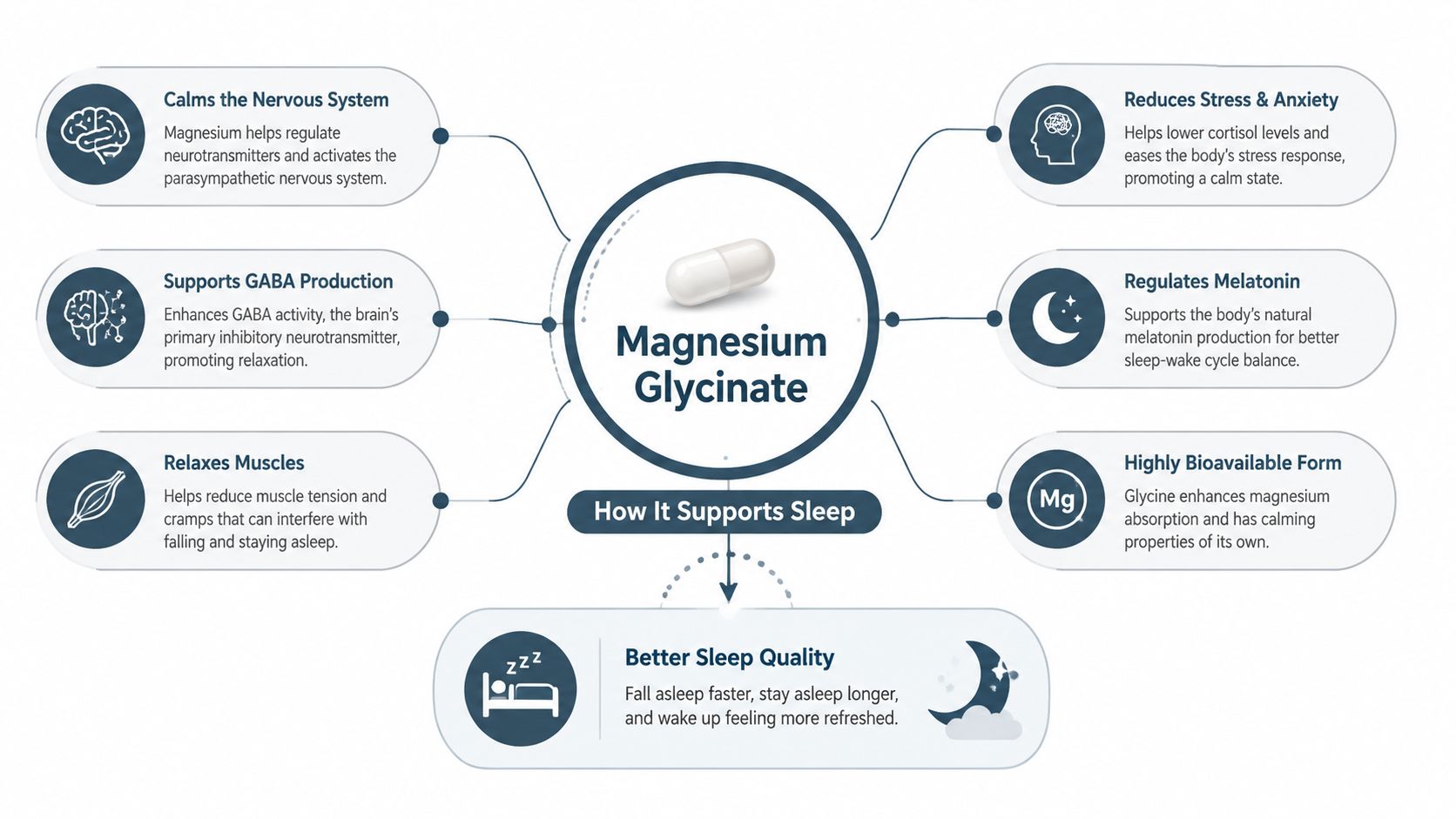
Your nervous system may still be revving after a demanding day. Magnesium is not a shutdown switch. It may act more like a gentle brake, helping the body shift from alertness toward rest.
Several possible mechanisms may contribute:
- Calming signals. Magnesium participates in GABA-related signaling, which supports the brain's “slow down” messages. That may ease racing thoughts before sleep, although people respond differently.
- Stress regulation. Magnesium may support parasympathetic activity, the branch of the nervous system linked with recovery and relaxation. It is also discussed in relation to cortisol regulation, which may matter when you feel tired but unusually wired.
- Glycine's separate role. After the chelate is processed, glycine may contribute to relaxation and sleep-related temperature regulation. Glycine may support the natural cooling process associated with sleep onset, similar to the body's gradual shift toward a lower nighttime temperature.
Magnesium also interacts with NMDA receptors, which help regulate excitatory glutamate signaling. In plain language, this may be another way magnesium helps limit excessive “stay alert” signals at bedtime.
Mechanisms aren't promises
These explanations describe how magnesium glycinate is thought to work. They do not prove that a particular dose will improve your sleep. Human evidence includes small-to-mid-sized trials and broader magnesium research, while direct evidence for every commercial glycinate product remains limited.
Your sleep problem may have several causes. An inconsistent schedule, bright evening light, caffeine late in the day, pain, or possible sleep-disordered breathing can each require a different response. Magnesium may address only one part of the picture. A broader resource on how to improve sleep quality at night can help you build a supportive routine around it.
A short video can provide a visual introduction to the topic:
Reading the Label Without Getting Confused
The number on the front of a magnesium glycinate bottle often isn't the number you should use for dosing. A capsule labeled 500 mg magnesium glycinate may contain only about 70 to 100 mg of elemental magnesium, according to a practical dosing example from this label guide.
The distinction is simple:
- Compound weight: The total weight of magnesium bound to glycine.
- Elemental magnesium: The actual magnesium amount used when calculating your dose.
For bisglycinate, a useful rule of thumb is approximately 14% elemental magnesium, though the exact amount depends on the molecule, manufacturing process, and chelate purity. That's why a 500 mg compound amount can translate into roughly 70 to 100 mg of elemental magnesium.
What to look for on Supplement Facts
Scan the Supplement Facts panel rather than relying on the largest number on the front label. Look for wording such as:
- Magnesium, as magnesium bisglycinate
- Magnesium, as magnesium glycinate
- Elemental magnesium per serving
“Magnesium glycinate,” “magnesium bisglycinate,” and “chelated magnesium” often refer to closely related labeling for the same general chelated form. The important question is how much elemental magnesium the serving supplies.
Be cautious with proprietary blend totals. A blend may combine magnesium glycinate with other ingredients, and “buffered” products may include magnesium oxide. Fillers and stearates are inactive formulation ingredients, but the label should still make the elemental magnesium amount clear.
| Label Term | What It Means | Typical Elemental Mg |
|---|---|---|
| Magnesium glycinate | The magnesium and glycine compound | Often lower than the compound weight |
| Magnesium bisglycinate | A chelated magnesium form bound with glycine | About 14% by weight as a rule of thumb |
| Elemental magnesium | The amount to count for dosing | The number used in your sleep plan |
| Buffered blend | May combine glycinate with another form, such as oxide | Depends on the complete formula |

If you're comparing a product such as Restore+ Magnesium Sleep Aid, use the same method. Restore+ is a melatonin-free magnesium wind-down drink that also contains L-theanine, tart cherry, lemon balm, and glycine, so check its serving information and count the listed elemental magnesium rather than the total powder weight.
Practical Dosage Ranges for Most Adults
For most healthy adults, a sensible starting point is 100 to 200 mg of elemental magnesium, taken in the evening. Independent evidence reviews commonly place sleep-support dosing around 200 to 400 mg of elemental magnesium, usually taken 30 to 60 minutes before bed, but that range describes elemental magnesium, not the total weight of magnesium glycinate powder (reviewed practical guidance).
The U.S. tolerable upper intake level for adults is 350 mg per day from supplements only. That limit doesn't include magnesium from food, but it does include elemental magnesium from all supplemental products, not just the capsule you associate with sleep. Some sleep-focused guidance keeps nightly use around 200 to 300 mg and considers higher amounts only when well tolerated and medically appropriate (safety-focused dosage guidance).
A gradual adjustment method
Use your response as the decision point:
- Begin with 100 to 200 mg for several nights.
- Hold the amount if sleep feels better and your digestion remains normal.
- Increase by 50 mg increments every few days only if sleep hasn't improved and you're tolerating the current amount.
- Return to the last comfortable dose if stools loosen, stomach upset appears, or you feel heavy and groggy the next morning.
- Stay at the lowest effective amount, rather than chasing the highest number on the label.
Body weight can be a mild contextual clue, but it isn't a reliable stand-alone formula for choosing a sleep dose. Age, dietary intake, kidney function, medications, and sensitivity matter more than trying to calculate a precise amount from body size.
| Dose Tier | Elemental Magnesium | When to Use | Notes |
|---|---|---|---|
| Conservative start | 100 to 200 mg | First trial or digestive sensitivity | Use the label's elemental amount |
| Common adult range | 200 to 350 mg | When a lower amount is tolerated but insufficient | Keep total supplemental intake in view |
| Higher range | 300 to 400 mg | Only with good tolerance and appropriate guidance | Amounts above 350 mg from supplements require medical supervision |
Absorption and comfort can also depend on the form and the rest of your routine. This discussion of magnesium supplement absorption can help you compare label and formulation details without confusing compound weight for elemental magnesium.
If congestion affects your sleep, Eucalyptus Nasal Strips are a separate tool designed to improve airflow, reduce nasal congestion, and encourage nasal breathing habits. They don't change the magnesium dose, and they shouldn't be treated as a substitute for evaluating persistent breathing problems.
When to Take Magnesium Glycinate Before Bed
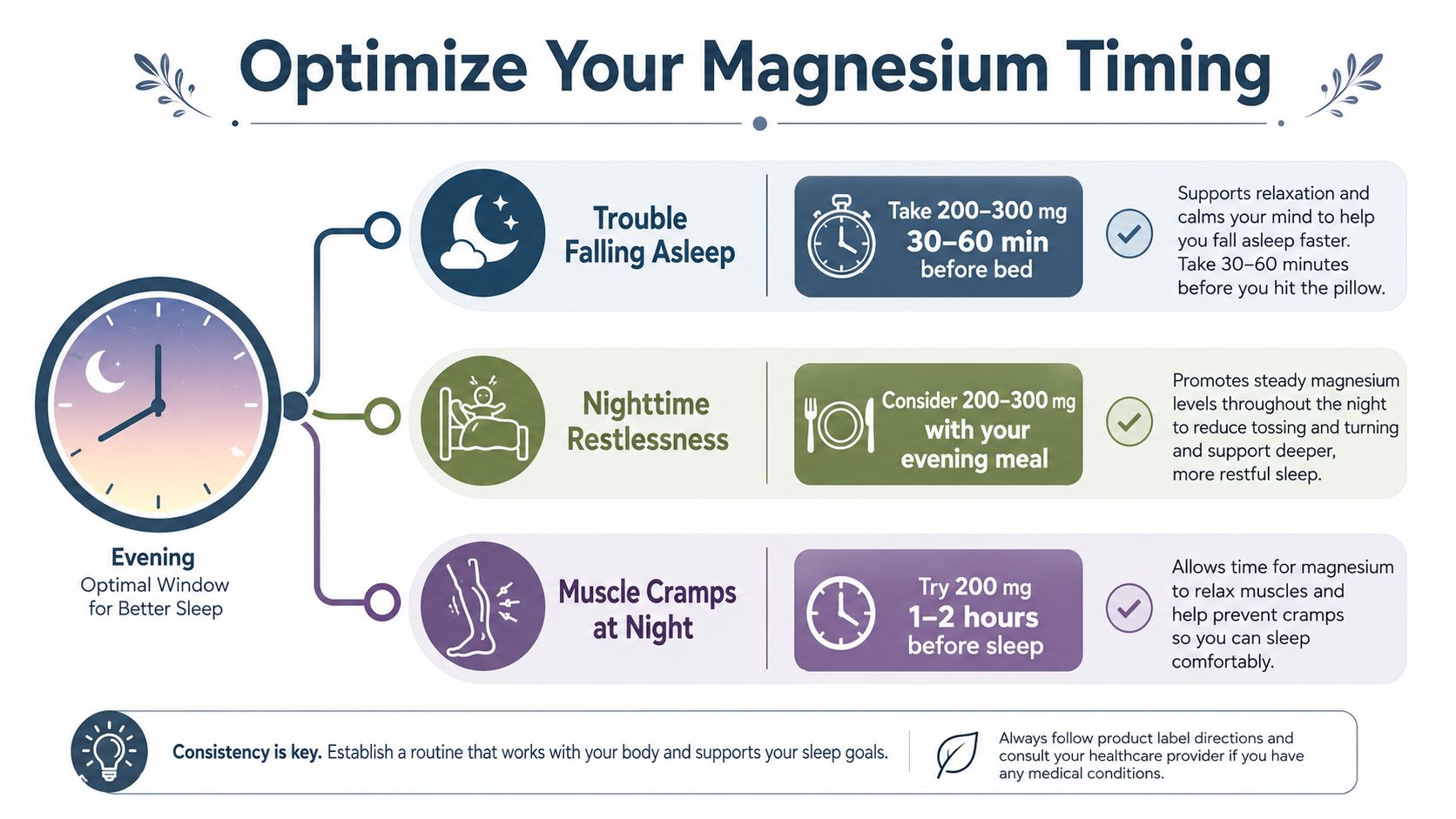
Timing depends on what “poor sleep” means for you. If you mainly struggle to fall asleep, taking 200 to 300 mg of elemental magnesium 30 to 60 minutes before lights out places the supplement inside your wind-down period. Start lower if you're new to magnesium or sensitive to supplements.
If you fall asleep easily but wake restless, try moving the dose earlier. Some people take it with an evening meal, while others shift the full amount to 60 to 90 minutes before bed. Splitting the dose can also improve comfort, with part taken in the early evening and the remainder closer to bedtime.
Food, caffeine, and missed doses
Take magnesium with a small snack or meal if an empty stomach causes nausea or stomach discomfort. If you tolerate it well, an empty stomach may also be reasonable, but comfort matters more than forcing a particular method.
Keep the rest of the evening predictable. Cutting caffeine after noon, dimming lights, and repeating the same pre-bed sequence may make it easier to tell whether magnesium is contributing anything. If you miss a dose, don't double the next one. Resume your normal amount the following evening.
Timing rule: Match the supplement to your intended sleep window, not simply to the clock time you happen to take it.
Practical timing guidance varies from 30 to 60 minutes before bed to 1 to 2 hours before bedtime, so use the first several nights to observe whether earlier or later timing suits your pattern (timing guidance).
Safety, Side Effects, and Interactions to Know
The main safety boundary is 350 mg of supplemental elemental magnesium per day for adults. That figure applies to supplements only, and you should add the elemental magnesium from every supplement you take before deciding how much magnesium glycinate fits your routine.
The most common signs that your amount is too high are loose stools, stomach upset, nausea, or cramping. Some people also notice next-morning drowsiness or an unusually heavy feeling. Reduce the dose or stop the trial if those symptoms appear, rather than pushing through them.
Medication spacing matters
Magnesium can bind with some medications in the digestive tract and reduce their absorption. The exact instruction depends on the medicine, so ask a pharmacist or clinician for personalized timing, especially if you take several prescriptions.
| Substance | Type of Interaction | Recommended Spacing or Action |
|---|---|---|
| Tetracycline antibiotics | Magnesium may reduce absorption | Commonly separate by 2 to 4 hours and confirm with a pharmacist |
| Fluoroquinolone antibiotics | Magnesium may reduce absorption | Use clinician or pharmacist guidance for spacing |
| Bisphosphonates | Magnesium may interfere with absorption | Separate doses according to the prescribing instructions |
| Proton pump inhibitors | May affect magnesium status or require medication review | Discuss regular supplementation with a clinician |
| Diuretics | May alter fluid and electrolyte balance | Review the full medication list before starting |
| Calcium supplements | High amounts may compete during absorption | Avoid taking high-dose minerals together unless advised |
| Other sedatives | Effects may be additive | Ask before combining with sleep medicines or calming agents |
People with kidney disease, severe heart conditions, or persistent diarrhea should speak with a clinician before using magnesium supplements. Stop the supplement and seek medical advice if severe weakness, unusual confusion, serious worsening symptoms, or persistent gastrointestinal problems develop.
For broader insomnia causes and practical bedroom habits, Giorgi Bros. Furniture advice offers useful context. If you're considering other calming supplements, review potential combinations such as ashwagandha with magnesium with a qualified professional rather than assuming that natural products are automatically compatible.
Adjusting the Dose for Different People
A standard adult starting range won't suit every sleeper. Your age, schedule, sweat losses, kidney function, digestive tolerance, and medications can all change the safest way to test magnesium glycinate.
| Population | Suggested Starting Elemental Mg | Timing & Cautions |
|---|---|---|
| Older adults | Around 200 to 300 mg, beginning at the lower end | Increase slowly and review kidney function with a clinician |
| Shift workers | A smaller morning amount after the sleep period and a larger evening amount | Use the intended sleep window rather than conventional bedtime |
| Athletes | Start according to tolerance and dietary intake | Count food plus supplements, remain within the supplemental limit, and avoid taking it immediately around intense training |
| People taking antibiotics or bisphosphonates | Use a clinician-confirmed amount | Separate the medication and magnesium by the advised interval |
| People taking PPIs or diuretics | Seek medication-specific guidance first | Review electrolyte and magnesium considerations |
| Chronic kidney disease | Don't self-select a dose | Clear supplementation with a clinician before starting |
Older adults may prefer the lower end of the adult range and a slower adjustment because kidney clearance can change with age. That doesn't mean magnesium is inappropriate, but it does make label accuracy and medical review more important.
Shift workers should anchor timing to the sleep period they're trying to protect. A small amount after waking from the main sleep period and a larger amount before the next intended sleep window may be more practical than taking everything according to daytime clock conventions.
Athletes may lose magnesium through sweat and may need to pay closer attention to food intake, but more supplemental magnesium isn't automatically better. Keep magnesium glycinate within the adult supplemental boundary unless a clinician gives you a different plan.
Consult a provider before starting if you have kidney disease, a severe heart condition, chronic diarrhea, a complex medication regimen, or uncertainty about how magnesium fits with another supplement.
Your Two-Week Plan and Common Questions
A two-week trial works best when the rest of your sleep routine stays reasonably steady. Treat the dose like a dimmer switch, not an on/off button. Change one setting, observe the response, then decide whether to continue.
- Days 1 to 3: Take 100 to 150 mg of elemental magnesium glycinate about 45 minutes before bed, preferably with a small snack. Note how long falling asleep seems to take, how often you wake, and whether morning grogginess appears.
- Days 4 to 7: If digestion remains normal, increase to 200 mg at the same time. Loose stool is a reason to return to 150 mg, not to push through.
- Days 8 to 14: Consider 250 to 300 mg only if sleep has not changed and your bowel tolerance remains good. Keep the combined amount from this product and other supplements below the 350 mg supplemental elemental magnesium limit.
Keep caffeine, bedtime, and your wind-down routine as consistent as practical. You are looking for a pattern in your own response, not trying to create a perfect experiment.
Common questions
How long until effects show? Some people notice a change within 3 to 7 days. Others need up to 2 weeks of consistent use. A single night provides little information, and the trial used four weeks of supplementation, so judge the pattern over time (trial details).
Can it be combined with melatonin or herbal calmatives? Low-dose combinations may be tolerated, but their calming effects can add together. Introduce one change at a time. If you take medication, check with a clinician or pharmacist first.
What if it stops working after months? Review the dose, dietary intake, stress, caffeine, sleep schedule, and other supplements. A worsening sleep pattern may point to an underlying issue rather than a need for more magnesium.
How do you choose a quality product? Check for third-party testing, a clearly stated elemental magnesium amount per serving, and a complete ingredient list. Be cautious with unnecessary fillers or proprietary blends that obscure the contents.
SleepHabits offers educational resources and melatonin-free nighttime tools, including magnesium-centered wind-down support and products designed to encourage nasal breathing. Visit SleepHabits to explore options that can fit alongside a consistent, evidence-informed sleep routine.