

You have probably read that magnesium is nature's sleep mineral. The honest version is more interesting and far more useful. Magnesium isn't a universal sleep switch, and a capsule won't reliably overpower stress, bright evening light, airway problems, an irregular schedule, or untreated insomnia.
The most useful question isn't "Does magnesium help sleep?" It's who might benefit, by how much, and what should you do if it doesn't help? In a small group of older adults with insomnia, magnesium shortened the time needed to fall asleep by 17.36 minutes compared with placebo, but the evidence was low quality and limited. A 2026 systematic review of 12 randomized controlled trials concluded that oral magnesium shouldn't be considered a routine treatment for insomnia because results were inconsistent and certainty remained low to very low (2026 systematic review).
This guide treats magnesium sleep claims with the same care you'd want from a sleep-savvy clinician. You'll learn what magnesium may do in the nervous system, how to read an elemental magnesium label, how to build a melatonin-free evening routine, and when poor sleep points to breathing or medical problems instead.
Why Magnesium for Sleep Deserves a Realistic Look
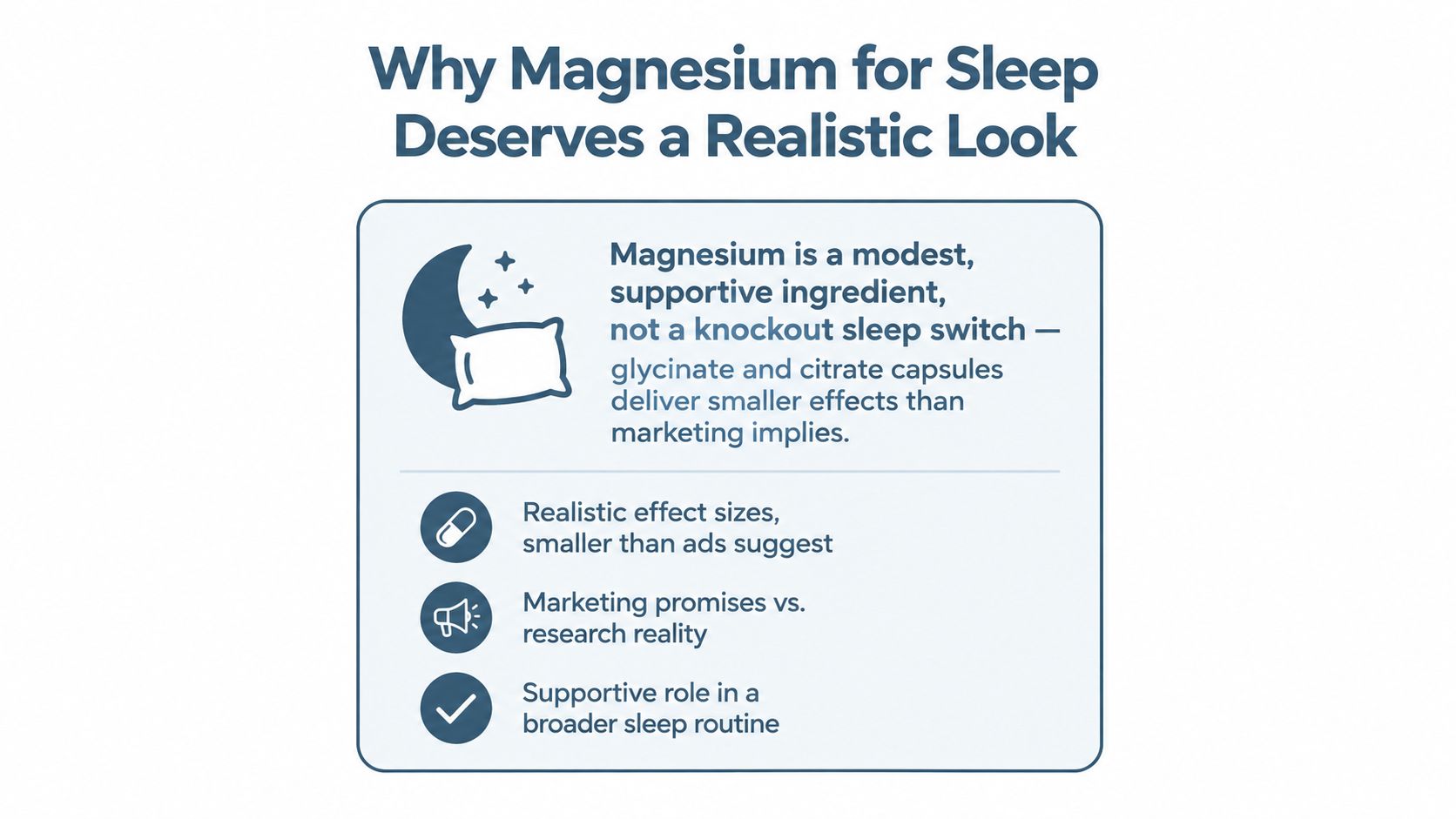
Magnesium is better understood as a supportive ingredient than a knockout sleep switch. Marketing often makes magnesium glycinate or citrate sound like a guaranteed way to shut down a busy mind. Research suggests a narrower possibility: some people may fall asleep a little faster, particularly when low intake, older age, or physical tension is part of the picture.
The clearest practical number comes from a 2021 systematic review of three randomized trials involving 151 older adults. Participants taking oral magnesium fell asleep 17.36 minutes faster than those taking placebo, while total sleep time increased by 16.06 minutes, a change that wasn't statistically significant (review in BMC Complementary Medicine and Therapies). That isn't nothing, but it isn't the dramatic transformation implied by many supplement advertisements.
Who may have more reason to try it
A person with low dietary magnesium, muscle tension, occasional twitching, or anxiety-driven bedtime arousal may notice a useful calming effect. Someone with restless legs should also consider the symptom itself rather than assuming every uncomfortable night is a magnesium problem. Persistent leg urges, painful sensations, or repeated movements deserve medical assessment.
The evidence is much thinner for shift workers with circadian misalignment, people with chronic insomnia unrelated to magnesium status, and adults who already have a nutrient-dense diet and stable sleep habits. Magnesium may be a reasonable experiment for some of them, but the research doesn't justify presenting it as a general insomnia treatment.
Practical expectation: Judge magnesium by whether it makes winding down easier or sleep onset modestly smoother, not by whether it sedates you.
A review summarized by the U.S. National Center for Complementary and Integrative Health examined nine studies with 7,582 participants and found conflicting results for sleep quality and sleep disorders. NCCIH described the overall evidence as too limited and low quality for well-informed decisions, while noting that larger, better-designed studies lasting more than 12 weeks are needed (NCCIH overview).
That uncertainty doesn't make magnesium useless. It tells you where it belongs: inside a broader routine that also addresses airway, breathing, light exposure, temperature, caffeine, and stress. Readers looking for a practical overview can compare this evidence-focused approach with magnesium for deeper sleep from The Sleep Consultant.
This article translates the physiology into plain language, puts the trial numbers in context, explains forms and elemental dosing, and finishes with a nightly plan you can test without relying on melatonin.
How Magnesium Actually Works in Your Sleep Physiology
Think of the nervous system as a car with an accelerator and several braking systems. Magnesium doesn't press a single “sleep” button. It may help the brain reduce unnecessary acceleration, relax muscles, and shift from alertness toward recovery.
The calming brake
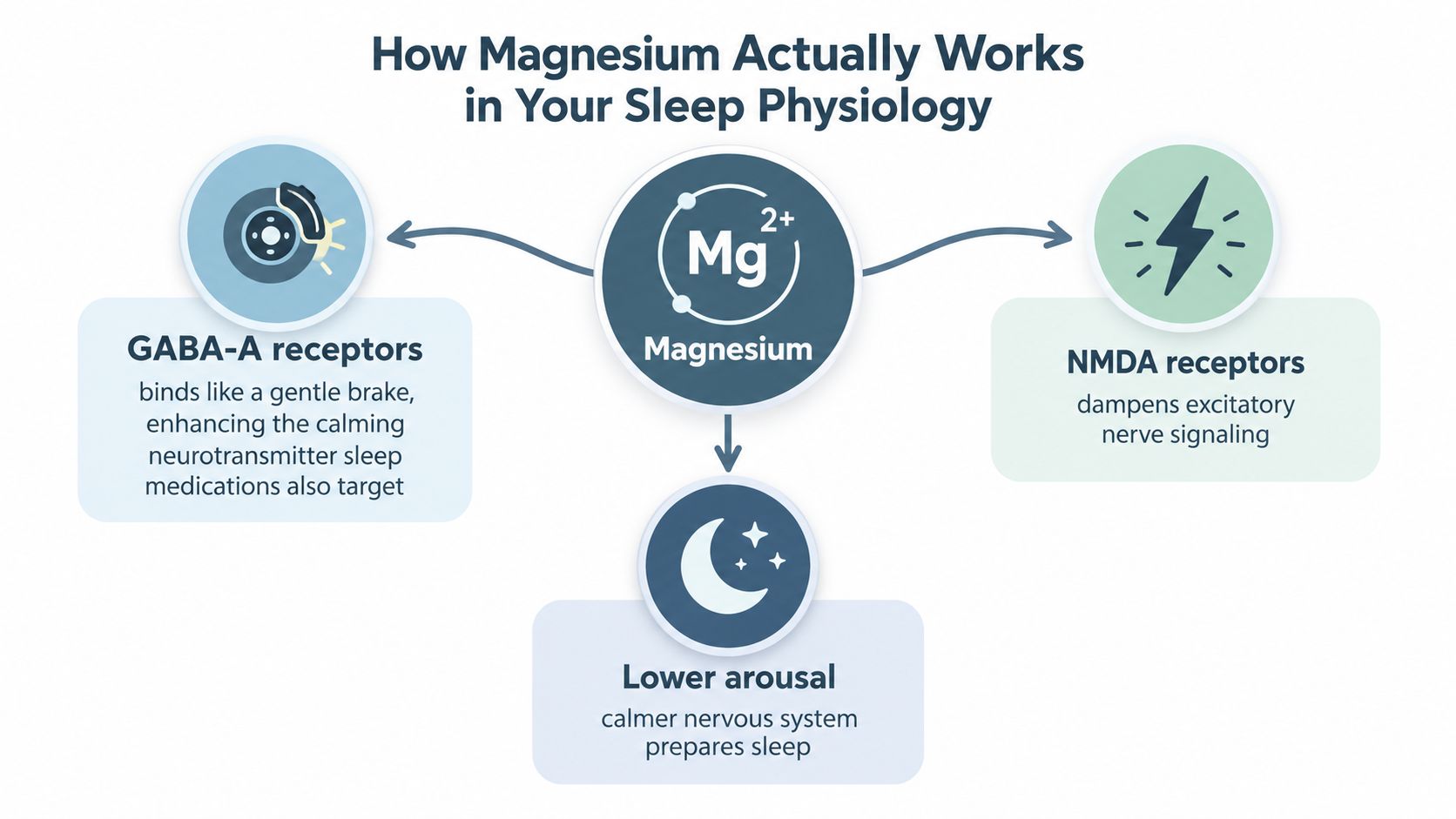
One proposed pathway involves GABA-A receptors, which respond to the brain's main calming neurotransmitter, GABA. Magnesium is often described as supporting this braking system, although simplified supplement explanations can overstate how directly a swallowed capsule changes receptor activity in the brain. The useful analogy is a dimmer switch, not an off switch. If your system is already highly activated, a small reduction in arousal may make the transition to sleep easier without causing sedation.
Magnesium also participates in the body's parasympathetic rest-and-digest response. That system counters the sympathetic alarm response associated with vigilance, fast thoughts, and physical tension. A calmer baseline can make it easier to settle into sleep, but it can't compensate for a loud bedroom, an irregular schedule, or repeated breathing interruptions.
The excitatory side of the equation
The NMDA receptor helps transmit excitatory glutamate signals. Magnesium can sit in the NMDA channel and act like a parking brake, limiting excessive excitation when nerve cells are firing too readily. This doesn't mean magnesium blocks normal thinking or awareness. It means the mechanism is relevant to the balance between “stay alert” and “power down.”
Magnesium also intersects with the HPA axis, the hormone network involved in stress responses and cortisol regulation. The relationship is complex, and research hasn't established that supplementation reliably normalizes cortisol in everyone with poor sleep. Still, the pathway helps explain why someone whose insomnia is driven by physical stress might experience a different result from someone whose main issue is circadian timing.
Muscles, sleep chemistry, and cellular work
Magnesium supports many enzyme reactions involved in energy production and nervous-system function. It also contributes to normal muscle relaxation. For a person who notices twitching, tension, or cramping at night, that role may matter more than a supposed sedative effect.
The mineral is involved in pathways connected with melatonin production and serotonin metabolism, but that doesn't make a supplement equivalent to taking melatonin. It supports the conditions in which sleep biology can operate. For a deeper explanation of the GABA connection, see magnesium and GABA.
Some people prefer a melatonin-free product that combines magnesium with other recovery-oriented ingredients. For example, Restore+ Sleep Aid is described as supporting nervous-system regulation, nitric oxide production, and overnight oxygen delivery, with third-party testing for toxins, PFAS, and heavy metals. Those claims describe the product's intended support, not proof that it treats insomnia.
What the Research on Magnesium Sleep Really Shows
The research signal is real, but its size and reliability matter more than the headline. The most frequently cited evidence comes from a small set of trials in older adults, not from a broad demonstration that magnesium works for every type of insomnia.
A 2021 meta-analysis of three randomized controlled trials involving 151 older adults found a 17.36-minute reduction in sleep-onset latency versus placebo. The same analysis found a 16.06-minute increase in total sleep time that wasn't statistically significant, and rated the evidence low to very low because of small samples and moderate-to-high risk of bias (Europe PMC summary).
A separate review found that observational studies connected magnesium status with sleep-related outcomes, including sleepiness and sleep duration, but randomized trials produced an uncertain relationship between supplementation and sleep disorders (2023 systematic review). That distinction matters. People with better magnesium status may sleep differently for many reasons, but correlation doesn't prove that a capsule will produce the same result.
Key magnesium sleep studies at a glance
| Study | Population | Dose & Form | Sleep Outcome |
|---|---|---|---|
| 2021 systematic review and meta-analysis | 151 older adults across three randomized trials | Oral magnesium, forms varied by trial | Sleep-onset latency was 17.36 minutes shorter; total sleep time improved by 16.06 minutes without statistical significance |
| 2022 review summarized by NCCIH | 7,582 participants across nine studies | Magnesium supplements, forms and protocols varied | Conflicting results for sleep quality and sleep disorders |
| 2023 systematic review | Observational studies and randomized clinical trials | Magnesium status or supplementation | Associations appeared in observational research, while treatment effects remained uncertain |
| 2026 systematic review | 12 randomized controlled trials | Oral magnesium, outcomes varied | No reliable routine insomnia benefit; certainty was low to very low |
The 2026 review is especially important for expectation-setting. It found inconsistent outcomes across subjective sleep measures, EEG, actigraphy, and physiological markers, and concluded that oral magnesium isn't supported as a routine insomnia treatment. That leaves room for selected subgroups, but it rules out the idea that magnesium is a dependable population-wide fix.
This evidence also explains why a product's form and dose shouldn't be treated as proof of effectiveness. Many studies have limitations, including short follow-up, small participant groups, reliance on self-reported questionnaires, and limited direct comparisons between forms. If your sleep is disrupted by nasal congestion or snoring, magnesium may not address the main problem. A tool such as Nasal Strips is designed to gently open the nasal passages and support smoother airflow, which is a different target from nervous-system calming.
Choosing the Right Magnesium Form and Dose
The label can make magnesium supplements look more potent than they are. A bottle may list the weight of the entire compound, such as magnesium glycinate or citrate, rather than the amount of elemental magnesium, which is the number relevant to dosing.
| Form | Elemental Mg % | Absorption Profile | Bedtime Suitability | Typical Adult Dose (elemental) | Key Caveat |
|---|---|---|---|---|---|
| Glycinate | About 14% | Generally well tolerated | Often suitable for evening use | 200 to 400 mg | Glycine may feel calming, but direct head-to-head sleep evidence is limited |
| Citrate | Varies by product | Generally soluble and well absorbed | Suitable if bowel effects aren't a concern | 200 to 400 mg | May loosen stools, especially at higher salt doses |
| Threonate | Product-dependent | Marketed for brain delivery, with sleep evidence still developing | More relevant to cognition-led goals than a standard bedtime trial | Follow elemental amount on the label | Often provides less elemental magnesium per serving |
| Malate | Product-dependent | Tolerance varies | Often chosen for daytime fatigue rather than bedtime | Follow label and elemental amount | Bedtime-specific evidence is limited |
| Oxide | About 60% by compound weight, but relatively poorly absorbed | Lower bioavailability than several other forms | Less appealing if gastrointestinal effects disturb sleep | Follow elemental amount on the label | More likely to cause digestive upset |
| Sulfate | Product-dependent | Epsom salt is mainly used externally in baths | Bath use differs from oral supplementation | Not a routine oral sleep choice | Don't treat bath salts as an equivalent pill dose |
The percentages and form comparisons above describe compound chemistry and commonly discussed formulation differences, not guaranteed absorption in an individual. Product labels vary, so check the line that says “Magnesium” in the Supplement Facts panel rather than multiplying the compound weight yourself.
A sensible trial window
For an adult with normal kidney function, 200 to 400 mg of elemental magnesium taken 60 to 90 minutes before bed is a practical trial range, but the supplement ceiling matters. The Food and Nutrition Board recommendation cited by the Sleep Foundation is 350 mg per day from supplements for adults, so a 400 mg supplemental dose should be discussed with a clinician rather than treated as an automatic target (Sleep Foundation guidance).
Start with the lowest amount that lets you assess tolerance. If citrate causes loose stools, the form isn't a good bedtime choice even if its absorption profile looks attractive on paper. For a side-by-side discussion of two common options, see magnesium glycinate versus citrate for sleep.
Formulation guides can be useful when you're comparing labels. Hemp Well Ireland's magnesium resources offer another place to review the differences, but no form should be treated as a guaranteed insomnia remedy.
Building a Magnesium-Friendly Evening Routine
Magnesium works best when the rest of the evening stops sending “stay alert” signals. A practical routine uses the supplement as one cue among several, rather than asking it to overcome bright light, stimulating content, alcohol, or a hot bedroom.
Start the wind-down before bedtime
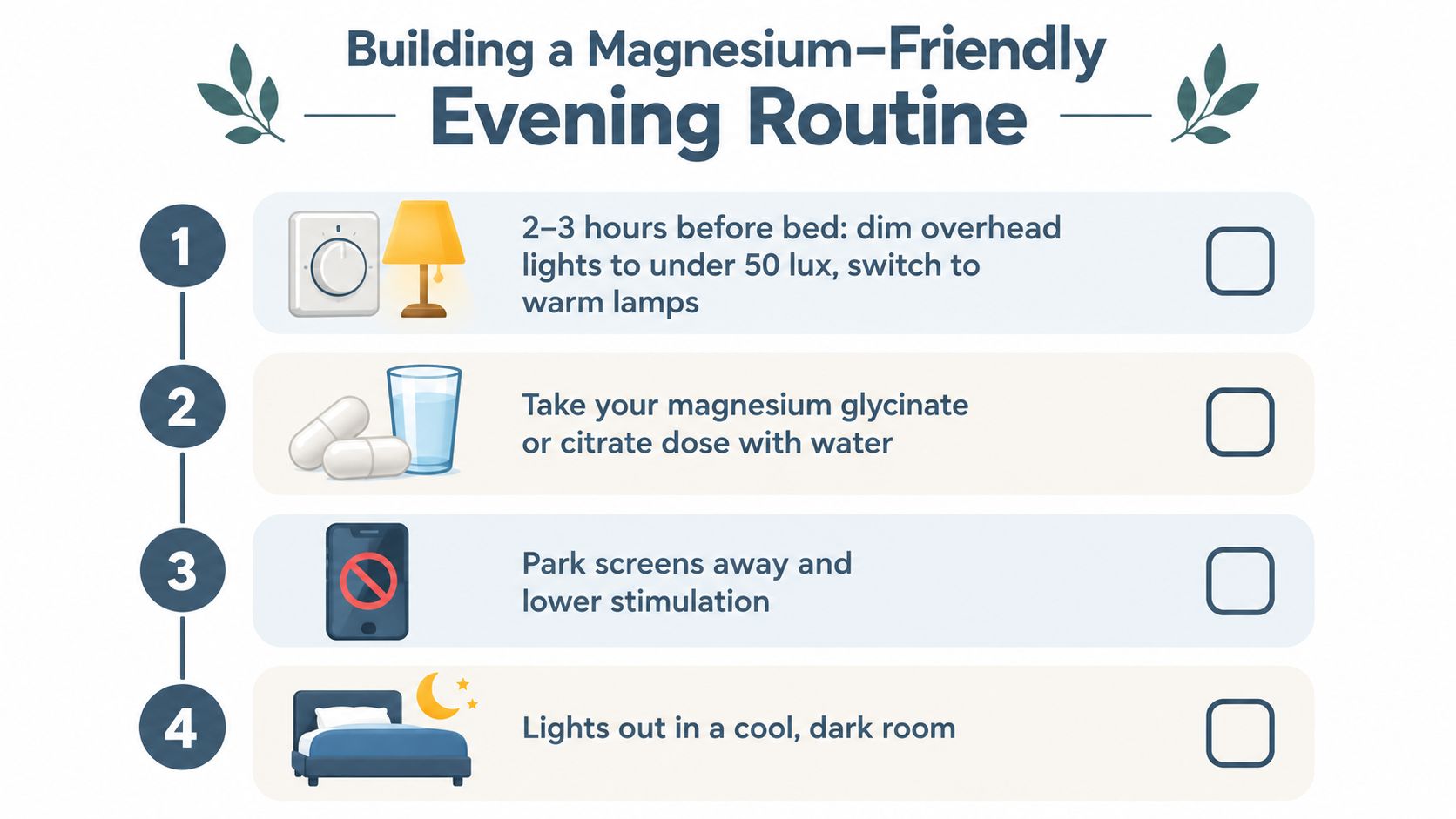
Two to three hours before bed, dim overhead lights to under 50 lux and switch to warm lamps. Put your phone on charge outside the bedroom, close blackout liners, and reduce tasks that require urgent decisions. The purpose isn't to create a perfect ritual. It's to remove repeated cues that keep the brain in work mode.
Take your chosen magnesium dose 60 to 90 minutes before bed with water. A small protein-containing snack may be more comfortable than taking it on an empty stomach, especially if supplements tend to upset your digestion. Don't add several new products at once, or you won't know what changed your sleep.
Simple experiment: Change one variable, keep a brief sleep log, and ask whether sleep onset, nighttime waking, and morning alertness changed together.
Let breathing become the transition cue
Replace scrolling with slow nasal, diaphragmatic breathing at roughly six breaths per minute for eight minutes. Keep the exhale easy rather than forcing a deep breath. When the exercise ends, move directly toward bed so the calm state becomes associated with the next step instead of another screen session.
Keep the room between 65 and 68 degrees Fahrenheit, make it as dark as possible, and leave screens in another room. Cap caffeine at 100 mg before 2 PM, and avoid alcohol within three hours of sleep. These boundaries are practical routine choices, not proof that magnesium can counteract every stimulant or sleep disruptor.
The embedded video below can provide a visual breathing cue for the routine.
Beyond Magnesium, Supporting Sleep from the Inside Out
A magnesium-friendly routine becomes more convincing when it addresses restorative sleep, not just the moment you fall asleep. A person can fall asleep quickly and still wake exhausted if nasal congestion, snoring, repeated airway narrowing, or an unstable schedule fragments the night.
Build the stack around the problem
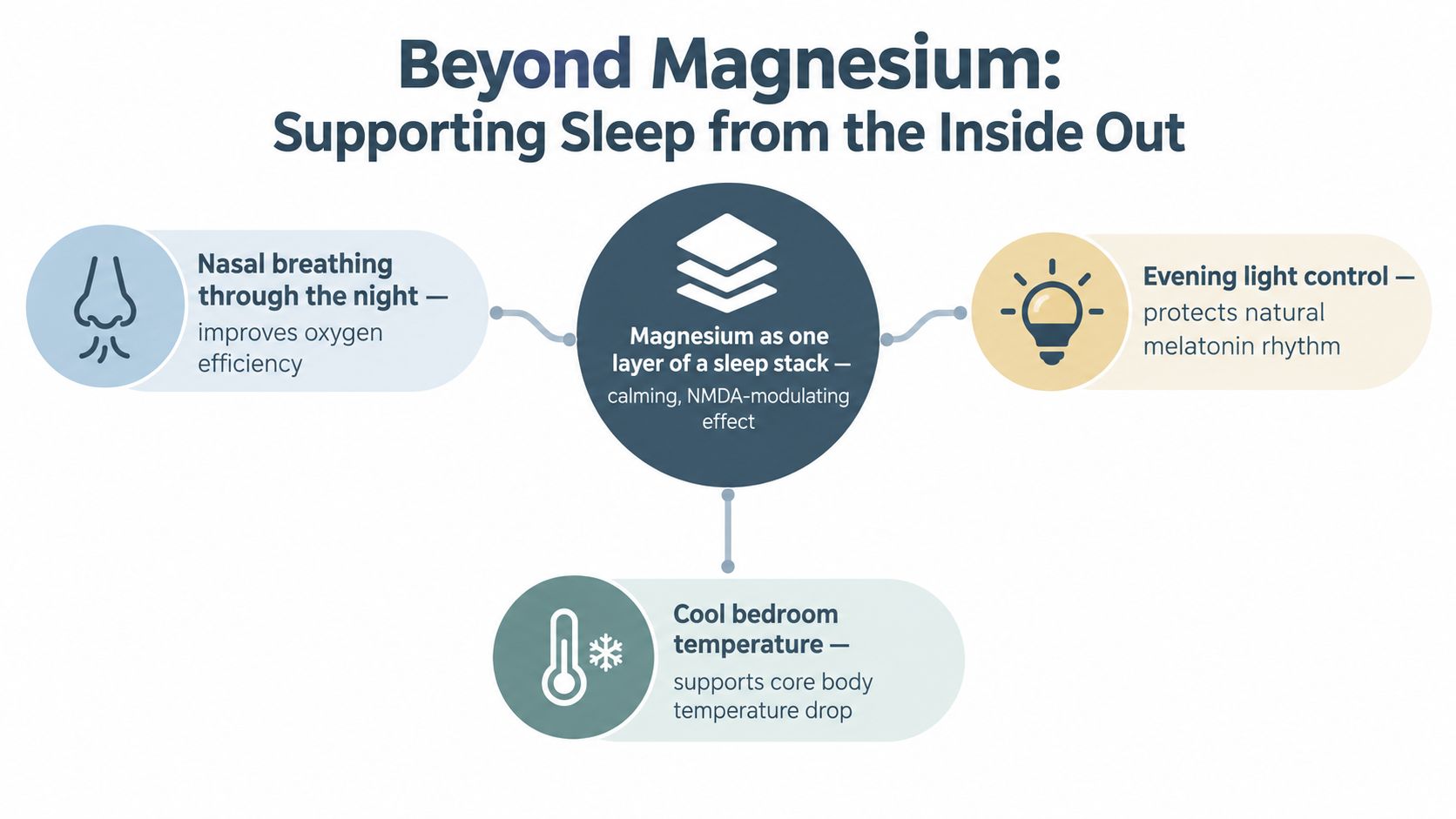
Use magnesium for the calming and muscle-relaxation layer. Support nasal breathing by managing congestion and observing whether mouth breathing, dry mouth, or snoring appears overnight. Morning outdoor light and a consistent wake time help anchor the body clock, while dim evening light protects the normal transition toward sleep.
Food can supply magnesium without turning bedtime into a supplement experiment. Leafy greens, pumpkin seeds, legumes, whole grains, and dark chocolate fit naturally into a varied diet. If you need ideas for working them into weeknight meals, simple home-cooking recipes from Just Cook It make lentil stews, grain bowls, and greens-heavy dishes easy to repeat. A protein-forward dinner may also reduce the urge to snack heavily late at night, although food choices aren't a substitute for evaluating persistent insomnia.
Humming exhalations and slow nasal breathing are low-tech ways to make the wind-down more deliberate. They won't diagnose or treat sleep apnea, and they shouldn't be used to ignore loud snoring, witnessed breathing pauses, or severe daytime sleepiness. Those symptoms call for clinical evaluation.
A melatonin-free approach can combine these layers, for example, magnesium for nervous-system support, airway-focused habits for smoother breathing, light control for circadian timing, and a cool dark room for the physical transition into sleep. The logic is cumulative rather than magical. When breathing remains steady, the calming effects of a bedtime routine have a better chance to support deeper, less fragmented rest.
Safety, Interactions, and When to Get Medical Help
Magnesium is a nutrient, not a risk-free substance. People with chronic kidney disease, serious heart conditions, or complex medical treatment shouldn't start a high-dose supplement without speaking with a clinician or pharmacist. Reduced kidney clearance can allow magnesium to accumulate.
Medication timing also matters. Magnesium can interfere with absorption of some antibiotics, including tetracyclines and quinolones, and with bisphosphonates. Certain diuretics and other medicines can affect magnesium balance or interact with supplementation, so check the timing instructions for every prescription and over-the-counter product you take.
Magnesium safety snapshot
| Situation | What to Know | Recommended Action |
|---|---|---|
| Normal kidney function and a modest trial | The supplement ceiling for adults is 350 mg per day | Check elemental magnesium and stay within the labeled limit unless a clinician advises otherwise |
| Chronic kidney disease | Clearance may be impaired | Ask a clinician before supplementing |
| Antibiotics or bisphosphonates | Magnesium may reduce medication absorption | Confirm separation timing with a pharmacist |
| Loose stools or abdominal cramping | Often signals poor tolerance or too much supplemental magnesium | Stop or reduce the supplement and seek advice if symptoms persist |
| Irregular heartbeat, profound fatigue, or severe weakness | May indicate a serious problem, especially with excess intake or impaired clearance | Stop the supplement and contact a clinician promptly |
| Chest pain or breathing difficulty | These aren't routine supplement side effects to monitor at home | Seek urgent medical care |
Food-based magnesium doesn't count toward the 350 mg supplemental ceiling, because that limit applies to magnesium from supplements and medications. Still, the total context matters if you're also using laxatives, antacids, or a combination product containing magnesium.
For questions about combining supplements, including magnesium and ashwagandha, review whether ashwagandha can be taken with magnesium and confirm the plan with a qualified professional. Stop a supplement if it causes persistent gastrointestinal symptoms, unusual weakness, or other concerning changes.
Magnesium is one possible tool inside a broader sleep plan. If poor sleep continues, look for the cause rather than continually increasing the dose. Loud snoring, witnessed breathing pauses, chest symptoms, severe daytime sleepiness, or breathing difficulty deserve medical attention instead of another bedtime capsule.
SleepHabits offers melatonin-free sleep support that combines magnesium-focused recovery support with products and education centered on nighttime breathing, nasal airflow, light control, and slow-breath routines. Visit SleepHabits to explore those options and choose the layer that matches your actual sleep problem.