

Most advice about magnesium vs melatonin for sleep gets the question backward. The core issue isn't which supplement wins in general, it's which sleep problem you're trying to fix, because melatonin and magnesium do different jobs. One nudges timing, the other helps the body downshift.
If your sleep is broken because your clock is off, melatonin is the cleaner tool. If your body feels tense, restless, or prone to waking, magnesium usually fits better. That distinction matters more than brand hype, bedtime rituals, or the size of the dose.
| Criterion | Melatonin | Magnesium |
|---|---|---|
| Main role | Circadian timing | Relaxation physiology |
| Best for | Jet lag, shift work, delayed sleep phase | Stress-related restlessness, waking at night, shallow sleep |
| What it is not | A strong sedative | A clock-resetting hormone |
| Main evidence pattern | Modest but real help with sleep onset | Modest help in some groups, especially for sleep maintenance |
| Timing | Earlier in the evening, often before target bedtime | Evening, often as part of a wind-down |
| Common caution | Grogginess, vivid dreams, wrong-time use | Digestive upset, kidney caution |
| Best mindset | Use it to shift sleep timing | Use it to support calming and recovery |
Why Magnesium and Melatonin Are Not the Same Solution
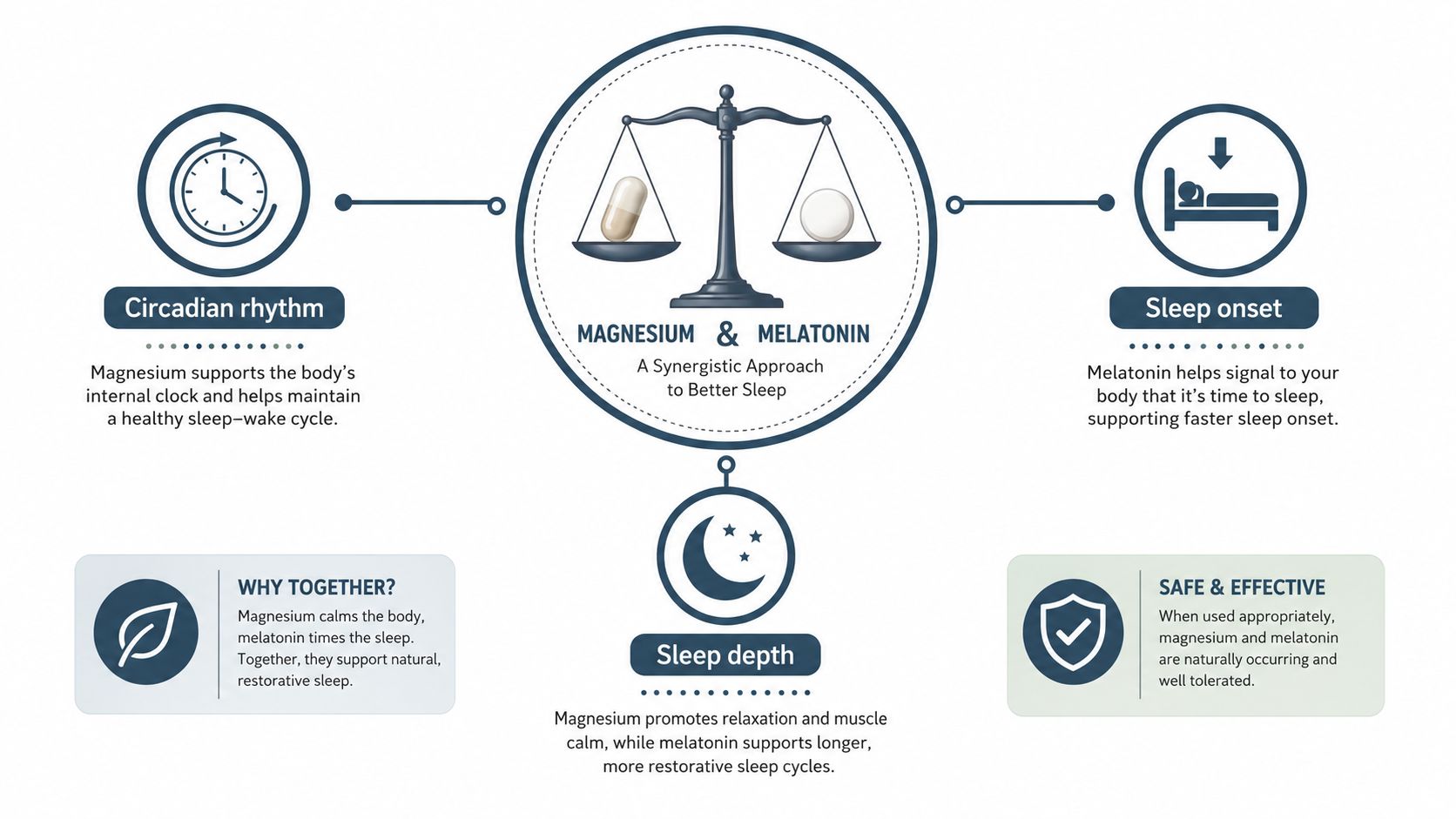
Melatonin and magnesium end up on the same shelf, but they don't solve the same problem. Melatonin is a chronobiotic, which means it signals timing to the brain. Magnesium works more like a support nutrient for relaxation physiology, nervous system modulation, and muscle calm.
That difference changes everything. Someone who can't sleep because their bedtime has drifted later is dealing with a timing problem. Someone who lies awake with tight shoulders, a racing body, or repeated waking is dealing with a relaxation problem.
The wrong question is “which is better”
The smarter question is, what's blocking sleep tonight? If you use melatonin when the issue is stress-driven hyperarousal, you may get a little help but not enough. If you use magnesium when your clock is shifted by travel or rotating shifts, you're treating the wrong bottleneck.
Practical rule: timing problems need melatonin, relaxation problems usually need magnesium, and mixed insomnia needs a more deliberate plan.
That's why the usual one-line summary, “melatonin for timing, magnesium for relaxation,” is only half useful. It tells you what each one does, but not how to decide when your symptoms overlap. The better approach is to match the supplement to the dominant sleep pattern, not to the one that sounds more natural or more popular.
What that means in practice
A person with jet lag needs a timing cue more than a calming mineral. A person who wakes up wired at 2 a.m. needs help lowering arousal more than shifting the body clock. Those are not interchangeable problems, so the supplements aren't interchangeable either.
The mistake many people make is buying both, taking both at random times, and then judging the whole category as “ineffective.” That outcome says more about poor matching than poor biology. When the fit is right, each one has a role.
What the Evidence Shows
The evidence is modest, but it is real. Melatonin has the stronger benchmark for sleep onset, while magnesium has a smaller but meaningful signal in people with insomnia and poor sleep quality. Neither one is a knockout pill.
Melatonin's effect is real, but modest
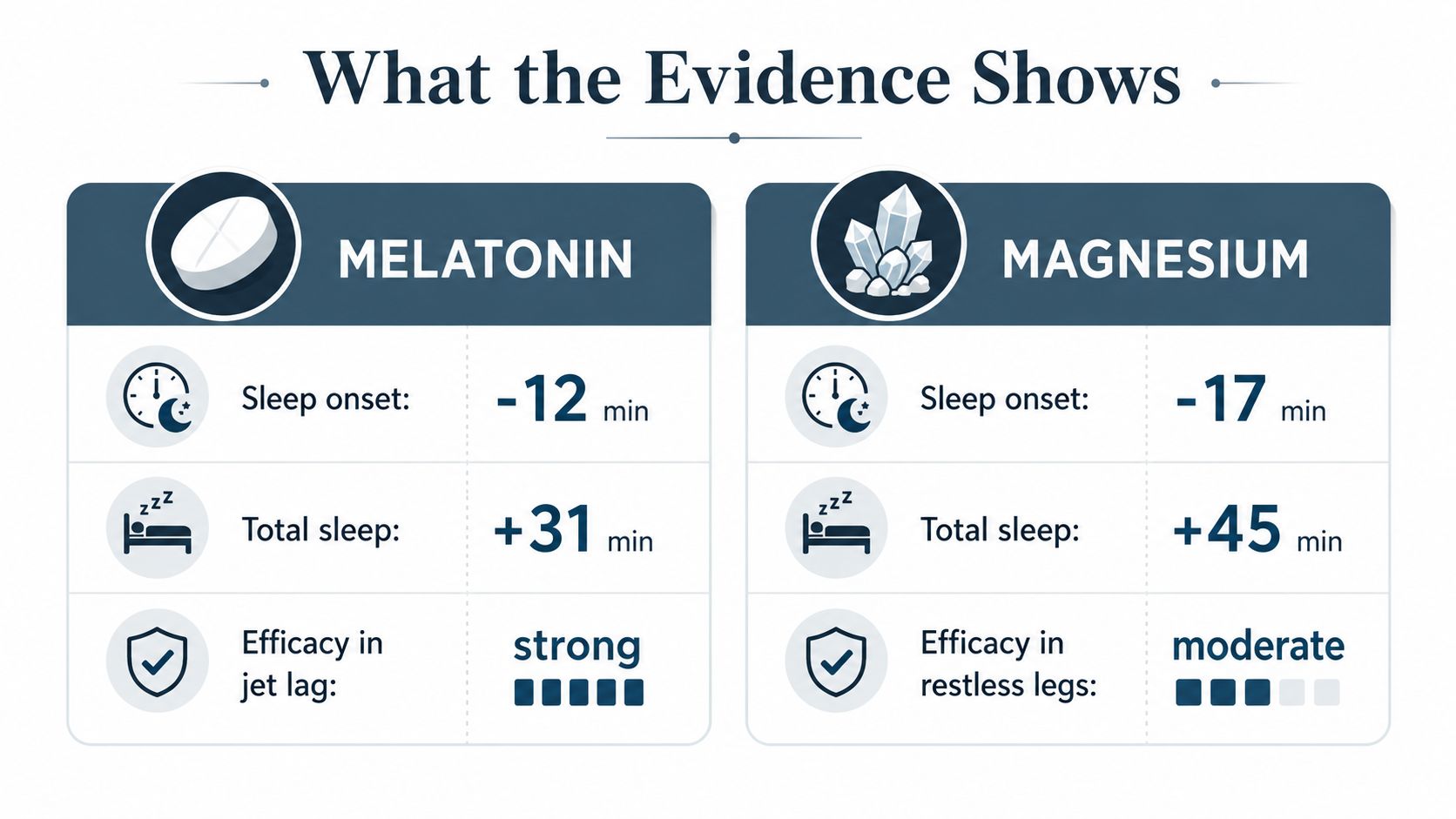
A 2013 meta-analysis of 19 randomized trials involving 1,683 participants found that melatonin reduced sleep onset latency by 7.06 minutes, increased total sleep time by 8.25 minutes, and produced only a modest improvement in sleep quality, with a standardized mean difference of 0.22 (sleep stack review). Another summary of 26 clinical trials reported that melatonin's benefits were strongest when taken at 2 to 4 mg about 3 hours before bedtime (GQ summary).
That puts a hard limit on expectations. Melatonin helps people fall asleep a bit faster and sleep a bit longer on average, especially when the problem is circadian misalignment. It is not a large restorative-sleep intervention.
Magnesium's evidence is narrower, but still useful
Clinical evidence for magnesium is smaller. One review identified only three clinical trials in people with insomnia, and those studies found magnesium reduced sleep-onset latency by about 17 minutes versus placebo. In one trial of 155 healthy adults with self-reported poor sleep, 252 mg of elemental magnesium as bisglycinate for four weeks reduced Insomnia Severity Index scores by 3.9 points versus 2.3 points for placebo, with statistical significance at p = 0.049.
That is modest, but clinically interesting. Magnesium looks more like a sleep-quality support than a timing cue. It fits best when the sleep problem is built around restlessness, tension, and fragmented sleep rather than a shifted body clock.
The clearest takeaway
Melatonin wins when the goal is sleep onset and circadian correction. Magnesium makes more sense when the goal is calm, maintenance, and smoother overnight sleep. A plain-language summary from a separate evidence review said melatonin can help people fall asleep about seven minutes faster and increase total sleep time by only eight minutes, while magnesium research remains mixed and lacks strong high-quality proof for general insomnia (SELF summary).
How Each One Works and a Side-by-Side Comparison
Melatonin and magnesium solve different sleep problems, and treating them as interchangeable is why people waste money on supplements that miss the mark. Melatonin is the better fit when sleep timing is off, especially with jet lag or shift work. Magnesium is the better fit when the problem is a wired body, stress, or broken sleep that never fully settles.
Melatonin is simple in a useful way. Your pineal gland makes it in response to darkness, and supplemental melatonin gives the brain a nighttime signal. That makes it useful when the issue is a sleep schedule that has drifted late or a body clock that has been disrupted by travel or shift work.
Magnesium works through a different route. It supports the parasympathetic nervous system, helps regulate arousal, and is commonly tied to muscle relaxation and calmer nighttime physiology. It supports sleep readiness rather than shifting timing, which is why it fits better when the problem is tension, restlessness, or light, fragmented sleep. For a closer look at forms and practical use, see SleepHabits' guide to magnesium for sleep.
Side by side, the decision gets clearer
| Criterion | Melatonin | Magnesium |
|---|---|---|
| Mechanism | Chronobiotic timing signal | Relaxation and nervous system support |
| Primary use case | Jet lag, shift work, delayed sleep phase | Stress-related restlessness, frequent waking, shallow sleep |
| Evidence strength | Better benchmark evidence for sleep onset | Smaller, mixed evidence base, but measurable benefit in some groups |
| Typical onset | Often same night if the timing is right | Often builds over days to weeks |
| Ideal timing | Earlier evening, often about 3 hours before bedtime in timing-focused use | Evening, often within a broader wind-down routine |
| Best form | Immediate-release for sleep initiation, extended-release only when early waking is the issue | Glycinate or threonate are commonly preferred for sleep |
| Main caution | Grogginess, vivid dreams, timing used incorrectly | GI upset, kidney caution |
The table makes the choice plain. Melatonin shifts sleep timing. Magnesium supports the body's readiness for sleep. Those are different jobs, so they should be used for different complaints.
If the problem is being too alert at night, magnesium is the better first move. If the problem is a late body clock, melatonin earns the spot. If the sleep complaint is frequent waking, stress-driven restlessness, or a body that feels stuck in gear, magnesium fits the pattern better than a hormone signal. If the complaint is jet lag or shift work, melatonin is the cleaner tool.
The reason people get mixed results is simple. They pick the supplement that sounds closest to “sleep,” then wonder why it does not match the bottleneck. One ingredient signals timing, the other supports calm, and that difference matters more than the branding.
Doses, Forms, and Timing That Actually Work
Dose matters, but timing and form matter just as much. A lot of poor results come from taking the right ingredient at the wrong time, or buying the wrong version. The goal is not to take more, it's to take it in a way that matches the sleep problem.
Melatonin needs less than people think
For most adults, 0.5 to 5 mg is the practical range, and lower doses often make more sense than higher ones. Immediate-release is usually the better choice for sleep initiation, because you want a timing cue, not a long tail of hormone exposure through the night. Extended-release only makes sense when the main complaint is early-morning waking.
A better default is to take melatonin about 3 hours before bedtime when you're trying to shift sleep timing. That fits circadian use much better than swallowing it right as the lights go out.
Magnesium works best when the form is gentle
For magnesium, the practical range is usually 200 to 400 mg elemental magnesium. Magnesium glycinate and magnesium threonate are the forms commonly chosen for sleep because they tend to be easier on the gut. Magnesium oxide and magnesium citrate are more likely to cause digestive issues, and that can backfire if stomach discomfort keeps you awake.
A split dose often works better than a single bedtime dose, with part taken at dinner and the rest 60 to 90 minutes before bed. That gives the body time to settle without dumping everything on the stomach right before sleep.
A simple default routine
Start with the goal, then choose the format:
- For timing correction: use melatonin earlier in the evening, and keep the dose conservative.
- For calming and maintenance: use magnesium in a sleep-friendly form, ideally glycinate.
- For a mixed night: don't stack randomly, decide which problem is louder first.
If you want a deeper magnesium routine, this guide on magnesium supplement for sleep is a useful companion. For people who prefer a non-pill evening option, Longevity Medical Institute supplements is another resource some readers explore when they're comparing formulations and routines.
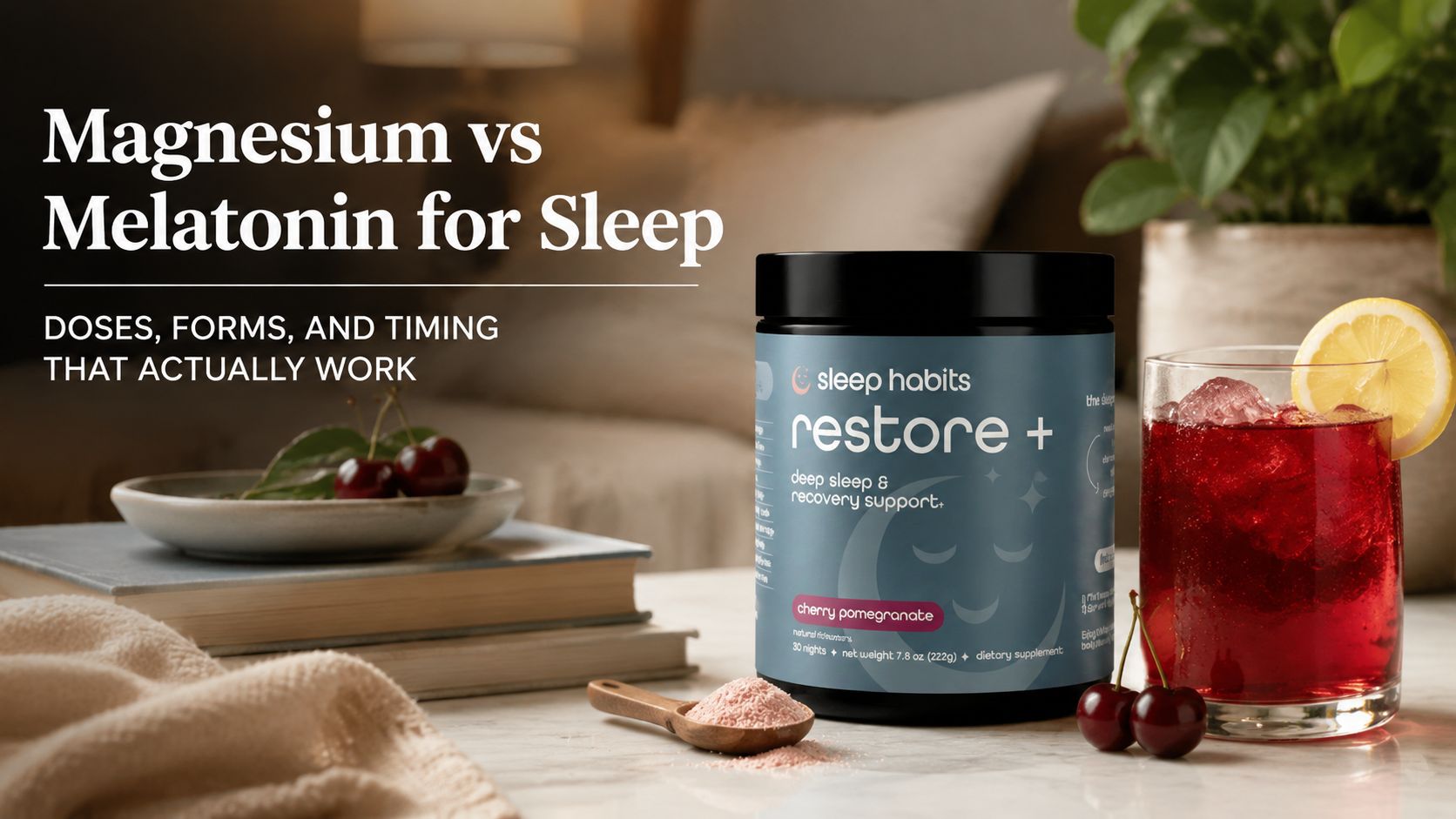
SleepHabits™ Restore+ is a melatonin-free magnesium wind-down drink designed to support an evening routine, and it combines magnesium with L-theanine, tart cherry, lemon balm, and glycine. It fits the category of a habit-based magnesium-first approach rather than a timing-only melatonin strategy.
Side Effects, Grogginess, and Who Should Avoid Each
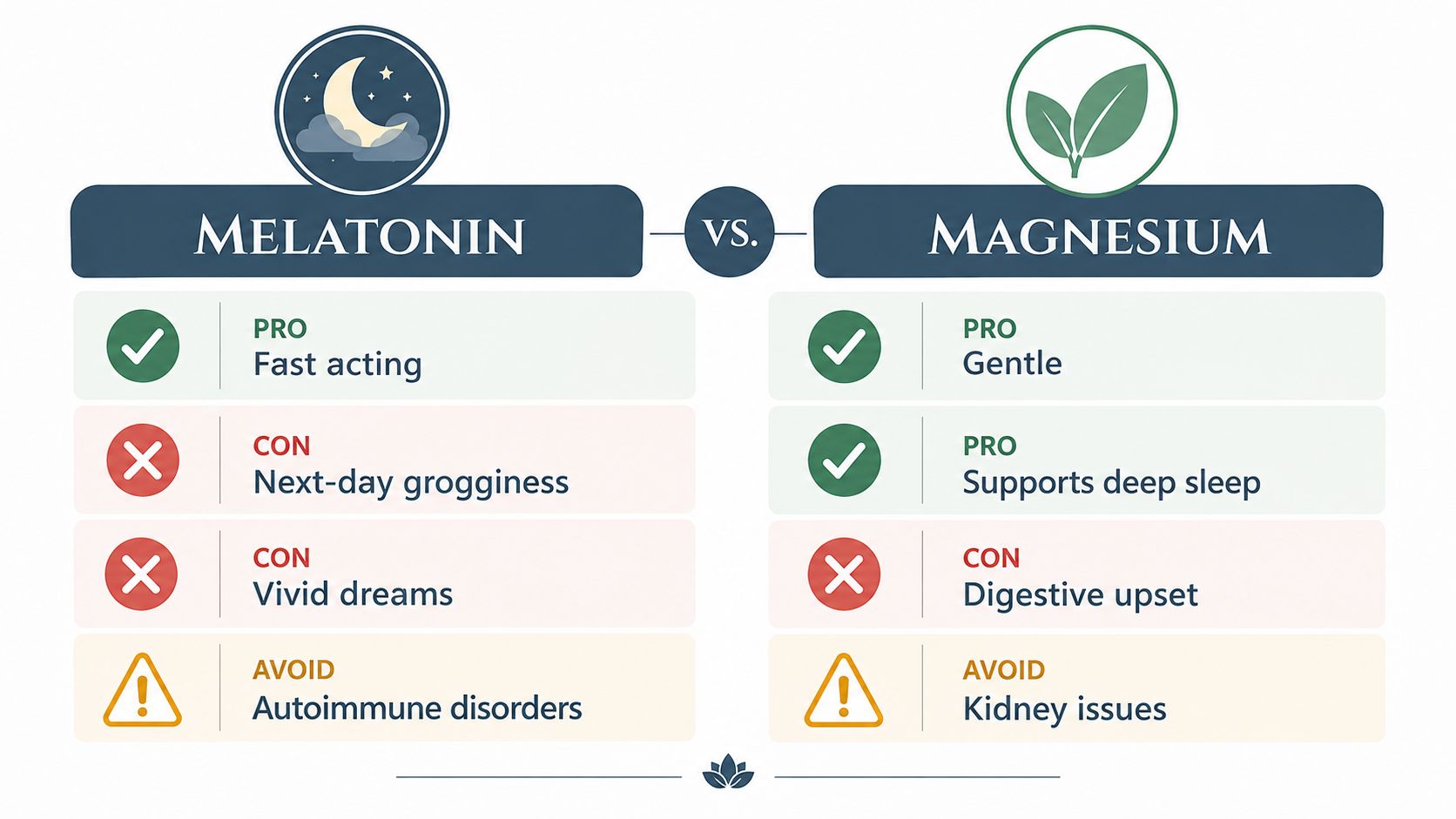
Melatonin is easy to underestimate. It may feel mild, but it can still cause next-day grogginess, especially at higher doses or with extended-release products. Some people also report vivid dreams, and if you take it at the wrong time, you can push your circadian rhythm in the wrong direction.
Who should be cautious with melatonin
People who are pregnant, have autoimmune conditions, or take blood thinners or immunosuppressants should not treat melatonin like a casual bedtime vitamin. It needs medical guidance. The same caution applies if you plan to use it for more than a short trial, because long-term safety data is still thinner than many shoppers assume.
For a closer look at risks, read side effects of melatonin supplements.
Magnesium has a different risk profile. The most common problem is GI upset, especially with cheaper or poorly chosen forms. People with kidney disease need caution because magnesium can accumulate, and that is where the risk sits.
What to skip and what to respect
- Skip topical hype: topical magnesium products get marketed hard, but the sleep evidence is weak.
- Skip huge melatonin doses: more is not better, and it can make grogginess worse.
- Respect kidney status: magnesium is not something to use casually if kidney function is impaired.
- Respect drug timing: magnesium can interfere with some medications, so spacing matters.
Magnesium is usually the better-tolerated long-term option at reasonable doses, while melatonin works better as a targeted tool than a nightly crutch. That is the honest tradeoff. Most adults do fine with either one, but the risk pattern is different.
If snoring, gasping, or repeated awakenings are part of the picture, sleep apnea devices by 3D DDS belong in the conversation.
Which One Fits Your Sleep Problem
This is the part you need. Don't pick by popularity. Pick by symptom pattern.
Use magnesium first when the problem is built around arousal
If you have trouble falling asleep but your circadian rhythm is basically normal, magnesium-first is the better move. If you wake frequently or sleep feels light and broken, magnesium fits even more clearly. Stress-driven restlessness and racing thoughts also point to magnesium, often alongside a wind-down routine and, when appropriate, L-theanine.
Use melatonin when the clock is late
If you're dealing with jet lag, delayed sleep phase, or rotating shift work, melatonin is the more direct choice. It's meant to move sleep timing, not just relax the body. That's the use case where it's easiest to justify.
Mixed insomnia needs a hierarchy, not a guess
When timing, stress, and waking at night all overlap, start with magnesium and a calmer routine. Add melatonin only if the timing problem is clearly the dominant issue. That keeps you from masking the wrong problem with the wrong tool.
If you're sorting out sleep disruption and suspect airway issues or snoring are part of it, sleep apnea devices by 3D DDS may be relevant to a broader treatment conversation.
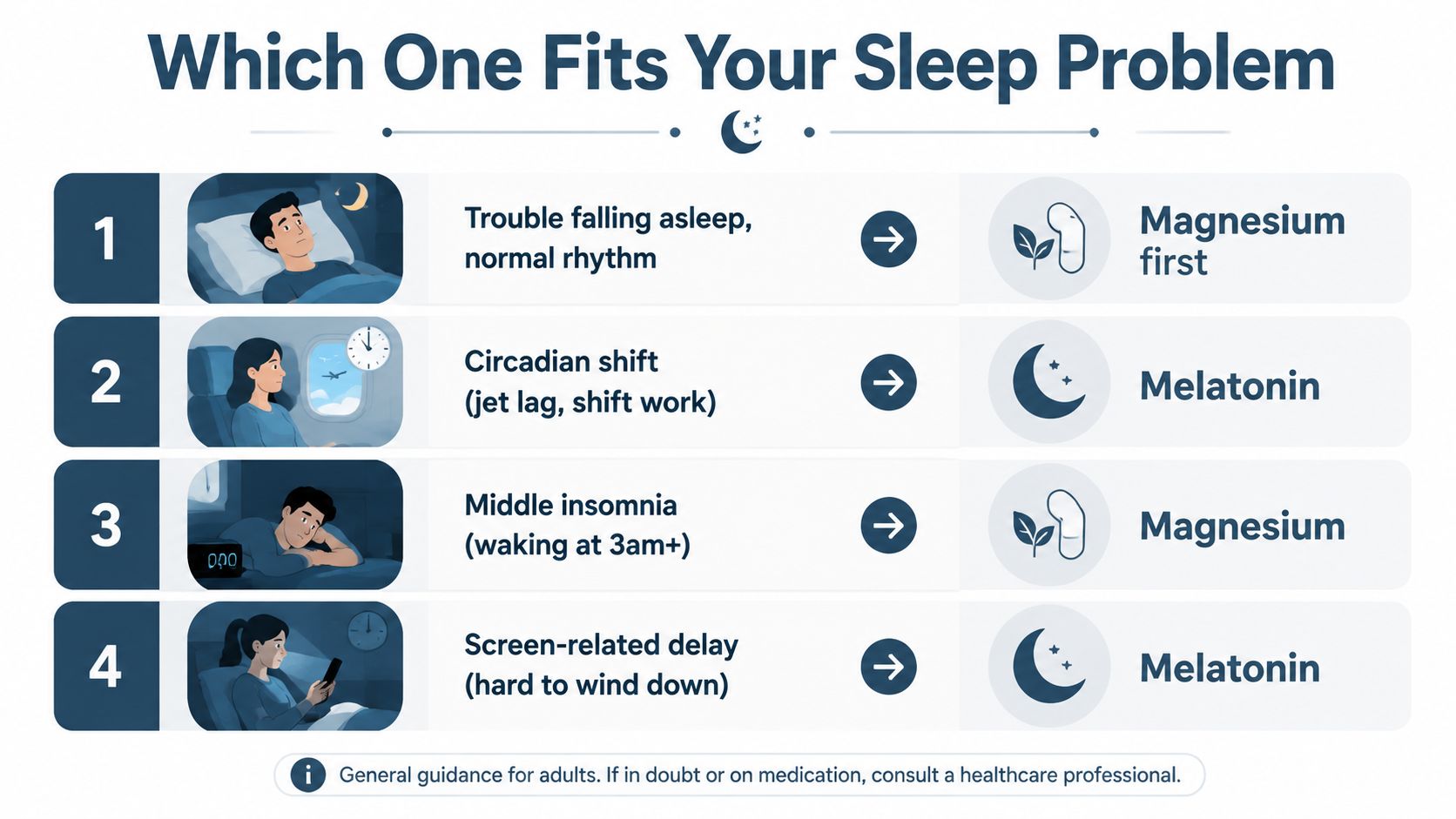
Direct rule: if your body is tired but too keyed up, choose magnesium. If your body clock is off, choose melatonin.
Screen-related delay belongs in the melatonin lane too, because the issue is timing and light exposure, not just relaxation. That's why a lot of people do better when they stop treating every insomnia pattern as the same problem.
A Magnesium-First Wind-Down Routine That Replaces the Melatonin Habit
A good routine beats a random pill almost every time. The point is to create a repeatable sequence that lowers arousal, protects your own melatonin production, and makes sleepiness show up on time. That's where a magnesium-first routine earns its place.
The 60 to 90 minute window before bed
Start by dimming lights and cutting down screen brightness. Then journal for a minute or read something calm, because the goal is to reduce mental switching. If you're using a magnesium drink, a formula like Restore+ Magnesium Sleep Aid is built around magnesium plus L-theanine, tart cherry, lemon balm, and glycine as part of an evening routine.
The SleepHabits magnesium guide, magnesium calm sleep, fits well here if you want the habit side of the routine spelled out more clearly.
Add nasal breathing on purpose
Hydrating mouth tape can be part of the setup if mouth breathing is an issue, and the product description for Hydrating Mouth Tape focuses on quieter nights, reduced snoring, and oral-care support. Nasal strips can be useful too, especially when airflow feels restricted.
Then do slow nasal breathing. A simple rhythm is about 5.5 seconds in and 5.5 seconds out, repeated calmly until the body downshifts. That breathing pattern supports parasympathetic activation, which is exactly what you want before sleep.
Why this works better than a melatonin habit
Melatonin can be useful, but a habit stack often works better for people whose problem is not just timing. Dim lights protect the melatonin your body already makes. Magnesium supports relaxation. Nasal breathing and airway support reduce the friction that keeps the body “on.”
The result is a routine built around physiology, not guesswork. That matters if you want better sleep on more than one night.
Combination Use, FAQ, and When to Loop in a Doctor
Yes, you can take magnesium and melatonin together. That combination is biologically plausible, and a 2020 review in PubMed Central reported that a 3-month regimen using magnesium, melatonin, and vitamin B complex had a significant positive effect on sleep disturbances and was described as highly effective for insomnia patients (PubMed Central review). The key is to use a stack only when both timing and relaxation are clearly part of the problem.
Magnesium usually needs patience. Most clinical benefits show up within 2 to 4 weeks, not overnight. Melatonin isn't addictive in the classic sense, but people can become dependent on the timing signal if they never fix the underlying sleep schedule.
Athletes can reasonably pay attention to magnesium because overnight recovery and muscle function are part of the picture, but they still need the same rule. Match the supplement to the sleep problem, not the training plan alone.
See a doctor if insomnia lasts longer than 3 months, if sleep apnea is suspected, or if the issue feels medical rather than lifestyle-based. Persistent snoring, choking, gasping, or extreme daytime sleepiness should push you toward evaluation, not more supplement experiments.
SleepHabits focuses on nighttime breathing, restorative sleep, and melatonin-free support that fits a habit-based routine. If you're deciding between magnesium and melatonin, or you want to build a calmer wind-down instead of chasing a stronger pill, visit SleepHabits and compare the tools against your actual sleep problem.