

The most popular advice about adult sleep is often the least precise: take melatonin and hope the night improves. Melatonin can be useful in situations involving body-clock timing, but it isn't a universal sedative, and many adults aren't struggling because their internal clock is shifted. They're lying awake with racing thoughts, waking repeatedly, or sleeping long enough without feeling restored.
A better melatonin free sleep aid for adults starts with the problem, not the bottle. First identify whether your main difficulty is falling asleep, staying asleep, or waking refreshed. Then choose an ingredient, product, or clinical option that fits that pattern, and pair it with habits that make sleep easier rather than asking one supplement to do all the work.
Why So Many Adults Are Rethinking Melatonin
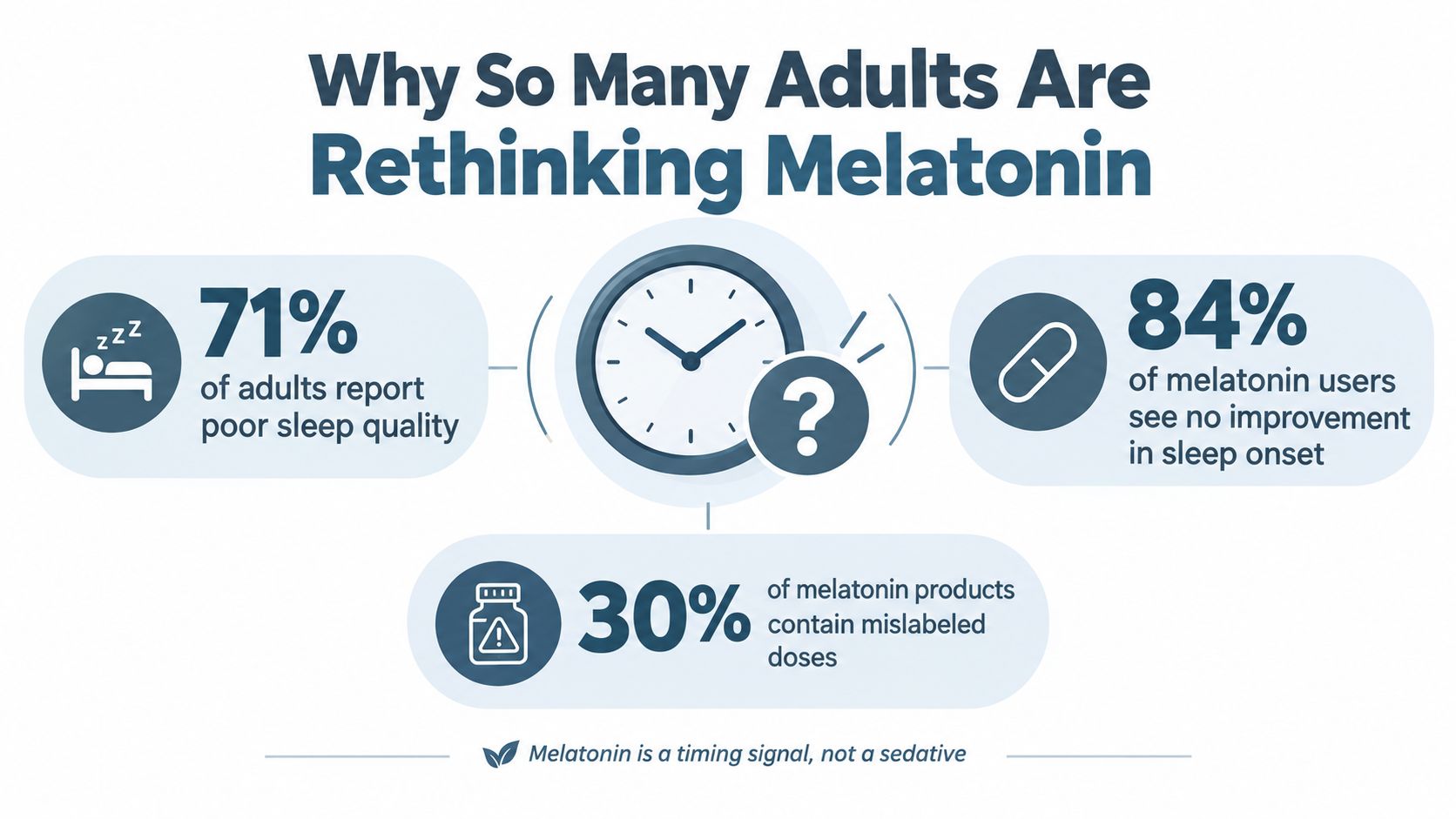
Melatonin is best understood as a timing signal, not a traditional sedative. Your body uses it to help coordinate the sleep-wake rhythm, which is why timing, light exposure, travel, and shift work can matter so much. If your primary problem is an overactive mind at bedtime or repeated awakenings during the night, changing the timing signal may not address the reason you're awake.
The evidence also gives adults a reason to be selective. The American Academy of Sleep Medicine recommends against melatonin for sleep-onset or sleep-maintenance insomnia in adults, while a 2023 review found only modest benefits in primary insomnia, including about 12.8 minutes more total sleep time and roughly 4 minutes less sleep latency. Those figures come from the American Academy of Sleep Medicine pharmacologic guideline, and they don't mean melatonin never helps. They do mean that a familiar ingredient shouldn't automatically be treated as the right answer for chronic insomnia.
Familiar doesn't always mean predictable
Melatonin use has grown sharply. Reported use among U.S. adults rose from 0.4% in 1999–2000 to 2.1% in 2017–2018, a more than fivefold increase over about two decades, according to NIH reporting on melatonin supplement use. Use of doses above 5 mg per day also rose from 0.08% in 2005–2006 to 0.28% in 2017–2018.
That rise matters because more use can encourage more experimentation with dose and timing. Independent reviews cited by the NIH found that 88% of melatonin products were inaccurately labeled, with some products containing 347% more melatonin per dose than stated. Adults concerned about grogginess, vivid dreams, inconsistent effects, or unclear dosing may reasonably prefer a formulation that doesn't rely on melatonin.
Sleep trouble itself is widespread. Population studies report nighttime insomnia symptoms in about 30% to 36% of people, while insomnia with daytime consequences affects roughly 10% to 15%; strict diagnostic definitions narrow the estimate to 5% to 10%, according to the American Academy of Sleep Medicine guideline. The same guideline states that over-the-counter antihistamine and herbal or nutritional sleep aids, including melatonin, aren't recommended for chronic insomnia because evidence for efficacy and safety is limited.
Practical rule: Don't ask only, “Which sleep aid is strongest?” Ask, “What exactly is breaking down in my night?”
For a balanced discussion of possible unwanted effects and why individual responses vary, see this guide to melatonin supplement side effects. The goal isn't to label melatonin as bad. It's to stop treating it as the automatic first step for every adult sleep complaint.
What Melatonin-Free Sleep Aids Are
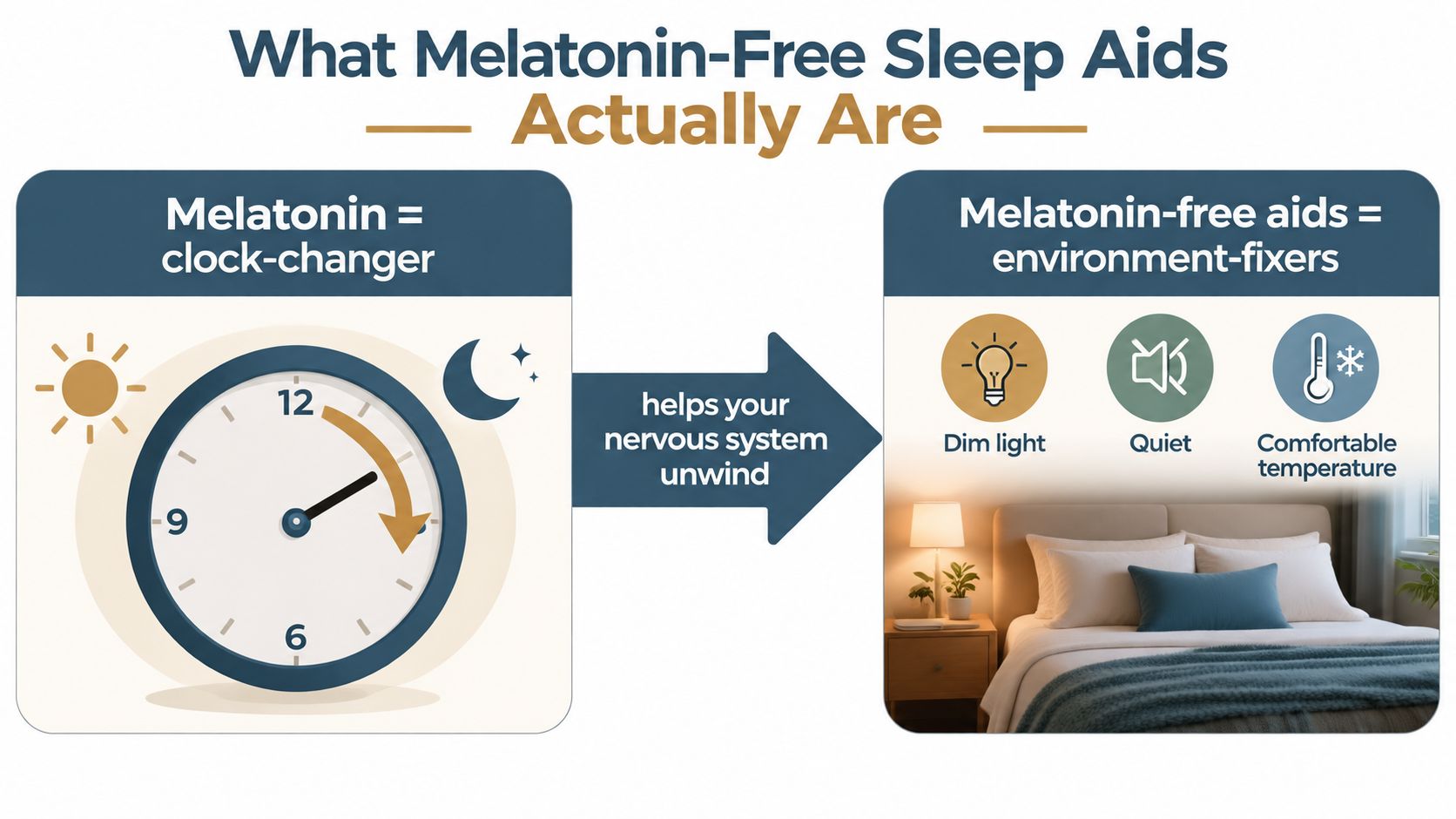
Melatonin-free sleep aids address parts of the sleep process rather than sending a timing signal. Melatonin changes the clock signal, telling the body when nighttime is approaching. Melatonin-free products generally work more like environment-fixers. They may relax muscles, quiet mental arousal, or support a calmer transition into sleep, while leaving the body's timing system unchanged.
Their usefulness depends on the problem you are trying to address:
- Relaxation support: Magnesium and glycine are commonly used to support muscle relaxation and a calmer nervous system.
- Calming neurotransmitter support: L-theanine may help reduce mental arousal without acting as a direct sedative.
- Gentle botanical support: Valerian, lemon balm, and chamomile are traditionally used for a mild calming effect.
This difference shapes reasonable expectations. Melatonin can feel like a direct sleep cue for some people. A melatonin-free formula may feel more like lowering the volume on a busy evening, with effects that develop more gradually. Regular use alongside a stable routine often makes more sense than taking a product only after frustration has peaked.
The formulation matters
Sleep problems do not all have the same source. Muscle tension, racing thoughts, frequent waking, and unrefreshing sleep can point to different needs. Someone who wakes unrefreshed may need to examine breathing, medication, stress, or an underlying sleep disorder instead of adding another calming compound.
A combined formula can therefore serve a practical role, provided its ingredients and purpose are clear. One example is Restore+ Magnesium Sleep Aid, a melatonin-free magnesium wind-down drink containing magnesium, L-theanine, tart cherry, lemon balm, and glycine. Its product description presents it as part of an evening routine, with ingredients selected to support relaxation, circulation, oxygen delivery, and overnight recovery. These are formulation goals, not a promise that the drink will resolve diagnosed insomnia.
Subtle doesn't mean useless
Judge a melatonin-free aid by the specific outcome you want. Falling asleep more calmly, waking less often, and feeling clearer in the morning are separate outcomes. A product that helps you unwind may be a poor match if loud snoring or repeated breathing disruption is driving the problem.
The label “natural sleep aid” can also create confusion. Natural describes an ingredient's origin, not its evidence, dose accuracy, interactions, or suitability for your symptoms. Look for a transparent formula, sensible dosing, and a clear role in a broader sleep plan. The practical choice is the ingredient combination that matches your sleep difficulty, whether the main issue is onset, maintenance, or recovery.
The Most Common Melatonin-Free Ingredients and What the Evidence Says
Ingredients often appear together on a label, but they shouldn't be treated as interchangeable. Magnesium, L-theanine, glycine, and calming herbs have different evidence bases and may fit different sleep patterns.
Magnesium
Magnesium supports normal muscle and nervous system function, but oral magnesium isn't a routine, guaranteed treatment for insomnia. A systematic review found benefits were modest and inconsistent, with low or very low certainty evidence, as reported in this systematic review of magnesium for insomnia. That makes magnesium a reasonable option for selected adults, not a universal fix.
Evidence is somewhat more concrete in older adults. Pooled randomized trials found magnesium reduced sleep-onset latency by 17.36 minutes compared with placebo, while total sleep time improved by 16.06 minutes, though that improvement wasn't statistically significant, according to this review of magnesium supplementation in older adults.
A newer randomized trial tested magnesium bisglycinate combined with glycine in 155 adults aged 18–65, using 250 mg elemental magnesium daily. Over four weeks, the active group's insomnia severity index fell more than placebo, −3.9 versus −2.3, with p=0.049 and a small effect size, Cohen's d=0.2. Most improvement appeared within the first 14 days, according to the randomized trial of magnesium bisglycinate and glycine.
Evidence strength: Modest and mixed.
Best fit: Adults seeking support for relaxation, especially when muscle tension or possible deficiency is relevant.
Expectation: A gradual, limited improvement rather than a dramatic sedative effect.
For practical context on forms and use, read this guide to a magnesium supplement for sleep.
L-theanine
L-theanine appears better suited to calming arousal than forcing sleep. A 2025 systematic review covering 13 trials reported that 200–450 mg per day appeared safe and effective for healthy sleep in adults, with improvements across measures related to sleep latency, sleep maintenance, sleep efficiency, sleep satisfaction, and morning refreshment. The findings are summarized in this 2025 L-theanine systematic review.
That profile makes L-theanine a logical candidate for adults whose minds stay active at night but who don't want a heavy sedative feeling. It may support the transition into sleep without directly shifting the body clock.
Evidence strength: Relatively strong among melatonin-free supplement options, though outcomes still vary.
Best fit: Racing thoughts, evening tension, and a desire for calm without a direct sleeping-pill effect.
Expectation: Easier unwinding and potentially better perceived sleep quality.
Glycine
Glycine is an amino acid used in sleep formulas, often alongside magnesium. The verified randomized evidence in the magnesium and glycine trial supports a multi-ingredient approach, but it doesn't establish glycine alone as a guaranteed treatment for insomnia. Claims about a specific standalone dose should therefore be treated cautiously unless the label and study design match.
Evidence strength: Emerging and more useful in combination than as a proven standalone insomnia treatment.
Best fit: Formulations aimed at sleep quality and a smoother transition into rest.
Expectation: A modest contribution, not an immediate knockout effect.
Valerian, lemon balm, and chamomile
Valerian has mixed research results, with some evidence suggesting a modest benefit for sleep onset. It may suit adults who want a botanical option, but inconsistent findings make it difficult to predict the response.
Lemon balm and chamomile are gentler calming herbs. Their data is limited but generally points toward relaxation rather than a direct treatment for diagnosed insomnia. They may be useful in a tea, drink, or combination formula that helps create a repeatable wind-down cue.
Evidence strength: Limited for lemon balm and chamomile, mixed for valerian.
Best fit: Mild evening tension and adults who respond well to calming rituals.
Expectation: Gentle support, with product quality and individual sensitivity affecting results.
Ashwagandha
Ashwagandha is commonly positioned as a stress-support ingredient. Available research suggests it may reduce stress and shorten sleep latency, but it isn't appropriate for everyone, particularly people with relevant medical conditions or medication interactions.
Evidence strength: Promising but not definitive for general insomnia.
Best fit: Stress-linked sleep difficulty, after reviewing safety with a clinician when needed.
Expectation: Possible improvement in stress and sleep onset, not a substitute for evaluating persistent insomnia.
| Ingredient | Evidence Strength | Typical Dose | Best For |
|---|---|---|---|
| Magnesium | Modest and inconsistent overall; stronger, measurable findings in selected older-adult research | 250 mg elemental magnesium in the cited combined trial | Relaxation and selected adults with relevant needs |
| L-theanine | Relatively strong among melatonin-free options | 200–450 mg per day | Mental arousal and sleep quality |
| Glycine | Emerging, especially in combination formulas | Use the studied product dose rather than assuming a standalone target | Sleep-quality support |
| Valerian | Mixed, with possible modest onset benefit | Follow the product label | Adults seeking botanical calming support |
| Lemon balm | Limited but positive calming evidence | Follow the product label | Mild evening tension |
| Chamomile | Limited calming evidence | Follow the product label | Ritual-based relaxation |
| Ashwagandha | Promising but not definitive | Follow the product label and safety guidance | Stress-related sleep difficulty |
Matching the Sleep Aid to Your Real Sleep Problem
The same word, insomnia, can describe very different nights. Start by recording what happens rather than choosing an ingredient based on a marketing phrase.
Sleep onset means the problem appears at the beginning of the night. You're tired, but your mind stays active, your body feels alert, or you keep checking the clock. L-theanine or glycine may fit a relaxation-focused approach, especially when the main obstacle is mental arousal.
Sleep maintenance means you fall asleep but wake during the night and struggle to return to sleep. Magnesium may be considered for relaxation, while a clinician may help identify causes such as pain, reflux, medication effects, restless legs, or breathing disruption. Apigenin is often used in commercial formulas, but its evidence should be treated more cautiously than the better-supported L-theanine findings.
Non-restorative sleep means you sleep for what seems like enough time but wake exhausted. This pattern deserves more than a supplement search. Snoring, gasping, morning headaches, nasal obstruction, alcohol, mood symptoms, and irregular schedules can all point toward a problem that requires assessment rather than additional ingredients.
Use a diary before changing products
Track bedtime, estimated time to fall asleep, awakenings, final wake time, morning alertness, caffeine timing, alcohol, exercise, and unusual stress. A short diary can reveal whether you're solving the wrong problem. It can also show whether a product changes the outcome you care about, instead of merely making you feel sedated.
| Sleep Problem | Best-Fit Ingredients | Why It May Help |
|---|---|---|
| Racing thoughts at bedtime | L-theanine, glycine | May support relaxation and reduce mental arousal |
| Restless middle-of-the-night waking | Magnesium, cautiously considered calming compounds | May support physical relaxation, though causes of waking still need attention |
| Stress-driven shallow sleep | Ashwagandha, reishi | Often selected for stress and relaxation support, with evidence varying by ingredient |
| Waking exhausted | No automatic supplement choice | Investigate breathing, sleep disorders, schedule, medication, and recovery factors |
If you snore heavily, wake gasping, or suspect obstructive sleep apnea, focus on assessment rather than masking fatigue. A useful explanation of the 3D DDS sleep apnea appliance process can help you understand how mandibular advancement devices are evaluated as part of professional care.
Your symptom pattern is more useful than a long ingredient list. Choose support after you know whether the failure happens at sleep onset, during maintenance, or in recovery.
Stacking Habits and Supplements for Better Results
A melatonin-free sleep aid usually works best as one layer in a larger routine. The supplement may lower the volume on tension, but habits determine whether your brain receives consistent signals that the day is ending.
Start with the wake time. Keep it consistent across the week, including weekends, because a stable morning anchor helps organize the rest of the schedule. Add morning light exposure soon after waking, and make the evening progressively less stimulating.
The sleep-hygiene guidance from NHS sources recommends a bedroom that's dark, quiet, and cool, around 18–24°C, using the bed only for sleep and intimacy, avoiding caffeine after midday, and limiting screens for at least an hour before bed.
Build a repeatable wind-down
Use a 60–90 minute transition when possible. Dim bright overhead lights, move demanding work out of the bedroom, and choose one low-stimulation activity such as reading, gentle stretching, journaling, or slow breathing.
A 4-7-8 pattern or box breathing can give your attention a simple task. Keep the exhale slow and comfortable rather than forcing a large breath. The purpose is to reduce effort and interrupt the loop of monitoring whether sleep has arrived.
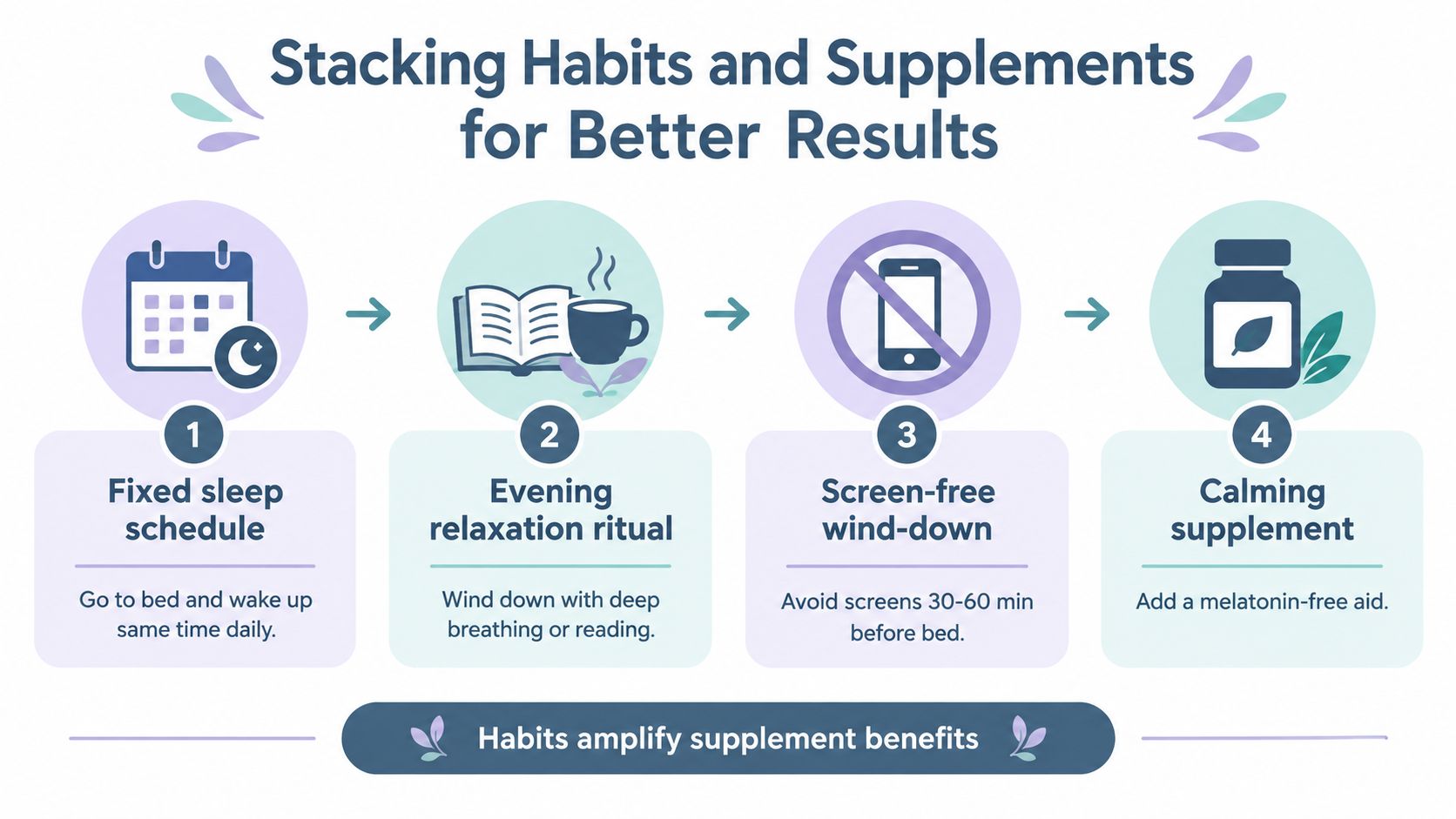
A practical routine might look like this: take a clearly labeled supplement during the wind-down, dim the room, put the phone away, and practice slow breathing before getting into bed. Many ingredients are used 30–60 minutes before sleep, but follow the product label and your clinician's advice rather than assuming timing is identical for every formula.
For more habit ideas, see this guide to a natural sleep quality boost and this resource on a nighttime routine for better sleep. If mouth breathing or snoring is part of your night, Hydrating Mouth Tape is described as supporting quieter nights, oral care, tongue posture, and nasal-breathing practices. Don't use mouth tape to conceal suspected sleep apnea or if nasal breathing is impaired.
How to Choose a High-Quality Melatonin-Free Product
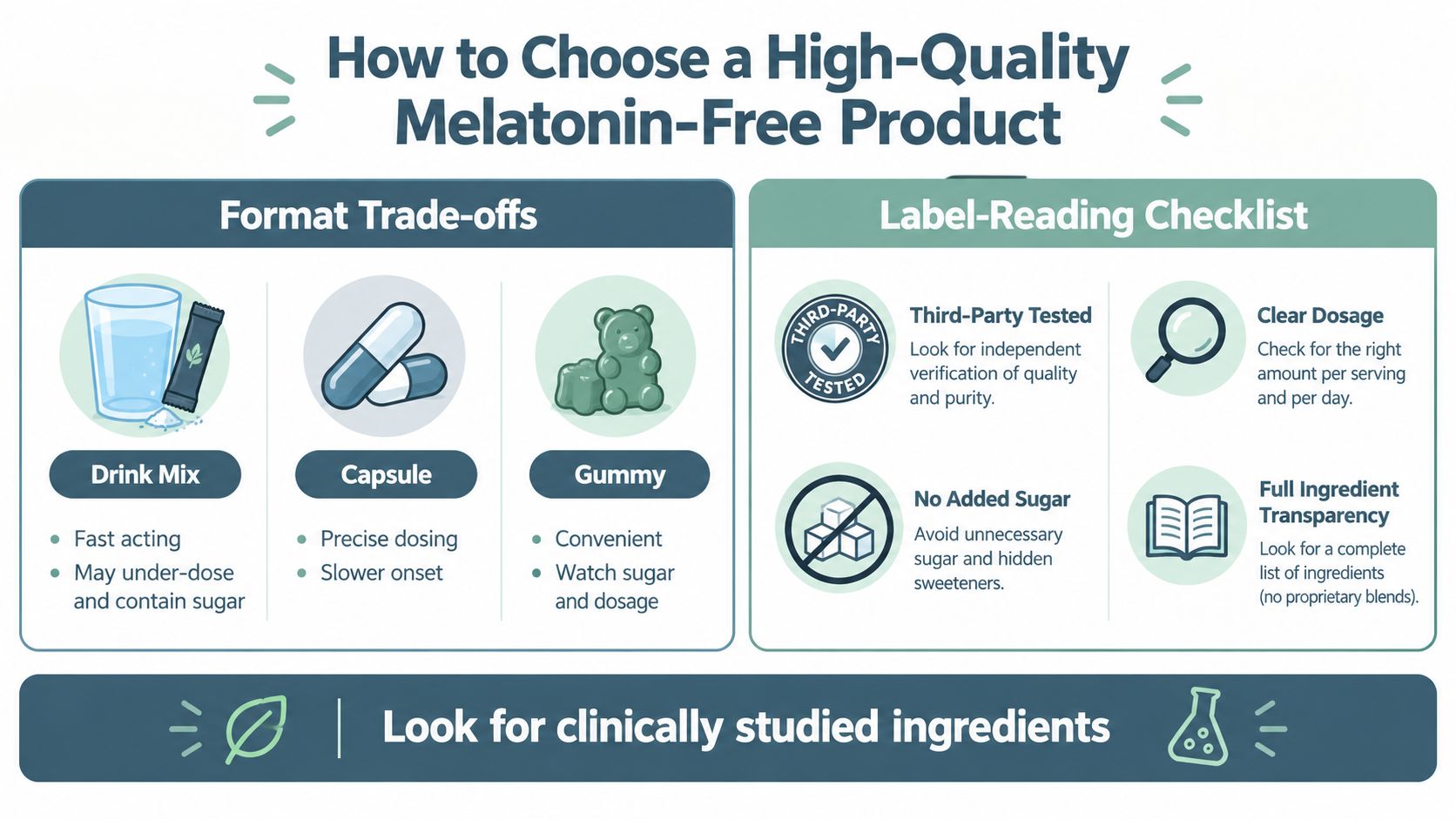
A trustworthy label should let you answer three questions quickly: What are the active ingredients, how much of each is included, and who tested the product? If the label hides amounts inside a proprietary “sleep blend,” you can't compare it with clinical research or tell whether the formula is meaningfully dosed.
Format changes the trade-offs:
- Drink mixes can fit naturally into a wind-down ritual, but they may contain sugar or provide less of an active ingredient than you expect.
- Capsules usually make precise dosing easier and often contain fewer extras, though they may feel less like a relaxing evening routine.
- Gummies are convenient, but check sweeteners, serving size, and the actual amount of each active ingredient.
Read the active dose, not the front label
Evidence-informed reference points often discussed in product evaluation include 200–400 mg of magnesium glycinate, 200 mg of L-theanine, 3 g of glycine, and 50 mg of apigenin. These figures come from the editorial framework for comparing products, but they aren't universal prescriptions, and the verified evidence above is stronger for some ingredients and doses than others. In particular, the cited L-theanine review supports 200–450 mg per day, while the magnesium and glycine trial used 250 mg elemental magnesium daily.
Look for third-party testing through certifications such as USP, NSF, or Informed Sport when available. Also check whether the formula clearly states the form of magnesium, distinguishes elemental magnesium from the compound weight, and lists every ingredient rather than using vague blends.
Use this quick label checklist
- Confirm the formula: Verify that the product is melatonin-free and lists all active ingredients.
- Check the dose: Compare the amount per serving with the relevant human research, not just the ingredient name.
- Avoid hidden blends: Reject labels that conceal individual amounts behind a proprietary formula.
- Review extras: Watch for unnecessary sugar, stimulant-like additives, and ingredients that could conflict with your medications.
- Look for testing: Prefer credible third-party verification when the manufacturer provides it.
- Check your needs: A relaxing formula isn't automatically suitable for repeated breathing problems or unexplained daytime exhaustion.
Product quality doesn't guarantee a result. It gives you a fairer test, because you'll know what you took and can track what changed.
Your Simple Plan for Picking and Using a Melatonin-Free Sleep Aid
Use this five-step process rather than shopping by promise.
- Name the pattern. Decide whether you mainly struggle to fall asleep, wake during the night, or wake unrefreshed. Keep a brief sleep diary so one difficult night doesn't define your conclusion.
- Choose one target. For bedtime mental arousal, L-theanine or glycine may be reasonable options. For physical relaxation and selected maintenance problems, magnesium may fit better. Apigenin is another ingredient found in wind-down formulas, but its evidence is less established than the better-supported options discussed earlier.
- Inspect the label. Confirm the active dose, avoid proprietary blends, and look for third-party testing. Don't assume “natural” means accurately labeled or risk-free.
- Test consistently. Use the lowest appropriate dose on the label for a limited trial, and track sleep-onset time, wake count, and morning alertness. Stop or seek advice if you experience concerning effects, and don't combine multiple new products at once.
- Add one habit. Dim screens, keep the bedroom dark and quiet, set a consistent wake time, or practice slow-exhale breathing. Supplements support habits, but they can't replace evaluation for persistent insomnia, loud snoring, gasping, severe daytime sleepiness, or sleep problems that continue despite reasonable changes.
If sleep difficulty continues, a clinician can help assess insomnia, medication effects, mood, restless legs, breathing disorders, and other causes. The most effective melatonin-free approach is usually the one that matches the actual problem and gives you a clear way to judge whether it's helping.
SleepHabits offers melatonin-free sleep support such as Restore+, along with educational resources and nighttime breathing tools that can fit into a consistent wind-down routine. Visit SleepHabits to explore the options and choose a calmer, more problem-focused next step for your sleep.