

You're in bed with the lights low, your phone finally out of reach, and a melatonin gummy dissolving on your tongue. You expect a quiet night. Instead, you wake at 2 a.m. with tense shoulders, a busy mind, or the uneasy feeling that sleep never became restorative.
That experience doesn't automatically mean you chose the wrong dose. It may mean you chose the wrong physiological target. Sleep and recovery supplements work through different pathways. Some influence timing, others support relaxation, amino-acid balance, circulation, or the body's overnight repair environment.
The global market reflects how broad this category has become. One forecast estimates the sleep supplement market at USD 7.91 billion in 2026, with a projection of USD 13.38 billion by 2036, while another estimates US$8.74 billion in 2025 and projects US$17.96 billion by 2035. These are projections, not guarantees, but they show that consumers are looking beyond a single sleep ingredient. Future Market Insights also identifies melatonin as a leading ingredient, with 36.7% share in 2026 in its forecast.
Why Most People Reach for the Wrong Sleep Pill
The familiar bedtime experiment starts. You swallow melatonin because you want to fall asleep faster and stay asleep until morning. When you wake in the middle of the night, the first conclusion is often that the supplement “didn't work,” so the next step becomes a stronger gummy or a more crowded formula.
That conclusion skips an important distinction. Melatonin is primarily a timing signal, helping communicate when the body should prepare for sleep. It isn't a universal sedative, and it may not address muscle tension, racing thoughts, irregular breathing, or the physical fatigue that makes sleep feel shallow.
A person whose main problem is delayed sleep timing may respond differently from someone who becomes alert after waking at night. Someone recovering from hard training may care less about falling asleep instantly and more about relaxation, circulation, and overnight tissue repair. The same product can't be expected to solve every bottleneck.
Start with the problem, not the bottle
Think of supplements as tools in a small toolbox:
- Magnesium may fit a routine built around muscular relaxation and nervous-system support.
- Amino acids, including glycine and L-theanine, are often used when mental activation makes it hard to settle.
- Adaptogens are selected by people focused on stress resilience, although their effects and tolerability vary.
- Nitric-oxide support targets circulation and oxygen delivery, which may matter for people interested in both sleep and physical recovery.
- Melatonin-free blends can help readers avoid a timing hormone while combining several wind-down ingredients.
Hormonal factors can also complicate the picture. If sleep changes accompany other persistent symptoms, educational resources such as LifeWorks Shawnee root-cause testing may help you decide whether a broader health conversation is appropriate.
Practical rule: Before changing the dose, name the bottleneck. Is it timing, tension, mental alertness, overnight waking, breathing, or poor recovery?
The useful question isn't “Which sleep pill is strongest?” It's “Which system needs support first?” Once you understand that, a product label becomes easier to interpret and a smaller, more deliberate experiment becomes possible.
The Core Physiology Your Supplements Are Trying to Support
Your body needs more than one signal before it can produce stable, restorative sleep. A simple way to understand the process is to treat bedtime like a lights-out checklist. The nervous system must shift into rest mode, the brain must receive appropriate timing and calming signals, and the body must have the conditions needed for overnight repair.
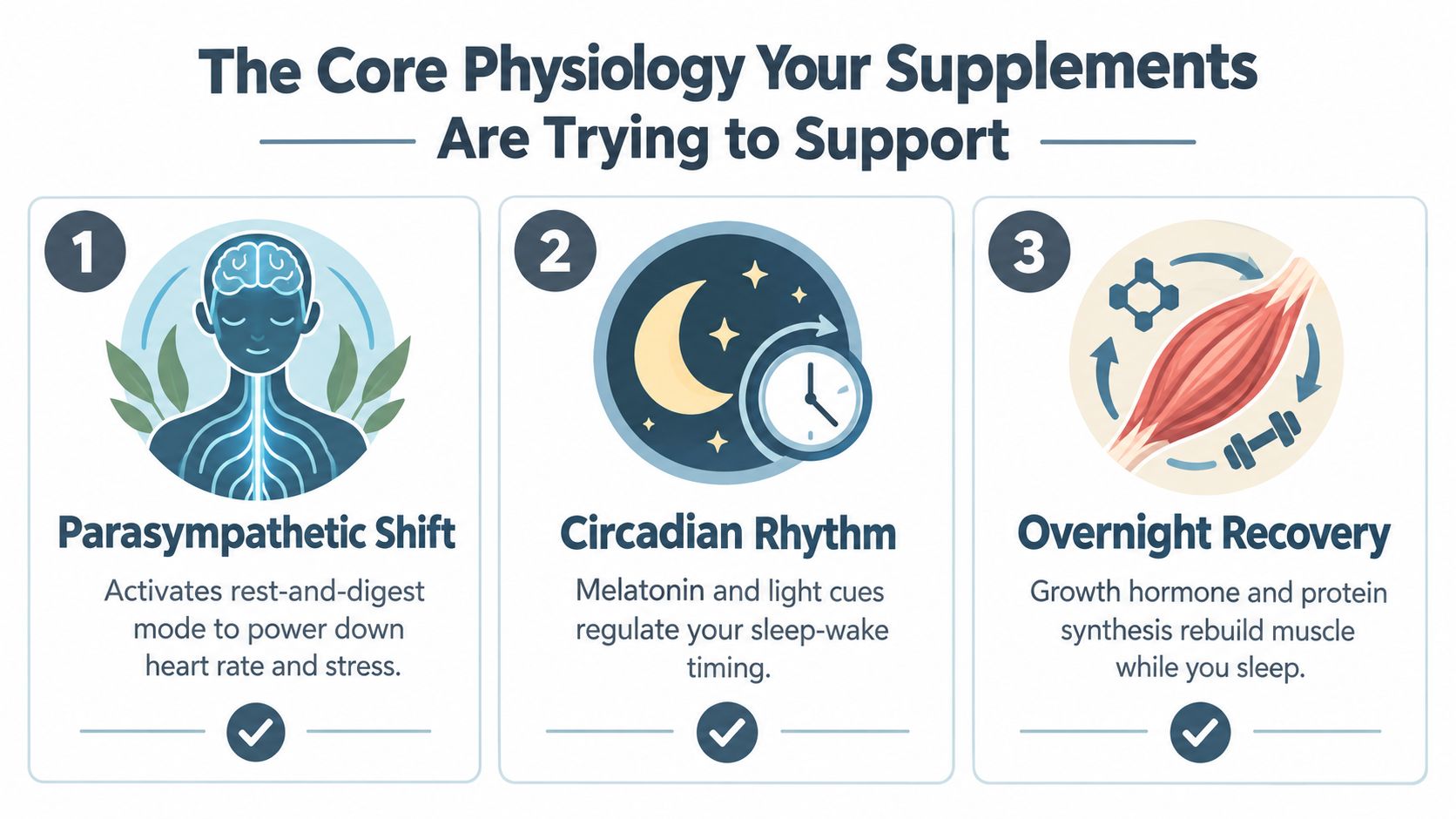
The first switch is parasympathetic
The parasympathetic nervous system supports rest and digestion. After a demanding day, your body may remain in a high-alert state even when you feel physically tired. A slower heart rate, easier breathing, relaxed muscles, and reduced mental urgency all help create the conditions for sleep.
Magnesium, L-theanine, glycine, and calming botanical ingredients are commonly placed in this part of the checklist. They aren't interchangeable, but they share a practical purpose: helping the transition away from constant alertness.
Timing and neurotransmitter balance come next
The circadian system uses light, darkness, and routine to organize sleep-wake timing. Melatonin belongs mainly to this timing pathway. GABA, serotonin, and cortisol also influence how quiet or activated the brain feels, although a supplement label can't tell you exactly which one is responsible for your personal sleep problem.
Late bright light, irregular schedules, stress, and stimulating habits can work against the same biological shift that a supplement is meant to support. If you're trying to understand whether stress physiology may be contributing to sleep disruption, a plain-language Repose Healthcare cortisol guide can provide useful background.
Recovery is more than sedation
Deep and REM sleep support processes connected with physical and mental recovery. Circulation, oxygen delivery, muscle relaxation, and protein availability all matter to the larger recovery picture. This is why nitric-oxide precursors, tart cherry, magnesium, amino acids, and protein-focused strategies appear in different sleep and recovery supplements.
A product such as Restore+ Magnesium Sleep Aid combines magnesium, L-theanine, tart cherry, lemon balm, glycine, and nitric-oxide-supporting ingredients in a melatonin-free evening drink. Its stated role is to support a wind-down routine, healthy circulation, oxygen delivery, and the body's natural rhythm, not to act as a guaranteed sedative.
The checklist helps explain why categories can complement one another. Magnesium may support relaxation, glycine may fit the amino-acid side of the routine, and nitric-oxide ingredients may address circulation. They target different links in the same chain.
The Major Supplement Categories Explained Side by Side
The category matters because each ingredient family aims at a different lever. A person with racing thoughts may need a different starting point from an athlete who sleeps through the night but wakes feeling physically under-recovered.
Exact “effective” dose ranges aren't established uniformly across all products or people. For that reason, the table below uses common label or research-oriented ranges as practical orientation, not promises of results. Check the elemental amount, extract standardization, and serving instructions rather than judging a formula by the number of ingredients.
| Category | Mechanism | Typical Dose Range | Best-Fit User | Key Caution |
|---|---|---|---|---|
| Magnesium salts and glycinate | Supports muscle relaxation and nervous-system regulation | Product and study amounts vary | People focused on tension, dietary gaps, or evening relaxation | Gastrointestinal effects and medication interactions are possible |
| Adaptogens such as ashwagandha and rhodiola | May influence stress-response signaling and perceived resilience | Extract-specific, so label ranges differ | People whose sleep is closely tied to stress | Can feel activating for some people and may interact with medicines |
| Nitric-oxide precursors such as beetroot and L-citrulline | Support pathways involved in nitric-oxide production and circulation | Formula-specific | Active adults interested in blood flow and recovery | Use caution with blood-pressure medicines |
| Amino acids including L-theanine, glycine, and GABA | Provide building blocks or signals associated with calm and sleep regulation | Ingredient-specific | People who struggle to quiet the mind or settle physically | Effects vary, and some combinations may cause next-day sluggishness |
| Melatonin alternatives such as tart cherry and tryptophan | Support sleep-related timing or precursor pathways without relying on supplemental melatonin | Product-specific | People seeking melatonin-free options | Tryptophan can interact with medicines affecting serotonin |
| Combined melatonin-free blends | Pair several pathways in one evening routine | Depends on the full formula | People who want a simplified routine | More ingredients make it harder to identify the active or poorly tolerated component |
A useful comparison is not “natural versus synthetic.” It's mechanism match versus mismatch. Melatonin may make sense for circadian timing, while glycine or L-theanine may be more relevant to mental settling. Nitric-oxide support may interest someone whose priority includes circulation and training recovery, while magnesium may be a more logical starting point for muscular tightness.
Read muscle recovery supplements alongside sleep guidance if training is part of your concern. Recovery isn't limited to soreness. It includes the ability to relax, restore energy, and return to normal function between demanding days.
Start with one category that matches your most obvious problem. Keep the rest of the routine stable long enough to notice a pattern, and ask a pharmacist or clinician about interactions if you take prescription medicines, have a chronic condition, or are pregnant.
What the Magnesium Evidence Actually Shows
Magnesium attracts attention because its possible role connects directly with sleep physiology. It supports nervous-system and muscle function, while proposed mechanisms include NMDA receptor modulation and support for GABA-related calming pathways. These pathways may help the body shift toward less stimulation, but biological plausibility does not make magnesium a universal sedative.
The clinical evidence remains mixed. A 2026 systematic review concluded that current research does not support oral magnesium as a routine insomnia treatment, although some people may report modest improvements in subjective sleep outcomes. The certainty of evidence was low or very low. The PubMed review also describes continuing research, including an 8-week UK trial involving people with magnesium deficiency and a trial examining magnesium citrate in healthy Saudi adults.
Earlier research gives a narrower picture. A 2021 systematic review identified 3 randomized controlled trials involving 151 participants. Pooled results showed sleep-onset latency improving by 17.36 minutes. Total sleep time increased by 16.06 minutes, but that change was not statistically significant. The authors rated the evidence low to very low quality. The systematic review in PMC supports treating these findings as preliminary rather than definitive.
What a newer trial adds
A 2025 randomized, double-blind, placebo-controlled trial included 155 adults with self-reported poor sleep quality. Participants received 250 mg elemental magnesium plus 1,523 mg glycine daily for 28 days. Their insomnia-severity scores fell by 3.9 points, compared with 2.3 points for placebo. The effect size was small, d = 0.2, and the largest improvements appeared during the first 14 days. The full trial report describes a modest difference, not a dramatic transformation.
Magnesium and glycine may therefore help some adults with mild insomnia symptoms, but the result does not show that taking progressively more magnesium produces proportionally deeper sleep. The formula also makes it difficult to assign the entire effect to magnesium alone.
Forms and practical selection
| Form | Elemental Mg % | Bioavailability | Best-Fit Use |
|---|---|---|---|
| Glycinate | Varies by product | Often selected for tolerability | Evening routines and people sensitive to digestive effects |
| Citrate | Varies by product | Generally well absorbed | People who also need a bowel-motility effect, if tolerated |
| Threonate | Varies by product | Marketed for brain-focused use, with product-specific evidence | People evaluating a specialized formulation cautiously |
| Oxide | Higher elemental proportion than some forms | Often less well tolerated or absorbed than preferred alternatives | Situations where a clinician specifically recommends it |
The elemental magnesium amount matters more than the compound name printed on the front of a package. Sleep products and trials may use around 250 to 500 mg, but a suitable amount depends on diet, kidney function, medications, and digestive tolerance. Glycinate is often chosen for evening use because it may feel gentler, while its attached glycine fits the broader relaxation rationale. That preference does not prove it is superior for everyone.
For a focused explanation of the research and practical considerations, see magnesium sleep quality. The National Center for Complementary and Integrative Health guidance says research on magnesium for insomnia is very limited and cites conflicting findings from a review of 9 studies involving 7,582 participants. Correcting a deficiency is a different aim from enhancing sleep when magnesium status is already adequate.
Building a Nighttime Routine That Compounds the Benefits
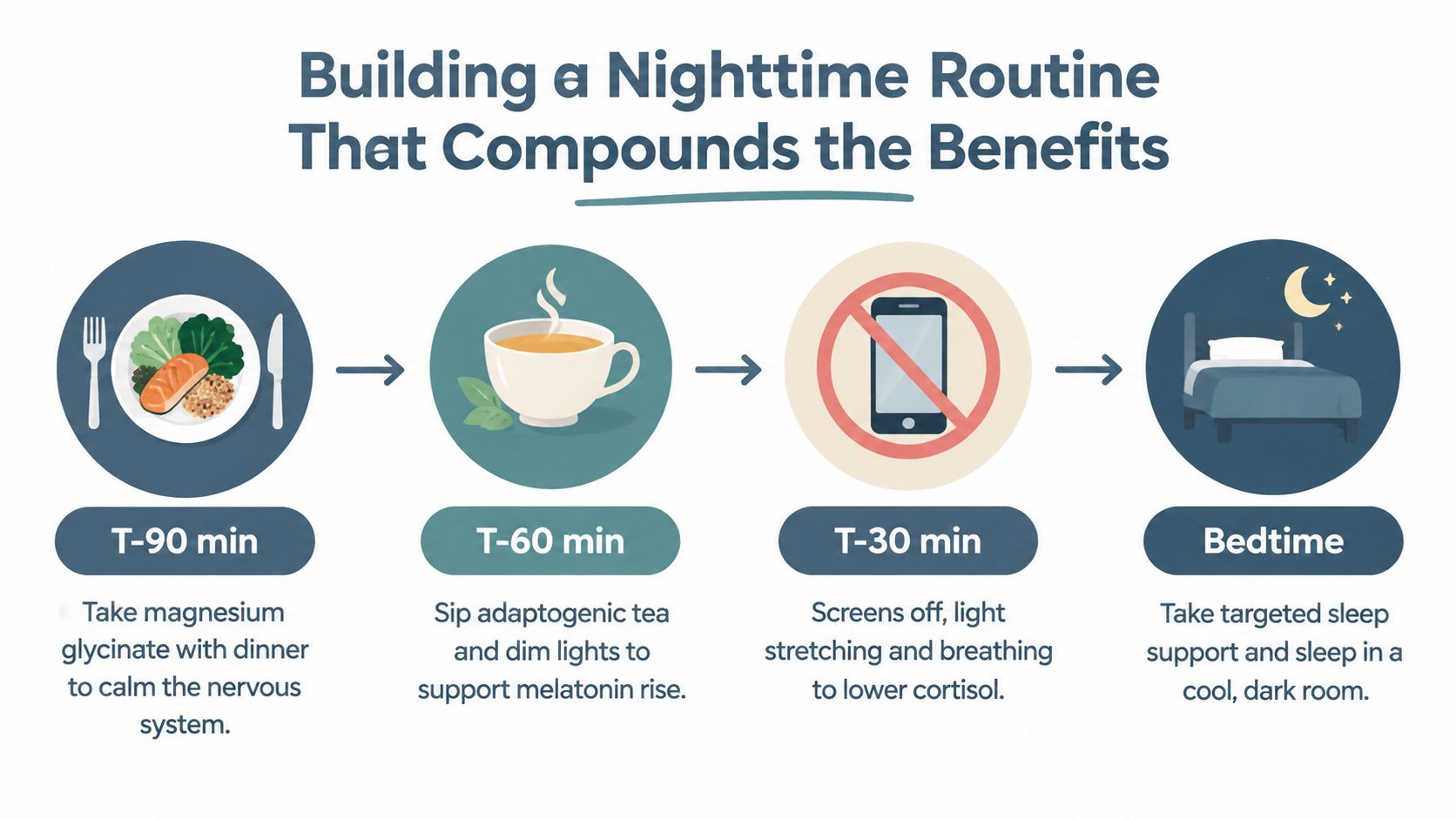
A supplement has a better chance of fitting your biology when bedtime follows recognizable signals. Instead of taking a product randomly, build a 60- to 90-minute wind-down that lowers stimulation in layers.
A workable evening sequence
- With dinner: If magnesium agrees with you, take a magnesium glycinate product with food rather than treating it like an emergency rescue pill.
- During the next hour: Dim overhead lighting, reduce demanding work, and use a quiet activity such as reading, light stretching, or journaling.
- About 30 minutes before bed: If you use an adaptogenic tea or blend, place it here and watch for activation rather than assuming “calming” applies to everyone.
- At lights-out: Reserve targeted amino acids such as glycine or L-theanine for the timing indicated on the label or by your clinician.
Your environment should repeat the same message. A cool, dark room, reduced screen exposure, and a predictable bedtime help the brain associate the sequence with sleep. For ideas involving scent and room atmosphere, Blushing Ivy Home Fragrance sleep tips can complement, but not replace, the core habits.
Add breathing carefully
Nasal breathing deserves attention because airway mechanics change during sleep. One study found upper-airway resistance was significantly lower with nasal breathing than oral breathing, while oral breathing was associated with a marked increase in obstructive sleep apnea severity. (European Respiratory Journal study)
In another sleep-monitoring study, changing from nasal to oral breathing reduced nasal flow signals by a mean of 83.7%, with p < 0.0001, showing how substantially mouth breathing can alter airflow detection. (PubMed airflow study)
If you're considering Hydrating Mouth Tape, don't use it to force the mouth closed when nasal breathing is difficult, congestion is present, or sleep apnea is suspected. Address airway concerns first. A nasal strip, gentle breathing practice, and professional evaluation may be more appropriate.
For a fuller habit sequence, see this guide to a nighttime routine for better sleep. The goal isn't perfect compliance. It's repeated cues that make the body anticipate rest, so supplement effects become easier to evaluate over time.
Common Mistakes and Misconceptions Worth Dropping
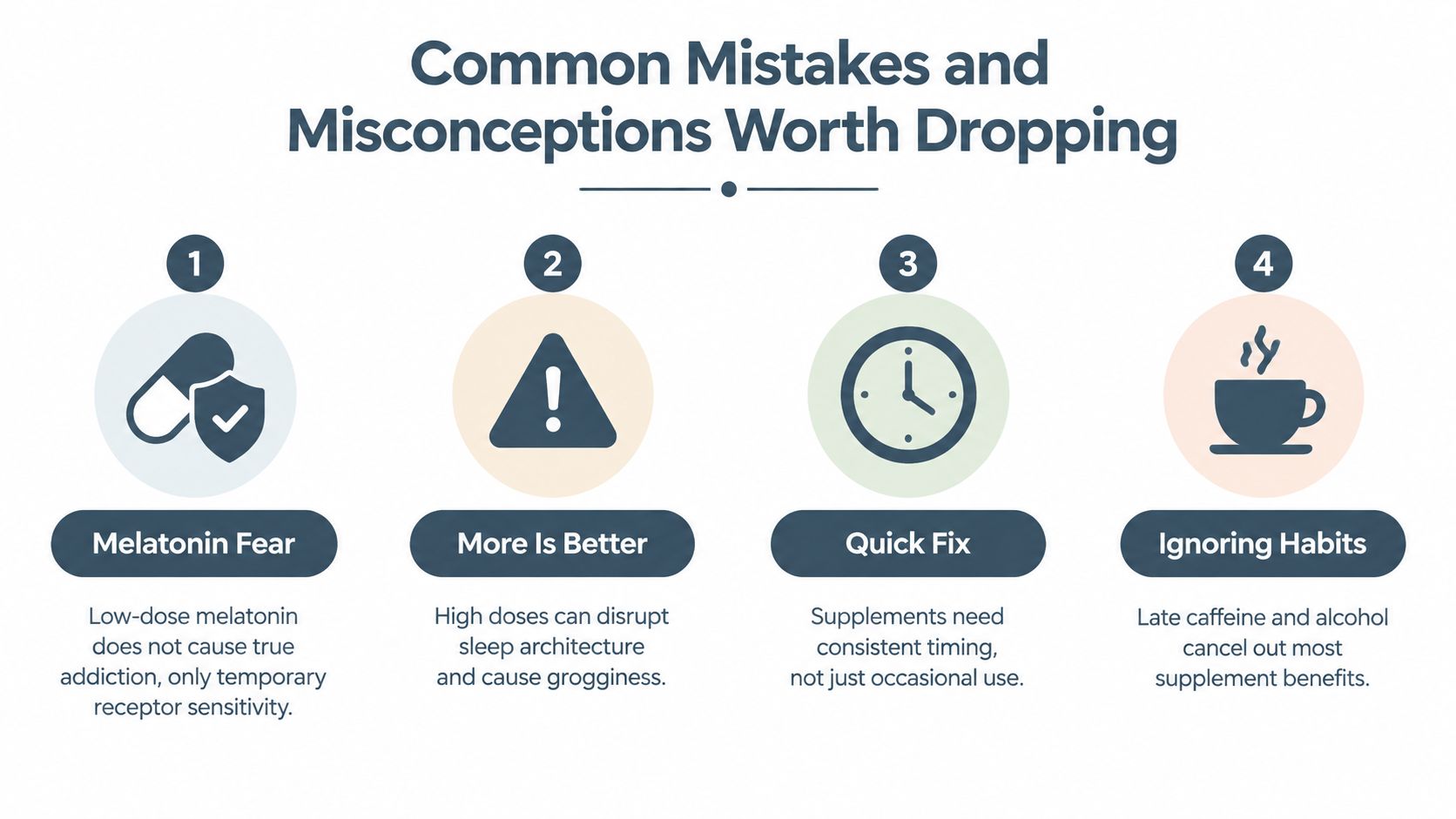
A supplement experiment becomes confusing when every assumption is treated as fact. The most useful correction is to separate dependency, tolerance, dose, and habit. They're related concepts, but they aren't the same thing.
Melatonin isn't the same as addiction
Melatonin doesn't produce true addiction in the way people commonly fear. Short-term use may be reasonable for some timing-related situations, but it can still cause unwanted effects, including vivid dreams or morning grogginess. If your primary issue is tension, stress, or physical recovery, a melatonin-free approach may fit better because it targets a different problem.
More magnesium isn't automatically better
Mega-doses don't guarantee better sleep. Different magnesium forms also don't behave identically, and a higher elemental amount may increase digestive problems without adding a meaningful benefit. Use the smallest amount that fits your situation, and account for kidney disease and medication interactions.
Stacking hides the answer
Adding valerian, apigenin, 5-HTP, magnesium, glycine, and an adaptogen at the same time may look thorough, but it removes your ability to identify what helped or caused side effects. L-theanine may require caution with blood-pressure medication, and glycine may interact with certain anticonvulsants. Ask a healthcare professional before combining supplements with prescriptions.
A clean experiment is more informative than a crowded formula.
Late caffeine, alcohol, irregular schedules, untreated pain, and breathing problems can overwhelm a carefully chosen supplement. Treat sleep and recovery supplements as one variable, not the centerpiece of a problem that may need behavioral, medical, or environmental attention.
Choosing the Right Stack for Your Sleep Problem
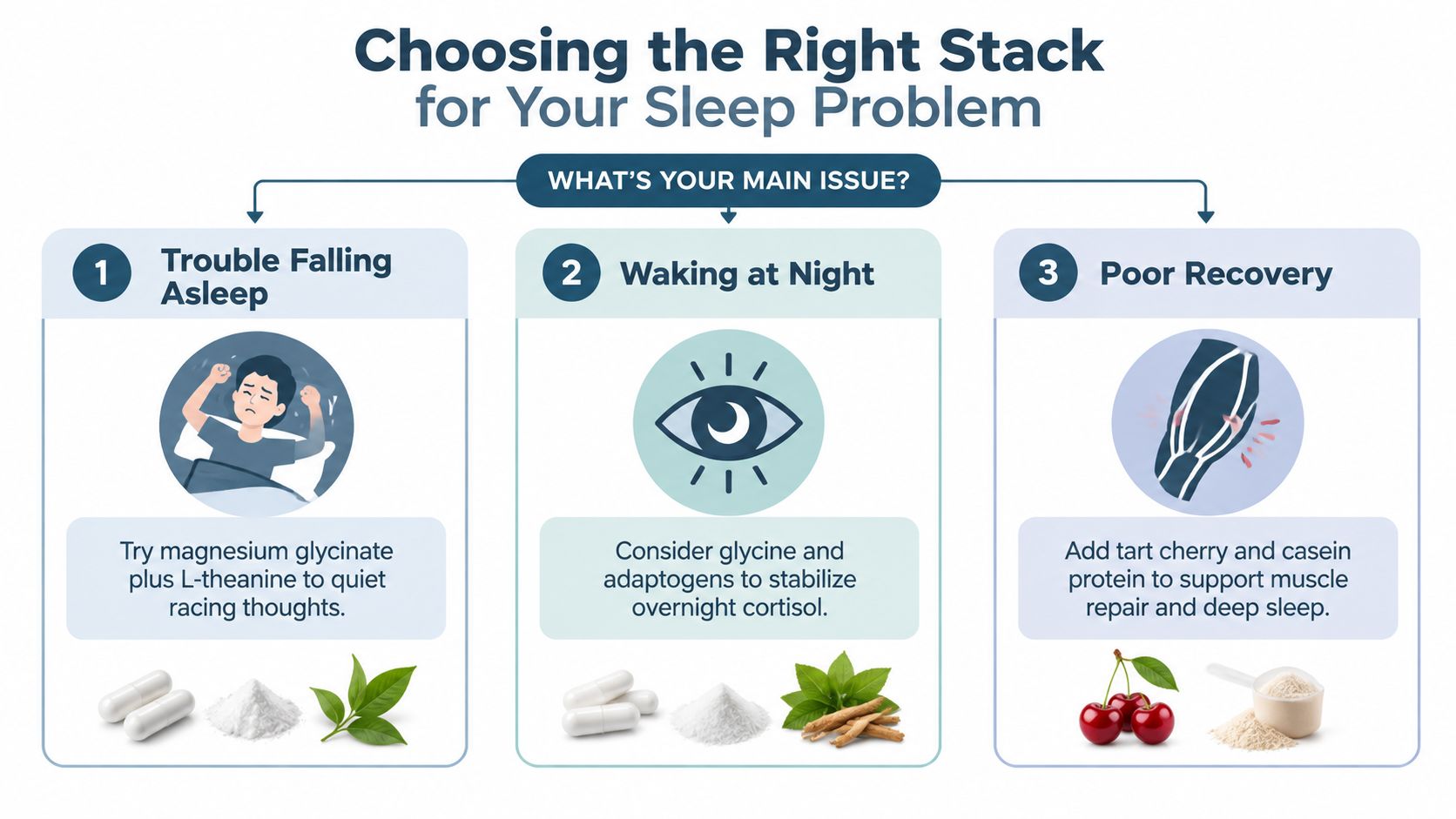
A practical shortlist starts with three questions. Your answer doesn't diagnose the cause, but it helps identify which physiological lever deserves attention first.
If falling asleep takes too long
Start by examining mental activation and the parasympathetic shift. A modest routine built around magnesium glycinate and L-theanine may make more sense than immediately adding several timing agents. Glycine can also fit an evening strategy for people who want amino-acid support, provided it's appropriate for their health situation and medications.
If you wake during the night
Look at the full pattern rather than assuming the supplement caused the waking. Magnesium glycinate and L-theanine may suit a relaxation-focused routine, while glycine or an adaptogenic formula may be considered when stress appears to shape overnight alertness. Snoring, gasping, or persistent mouth breathing deserves medical attention rather than a larger supplement stack.
If you wake groggy or under-recovered
Think beyond sedation. Nitric-oxide-supporting ingredients, tart cherry, or an adaptogen may appeal to active adults focused on circulation, stress resilience, and recovery, while protein intake and training load may matter just as much. Avoid treating morning fatigue as proof that you need a stronger sleep aid.
Use a sensitivity filter before choosing:
- Stimulant-sensitive: Be cautious with products containing activating botanicals or stimulating add-ons.
- Pregnancy: Discuss every supplement with a qualified clinician.
- Gut issues: Consider form, serving size, sweeteners, and the possibility of laxative effects.
- Blood-pressure medication: Ask about L-theanine, nitric-oxide-supporting ingredients, and adaptogens before use.
Choose products using four filters: mechanism match, transparent dosing, third-party testing, and a melatonin-free formulation when timing support isn't your priority. The best stack is usually the smallest one that addresses the specific bottleneck without adding ingredients you don't need.
SleepHabits offers melatonin-free options that combine evening wind-down support with tools focused on nasal breathing and restorative sleep. Visit SleepHabits to compare sleep and recovery supplements, explore breathing products, and build a more deliberate nighttime routine around the problem you're trying to solve.