

You wake after a short night, silence the alarm, and promise yourself that coffee will carry you through. By midmorning, your reactions feel slightly slower. By afternoon, you're reaching for convenient food, losing patience, and wondering why a routine task requires so much effort. If this has happened for several nights, the problem isn't only tiredness. The sleep deprivation effects on body can involve the brain, heart, metabolism, immune defenses, and the breathing-dependent recovery that should happen overnight.
Why a Rough Night Echoes Across the Whole Body
After about six hours of sleep for three consecutive nights, someone may still reach work, answer messages, exercise, and drive home. The outside picture can look ordinary. Inside, the body has had less time to regulate the nervous system, control metabolism, coordinate immune activity, and complete overnight repair.
Short sleep is common, not a personal failure. CDC data report that about one-third of U.S. adults have short sleep duration. In the same analysis, 35.3% of adults in 12 states reported sleeping fewer than 7 hours in a typical 24-hour period, while 8% usually slept fewer than 6 hours. Obesity prevalence was 33% among adults sleeping fewer than 6 hours, compared with 22% among adults sleeping 7 to 8 hours. These figures describe an association, not proof that short sleep alone causes obesity. Work schedules, stress, diet, illness, and other factors can affect both sleep and weight. CDC data on sleep duration and health
Sleep is a coordinated overnight service period, not an isolated brain event. Breathing, blood pressure, hormones, appetite signals, immune activity, and brain function influence one another. If sleep is repeatedly shortened or fragmented, the body loses part of its regular reset. Breathing sits at the center of that process because oxygen and carbon dioxide exchange must remain steady while repair and regulation continue.
Practical rule: Treat several short nights as a physiological problem to correct, not merely an uncomfortable mood.
A rough night can therefore reach systems that seem unrelated to sleep. Disrupted airflow may trigger repeated alerts from the nervous system, while stable breathing gives the heart, blood vessels, and brain quieter conditions for recovery. The result may be changes in alertness, appetite, blood pressure, and immune regulation, even when a person feels capable of completing normal tasks.
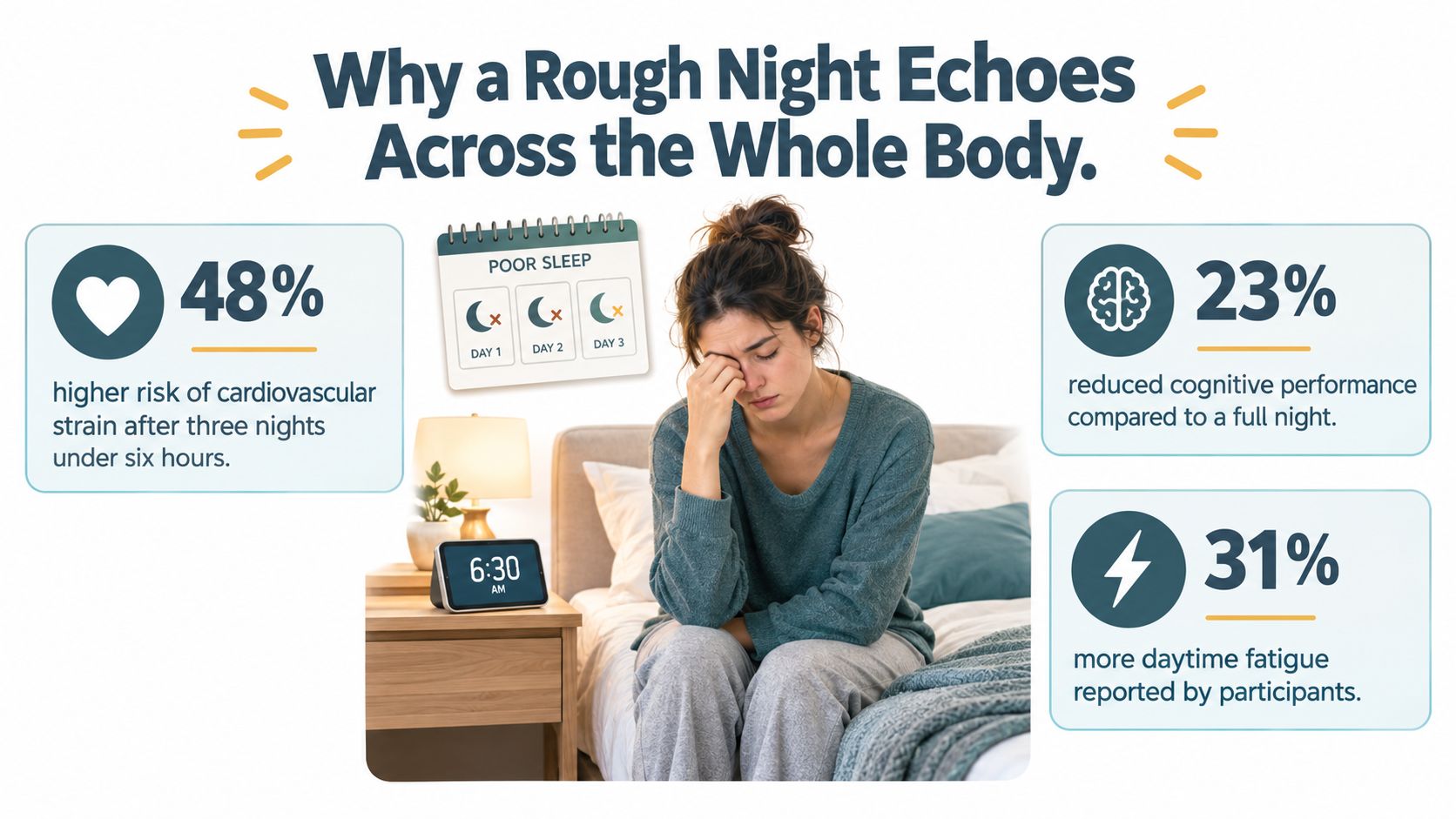
The main point is simple: a rough night changes how the body regulates itself. Repeated rough nights give those changes more time to persist. Individual impressions, such as "I feel fine," provide limited information. Objective markers, including sleep duration, breathing stability, blood pressure patterns, and daytime function, show more clearly whether overnight recovery is taking place.
How Sleep Loss Disrupts Your Physiology
Healthy sleep functions like scheduled maintenance, not an off switch. During the night, the brain reduces some alerting activity, blood pressure follows a quieter rhythm, hormones change timing, appetite signals are recalibrated, and immune processes continue. Stable breathing supports this shift. Repeated airflow disruption can interrupt it by sending the nervous system back toward an emergency response.
Sleep loss breaks that coordination through several connected pathways.
The nervous system stays closer to high alert
The sympathetic nervous system helps you respond to demands, from solving a problem to escaping danger. With insufficient sleep, evidence reviews describe increased sympathetic activity and high or poorly timed cortisol, leaving the body prepared for action even while you are sitting still. Review of sleep loss, cardiometabolic pathways, and immunity
The pattern resembles a phone with its screen off while demanding apps continue running. It appears inactive, but its battery keeps draining. Sleep loss can create a similar hidden workload: breathing, heart rate, blood pressure, and digestion receive less time to settle into their overnight recovery pattern.
Hormonal timing becomes less coordinated
Sleep loss is associated with reduced growth-hormone signaling, while cortisol may remain high or arrive at the wrong time. These hormones help coordinate tissue repair, energy use, and the stress response. If their timing becomes less orderly, the body may complete less of its overnight maintenance.
Sleep is therefore active biological time. This guide to what happens to your body during sleep explains the normal sequence in more detail. Breathing stability matters because repeated arousals can cut that sequence into separate, less restorative periods.
Blood vessels and immune signals respond
The same review also describes endothelial dysfunction, meaning that the inner lining of blood vessels regulates circulation less effectively. Sleep loss is linked with inflammatory activation and changes in leptin and ghrelin signaling, which can contribute to stronger hunger and greater caloric intake. That combination helps explain why inadequate sleep may leave someone physiologically tense while increasing interest in energy-dense food.
The immune system operates within this same network. Insufficient sleep can reduce host defense and weaken responses to vaccination. Breathing interruptions add strain by repeatedly pulling the body out of a stable recovery state, so the issue is not only how long someone is in bed but also how continuously they can breathe and remain asleep.
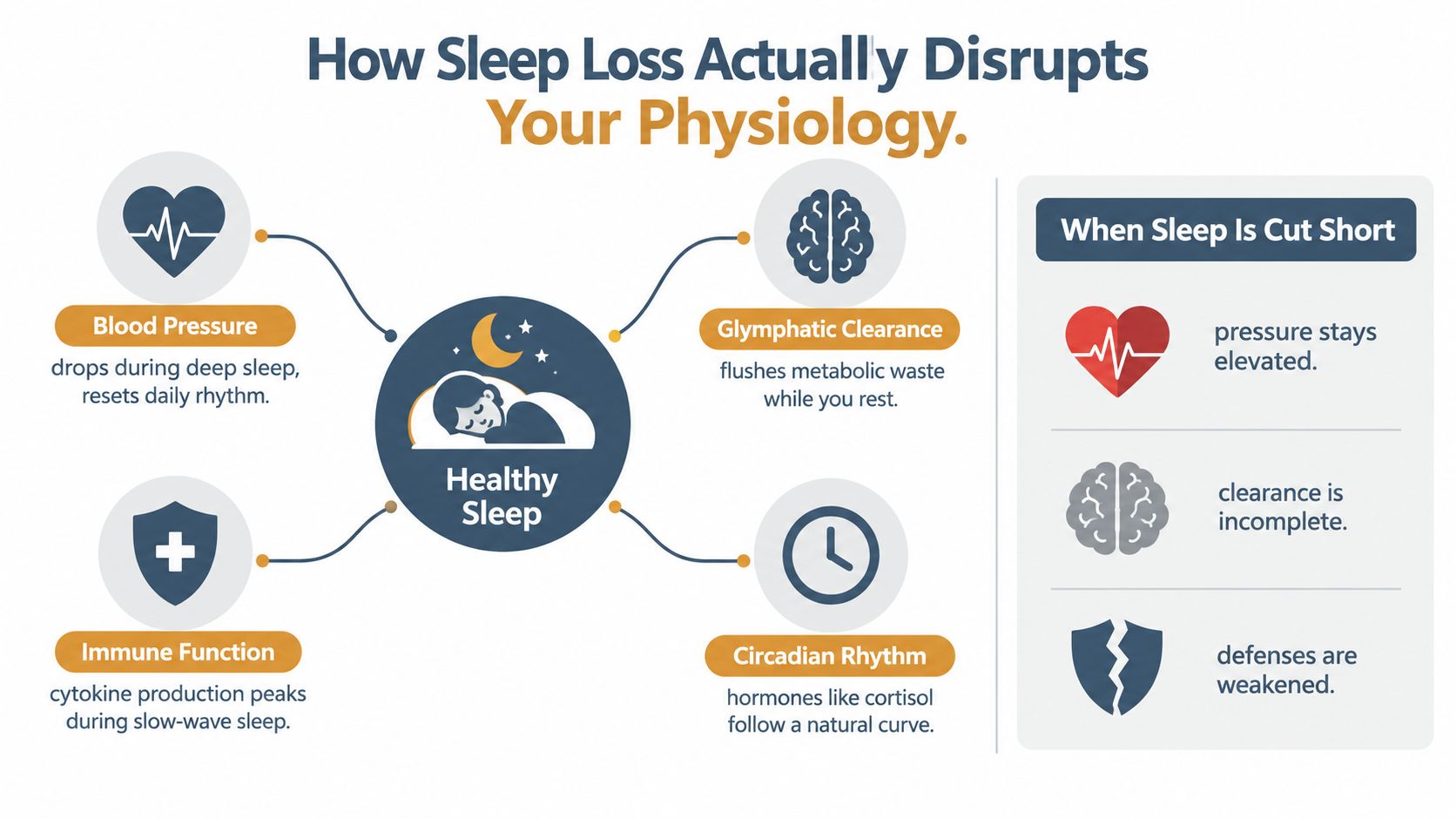
A racing mind, stronger appetite, slower reactions, and persistent soreness can seem unrelated. They may reflect one body-wide problem: overnight regulation was repeatedly interrupted before breathing, hormones, circulation, and immune activity could complete their recovery work. Feelings provide clues, but sleep duration, breathing stability, blood pressure patterns, and daytime function offer clearer markers of whether recovery occurred.
The Brain, Heart, Metabolism, and Immune System Under Sleep Pressure
Sleep pressure doesn't affect every person or every task in exactly the same way, but the major systems show recognizable patterns. The useful question isn't only, “How tired do I feel?” It's also, “What task is becoming less reliable?”
Brain and cognitive control
The brain often shows the earliest practical signs. Reaction time slows, attention becomes less stable, and working memory has less capacity for holding information in mind. A 2024 meta-analysis found that sleep deprivation significantly reduced inhibitory control, the ability to stop an inappropriate response or halt an ongoing action. The effect was Hedges' g = 0.481, with a 95% confidence interval of 0.361 to 0.600 and p < .001. Results were similar for the Go/No-Go task, g = 0.475, and the Stop-Signal task, g = 0.482. 2024 meta-analysis of sleep deprivation and inhibitory control
In ordinary life, weaker inhibition can mean sending an impulsive message, taking a risky turn, or failing to stop a process when conditions change. For a deeper explanation of deep sleep, see what slow-wave sleep does.
Use it today: If you're making unusually simple mistakes or reacting late, postpone complex decisions rather than trusting motivation to compensate.
Heart and blood vessels
Sleep loss can keep the cardiovascular system closer to a stress-ready state. Increased sympathetic activity, cortisol changes, inflammation, and endothelial dysfunction can affect blood pressure regulation and vascular function. Over time, persistent short or fragmented sleep deserves the same practical attention as other cardiovascular risk factors, including checking blood pressure and discussing concerning results with a clinician.
Notice this signal: A pattern of raised readings, palpitations, or unusual exertional strain deserves evaluation, especially when it accompanies loud snoring or disrupted breathing.
Metabolism and appetite
Sleep loss can alter leptin and ghrelin signaling, making hunger stronger and caloric intake higher. The body may also respond less effectively to insulin, which affects how glucose moves from the bloodstream into cells. These changes can turn a late afternoon of fatigue into repeated snacking, reduced movement, and a longer-term shift in weight trajectory.
Try this interpretation: Don't treat intense evening cravings as a simple discipline problem. Check whether several short nights or fragmented breathing preceded them.
Immune defense and recovery
Insufficient sleep can reduce host defense and weaken responses to vaccination. It also affects the conditions in which physical recovery occurs, including the regulation of inflammation and overnight repair. If you're training, persistent sleep loss may show up as slower recovery, greater perceived soreness, or declining performance even when the training plan hasn't changed.
Track the pattern: Record sleep opportunity, morning energy, soreness, and repeated infections together. A cluster is more informative than one difficult morning.
Why Some People Seem Fine on Little Sleep
One person sleeps poorly and struggles to focus the next day. Another says, “I'm fine on five hours.” Both may be telling the truth about how they feel, but neither feeling alone proves that performance and physiology are intact.
A 2025 review emphasizes that cognitive effects cannot be reduced to one global decline. Different cognitive domains depend on sleep processes differently, and individual variability is substantial. Attention and working memory often show some of the largest impairments, while another task may show a smaller measurable change in the same person. 2025 review of individual variability in cognitive responses to sleep loss
Why resilience can be misleading
Your response depends partly on circadian timing, previous sleep history, and the type of task you're performing. A familiar desk task may feel manageable while sustained attention during a night drive deteriorates. Someone may also become accustomed to the sensation of tiredness without recovering the reaction speed, judgment, or working memory they had with adequate sleep.
Coffee can make you feel more alert without repairing the underlying sleep debt. Confidence can rise while lane control, stopping decisions, or attention to changing conditions declines. That gap between subjective confidence and objective performance is especially important for drivers, shift workers, parents, athletes, and people operating machinery.

Use observable markers instead of asking only whether you feel sleepy:
- Reaction changes: You take longer to respond to a question, warning, or road event.
- Attention lapses: You reread the same paragraph or miss part of a conversation.
- Riskier choices: You accept a shortcut or maneuver you'd normally reject.
- Poorer control: You drift in a lane, fumble equipment, or make preventable errors.
- Mood volatility: Small frustrations produce a larger response than usual.
Feeling adapted to short sleep is not the same as being protected from its effects.
The safest personal rule is task-specific. If the task depends on rapid decisions, sustained attention, or precise motor control, objective warning signs matter more than the claim that you've “always functioned this way.”
The Truth About Catch-Up Sleep on Weekends
Weekend sleep can restore some alertness, yet recovery does not happen evenly across the body. Breathing and overnight recovery provide the foundation: if short sleep continues or airway disruption repeatedly causes arousals, a longer sleep window may improve how awake you feel without fully normalizing metabolism, hormones, or cardiovascular regulation.
In NIH-reported research, adults restricted to about five hours of sleep nightly gained roughly 3 pounds. After weekend recovery, they returned to restricted sleep, and insulin sensitivity still declined by 9% to 27% across whole-body, liver, and muscle measures. The longer sleep period did not erase the metabolic disruption once short sleep resumed. NIH report on weekend catch-up sleep and metabolic effects
A 2024 study offers a useful distinction. Recovery sleep taken at the earliest available opportunity, rather than postponed until the weekend, may reduce accumulated vigilance impairment after repeated short nights. That finding supports earlier recovery for attention, while leaving other systems in need of several consistent nights. Timing matters because the brain may regain alertness before breathing stability and metabolic regulation have caught up.
| Effect of Sleep Loss | Recovery Speed | What Actually Helps |
|---|---|---|
| Alertness and vigilance | May improve sooner when sleep begins at the earliest opportunity | Sleep as soon as practical, then protect additional nights |
| Appetite and eating regulation | May remain unsettled when short sleep resumes | Keep a consistent sleep opportunity instead of relying on one long night |
| Insulin sensitivity | May not fully recover through weekend sleep alone | Avoid repeated short nights and discuss metabolic concerns clinically |
| Cardiovascular and hormonal regulation | Depends on the pattern and underlying cause | Maintain regular sleep and investigate persistent disruption |
| Breathing-related arousals | Will continue if airway disruption persists | Seek evaluation for loud snoring, witnessed pauses, or unrefreshing sleep |
The National Heart, Lung, and Blood Institute reports that losing only 1 to 2 hours of sleep per night for several nights can impair daytime functioning as severely as going without sleep for one or two full days. NHLBI guidance on sleep deprivation health effects
A longer night can help tonight. Waiting several days can leave breathing, attention, and recovery systems under strain throughout the week.
If you can sleep longer tonight, don't postpone recovery until the weekend.
Natural Ways to Rebuild Restorative Sleep
A better night begins before you get into bed. Set up conditions that let breathing, nervous-system regulation, and circadian timing work together. One habit cannot correct a persistent sleep disorder, but a repeatable routine can remove avoidable disruption and reveal whether symptoms improve.
Begin with airflow and breathing
Nasal breathing filters and humidifies incoming air while supporting steadier airflow as you fall asleep. If congestion or a narrow nasal passage pushes you toward mouth breathing, a nasal strip can be a practical, non-drug option to test. Avoid mouth tape if you have unexplained breathing problems, major nasal obstruction, or suspected sleep apnea unless a qualified professional advises you.
Try several minutes of slow nasal breathing before bed, with your shoulders relaxed. The exercise gives your nervous system a gradual transition from daytime stimulation to sleep. It does not diagnose or treat an airway disorder, so loud snoring, witnessed pauses, or repeated gasping still warrant clinical assessment.
Anchor light and timing
Morning light strengthens the body's wake signal. Dimmer light in the evening reduces stimulation and makes the shift toward sleep easier. Keep your wake time reasonably consistent, including days off, because large schedule changes can delay sleep the following night.
Because accumulated loss affects daytime function, anchor your wake time first and let bedtime follow. A stable wake time protects sleep opportunity across the week more reliably than relying on an occasional long lie-in.
Reduce the evening load
Use a short wind-down routine that lowers stimulation from several directions:
- Light exposure: Dim screens and bright room lighting before bed.
- Caffeine timing: Avoid late caffeine that masks growing sleep pressure.
- Food timing: Finish heavy meals early enough to limit reflux or digestive discomfort.
- Stress discharge: Write down unfinished tasks, then try slow breathing or gentle stretching.
- Room comfort: Keep the bedroom cool, dark, and quiet enough for uninterrupted rest.
Sleep disruption can also have a hormonal component. Information about hormonal insomnia solutions may offer context, but persistent symptoms still deserve appropriate clinical support.
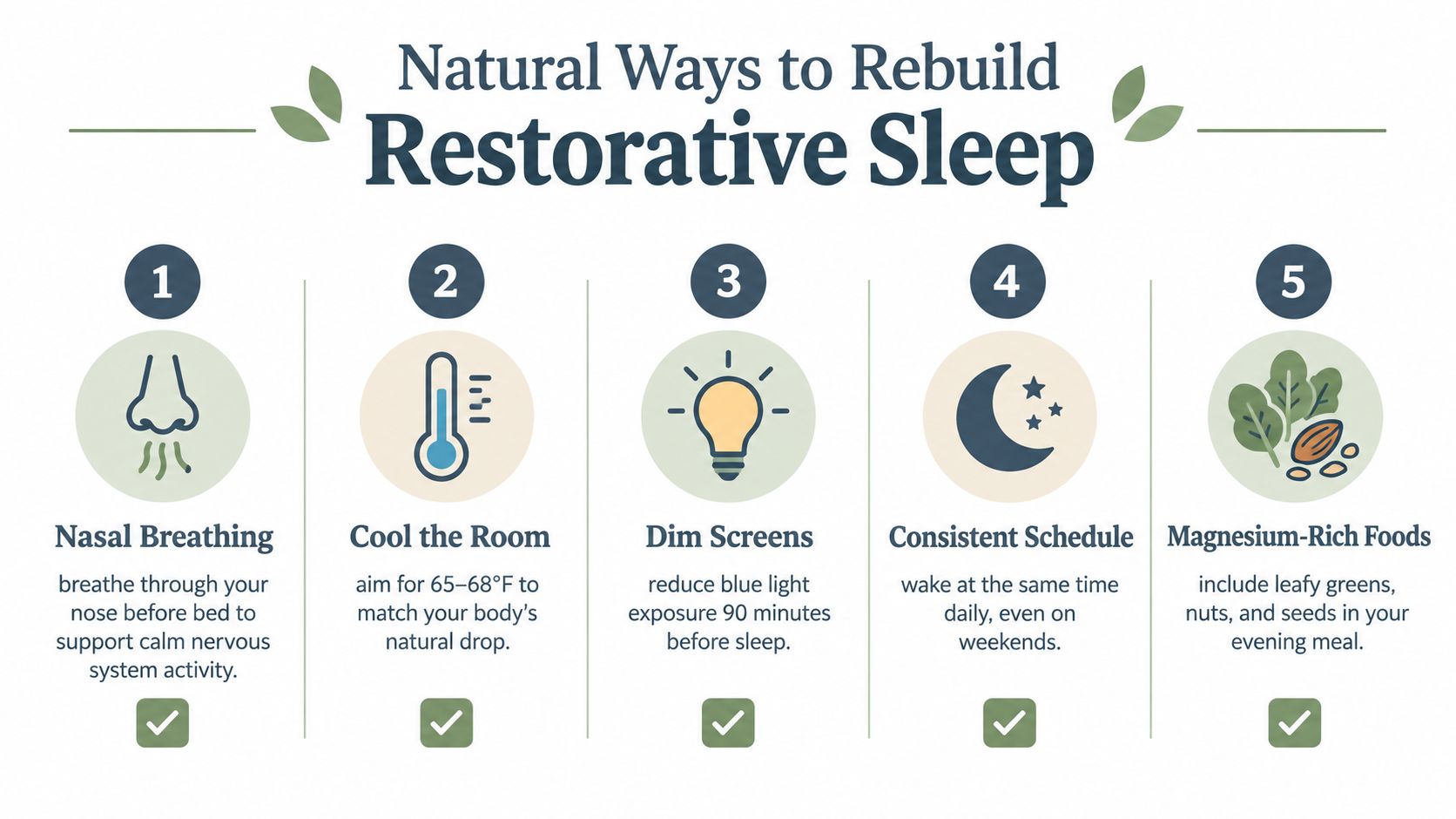
Leafy greens, nuts, and seeds provide magnesium within an evening meal. Magnesium supplements, nitric oxide products, nasal strips, and similar tools should supplement a routine, not replace evaluation for snoring, apnea, persistent insomnia, or major daytime impairment. Restore+ Sleep Aid is described as a melatonin-free product intended to support nitric oxide production, nervous-system regulation, and overnight oxygen delivery.
Read this plain-language guide to what restorative sleep means to understand how overnight recovery depends on more than being unconscious.
The aim is a routine you can repeat. That consistency gives breathing, the nervous system, hormones, and immune defenses enough uninterrupted time to carry out their overnight work.
Driving, Safety, and When to Ask for Help
Sleep loss becomes an immediate hazard when you're driving or operating equipment. The European Road Safety Observatory reports that driving after 17 hours awake produces impairment comparable to a blood-alcohol concentration of 0.05%, while 24 hours without sleep produces impairment comparable to an illegal BAC of 0.10 g/L. European Road Safety Observatory information on fatigue and driving
If you've worked overnight or stayed awake for a prolonged period, don't drive just because you haven't consumed alcohol. Arrange a ride, use public transportation, or sleep before driving. A broader discussion of insomnia causes and sleep solutions may help you identify habits that deserve attention, but it can't replace medical evaluation when symptoms persist.
Ask a clinician about ongoing sleep problems alongside high blood pressure, rising fasting glucose or HbA1c, unexplained weight changes, frequent infections, loud snoring, or witnessed breathing pauses. Persistent unrefreshing sleep can indicate sleep-disordered breathing or another condition that lifestyle changes alone won't resolve.
SleepHabits offers education and melatonin-free sleep tools focused on nighttime breathing, nasal airflow, and restorative overnight recovery. Visit SleepHabits to explore practical options and build a consistent routine that supports safer, more restorative sleep.