

You go to bed exhausted, fall asleep, and expect the night to restore you. Instead, you shift positions, wake with a dry mouth, notice the clock more than once, and open your eyes in the morning feeling as though sleep happened to someone else. You may remember only a few awakenings, but your body can interrupt sleep without bringing you fully to consciousness.
Understanding what causes restless sleep starts with looking beyond a busy mind. Stress can contribute, but restless sleep often reflects a physical disruption in breathing, movement, body temperature, pain signals, or sleep timing. Once you identify the mechanism, you can choose a more useful response than trying harder to relax.
Understanding the Mechanics of Restless Sleep
Maya notices the problem on a typical workday. She spends enough time in bed, but her partner says she moves constantly. She wakes briefly after a snore, turns over, and falls back asleep without remembering it the next morning. Her mind isn't racing when she goes to bed, yet she still feels foggy and unrefreshed.
That pattern illustrates an important distinction. Restlessness isn't always difficulty falling asleep. It can be repeated disruption after sleep has already begun. Your brain moves through different sleep stages, and deep, continuous periods help support physical recovery, memory processing, and emotional regulation. When something repeatedly triggers an arousal, the brain may shift toward lighter sleep before returning to the cycle.
Fragmented sleep versus a busy mind
Think of sleep as a long train journey. A busy mind may delay the departure, because thoughts keep you from settling. Fragmented sleep is different. The train leaves, but the brakes engage repeatedly because something keeps interrupting the route. You might not step off the train, but you won't travel smoothly through the full journey.
Those interruptions can come from breathing pauses, leg sensations, jaw clenching, pain, noise, light, or the need to urinate. The result may feel like tossing and turning, vivid dreams, frequent position changes, or waking too early. The visible movement is the symptom. The underlying trigger deserves attention.
Population research suggests that insomnia symptoms are widespread. About 30% of adults worldwide report at least one symptom such as difficulty falling asleep, staying asleep, or waking too early, while prevalence falls to about 6% when stricter diagnostic criteria are used, according to this review of insomnia and related sleep disorders. That difference matters because disrupted sleep can be common even when a person doesn't meet the criteria for a formal disorder.
Practical distinction: If your mind won't settle, look at arousal and routine. If your body keeps jolting, moving, snoring, clenching, or waking, investigate physical fragmentation too.
Why the distinction changes the solution
A person who assumes every restless night comes from stress may spend hours on relaxation exercises while overlooking nasal congestion or loud snoring. Relaxation can still help the nervous system, but it won't correct every airway, movement, or medical problem.
For a useful explanation of the difference between emotional agitation and physical restlessness, see agitation vs restlessness explained. The aim isn't to label yourself from one difficult night. It's to observe whether your sleep problem begins before sleep, during sleep, or both.
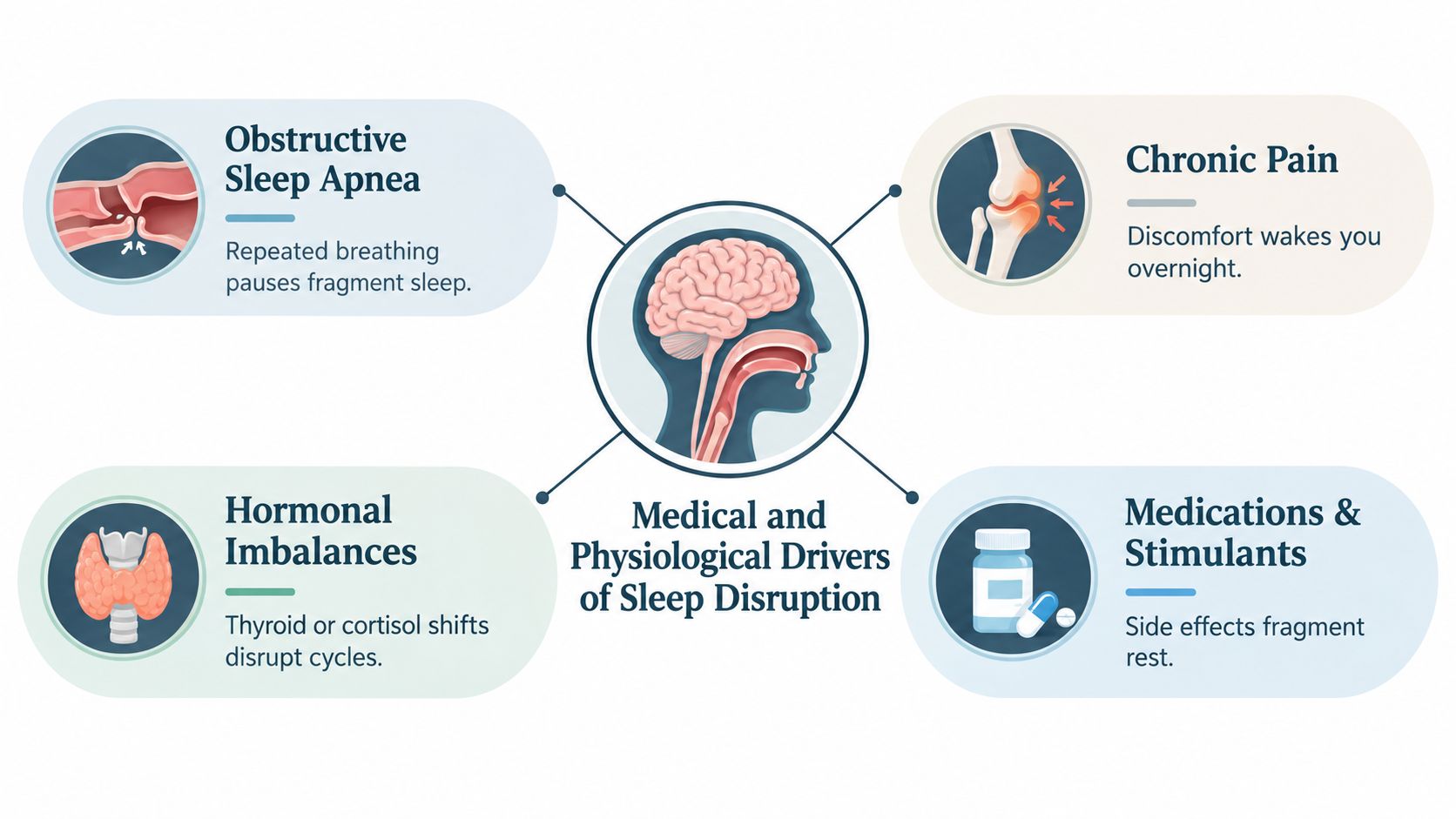
Medical and Physiological Drivers of Sleep Disruption
The body doesn't treat sleep as a single switch. It continually monitors breathing, oxygen delivery, movement, temperature, discomfort, and perceived safety. If one of those systems signals a problem, the brain can briefly increase alertness to protect you, even when you don't remember waking.
Breathing interruptions and micro-arousals
Obstructive sleep apnea is a major mechanical cause of restless sleep. During sleep, the upper airway can narrow or collapse, interrupting airflow and contributing to oxygen drops. The brain responds with a brief arousal that helps reopen the airway. You may not become fully awake, but the interruption can push you into lighter sleep and break the continuity of the night.
This process is similar to a phone repeatedly losing a signal and reconnecting. Each reconnection may take only a moment, but the repeated interruptions prevent a stable connection. The clinical explanation of restless sleep and obstructive sleep apnea describes this relationship between airway collapse, airflow interruption, oxygen changes, and brief arousals.
Snoring doesn't prove that apnea is present, but loud, persistent snoring deserves attention, especially when it occurs with gasping, morning headaches, or daytime exhaustion. You can learn more about the broader category in sleep-disordered breathing.
Movement, pain, and nervous system alertness
Restless legs syndrome creates uncomfortable sensations and an urge to move that can delay sleep or trigger repeated movement after bedtime. It appears in 1-2% of the general population and in 12-15% of patients seen at sleep centers, according to the insomnia review linked above. That contrast suggests that movement-related disruption can cluster among people who already seek help for poor sleep.
Bruxism, or nighttime teeth grinding, can activate jaw muscles and leave you with tenderness or a tight face in the morning. Pain, reflux, and other bodily signals can work in a similar way. Your nervous system keeps checking the source of discomfort instead of remaining fully settled.
Anxiety can intensify this alert state, but it doesn't mean the problem is imaginary. Professional support, such as anxiety relief with professional help, may help when worry and hyperarousal keep your body from downshifting. At the same time, persistent snoring, gasping, unusual movements, or pain should prompt a physical assessment rather than being attributed to anxiety alone.
If nasal congestion forces you to breathe through your mouth, Nasal Strips may gently open the nasal passages and support smoother airflow. They aren't a diagnosis or treatment for sleep apnea, and they shouldn't replace medical evaluation when breathing pauses are suspected.
Lifestyle and Environmental Factors Fragmenting Your Rest
A bedroom can look comfortable while still sending repeated signals that interfere with sleep. A late coffee can increase alertness, a bright screen can delay the transition to sleep, and an unpredictable work schedule can place bedtime outside your body's preferred rhythm. Each factor may seem minor, but several together can produce a restless night.
A 2023 review lists shift work, jet lag, alcohol, excessive caffeine, noise, light, anxiety, young children, obstructive sleep apnea, insomnia, circadian rhythm disorders, diabetes, neurodegenerative disease, and pain among major contributors to fragmented sleep, as summarized by the National Council on Aging's insomnia resource. This broad list explains why a single generic sleep tip rarely works for everyone.
The timing problem
Your sleep system responds to patterns, not just intentions. Shift work and jet lag can place your sleep opportunity at a time when your internal clock is promoting alertness. Alcohol may make you feel drowsy initially, but drowsiness isn't the same as stable sleep. Caffeine and nicotine can also keep the nervous system activated when you want it to become quieter.
Screens create a related challenge. The content itself may be stimulating, while the light and habit of checking messages can keep the brain engaged. A practical screen-time-before-bed guide can help you audit the habit without assuming every device affects every person in exactly the same way.
The room as a sleep signal
Noise can trigger brief arousals even when you don't fully wake. Street lighting, hallway illumination, and bright electronics can make it harder for the brain to maintain a stable nighttime state. Children, pets, partners, and changing household schedules can add interruptions that are easy to overlook because they feel normal.
Start with the simplest environmental experiment. Make the room darker and quieter, keep the sleep space comfortable, and observe whether awakenings change. Don't change every variable on the same night, or you won't know what helped.
Mouth breathing may also accompany nasal congestion and snoring. Nasal breathing normally filters, humidifies, and regulates incoming air before it reaches the lungs. When allergies or blockage narrow the nasal passages, breathing can become less comfortable, and a person may wake with a dry mouth or feel unrefreshed. Those clues don't establish the cause by themselves, but they can point you toward an airway assessment instead of another search for a stronger sedative.
How to Identify Your Specific Sleep Disruptors
You don't need to diagnose yourself to gather useful information. You need a consistent way to connect when the disruption occurs with what your body is doing at that time.
Start with a short observation log
For several nights, record your bedtime, estimated sleep onset, awakenings, final wake time, and how refreshed you feel. Add the timing of caffeine, alcohol, nicotine, exercise, medication, and screen use. You don't need perfect measurements. You need enough detail to notice patterns.
Then classify the disruption:
- Before sleep: Racing thoughts, late stimulation, discomfort, or an irregular schedule may be delaying sleep onset.
- During sleep: Snoring, gasping, dry mouth, leg sensations, jaw tension, pain, or repeated bathroom trips may be interrupting continuity.
- In the morning: Headache, sore jaw, dry mouth, heavy fatigue, or brain fog can provide clues about what happened overnight.
Scan the environment before blaming yourself
Walk through the bedroom as if you were investigating someone else's sleep. Check noise from traffic or appliances, light from windows and electronics, and anything that changes during the night. Notice whether your partner's movement, a child, or a pet tends to wake you at a predictable time.
Next, review substances and timing. A late caffeinated drink, nicotine, or alcohol may be more relevant than the total amount consumed earlier in the day. If you take prescription or over-the-counter medicine, don't change the dose or timing without asking the prescribing clinician. Instead, record when you take it and when the sleep change began.
Ask for observations you can't make
A bed partner may notice loud snoring, choking sounds, unusual pauses, or repeated leg movements that you never remember. Morning dry mouth can suggest mouth breathing, while jaw soreness may suggest clenching. An urge to move the legs, especially when resting, points toward a different line of questioning than a bedroom that is too bright.
Use the log to run one small experiment at a time. Darken the room for a few nights, then address late caffeine, then review nasal congestion or breathing. If the pattern remains unclear, take your notes to a clinician or sleep specialist. A record of symptoms is more useful than the vague statement that you sleep badly.
Evidence-Based At-Home Strategies for Deeper Rest
The most useful home strategies reduce preventable interruptions without masking warning signs. They work best when they match the suspected mechanism. A dark room won't correct airway collapse, and a breathing aid won't solve pain caused by an untreated medical condition.
Build a stable sleep foundation
Begin with the basics that reduce unnecessary stimulation:
- Keep a regular schedule. Wake and go to bed at consistent times as far as your work and family life allow.
- Reserve the bed for sleep. Avoid working, eating, or watching television in bed so your brain associates the space with rest.
- Reduce late caffeine and nicotine. Record timing, not just quantity, because late use may matter more than an earlier drink.
- Make the room dark and quiet. Reduce light sources and manage recurring noise before you get into bed.
- Exercise during the day. Regular daytime exercise can support deeper sleep. WebMD advises finishing exercise at least five hours before bedtime, as described in its sleep hygiene guidance.
These measures don't need to become a rigid performance test. Their value comes from lowering the number of signals that compete with the body's nighttime transition.
Support comfortable nasal breathing carefully
If congestion is making nasal breathing difficult, address the congestion and consider a non-drug airflow aid. Nasal strips can support the nasal passages, but they won't treat a blockage deeper in the airway or replace assessment for suspected apnea.
Mouth tape requires even more caution. It should never be used to force the mouth closed when you have significant nasal obstruction, breathing difficulty, vomiting risk, or suspected sleep apnea. If you explore it, discuss the idea with a clinician and make sure nasal breathing is comfortable first. A product's marketing language can't determine whether the approach is safe for your particular airway.
Some adults also consider a melatonin-free supplement as part of a broader routine. Restore+ Sleep Aid is described in the catalog as melatonin-free and formulated to support nitric oxide production, nervous system regulation, and overnight oxygen delivery. Those are support claims, not proof that a supplement will resolve apnea, insomnia, pain, or another clinical cause.

Regulate the transition, not just the bedroom
Try slow, comfortable nasal breathing before sleep, with an emphasis on an unforced exhale. You aren't trying to take very large breaths. You're giving your body a predictable period of lower stimulation.
A simple sequence might include dimming the lights, putting the phone away, writing down unfinished tasks, and doing gentle breathing or stretching. For people dealing with parent exhaustion, practical ideas in parent exhaustion help can make the routine more realistic. The best plan is one you can repeat without turning bedtime into another demanding project.
When to Seek Medical Evaluation for Sleep Issues
Some restless nights respond to a quieter room, a steadier schedule, or less late-day stimulation. Persistent or physically conspicuous symptoms call for a different response. The question isn't whether you should worry about every awakening. It's whether the pattern suggests that your body is repeatedly responding to a medical or physiological trigger.
Home adjustments may be reasonable when
A short period of poor sleep follows travel, a noisy environment, an unusual schedule, or a temporary increase in stress. If you otherwise breathe comfortably, don't have concerning daytime sleepiness, and improve after correcting the trigger, continue observing rather than assuming you have a disorder.
Keep your changes measured. One or two practical adjustments can show whether the environment or routine is involved. Avoid adding several sedating products at once, because that can hide symptoms and make the cause harder to identify.
Arrange an evaluation when symptoms persist
Speak with a healthcare professional or sleep specialist if you regularly wake unrefreshed despite giving yourself adequate opportunity to sleep. Seek assessment sooner if a partner reports loud snoring, gasping, choking, or pauses in breathing, or if you experience marked daytime sleepiness that affects work, driving, or ordinary activities.
Other clues deserve attention:
- Movement urges: An uncontrollable urge to move the legs or uncomfortable sensations at rest may indicate restless legs syndrome.
- Jaw symptoms: Morning jaw pain, tooth sensitivity, or facial tension may point toward bruxism.
- Repeated urination: Nocturia can interrupt continuity and may need evaluation rather than simple acceptance.
- Persistent pain: Ongoing discomfort can repeatedly activate the nervous system during sleep.
- Broader health changes: Cardiovascular, hormonal, lung, and neurological conditions are among the medical factors associated with interrupted sleep, according to this overview of interrupted sleep.
Don't stop prescribed medication on your own, even if the timing seems connected to restless nights. A clinician can review possible side effects, interactions, breathing symptoms, and whether a sleep study or other evaluation is appropriate.
Building a Sustainable Nightly Wind-Down Routine
Consistency gives your brain and body a reliable sequence of signals. A wind-down routine won't cure every cause of restless sleep, but it can reduce avoidable arousal and make it easier to recognize when a medical issue remains.
Try a flexible 60-minute transition:
- At the beginning, dim the lights and finish work, household planning, and stimulating conversations.
- In the middle, put screens away, prepare the bedroom, and write down tomorrow's tasks so they don't keep circulating in your head.
- Near bedtime, use slow, comfortable nasal breathing, gentle stretching, reading, or another quiet activity.
- At the final step, check that the room is dark and quiet and that any nasal support you're using feels comfortable.
Don't treat the routine as a checklist you can fail. If you miss one step, continue with the next. Guidance on a nighttime routine for better sleep can help you shape the sequence around your schedule.
The routine should also include a boundary. If you notice repeated breathing pauses, severe daytime sleepiness, or persistent physical symptoms, move from self-experimentation to medical evaluation. Better sleep begins with calming the system, but it also depends on finding and addressing the mechanism that keeps interrupting it.
SleepHabits offers breathing-focused tools and melatonin-free sleep support designed to fit into a consistent wind-down routine, alongside educational resources about nasal breathing and restorative sleep. Visit SleepHabits to explore the options, then choose one practical change to test tonight and track how your sleep responds.