

You wake at 3 a.m. with cracked lips, a tongue that feels like sandpaper, and a dull ache along your jaw. Your throat seems to stick when you swallow. The pillow is damp, your partner has nudged you more than once because of the noise, and you're left wondering, why do my mouth open when I sleep?
The answer usually isn't that your mouth has developed a bad habit. Your jaw may be responding to a problem farther upstream, often a blocked nose or a narrowing somewhere in the upper airway. Mouth opening can be an adaptive attempt to keep air moving when nasal breathing becomes difficult, and it frequently appears alongside snoring or sleep-disordered breathing (PubMed research on mouth breathing and sleep-related breathing disorders).
The useful question, then, isn't how to force your lips closed. It's what is making nasal breathing inefficient, and could the airway be narrowing during sleep? Once you identify that cause, you can sequence solutions in the same order a sleep clinician would, starting with airflow and escalating only when necessary.
The Night Your Mouth Falls Open
By the time morning arrives, your mouth may be open even though you fell asleep breathing through your nose. Dry lips, a tired jaw, rough breathing, or a sore throat can make the change obvious. Because sleep removes much of your conscious control, you may have no memory of your jaw dropping.
A partner often notices first. They may hear snoring, see the lower jaw fall back, or notice breathing that sounds harsher than it does during the day. You might also wake with bad breath, a coated tongue, or the sense that sleep did not restore you. These clues often point to the same mechanical problem: airflow is bypassing the nose.
The nose is usually the preferred route because it filters, warms, and humidifies incoming air before it reaches the throat and lungs. Allergies, a cold, sinus inflammation, a deviated septum, enlarged nasal tissues, or another obstruction can make that route harder to use. The mouth then acts like a wider side entrance, allowing air through when the nasal passage feels restricted. A clinical overview describes nighttime mouth breathing as a compensatory response to impaired nasal breathing (Healthline's explanation of mouth breathing).
The central reframe: Your mouth may be opening because your body is trying to preserve airflow, not because you have developed a bad sleep habit.
Sleep-related breathing disorders can make the pattern more complicated. A 2002 study reported different average amounts of mouth breathing among people with and without sleep-related breathing disorders, with the highest value in the mild group and lower values in the severe group (study record in PubMed). Other sleep testing has also found that people with obstructive sleep apnea kept their mouths open for much more of the night than control participants, and complete mouth breathing was more common.
An open mouth does not automatically mean sleep apnea. It does mean the symptom needs context. The jaw may be responding to a temporary blocked nose, a structural restriction, or an upper airway that narrows as the muscles relax. Finding that upstream cause matters more than trying to keep the lips together.
Why Your Body Chooses Mouth Breathing Over Nasal
Think of your upper airway as a two-lane highway. The nose is the narrower, slower, carefully engineered on-ramp. It filters particles, adds warmth and moisture, and regulates airflow. The mouth is the wide shoulder, offering a more direct route when the main lane feels restricted, but without the same preparation for the air or protection for the tissues below.
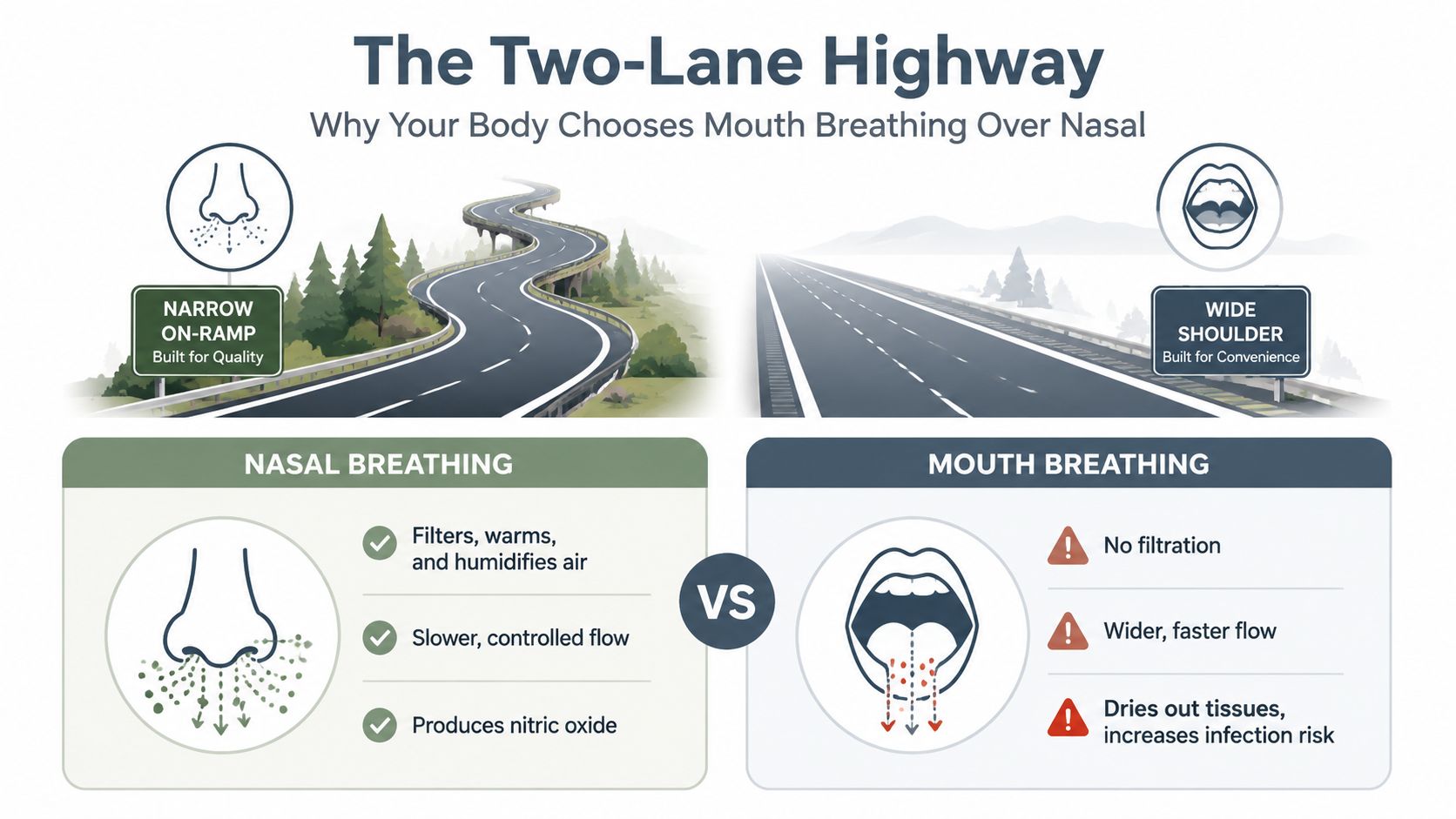
During the day, you can consciously adjust your breathing. Facial and throat muscles also have more active tone, and you may naturally compensate for mild nasal resistance by changing posture or breathing effort. Sleep reduces that conscious control. As the muscles around the upper airway relax, the brain favors the route that moves enough air with the least resistance.
Research comparing airflow routes found that upper-airway resistance during sleep is significantly lower with nasal breathing than with oral breathing, which might sound counterintuitive. The finding doesn't mean nasal breathing is always easier in practice. It means that when the nose is functioning normally, nasal breathing can be mechanically efficient, while a blocked or narrowed nose may push the body toward oral breathing as a workaround (research on nasal and oral airflow resistance).
What changes after you fall asleep
The body doesn't make a philosophical choice between nose and mouth. It responds to pressure, resistance, muscle tone, and the amount of air it needs. If congestion narrows the nasal passage, opening the mouth can immediately create a larger entrance. If the soft tissues in the throat collapse, mouth opening may accompany a more serious effort to restore airflow.
That's why a person can breathe through the nose comfortably while reading on the sofa but wake with an open mouth after sleeping flat. The airway environment has changed. Gravity, relaxed muscles, nasal swelling, and sleep-related obstruction can all shift the balance.
You can compare the two routes in more detail through this guide to nasal breathing versus mouth breathing. If the external walls of your nostrils narrow during inhalation, a mechanical aid such as Transparent Nasal Strips may help improve airflow for nighttime breathing and support more consistent nasal breathing. It won't correct a deviated septum or treat sleep apnea, but it can be a reasonable airflow experiment when external nasal narrowing contributes.
Breathing through your mouth also dries the tissues that nasal breathing would normally protect. That explains the sandpaper tongue, sticky throat, and cracked lips you notice after a night when the jaw has remained open.
For readers managing orthodontic appliances or looking after oral hygiene around them, a hygienic orthodontic product range can be a useful adjacent resource. It addresses cleaning and care, not the underlying reason your mouth opens during sleep.
The Most Common Reasons Mouths Open During Sleep
Your mouth usually opens during sleep because nasal breathing is no longer supplying enough comfortable airflow, or because the throat becomes less stable after sleep begins. More than one factor can contribute. Use the patterns below as clues, not as a diagnosis.
| Cause | Mechanism | Typical Profile | Quick Self-Check |
|---|---|---|---|
| Allergies or chronic congestion | Swollen nasal tissues restrict airflow | Seasonal allergies, sinus symptoms, persistent stuffiness | Is one or both nostrils blocked at bedtime? |
| Deviated septum | Structural narrowing limits one or both nasal passages | Longstanding one-sided breathing difficulty | Do you usually breathe better through one nostril? |
| Enlarged tonsils or adenoids | Tissue crowds the upper airway | More common concern in children, especially with snoring | Does a child sleep with an open mouth or noisy breathing? |
| Obstructive sleep apnea | Throat tissues narrow or collapse during sleep | Snoring, gasping, witnessed pauses, unrefreshing sleep | Has anyone seen you stop breathing? |
| Higher body weight | Additional tissue can reduce space around the pharyngeal airway | Adults with snoring or other airway symptoms | Do symptoms worsen when sleeping on your back? |
| Reduced muscle tone with age | Tongue and pharyngeal muscles provide less airway support | Older adults with new or worsening snoring | Did the problem appear or increase later in life? |
| Alcohol or sedating medication | Relaxed upper-airway muscles can make narrowing more likely | Symptoms after evening alcohol or sedative use | Is mouth opening worse after those evenings? |
| Back sleeping | Gravity allows the tongue and soft tissues to move backward | People whose snoring is position-dependent | Is breathing noisier when you wake on your back? |
Start with the nose
A blocked nose is often the first link in the chain. Allergies, a cold, sinus infection, nasal polyps, and enlarged turbinates can narrow the nasal passage or make its lining swell. The body then opens the mouth to maintain airflow. If congestion appears during particular seasons or after exposure to dust, pollen, smoke, or dry air, nasal inflammation deserves attention before you focus on the jaw itself.
A deviated septum follows a different pattern. One side may feel restricted most of the time, including when you are not ill. In nasal conditions such as nasal deviation or inferior turbinate hypertrophy, people may bypass the narrowed route by opening the mouth and moving more air, as described in the Journal of Clinical Sleep Medicine.
Look below the nose
In children, enlarged adenoids or tonsils can crowd the upper airway and make open-mouth sleep more likely. Research found habitual mouth breathing during sleep in 18.7% of 4,839 children, while habitual snoring occurred in 6.0%, and 79.3% of snoring children were also mouth breathers (pediatric mouth-breathing research). Another study of elementary school children also detected mouth breathing in 27.7% of participants, using the same research source.
Adults may have a different obstruction farther back. Obstructive sleep apnea can narrow the throat after sleep begins, especially when the tongue and soft palate lose support. Alcohol and sedating medicines can relax the upper-airway muscles, while back sleeping lets the tongue and soft tissues shift toward the throat. Higher body weight can further reduce the available space around the pharyngeal airway.
The timing and pattern matter. Mouth opening that appears mainly during allergy season points toward the nose. Open-mouth sleep with loud snoring, gasping, or breathing pauses raises a different concern.
Ask your partner what they observe, not only what they hear. Snoring offers useful context, but witnessed pauses, choking, or gasping carry greater clinical significance than an open mouth by itself.
What Happens When You Sleep With Your Mouth Open
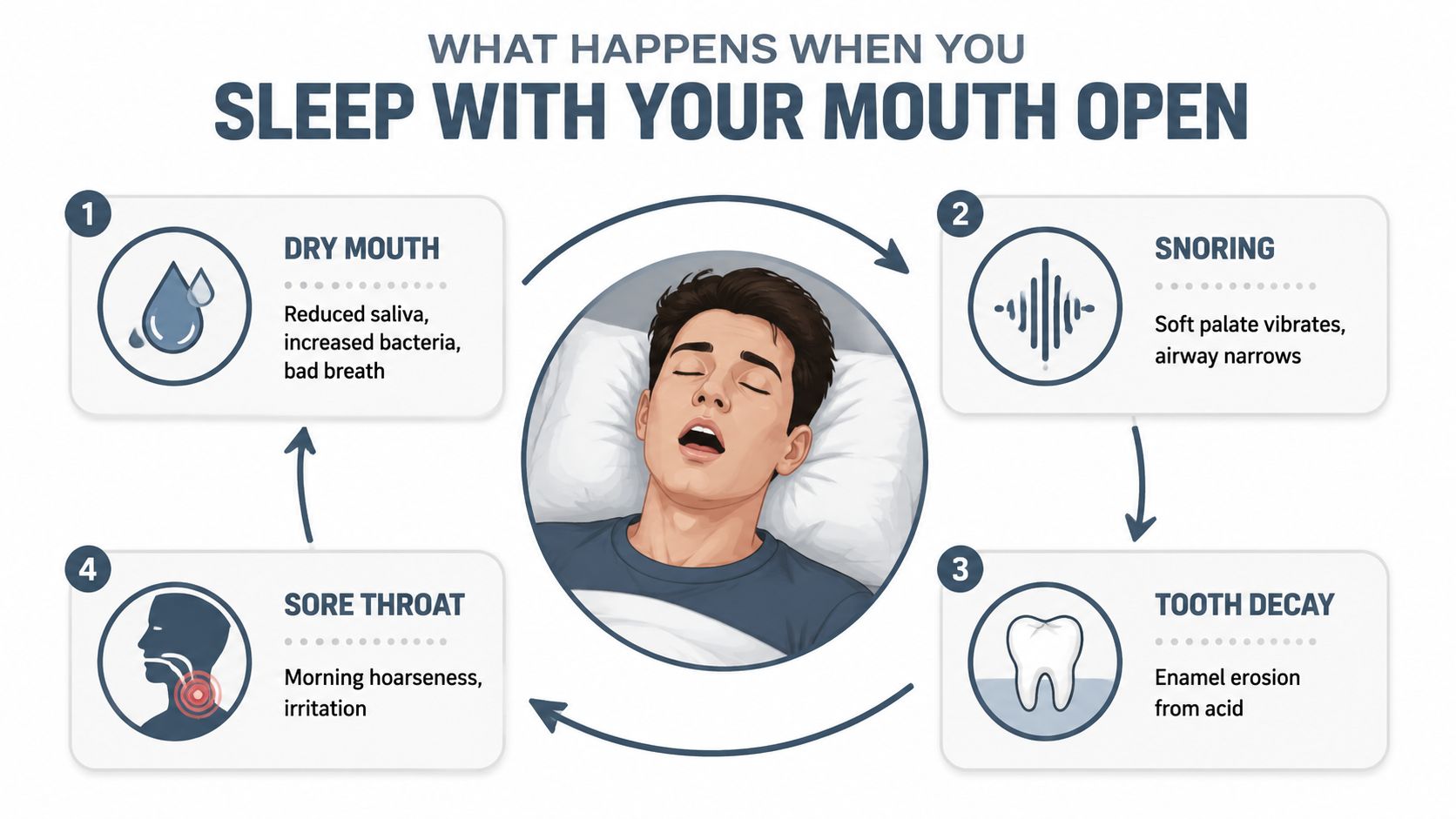
By morning, the open mouth often leaves clues: a sticky tongue, a rough throat, or breath that smells stronger than usual. The mouth has been exposed to moving air for hours, while the nose normally filters, warms, and humidifies each breath. Dry room air or a blocked nose can make that airflow feel even harsher.
Snoring may follow. An open mouth changes the route air takes, and relaxed tissues can vibrate as air moves through the throat. If the throat also narrows, the sound may become louder or more frequent. A bed partner may notice this pattern even when you remember sleeping continuously.
The morning evidence
Saliva rinses the mouth and supports its normal antimicrobial environment. Reduced moisture removes part of that protection. You may notice:
- Dry mouth: Saliva feels scarce, and the tongue or palate may feel sticky.
- Sore throat: Air that has not been conditioned by the nose can leave the throat rough or hoarse.
- Bad breath: Odor becomes easier to notice when the mouth is dry.
- Jaw tightness: The jaw may stay lowered or tense while the body tries to maintain airflow.
Persistent dryness can contribute to dental concerns such as caries, gingivitis, and halitosis. Guidance on senior dental health from Seven Oaks Dentistry provides useful oral-care context, particularly when dry mouth or medication use is part of the picture.
Sleep may also become less restorative. Airway obstruction can cause brief arousals that you do not remember, yet the repeated interruptions may leave you tired, foggy, or headachy. Mouth opening can occur alongside obstructive sleep apnea, so the symptom deserves more attention when it appears with loud snoring, gasping, or breathing pauses.
Treating nasal obstruction has been associated with less mouth breathing during sleep and reduced obstructive sleep apnea severity in a clinical study (clinical research on nasal obstruction treatment). That finding supports the upstream explanation: an open mouth may be compensating for restricted nasal airflow, rather than acting as an isolated habit.
A short visual explanation can help connect these symptoms:
One dry morning does not identify the cause. Repeated dryness, noisy sleep, or morning fatigue makes the pattern more meaningful. The useful question is what is blocking comfortable nasal or throat airflow, because addressing that source is more effective than trying to keep the lips closed.
Evidence-Based Ways to Stop Sleeping With Your Mouth Open
A mouth that falls open at night is often responding to an upstream airflow problem. Treatment works best when it follows that pathway in order. Clear the nose first. If nasal breathing remains difficult, forcing the lips together can increase discomfort while leaving the underlying obstruction untouched.
| Strategy | Mechanism | Best For | Evidence Level |
|---|---|---|---|
| Nasal hygiene and allergy care | Reduces inflammation or clears mucus | Allergies, colds, sinus irritation | Common clinical first step |
| Saline rinses and humidification | Adds moisture and helps clear nasal material | Dry air and congestion | Low-risk supportive care |
| Nasal strips or dilators | Expands the external nasal passage | External narrowing or mild resistance | Adjunct, not a cure |
| Side sleeping and head elevation | Uses position to reduce airway narrowing | Position-dependent snoring | Practical behavioral measure |
| Mandibular advancement device | Moves the lower jaw forward to support the airway | Clinician-selected obstructive sleep apnea | Dental and sleep evaluation recommended |
| Mouth taping | Encourages nasal breathing by limiting oral airflow | Only after nasal breathing is clearly comfortable | Limited evidence, safety screening required |
Restore nasal airflow
Start with the trigger you can identify. Saline irrigation may clear mucus and irritants, while allergy treatment can address inflammation rather than merely covering up the symptom. An appropriate antihistamine or nasal steroid spray may be suitable in some cases, but a clinician should guide medication choices. Humidification can improve comfort when dry air irritates nasal tissues.
External aids target the entrance to the nose. Nasal strips and dilators may make that passage easier to use when the nostrils narrow during sleep. They cannot correct a deviated septum, reduce enlarged internal tissues, or treat collapse farther back in the throat. SleepHabits explains this sequence in its guide to stopping mouth breathing at night.
Adjust position before adding devices
Try side sleeping if mouth opening or snoring becomes worse on your back. Raising the head of the bed may also ease the sensation of congestion for some people. These changes can support airflow, but breathing pauses or gasping still warrant evaluation rather than positional experiments alone.
For suspected obstructive sleep apnea, a mandibular advancement device may support the airway by moving the lower jaw forward. It is a clinician-guided option, not a general anti-snoring purchase. A sleep clinician or qualified dental professional should determine whether it matches the pattern of airway narrowing.
A melatonin-free evening routine may support relaxation, but it will not clear a blocked nose or prevent airway collapse. People who want to examine that part of their routine separately can consider Restore+ Magnesium Sleep Aid, described as a magnesium wind-down drink containing L-theanine, tart cherry, lemon balm, and glycine. Treat it as routine support, not as a treatment for mouth breathing.
Consider mouth taping only after nasal breathing feels easy during the day and remains unobstructed at night. Closing the oral route before confirming that the nasal route works reverses the clinical order.
The Mouth Taping Question
Mouth taping appeals because it's simple. A small strip over the lips appears to promise quieter breathing and deeper sleep without investigating why the mouth opened in the first place.
The evidence doesn't support treating it as a universal solution. A 2025 review of 10 studies found little evidence that mouth taping improves mouth breathing, snoring, or sleep apnea, and several studies warned that it may create an asphyxiation risk when nasal airflow is limited (2025 review summarized by MedicalXpress). The review concluded that current evidence doesn't support mouth taping as a treatment for sleep-disordered breathing.
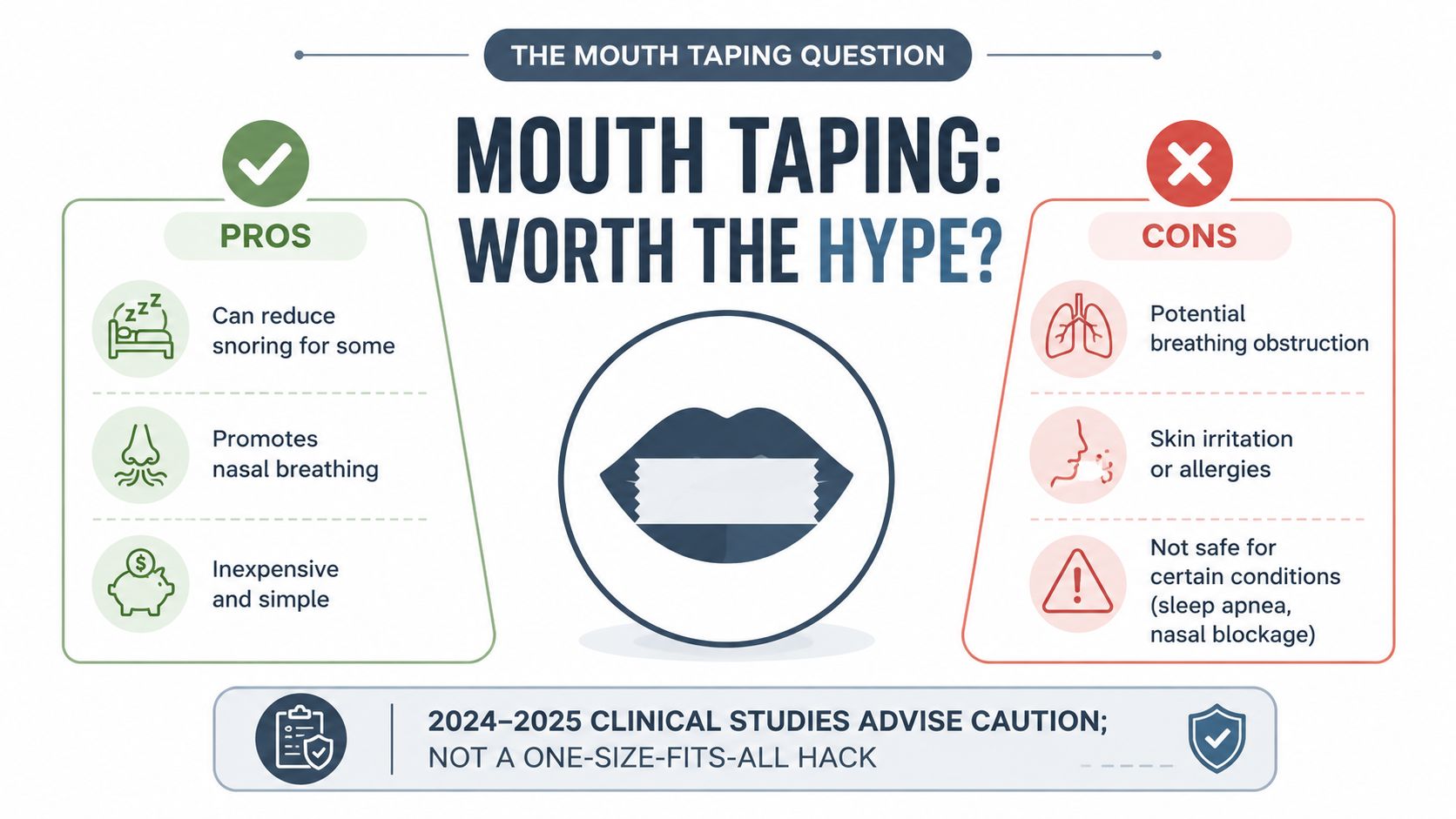
Don't tape your mouth if you have significant nasal blockage, a deviated septum, large tonsils or adenoids, suspected sleep apnea, or unexplained nighttime breathing difficulty. You should also avoid using it as a way to silence snoring before someone has considered whether the snoring reflects airway obstruction.
If a clinician has confirmed that nasal breathing is comfortable and appropriate, discuss a cautious trial rather than assuming it's safe. You should be able to breathe comfortably through both nostrils during the day, and you shouldn't have witnessed apneas, gasping, or choking. A supervised or conservative trial is more sensible than starting overnight with a fully sealed mouth, and discomfort is a reason to stop.
The SleepHabits guide to mouth tape for sleeping can help you understand the practical debate. A product such as Hydrating Mouth Tape is marketed for quieter nights, reduced snoring, oral comfort, and nasal-breathing practice, but those product descriptions don't replace airway screening.
Clinical order matters: Mouth taping belongs at the end of the decision process, after nasal breathing is demonstrably clear, not at the beginning.
When Self-Model Is Not Enough
Home measures make sense when the pattern is mild, recent, and clearly linked to a temporary cause such as a cold, dry air, or seasonal allergies. Work on nasal hygiene, allergy management, side sleeping, and other low-risk measures while observing whether your morning dryness, snoring, and open-mouth sleep improve.
If the problem continues despite those changes, stop treating it as a simple habit. Persistent mouth opening may point to structural nasal narrowing or sleep-disordered breathing, and a clinician can assess the nose, throat, tonsils, adenoids, tongue position, and medication factors together.
Use red flags to choose the next step
Book an evaluation with an ENT clinician or sleep specialist if you notice:
- Breathing pauses: Someone sees you stop breathing during sleep.
- Gasping or choking: You wake abruptly trying to catch your breath.
- Loud habitual snoring: The sound occurs regularly rather than only during illness.
- Daytime sleepiness: You struggle to stay alert despite allowing enough time for sleep.
- Morning headaches: You wake with recurring head pain alongside poor-quality sleep.
- Persistent obstruction: One or both nostrils remain difficult to use even when you aren't congested.
A home sleep apnea test may be appropriate for some adults, while in-lab polysomnography provides a more detailed assessment when the situation is complex or the initial test doesn't answer the question. An ENT evaluation is particularly useful when symptoms suggest a deviated septum, enlarged turbinates, polyps, or other nasal blockage.
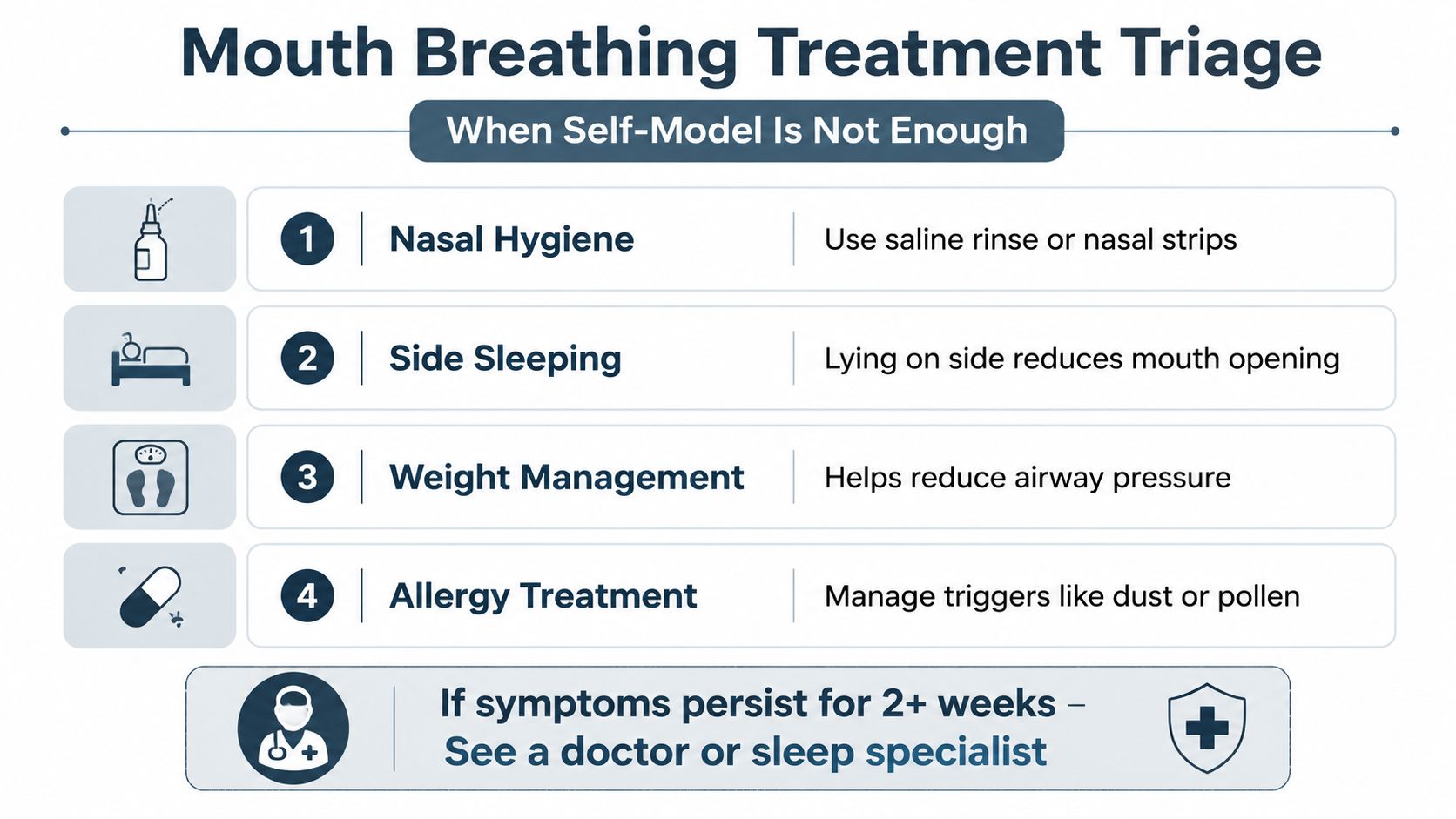
The short version is simple. If your nose is blocked, investigate the blockage. If your throat appears to close, investigate sleep apnea. Nasal-breathing tools and training can support comfort alongside professional care, but they shouldn't replace a diagnosis when red flags are present.
SleepHabits offers nasal-breathing tools, hydrating mouth tape, and a melatonin-free magnesium wind-down option to support a consistent nighttime routine after you've considered the cause of your mouth opening. Visit SleepHabits to explore those options and build a breathing-focused sleep routine that complements, rather than substitutes for, medical evaluation.