

Most advice on an alternative to nasal strips starts in the wrong place. It assumes every breathing problem at night needs a different adhesive, a new gadget, or a stronger hack. That misses the obvious. A blocked nose, a narrow nasal valve, habitual mouth breathing, position-related snoring, and possible sleep-disordered breathing are not the same problem, so they shouldn't get the same fix.
A simple example shows why. If your nose feels stuffy at bedtime and clearer after a shower, congestion is probably the bottleneck. If your nose feels open but you still wake with a dry mouth, open-mouth breathing or habit may be the bigger issue. The better rule is to identify the likely bottleneck first, then compare convenience, comfort, expected benefit, and safety.
That's how I'd sort the six main options people try: nasal strips, internal dilators, saline or sprays, breathing retraining, mouth tape, positional therapy, and when to stop experimenting and get medical help. If allergies are part of the picture, a broader routine can help too, including approaches like aromatherapy for seasonal allergies.
Persistent loud snoring, witnessed breathing pauses, gasping, or significant daytime fatigue deserve medical evaluation rather than more trial-and-error.
1. Nasal Strips
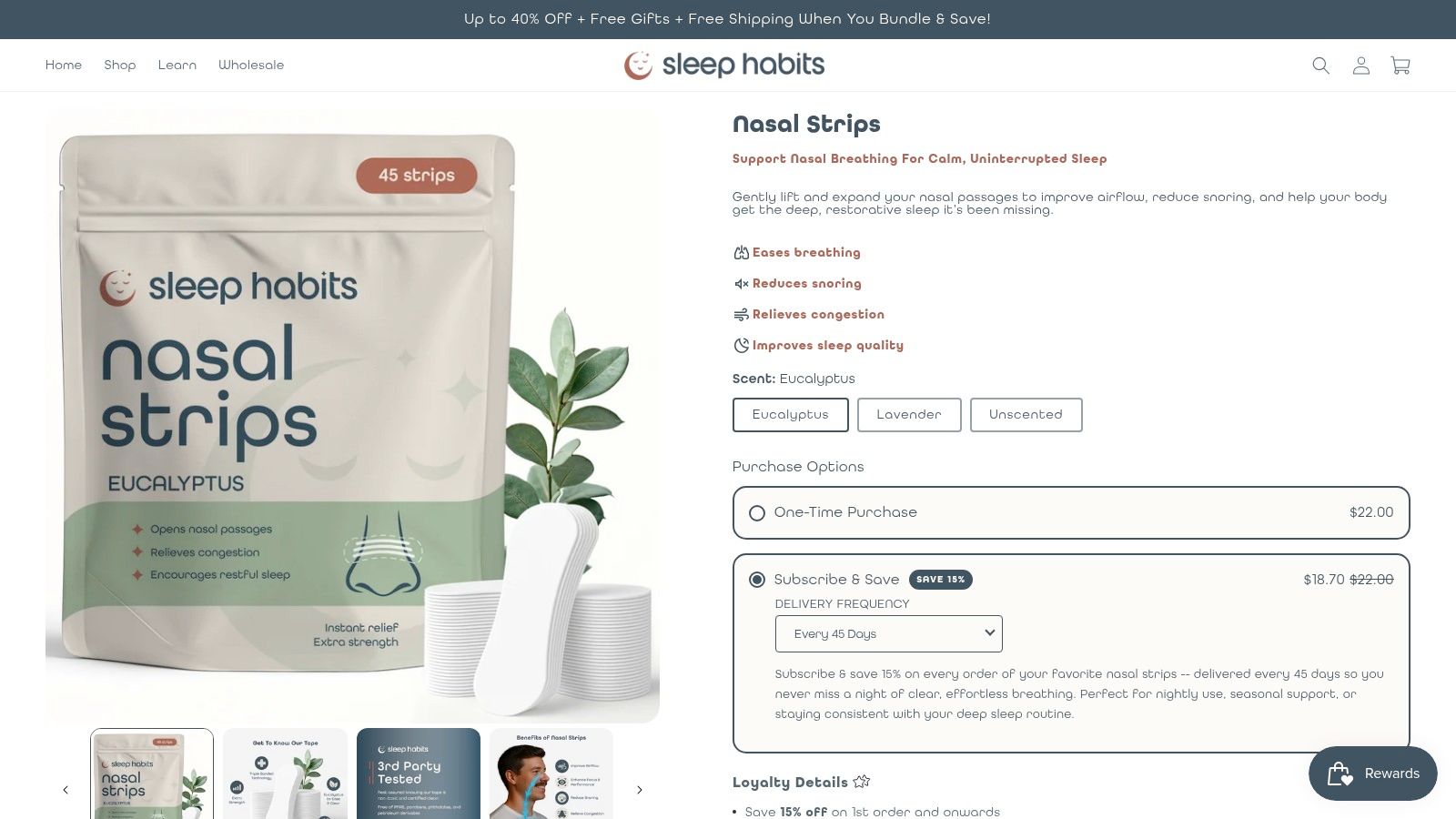
Nasal strips are still the reference point because they directly target one common bottleneck: mechanical restriction at the front of the nose, especially around the nasal valve. They don't medicate anything. They pull outward on the outer nose, which can make airflow feel easier when the issue is collapse or narrowing rather than deep sinus congestion.
That distinction matters. Your nose is built to filter, humidify, and regulate airflow before it reaches the lungs. When nasal airflow drops, many people default to mouth breathing, then wake up dry, restless, or noisy. A product like Nasal Strips fits that use case as a simple mechanical aid. The catalog lists 3 variants across option1, option2, and option3, with availability data shown for 2 variants.
Where nasal strips fit best
The best use case is a nose that feels structurally tight at night, not one that's packed with mucus. In a randomized placebo-controlled study on chronic nocturnal nasal congestion, users reported improvement in ease of breathing during sleep, snoring loudness, sleep quality, and daytime sleepiness after using a nasal dilator strip, with the linked study reporting changes of 25.6%, 34.0%, 21.8%, and 26.0% respectively versus baseline in those subjective measures (PubMed study on nasal dilator strips).
That's the good news. The trade-off is that symptom relief and treatment effect aren't the same thing.
Practical rule: Use strips when the nose feels narrow or collapses easily. Don't expect them to fix every form of snoring or sleep apnea.
A later evidence review summarized a 2026 meta-analysis and noted no significant pooled benefit for external nasal strips on apnea-hypopnea index, snoring index, oxygen saturation, sleep time, or nasal airway resistance versus controls, even though users may still feel more open airflow (evidence review of nasal strips vs mouth tape).
What works and what falls short
Nasal strips are convenient. They're fast to apply, easy to test for a few nights, and useful when you want a low-friction starting point. They also make sense for people who breathe reasonably well once the outer nose is supported.
Their limits show up fast in a few situations:
- Congestion-driven blockage: If swelling, allergies, or mucus are the problem, a strip may feel underpowered.
- Open-mouth breathing with a clear nose: The strip may improve airflow, but it won't train lip seal.
- Suspected sleep apnea: A strip can make breathing feel nicer without changing the bigger airway issue.
If a strip helps, that's useful information. It suggests the front end of the nose may be part of the problem. If it doesn't, don't keep swapping adhesives blindly. Move to the option that matches the actual bottleneck.
2. Internal Nasal Dilators
If you want the closest alternative to nasal strips without adhesive on the skin, start here. Internal nasal dilators sit inside the nostrils and mechanically support the nasal valve from within. For people who dislike residue, skin sensitivity, or strips that peel loose overnight, that can be a better fit.
A systematic review of mechanical alternatives found a limited but real evidence base across non-drug devices: five studies for external nasal dilator strips, four for internal nasal dilator clips, two for nasal stents, and none for septal stimulators. The review concluded that the studied devices mainly dilated the nasal valve and reduced airflow resistance, but evidence remained limited to only a few products (systematic review of nasal dilator devices).
The real trade-offs
Internal dilators are often less visible once placed, but they're more intrusive to wear. Some people love that they avoid adhesive. Others never get past the sensation of having something inside the nostrils.
Use them well or skip them:
- Choose fit first: The right size stays put without pinching.
- Test while awake: Wear it during reading or screen-free wind-down time before trying a full night.
- Clean it properly: Follow the product's labeling. Hygiene matters more here than with an external strip.
For a deeper look at fit and design, SleepHabits has a guide on the Turbine nasal dilator.
Internal devices can work well when the bottleneck is the nasal valve. They won't solve deep congestion, sinus pressure, or every cause of chronic blockage.
This is also where people sometimes confuse categories. Mouth Tape supports lip closure and nasal breathing habits, but it doesn't mechanically open the nose the way an internal dilator does. If the nose itself is the problem, start with a nasal-opening tool, not a mouth-breathing tool.
3. Saline and Nasal Sprays
When congestion is the problem, a mechanical dilator may not be the smartest first move. Saline and nasal sprays address a different bottleneck: swelling, dryness, mucus, or irritation inside the nose.
Saline is the simplest option. It helps hydrate nasal tissue and clear out irritants or secretions. Medicated sprays are a separate category and need more care because label instructions, timing, and duration all matter.
A practical evening routine
Keep this trial simple. Use the chosen product as directed, give it time to work before lying down, and then notice whether your breathing changes enough that snoring or mouth breathing eases.
For short-term nighttime congestion relief, mainstream consumer medical guidance recommends a broader set of practical steps including head elevation, nasal irrigation, steam or a humidifier, warm compresses, hydration, and over-the-counter antihistamines or decongestants rather than treating the issue as a one-device problem (blocked nose treatments at night from Sleep Foundation).
That's the right mindset. Congestion often responds best to a small routine, not a single hero product.
Where sprays fit and where they don't
A few patterns are worth keeping straight:
- Dryness and mild irritation: Saline often makes more sense than a purely mechanical opener.
- Seasonal allergy nights: Relief may depend on reducing the allergic trigger, not just widening the nostrils.
- Recurring severe blockage: If you need escalating measures often, get assessed.
For more targeted ideas, SleepHabits has a practical guide on ways to get rid of a stuffy nose.
Don't extend medicated spray use beyond its labeling. If the nose stays blocked despite routine care, the issue may be structural, inflammatory, or both.
4. Breathing Retraining
Some people don't have a severely blocked nose. They have a breathing habit problem. Their mouth hangs open at rest, they breathe through the mouth while working or scrolling at night, and that pattern carries into sleep.
Breathing retraining is useful here because it targets behavior, not hardware. It's also the least flashy option on this list, which is probably why people skip it.
A simple practice that's worth trying
Start during the day, not in bed. Notice whether your lips are open while sitting. Then practice light, nasal breathing without forcing big breaths or trying to turn it into a performance.
Useful moments include a short walk, reading, or your pre-bed routine. If the nose is comfortable, keep the breath slow and easy. If breathing feels strained, stop and reassess whether obstruction is the issue.
For technique ideas, SleepHabits has a guide to nasal breathing techniques.
Watch for pattern changes: less dry mouth in the morning, fewer awakenings, and less perceived snoring matter more than whether the exercise feels impressive.
Breathing through the mouth can also affect oral health over time. This overview of how mouth breathing affects your teeth is a useful reminder that nighttime breathing habits don't stay confined to sleep.
Breathing retraining works best when the nose is reasonably usable and the main issue is habit. It won't override major congestion, a deviated structure, or suspected sleep apnea. But when habit is the bottleneck, it's one of the few options that can improve daytime breathing and nighttime breathing at the same time.
5. Mouth Tape
Mouth tape is not a nasal opener. That's the first thing to get right. It's a behavior-support tool for people whose nose is already comfortable enough to breathe through.
That makes it a narrower option than social media suggests. If nasal airflow is restricted, taping the mouth can turn a manageable issue into an uncomfortable or unsafe one.
Who it may help
The most relevant group is people who mouth-breathe despite a usable nose, especially those with mild obstructive sleep apnea who primarily leak air through the mouth. In a randomized study of mouth-breathers with mild OSA, mouth-taping reduced apnea-hypopnea index and snoring index by about half, and another review found about 65% of participants were responders based on at least a 50% snoring reduction (clinical review of mouth-taping evidence).
That sounds promising, but the evidence base is still narrow. A 2025 systematic review found that only two of ten included studies suggested a small improvement in apnea-hypopnea index for mild OSA, and the overall evidence didn't support mouth taping as a general treatment for sleep-disordered breathing, with some studies raising serious safety concerns when nasal airflow is restricted (2025 systematic review on mouth taping).
Safe setup matters more than hype
A careful trial looks like this:
- Use a mouth-specific product: Don't improvise with random household tape.
- Test while awake first: If it feels panicky or hard to tolerate, stop there.
- Only try it when nasal breathing feels easy: If the nose is blocked, this isn't the night to experiment.
If allergies and dust are pushing you toward mouth breathing, improving the room can matter as much as the tape itself. This guide to bedroom cleaning for allergy relief is a practical place to start.
Mouth tape can be useful, but only when the nose is clearly open and the user has screened for obvious red flags.
6. Positional Therapy
Position changes airway mechanics. That's why some people snore heavily on their back and much less on their side, even when they haven't changed anything else.
Positional therapy is worth testing because it's simple and low-tech. It also answers an important question fast: are your symptoms position-sensitive or not?
Run a clean side-sleeping experiment
Don't overcomplicate it. Compare back-sleeping nights with side-sleeping nights across a short stretch. Use a pillow arrangement or another comfortable cue that makes side sleeping easier to maintain.
Track a few plain observations in the morning:
- Snoring intensity: Did anyone notice a difference?
- Dry mouth: Better, worse, or the same?
- Awakenings: Fewer wake-ups or no real change?
This works best when symptoms clearly vary by position. It's less helpful when you feel blocked in every posture because that points back toward congestion, nasal obstruction, or another airway issue.
One caution matters here. Position changes are a management tool, not a diagnosis. If you have loud snoring, witnessed pauses, gasping, or persistent daytime sleepiness, don't let a slightly better side-sleeping night convince you nothing serious is going on.
7. Lifestyle and Medical Interventions
Some nighttime breathing problems don't belong in the consumer product aisle at all. If the issue is persistent, multifactorial, or clearly affecting sleep quality, lifestyle review should happen alongside proper medical evaluation.
Start with what you can observe. Is the room dry or dusty? Do symptoms flare with allergy exposure? Is the nose blocked most nights, or only during colds and seasonal shifts? Those details help separate an occasional routine issue from a structural or sleep-related disorder.
When to stop self-testing
A review in the medical literature concluded that nasal valve dilators were not a reliable treatment for obstructive sleep apnea, with most studies failing to show meaningful effectiveness, and based on limited evidence they were not recommended as an OSA treatment option (medical review on nasal dilators and OSA). That's the clearest boundary in this whole category.
Get evaluated if you have ongoing obstruction, frequent loud snoring, gasping, witnessed breathing pauses, poor-quality sleep, or mornings that still feel unrefreshing after sensible self-testing. A qualified clinician can sort out whether the main driver is nasal anatomy, inflammation, allergy, sleep apnea, or another airway issue.
Better tools help when you're solving the right problem. They waste time when they distract from a medical one.
There's still room for supportive wellness products within that bigger picture. A product like Restore+ Sleep Aid is positioned in the SleepHabits catalog as melatonin-free recovery support designed around breathing, nitric oxide support, and overnight recovery, but it shouldn't be treated as a substitute for individualized care when symptoms point to an airway disorder.
7 Alternatives to Nasal Strips Compared
| Option | Implementation (🔄) | Resources & Setup (⚡) | Expected outcomes (⭐📊) | Ideal use cases (💡) | Key advantages |
|---|---|---|---|---|---|
| Nasal Strips | Low complexity, apply to external nose; minimal learning 🔄 | Low, consumer packs, replace nightly as needed ⚡ | Moderate effectiveness ⭐⭐, improves nasal airflow for many, limited for structural blockages 📊 | Mild congestion, habitual nasal narrowing, temporary allergy-related blockage 💡 | Non‑invasive, immediate effect, easy to trial |
| Internal Nasal Dilators | Moderate, sizing, insertion and comfort testing needed 🔄🔄 | Low–moderate, device purchase, regular cleaning required ⚡ | Moderate effectiveness ⭐⭐, supports nasal valve area; not for deep congestion 📊 | Users who dislike adhesive/skin irritation or want discreet mechanical support 💡 | No skin adhesive, discreet once positioned |
| Saline and Nasal Sprays | Low–moderate, rinse technique or spray timing; follow labels 🔄 | Low, saline kits or medicated sprays; product‑specific precautions ⚡ | Variable outcomes ⭐–⭐⭐, treats congestion/dryness directly; medicated sprays effective short‑term 📊 | Seasonal allergies, congestion, nasal dryness; part of bedtime routine testing 💡 | Addresses congestion cause, supports clearer airflow before bed |
| Breathing Retraining | Higher, habit change requires practice and monitoring 🔄🔄🔄 | Minimal, time and consistency; optional guides or clinician input ⚡ | Gradual improvement ⭐–⭐⭐, improves nasal breathing habits over weeks/months 📊 | People with open nasal passages who default to mouth breathing; daytime habit work 💡 | No device needed, builds lasting breathing awareness |
| Mouth Tape | Low, apply adhesive to close mouth after screening 🔄 | Low, specific mouth‑tape products; test tolerance while awake ⚡ | Targeted outcome ⭐, promotes nasal breathing only when nose is clear; no structural change 📊 | Closed‑mouth support when nasal airflow is already comfortable; adjunct use 💡 | Directly reduces mouth breathing, complements other strategies |
| Positional Therapy | Low, change sleep position; trial over multiple nights 🔄 | Very low, pillows or positional devices; consistent practice ⚡ | Variable outcomes ⭐–⭐⭐, reduces position‑dependent snoring; no effect on structural obstruction 📊 | Snoring or dry mouth that varies by sleep position; non‑device preference 💡 | Low‑tech, easy to trial, combines well with other approaches |
| Lifestyle & Medical Interventions | Variable, may include clinical evaluation and tailored treatments 🔄🔄🔄 | Moderate–high, clinician visits, diagnostics, possible medical/surgical interventions ⚡ | Highest potential for durable resolution ⭐⭐⭐, identifies and treats underlying causes 📊 | Persistent obstruction, loud snoring, witnessed apneas, daytime sleepiness, when self‑measures fail 💡 | Enables definitive diagnosis and individualized, evidence‑based care |
Choose the Option That Matches the Bottleneck
The best alternative to nasal strips depends on what's limiting your breathing. If you want a nonadhesive mechanical approach, internal nasal dilators are the closest substitute. If congestion is the main issue, saline or a suitable spray usually makes more sense than adding another opening device. If your nose is reasonably clear but you default to mouth breathing, breathing retraining is the cleaner first step.
Mouth tape belongs in a narrower lane. It can be useful when nasal breathing is already comfortable and the problem is open-mouth breathing, but it isn't a fix for a blocked nose. Positional therapy is worth testing when symptoms change by sleeping position. If they don't, move on quickly rather than forcing it.
The most important rule is to change one variable at a time. Don't stack a strip, a clip, a spray, and tape all in the same week and then guess what helped. Run a short trial, note comfort, dryness, snoring, awakenings, and how rested you feel in the morning. That gives you usable information instead of noise.
This category also has a built-in trap. People often chase the feeling of “more air” and assume that feeling means the underlying problem is solved. Sometimes it is. Often it isn't. Better nasal breathing is the goal, but better nasal breathing and treatment of a sleep-breathing disorder are not always the same thing.
Use internal support for mechanical narrowing. Use saline or sprays for congestion. Use habit work for habitual mouth breathing. Use mouth tape carefully and only when the nose is clearly open. Use side-sleep trials when position seems to matter. And when symptoms are persistent, loud, or alarming, stop shopping and start getting answers.
Replacing one strip with another isn't a real win. Matching the tool to the bottleneck is.
SleepHabits offers melatonin-free sleep and breathing tools that fit naturally into this kind of trial-and-observe approach, including nasal strips, mouth tape, and recovery-focused sleep support. If you're trying to improve nighttime breathing without guessing, visit SleepHabits for products and educational resources built around better airflow, better habits, and more restorative sleep.