

You're in bed, the room is dark, and your body is tired. The problem is your mind keeps reopening every conversation, deadline, and unfinished task as if it's the middle of the afternoon. That's the exhausting loop people mean when they ask how to calm racing thoughts, and it usually gets worse when you try to force sleep.
The fix isn't to “stop thinking.” That approach backfires because bedtime rumination is often a cognitive arousal problem, not a willpower problem. Your nervous system is still in problem-solving mode, so the goal is to lower activation, redirect attention, and give the brain a different job before the bed becomes the place where you wrestle with your thoughts.
Why Your Mind Won't Shut Off at Bedtime
At 2 AM, racing thoughts rarely feel like a single worry. They move from a work mistake to tomorrow's schedule to something awkward from last week, and they do it without landing anywhere useful. That's the hallmark of a mind stuck in high-alert mode, where the brain keeps scanning for danger, unfinished business, or something it can still control.
Why the bedroom makes the loop louder
The bedroom removes distraction, which sounds helpful until you realize distraction was doing some of the work. Once the house gets quiet, there's room for unprocessed worry to surface, and the stillness can make every thought feel louder. That's why the same person who felt fine on the couch can suddenly spiral as soon as their head hits the pillow.
Practical rule: If your mind is revving up in bed, don't treat that as a cue to think harder. Treat it as a cue to lower arousal first.
Harvard Health recommends a scheduled worry-time approach, where you set aside a fixed time later in the day to intentionally “explore those thoughts and work through them,” instead of trying to solve them at bedtime. That shift matters because insomnia is strongly tied to cognitive arousal, and standard sleep-hygiene guidance treats nighttime problem-solving as part of the problem, not the solution. You can read more in this SleepHabits resource on stress and anxiety for sleep.
Normal bedtime reflection is brief and settles. Racing thoughts keep looping, keep switching topics, and keep pulling you back into analysis when your body is asking for rest. That difference matters, because it tells you whether you need a gentle wind-down or a more deliberate behavioral reset.
Scheduled Worry Time to Break the Bedtime Loop
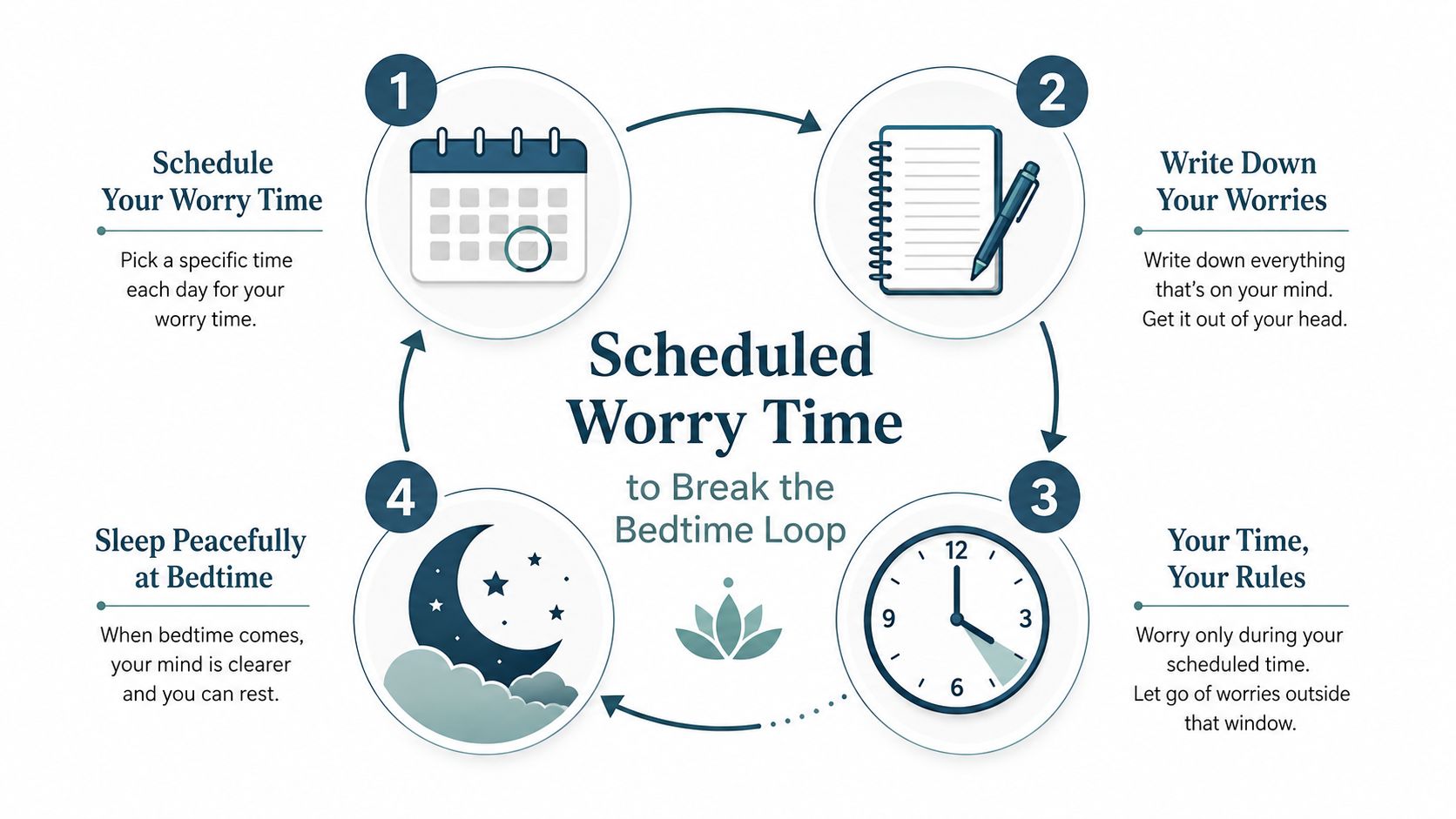
The most effective move is often to stop trying to process worry at bedtime at all. Instead, give it a home earlier in the day, when your brain is allowed to plan, sort, and problem-solve without hijacking sleep. A 15 to 20 minute worry window in the late afternoon or early evening is enough for many people to offload the mental clutter before night arrives.
How to run the worry window
Set a timer, open a notebook, and write down the thoughts that keep stealing sleep. Don't polish them. Put them in plain language, then split each one into one of three buckets: what you can act on tonight, what can wait until tomorrow, and what isn't solvable right now. The point is to teach your brain that concern has a container.
Use prompts like these:
- What is urgent?
- What needs one action step tomorrow?
- What am I replaying without any new information?
- What can I safely defer until my next worry window?
If a worry shows up at bedtime, don't argue with it. Write it down and tell yourself it has a slot tomorrow. That deferred-processing move is more effective than repeated reassurance, because reassurance feeds the loop while postponement weakens it.
For people who carry work stress home, this is especially useful. Shift workers and busy professionals often need a clean boundary between planning time and sleep time, and journaling is one of the easiest ways to draw it. A non-drug routine can help reinforce that boundary, which is one reason some people pair it with a habit-based wind-down drink such as Restore+ Magnesium Sleep Aid, a melatonin-free magnesium drink built around magnesium, L-theanine, tart cherry, lemon balm, and glycine.
Structured Breathing Techniques That Actually Work
Breathing exercises get recommended constantly, but many people do them too fast, too big, or too briefly to change much. The useful versions are structured, repeatable, and boring in the best way. They give your body a rhythm that competes with the stress response instead of feeding it.
Three patterns worth using tonight
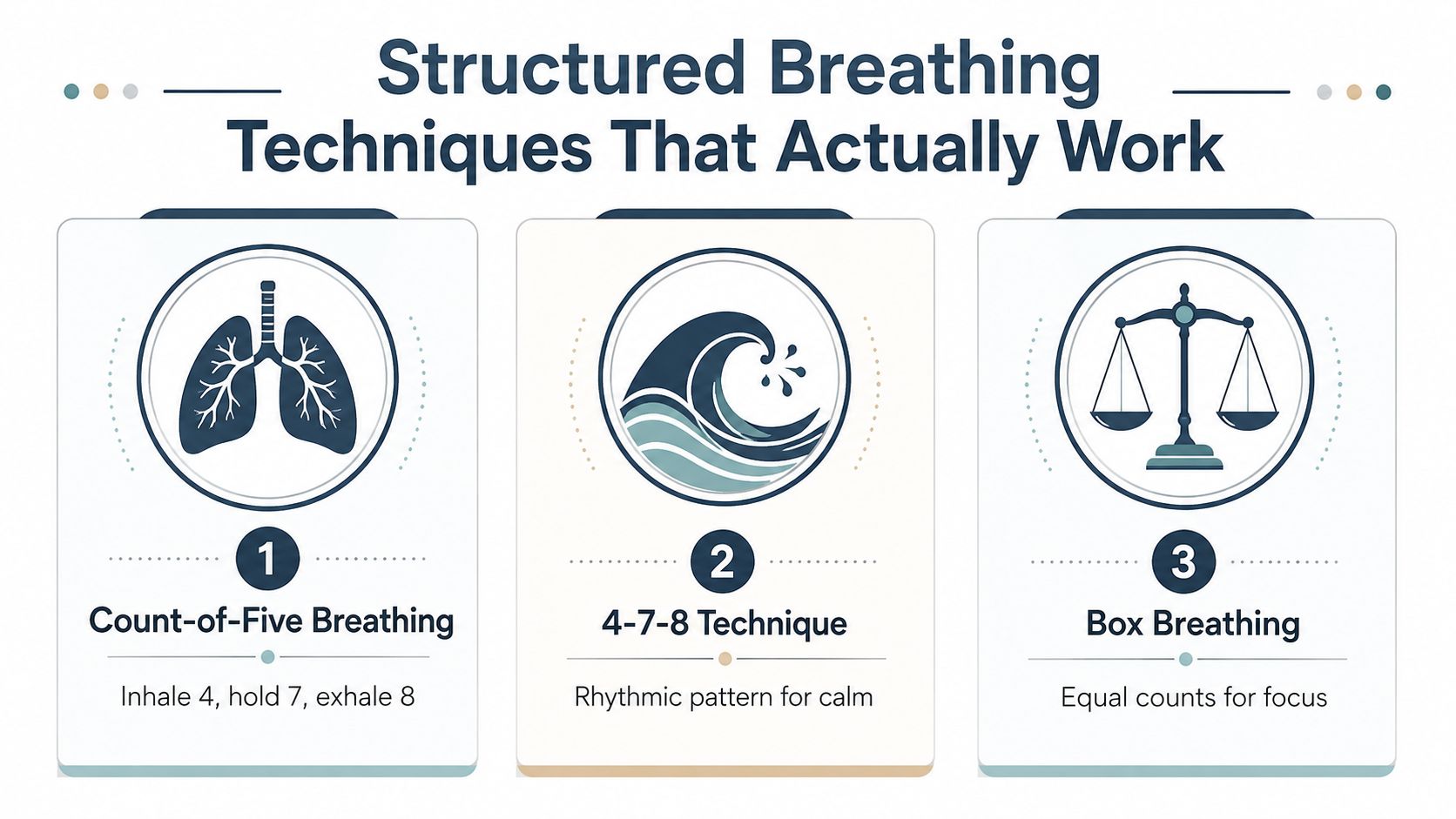
A simple starting point is count-based breathing, where you inhale and exhale to a count of five. It's easy to remember and works well when you're half-asleep and don't want to track a complicated pattern.
Box breathing uses 4-4-4-4. Inhale for 4, hold for 4, exhale for 4, hold for 4. Do 3 to 4 rounds. The symmetry helps many people feel steadier because the breath becomes predictable.
4-7-8 breathing uses a longer exhale. Inhale for 4, hold for 7, exhale for 8, then repeat for up to 4 cycles. It's a useful option when your mind is busy and your body feels keyed up.
The main goal is to keep breathing cycles going for 3 to 5 minutes. That short window is often enough to shift attention away from intrusive thinking and toward the breath pattern itself.
A good resource if you want another clinical-style walkthrough is the guide from Pain and Sleep Therapy Center. The mechanics matter more than people think, and the wrong mechanics usually look like this: huge inhales, visible shoulder lifting, and so much effort that the exercise becomes another task to perform. That can lead to dizziness, especially when you over-breathe, so keep the breath small, smooth, and sustainable.
You can also use box breathing for sleep as a nightly anchor when your mind needs something structured but not stimulating. If nasal breathing feels blocked, some people use Transparent Nasal Strips to improve airflow and support easier nighttime breathing.
Grounding and Progressive Muscle Relaxation Protocol
When breathing alone doesn't break the loop, grounding does the heavier lifting. The reason is simple. A racing mind is trapped inside internal dialogue, and grounding forces attention into the body and the room instead. That shift from internal rumination to external sensory processing is often what interrupts the spiral.
Use the sensory scan first
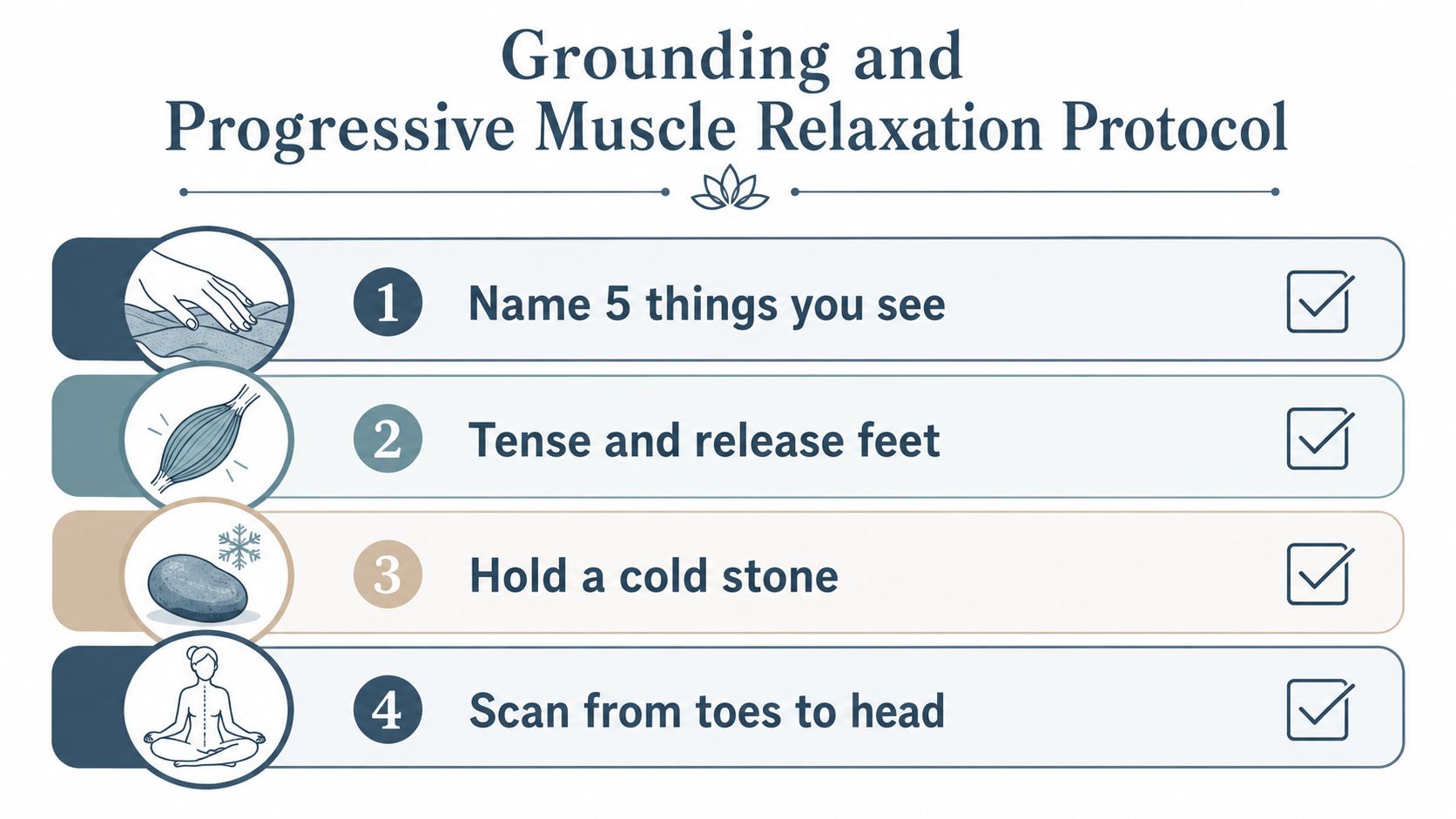
The 5-4-3-2-1 technique is concrete, not abstract. Name 5 things you see, 4 things you feel, 3 things you hear, 2 things you smell, and 1 thing you taste. Say them in your head or out loud, and keep moving even if the mind wants to jump back to the worry.
That sensory sequence matters more than perfect calm. A lot of people stop after breathing and wonder why the thoughts return. The grounding phase is the part that interrupts the mental loop more reliably, because it gives working memory something immediate and external to do.
Layer in muscle release when the body still feels tight
If your shoulders are still clenched or your jaw won't let go, add progressive muscle relaxation. Tense one muscle group for 5 to 10 seconds, then release for 20 to 30 seconds. Start with the feet, then move up through the legs, hands, shoulders, and jaw if needed.
For a fuller clinical overview, the progressive muscle relaxation for anxiety resource from Cedar Hill Behavioral Health is useful because it frames the method as a body-based way to downshift activation, not just a relaxation trick.
Keep the sequence tight, breathing first, grounding second, muscle release last if you still feel keyed up.
You can also pair this with sensate vagus nerve stimulation if you respond well to body-centered calming supports. The key is to stay specific. Don't vaguely “try to relax.” Give your nervous system a task it can complete.
Building Your Complete Nightly Wind-Down Routine
The most reliable nights usually come from stacking a few small signals in the right order. Your brain reads patterns better than pep talks, so the routine should tell it, over and over, that problem-solving is ending and sleep is next. That's why the best wind-down plans are behavioral first, environmental second, and supportive tools last.
A practical sequence to use
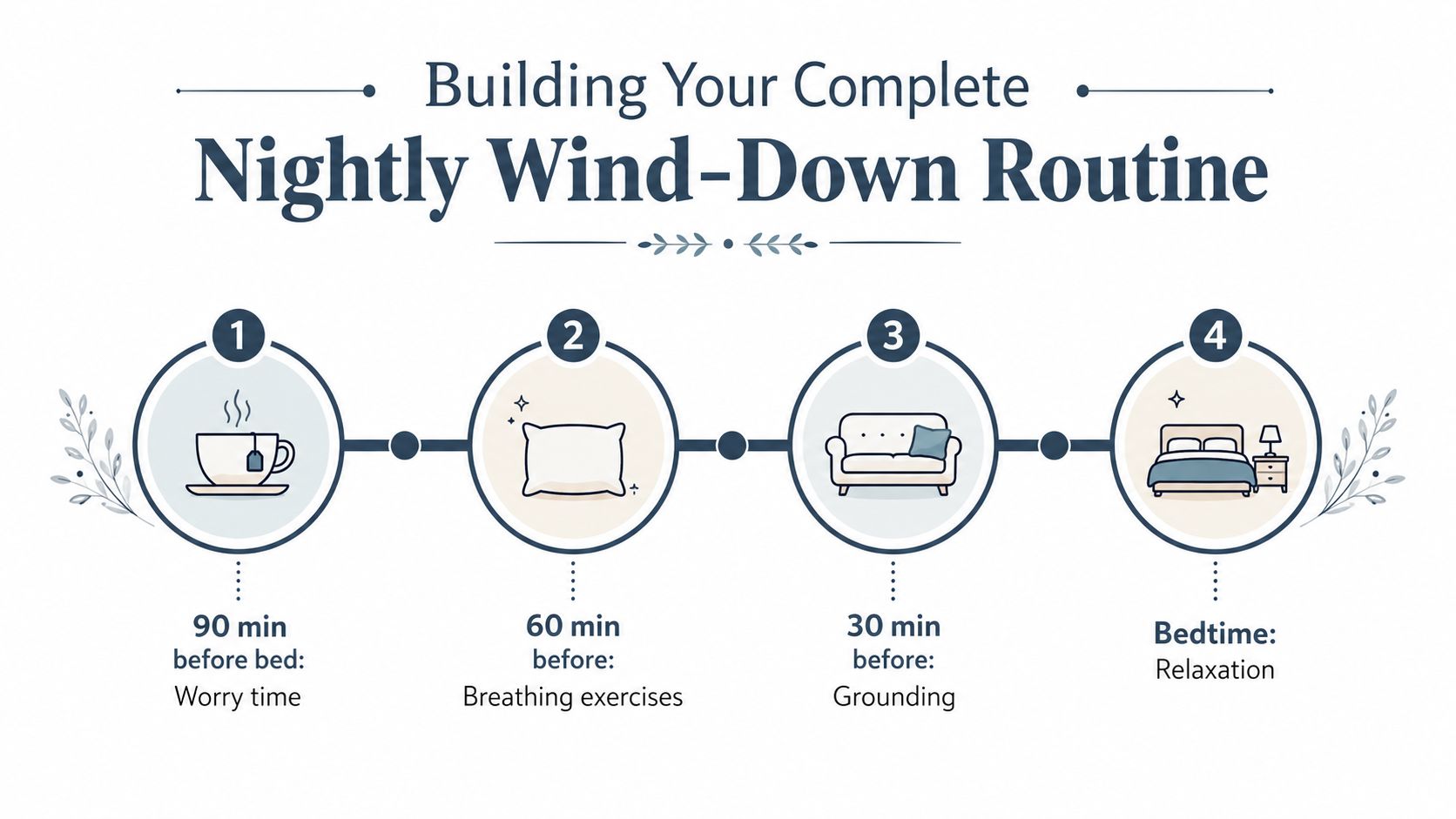
Start with worry time earlier in the evening, not in bed. Then dim the lights, reduce screen exposure, and let the room get quieter as bedtime approaches. That reduction in stimulation matters because a bright, noisy evening tells the nervous system to keep scanning instead of settling.
About an hour before bed, use your breathing pattern of choice. Box breathing works well if you want structure, while 4-7-8 breathing can feel more calming when your body is wound tight. If your mind is still active after that, move straight into the 5-4-3-2-1 scan and add muscle relaxation only where the tension lingers.
A clean routine can look like this:
- Early evening: write worries down and decide what can wait
- Before bed: lower lights, mute stimulating content, and stop the mental debate
- At bedtime: do a breathing pattern for a few minutes
- If thoughts persist: ground through the senses, then relax tense muscle groups
A melatonin-free drink like Restore+ Magnesium Sleep Aid can fit into that sequence when you want a habit-based cue before sleep. Some people also use nasal support such as Transparent Nasal Strips to encourage easier airflow and nose breathing, especially if congestion or dryness makes bedtime breathing feel effortful.
The routine only works if it's repeatable. One great night won't retrain your brain, but a consistent pattern can. Keep the steps simple enough that you'll still do them on tired nights, because that's when they matter most.
When Racing Thoughts Signal Something More Serious
Not every racing mind is a sleep problem alone. Sometimes it's a sign that anxiety, bipolar disorder, chronic insomnia, or another condition needs a professional look. The difference isn't whether the thoughts are annoying. It's whether they're persistent, impairing, and hard to interrupt even when you're doing the right things.
A useful way to sort it out is to ask what else is happening alongside the thoughts. If the mind is busy but the rest of life is stable, behavioral tools may be enough. If the thoughts come with mood shifts, repeated sleep disruption, or a sense that your nervous system stays revved for days, it's time to talk with a clinician.
Signs that deserve attention
- The thoughts keep disrupting sleep repeatedly, not just during a stressful week.
- Your mood changes noticeably, especially if you feel unusually energized, irritable, or impulsive.
- Your focus starts slipping, and work or daily tasks become harder to finish.
- Breathing, grounding, and journaling aren't helping, even after consistent use.
- You also notice trauma symptoms or panic, which can keep the cycle going.
A psychiatric or behavioral health evaluation usually looks at timing, triggers, sleep pattern, mood, and what you've already tried. If faith is an important part of how you process distress, mental health and faith advice can be a useful supplemental perspective, but it shouldn't replace assessment when symptoms keep recurring.
The point isn't to pathologize a rough night. It's to avoid dismissing a pattern that may respond better to targeted care than to more self-help guesswork. If the same issue keeps showing up, the most practical move is to get a clearer read on what's driving it.
Common Mistakes That Keep Your Mind Racing
The biggest mistake is treating sleep like a contest you can win by trying harder. That mindset usually creates more arousal, not less. The better approach is to stop reinforcing the bed as a place where you force sleep, debate thoughts, or keep checking whether you're making progress.
Practical rule: If you're still wide awake after about 20 minutes, get out of bed, keep the lights low, do something quiet, and return only when you feel sleepy again.
Clock-checking is another quiet sabotage. Every glance makes the night feel more urgent, and urgency is the opposite of sleep. If the numbers on the clock are triggering you, turn it away before you lie down.
A few more mistakes show up again and again:
- Stopping after the breathing step: breathing helps, but the grounding scan is often what interrupts the loop.
- Trying to suppress thoughts: suppression keeps attention locked on the exact thing you want to avoid.
- Forcing sleep in bed: that trains the brain to associate the bed with struggle.
- Expecting instant results: these techniques work best when you repeat them consistently, not when you judge them after one try.
The correction is boring, but it works better. Use worry time earlier, lower stimulation at night, run a structured breathing pattern, then ground if the thoughts keep pushing back. If sleep still doesn't come, leave the bed briefly and return when your body feels sleepy rather than mentally defeated.
SleepHabits focuses on the practical pieces that make this work, from melatonin-free wind-down support to tools that encourage calmer nighttime breathing. If racing thoughts keep stealing your nights, visit SleepHabits for products and routines built around quieter evenings and more restorative sleep.