

Aim for roughly 10 minutes of actual sleep, a target supported by controlled nap-duration research. Allow 30 to 40 minutes for the full nap attempt as a practical planning range, not a research-established protocol. If you need to be alert right after waking, set a 20-minute alarm as a rule of thumb, not a guarantee.
At 2:15 p.m., your eyes are heavy, your inbox is open, and the next meeting starts in an hour. You lie down wired, watch the ceiling, then get up feeling worse. That does not mean you have failed at napping. It means the time you set aside and the time you sleep are different, and your alarm needs to account for both.
Why Falling Asleep Fast for a Nap Is a Skill You Can Train
A night-shift nurse lies down after a demanding shift, but daylight and a busy mind keep sleep at bay. Later, an office worker falls asleep in minutes and wakes groggy. Nap success depends on more than how long you set aside: time in bed and actual sleep are different clocks.
Someone who takes 10 minutes to drift off gets less sleep from a half-hour rest than someone who falls asleep right away. The second person may also sleep long enough to wake less alert. The same window can produce different results.
The two numbers that run the nap
A controlled study comparing 5-, 10-, 20-, and 30-minute naps supports roughly 10 minutes of actual sleep as a useful refresh target. Use 20 minutes as a practical wake-up boundary, not a hard physiological cutoff: crossing it can raise the chance of sleep inertia, though sleep depth and timing differ from person to person.
The goal is to fall asleep promptly and wake ready for what comes next. A repeatable pre-nap routine can help your body recognize the cues for rest, even if some attempts still don't lead to sleep.
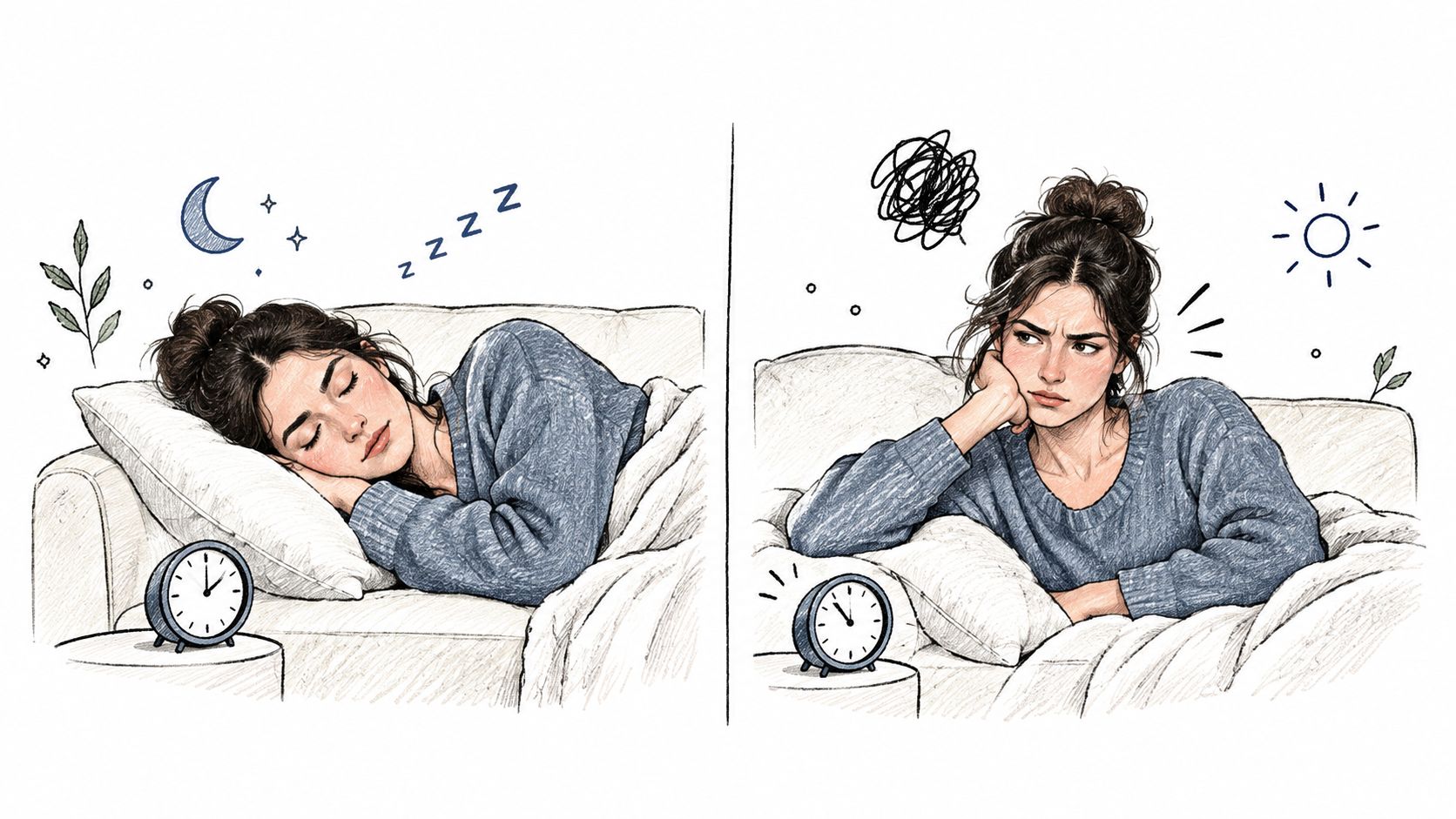
A nurse between night shifts, an athlete between training sessions, and an office worker after lunch have different demands on their time. Choose a routine that fits the next obligation, and reduce distractions where you can. Setting up daytime rest in a comfortable home can make it easier to settle when daylight or household noise gets in the way.
Practical rule: Judge the nap by minutes asleep, not by how long you were horizontal.
How Long a Nap Should Actually Last
A controlled afternoon study published in 2006 tested five conditions: no nap, and naps containing precisely 5, 10, 20, or 30 minutes of actual sleep. Among those durations, the 10-minute nap produced the strongest mix of rapid benefit and low after-effects. Participants showed immediate improvements in sleep latency, subjective sleepiness, fatigue, vigor, and cognitive performance, with some benefits continuing for as long as 155 minutes after waking. The 30-minute nap did the opposite at first. Alertness and performance dropped, consistent with sleep inertia, before later benefits emerged.
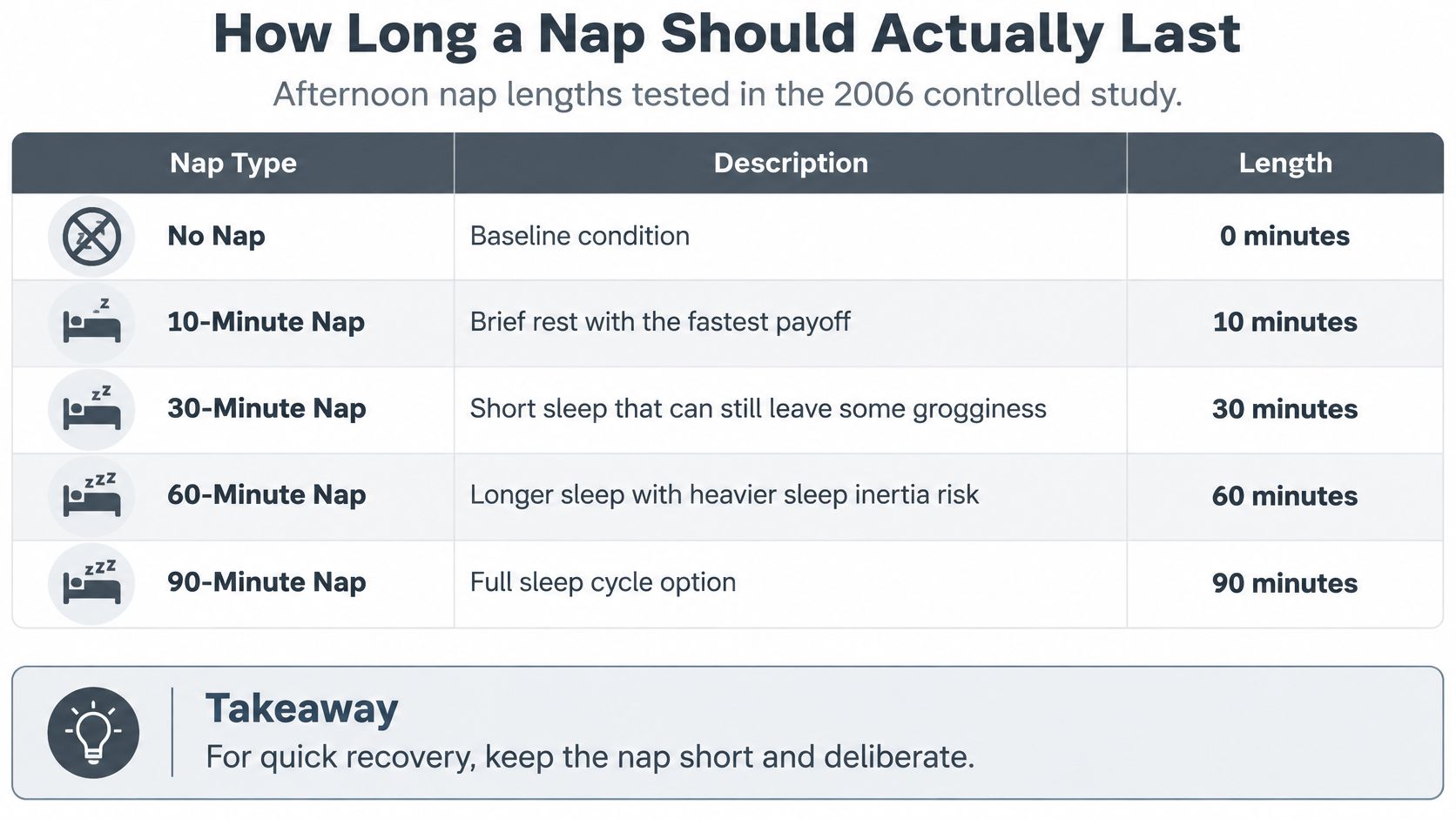
Opportunity is not sleep time
NASA's controlled-rest research separates the scheduled window from the minutes you spend asleep. Pilots received a 40-minute in-seat nap opportunity. 93% obtained some sleep, and average total sleep time was 26 minutes. That rest was tied to better performance and alertness, a lower risk of unintentional sleep during cruise, and elimination of microsleeps during critical flight phases. A 40-minute window yielded about 26 minutes of sleep, not 40.
If you need to be sharp soon, stay near that 10-minute sleep target. If fatigue is heavy and you can absorb a slower wake-up, a structured longer opportunity still has a place. Aviation crews aren't a template for every adult, and a 40-minute nap isn't a daily prescription. For a plain comparison of durations, see this look at the best nap length for energy. A guide to the benefits of naps is useful background for why the break is worth protecting.
This short clip shows a simple afternoon reset you can pair with that duration choice.
The Ten-Minute Pre-Nap Wind-Down Routine
Daylight and ordinary household noise work against you at 2 p.m. in a way they don't at midnight. CDC and NIOSH guidance is specific about the room: make it very dark with opaque coverings or an eye mask, cut noise with earplugs or by silencing nonessential alerts, and keep it comfortably cool, about 65-68°F (18-20°C). Those three changes do more for sleep onset than another scroll through your messages.
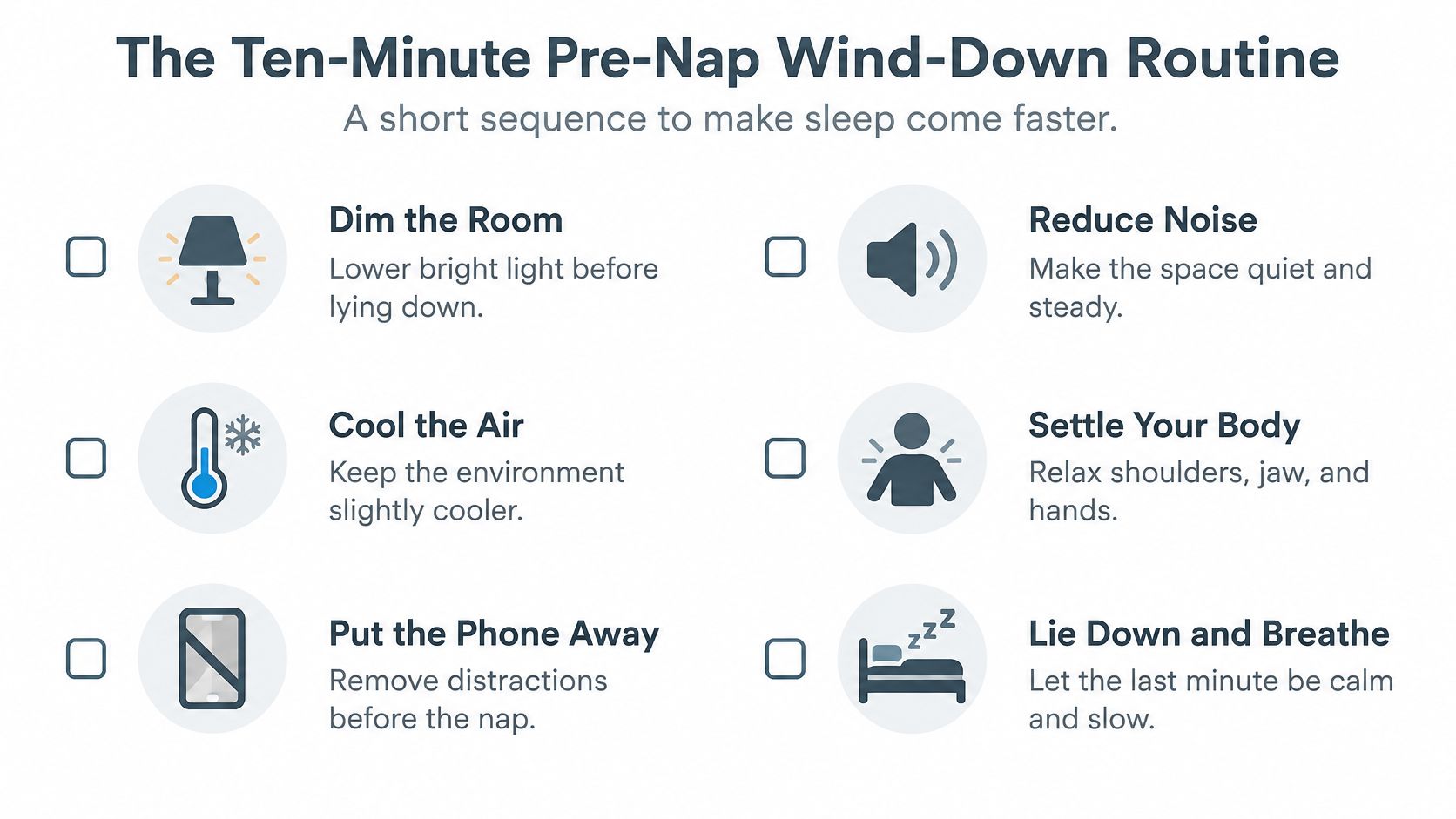
Run this before you lie down
You can finish the sequence in under ten minutes. Don't turn it into a second work session.
- Kill the light. Close blackout curtains, cover indicator lights, and put on an eye mask if the room still glows.
- Silence the phone, don't just flip it. Face-down still buzzes. Do Not Disturb, or leave it in another room with the alarm audible.
- Cool the air. A light layer is fine. If you're shivering, you've gone too far and you'll stay alert.
- Drop the problem. Decide the next task waits until after you wake. Unfinished loops keep the nervous system on duty.
- Breathe slowly, then scan down. A longer exhale, then soften feet, calves, hands, shoulders, and jaw. Stop at the jaw. That's where tension tends to linger.
If your mind keeps bargaining, use a short practice from these relaxation techniques for sleep and keep it under a few minutes. The wind-down is a cue, not a project.
A dark, quiet, cool room won't guarantee sleep. It removes the barriers that make a daytime attempt fail before it starts.
Choosing the Right Nap Type for Your Schedule
Match the nap to the next obligation, not to a favorite clock time. A review of nap timing and cognition puts the post-lunch dip at about 1:00-4:00 p.m., when afternoon naps are often more restorative than early-morning or evening ones. The same review warns that long naps and naps close to bedtime can disturb nighttime sleep by shifting the sleep-wake rhythm. Someone with a 10:30 p.m. bedtime can try a 10- to 20-minute nap around 1:00-3:00 p.m. An evening nap only makes sense when recovery outweighs the hit to the main sleep.
NIOSH shift-work guidance is more flexible than "nap after lunch." Early morning, mid-afternoon, and nighttime can all work, and many people nap poorly late in the morning or early in the evening. A short nap before a night shift supports alertness. A 60-90 minute nap after a shift fits when sleep debt is the priority. Consensus guidance in that same material separates 15-20 minute alertness naps from about 90-minute recovery naps, and warns that longer naps within 4-6 hours of the main sleep can make nighttime sleep harder.
Three options, one decision
| Nap type | Duration | Best timing | Primary benefit | Main risk |
|---|---|---|---|---|
| Alertness nap | About 15-20 minutes | Early-to-mid afternoon, or before a demanding shift | Sharper wake-up with little inertia | Too short if you needed real recovery |
| Recovery nap | About 60-90 minutes | After a shift, when the next sleep isn't close | Pays down sleep debt | Can shove bedtime later |
| Caffeine nap | About 20 minutes after caffeine | Not after mid-afternoon if nights are fragile | Faster alertness once you're up | Dose and timing can wreck nighttime sleep |
In the studied caffeine-nap protocol, people took about 5 mg/kg of caffeine right before a 20-minute nap opportunity. The nap period began after about 10 minutes of settling, and caffeine plus nap beat caffeine alone or placebo on subjective sleep outcomes, as reported in research on the caffeine-nap method. For a 70-kg adult, 5 mg/kg is about 350 mg, near the high end of a single dose. A lower dose is wiser if you're sensitive, pregnant, anxious, or on relevant medication. A crossover trial in that same line of evidence found caffeine even 6 hours before nighttime sleep more than doubled reported sleep-onset time. Don't stack doses, and don't use this as a nightly sleep aid. Caffeine can mask sleepiness without paying the debt.
Ask one question before you set the alarm: do you need alertness now, recovery later, or practice falling asleep on demand?
Setting the Alarm and Waking Without Grogginess
Start the timer when you intend to sleep, then adjust it with your own sleep-onset latency. If you usually need 10 minutes to drop off, a 30-minute alarm can hand you 20 minutes of sleep, which is fine, or it can push a fast sleeper into deeper stages. Fast sleepers should set a shorter alarm. Slow starters need a longer protected window, not a longer sleep target.
A review summarized by the European Union Aviation Safety Agency found that naps of 20 minutes or less consistently produced no measurable performance inertia across the reviewed studies. Naps of 30 and 60 minutes produced performance drops right after waking. For naps lasting 30 to 60 minutes, reported sleep inertia ran from about 5 minutes to 30-35 minutes. Inertia also tends to be milder in the daytime than near the circadian low, around 4:00-5:00 a.m.
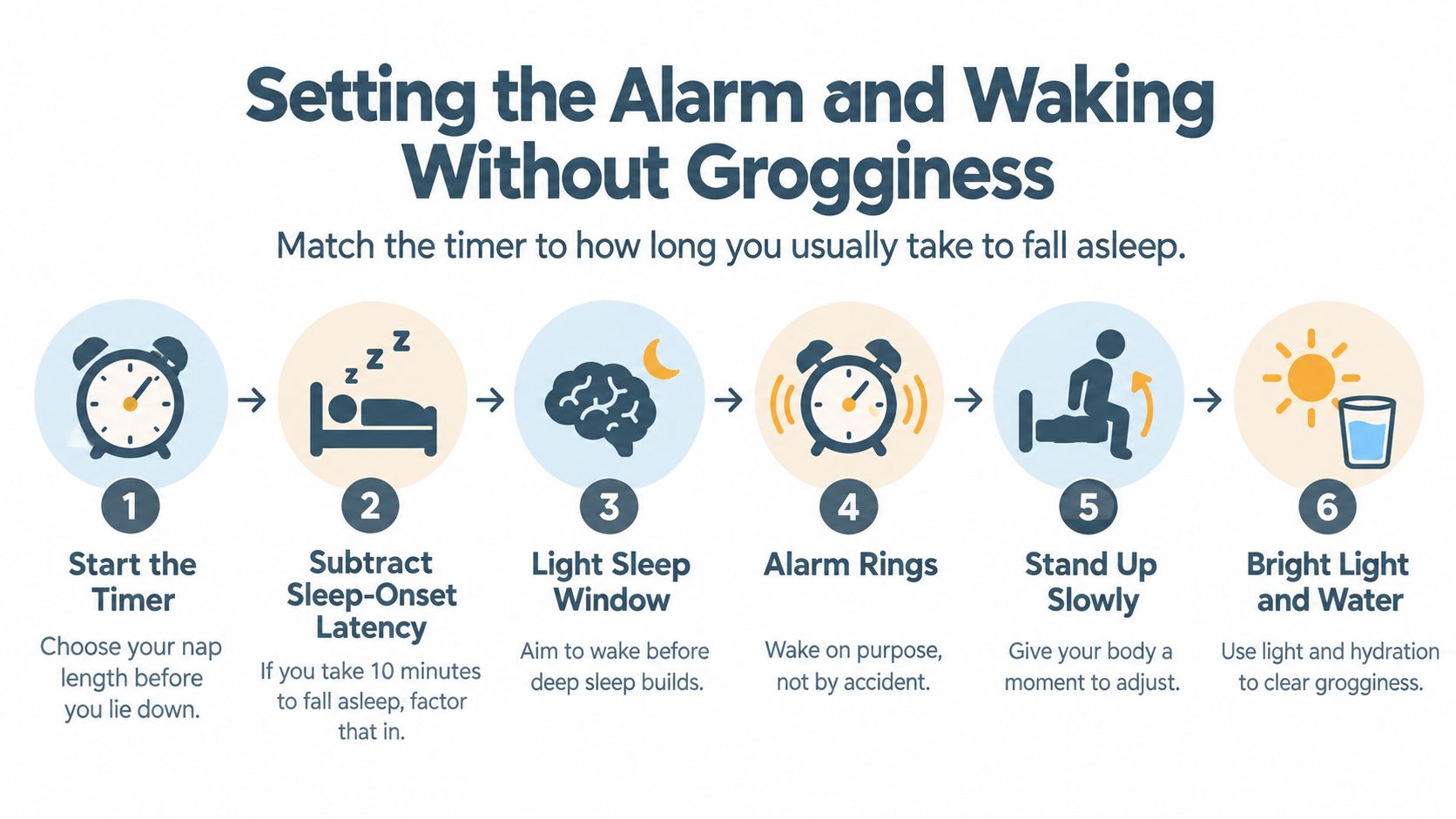
The first minutes after the alarm
Treat those minutes as a transition, not a verdict on the nap.
- Sit up before you stand. Give your eyes a moment. Don't grab the car keys.
- Add light and a glass of water. Both cut the fog faster than lying there negotiating with the alarm.
- Hold a buffer. Wait several minutes, longer after a 30-minute-plus nap, before driving, running equipment, training hard, or making a call that matters.
- Log what happened. Noting onset time alongside sleep tracking alongside nutrition shows whether the alarm is early, late, or about right.
If you never slept, the rest can still count. Quiet time in a dark, cool room lowers the load even when sleep doesn't arrive. For the wake-up side, this guide on how to wake up feeling refreshed covers the transition after the alarm in more detail.
Building a Repeatable Nap Routine That Fits Real Life
The pieces only work as one sequence. Pick the nap type from the next obligation. Protect a 30-40 minute window for a short nap, with about 15-20 minutes aimed at sleep. Run the wind-down, start the timer when you intend to sleep, and leave a buffer before anything sharp. On a training day that buffer includes skipping a heavy lift in the first minutes upright. On a night shift it means the nap ends before report time, not during it.
NASA's pilot data, covered above, is the reminder that a bounded opportunity beats hoping you'll "just rest." Most of those crews slept. They slept inside a planned window, with an end point.
Breathing and a cue, not a knockout
Nasal breathing supports smoother airflow while you rest. If your nose is blocked, a nasal strip can make that easier, but it doesn't replace the alarm. A melatonin-free wind-down fits the same ten minutes: a calming drink, lights already dim, a few lines in a notebook, then slow nasal breaths. Restore+ Sleep Aid is built as melatonin-free support for nitric oxide production, nervous system regulation, and overnight oxygen delivery, developed with sleep and airway doctors and third-party tested. It belongs with the nighttime routine, not as a substitute for keeping a daytime nap short.
Test the sequence for a week. Write down when you lay down, when you think you fell asleep, and how you felt ten minutes after the alarm. Move the alarm by a few minutes based on that onset, not on how guilty you feel for stopping work.
One protected window, one wind-down, one alarm, one buffer. That's the whole routine.
Troubleshooting Naps That Do Not Work
NIOSH guidance for long work hours recommends short daytime naps and notes that sleep deepens with time, reaching slow-wave sleep at roughly one hour. Waking near that point can substantially worsen functioning through sleep inertia. The same guidance suggests waking after about 20 minutes or around 90 minutes. Severe sleep deprivation can pull deep sleep forward, so a short nap isn't automatically safe if you're badly behind.
Match the failure to the fix
- You lie there awake. Extend the protected window, not the sleep target. If onset is slow, a 40-minute opportunity can still yield a short nap. Don't keep adding time until the nap eats the night.
- You wake foggy. Shorten the alarm. You likely crossed the 20-minute line or woke near deeper sleep. Stand, get light, and wait out the inertia before you drive.
- Bedtime slides later. Move the nap earlier. Long naps close to the main sleep steal pressure you needed at night.
- The clock time never fits. Use a short nap before the demanding shift, and save the 60-90 minute recovery nap for after, when it won't collide with the next sleep.
- The caffeine nap backfires. You dosed too late or too high. Drop the caffeine version after mid-afternoon, and don't repeat the dose.
A failed attempt isn't a reason to abandon the skill. Run the routine once this week, note your real sleep-onset latency, and set tomorrow's alarm from that number.
SleepHabits focuses on melatonin-free support for nighttime breathing and restorative sleep, which is the other half of a nap that actually helps. If short daytime rest keeps failing because nights are shallow, their guides and tools on nasal breathing and wind-down routines are a practical next step. Visit SleepHabits and pick one change you can test tonight.