

Feeling exhausted doesn't guarantee restorative sleep. You can go to bed drained and still remain physiologically alert, hold tension in your jaw and shoulders, replay tomorrow's tasks, or wake during the night with breathing discomfort. Relaxation techniques for sleep work best when they address the barrier keeping you awake, rather than treating tiredness as the whole problem.
A useful wind-down routine helps your body reduce arousal, release physical tension, quiet mental activity, and recognize that sleep is approaching. The eight methods below include quick in-bed practices, earlier evening habits, breathing and airway strategies, and complementary SleepHabits options. None is a cure-all, and persistent insomnia, loud snoring, breathing pauses, or suspected sleep apnea deserves professional evaluation rather than a longer bedtime routine.
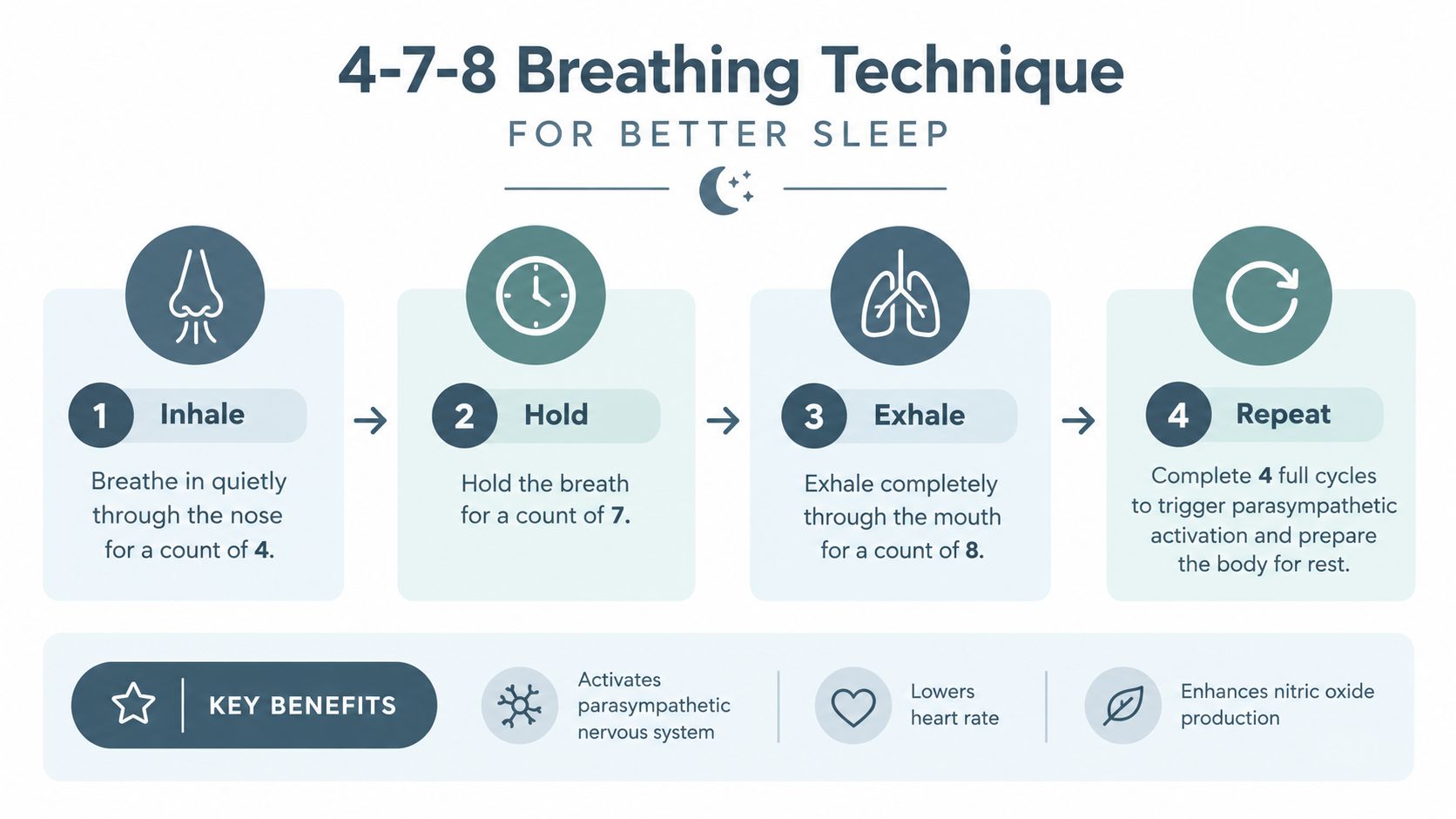
1. 4-7-8 Breathing Technique
The 4-7-8 method gives a racing mind a simple sequence to follow. You inhale through your nose for 4 seconds, hold for 7 seconds, and exhale through your mouth for 8 seconds. A sleep-focused guide recommends repeating the cycle three to four times, so you have a clear starting point instead of an instruction to “breathe completely” without knowing what that means. Sleep Foundation explains the 4-7-8 sequence and its bedtime use.
The extended exhale can make the transition from alertness to rest feel more deliberate. Nasal breathing may also feel more comfortable for people whose congestion or allergies encourage mouth breathing. Nasal Strips gently open the nasal passages to support smoother airflow, but they aren't a treatment for an underlying airway disorder.
How to practice it
Sit or lie comfortably and let your shoulders drop. Exhale fully before beginning, inhale gently through your nose for four, hold without straining, then exhale slowly for eight. If holding your breath feels uncomfortable, shorten the counts while preserving a longer, gentle exhale. The exercise should feel calming, not like a test of lung capacity.
Practice it during the day first. A shift worker might use several comfortable cycles after arriving home, while an athlete could add the method to an evening recovery routine. At bedtime, dim the lights, put the phone away, and repeat the pattern only as long as it remains easy. If focusing on breathing makes you anxious or unusually self-monitoring, switch to PMR or visualization instead. NCCIH notes that some people experience increased anxiety, intrusive thoughts, or fear of losing control during relaxation practices, so personal comfort matters. Its guidance on relaxation techniques supports adapting the practice rather than forcing it.
2. Progressive Muscle Relaxation
Progressive muscle relaxation, or PMR, targets a different problem: a body that hasn't released the day's tension. You tense one muscle group, notice the sensation, and then let it soften before moving through the body. The contrast helps you recognize tension that may have become so familiar you no longer notice it.
PMR has substantial sleep-specific evidence. A 2026 systematic review and meta-analysis included 14 randomized controlled trials involving 957 participants. The pooled result showed a significant improvement in sleep quality, with Hedges g = -1.24, a 95% confidence interval from -1.71 to -0.77, and p < 0.001. The review also found a stronger effect among adults younger than 55, with Hedges g = -1.40, while the result for adults aged 55 and older didn't reach statistical significance. Read the systematic review and meta-analysis in PMC.
A practical body scan
Lie on your back if that's comfortable. Start with your feet, gently tense them, release, and notice the difference. Continue through the calves, thighs, back, shoulders, arms, neck, jaw, tongue, forehead, and scalp. Harvard Health's example pairs this sequence with slow nasal breathing and recommends returning attention to the breath when thoughts interrupt. Follow Harvard Health's progressive relaxation guidance.
- Use moderate tension: Contract firmly, but never cause pain, cramping, or strain.
- Move slowly upward: Larger areas can come before smaller areas such as the jaw and forehead.
- Practice before bedtime: Learning the tension-release contrast during the day can make the routine easier at night.
- Stop if discomfort increases: Relaxation should reduce physical activation, not aggravate an injury.
A desk worker with tight shoulders may find PMR more useful than another breathing pattern. Someone whose mind is calm but whose body feels restless may also prefer this method. Keep the routine simple enough that it doesn't become another task to complete perfectly.
A guided recording can help you maintain the sequence without checking the clock or wondering which muscle comes next.
3. Guided Visualization and Imagery
Racing thoughts rarely respond to an order to stop. Guided imagery gives attention a calm, specific subject instead. A quiet beach, familiar forest path, or safe personal space can provide enough structure to interrupt mental rehearsal. The goal is not to force sleep. It is to keep attention with neutral sensory details while worry gradually loses its grip.
Build the scene through several senses. Notice the sky's color, leaves moving in the distance, the air's temperature, the surface beneath your hands, and a gentle scent linked to the setting. Someone returning from a demanding workday might use a brief beach recording. An athlete may prefer a calm recovery environment instead of replaying training decisions.
NCCIH's overview of relaxation techniques reports that use of guided imagery and/or PMR among U.S. adults rose from 3.8% in 2002 to 6.4% in 2022. The NCCIH overview reports this increase in use. Wider use does not show that imagery works for everyone, but it indicates that structured relaxation has moved beyond a niche self-help practice.
Keep the image stable
Choose one scene and revisit it regularly. A familiar setting works like a well-worn path, reducing the effort needed to create a new one each night. If thoughts interrupt, avoid debating them. Return to one detail, such as water sounds or warm sand under your feet.
A guided audio track, sleep story, or written prompt can help people who find open-ended visualization difficult. Others become more alert when they try to produce a vivid mental movie. Use a broad sense of the place instead, such as “quiet and warm,” or choose PMR if physical tension is the larger barrier.
Keep the exercise flexible. You do not need a perfect scene or an immediate result. The useful change is directing attention away from worry and toward neutral sensory experience, while recognizing that imagery is one option within a broader wind-down routine, not a cure-all.
4. Box Breathing
Box breathing uses four equal phases: inhale, hold, exhale, and hold again. A standard pattern is 4-4-4-4, although a shorter 3-3-3-3 rhythm may feel more comfortable when you're beginning. The symmetry creates a predictable mental anchor, which can help when uncertainty and anxious thoughts keep pulling your attention toward the next day.
This method suits people who prefer structure over imagery. Imagine tracing one side of a square during each phase. Inhale up, hold across, exhale down, and hold across again. Keep the breath quiet and comfortable. If the holds make you feel tense, reduce the count or use ordinary slow breathing instead.
Adapt the pattern to the barrier
A shift worker preparing for daytime sleep may use a few minutes of box breathing after darkening the room. Someone with anxiety-related insomnia may practice it earlier in the evening, when the stakes feel lower, before bringing it into bed. An athlete could use the same predictable rhythm after evening training as a transition from activity to recovery.
Nasal breathing can be part of the exercise if your nose is comfortably open. Mouth breathing products aren't appropriate for everyone, especially when nasal obstruction or possible sleep-disordered breathing hasn't been assessed. If you already breathe comfortably through your nose and choose to explore a product, Mouth Tape is described by its manufacturer as encouraging nasal breathing by keeping the lips comfortably sealed during sleep. Don't use it to mask congestion, breathing difficulty, or suspected apnea.
Safety first: A relaxation exercise should never leave you gasping, dizzy, panicked, or compelled to continue. Return to normal breathing and choose a gentler technique if that happens.
Try box breathing during a stressful daytime moment before using it at night. That lets you learn the rhythm without also worrying about falling asleep. As the pattern becomes familiar, you may find that the visual square itself is enough to interrupt repetitive thoughts.
5. Strategic Sleep Positioning With Nasal Breathing
Airway comfort can become the overlooked barrier to restorative sleep. A person may be mentally relaxed but still wake with a dry mouth, snore, or repeatedly adjust position because breathing feels restricted. Position changes and nasal comfort can support a calmer night, but they shouldn't replace an evaluation when symptoms suggest sleep apnea or another breathing disorder.
Start with the position that feels stable and lets you breathe easily. Side sleeping may feel preferable for someone whose snoring or congestion worsens on the back, while another person may rest comfortably on their back with suitable pillow support. A pillow should keep the neck neutral rather than pushing the head sharply forward. Stomach sleeping can be uncomfortable for the neck and may make relaxed breathing harder for some people.
The practical guidance on relaxation for insomnia includes using these methods during the day, before bed, and after a middle-of-the-night awakening. It lists PMR, deep breathing, body scanning, and autogenic training as options rather than prescribing one universal routine. Review the insomnia relaxation guidance.
Make airway changes gradual
If nasal congestion is the main obstacle, address that problem first. A nasal strip may support smoother airflow through the nose, but it cannot correct every cause of nighttime breathing difficulty. Try any new sleep position or breathing aid while awake, and stop if it causes discomfort, panic, or a sense that you can't breathe freely.
A person who wakes at two in the morning can first sit up, check whether the position or congestion is contributing, and then use slow breathing or PMR. If loud snoring, witnessed pauses, choking sensations, or persistent morning exhaustion are present, seek medical guidance. You shouldn't interpret a quieter night after using an airway product as proof that a breathing disorder has been resolved.
For practical advice on supporting nasal breathing during sleep, see how to breathe through your nose while sleeping. Treat positioning as an experiment in comfort, not a promise of deeper sleep.
6. Journaling and Thought Release
Journaling works before the bedroom becomes a place for mental debate. Writing down unfinished tasks, worries, decisions, and emotions gives each thought a physical location outside your head. It won't solve every problem at night, but it can reduce the urge to keep rehearsing the same concern.
Use paper and a pen if possible. Digital notes can pull you back toward notifications, bright screens, or work. Set aside a short period earlier in the wind-down, then close the journal and move to a less cognitive practice.
Try a simple three-part page
- Unfinished business: Write the tasks or decisions you don't want to forget.
- Worry release: Name the concern, then record the next reasonable action for tomorrow, if one exists.
- Sleep intention: End with a neutral sentence such as, “These thoughts can wait until morning.”
A professional might spend the evening writing down tomorrow's priorities before turning to breathing. Someone with anxiety may prefer a worry list, while another person may find gratitude or a description of a good moment more settling. The format matters less than creating a clear endpoint. Keep the session brief enough that it doesn't become an opportunity to analyze every feeling in detail.
If you wake with a thought at night, write one short phrase rather than starting a full journal entry. The purpose is to reassure your memory that the thought has been captured, then return to rest. This guide to calming racing thoughts offers a related approach to reducing mental activity around bedtime.
A prayer journal can also provide a meaningful structure for people whose spiritual practice helps them settle. HolyJot's prayer journal guide describes ways to begin that kind of reflective routine. Choose a format that reduces pressure rather than creating another nightly obligation.
7. Strategic Lighting Control and Circadian Rhythm Optimization
Your brain uses light and darkness as timing information. Bright daytime light and a dimmer evening environment can make the transition to sleep feel more predictable, while a bright screen or strongly lit room can keep the evening feeling active. Lighting won't resolve every sleep problem, but it can remove a source of unnecessary stimulation from the wind-down.
Start with the morning. Open curtains, spend time outdoors, or work near a bright window after waking when practical. In the evening, lower the brightness of household lighting and choose quieter activities that don't require constant screen use. Shift workers need a schedule-specific approach, with planned light exposure during their active period and darkness when they are preparing to sleep.
Let the room signal rest
Dim lights before your intended bedtime and keep the bedroom as dark as is comfortable. Blackout curtains or a sleep mask may help if streetlights, hallway light, or early morning brightness repeatedly wakes you. Keep screens farther from the bed, and if work makes screen use unavoidable, reduce brightness and avoid switching between stimulating tasks.
This is also a sensible point to introduce a consistent supplement ritual, if you choose to use one. Restore+ Sleep Aid is described in its product information as a melatonin-free option designed to support nitric oxide and oxygen delivery, with development involving sleep and airway doctors and third-party testing for toxins, PFAS, and heavy metals. Those product details don't establish that it will solve insomnia, so treat it as complementary to a routine rather than a substitute for evaluation.
A night shift worker might dim the home environment immediately after arriving from work, use a sleep mask, and pair the change with journaling or slow breathing. A daytime sleeper needs the same principle applied in reverse, with light controlled during the sleep window and a clear light cue after waking. The best schedule is the one you can repeat.
8. Magnesium Supplementation as a Pre-Sleep Ritual
Magnesium can mark the shift from daytime activity to sleep preparation, but it should not carry the whole job of improving sleep. The cue works like a signpost: once you take it according to your chosen routine, work, exercise, screens, and problem-solving can begin to wind down. Pairing that moment with a quiet activity makes the habit behavioral as well as nutritional.
The research on relaxation methods is stronger than the evidence for any single magnesium product or dose for insomnia. Treat the supplement as one part of the routine, not as the active ingredient that solves every sleep problem. It may suit some adults and be unsuitable for others because of medical conditions, medications, allergies, or excess intake from other sources. Check the label, and ask a clinician or pharmacist if you are uncertain.
Build a low-effort sequence
Take the product according to its label rather than copying someone else's schedule. Use water or a non-stimulating drink, then move directly into a quiet activity. The sequence should address a specific barrier without becoming another task to manage.
An athlete might take it before progressive muscle relaxation after training. A busy professional could write a short journal entry, then use box breathing to settle physiological arousal. A shift worker can follow the same pattern before daytime sleep while controlling light and noise.
For guidance on the amount of magnesium that may be appropriate for sleep, read this explanation of how much magnesium for sleep. More is not automatically better. Do not use a supplement to postpone assessment of persistent insomnia, breathing pauses, or significant daytime impairment.
A calming scent may support the environment if you tolerate it, but aromatic products can affect people, pets, and medical conditions differently. ArtNaturals' sleep guide discusses sleep-related scent use, while this safe aromatherapy guide for insomnia covers additional precautions. Keep the sequence short enough to repeat.
8-Method Sleep Relaxation Comparison
| Technique | 🔄 Implementation complexity | ⚡ Speed / Efficiency | 🧰 Resource requirements ⚡ | 📊 Expected outcomes ⭐ | Ideal use cases | 💡 Key advantages / Tips |
|---|---|---|---|---|---|---|
| 4-7-8 Breathing Technique | Low, simple count pattern after practice | Fast, calming within 1–2 cycles | None; optional nasal strips/mouth tape | ⭐⭐⭐⭐, rapid parasympathetic activation, lower HR | Sleep onset, acute stress, shift workers | Practice daytime first; breathe nasally for best effect |
| Progressive Muscle Relaxation (PMR) | Moderate, systematic sequence, needs guidance | Moderate, 15–20 min for full effect (5–10 min shortened) | Quiet space, optional guided audio | ⭐⭐⭐⭐⭐, deep tension release, lowers cortisol | Physical restlessness, tension-based insomnia, athletes | Start large→small groups; use guided audio to maintain focus |
| Guided Visualization & Imagery | Moderate, requires imagination or recordings | Moderate, 10–30 min sessions; immediate mental quieting | Quiet space, optional audio player/app | ⭐⭐⭐⭐, reduces rumination, aids sleep onset | Racing mind, anxiety-related insomnia, those with mobility limits | Engage all five senses; use reputable guided recordings |
| Box Breathing (Square Breathing) | Low, symmetric inhalation/hold/exhale/hold | Fast, calming in 2–3 minutes for most | None; optional nasal strips/mouth tape | ⭐⭐⭐⭐, rhythmic stabilization, reduces anxiety | Panic/anxiety before sleep, quick wind-down for shift workers | Visualize a box; start at comfortable count (3–4 secs) |
| Strategic Sleep Positioning + Nasal Breathing | Moderate–High, positional change + adaptation | Gradual, benefits within 1 week; optimal at 2–4 weeks | Mouth tape, nasal strips, supportive pillows | ⭐⭐⭐⭐⭐, improved airway, reduced snoring, deeper sleep | Chronic mouth-breathers, snorers, athletes seeking recovery | Start gradual; use tape/strips 30 min before bed; allow 2–4 weeks to adapt |
| Journaling & Thought Release | Low, short disciplined practice | Fast, 5–15 min to reduce pre-sleep rumination | Pen and paper (recommended) | ⭐⭐⭐⭐, lowers cognitive load, reduces nighttime anxiety | Busy professionals, shift workers, worriers | Write by hand; limit to 15 min and end with an intention |
| Strategic Lighting Control & Circadian Optimization | Moderate, behavioral changes and consistency | Slow–Moderate, 1–2 weeks to notice benefits | Natural light or 10,000-lux lamp, dimmable warm bulbs | ⭐⭐⭐⭐⭐, sustainable sleep quality improvements, better daytime alertness | Shift workers, circadian-disrupted individuals, long-term sleepers | Morning bright light + evening dimming; eliminate screens 2–3 hrs before bed |
| Magnesium Supplementation (Restore+) | Low, simple nightly ritual; requires consistency | Moderate, benefits over 2–4 weeks; supports immediate relaxation | Supplement (Restore+), water/tea; medical review if meds present | ⭐⭐⭐⭐, physiological relaxation, supports recovery and sleep architecture | Athletes, those with suspected deficiency, chronic poor sleepers | Take 30–45 min before bed; combine with behavioral routines for best results |
Build a Wind-Down Routine You Can Repeat
You don't need to use all eight relaxation techniques for sleep on the same night. A long sequence can become another performance task, especially if you start watching the clock and judging whether each step is “working.” Choose the method that matches the barrier you notice most often.
If your evenings stay bright and mentally active, begin by dimming lights and reducing screen stimulation. If unfinished tasks keep circling, journal before you get into bed. If your body feels tense, try PMR. If thoughts keep moving but your muscles feel comfortable, use guided imagery. If you feel physiologically alert, choose 4-7-8 breathing or box breathing, but stop if breath control increases anxiety.
A realistic sequence might look like this:
- Earlier evening: Dim the room and finish demanding work before the bedroom becomes the place where you solve problems.
- Mental release: Write down tomorrow's tasks, worries, and one next action for anything that needs attention.
- One breathing method: Choose either 4-7-8 breathing or box breathing. Don't switch repeatedly in search of a perfect pattern.
- Physical release: Add PMR if your jaw, shoulders, back, or legs still feel tight.
- Airway comfort: Adjust your position and address nasal congestion. Products intended to support nasal breathing may be complementary, but they aren't substitutes for medical assessment.
- Quiet repetition: Keep the same basic order for several evenings before deciding whether it suits you.
Relaxation may also be useful after a nighttime awakening. Academic guidance supports practicing relaxation during the day, before bed, and again during the night when you wake and can't return to sleep. If you become frustrated while lying awake, leave the bed for a quiet activity in dim light and return when you feel sleepier. The goal is to reduce struggle, not to force sleep through a longer exercise.
Track only a few signals. Note which method you used, whether falling asleep felt easier, how often you woke, and whether you felt refreshed in the morning. Avoid inventing a precise score if that makes you more vigilant. Look for a consistent personal pattern instead.
SleepHabits options such as Restore+ and nasal strips may fit into a broader wind-down routine for adults who want melatonin-free support or help with nasal airflow. Use them as complementary tools, not as treatment for suspected sleep apnea, persistent insomnia, or unexplained daytime sleepiness. If you snore loudly, experience breathing pauses, wake choking or gasping, or struggle with significant daytime impairment, speak with a healthcare professional.
Give one change a fair trial, keep the routine manageable, and adjust based on your response. You can also explore this sleep guide from ArtNaturals for additional environmental ideas, while keeping your core plan focused on repeatable habits rather than an ever-growing list of products.
SleepHabits offers melatonin-free sleep support, nasal strips, and mouth-breathing tools that can complement breathing exercises, light control, journaling, and other wind-down habits. Visit SleepHabits to explore the available options and build a nighttime routine that fits the way you sleep.