

Popular advice treats sleeping with your mouth taped shut as a simple hack. Put tape on, breathe through your nose, wake up better. That order is backwards.
Mouth taping might suit some adults, and it might make breathing harder for others. The difference usually isn't willpower or tape quality. It's whether your nose can carry enough air all night and whether snoring is signaling a medical problem. Start with that screen, not with a purchase. If you can't breathe freely through your nose while you're awake and calm, don't test the question while you're asleep.
Who Can Try Mouth Taping Safely
Can you breathe freely through your nose right now, with your lips closed and no effort? Try it sitting down, then lying down. If air feels thin, noisy, or blocked on one or both sides, that's your answer for tonight. No tape.
Mouth taping means placing a strip over closed lips during sleep to encourage nasal breathing. It's a conditional habit, not a treatment for snoring, sleep apnea, congestion, or poor sleep. People often confuse a habit with a diagnosis. Tape can keep lips together, but it can't open a blocked nose, shrink enlarged tonsils, or keep a collapsing airway open.
Work Through the Screen Line by Line
Use the checks below. One item in the right column is enough to pause.
| Check | Reasonable to Try | Get Medical Advice First |
|---|---|---|
| Nasal breathing at rest | Nose clears freely when lying down | Nose stays blocked for days or most nights |
| Congestion or allergies | Occasional and clears with treatment | Persistent or seasonal congestion that limits airflow |
| Deviated septum or enlarged tonsils | Not diagnosed | Diagnosed or suspected |
| Asthma | Well controlled with no night symptoms | Night wheeze or poorly controlled asthma |
| Sleep apnea | Not suspected and never tested | Diagnosed, suspected, or treated with CPAP or an oral appliance |
| Snoring | Light and occasional | Loud and habitual, or with pauses or gasping |
| Claustrophobia or panic | Calm with a covered mouth or face | Panic when the mouth or nose feels covered |
| Heart or lung disease | None diagnosed | Any diagnosis |
If your main problem is that you can't breathe comfortably through your nose, treat that as the first problem to solve. Don't tape over it and hope your nose adapts overnight.
Why Averages Can Mislead You
A group average can hide the people who get worse. In medical reporting on a 2024 study of more than 50 patients, overall airflow improved when the mouth was occluded, but participants with mild airflow limitation improved while those with the worst airflow limitation became measurably worse.
That's the practical point. Say two people both mouth breathe. One has a clear nose and a habit of letting the jaw drop. The other mouth breathes because nasal airflow is already limited. Tape changes the first person's route. For the second person, it may remove the backup route.
Plain rule: If any right-hand cell describes you, skip the tape and speak to a clinician first. If every cell is green, your next step is a daytime trial, not a full night.
Don't use tape to mask possible sleep-disordered breathing. Severe congestion, suspected sleep apnea, cardiovascular disease, or substantial nighttime breathing difficulty needs assessment first. The same applies if you already use CPAP or an oral appliance. Adding tape changes your setup, so the clinician managing that treatment should know before you experiment.
Choosing Tape Styles and Nasal Strips
The first comparison is whether your nose feels clear enough for comfortable breathing. Tape styles differ in material, fit, and how easily they come off, so choose one that feels manageable on your skin and lips.
| Tape Type | Best For | Trade-off |
|---|---|---|
| Vented or cut-out tape | Leaving room for airflow | Less coverage across the lips |
| Hydrating Roll Mouth Tape | Sensitive skin | Facial hair may affect adhesion |
| Paper or surgical-style tape | A simple, low-cost option | May irritate skin or pull during removal |
Vented or cut-out tape leaves room for airflow when needed. The SleepHabits X Tape is cut to allow airflow, while its Roll Mouth Tape is hydrating and suited to sensitive skin. The Hydrating Roll can also be cut to leave room for airflow, and the tape can be gently removed at any time.
Paper or surgical-style tape may feel familiar, but removal can pull at the delicate skin around the mouth. Avoid household tape, duct tape, and strong athletic tape, which are not designed for use on lips or for gentle removal.
Facial Hair and Skin Checks
Facial hair can make it harder for adhesive to hold against the skin. The Roll Mouth Tape may not stick as strongly to facial hair, though many customers with trimmed stubble use it effectively. If you have a fuller beard around the lips, adhesion may be weaker. Pressing harder can irritate skin without improving the fit.
If a new adhesive causes redness, itching, or burning, remove it and stop using it. Skin tolerance can vary, so pay attention to how your lips respond.
Where Nasal Strips Fit
Nasal strips can be layered with mouth tape when you can already breathe comfortably through your nose. They sit on the outside of the nose and may help support airflow. Learn more about how nasal strips are used for snoring before combining them with tape.
Start with your nasal breathing, then consider whether a strip feels helpful. If breathing through your nose remains difficult, leave the tape off that night and address the nasal issue first.
For purpose-made options, SleepHabits offers Mouth Tape. Its Roll Mouth Tape is hydrating and suited to sensitive skin, while the X Tape is cut to allow airflow when needed. Choose based on fit, skin comfort, and how easily you can remove the tape.
How to Apply Mouth Tape Step by Step
For the first week, test the tape during the day before any night use. New users should learn how it feels, how their nose handles the full airflow, and how quickly they can remove it while they're fully awake. A calm ten minute trial on the sofa tells you more than a determined first night in bed.
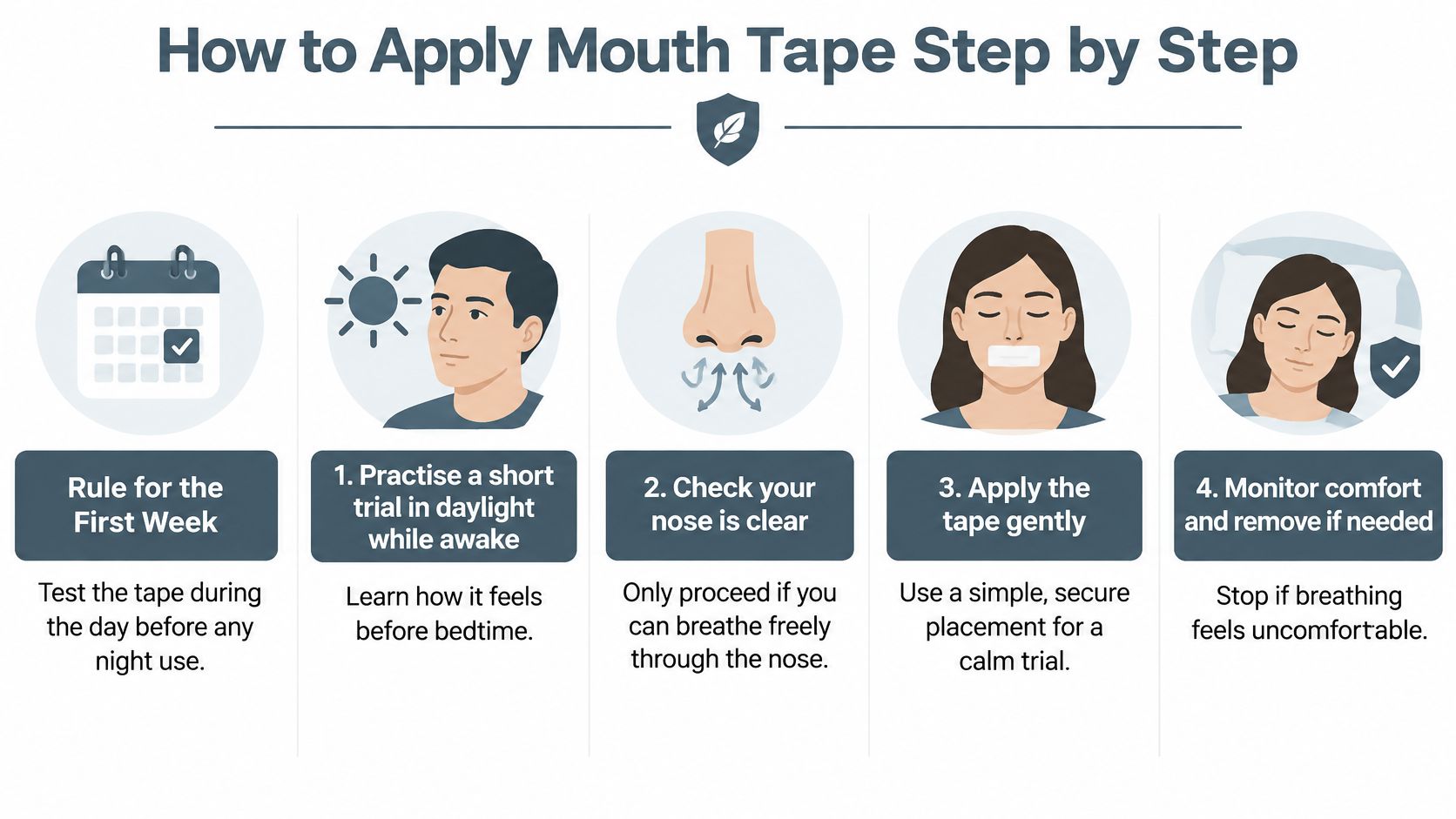
The Nighttime Sequence
- Practise a short trial in daylight while awake. Sit or lie down, breathe through your nose, talk yourself through removal, and peel it off once so the motion is familiar.
- Clean and dry your lips. Don't use lip creams or oily moisturizers right before application, because oils weaken the hold and cause sliding or repeated reapplication.
- Cut or select a strip long enough to cover both lips. Fold a tiny corner over if the product allows it, so you have a tab you can lift quickly.
- Centre the strip over closed lips. Press gently along the edges. Keep both nostrils completely open and unobstructed, and don't stretch the tape tight across your mouth.
- Breathe slowly through your nose. Stay awake for a few minutes. Air should move freely without you pulling harder, flaring your nostrils, or counting breaths to stay calm.
- Remove it at once if anything feels wrong. Air hunger, panic, a blocked nose, nausea, or a strong urge to mouth breathe means you skip the night. Don't wait to see whether sleep fixes it.
- Peel from one corner in the morning. Support the skin with the other hand and remove it slowly. Then note how you slept before the details fade.
If you have to convince yourself that breathing feels fine, it doesn't feel fine enough for sleep.
What a Good First Night Looks Like
Judge the trial by boring signs, not by a dramatic transformation. Breathing stays quiet. You don't wake repeatedly to adjust the tape. Your nose stays clear enough that you aren't aware of every breath. In the morning, you have no new headache, unusual grogginess, sore lips, or extra fatigue.
Write down four things for the first few nights.
- Nasal ease: Clear, partly blocked, or blocked when you applied the tape
- Tape survival: Stayed on, loosened, or removed during the night
- Awakenings: None remembered, brief, or repeated
- Morning state: Headache, dry mouth, energy, and any partner report of snoring or gasping
That short log prevents a common mistake. People remember whether the tape stayed on, but they forget whether they slept better. Staying on is a product detail. Breathing comfortably and waking normally are the outcomes that matter. Store unused tape in a dry place away from direct sunlight, and replace any piece that has lost its backing cleanliness or been handled repeatedly.
Troubleshooting Symptoms and When to Stop
Most early problems are mechanical. Skin is oily, placement is crooked, stubble breaks the seal, or the adhesive doesn't suit you. Fix those once or twice. Breathing problems are different. They are not a technique challenge to push through.
| Symptom | Likely Cause | What to Do |
|---|---|---|
| Tape loosens or peels off | Dry or oily lips, or stubble | Clean and dry lips, trim facial hair, try a gentler adhesive |
| Blocked nose or air hunger | Congestion or inflamed nasal passages | Remove tape at once, skip the night, treat congestion first |
| Panic or feeling trapped | Claustrophobia or discomfort with a covered mouth | Remove tape and stop the trial |
| Waking repeatedly | Tape irritating the skin or pressing too tight | Shorten use, check placement, reduce pressure |
| Skin redness or irritation | Adhesive sensitivity | Stop use and patch-test before the next attempt |
| Morning headache or extra fatigue | Reduced airflow or disturbed sleep | Stop the trial and arrange a clinician review |
Measure the Right Things
Don't ask only whether your mouth stayed closed. Watch mouth leak, snoring, awakenings, sleep continuity, and next-day alertness. If you already use a monitor, oxygen readings can add context, but a consumer gadget doesn't diagnose sleep apnea and a reassuring number doesn't cancel symptoms.
Results vary for a reason. A 2025 review indexed by PubMed found that some small studies reported improvements in snoring or selected apnea measures, while other evidence showed no benefit, including a study involving people with asthma. The authors emphasized inconsistent methodology and insufficient high-quality data.
That mixed picture matches the physiology. If your nose is clear and your mouth falls open, closing your lips may change little beyond dry mouth. If your baseline airflow is poor, closing your mouth can reduce your breathing reserve. The same action produces different results because the starting airway is different.
Stop rule: Remove the tape and skip the next night if you have nasal blockage, air hunger, panic, repeated awakenings, headaches, or worsened fatigue the next day.
Try easy fixes only for easy problems. Clean skin, trim stubble, centre the strip, use less pressure, or change adhesive after a patch test. Don't switch to a stronger tape to overpower discomfort. Don't add more tape. Don't tape over irritated skin.
Symptoms that continue after your nose is clear need medical review, not another adjustment. Tape can't fix witnessed breathing pauses, gasping, loud habitual snoring, or morning headaches that keep returning. Those signs point beyond lip position.
Why Nasal Breathing Changes Airflow in Sleep
Air moves through your airway a bit like water through a hose. Narrow the passage and you need more push to move the same amount. Widen it and flow takes less effort. The route matters because the nose and mouth don't create identical conditions once you're asleep and your airway muscles relax.
The sketch below is a simple visual reminder that airflow, comfort, and sleep position interact.
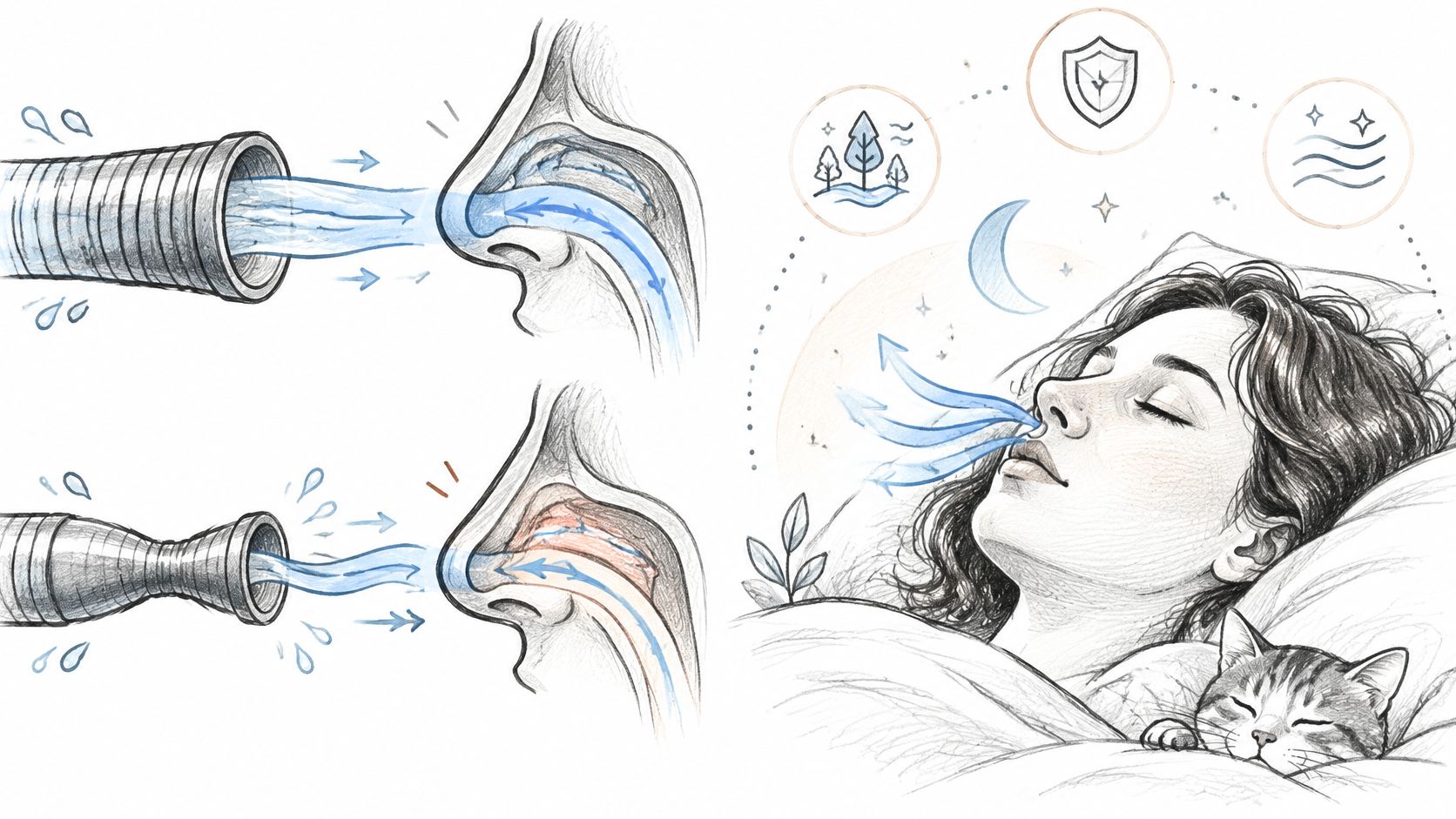
Your nose is built as the main route. It filters, warms, and humidifies incoming air before it reaches your lungs. When your lips part and your mouth takes over, air bypasses much of that preparation and the upper airway can behave differently. For a broader comparison, see nasal breathing versus mouth breathing during sleep.
What the Resistance Numbers Mean
In a randomized, single-blind crossover study of 12 healthy adults with normal nasal resistance, median supine stage-2 sleep airway resistance was 12.4 cmH₂O·L⁻¹·s⁻¹ during oral breathing versus 5.2 cmH₂O·L⁻¹·s⁻¹ during nasal breathing, approximately 2.4-fold higher with oral breathing.
You don't need to memorize the units. Resistance is the pressure burden required to move air. Higher resistance means more effort for the same flow. The video below gives additional visual context for how breathing route and airway effort connect.
Those numbers support a plausible mechanism, not a promise. The volunteers were healthy and had normal nasal resistance. They weren't selected for blocked noses or obstructive sleep apnea. Lower resistance during nasal breathing in that setting doesn't prove tape improves oxygenation, sleep quality, or apnea severity in a different person.
The Backup Route Problem
Mouth breathing is sometimes compensation. If allergies, swelling, or anatomy narrow your nose, your mouth becomes the reserve pathway your body uses to maintain airflow. Closing it can remove that reserve. That's why guidance on ways to reduce mouth breathing without blocking airflow is useful context from Pain and Sleep Therapy Center before you consider sealing your lips.
Mouth taping rests on the nasal breathing principle. The principle only helps when your nose can carry the airflow for the whole night, including when you roll onto your back or congestion shifts from one side to the other.
What the Research Shows So Far
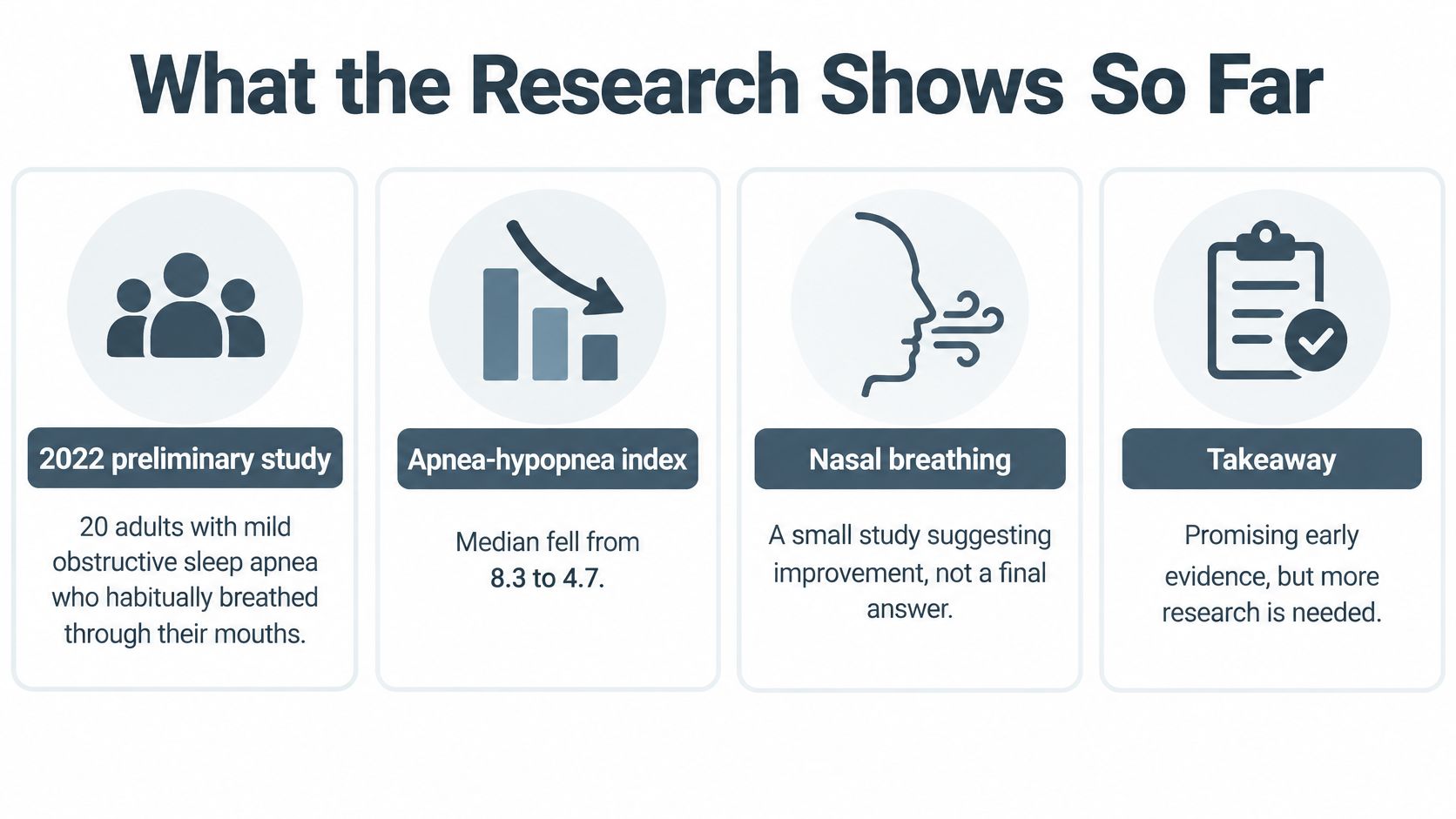
The headline result on mouth taping comes from a small preliminary study, so the finding and its limits belong together. In the 2022 preliminary study discussed by the American Academy of Dental Sleep Medicine, 20 adults with mild obstructive sleep apnea who habitually breathed through their mouths used mouth tape for one week. Their apnea-hypopnea index fell from a median of 8.3 to 4.7 events per hour.
The apnea-hypopnea index, or AHI, counts breathing interruptions per hour. The reported decrease was just under 50%, and snoring and oxygen-desaturation measures also improved. Those numbers can sound conclusive, especially in a headline. Study design determines how firmly they can be interpreted.
Read the Limits Before the Result
The 2022 preliminary study discussed by the American Academy of Dental Sleep Medicine included 19 men and 1 woman, lasted seven days, and had no control group. Without a comparison group, it is difficult to distinguish a tape effect from ordinary night-to-night variation, regression to the mean, changes in sleep position, or participants paying closer attention to sleep during the study week.
Who was studied matters, too. Participants were selected without significant nasal obstruction, so the findings do not answer whether taping is suitable for people whose mouth breathing compensates for blocked nasal passages. That is a different question from whether a selected group with mild apnea showed changes during a short study.
| Study | Participants | Duration | Headline Result |
|---|---|---|---|
| 2022 preliminary mouth-tape study | 20 adults with mild OSA | 7 days | AHI fell from 8.3 to 4.7 events per hour |
| 2024 occlusion airflow study | More than 50 patients | Study occlusion sessions | Mild limitation improved while worst limitation worsened |
| Crossover study in healthy adults | 12 adults | Crossover sleep sessions | Stage-2 airway resistance 12.4 oral vs 5.2 nasal |
| 2025 systematic review | 10 studies | Varied | Mixed results, benefit not established |
How to Read the Next Headline
Before sharing or acting on a new claim, check what the study tested:
- Sample size: Could a small number of unusual results substantially shift the average?
- Control group: Was tape compared with no tape, sham tape, or another intervention?
- Duration and selection: Did the study last beyond a few nights, and were people with nasal obstruction excluded?
The evidence remains an early signal that needs larger controlled trials. It does not establish that mouth taping treats sleep apnea, reliably stops snoring, or produces lasting recovery benefits. It also cannot establish the opposite for every person. With evidence this limited, any personal trial should be narrow, brief, and easy to stop.
Decide Tonight Whether Mouth Taping Fits Your Sleep
The first decision is whether your nose can breathe freely and whether symptoms call for medical advice. Mouth taping is only a conditional trial for adults who pass both checks. Mouth taping does not treat snoring or sleep apnea, and symptoms that suggest either deserve evaluation.
The flowchart below lays out the screening decision before you consider a trial.
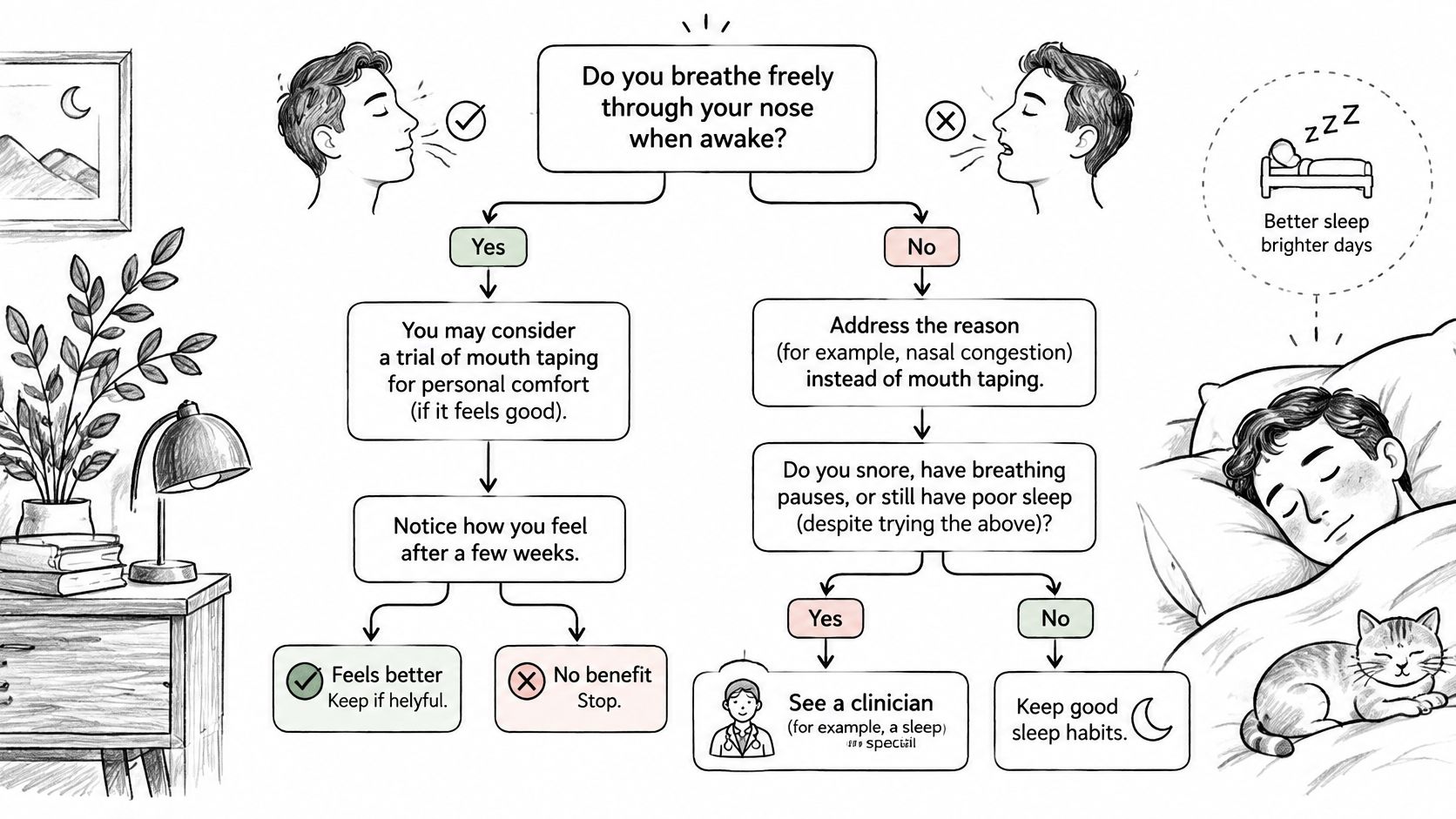
Choose medical advice over experimentation if you have loud habitual snoring, witnessed breathing pauses, gasping or choking at night, morning headaches, excessive daytime sleepiness, or high blood pressure. One symptom warrants attention. Several together make tape the wrong next step.
Cleveland Clinic guidance on mouth taping reports that scientific evidence remains insufficient because studies are few and generally involve very small populations. It describes alternatives such as side sleeping, nasal strips, treatment for nasal congestion, and medical evaluation for possible sleep apnea.
A Three Step Decision Path
- Pass every screening check. If one check fails, stop and address the issue or book a consultation.
- Complete a daytime trial. Check that nasal breathing feels easy, removal is calm, and your skin has no reaction.
- Try one or two nights with a log. Continue only if breathing stays comfortable, awakenings do not increase, and mornings feel no worse.
If a step fails, choose an alternative: sleep on your side, address congestion, try a nasal strip without tape, improve oral hygiene for dry-mouth concerns, or ask a clinician about snoring. These options let you address the concern without taping your mouth.
SleepHabits offers mouth tape, and its routine has 3 steps: Restore+, then Nasal Strips, then Mouth Tape. Treat tape as an optional final step, only after the health checks. Mouth tape is not intended to cure, prevent, or treat any health condition or disease. If your nose is not clear tonight, leave your mouth untaped.
If you have passed the nasal and medical screen and want a purpose-made option for a cautious daytime trial, SleepHabits offers mouth tape and nasal strips designed to encourage nighttime nasal breathing. Test while awake, and stop if breathing feels restricted.