

Why do so many people treat a blocked nose as a comfort problem, then wonder why they wake up gasping, snoring, or exhausted? Nasal congestion breathing difficulty starts as an airflow problem. Air can't get through a narrowed passage easily, so you work harder for each breath, switch to your mouth, and sleep worse. Most stuffiness clears on its own. Some doesn't, and that's where another spray stops being the answer.
Causes of Nasal Congestion and Their Breathing Impact
Different causes block your nose in different ways, for different lengths of time. Matching the pattern to a likely cause tells you whether home care makes sense or whether you need a clinician.
Common Causes of Nasal Congestion and What They Do to Breathing
| Cause | Typical duration | Effect on breathing | First step |
|---|---|---|---|
| Viral cold | Usually 7 to 10 days | Stuffy nose, worse when lying down | Saline rinses, fluids and rest |
| Allergic rhinitis | Seasonal or ongoing | Congestion with itchy or watery eyes | Allergen control and clinician-directed treatment |
| Chronic rhinosinusitis with nasal polyps | Weeks to months | Persistent blockage in both nostrils | Evaluation by an ENT clinician |
| Decongestant spray rebound | Starts within days of overuse | Blockage returns worse after each dose wears off | Stop the spray and seek advice on withdrawal |
| Structural obstruction (deviated septum, enlarged turbinates) | Constant | Often one side, reduced airflow at night | ENT assessment |
| Sleep-related breathing problem | Ongoing, every night | Snoring, pauses, gasping, poor sleep | Sleep evaluation |
A cold is the familiar one. Swelling and mucus narrow both sides, lying flat makes it feel worse, and it usually clears within 7 to 10 days. Allergic rhinitis behaves differently. It flares with pollen, dust, or pet dander, brings itching and watery eyes, and keeps returning while the trigger stays in your environment. Reducing exposure at home helps, and guidance on home air purification for allergy season can be useful context if indoor allergens are part of your pattern.
Chronic rhinosinusitis with nasal polyps (CRSwNP) sits at the persistent end. It's a long-running inflammatory condition where swelling and polyps narrow the passages for extended periods, encouraging mouth breathing and disrupted sleep. Congestion isn't a side symptom here, it's central. A 2020 systematic literature review on CRSwNP found congestion reported by 95-100% of CRSwNP patients in North America, 73-88% in Europe, and 76-81% in Asia.
Those figures describe diagnosed CRSwNP populations, not all adults, so don't read them as how common congestion is in general. The regional spread likely reflects diagnostic criteria, healthcare access, disease severity, and study design more than biology. What the numbers do show is simple. When this disease is present, obstructed breathing almost always comes with it.
Structural problems work differently again. A deviated septum bends the wall between your nostrils, and enlarged turbinates take up space inside the passage, so one side often feels permanently tighter. Rebound congestion is self-inflicted by medication overuse, and sleep-related problems show up mainly at night, even if daytime breathing seems fine.
Three Questions to Find Your Row
- One side or both: Both sides points toward a cold, allergy, or CRSwNP. One side, constantly, points toward structural obstruction.
- More than three weeks: Under that, a cold or allergy flare is plausible. Beyond it, think chronic inflammation, polyps, structure, or rebound.
- Snoring or waking gasping: Yes moves you to the sleep row, whatever else is going on. Your nose may be contributing, but the nighttime breathing itself needs assessment.
Practical rule: Duration plus pattern beats severity. A mild blockage that never leaves deserves more attention than a bad one that's clearly improving.
How a Blocked Nose Makes Breathing Harder
Why does a nose that looks almost open feel completely shut at 2 a.m.? The answer sits in a segment of airway barely a centimeter long.
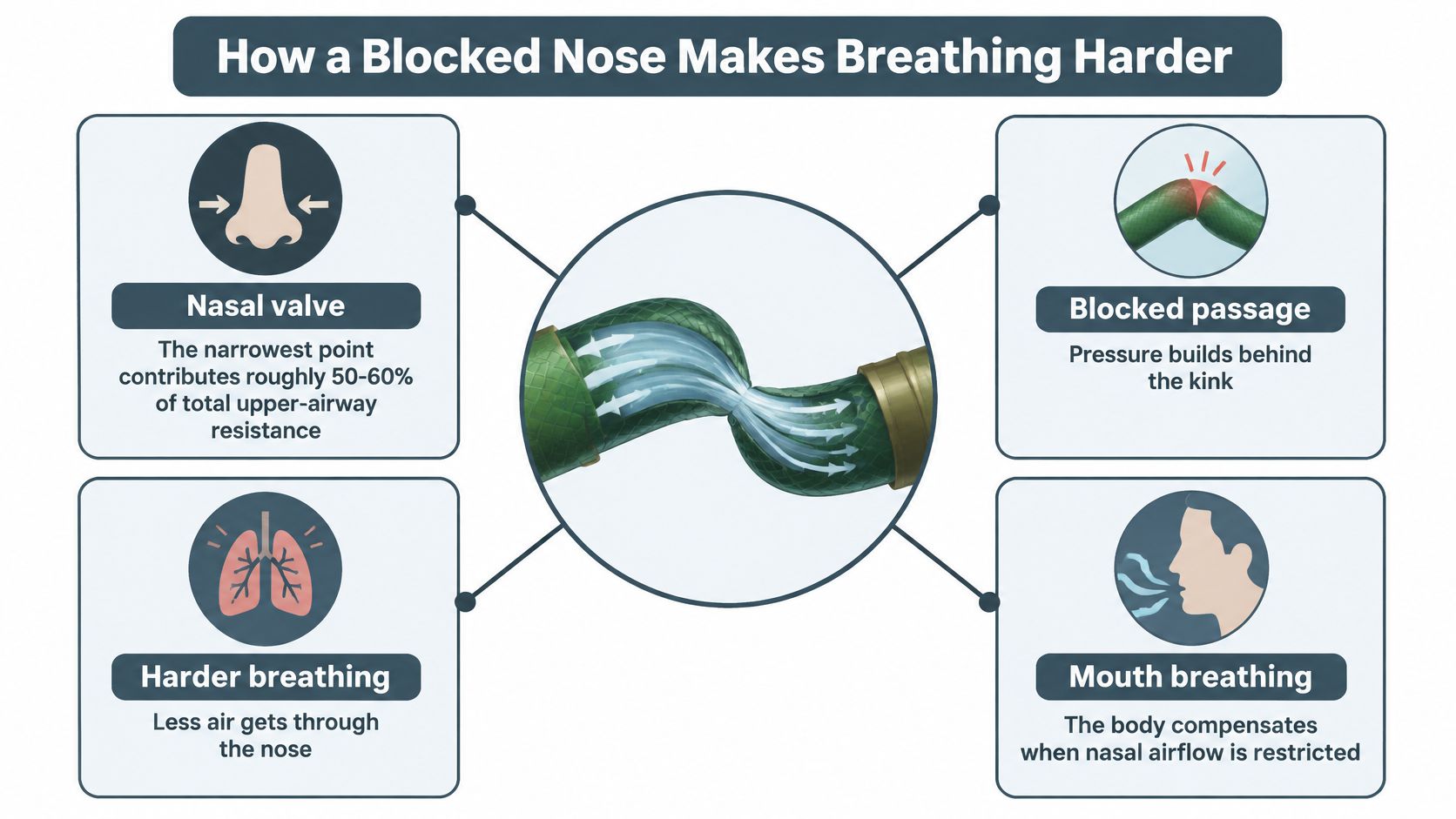
The diagram below maps that hose analogy onto your airway, from the narrow point to the compensation your body makes.
The Nasal Valve Does Most of the Resisting
The nasal valve is the narrowest functional segment of your nasal airway, just inside the nostril. It works like a kink near the end of a garden hose. Pressure builds behind it, flow turns choppy, and small tightening demands far more effort for the same breath.
According to a clinical review on nasal valve obstruction, which attributes approximately 50-60% of total upper-airway resistance to the valve and finds that a 15-20% decrease in its radius markedly increases resistance, you need a larger inspiratory pressure gradient to keep air moving. In plain terms, you suck harder for the same breath.
That nonlinear response explains the nighttime surprise. Say you catch a cold and the lining swells a little. During the day, upright and active, you manage. At night you lie flat, blood shifts toward your head, the lining swells a bit more, and suddenly one side feels shut. The anatomy shifted only slightly. The narrow point just crossed a threshold where effort spikes.
What Happens Downstream
Obstruction also changes how air moves, not just how much gets through. It promotes turbulent jets and more negative pressure downstream, and that suction can pull soft tissue at the back of your throat inward, increasing pharyngeal collapsibility. Your body then does the sensible thing and opens the mouth, particularly during sleep when you cannot consciously compensate.
Clinicians can measure this rather than guess. Rhinomanometry calculates nasal airway resistance from the pressure difference across the nose divided by airflow, as described in this review of adult nasal resistance reference data. That review reported normal total resistance under congested-mucosa conditions around 0.25 Pa/cm³/s, with a 95% reference interval of 0.10-0.40 Pa/cm³/s. Readings above that range indicate higher-than-reference resistance.
A test result and a feeling measure different things. Measured airflow can be only modestly reduced while breathing still feels blocked, because effort and turbulence shape sensation as much as volume does.
Reduced nasal airflow also decreases stimulation of nasal airflow receptors, while the added inspiratory suction promotes downstream narrowing. That combination helps explain why congestion wrecks sleep quality even when daytime oxygenation looks normal. You are not necessarily short of oxygen. You are working against resistance all night, which fragments sleep and pushes you toward mouth breathing.
Notes Worth Taking to an Appointment
Write down two patterns before you see anyone.
- Side pattern: Is breathing consistently worse on one side, or does it alternate?
- Position pattern: Does lying down reliably make it worse within minutes?
Those notes point to where the blockage sits. An ENT clinician can then use nasal endoscopy, the NOSE symptom scale, and objective airflow or resistance testing instead of relying on visual inspection alone. Bring the pattern, not just the complaint.
At-Home Remedies Ranked by Evidence and Safety
Start with the lowest-risk options and match them to your cause. The table below ranks common remedies by risk, not by how dramatic the relief feels.
At-Home Congestion Remedies Compared
| Remedy | Best for | Evidence and limits | How to use |
|---|---|---|---|
| Saline spray or rinse | Colds, allergies, daily stuffiness | Lower risk, no dependence, can be used as needed | Distilled or boiled water for rinses, several times a day |
| Nasal strips | Easier airflow during sleep | Improves how open the nose feels, not a treatment for sleep apnea | Clean and dry the skin, apply across the bridge at bedtime |
| Humidified air | Dry air, heated rooms, winter nights | Comfort measure, not established as treatment for congestion itself | Cool-mist humidifier, cleaned regularly |
| Steam inhalation | Short-term relief | Relief is brief, scald risk | Keep a safe distance from hot water |
Saline comes first for a reason. It rinses mucus and allergens off the lining, it can be used as needed several times a day, and it doesn't cause dependence. For rinses and neti-style irrigation, use distilled or previously boiled water, never straight tap water, and clean the device after each use. A spray is gentler and easier during the day. A rinse moves more volume and helps when mucus is thick.
Our guide to ways to get rid of a stuffy nose walks through these day-to-day options in more detail if you want step-by-step help tonight. Keep the principle in mind while you read it. You're clearing and soothing the passage, not forcing it open with medication.
Where Nasal Strips Fit
External strips work mechanically. Nasal Strips gently lift and open the nasal passages to reduce airway resistance and improve airflow while you sleep. That suits people whose main problem is nighttime airflow at the nasal valve, the narrow point described earlier in mechanical terms.
Placement matters more than brand claims. Clean and dry the skin first, since oil and moisturiser break adhesion. Center the strip across the bridge of the nose so the spring lifts both sides evenly, press it down for a few seconds, and apply it at bedtime rather than hours earlier.
Ours come in Eucalyptus, Lavender and Unscented. Lavender is calming and ideal for winding down, Eucalyptus is clearing and great for stuffy nights, and Unscented is for sensitive users or minimalists. For children, we recommend speaking with a pediatrician or airway specialist before use.
Be clear about the limit. Strips can improve how open your nose feels, but a subjective feeling of easier airflow doesn't prove better oxygenation, and strips don't treat sleep apnea. If pauses, gasping, or heavy daytime sleepiness are part of your picture, a strip isn't the intervention you need.
Comfort Measures and Their Limits
Humidified air suits dry rooms and winter nights when heating dries the lining. Treat it as comfort rather than treatment, use a cool-mist unit, and clean it regularly so you're not aerosolising mould. Steam from a shower or bowl gives brief relief only, and bowls of hot water carry a real scald risk, especially around children. A warm shower is the safer version of the same idea.
Two simple supports round this out. Hydration keeps mucus thinner, and raising your head on an extra pillow reduces the lying-flat swelling that makes nights worse. Neither fixes inflammation or structure. Both make the waiting period more tolerable.
Choosing rule: Saline for infection and allergy, strips for nighttime airflow at the valve, clinician advice for anything persistent. Match the remedy to the cause, not to how blocked you feel at 2 a.m.
Decongestant sprays are deliberately absent from this ranking. Their risk profile is different enough to need separate treatment.
Decongestant Sprays and the Three-Day Limit
Why does a spray that cleared your nose in minutes leave it more blocked a week later? The answer is in how fast topical decongestants act on airflow, and how quickly the lining adapts to them.
Oxymetazoline narrows the small blood vessels in the nasal lining. Swollen tissue shrinks, resistance falls, and air moves through with less effort. Sleep improves that night. When the dose wears off around 3 a.m., those vessels dilate again and swelling returns, often stronger than the original congestion. Another dose follows. Within a week, many users are spraying to feel normal, not to feel better. That cycle has a name, rhinitis medicamentosa.
How Rebound Congestion Develops
Think of the lining as a spring. Each spray compresses it. Repeated compression changes its resting shape, so it rebounds further once pressure lifts. The Cleveland Clinic guide to oxymetazoline nasal spray sets the limit at no more than three consecutive days unless a clinician advises otherwise.
Timing surprises people. According to the Cleveland Clinic overview of rhinitis medicamentosa, rebound can appear as early as three days, with many cases developing after approximately five to seven days of regular use. There is no safe extended schedule hiding inside those ranges.
Alternating nostrils does not protect you. It feels logical, one side resting while the other gets relief, but continued exposure maintains the cycle in the tissue still being treated. You rotate the problem instead of removing it.
A Withdrawal Plan That Works
- Stop the spray and start saline rinses. Expect two or three rough nights while the lining recovers, and use saline freely since it carries no dependence risk.
- Track congestion each morning for a week. Rate it out of ten before you do anything else, so you can see the trend rather than judging by your worst moment.
- Ask about gradual withdrawal if rebound is severe. Clinicians sometimes stop the spray in one nostril first while the other recovers, but the right plan depends on severity and your medical history.
- Do not test it with one more dose. Rebound can look exactly like a worsening infection, and a test spray that works proves dependence, not illness.
- Seek advice if congestion persists. If you are still blocked beyond about two weeks of home care, or sooner if warning signs appear, get assessed rather than restarting.
Saline irrigation can also help reduce reliance on decongestant medication during this process, which is why it anchors step one. The goal is to give the lining a way to recover while you keep mucus moving.
Congestion, Mouth Breathing and Sleep Problems
What happens when a stuffy nose meets eight hours of lying flat with no conscious control? Air takes the path of least resistance, and sleep quality pays for it.
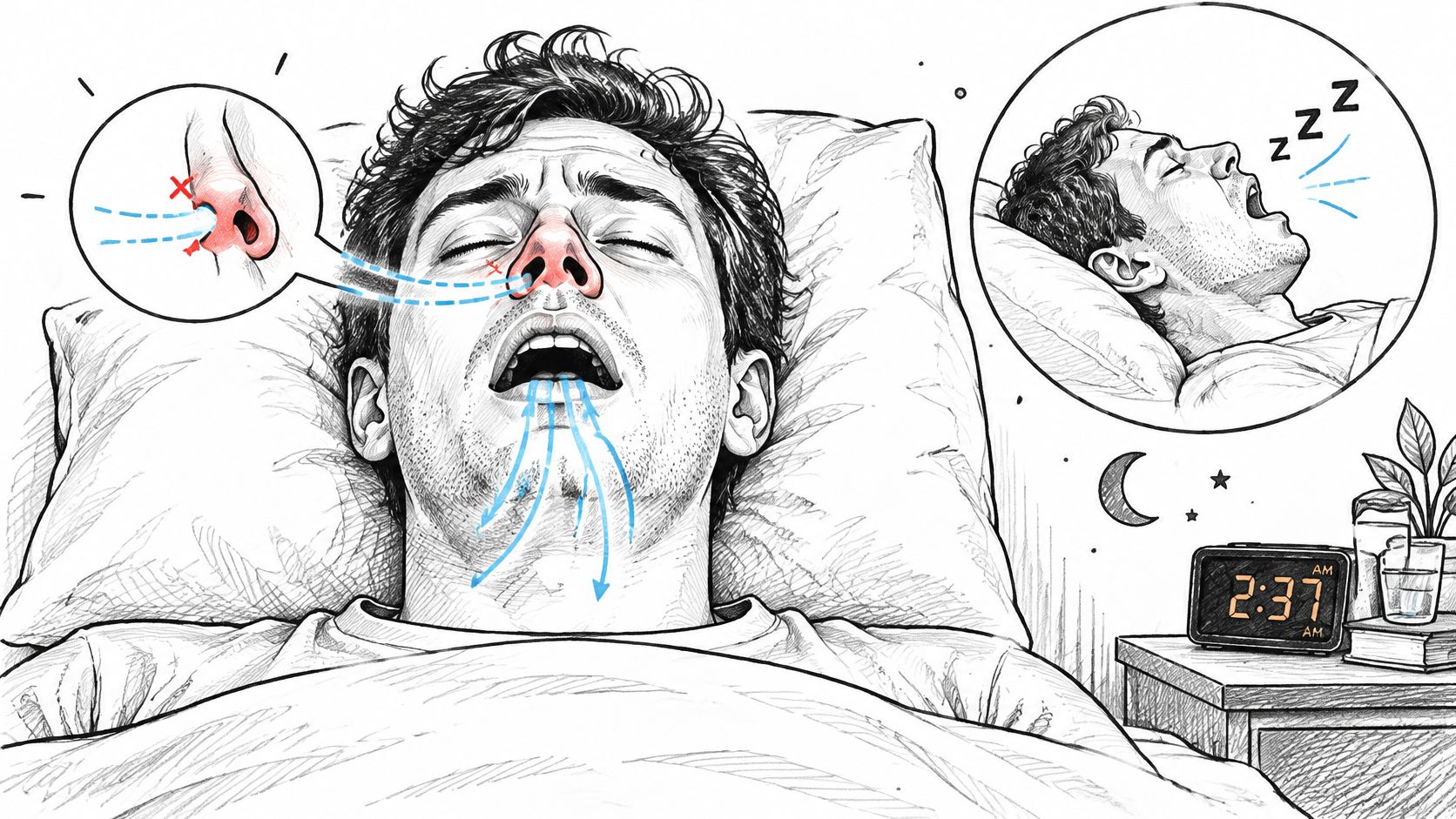
The illustration below shows the familiar end point, a sleeper struggling for nasal airflow and defaulting to an open mouth.
How Common Nighttime Breathing Problems Are
Think of the nose as a narrow valve at the top of a tube. Swelling inside that valve raises resistance, so the lungs pull harder to draw the same volume of air. During sleep, that extra suction can narrow the soft throat below and force a switch to mouth breathing, which dries tissues and makes vibration and collapse more likely.
A review in Rhinology on nasal obstruction and sleep reported habitual snoring in approximately 25-50% of middle-aged men, while obstructive sleep apnea (OSA) affects about 2-4% of men and 1-2% of women. Snoring is common and often harmless. OSA is less common and needs proper evaluation.
The same review explains that nasal obstruction can promote mouth breathing, which may destabilize the upper airway and worsen sleep-related breathing disorders. Nasal inflammation is also frequently seen in people with nighttime breathing problems.
Correlation is not causation here. Blockage and nasal inflammatory disease often travel with snoring and apnea, but weight, airway anatomy, and age shape risk too. A stuffy nose can make sleep louder and more fragmented without being the main driver of a true sleep disorder.
That distinction is why our comparison of nasal breathing vs mouth breathing frames nasal breathing as a worthwhile habit, not a cure for a sleep disorder. Easier nasal airflow may help comfort and sleep quality. It is not a substitute for evaluating loud snoring, witnessed pauses, or gasping.
The short video below gives a visual walkthrough of how nighttime nasal blockage and mouth breathing connect.
Mouth Taping and the Safety Boundary
Mouth taping gets promoted as a simple fix, but the evidence doesn't support blanket advice. A systematic review summary on mouth taping found only minimal or uncertain evidence for mouth taping as a general treatment for mouth breathing, sleep-disordered breathing, or OSA, with potential serious risks in people who have nasal obstruction.
Screen yourself in this order before considering any mouth-closure approach.
- Confirm comfortable nasal breathing while awake. Sit still, close your mouth, and breathe through your nose for several minutes. If that's a struggle awake, it won't improve asleep.
- Skip mouth closure during acute congestion. A cold, an allergy flare, or unexplained nighttime breathlessness means no, full stop for that night and until it clears.
- Get evaluated first if red flags exist. Snoring with pauses, gasping, morning headaches, or persistent fatigue means assessment comes before any intervention.
Our own position is the same. The product should not be used by people with respiratory conditions, trouble breathing through the nose, or severe heart conditions. Encouraging nasal breathing and forcing it are different things, and congestion is where that line sits.
Red Flags That Need a Doctor
Some symptoms mean stop self-treating and book an assessment. Scan these three sets in under a minute.
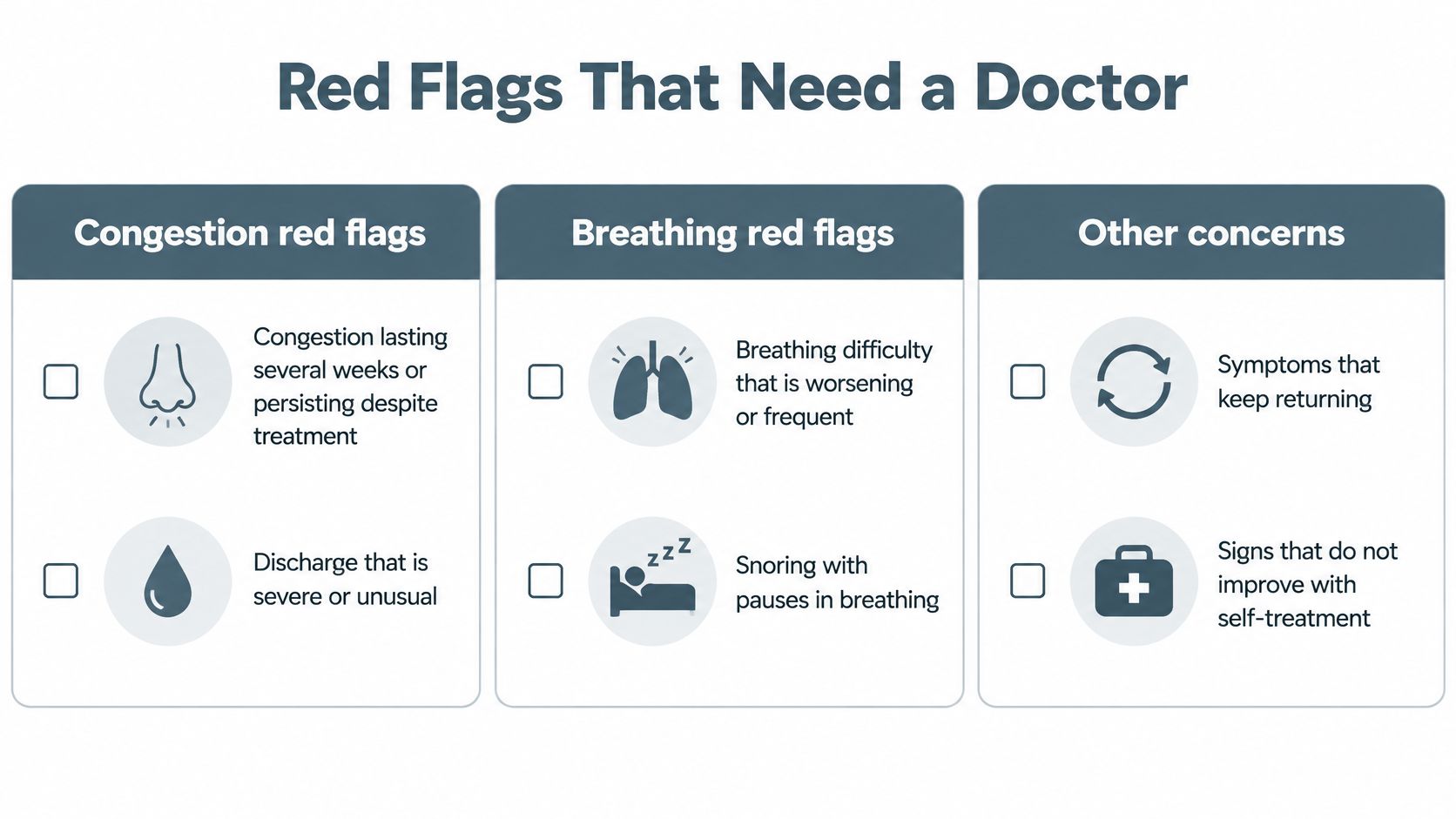
The checklist graphic below groups the same warning signs visually, so you can work through them item by item.
Congestion Red Flags
- Lasting several weeks: Congestion that persists despite treatment, or keeps returning, needs a cause identified rather than another product.
- One-sided foul or bloody discharge: Discharge that's severe or unusual, especially from one side only, isn't typical cold behaviour.
- Facial swelling or pain: Pressure is common, visible swelling or significant pain is not.
- Fever or blurred vision: Either one alongside nasal symptoms raises the stakes quickly.
- After a head injury: New nasal symptoms following head trauma always warrant assessment.
A 2025 review on nasal obstruction and sleep apnea supports this kind of triage approach, noting obstruction can worsen upper-airway collapsibility and reduce CPAP adherence while rarely being the sole cause of moderate-to-severe OSA. Our overview of airway obstruction symptoms covers the broader airway picture if several items here sound familiar.
Sleep Red Flags
- Loud nightly snoring: Especially if a partner can hear it through a door.
- Witnessed pauses: Someone has seen you stop breathing, then snort or gasp awake.
- Gasping or choking at night: Waking with a sense of suffocation isn't normal congestion.
- Morning headaches: Present on waking, fading within an hour or two.
- Excessive daytime sleepiness: Falling asleep in meetings, on the couch, or worse, while driving.
- Insomnia beyond three months: Persistent difficulty sleeping alongside breathing symptoms deserves a proper workup.
Emergency Signs
Severe breathlessness, chest pain, confusion, or blue lips mean emergency services at once. Don't drive yourself, don't wait until morning, and don't try a remedy first to see if it settles.
Each checked item is a reason to book an appointment, not to wait and see. You don't need three boxes ticked. One is enough.
One distinction helps at the appointment. The subjective feeling of "I cannot breathe through my nose" differs from measured airflow or oxygen impairment, and both can be true in different proportions. A clinician using nasal endoscopy and airflow testing can tell them apart, which determines whether you need anti-inflammatory treatment, structural correction, a sleep study, or simple reassurance.
Choosing Home Care or a Doctor Visit Next
Which path fits your pattern? Congestion becomes an airflow problem when swelling narrows the passage and forces faster, more turbulent flow. Home care works when that narrowing is diffuse, recent, and already easing. Medical care fits when airflow stays blocked on one side, fails to improve, or breaks down sleep.
Use the earlier parts of this guide as your filter. The remedy ranking explains which home measures support airflow and which ones carry safety limits. The decongestant section sets the stop rule for sprays. The sleep and red flag lists define the symptoms that shift the decision toward a clinician or urgent care. Read your week against those three checks rather than starting over.
Keep one short log while you decide. Each night, write a congestion score, any snoring or waking, and what you used. That record shows whether morning air moves more easily after saline, humidity, and head elevation, or whether nighttime mouth breathing keeps returning despite steady home care.
Anyone with respiratory conditions, trouble breathing through the nose, or severe heart conditions should talk with a clinician before using nasal strips or other breathing devices. Layering an airflow aid onto an undiagnosed airway or cardiac issue hides the signal your doctor needs to see.
Short colds and mild allergy flares with clear runny mucus and steady improvement usually resolve at home with saline, fluids, humidity, and positioning. Persistent one sided blockage, thick discolored discharge that does not ease, facial pressure that worsens, or loud snoring with gasping and daytime sleepiness point the other way. Those patterns suggest inflammation, structural narrowing, or sleep disordered breathing that home measures cannot correct.
If nighttime airflow is your main issue and no red flags are present, visit SleepHabits to explore nasal strips, gentle mouth tape, and melatonin-free sleep support, all designed around consistent nasal breathing. Start with the cause you identified, add one tool at a time, and keep your week long log so you can tell what is helping.