

Nasal strips can make nasal breathing easier for some people by lifting the nasal valve, but they don't treat sleep apnea or reliably stop snoring. In an exploratory study, sleeping nasal resistance was 21.7% lower with a strip at the tested low airflow rate, although that difference wasn't statistically significant.
If your nose feels more open, does that mean you're breathing safely throughout the night? That's the gap worth understanding before buying nasal strips to help breathing: easier airflow, quieter snoring, and treatment of sleep apnea are different outcomes.
Do Nasal Strips Actually Help Breathing?
Yes, for selected people with nasal obstruction. A strip is a reasonable comfort aid when the restriction is near the front of the nose, but it isn't a dependable solution for sleep-disordered breathing.
A 2026 systematic review of 17 studies involving 496 participants found no significant improvement in apnea-hypopnea index, oxygen saturation, snoring index, sleep architecture, or nasal airway resistance compared with controls. The authors didn't recommend nasal dilators as standalone treatment, while allowing that selected people with mild symptoms or congestion might benefit.
Who Gets Relief From Nasal Strips
| Situation | Likely result | Verdict |
|---|---|---|
| Temporary congestion from a cold or allergies | Often more comfortable nasal breathing for the night, without treating the swelling | Reasonable short-term trial |
| Narrow or collapsing nasal valve, with blockage felt near the bridge | Most likely group to notice better airflow | Best candidate for a strip |
| Mild snoring linked to nasal airflow, without breathing pauses | May reduce the loudest snoring in some people | Try cautiously for a few weeks, then reassess |
| Snoring with witnessed pauses, gasping, or choking | Strips don't address the underlying cause | See a clinician first |
| Daytime sleepiness or morning headaches with any snoring | Strips may feel helpful but don't confirm safety | See a clinician first |
| Diagnosed obstructive sleep apnea | Not a treatment for apnea | Use only alongside medical advice |
These are starting points, not a way to diagnose yourself. Feeling blocked near the nasal bridge can suggest that a strip is worth testing, but it doesn't establish where every obstruction sits.
Practical rule: If breathing feels restricted near the bridge of your nose, a strip is a reasonable trial. If the problem includes loud snoring with pauses or gasping, it becomes a medical question.
How Nasal Strips Lift the Nasal Valve
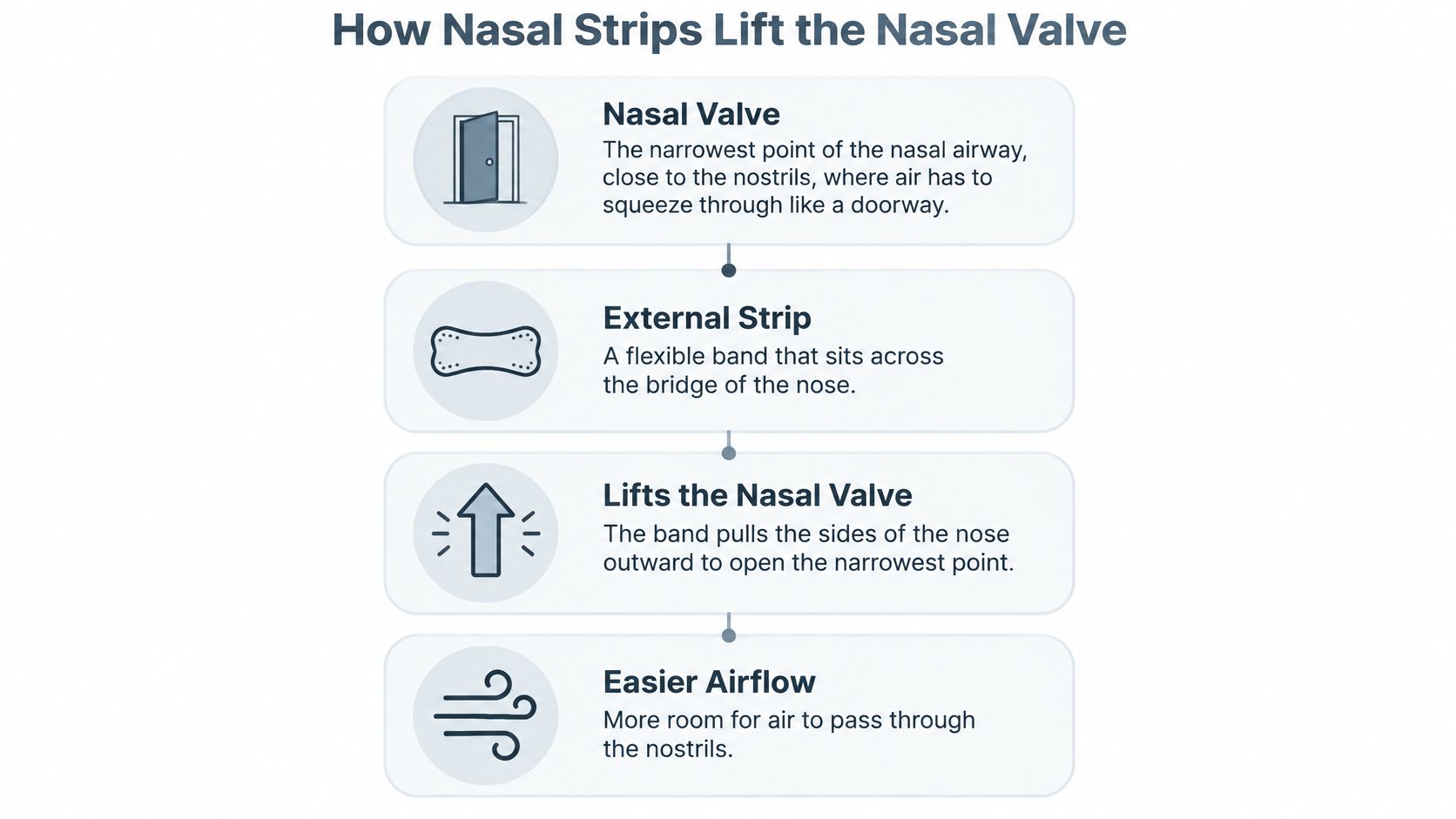
The nasal valve is the narrowest region of the nasal airway, close to the nostrils. Think of it as a doorway: even when the room beyond it is spacious, a narrow entrance can make passage difficult.
An external strip acts like a small brace for that entrance. Its flexible band contains spring-like support that gently pulls the sides of the nose outward, helping keep the opening from narrowing.
The diagram shows where that mechanical support acts.
A Wider Passage Isn't the Same as Less Swelling
In a 2018 randomized, single-blind crossover study of 50 healthy volunteers in Cardiff, all three tested designs improved minimum cross-sectional area, total nasal volume, and nasal-flow measures after a single day of use. The area and volume improvements reached P < .0001, and different strip geometries produced different results.
That supports a straightforward explanation: strips can physically enlarge the passage. They don't reduce mucosal swelling, treat inflammation, or change how the lungs function.
Consider someone whose nostril sidewall pulls inward when they breathe in. Supporting that wall may help, much as holding a flexible doorway open makes it easier to pass through. Someone with obstruction deeper inside the nose or throat has a different problem, beyond the strip's reach.
A nasal-resistance study in healthy adults also found that responses varied, supporting the importance of baseline resistance and the location of the narrowing. Strips are less likely to compensate for deep congestion, polyps, or lower-airway disease.
A brace at the entrance can help the entrance. It can't clear every obstruction farther along the route.
Keep these labels separate when interpreting any diagram or product claim:
- Nasal valve: The local structure being supported.
- External strip: The device applying that support.
- Airflow: A possible measurable consequence.
- Sleep effect: A separate outcome that must be demonstrated, not assumed.
What the Studies Show About Snoring and Airflow
The clearest way to read the evidence is to ask what researchers measured. Nasal resistance describes how difficult it is to move air through the nose. Snoring intensity describes sound, while the apnea-hypopnea index, or AHI, counts breathing disturbances during sleep.
Those measurements aren't interchangeable. A statistically significant change in one doesn't establish improvement in the others.
Study Results Side by Side
| Measure | Result | P value | Verdict |
|---|---|---|---|
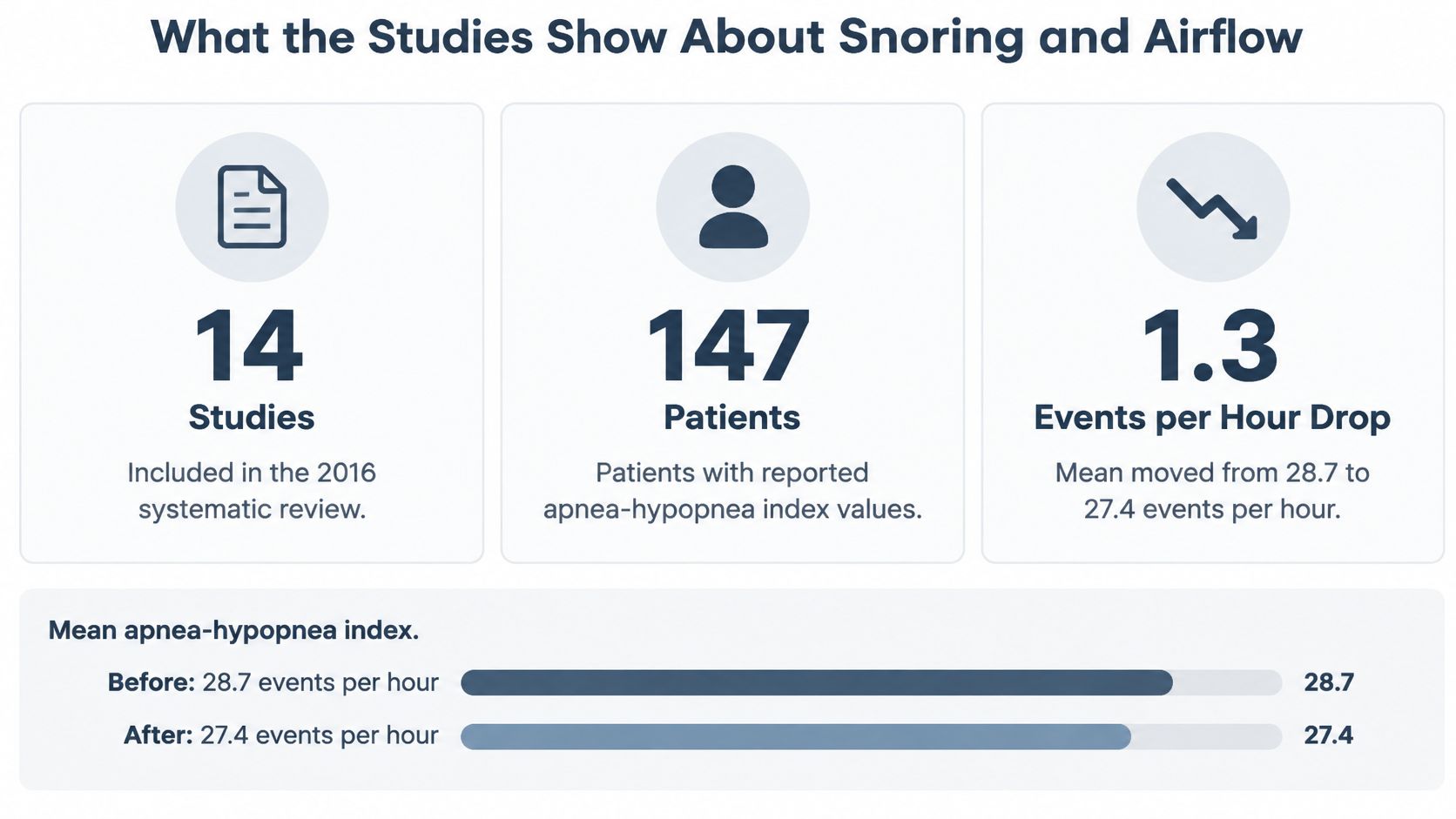
| 2016 review, AHI in 147 patients across the included studies | 28.7 to 27.4 events per hour | P=0.64 | Not significant |
| Westmead exploratory study, nasal resistance at 0.2 L/s | 21.7% lower | P=0.77 | Not significant |
| Westmead post-hoc subgroup at 0.2 or 0.25 L/s, from the study linked above | 39.1% lower | P=0.048 | Significant, but exploratory |
| Trial of 30 adults with primary habitual snoring | Maximum intensity reduced, particularly in sleep stages 1 and 2 | P=.02 | Significant reduction, not demonstrated elimination |
| Internal versus external dilators, apnea-index subanalysis | −4.87 versus +0.64 events per hour | Not specified in this summary | Device-dependent, not proof of apnea treatment |
The review also found no significant improvement in lowest oxygen saturation or snoring index among people with obstructive sleep apnea. Its internal-device finding concerns the apnea index, not the broader AHI, and shouldn't be treated as evidence that an insert replaces prescribed treatment.
The visual summary highlights how small the average AHI change was.
Why the Positive Findings Need Limits
The Westmead result is encouraging for nasal mechanics, but the main low-flow comparison wasn't statistically significant. The stronger result came from a post-hoc subgroup, meaning researchers examined that grouping after the initial analysis.
The habitual-snoring trial offers a different positive signal: quieter peak snoring. That doesn't mean everyone stopped snoring, and it doesn't establish benefit for snoring caused by apnea.
The practical verdict is supportive evidence for airflow mechanics in selected users, limited evidence for quieter snoring, and no established benefit as a sleep-apnea treatment.
Nasal Strips Compared With Other Breathing Aids
Choose an aid by the problem it addresses, not by whether its packaging mentions better sleep. A nasal-opening device, a moisture-supporting spray, and prescribed airway pressure serve different purposes.
The comparison below is a map of those purposes. It isn't a recommendation to combine everything or move through the options without medical advice.
Nasal Strips Compared With Other Breathing Aids
| Option | How it works | Best for | Evidence | Main limit |
|---|---|---|---|---|
| External nasal strip | Adhesive band lifts the outer nasal valve | Congestion, narrow valve, selected mild snoring | Airflow improvements in selected users; no established apnea benefit | Skin irritation and variable fit |
| Internal nasal dilator | Insert, often silicone, widens the valve from inside | Narrow valve needing internal support | Small apnea-index reduction in the earlier subanalysis | Comfort, fit, and potentially less common availability |
| Decongestant spray | Shrinks swollen nasal lining | Short bouts of cold or allergy congestion | Established short-term relief | Rebound congestion with prolonged use over several days |
| Saline spray | Moisturizes and helps clear mucus | Dry or stuffy nose | Supportive rather than apnea treatment | Relief may be temporary |
| Mouth tape | Encourages the lips to remain closed | Only people whose nose is already open, after contraindications are excluded | Limited research | Unsafe with blocked nasal passages or sleep apnea |
| CPAP, prescribed | Delivers pressurized air through a mask | Diagnosed obstructive sleep apnea | Established apnea treatment | Requires diagnosis, fitting, and regular nightly use |
Match the Aid to the Obstruction
An internal device changes how support is delivered, not the need to understand the cause of blockage. The guide to the Turbine nasal dilator offers another option to discuss when external fit is troublesome.
Sprays require a different choice: are you addressing swollen tissue, dryness, or mucus? Follow the product label and ask a pharmacist about decongestant duration rather than treating every nasal spray as interchangeable.
Mouth Tape is designed to encourage closed lips during sleep. It doesn't open a blocked nose, and this isn't a recommendation to tape your mouth when breathing is restricted.
Safety boundary: Use strips for a nasal-airflow trial, prescribed CPAP for apnea, and consider mouth taping only with an open nose and no medical contraindication.
Choosing Between Strip Types and Sizes
Shelves commonly offer standard strips, extra-strength versions with firmer spring support, transparent or skin-tone designs, and aromatic options. A scent isn't evidence of increased airflow, and fragrance isn't a sensible choice if it irritates you.
Fit matters more than appearance. Choose a size that supports the sides of your nose without overhanging, and follow the manufacturer's placement diagram. The design differences measured in the Cardiff study make it sensible to compare options rather than assume every strip performs identically.
Test One Design at a Time
- Start with standard support. Try it for three to five nights as a practical comparison period, not a medically validated testing interval.
- If the strip lifts or slides, check size, placement, and skin preparation before buying a stronger version.
- Compare firmer support only if needed. If restriction still feels local to the nasal valve, test an extra-strength design for a similar period.
- Keep the design that produces the clearest comfortable change, and record it in your morning log.
Don't stack strips or change designs every night. You'll have a harder time identifying what helped, and more adhesive isn't necessarily better.
SleepHabits Nasal Strips are one external-strip option intended to support nasal airflow. Apply the same fit, comfort, and outcome checks you would use with another brand.
How to Apply a Nasal Strip Without Irritation
Follow your strip's own directions first. Placement and wear instructions can differ, and a stronger pull isn't a reason to tolerate sore skin.
Begin with clean, intact skin. Don't place adhesive over a rash, wound, or already irritated area.
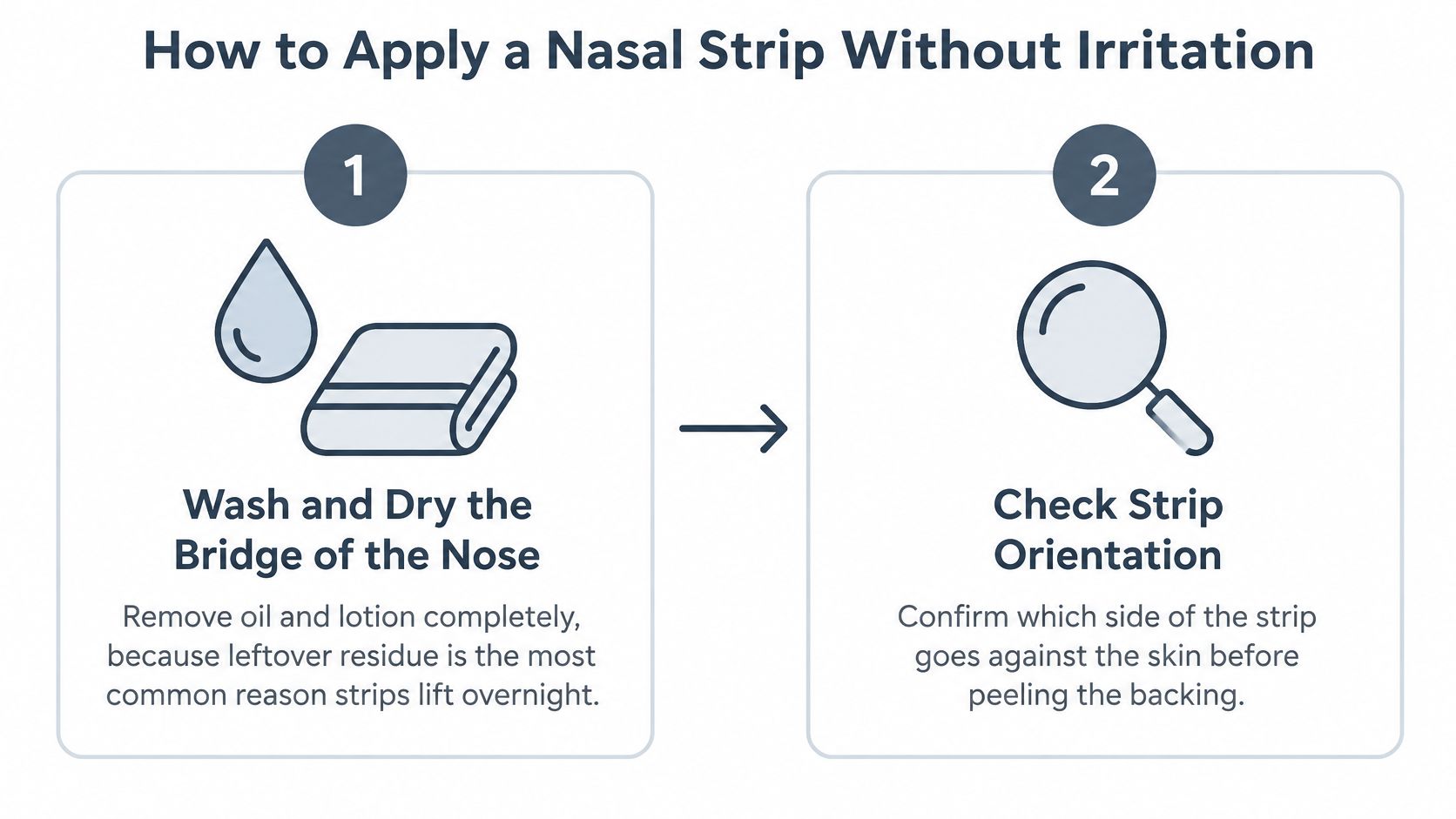
These preparation checks help the strip sit flat.
A Gentle Application Routine
- Wash and fully dry the nose. Remove oil and lotion so the adhesive can contact the skin rather than residue.
- Check orientation before peeling the backing. Confirm which side faces the skin and whether the design has a specified top and bottom.
- Position without stretching the skin. Press the centre into the recommended location, then smooth the wings onto the sides of the nose.
- Hold it gently in place for about 10 seconds, unless the packaging specifies otherwise. Check that it lies flat without wrinkles.
- Use it for one night only. Don't reuse a disposable strip that has lost its stickiness or keep pressing a dirty adhesive surface back onto the skin.
- Remove it slowly from one edge in the morning, supporting the skin as you peel. Give sore skin a night off rather than applying another strip immediately.
Stop and remove the strip if rash, itching, or swelling appears. Seek medical advice if symptoms persist, and don't keep retesting an adhesive that repeatedly causes a reaction.
Strip Problems, Causes and Fixes
| Problem | Likely cause | Fix |
|---|---|---|
| Redness or itching underneath | Adhesive sensitivity or damaged skin | Remove, rinse, and pause use for a few days; seek advice for swelling or persistent symptoms |
| Strip lifts by morning | Oil, lotion, residue, or unsuitable fit | Clean gently with an alcohol-free wipe if tolerated, dry fully, and check placement |
| Skin tears during removal | Fragile or sun-damaged skin | Peel slowly and stop using adhesive on damaged skin |
| No breathing change after several nights | Poor fit or obstruction beyond the nasal valve | Recheck placement, then stop relying on strips and seek assessment |
| Dry mouth or sore throat on waking | Possible continued mouth breathing | Address congestion; saline may help moisture, but persistent symptoms need review |
The nasal-strip side-effects guide provides further practical considerations for tolerability. A strip that stays attached but makes your skin sore isn't a successful fit.
For a visual application demonstration, use the video alongside your package instructions.
Test Your Strip Then Decide on a Clinician
A useful home trial answers a modest question: does this make my nasal breathing more comfortable? It can't establish whether oxygen levels or breathing interruptions are normal.
Results can differ sharply by anatomy. In a randomized crossover study of heavy snorers, objective benefits were confined to a small subgroup with pronounced nasal obstruction: mean sleep oxygen saturation increased from 92.4% to 96.7%, and time below 95% fell from 49.9% to 4.9%.
Those findings don't predict what will happen to you. They show why a targeted subgroup can benefit even when broader studies don't establish reliable sleep improvements.
Keep a Simple Morning Log
Choose three to five comparable nights as an initial practical trial. Keep bedtime, alcohol exposure, and sleep position as similar as possible, and alternate strip and no-strip nights if feasible.
| Record each morning | What to note |
|---|---|
| Strip use | Design used, or no strip |
| Nasal stuffiness | Rate from 1 to 5, using the same meaning each day |
| Feeling rested | Rate from 1 to 5 consistently |
| Snoring | Partner noticed none, less, similar, or more |
| Other symptoms | Dry mouth, headache, gasping, or skin irritation |
These ratings are personal tracking tools, not validated diagnostic scores. For example, clearer nasal breathing with unchanged snoring is a comfort benefit, not evidence that the snoring's cause has been treated.
Continue, Stop, or Book an Assessment
- Continue cautiously: Strip nights are consistently more comfortable, the restriction feels nasal, and there are no warning symptoms. A further week or two can help you judge whether the benefit remains useful.
- Stop the trial: There's no meaningful difference after about a week, or the adhesive causes irritation. These are practical stopping points, not research-established treatment durations.
- Book a clinician visit: You snore loudly most nights, someone witnesses breathing pauses, you wake gasping or choking, or you have morning headaches or daytime sleepiness.
- Keep prescribed treatment: An existing apnea diagnosis calls for medical guidance, not replacement of treatment with a strip.
Bring the log and ask whether a home sleep test or overnight study is appropriate. Don't wait to finish the trial if warning symptoms are already present.
If persistent nasal blockage is the main problem, the guide to difficulty breathing through your nose can help you organize what to discuss. Once apnea has been excluded when appropriate, an external strip remains a reasonable airflow experiment, judged by comfort rather than promises.
SleepHabits offers external nasal strips and educational resources for understanding nighttime nasal breathing. Visit SleepHabits to review the strip options, then use a simple morning log to decide whether they help your nasal comfort, without postponing assessment for snoring, gasping, or daytime sleepiness.