

Falling asleep faster isn't the same as sleeping better. A product can make you feel drowsy while leaving the deeper work of the night, including steady breathing, nervous-system recovery, and physical repair, poorly supported. A useful sleep aid powder should be viewed less like an off switch and more like one ingredient in a carefully built wind-down system.
That distinction matters because sleep support is already a substantial consumer category. A CDC report published in 2026 found that 12.9% of U.S. adults aged 18 and older used sleep aids most days or every day during the previous 30 days in 2024, including prescription medicines, over-the-counter products or supplements, and marijuana or CBD products (reported sleep-aid statistics). The question isn't whether people want help sleeping. It's whether the help addresses restoration rather than only unconsciousness.
Why Most Sleep Aids Miss What Actually Makes Sleep Restorative
The popular advice is simple: take something calming, fall asleep quickly, and assume the job is done. But sleep onset is only one part of restorative sleep. Your body also needs a quiet nervous system, consistent oxygen delivery, and uninterrupted breathing so it can carry out its overnight maintenance work.
A sedating product may reduce your awareness of wakefulness without improving the conditions that support recovery. You might spend less time noticing that you're awake, yet still wake with a dry mouth, a heavy head, or the sense that the night passed without refreshing you. That isn't proof that every sedating product fails, but it is a reason to separate feeling knocked out from sleeping restoratively.
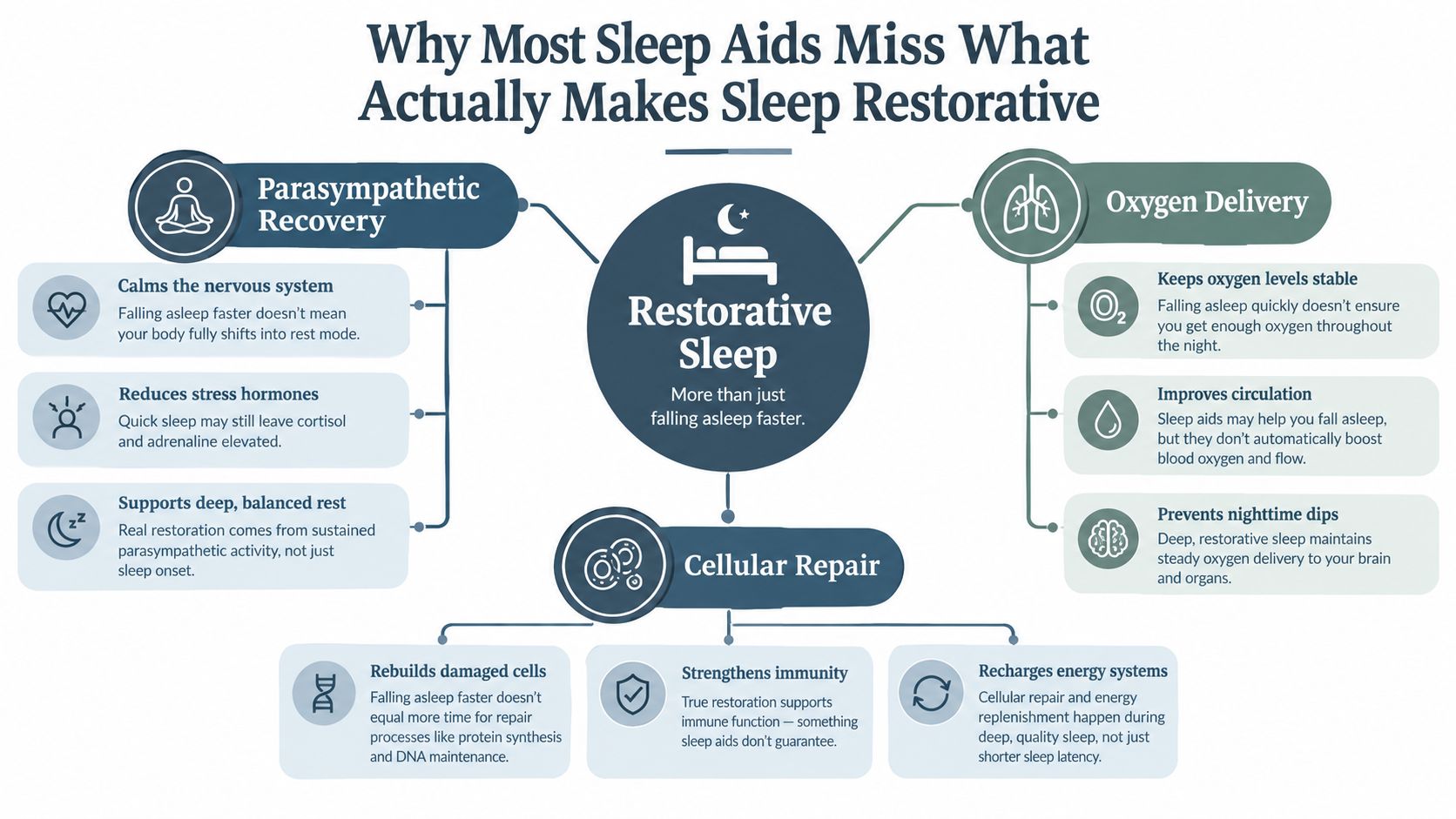
The recovery targets that matter
During healthy sleep, the parasympathetic nervous system helps shift the body away from alertness. Muscles relax, breathing should remain efficient, and circulation continues delivering oxygen and nutrients to tissues. A powder containing ingredients such as magnesium or glycine may support parts of that environment, but it won't compensate for loud snoring, severe congestion, untreated apnea, alcohol, or an overstimulating bedtime routine.
Breathing deserves more attention than it gets. Nasal breathing creates lower upper-airway resistance during sleep than oral breathing, and research summarized by the European Respiratory Journal found that the propensity to obstructive sleep apnea is significantly lower when people breathe through the nose rather than the mouth (European Respiratory Journal study). That doesn't make a powder an apnea treatment. It does show why a sleep plan should include the airway, not just the supplement cabinet.
Practical rule: If a product makes you sleepy but your breathing remains poor, it may be masking one symptom while leaving the recovery problem untouched.
Nasal symptoms can be part of that problem. In a population study of 1,032 healthy volunteers, people reporting nocturnal nasal congestion had a threefold increased incidence of snoring and daytime sleepiness (population study on nasal symptoms and snoring). For some adults, better sleep begins with making it easier to breathe through the nose, then adding nutritional support that encourages relaxation and recovery.
People dealing with persistent anxiety, stress, or sleep disruption may also benefit from professional guidance. The resource from Uptown Psychology counselors can help readers think about when sleep trouble may be connected to a broader mental-health concern.
What a Sleep Aid Powder Actually Is
A sleep aid powder is a dry blend of ingredients mixed into water or another bedtime drink. Depending on the formula, it may contain minerals, amino acids, botanicals, or nutrients intended to support relaxation, sleep quality, circulation, or overnight recovery.
Think of it as a spice blend rather than a single spice. A melatonin tablet or gummy centers the formula around one recognizable ingredient. A powder can combine magnesium for nervous-system and muscle support, glycine as an amino acid with human sleep-trial evidence, and other compounds in amounts that are easier to adjust and inspect.
That format offers practical advantages. You can see the powder's full ingredient list, mix it into a consistent volume of liquid, and avoid swallowing another pill. It also lets a formulator distribute several ingredients across a serving instead of asking one compound to carry the entire product's purpose.
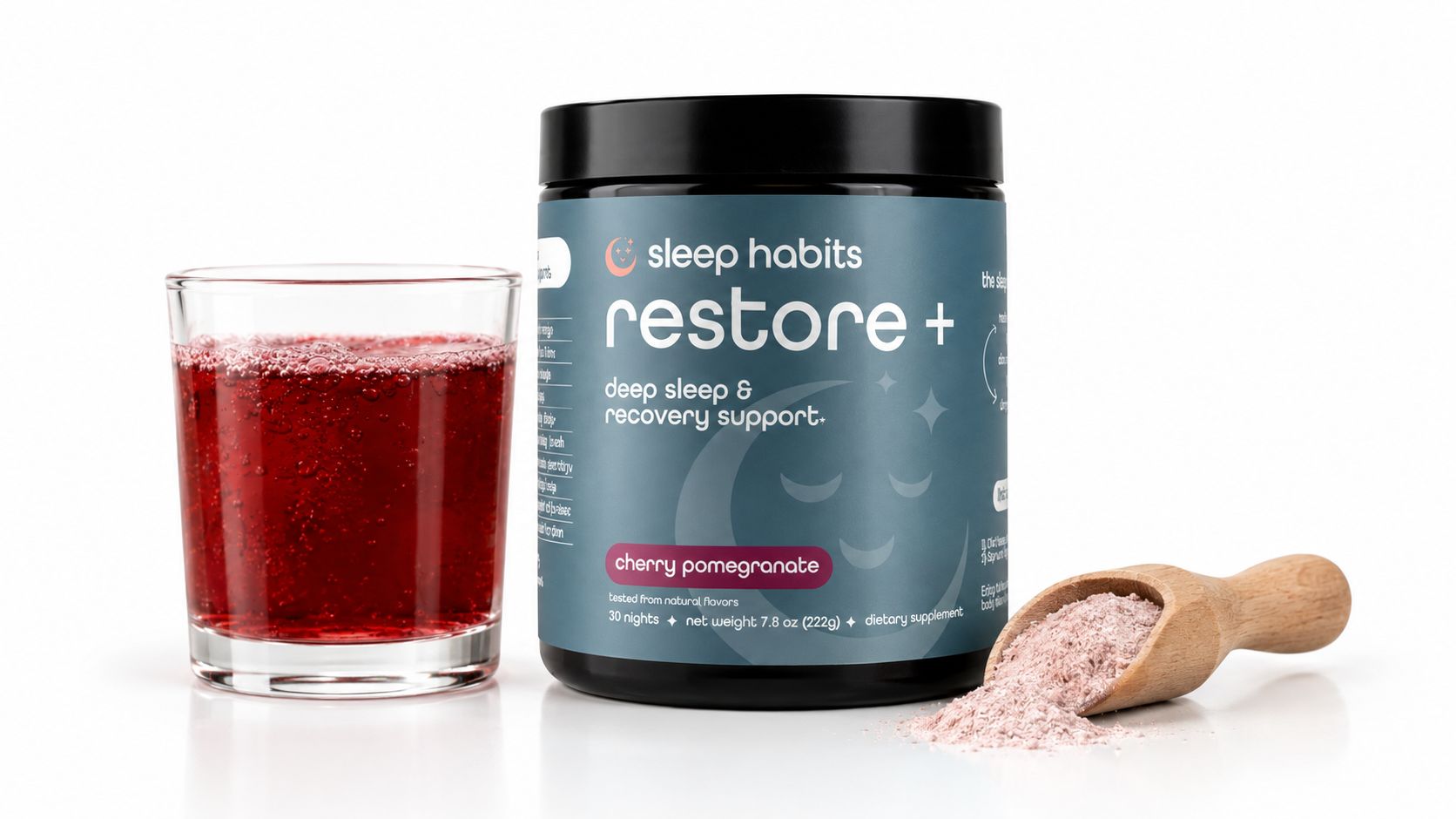
Powder versus a melatonin-centered product
A melatonin-free powder doesn't aim to imitate a sedative. Its intended role is usually broader, supporting the conditions in which sleep can become calmer and more restorative. That may appeal to travelers, shift workers, or adults who dislike the feeling of next-day grogginess, although individual responses still vary.
The format also makes dose transparency especially important. If a scoop contains a tiny amount of an ingredient that has only been studied at a larger dose, the formula may sound impressive while delivering little of the tested compound. A clear label should tell you exactly how much magnesium, glycine, or another active ingredient appears in each serving.
Restore+ Sleep Aid is one example of a melatonin-free powder positioned around nervous-system regulation, nitric oxide support, and overnight oxygen delivery. Its catalog description also states that it was developed with sleep and airway doctors and third-party tested for toxins, PFAS, and heavy metals. Those are product-description claims, not proof that every user will experience the same sleep result.
Use the same standard for any brand. Ask what the powder contains, how much of each ingredient it provides, what evidence supports those amounts, and whether the formula complements your breathing and wind-down habits rather than promising to replace them.
The Ingredients That Drive a Good Sleep Aid Powder
A long ingredient list isn't automatically a strong formula. The useful question is whether each ingredient has a clear role, an amount that can be evaluated, and an evidence base that matches the promise.
Magnesium comes with important qualifications
Magnesium is often included for nervous-system calm, muscle relaxation, and general nutritional support. Common forms include magnesium glycinate, magnesium threonate, and magnesium citrate, but the form doesn't eliminate the need to check the actual elemental magnesium amount.
Evidence is mixed. In a randomized placebo-controlled study of older adults with primary insomnia, magnesium supplementation increased total sleep time and sleep efficiency and reduced sleep-onset latency, while early-morning awakening showed a downward trend (magnesium and primary insomnia trial). The strongest practical case may be in people whose magnesium intake is low, rather than in every adult regardless of diet.
Sleep-related research has also used defined doses. One review identified 729 mg per day of magnesium L-aspartate in a 2004 study, among the highest daily magnesium doses included in its review of sleep research (review of magnesium and sleep). That doesn't mean you should copy the dose. It means a label should disclose elemental magnesium clearly so you can understand how the product compares with studied regimens.
Glycine has the clearest powder-friendly target
Glycine is an amino acid that fits naturally into a drink because a gram-level serving is easy to measure. In a placebo-controlled human study, 3 g taken before bed improved subjective sleep quality, increased sleep efficiency, and shortened measured latency to sleep onset and to slow-wave sleep without changing overall sleep architecture (human glycine sleep study).
The realistic expectation isn't a dramatic knockout effect. Glycine is better understood as a possible sleep-quality and next-day-fatigue support ingredient. If a formula aims to reflect that research, its serving should make the 3 g bedtime target easy to identify.
Other popular ingredients need a cautious reading
L-theanine is commonly used in relaxation formulas, while beetroot and L-citrulline are used as nitric oxide precursors intended to support circulation. Ashwagandha and reishi are often positioned as adaptogens that may help people manage stress load. These ingredients can be reasonable formulation choices, but their presence doesn't prove that the finished blend works as a whole.
Passionflower is another botanical that appears in sleep products. Readers who want a focused overview of the herb can consult the Providers for Healthy Living herb guide, then discuss possible interactions with a clinician rather than assuming that “natural” means risk-free.
| Ingredient | Mechanism | Best Form | Evidence-Backed Dose | Realistic Effect |
|---|---|---|---|---|
| Magnesium | Nervous-system and muscle support | Glycinate, threonate, or citrate, with elemental amount disclosed | Research varies, including 729 mg per day in one reviewed study (magnesium review) | Possible sleep support, especially when intake is low; gastrointestinal tolerance matters |
| Glycine | Supports sleep quality and measured sleep onset | Powder | 3 g before bed (human glycine study) | Better subjective sleep quality and potentially less next-day fatigue |
| L-theanine | Relaxation support | Clearly quantified powder or capsule ingredient | No specific dose established in the verified data | May support a calmer wind-down, but don't treat it as proof of deeper sleep |
| Beetroot or L-citrulline | Nitric oxide and circulation support | Clearly disclosed powder | No specific dose established in the verified data | A formulation-level circulation target, not a guaranteed sleep effect |
| Ashwagandha or reishi | Adaptogen-style stress support | Standardized extract with amount disclosed | No specific dose established in the verified data | Potential stress support, with evidence and interaction questions requiring caution |
Nasal breathing belongs beside these ingredients, not beneath them. If congestion or mouth breathing disrupts the night, Nasal Strips are a non-ingested tool designed to gently open the nasal passages and support smoother airflow. Research links nocturnal nasal congestion with snoring and daytime sleepiness, so airway support can be a practical complement to a powder rather than an unrelated add-on.
For a deeper look at the mineral side, this guide to a magnesium supplement for sleep can help you compare forms and label details without treating magnesium as a universal answer.
How Sleep Aid Powders Support Deep Sleep From the Inside
Restorative sleep isn't a single switch. It's more like a small orchestra. The nervous system has to quiet down, breathing has to remain reasonably open, circulation has to continue, and the body needs enough uninterrupted time to carry out repair.
A thoughtful powder can target several of those conditions at once, but the distinction between support and treatment matters. Magnesium may help some people relax, glycine has human evidence at a defined bedtime dose, and nitric oxide precursors may be included to support circulation. None of those facts turns a supplement into a treatment for chronic insomnia or obstructive sleep apnea.
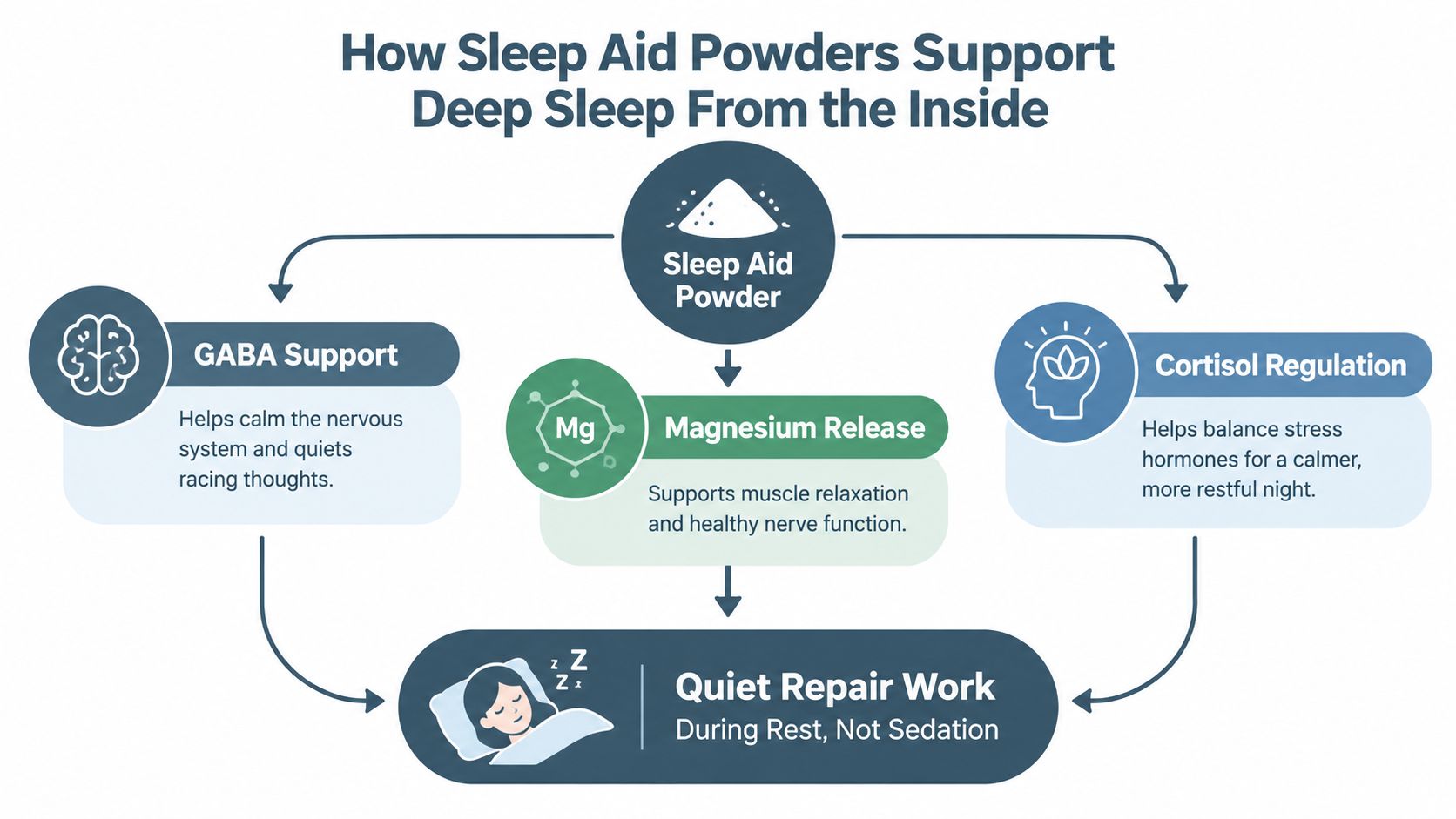
Three internal targets
Nervous-system quieting is the first layer. Magnesium and L-theanine are often selected to support a calmer transition out of alertness. The goal isn't to erase awareness. It's to make it easier for the body to stop treating bedtime as another work session.
Circulation and oxygen delivery form the second layer. Nasal breathing has lower upper-airway resistance than oral breathing during sleep, and nasal obstruction can increase mouth breathing and snoring risk (European Respiratory Journal study). A powder that includes nitric oxide support may fit into this strategy, but it can't correct a blocked airway by itself.
Overnight recovery is the third layer. Glycine's human trial evidence makes it especially interesting because the observed effects concerned sleep quality, efficiency, and measured sleep-onset processes rather than simple sedation (glycine sleep trial). That profile aligns with the practical aim of waking clearer, not merely falling unconscious sooner.
Falling asleep is the doorway. Restorative breathing and uninterrupted recovery are what happen inside the room.
The following video can serve as a visual introduction to the breathing and recovery concept:
A powder works best as one coordinated input among several. If the bedroom is bright, the nose is blocked, caffeine is still active, or alcohol fragments sleep, adding more ingredients may only make the routine harder to interpret.
Building a Bedtime Routine Around Your Sleep Aid Powder
A consistent routine gives the powder a fair test. It also prevents you from blaming the supplement for problems caused by light, timing, congestion, or late-night stimulation.
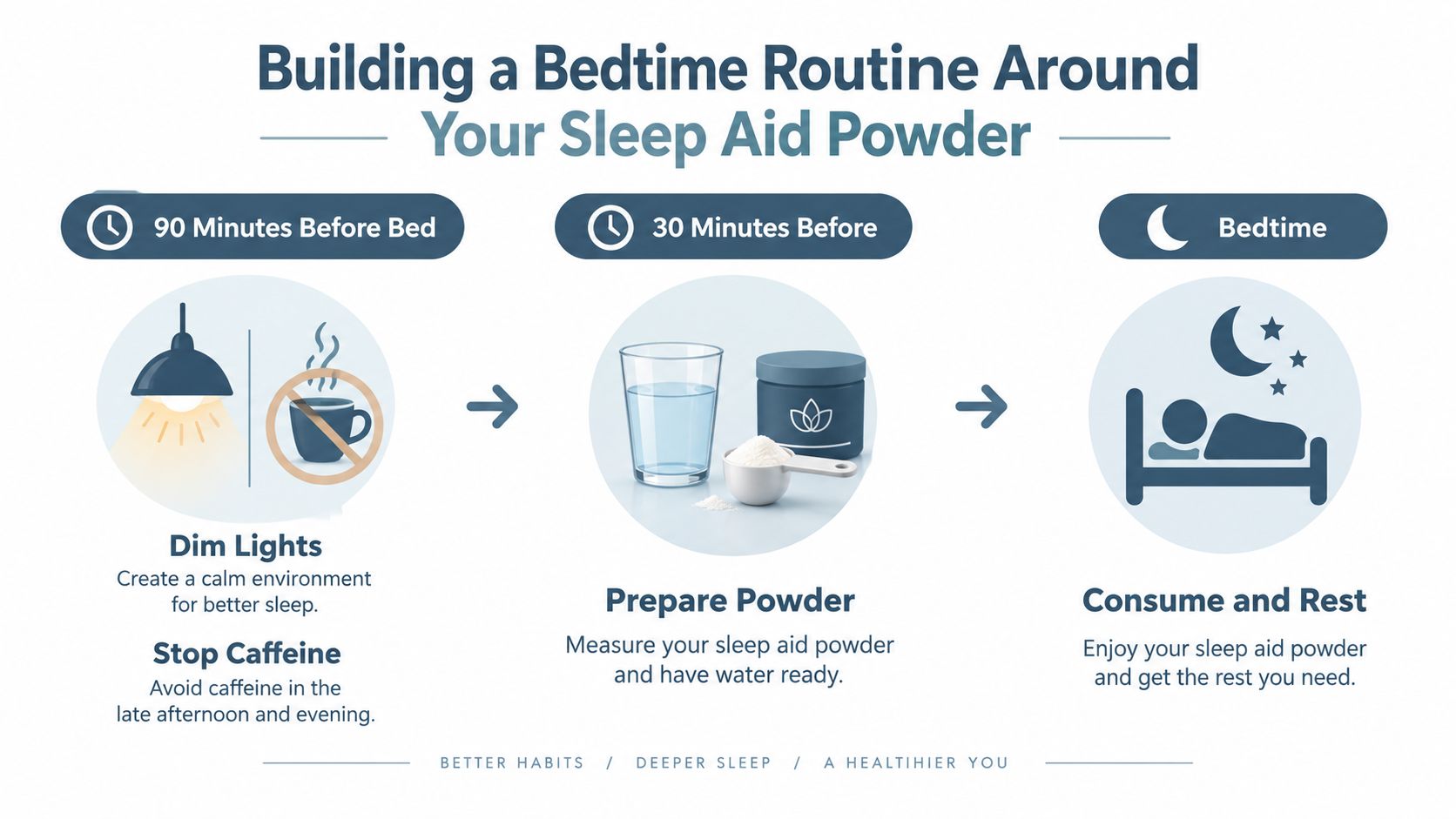
Start the wind-down before you feel sleepy
Create a 90-minute light-down period. Dim indoor lights, lower screen brightness, and stop high-stimulation scrolling. Sleep-hygiene guidance recommends shutting off screens and dimming lights during this period, while a separate study summary reported that blue-light exposure reduced sleep duration by about 16 minutes on average (sleep-hygiene guidance and blue-light summary).
Caffeine belongs earlier in the day. Stopping it by mid-afternoon gives your evening a cleaner baseline, especially if you already lie awake with a busy mind. Keep the routine boring on purpose. Predictability is useful when your brain has spent the day switching tasks.
Mix the powder before the final transition
Prepare the serving 30 to 45 minutes before bed, following the product label. Use the same liquid and a similar serving each night so you can tell whether changes come from the formula or from an inconsistent routine.
Don't take it immediately before lying down if the drink adds enough fluid to wake you for the bathroom. Avoid pairing it with alcohol, and don't use a heavy meal as part of the bedtime ritual. Both choices can make it harder to understand whether the powder is helping.
For a practical routine that combines light, breathing, and pre-bed habits, use this nighttime routine for better sleep as a planning reference.
Open the airway before you settle
If nasal congestion is part of your pattern, address it before getting into bed. A nasal strip may improve the physical ease of nasal breathing, while a humidified room, allergy management, or clinician advice may be more appropriate for persistent obstruction.
Mouth tape requires extra caution. Never use it if you can't breathe comfortably through your nose, if you have significant congestion, or if you suspect sleep apnea. A tape strip should never be used to force nasal-only breathing through an obstructed airway.
Once you're lying down, try a slow 4-7-8 breathing pattern, inhaling for four counts, holding for seven, and exhaling for eight, if that pattern feels comfortable. Stop if you feel strained or light-headed. The point is to lengthen the exhale gently, not to turn breathing into another performance task.
Small experiment: Change one variable at a time. If you add a powder, nasal support, and a new breathing method on the same night, you won't know which change helped or caused discomfort.
If the first week feels unchanged, don't immediately increase the dose. Check the basics first: Was the powder taken too late? Did screens continue in bed? Was the room bright? Did congestion force mouth breathing? Adjust one factor, then observe the pattern over several nights.
How to Choose a Melatonin-Free Sleep Aid Powder
A melatonin-free label is only a starting point. The better question is whether the powder supports the parts of sleep that affect recovery, including relaxation, steady nighttime breathing, and a clear morning. A useful formula should fit into a wind-down system, not carry the whole job alone.
Read the label as if you were checking a recipe. Start with each active ingredient, its amount per serving, and the reason it appears. For magnesium, look for the elemental magnesium amount, rather than only the weight of the magnesium compound. For glycine, compare the serving with the human trial's 3 g bedtime dose (glycine research). Hidden quantities inside a proprietary blend make that comparison difficult.
The formula should also state what it leaves out. Someone seeking a melatonin-free option may want relaxation support without adding melatonin. That label does not remove the need to check interactions, tolerability, or whether the ingredients suit the person's health situation.
| Criterion | Look For | Red Flag |
|---|---|---|
| Dose clarity | Exact amount of every active ingredient per serving | Proprietary blend with no individual quantities |
| Magnesium labeling | Elemental magnesium amount and named form | Compound weight shown without elemental content |
| Glycine target | A serving that makes comparison with the 3 g bedtime dose straightforward | A token amount used mainly for marketing |
| Testing | Third-party testing, such as NSF, USP, or Informed Sport, with accessible documentation | “Tested for quality” without supporting records |
| Ingredient purpose | A clear relaxation, breathing, or recovery rationale | A crowded blend claiming every herb works together |
| Melatonin status | Clearly stated melatonin-free positioning | No clear statement |
| Tolerability | Warnings, serving guidance, and interaction information | Vague dosage instructions or no safety directions |
A transparent product discloses every ingredient, explains the combination, identifies its testing process, and states whether it contains melatonin. A poor label hides amounts behind a long botanical list and treats “natural” as if it answered the safety question.
Dose size still needs context. Magnesium research uses varied forms and amounts, and findings are mixed, especially outside groups who may have low intake, as described in the magnesium trial discussed in the ingredients section. For a wider comparison of non-melatonin options, read these alternatives to melatonin for sleep.
Safety, Interactions, and When to Adjust Your Approach
Start with a small serving, especially when the ingredients are new to you. Pregnant or nursing individuals, and people taking SSRIs, blood-pressure medicines, or sedatives, should consult a qualified clinician before using a sleep aid powder.
Magnesium can interact with certain antibiotics, while excessive amounts may cause diarrhea or other gastrointestinal symptoms, as described in the magnesium sleep research. Alcohol may intensify unwanted relaxation or impairment from L-theanine. Ashwagandha and valerian can also interact with medicines. Review these risks with a clinician or pharmacist, and consult this NIH supplement safety guidance. “Natural” describes an ingredient's origin, not its safety.
If sleep improves but mornings feel foggy, take the serving earlier or reduce it. If nothing changes, remove one ingredient at a time. Track sleep quality, awakenings, nighttime breathing, and morning clarity for at least five nights before adjusting again. This makes the powder easier to assess as one part of a wind-down system, not a standalone fix.
Stop using it and seek medical advice for an allergic reaction, major mood change, severe gastrointestinal symptoms, or worsening sleep. Loud snoring, witnessed breathing pauses, gasping, or marked daytime sleepiness call for medical evaluation rather than a larger scoop.
SleepHabits offers melatonin-free support through Restore+, nasal strips, and guidance on breathing and wind-down habits. Explore SleepHabits for recovery-focused options and sleep education.