

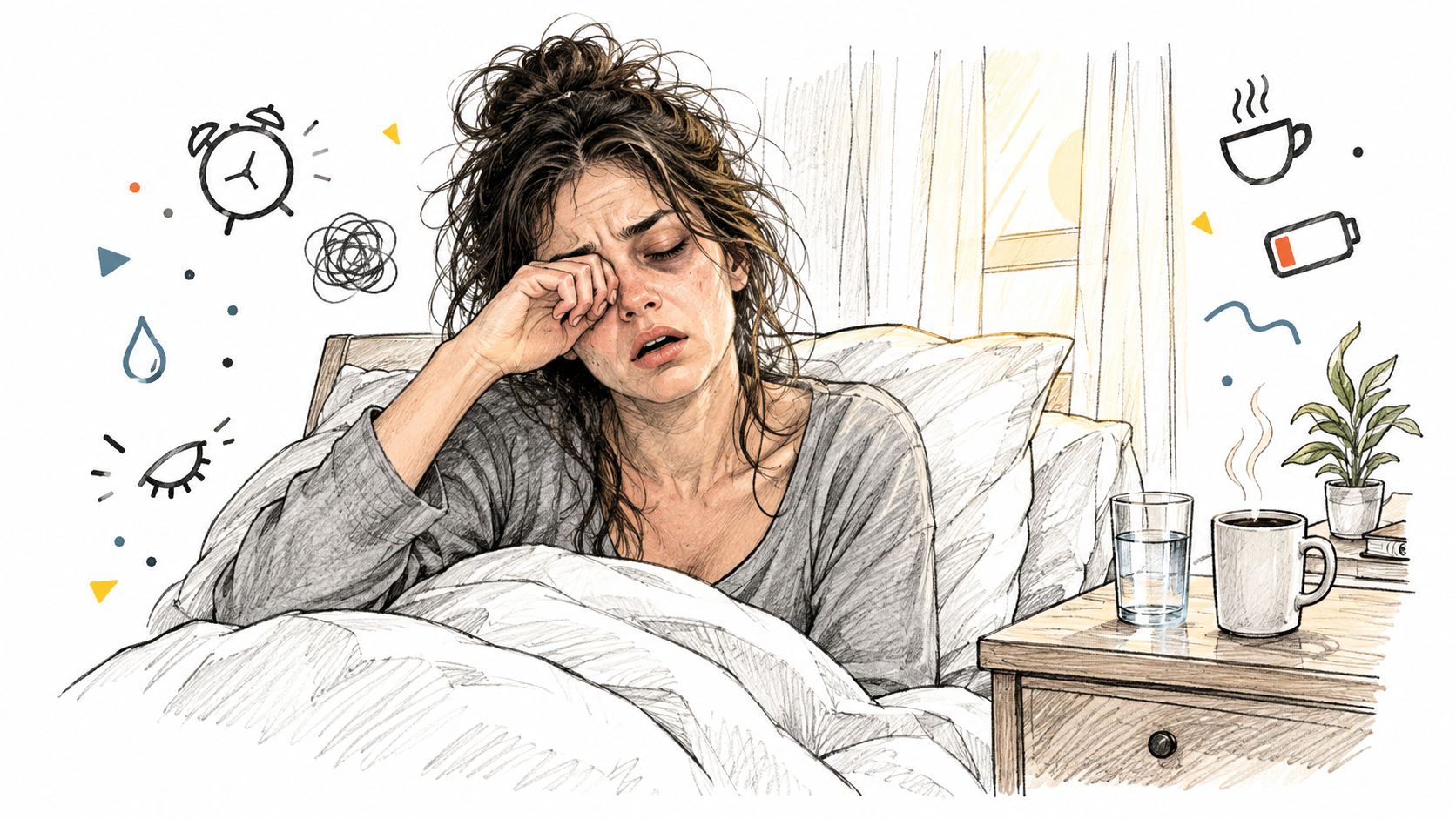
You wake after what should have been a full night in bed, yet your head feels heavy. Your throat is dry, your mouth tastes stale, and coffee seems less like a choice than a requirement. If this happens often, the problem may not be how long you sleep. It may be how air reaches your lungs while you sleep.
Mouth breathing changes the route, pressure, moisture, and stability of airflow. The result can be a chain reaction that starts with a blocked nose or relaxed jaw and ends with snoring, fragmented sleep, and a foggy morning. Understanding what happens when you breathe through your mouth makes the solution more practical, because you can address the obstruction instead of treating tiredness as a personal failure.
The Morning Reality of Mouth Breathing
You may wake without remembering that your mouth stayed open. Instead, you notice the clues: reaching for water, a dry throat, stale breath, or a partner mentioning noise. The underlying problem is a disrupted breathing system. A blocked or unstable nasal route shifts airflow to the mouth, where less conditioning and greater dryness can disturb comfort throughout the night.
The pattern is common. A 2024 survey of 1,001 American adults found that 61% self-identified as mouth breathers, while 71% said at least one bed in their household hosted a mouth breather. Respondents associated mouth breathing with waking from nighttime nasal congestion (75%), waking with a dry mouth (61%), and snoring (37%) (Sleep Review survey).
The same survey reported that 64% said mouth breathing affects sleep quality, 54% of mouth breathers said they had not had a good night's sleep the previous night, and 56% woke at least twice per night because of mouth breathing. These responses show a pattern, not proof that mouth breathing causes every case of fatigue. They do, however, support closer attention when dryness, noise, or repeated waking keeps returning.
Morning clue: Dryness, snoring, and repeated waking are signals to investigate. They cannot identify the cause alone, so consider nasal airflow, jaw position, congestion, and other sleep-breathing factors together.
The Pain and Sleep Therapy Center on breathing explains how nasal and oral airflow differ. For recurring symptoms, SleepHabits also outlines common causes of dry mouth in the morning. Looking at the full chain, from airway route to dryness and sleep disruption, makes morning fatigue easier to investigate rather than dismiss.
How the Nose Optimizes Your Sleep
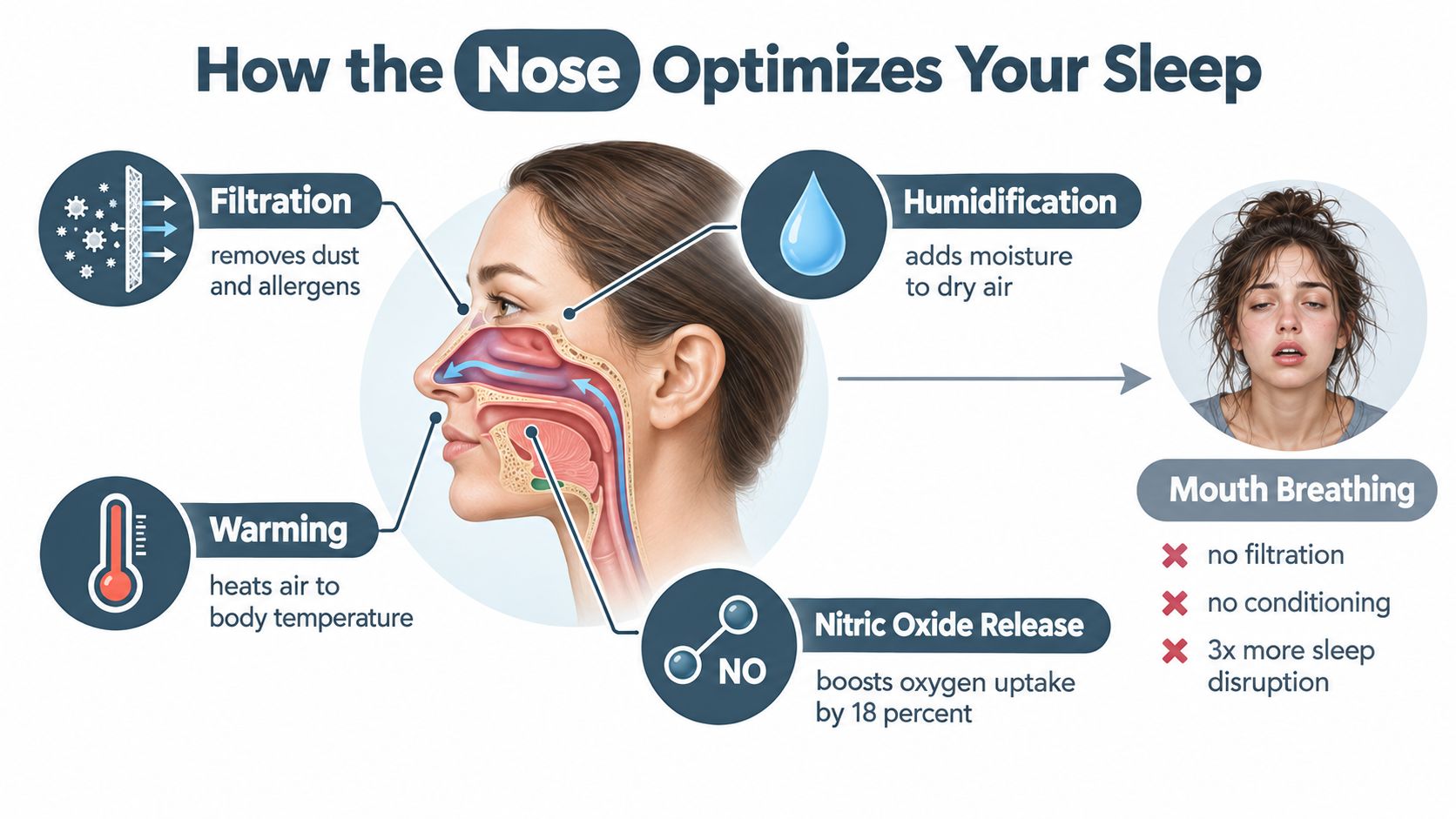
The nose isn't just an opening that air passes through. It acts more like a biological climate-control system, preparing air before it reaches the lower respiratory tract. Nasal passages filter particles, add moisture, and warm incoming air, which helps protect the delicate surfaces involved in breathing.
The nose also contributes nitric oxide to inhaled air. Nitric oxide supports blood-vessel relaxation and helps the body use oxygen efficiently. It also fits the calmer breathing pattern associated with rest, although nasal breathing shouldn't be treated as a standalone cure for insomnia or a diagnosed breathing disorder.
A built-in conditioning system
When congestion, allergies, or structural narrowing restricts the nose, the mouth provides a wider alternate route. That route keeps air moving, but it bypasses much of the nose's filtering and conditioning work. Air can feel harsher and drier, particularly during a long night when saliva and throat moisture are already limited.
Sleep depends on a stable airway and a body that can remain relaxed. Nasal breathing offers resistance that helps regulate airflow, while the nose's conditioning functions make each breath less irritating to the throat. Oral breathing can remove those advantages at the same time that sleep-related muscle relaxation makes the throat more vulnerable.
A Nasal Strips product is designed to gently open the nasal passages when congestion or restricted nasal airflow encourages mouth breathing. That kind of aid may support smoother airflow, but persistent obstruction still deserves medical assessment rather than indefinite self-treatment.
The Mechanical Cost of Open-Mouth Breathing
The important question isn't only whether air enters the lungs. It's how much resistance the airway creates while that air moves. During sleep, oral breathing can substantially raise upper-airway resistance compared with nasal breathing.
One clinical study measured median resistance of 12.4 cmH2O·L−1·s−1 during oral breathing versus 5.2 cmH2O·L−1·s−1 during nasal breathing. In the same study, the obstructive apnea-hypopnea index rose from 1.5±0.5 to 43±6, demonstrating a strong relationship between the breathing route and sleep-disordered breathing severity (European Respiratory Journal study).
Why the throat becomes less stable
An open mouth changes the shape and direction of the upper airway. Physiologic and computational work indicates that mouth opening can narrow the pharyngeal lumen, reduce the space behind the tongue, and increase airflow velocity and static pressure. Under the Starling-resistor model, those changes make the airway more collapsible, especially when sleep reduces the muscle tone that normally helps hold it open (PLOS One airway mechanics research).
A simple analogy is a flexible tube. If air moves through it under greater pressure while the surrounding support weakens, the walls can narrow or flutter. In the sleeping throat, soft tissues may vibrate, producing snoring, or narrow enough to restrict airflow.
That doesn't mean every mouth breather has sleep apnea. It does mean mouth breathing can be part of a mechanical pathway that increases airway strain. If loud snoring, gasping, witnessed pauses, or persistent daytime sleepiness occur together, a clinician should evaluate the possibility of sleep-disordered breathing.
Why Mouth Breathers Wake Up Tired
Fatigue often comes from interrupted sleep rather than a single dramatic event. A sleeper may not fully awaken after every change in airflow, but brief arousals can still break the continuity needed for restorative rest. The next morning, they may remember only a restless night or no clear memory at all.
Open-mouth breathing can create several overlapping disturbances. Faster airflow can vibrate relaxed throat tissues and produce snoring. Dryness can make the throat uncomfortable. Increased resistance can require more effort from the breathing muscles. Together, those signals can keep the nervous system from settling into uninterrupted sleep.
The cycle behind the foggy morning
The pattern often looks like this:
- Nasal airflow becomes difficult. Congestion, allergies, anatomy, or sleep-related airway narrowing may encourage the jaw to drop.
- The mouth opens. Air bypasses the nose's filtering, humidifying, warming, and nitric-oxide-related functions.
- Airway resistance rises. The throat experiences less favorable mechanics, with more opportunity for tissue vibration or narrowing.
- Sleep becomes less continuous. Snoring, dryness, and breathing effort can produce arousals that the sleeper may not remember.
- Morning recovery feels incomplete. The person wakes tired, thirsty, unfocused, or irritable.
A sleep study summarized by the Sleep Foundation's explanation of sleeping with the mouth open found higher median resistance with oral breathing, 12.4 cmH2O·L−1·s−1 versus 5.2 cmH2O·L−1·s−1 for nasal breathing in one comparison, and 14.9 versus 5.65 cmH2O·L−1·s−1 in another. The practical implication is straightforward: improving nasal airflow may reduce the resistance your airway faces, but it doesn't replace evaluation for suspected apnea.
A dry mouth isn't just an annoyance. Repeated dryness, loud snoring, and unrefreshing sleep together are reasons to investigate the breathing pattern.
For readers who want to understand how dental and airway concerns can overlap, Dental Professionals of Fair Lawn's information on sleep provides another perspective. Persistent symptoms should be discussed with an appropriate healthcare professional.
Practical Tools to Seal the Airway
Tools work best when they address the reason your mouth opens. If your nose is blocked, just trying to keep your lips closed may feel uncomfortable and may not solve the underlying problem. If your nose is clear but your jaw relaxes open from habit, a gentle behavioral cue may be more relevant.
Start with the least complicated explanation. Notice whether you wake with a dry mouth, whether a partner hears snoring, and whether one side of your nose feels consistently restricted. Don't use a mouth-closing aid to force breathing through a nose that feels obstructed.

Match the tool to the problem
Mouth tape can act as a reminder to keep the lips together when habitual opening is the main issue. Choose a product intended for sleep, test the adhesive while awake, and stop if you experience anxiety, skin irritation, or any difficulty breathing. A small vertical application may feel less restrictive than covering the entire mouth, but comfort and safe nasal airflow come first.
Nasal strips work from the outside by gently supporting the nasal passages. They're more logical when congestion or a sense of restricted nasal airflow encourages the mouth to open. They won't correct every internal cause of obstruction, so ongoing blockage, frequent sinus symptoms, or suspected apnea warrants professional advice.
The beginner's guide to mouth tape for sleeping can help you think through fit and first-use precautions. Never use mouth tape as a substitute for diagnosis or treatment of sleep apnea, and don't apply it if you can't breathe comfortably through your nose.
Cleveland Clinic explains that mouth breathing can worsen snoring because air passes through the throat with greater force and vibrates soft tissues. It also connects chronic mouth breathing with dry mouth and throat discomfort, which makes those morning symptoms useful clues rather than random inconveniences (Cleveland Clinic's overview of mouth breathing).
Choosing Between Nasal Strips and Mouth Tape
The choice becomes easier when you identify where airflow is failing. Nasal strips support the entrance of the nasal airway, while mouth tape encourages the lips to remain closed after nasal breathing is already possible. They solve different parts of the same pattern.
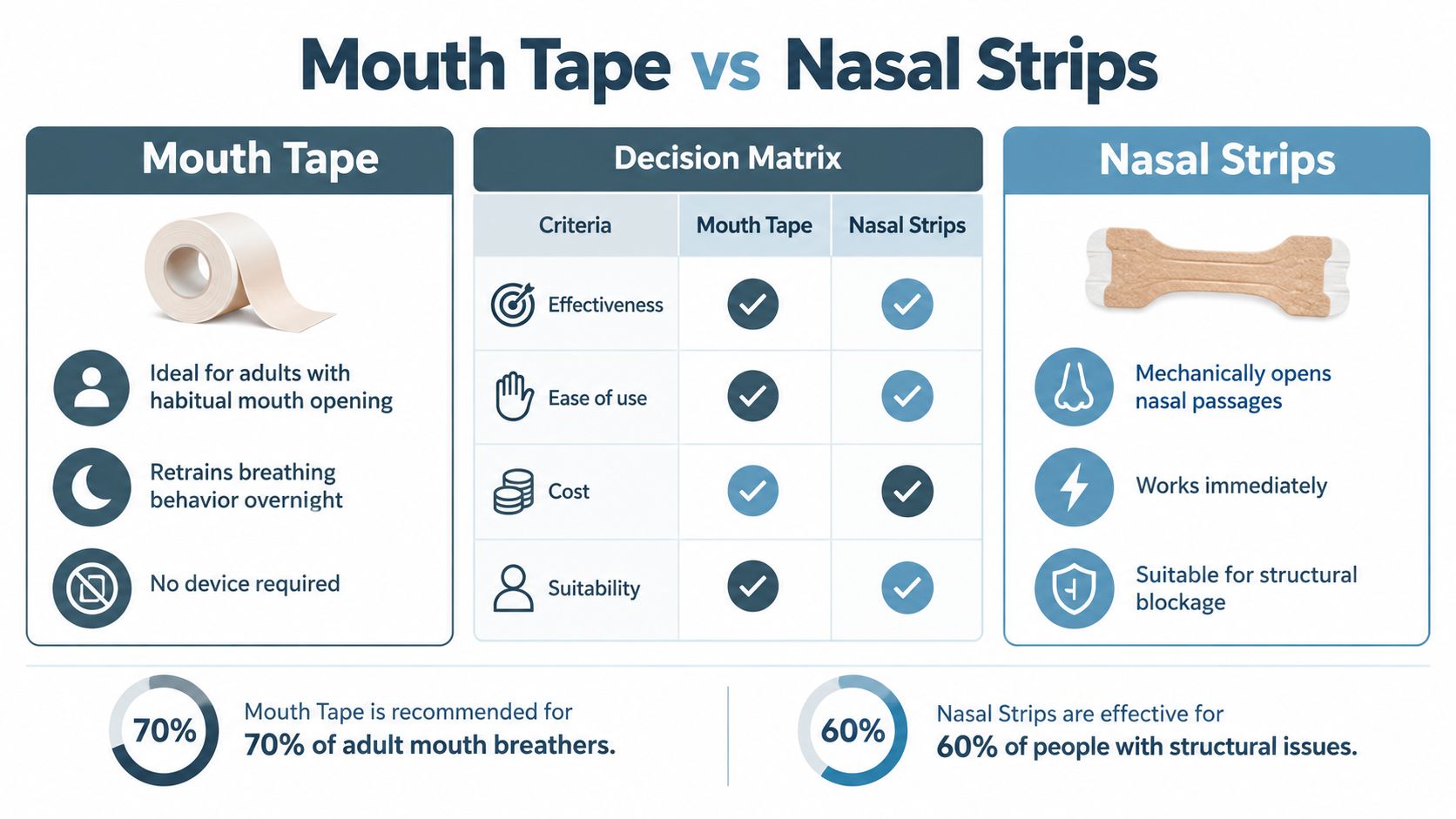
| Your main pattern | More relevant first option | Why |
|---|---|---|
| Your nose feels open, but your jaw drops during sleep | Mouth tape | It provides a gentle cue for keeping the lips together |
| Congestion or restricted nasal airflow starts the problem | Nasal strips | They support the external nasal passages |
| You have both nasal restriction and habitual mouth opening | Address nasal airflow first, then consider a combined approach | Closing the mouth makes more sense when nasal breathing feels comfortable |
| You snore loudly, gasp, or wake unrefreshed despite trying aids | Clinical evaluation | A tool shouldn't replace assessment for sleep-disordered breathing |
Avoid choosing by symptom alone
Dry mouth points toward overnight oral airflow, but it doesn't tell you whether congestion, anatomy, medication, or apnea caused the mouth to open. Likewise, snoring can occur for several reasons. A strip may improve the sensation of nasal airflow without resolving narrowing deeper in the airway.
Use one change at a time when possible. That makes it easier to notice whether the nose feels clearer, whether the mouth stays closed, and whether morning dryness changes. If both tools seem appropriate, introduce them cautiously and discontinue anything that causes distress or breathing difficulty.
The nasal strips benefits guide offers additional practical context. The goal isn't to create dependence on devices. It's to make nasal breathing comfortable enough that your natural pattern can return.
Building a Nightly Routine for Better Breathing
A breathing aid can't compensate for a chaotic bedtime. Give your body a predictable transition into sleep, then add airflow support where it fits. The routine should feel calm rather than like a test you have to pass.
Try this sequence:
- Dim bright screens and lights before bed. A quieter visual environment helps signal that the active part of the day is ending.
- Settle your body. Gentle stretching, journaling, or slow breathing can reduce the urge to rush into sleep.
- Support nasal airflow. If nasal strips are appropriate for you, apply them according to their instructions before lying down.
- Use a lip-sealing cue only when nasal breathing is comfortable. Mouth tape should never be used to overcome a blocked nose.
- Review the morning evidence. Note dryness, snoring, awakenings, and energy without assuming one night's experience proves a diagnosis.
Some adults also choose Restore+ Sleep Aid, a melatonin-free product described as supporting nitric oxide production, nervous-system regulation, and overnight oxygen delivery. Its listed formulation includes magnesium and other sleep nutrients, but no supplement should be used to diagnose or treat a breathing disorder.
Keep the routine repeatable. The purpose is to reduce friction around nasal breathing and make the healthier route easier to maintain, not to add another complicated performance ritual to bedtime.
Taking Control of Your Sleep Breath
What happens when you breathe through your mouth isn't limited to a dry throat. The route bypasses the nose's conditioning system, changes airflow mechanics, increases the work required from the upper airway, and can contribute to snoring and fragmented sleep. Over time, the morning symptoms become a practical report from your nighttime physiology.
The first useful step is observation. Notice whether your nose is blocked, whether your mouth is dry, whether a partner hears snoring, and whether you wake feeling restored. Then choose an intervention that matches the likely problem, such as addressing congestion before trying a lip-sealing cue.
Mouth breathing isn't always a fixed trait. It may reflect a reversible habit, but it can also signal allergies, structural nasal obstruction, or sleep apnea. If you experience gasping, witnessed breathing pauses, severe daytime sleepiness, or persistent unrefreshing sleep, seek medical evaluation instead of relying only on sleep accessories.
SleepHabits offers educational resources and nighttime breathing tools, including nasal strips, mouth tape, and a melatonin-free sleep aid designed around overnight recovery support. Visit SleepHabits to compare the options and build a bedtime routine that makes comfortable nasal breathing easier.