

You wake around 3 a.m. with a dry throat, a sticky mouth, and the vague sense that sleep has been more work than rest. Your partner says you snored. By morning, you've got a headache, foggy thinking, and coffee doing the job your sleep should have done.
Mouth taping has become a popular answer to that problem, but the useful question isn't whether it works as a viral sleep hack. The better question is narrower: who might plausibly benefit from gently encouraging nasal breathing, and when could the practice create more risk than value?
The potential benefits of sleeping with mouth taped are mostly tied to one change, keeping the lips closed so breathing happens through the nose. That can be meaningful for a carefully selected person with clear nasal passages and mild mouth-breathing habits. It isn't a cure for sleep apnea, a substitute for clinical care, or a universal solution for snoring.
Waking Up Dry, Foggy, and Still Tired
A chronic mouth-breather often drifts off on their back with the jaw relaxed. Sometime during the night, the lips part. Air begins bypassing the nose, the tongue loses some contact with the roof of the mouth, and the lower jaw can settle backward. Around 3 a.m., the sleeper wakes with a parched throat, reaches for water, and struggles to return to comfortable sleep.
The morning pattern is familiar. There may be dry mouth, a sore throat, morning headache, brain fog, and loud snoring that a partner noticed before the sleeper did. The person may not remember waking repeatedly, yet the next day feels unaccountably heavy. Mouth breathing doesn't explain every case of poor sleep, but it can be an important mechanical clue.
The problem is airflow, not willpower
Nasal breathing means drawing air through the nasal passages, while oral breathing means using the mouth as the main route. During sleep, muscle tone naturally changes, and a person who breathes comfortably through the nose while awake may still open their mouth when lying down.
That matters because the nose conditions incoming air and supports a more stable breathing pattern. Closing the lips may help the tongue remain nearer the palate and reduce the open-mouth airflow that can contribute to throat vibration. But tape can't remove swollen tissue, straighten a severely deviated septum, or prevent an airway from collapsing because of obstructive sleep apnea.
Practitioner's view: Mouth tape is best understood as a behavioral cue for nasal breathing, not as an airway-opening device.
This guide treats the practice as a targeted experiment with clear stop conditions. The possible upside is modest, such as less morning dryness or quieter breathing in a selected group. The downside deserves equal attention, especially if nasal airflow becomes blocked after you fall asleep.
How Nasal Breathing Actually Works at Night
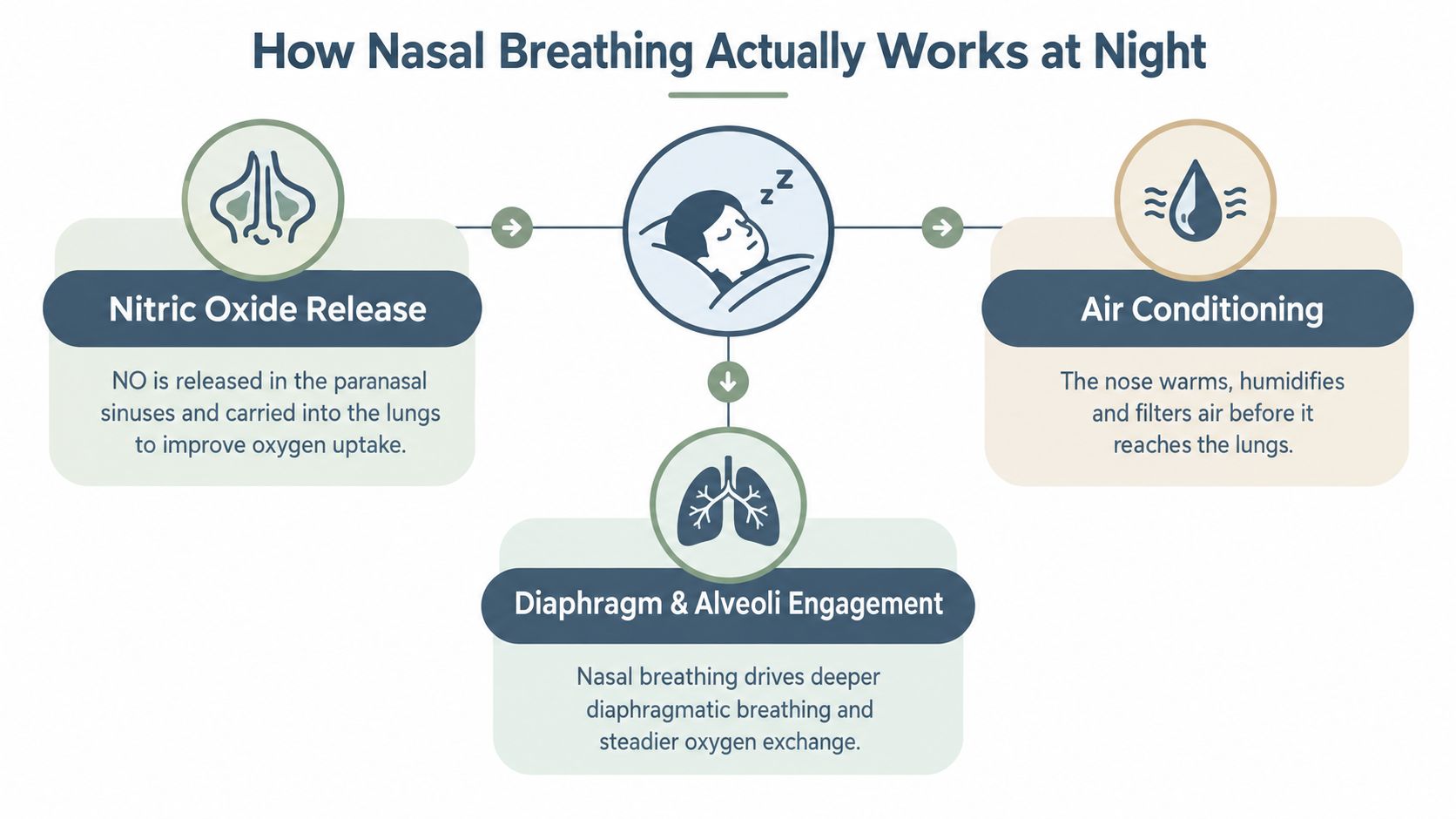
The nose isn't just an alternative opening for air. It acts as an airway-conditioning system, and several features become relevant when the mouth tends to fall open during sleep.
First, the paranasal sinuses release nitric oxide, which travels with inhaled air toward the lungs. Nitric oxide supports blood-vessel relaxation, oxygen uptake, and aspects of pathogen defense. Keeping the lips closed doesn't manufacture a new substance, but it may encourage the breathing route that carries nasal nitric oxide into the lower airway.
Second, the nasal passages warm, humidify, and filter incoming air. Mouth breathing sends relatively unconditioned air directly toward the throat. For some sleepers, that contributes to dryness and irritation, which can make snoring and small arousals more noticeable. This is one reason a person may wake with a dry mouth even when they don't recall a full awakening.
Tongue posture changes the mechanics
With the lips gently closed, the tongue is more likely to rest against the palate, meaning the roof of the mouth. That tongue-palate contact can support the space behind the tongue and reduce the loose, turbulent airflow associated with an open mouth. The result may be less vibration, but only when the nasal passage can handle the airflow.
A clear nose is therefore the starting condition, not an optional detail. If allergies, infection, swelling, or structure restrict the nose, taping can turn a compensatory mouth-opening habit into a breathing problem. A plain-language guide to breathing through the nose can help you assess the habit before trying an adhesive.
Other changes may matter just as much. Side sleeping can reduce positional snoring, and the right bed setup can reduce pressure and support alignment, so it's reasonable to review advice on how to upgrade your mattress for less snoring. For external nasal support, Nasal Strips are designed to gently open the nasal passages, but they don't treat sleep apnea or guarantee quieter sleep.
What the Mouth Taping Studies Really Show
The strongest direct evidence is narrow. A 2022 peer-reviewed study of 30 mouth-breathers with mild obstructive sleep apnea found that mouth taping reduced the median apnea-hypopnea index, or AHI, from 8.3 to 4.7 events per hour, a 47% decrease. The study also reported lower snoring index values, and the authors concluded that AHI and snoring severity fell by about half in this selected group. The Sleep Foundation summarizes those findings.
AHI counts breathing disruptions per hour of sleep. An AHI below 5 is generally within the normal range, so the change from 8.3 to 4.7 is clinically interesting for that group. It doesn't mean every person who snores will experience the same result, and it doesn't establish mouth tape as a general treatment for obstructive sleep apnea.
The evidence is promising, but small
A 2025 systematic review in PLOS One identified 10 eligible studies involving 213 patients. It found that evidence for mouth taping as a treatment for mouth breathing, obstructive sleep apnea, or sleep-disordered breathing was minimal in most groups and not clinically significant outside mild OSA. Only 2 of the 10 studies suggested possible benefit. The review's findings are available in PLOS One.
A small clinical study of 30 subjects similarly found that AHI and snoring index values fell by about half during sleep. The proposed mechanism was straightforward: forced lip closure encouraged nasal breathing, which may improve airflow continuity and reduce the collapsible, turbulent pattern associated with open-mouth breathing. The researchers also emphasized that the results came from a narrow patient group, not the general population. The full clinical study is available through PubMed Central.
| Study | Population | Intervention | Key Result | Plain-Language Takeaway |
|---|---|---|---|---|
| 2022 clinical study | 30 mouth-breathers with mild OSA | Mouth taping during sleep | Median AHI fell from 8.3 to 4.7, with lower snoring index values | A selected mild-OSA group showed a meaningful short-term response |
| 2025 systematic review | 10 eligible studies, 213 patients | Mouth taping across studied groups | Evidence was minimal in most groups, with possible benefit suggested in only 2 studies | The overall evidence remains limited and inconsistent |
| Small clinical study | 30 subjects with mild OSA | Mouth taping during sleep | AHI and snoring index values fell by about half | Nasal breathing may stabilize airflow in selected mouth-breathers |
The practical interpretation is modest. Mouth tape may reduce snoring or breathing disruption when a person has mild sleep-disordered breathing and a clear nose. It hasn't been shown to deliver broad, durable improvements in sleep quality, oxygen saturation, sleep fragmentation, or next-day alertness across the wider population.
Who Is a Good Candidate and Who Should Skip It
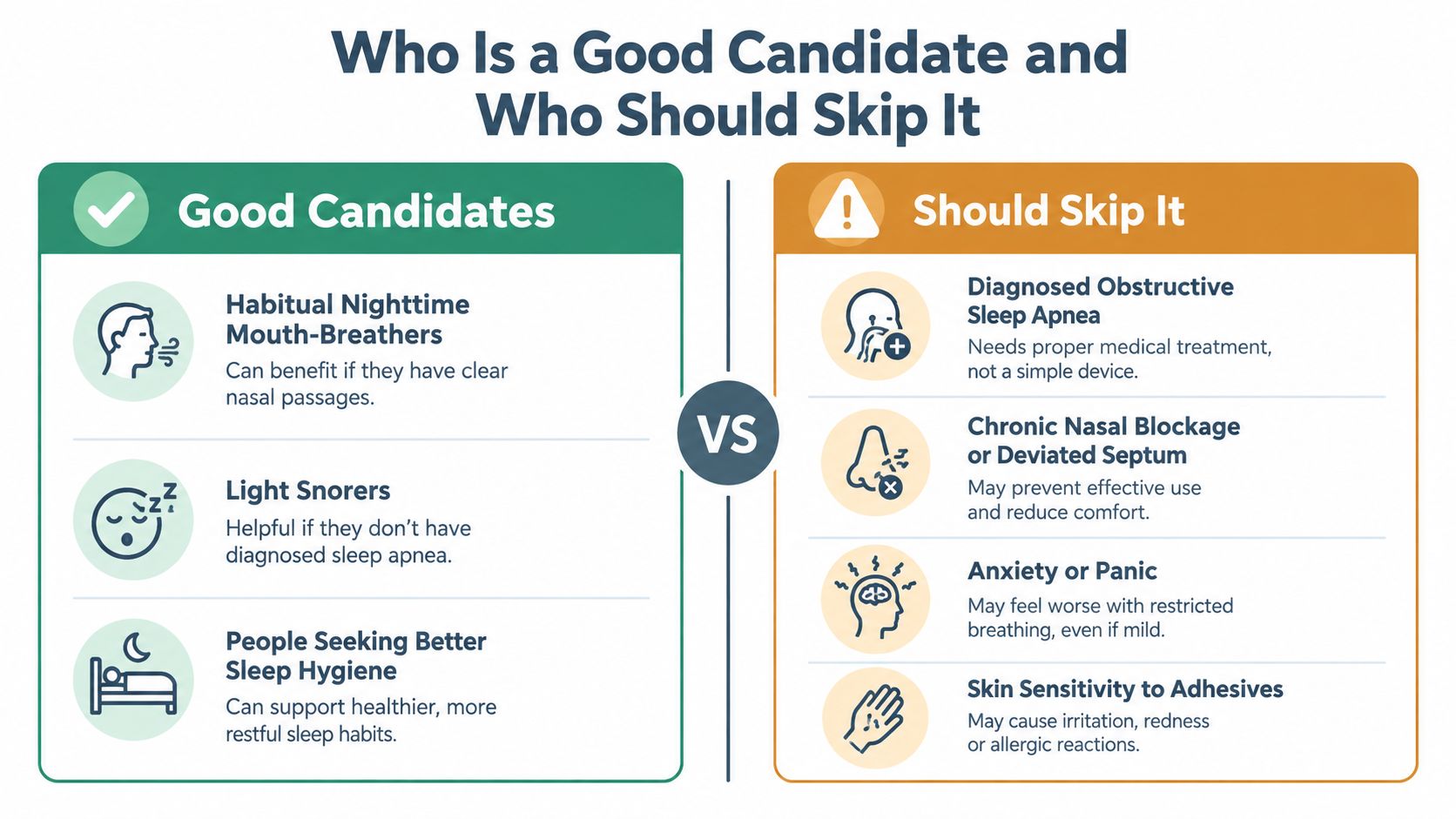
Candidacy should be decided by airway conditions, not by enthusiasm. A plausible candidate is an adult who habitually breathes through the mouth at night, can breathe freely through the nose, and doesn't have signs of untreated sleep apnea.
A reasonable candidate
This may include a habitual nighttime mouth-breather with clear nasal passages, a light snorer without diagnosed sleep apnea, someone with mild snoring and a normal BMI, or a person already practicing nasal-breathing drills during the day. These features don't prove safety or effectiveness, but they fit the subgroup in which the limited evidence is most relevant.
Try a simple nasal-patency check while awake. Sit comfortably and take 10 deep breaths through each nostril, then repeat while lying down. Notice whether one side collapses, whether airflow feels blocked, or whether you instinctively open your mouth. If the nose feels restricted in either position, don't use tape to force the issue.
Reasons to skip the experiment
Avoid mouth taping if you have:
- Diagnosed obstructive sleep apnea: Get treatment guidance first. Mouth tape doesn't create a new airway, and it may worsen breathing disruptions.
- Severe nasal restriction: A severe deviated septum, nasal polyps, active sinus infection, or allergies causing blockage can make nasal breathing unreliable.
- Restricted-breathing sensitivity: Asthma triggered by restricted breathing, claustrophobia, or anxiety around covering the mouth are strong reasons not to proceed.
- Bedtime risk factors: Alcohol close to bedtime or any risk of vomiting during sleep makes occluding the mouth inappropriate.
If any of these apply, an ENT evaluation, allergy treatment, or CPAP or BiPAP consultation is a better next step. Guidance on tape for sleep apnea shouldn't replace an assessment for gasping, witnessed pauses, severe snoring, or excessive daytime sleepiness.
A Practical First Week With Mouth Tape
Start with the tape, not the overnight commitment. Choose a purpose-made porous sleep strip or medical paper tape. Don't use duct tape, painter's tape, full-coverage occlusive strips, or anything wrapped around the lips. Place a vertical strip about 1 to 1.5 inches long over the center of closed lips, leaving a small lower gap or a folded tab for quick removal.
Before bed, sit upright and breathe through your nose for two minutes. If breathing feels effortless, lie on your side rather than your back for the first attempt. Anxiety, air hunger, nasal blockage, or a need to remove the strip is a stop signal, not a challenge to overcome.
A cautious seven-night progression
- Nights one to three: Use a porous strip with a deliberate lip gap. Keep the first trials conservative.
- Nights four to five: If comfortable, add gentle chin-tuck awareness during relaxation. Don't force the neck position.
- Nights six to seven: Continue the partial strip. Full coverage isn't necessary, and increasing coverage doesn't prove a stronger benefit.
The supplied seven-day visual guide also emphasizes a daytime patch test, a short relaxing trial, a nasal check, and morning notes. Those checks are more useful than treating the first successful night as proof that the method works.
For product-specific placement ideas, see how to mouth tape for better sleep. If you compare purpose-designed options, Mouth Tape is described as a gentle lip-sealing product with an X style for sensitive skin and a Roll style made from medical-grade silicone. Follow the package directions rather than copying a placement pattern from social media.
This video can provide another visual reference for the setup:
Brush your teeth before taping, moisturize the lips or surrounding skin if needed, and follow the instructions for the specific strip. Stop if you develop skin irritation, repeated awakenings, panic, worsening snoring, choking, or morning headaches. A persistently dry mouth may indicate that the seal is incomplete or that nasal breathing isn't holding through the night.
Building a Non-Melatonin Wind Down Around Mouth Tape
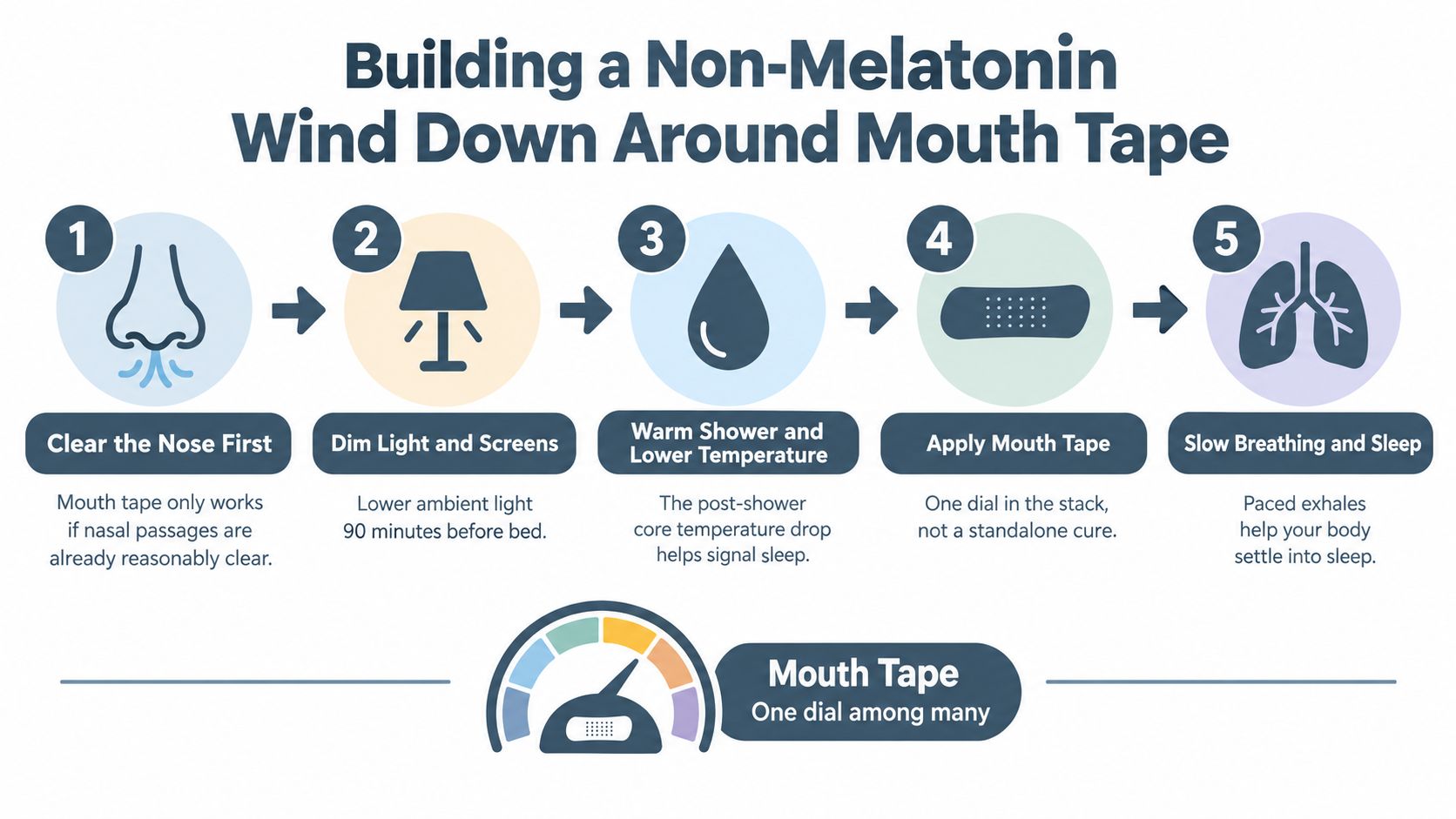
Mouth tape only has a plausible role when the nose is reasonably clear and the nervous system is already moving toward sleep. It can't compensate for bright screens, alcohol, congestion, an uncomfortable bed, or untreated sleep-disordered breathing.
A practical non-melatonin routine can look like this:
- An hour before bed: Dim screens and shift toward warm lighting.
- About 20 minutes before lights-out: Use a saline nasal rinse or steam inhalation if that normally helps your nasal comfort.
- Thirty to 45 minutes before bed: If you use a supplement, a magnesium-based sleep drink can fit here rather than melatonin.
- In bed: Complete four to six cycles of 4-7-8 breathing or box breathing, keeping the pace comfortable and nasal.
- Last: Apply the tape only when nasal breathing feels effortless.
The surrounding habits can do more work than the tape. Side sleeping may reduce positional snoring, daytime myofunctional exercises can build nasal-breathing awareness, and a cool, dark bedroom removes common sources of sleep disruption. For people looking for a melatonin-free supplement option, Restore+ Sleep Aid is described as supporting nitric oxide production, nervous-system regulation, and overnight oxygen delivery.
The stack follows the same mechanics as nasal breathing. Clear airflow supports the nose's conditioning role, closed lips encourage tongue-palate contact, slow breathing helps reduce arousal, and a consistent wind-down gives the brain fewer reasons to remain alert. Mouth tape is one dial among several, and it should be the smallest dial in the system.
Common Myths and Misconceptions About Mouth Taping
Myth one: mouth taping eliminates snoring for everyone. It may reduce soft-palate vibration in some light snorers when nasal airflow is good. It won't address every anatomical cause of snoring, and it may worsen breathing disruptions when snoring is driven by obstructive sleep apnea.
Myth two: mouth tape cures sleep apnea. The 2022 study involved a selected group with mild OSA, and the broader review found minimal evidence in most groups. Mouth tape isn't a CPAP alternative, and someone with gasping, witnessed pauses, or persistent daytime sleepiness needs clinical evaluation.
Myth three: mouth taping replaces melatonin. The tape changes the breathing route. It doesn't act on the melatonin pathway, so it can't substitute for melatonin in shift work, jet lag, or delayed sleep phase. It may fit inside a non-melatonin routine, but it isn't a sleep-timing treatment.
Myth four: dry mouth proves the tape failed. Persistent dryness after taping suggests an incomplete lip seal, continued mouth breathing, nasal blockage, or another oral-health issue. The tape may not have controlled the underlying problem.
Myth five: mouth taping is risk-free. Adhesive can irritate skin, and the sensation can provoke anxiety or panic. Occluding the mouth also creates a safety concern if nasal obstruction develops or if someone vomits during sleep.
The safest response to a dramatic social-media claim is to reduce it to a testable observation. Did morning dryness improve? Did your partner notice quieter breathing? Did you wake with less comfort, more anxiety, or signs of airflow struggle? Those answers matter more than a promise of universal transformation.
Your Next Steps for Safer Better Sleep
My verdict is measured. Mouth taping is a small optional add-on for a narrow group, not a cure and not a substitute for diagnosing poor sleep. Try it only if your nose stays open with your lips closed for 60 seconds, you don't have diagnosed OSA, and you aren't dealing with severe allergies or congestion on the test night.
Use this checklist:
- Confirm your nasal-breathing baseline while seated and lying down.
- Choose hypoallergenic, porous tape intended for skin.
- Apply it vertically with a gap or easy-removal tab.
- Set a 15-minute bedtime wind-down before applying it.
- Avoid alcohol within three hours of bedtime.
- Journal dry mouth, awakenings, headaches, snoring feedback, and alertness for two weeks.
- Escalate to a sleep physician if daytime sleepiness, witnessed apneas, or morning headaches persist.
A realistic responder may notice less morning dry mouth and modestly fewer night wakings within two weeks. Those gains are useful, but they're also unglamorous. If the tape causes anxiety, obstructed breathing, or worse sleep, the experiment has answered its own question.
For broader sleep preparation, guidance on how to get to sleep quicker can help you improve the wind-down before adding any airway tool. Start with nasal comfort and consistent sleep habits, then seek professional assessment when symptoms point beyond a simple mouth-opening habit.
SleepHabits offers mouth tape, nasal strips, and a melatonin-free Restore+ sleep aid for people building a breathing-focused wind-down routine. Review the products and educational resources at SleepHabits, then choose only the tool that matches your nasal airflow, comfort, and clinical situation.