

At 2 a.m., you're either nudging a snoring partner, moving to the sofa, or waking yourself with the sound you hoped nobody else could hear. The natural question is simple: do anti-snore mouthpieces work? The honest answer is yes for many suitable snorers, but no device reliably stops loud snoring every night for everyone.
Anti-snore mouthpieces are oral appliances worn during sleep to help keep the upper airway open. The two main families are mandibular advancement devices (MADs), which move the lower jaw forward, and tongue-stabilizing devices (TSDs), which hold the tongue forward without repositioning the jaw. Clinical evidence supports meaningful benefits, especially for primary snoring and mild-to-moderate obstructive sleep apnea, but real-world results depend heavily on fit, comfort, the source of the snoring, and whether you keep wearing the device.
What You Really Want to Know Before You Buy
The phrase “anti-snore mouthpiece” covers several very different products. A basic night guard protects teeth from grinding, but it may do nothing for airway narrowing. A dedicated oral appliance is designed to influence breathing during sleep, usually by changing the position of the jaw or tongue.
Clinical trials show that these devices can help many people with mild-to-moderate snoring. The difficulty is that a device can work in a sleep study and still disappoint at home. A poor fit may cause jaw discomfort. A device that advances the jaw too aggressively may be hard to tolerate. And if your snoring comes mainly from nasal congestion, back sleeping, alcohol, or another untreated breathing problem, moving the jaw may not address the cause.
Four questions matter before you spend money:
- Does the science support the claims? Evidence is stronger for custom, adjustable appliances than for generic guards.
- How does custom compare with store-bought? OTC devices can suit some simple snorers, while more complex symptoms call for professional assessment.
- What side effects should you expect? Temporary tooth tenderness, saliva changes, jaw soreness, and longer-term bite changes are possible.
- When is a nasal alternative smarter? Nasal strips or mouth-breathing strategies make more sense when airflow starts with the nose rather than the jaw and throat.
Practical rule: Treat a mouthpiece as a targeted airway tool, not as a universal snoring cure.
Your goal shouldn't be to find the product with the boldest promise. It should be to identify whether your snoring pattern matches the mechanism, choose a device you can tolerate, and know when snoring deserves a sleep evaluation instead. That framework is more useful than a generic recommendation.
How Anti Snore Mouthpieces Actually Work
Think of your upper airway as a hallway. During sleep, the tongue and soft palate relax backward, a little like a loose drape narrowing the passage. Air still moves through, but the tighter space makes soft tissue vibrate. That vibration produces the familiar snoring sound.
A mandibular advancement device grips the upper and lower teeth and gently positions the lower jaw forward. The jaw brings the tongue and nearby soft tissues forward, helping enlarge the space behind the tongue. A major review describes enlargement especially at the sides of the upper airway and an anterior movement of the tongue, which helps explain why mandibular advancement devices change airway shape.
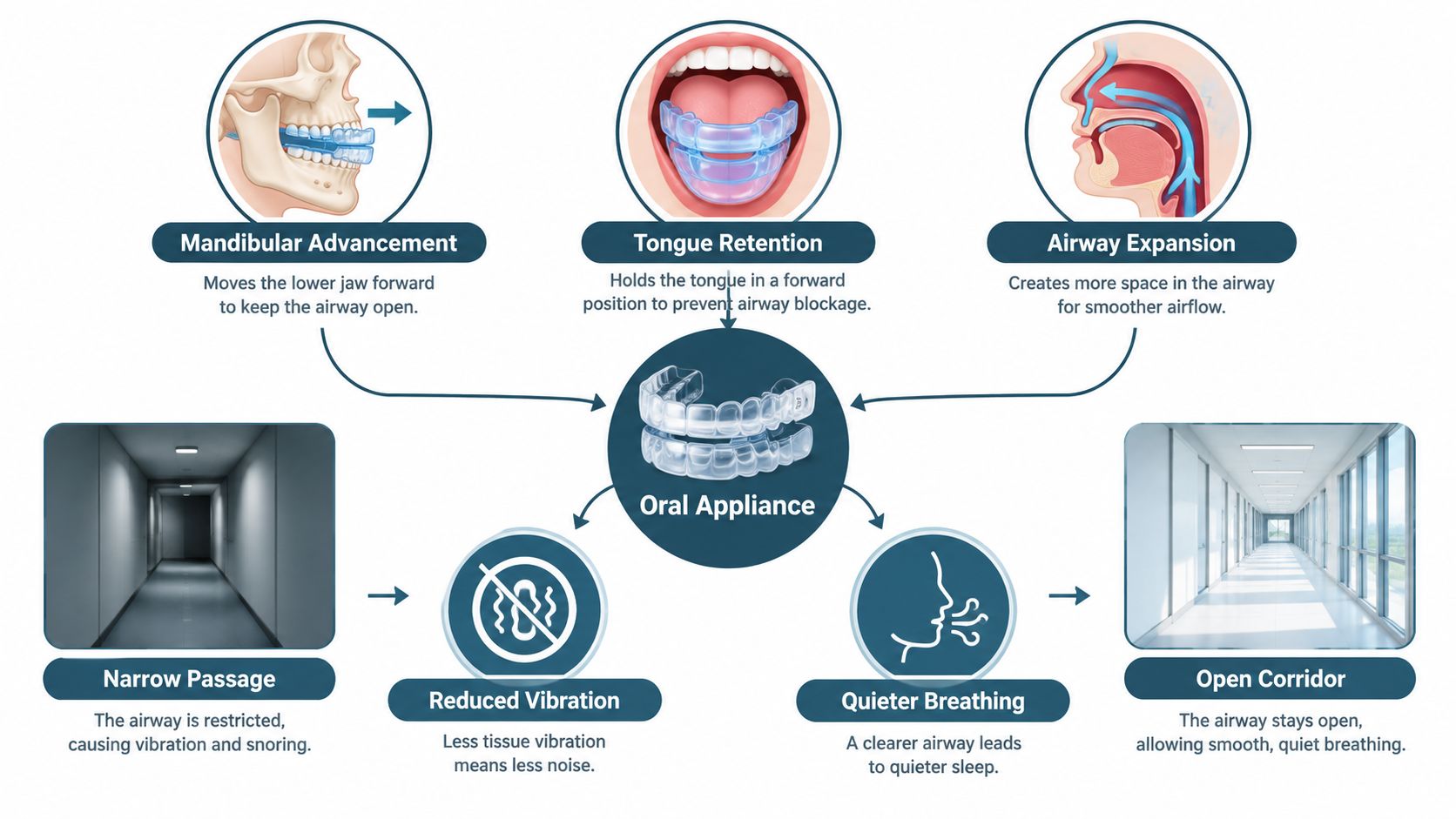
MADs are the more common oral appliance, but they aren't the only design. Tongue-stabilizing devices, also called tongue-retaining devices, use gentle suction to hold the tongue forward. Because they don't move the jaw, they may be considered by people who can't tolerate jaw advancement, including some people with temporomandibular joint concerns or certain dental limitations. Denture wearers may also need a different approach, although a dental professional should assess whether an appliance is suitable.
The mechanism separates oral appliances from other sleep tools:
- CPAP uses pressurized air delivered through a mask to splint the airway open.
- MADs reposition the lower jaw and connected soft tissues.
- TSDs hold the tongue forward with suction.
- Vestibular shields mainly discourage mouth breathing and don't reposition the jaw.
The amount of advancement matters. Guidance says clinicians should use the minimum protrusion needed for effect, commonly around 50% of maximum horizontal protrusion, though it may reach 70% to 75% in severe obstructive sleep apnea when clinically indicated (dental guidance on mandibular advancement).
If your breathing pattern is driven by nasal blockage, a loose open mouth, or a position-related issue, a jaw device may only solve part of the problem. Learning the difference between nasal breathing and mouth breathing can help you identify whether the airway problem begins at the nose or farther back in the throat. For a closer look at how oral designs differ from ordinary sports guards, you can also compare SISU mouthguard features, while remembering that a sports mouthguard isn't automatically an anti-snoring appliance.
Here's the practical distinction: a MAD can help when the hallway narrows because the jaw and tongue fall backward. It won't necessarily help if the hallway is already restricted by a blocked nose, or if the main issue is severe sleep apnea that requires medical treatment.
What the Clinical Evidence Really Shows
The evidence becomes easier to understand when you separate objective breathing results, reported snoring, and long-term use. These outcomes overlap, but they aren't interchangeable.
A foundational randomized trial published in 2006 compared an advanced thermoplastic mandibular advancement device with a non-advanced version. At a 45 dB threshold, the advanced device reduced median snoring from 398 snores per hour to 17, while the non-advanced appliance had no effect. The authors concluded that it was effective for snoring in two out of three non-apnoeic snorers, supporting the idea that forward jaw positioning, rather than just wearing material in the mouth, was the active mechanism (the 2006 randomized trial).
Modern evidence gives a similarly encouraging but more conditional picture. In a 2024 randomized pilot trial of 50 couples, 91% of couples assigned to a mandibular advancement device reported that snoring responded after four weeks, compared with 58% in a combined airway and positional therapy group. When the snoring person judged the outcome, the response was 91% with the mandibular advancement device and 44% with the comparison approach (the 2024 randomized pilot trial and related evidence).

Those figures don't mean every user becomes silent. In a separate retrospective study, 56 of 90 patients, or 73.3%, were classified as snoring-index responders after 12 months, with snoring falling by 64.5% overall. The same evidence base also reported mean reductions of 16.4 apnea-hypopnea events per hour and 10.8 oxygen desaturation events per hour, showing why a mouthpiece can improve sleep-disordered breathing metrics even when some audible snoring remains.
| Study / Source | Device Type | Key Finding |
|---|---|---|
| 2006 randomized trial | Advanced and non-advanced thermoplastic MADs | Median snores per hour fell from 398 to 17 with the advanced device, while the non-advanced device had no effect. |
| 2024 randomized pilot trial | Mandibular advancement device | Snoring response was reported by 91% of assigned couples after four weeks. |
| Retrospective 12-month study | Mandibular advancement device | 56 of 90 patients responded on the snoring index, with overall snoring falling by 64.5%. |
| Evidence review | Oral appliances | Benefits are strongest for custom, adjustable devices and less consistent in more complex sleep-disordered breathing. |
The important gap is between sleep apnea metrics and nightly sound. A lower apnea-hypopnea index can represent a meaningful health improvement even if a bed partner still hears occasional snoring. Oral appliances are also generally less effective than CPAP for lowering apnea-hypopnea index in obstructive sleep apnea, so a positive response doesn't make the treatments interchangeable. A practical overview of sleep apnea treatments other than CPAP can help place mouthpieces within the broader range of available therapies.
For people focused on restorative sleep rather than snoring alone, Restore+ Sleep Aid is described as a melatonin-free product designed to support nitric oxide production, nervous system regulation, and overnight oxygen delivery. It isn't a replacement for an airway appliance or sleep apnea treatment.
Custom Devices vs Over the Counter Options
A custom dental appliance starts with your mouth. A dentist takes an impression or digital scan, checks your teeth, gums, bite, and jaw movement, then has a laboratory fabricate an appliance around those measurements. Many custom MADs include adjustment screws or other titration features, allowing advancement to increase gradually rather than locking you into one position.
An OTC boil-and-bite device takes a different route. You soften thermoplastic in hot water, place it over your teeth, and bite into it to create a home-molded shape. Some models offer adjustment, but many provide a limited range of positioning and can feel bulky or unstable.
| Factor | Custom Dental Device | OTC Boil-and-Bite |
|---|---|---|
| Fit | Made from a dental impression or digital scan | Shaped at home with heated thermoplastic |
| Advancement | Usually titratable and adjusted under supervision | Often fixed or limited to home adjustments |
| Durability | Commonly described as lasting longer with care | Usually needs replacement sooner |
| Comfort | More precise contact with teeth and gums | Fit can be inconsistent |
| Best match | Persistent snoring, suspected OSA, or complex bite needs | Simple, mild snoring with no warning signs |
| Clinical oversight | Dental and sleep assessment can monitor results | The user manages fit and response |
The price difference can be substantial. Custom appliances usually cost $1,500 to $3,500, while OTC models commonly cost $30 to $150, based on the evidence summary provided for this comparison. Prescribed custom devices may also qualify for insurance or a flexible spending account, depending on the plan and medical documentation.
The cheapest option isn't always the lowest-cost decision. An inexpensive device that causes morning jaw pain, slips out, or ends up in a drawer has no practical value. On the other hand, a mild positional snorer with healthy teeth and no symptoms of sleep apnea may reasonably start with a carefully chosen OTC MAD rather than committing immediately to a custom appliance.
A useful match: Mild, uncomplicated snoring may justify an OTC trial. Persistent symptoms, suspected apnea, a larger jaw-position challenge, or previous device failure favor a custom evaluation.
Side Effects and Who Should Avoid Mouthpieces
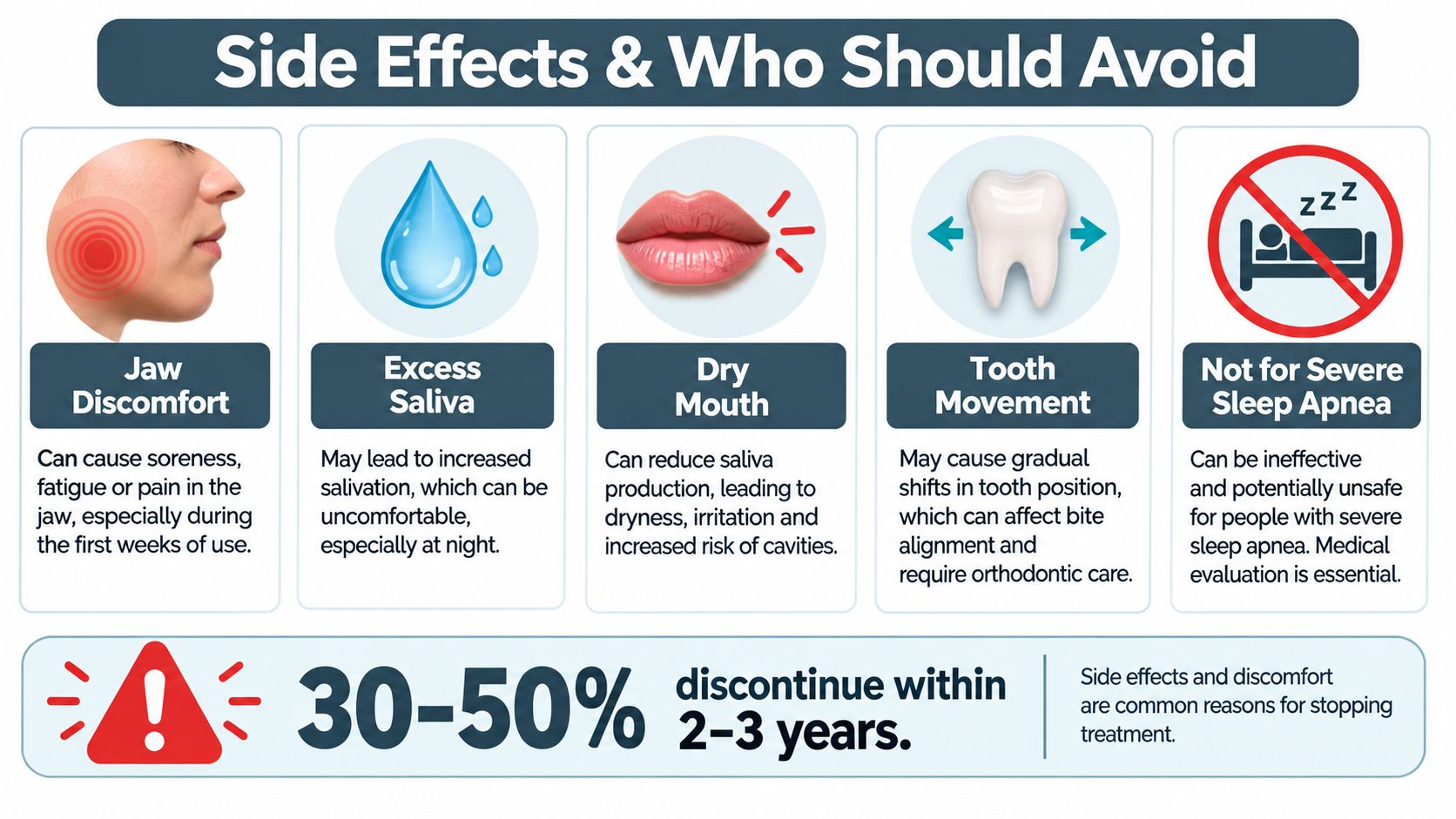
A mouthpiece changes the way your teeth, jaw muscles, tongue, and saliva interact for several hours at a time. The first nights can feel strange even when the device is correctly fitted. Morning jaw soreness, tooth tenderness, extra saliva, and dry mouth are common complaints, and pushing the jaw forward too quickly can make discomfort worse.
Long-term tolerability deserves equal attention. A long-term compliance study found satisfactory snoring control in 75.6% of users, while dry mouth and tooth or jaw discomfort were common enough to differ significantly between users and nonusers. A separate review reported common adverse effects including excessive salivation and tooth discomfort, with 56% to 68% continuing use at about 33 months (long-term compliance and adverse-effect evidence).
Dental changes can develop gradually. Tooth movement, jaw pain, and progressive changes in the bite are documented concerns with longer use. That doesn't mean every wearer will experience a serious problem, but it does mean a device deserves monitoring rather than permanent “set and forget” use.
Pause before buying if you have
- Severe TMJ symptoms: Pain, locking, restricted movement, or significant jaw dysfunction can make advancement harder to tolerate.
- Unstable teeth or active gum disease: The appliance applies forces to teeth and surrounding tissues.
- Untreated cavities: Dental problems should be addressed before placing an appliance over the teeth overnight.
- A fully edentulous upper or lower arch: A conventional tooth-retained device may not be suitable.
- Diagnosed central or severe OSA: A mouthpiece shouldn't replace a prescribed treatment plan or CPAP titration.
- Warning symptoms: Witnessed breathing pauses, gasping, choking, or marked daytime sleepiness call for medical assessment before self-treatment.
Use discomfort as information. Mild tenderness during the adjustment period may settle, but persistent pain, a new bite that doesn't return to normal in the morning, loose teeth, or worsening jaw symptoms deserves a dental review. A clinician can reduce the advancement, modify the fit, or recommend a different treatment.
If the main issue is open-mouth breathing without signs of airway collapse, Mouth Tape is one non-jaw option described as gently encouraging nasal breathing during sleep. It shouldn't be used to mask suspected sleep apnea, severe nasal obstruction, or an inability to breathe comfortably through the nose.
Mouth Tape and Nasal Strips as Alternatives
Mouth tape and nasal strips target a different part of the breathing pathway. A mouthpiece changes jaw or tongue position. Tape encourages the lips to stay closed, while nasal strips or internal dilators aim to improve airflow through the nose.
That distinction helps explain why one person may benefit from a nasal tool and another may need a MAD. If your snoring begins with habitual open-mouth breathing, closing the lips may reduce the turbulent airflow that vibrates tissues in the mouth. If allergies, congestion, a narrow nasal valve, or a deviated septum makes nasal breathing difficult, a strip can support the nose without applying force to the jaw.
Match the tool to the pattern
- Nasal resistance: Try addressing congestion and nasal airflow first. Nasal strips can gently open the nasal passages and support smoother airflow.
- Habitual mouth breathing: A lips-only approach may be relevant for selected mild snorers who can breathe freely through the nose and don't have suspected OSA.
- Jaw or tongue collapse: A MAD is more directly matched to this pattern because it advances the lower jaw.
- Two contributing problems: Some people may need both nasal support and an oral appliance, but each tool should address a distinct cause rather than adding products at random.
The safety rule is simple: never seal a mouth that can't breathe comfortably through the nose. Treat significant congestion first, and seek assessment if snoring comes with pauses, gasping, or daytime sleepiness. A practical guide to using mouth tape for sleeping should be read as a breathing-habit resource, not as a substitute for apnea evaluation.
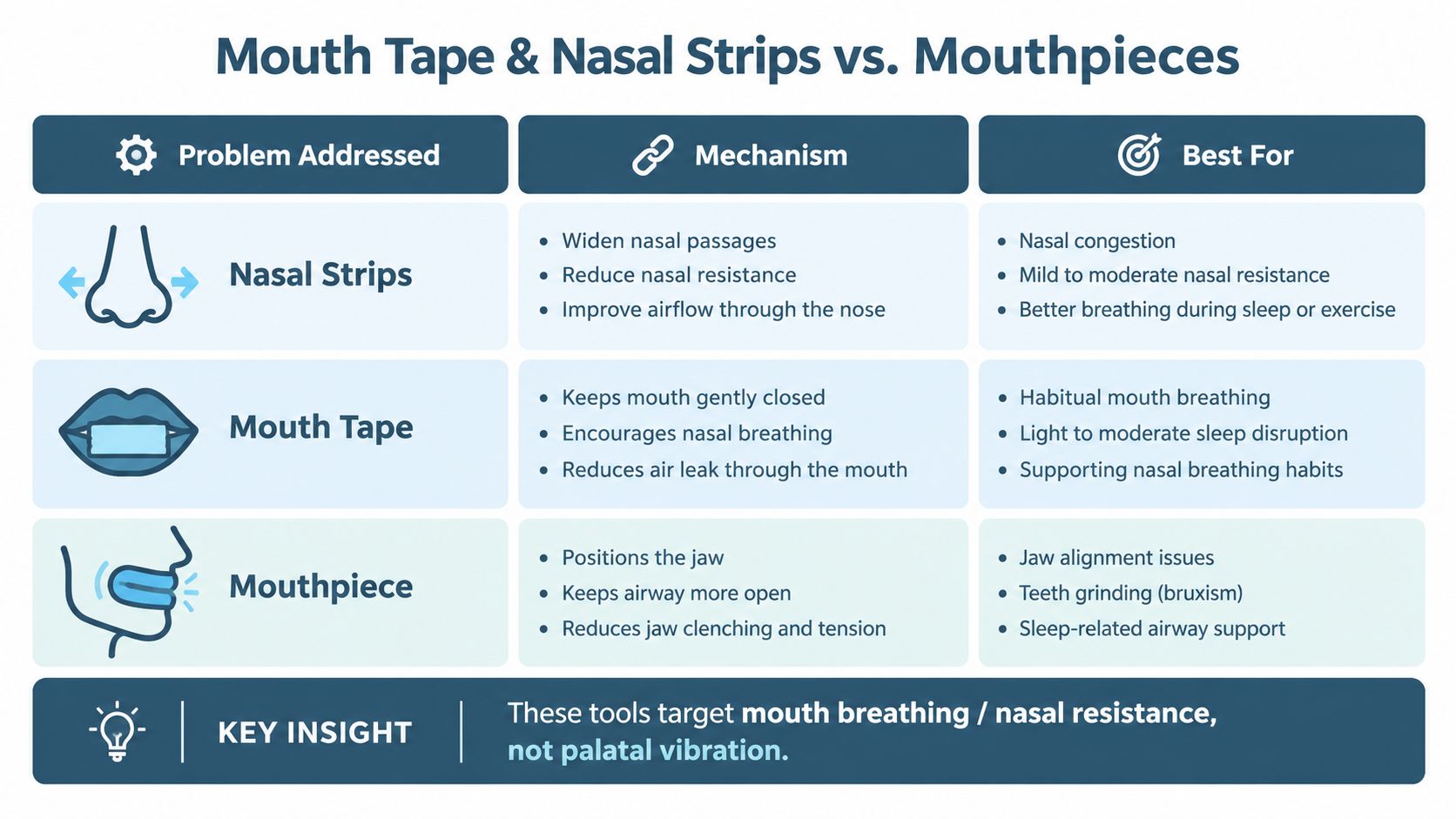
Nasal Strips are described as tools that gently open the nasal passages, which may suit people whose snoring is linked to allergies, congestion, or restricted nasal airflow. They don't reposition the jaw or directly treat palatal vibration, so a person with throat-level collapse may need a different intervention.
For a dual snorer, a nasal strip plus a properly fitted mouthpiece can be more logical than increasing jaw advancement. The strip supports the entrance of the airway, while the appliance addresses the jaw and tongue. If neither changes the pattern, stop experimenting and arrange a clinical assessment.
Putting It All Together for Quieter Nights
Use your snoring pattern to choose the next step, not the packaging on a product.
Start with the sound and the circumstances
Ask your bed partner when the snoring happens. Is it strongest with a blocked nose, after sleeping on your back, or regardless of position? Does it sound like vibration in the mouth and throat, or does it come with pauses and gasps? A short recording can help, but a recording can't diagnose sleep apnea.
Choose the least invasive tool that matches the cause
For mild snoring linked to nasal resistance or mouth breathing, start with nasal airflow and sleep-position changes. A carefully fitted OTC MAD may be reasonable when the pattern suggests jaw-related narrowing and there are no dental or apnea warning signs. Persistent or more disruptive snoring deserves a custom MAD evaluation, particularly when comfort and gradual adjustment matter.
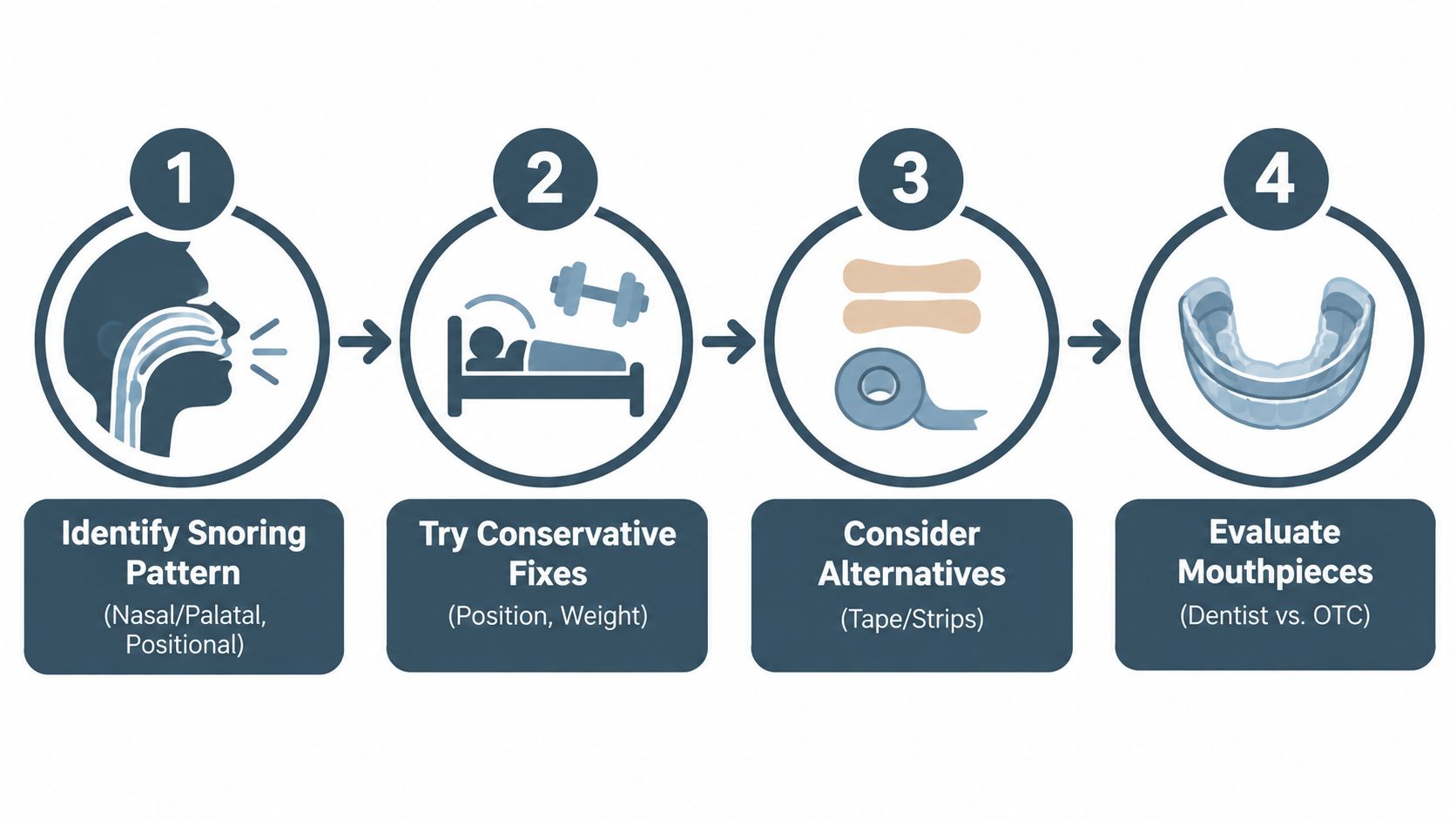
Use this order of operations:
- Identify the pattern. Separate nasal from palatal or throat-related snoring, and note whether position changes it.
- Try conservative measures. Improve nasal breathing and avoid the position that reliably worsens the sound.
- Select the device class. Consider an OTC MAD for uncomplicated mild snoring, or a dentist-fitted MAD when symptoms persist or the anatomy is more challenging.
- Escalate when needed. Arrange a sleep study if you notice witnessed apneas, gasping, significant daytime sleepiness, or known apnea-hypopnea abnormalities.
Give a chosen device a structured trial rather than judging it after one uncomfortable night. Track whether the bed partner can sleep through the night, whether snoring falls to conversational volume, whether morning jaw pain stays within mild first-week tenderness, and whether you can continue using the device beyond 30 days. If the sound improves but you develop persistent jaw or bite symptoms, the result isn't successful enough to ignore the side effect.
For the majority of people, the practical priority is:
- First, optimize nasal breathing when congestion or open-mouth breathing appears involved.
- Then address sleep position if the snoring changes clearly with posture.
- Next consider a custom MAD when jaw-related narrowing remains likely.
- Use CPAP for diagnosed sleep apnea when prescribed, especially when disease is moderate or severe.
SleepHabits offers breathing-focused tools such as mouth tape and nasal strips, alongside Restore+ as a melatonin-free recovery product, so you can explore nasal breathing support without treating those products as substitutes for dental or sleep medicine care. Visit SleepHabits to compare those options and choose a practical next step for your nighttime breathing routine.