

Yes. Snoring can lower sleep quality for both the snorer and the bed partner, but how much depends on whether the snoring comes with breathing pauses, gasping or daytime sleepiness.
You're awake in the dark, listening for the next snore, while the person beside you seems peacefully asleep. By morning, you feel exhausted and they say they slept fine. Both experiences can be real: noise can disturb your sleep without necessarily disrupting theirs in the same way.
The Short Answer Depends on the Pattern of Snoring
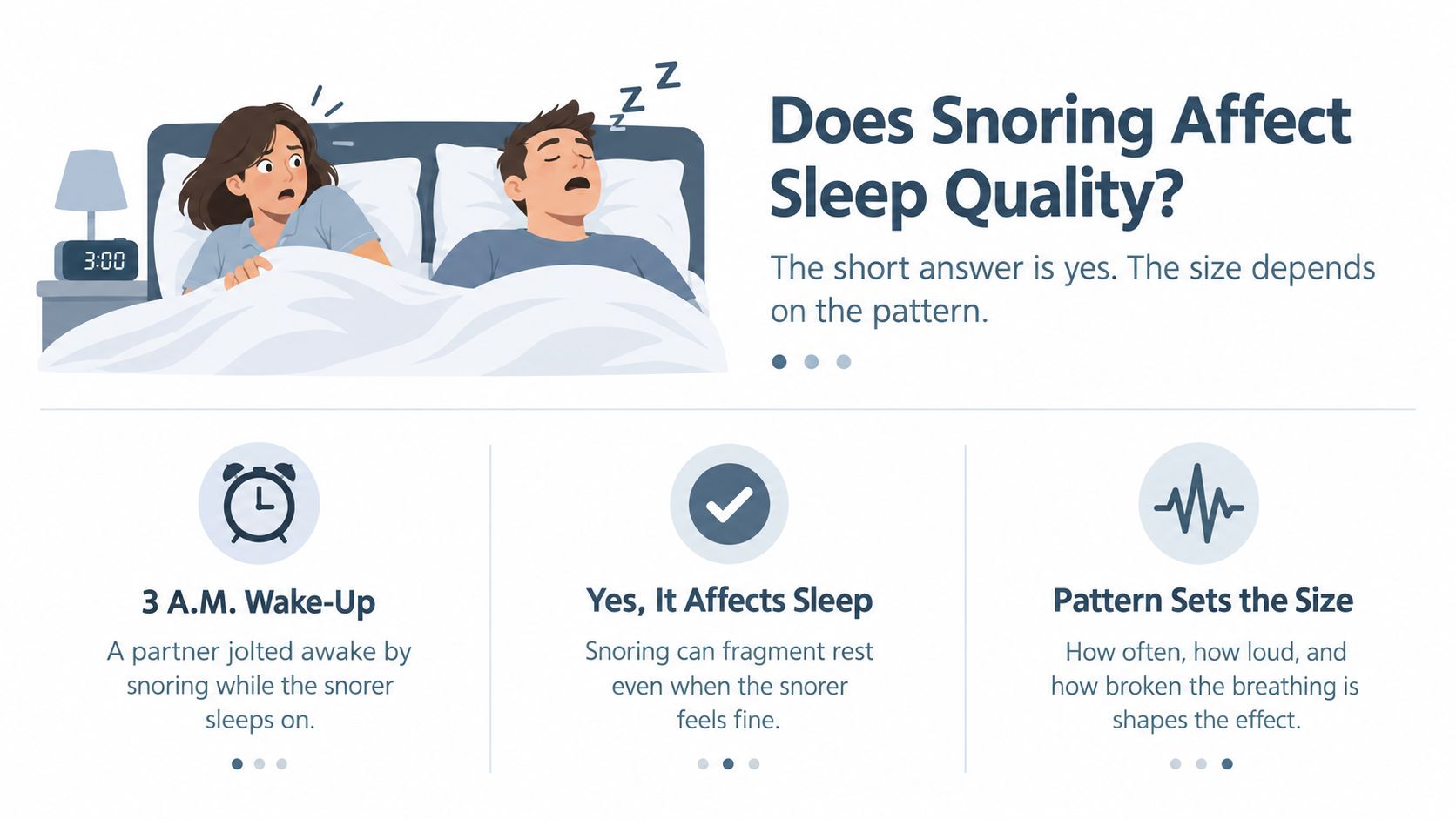
Say it's 3 a.m. and a sudden snort jolts you awake. Your partner rolls over, keeps sleeping and wakes feeling refreshed. That situation calls for a different response from snoring punctuated by silence, struggling breaths and gasping.
Snoring is common: a 2021 American Academy of Sleep Medicine survey found that nearly 70% of Americans who share a bed reported that their partner snores; the AASM's overview also places occasional snoring at approximately 45% of adults and regular snoring at about 25%, and describes a 2020 study of 162 participants in which snoring exceeded 45 dB(A) in 66% and 53 dB(A) in 14%.
Those sound measurements show why snoring can be difficult to sleep beside. They don't tell you whether a particular snorer has a breathing disorder, or how much restorative sleep that person gets.
The illustration captures the mismatch between the person making the noise and the person losing sleep.
Snoring Pattern and Its Likely Effect on Sleep
| Snoring pattern | Likely effect on sleep | Priority action |
|---|---|---|
| Occasional snoring, mainly with colds or after alcohol | Usually minor, with occasional short awakenings | Track the pattern for two weeks |
| Regular loud snoring, partner reports no pauses | Partner disturbed; snorer may wake unrefreshed | Log symptoms for both people |
| Loud snoring with witnessed pauses or gasping | Repeated oxygen drops and arousals are likely | Request a sleep evaluation |
| Snoring with daytime sleepiness or morning headaches | Fragmented, unrefreshing sleep is likely | Book a clinical assessment soon |
These are practical starting points, not diagnoses. A partner who hasn't noticed pauses hasn't necessarily ruled them out, especially if they sleep through most of the night.
Find the row that most closely matches your situation. When asking “Does snoring affect sleep quality?”, the useful distinction is between sound disturbing someone nearby and breathing trouble disturbing the sleeper.
How Snoring Breaks Up Your Sleep
A film with frequent splices can still run from beginning to end, yet feel disjointed. Sleep can be similarly interrupted: you spend the night in bed, but repeated disturbances prevent long, continuous stretches of rest.
The film analogy helps separate time asleep from continuity of sleep.

Brief Arousals Aren't Always Remembered
An arousal is a brief shift toward wakefulness or lighter sleep. You don't have to sit up, check the clock or remember anything for your sleep to have been interrupted.
Noise can trigger an arousal in a bed partner. In someone with disordered breathing, the effort to restore airflow can trigger an arousal in the sleeper. Either way, counting hours alone misses part of the picture.
Your sleep architecture describes how sleep stages are organized across the night. Continuity matters alongside the amount of time spent asleep.
What Fragmentation Experiments Tell Us
In a controlled sleep-fragmentation study of 16 subjects, researchers compared interruptions at regular 90-second intervals with interruptions clustered into 30-minute periods every 90 minutes; total sleep time and microarousal frequency were similar, but stage 2 sleep was 55% ± 4% versus 62% ± 7%, and slow-wave sleep was 21% ± 3% versus 12% ± 6%, respectively.
In plain language, changing the timing of interruptions changed the balance between lighter and deeper sleep. Daytime function was similar between conditions, so the experiment doesn't establish that one interruption pattern was harmless. It also wasn't a snoring experiment, so it explains fragmentation rather than proving that every snore damages sleep.
A Japanese outpatient study found frequent awakenings in 17.8% of habitual male snorers versus 6.6% of non-habitual male snorers, and 21.5% versus 9.7% among women, with habitual snoring also associated with excessive daytime sleepiness in both groups at P < 0.001.
That association doesn't prove snoring caused every awakening. It does make regular snoring combined with unrefreshing sleep worth discussing with a clinician.
For a visual companion to the explanation, you can watch the video below.
Practical rule: Don't use “I never remember waking up” as proof that your sleep is uninterrupted.
Oxygen Drops and When Snoring Signals Sleep Apnea
A 55-year-old snores loudly most nights. A partner notices pauses, then a gasp, then breathing that restarts with a snort. That pattern raises a different question from “How loud is the noise?” It asks whether the airway is narrowing enough to interrupt airflow, oxygen or sleep continuity.
Snoring comes from vibrating upper-airway tissues. Obstructive sleep apnea, or OSA, involves repeated airway narrowing or closure during sleep. Reduced breathing events are called hypopneas; breathing pauses are called apneas. The sound may be the most noticeable sign, yet the diagnosis rests on what airflow and oxygen are doing.
The Breathing Pattern Matters More Than the Sound
During obstructive events, oxygen can fall and the sleeper may briefly arouse to reopen the airway. Some breathing-related arousals also occur without a substantial oxygen drop, so oxygen isn't the only measurement that matters.
A polysomnography study of adults referred for suspected sleep disorders found that objectively measured snoring frequency had no significant relationship with sleep-stage distribution, arousal frequency or Epworth Sleepiness Scale scores, while the apnea-hypopnea index was significantly associated with arousal frequency.
The Epworth scale measures a person's reported tendency to doze during everyday situations. The apnea-hypopnea index, usually shortened to AHI, counts breathing events during sleep. Those are different questions from how often someone makes a snoring sound.
Read carefully, that finding separates acoustic disturbance from breathing-related damage: snoring alone isn't a reliable measure of breathing-related sleep disruption. Persistent loud snoring still deserves attention, but a recording of the noise cannot establish the diagnosis or severity. A quieter bedroom can also hide a separate loss for the bed partner, whose sleep should be tracked as its own outcome rather than treated as a footnote.
Common Doesn't Mean Diagnostic
An AASM clinical document discussed in this NIH-hosted review reports that snoring occurs in up to 30%-50% of adults over age 50. Familiarity can make people dismiss it, particularly when several family members snore.
Snoring and OSA overlap without matching one-to-one: many people with OSA snore, some people with OSA do not snore, and many snorers never meet OSA criteria. For a plain-language explanation of how sleep apnea differs from snoring, Seven Oaks Dentistry and Sleep Medicine compares the conditions side by side.
In the opening example, age and the familiar sound are the weak evidence. The stronger evidence is the cluster: observed pauses, gasping and symptoms that suggest repeated breathing interruption. A clinician needs to determine whether airflow is being restricted, whether oxygen or sleep continuity is affected, and which treatment fits. Turning down the noise without answering those questions can leave the underlying problem unresolved.
A quieter recording isn't the same thing as a normal breathing assessment.
How Snoring Costs Your Bed Partner Sleep
You don't need a breathing disorder of your own to lose sleep beside someone who snores. Repeated sound can cause brief awakenings, lighter sleep and difficulty settling again.
In a simultaneous polysomnography study of 10 couples, eliminating the patient's snoring and obstructive breathing with CPAP reduced partners' median arousal index from 21 to 12 arousals per hour and increased median sleep efficiency from 74% to 87%; both changes were statistically significant.
Sleep efficiency means the proportion of time in bed spent asleep. This was a small study, and CPAP treated both obstructive breathing and snoring, so it doesn't isolate the effect of noise alone. It does demonstrate that treating one person's sleep disorder can improve the other person's measured sleep.
Keep Separate Records in a Shared Log
A shared notebook or phone note works well, but give each person their own entries. Otherwise, “we slept better” can hide the fact that only one person improved.
- The snorer's morning entry: Note whether sleep felt refreshing, whether a headache was present and whether daytime alertness felt normal.
- The partner's morning entry: Record remembered awakenings, trouble returning to sleep, fatigue and concentration.
- Observed breathing: Describe pauses, gasping or choking without trying to diagnose them. With consent, a short phone recording can help a clinician understand what you observed.
- Changes made: Note side sleeping, congestion, evening alcohol or use of a prescribed treatment, so improvement has some context.
Don't ask the partner to stay awake monitoring breathing. Their sleep needs protection too.
Judge Improvement for Each Person
Say nasal congestion improves and the snoring becomes softer. The partner may sleep better, but ongoing morning headaches or daytime sleepiness in the snorer still need attention.
Conversely, the snorer may feel better with treatment while the partner continues struggling to fall asleep after a long period of disrupted nights. That deserves its own conversation rather than being dismissed as solved.
Practical ideas for managing a partner's snoring can help with the bedroom environment. Temporary separate sleeping arrangements can also protect rest while assessment or treatment is underway; they're a practical choice, not a substitute for care.
Devices and Habits That Help, and Where They Stop
A congested nose, a night spent on your back and an airway that narrows during sleep can all produce the same sound from the next room. The fix that helps one cause can do nothing for another, so start by naming the problem you are trying to change.
Low-risk adjustments suit occasional or position-related snoring. Clinical treatment sits in a different category: its purpose is to control a diagnosed breathing disorder, and quieting the room is a side benefit of doing that well.
Snoring Fixes Compared by Target and Suitability
| Option | What it targets | Evidence strength | Who it suits |
|---|---|---|---|
| Side sleeping and raised head of bed | Position-related airway narrowing | Modest; individual response differs | Snorers who snore mainly on their back |
| Limiting alcohol and sedatives near bedtime | Airway relaxation | Helps most when snoring follows evening drinking | People who notice snoring after evening drinks; review prescribed sedatives with a clinician |
| Nasal strips | Restricted nasal airflow | Limited for overall sleep quality; mainly short-term symptom support | Snoring linked to nasal congestion or narrowing |
| Mouth tape | Mouth breathing | Limited; safety and apnea concerns require caution | Only consider with clinician guidance, unobstructed nasal breathing and no suspected apnea |
| Mandibular-advancement mouthpiece | Airway collapse during sleep | A standard clinician-fitted option for diagnosed cases | Suitable diagnosed patients, fitted with clinician input |
| CPAP | Airway collapse during sleep | Established treatment, including measured partner sleep gains | Diagnosed sleep apnea, often moderate to severe, as prescribed |
Each row addresses a different mechanism. A device that opens a stuffy nose leaves a collapsing throat exactly as it was.
Match the Tool to the Problem
For back-related snoring, try a supportive side-sleeping arrangement. If you raise your upper body, use a suitable wedge or stable bed adjustment rather than piling pillows until your neck bends forward.
Limit evening alcohol if you notice it worsens snoring. Keep taking prescribed sedatives or sleeping medicines as directed, and ask the prescriber whether they could be affecting nighttime breathing.
Nasal strips mechanically open the nasal passages. SleepHabits' nasal strips are one example of this type of aid, alongside other external nasal dilators. Easier nasal airflow on its own doesn't establish that oxygen levels or throat-level obstruction have improved, so treat them as a comfort measure and watch whether mornings actually change.
Safety boundary: Mouth taping isn't an apnea treatment. Don't use it when your nose is blocked, you're struggling to breathe or sleep apnea is suspected.
Breathing comfortably through your nose while awake doesn't guarantee that taping your mouth is safe during sleep. It isn't a routine first choice for unexplained snoring.
A mandibular-advancement mouthpiece moves the lower jaw forward and needs appropriate dental and clinical assessment. CPAP uses pressurized air to keep the airway open; fitting, comfort and follow-up matter for consistent use.
A comparison of snoring sleep aids can help distinguish product types. When pauses, gasping or substantial daytime sleepiness are present, assessment takes priority over trying another consumer remedy.
Red Flags and the Sleep Test Decision
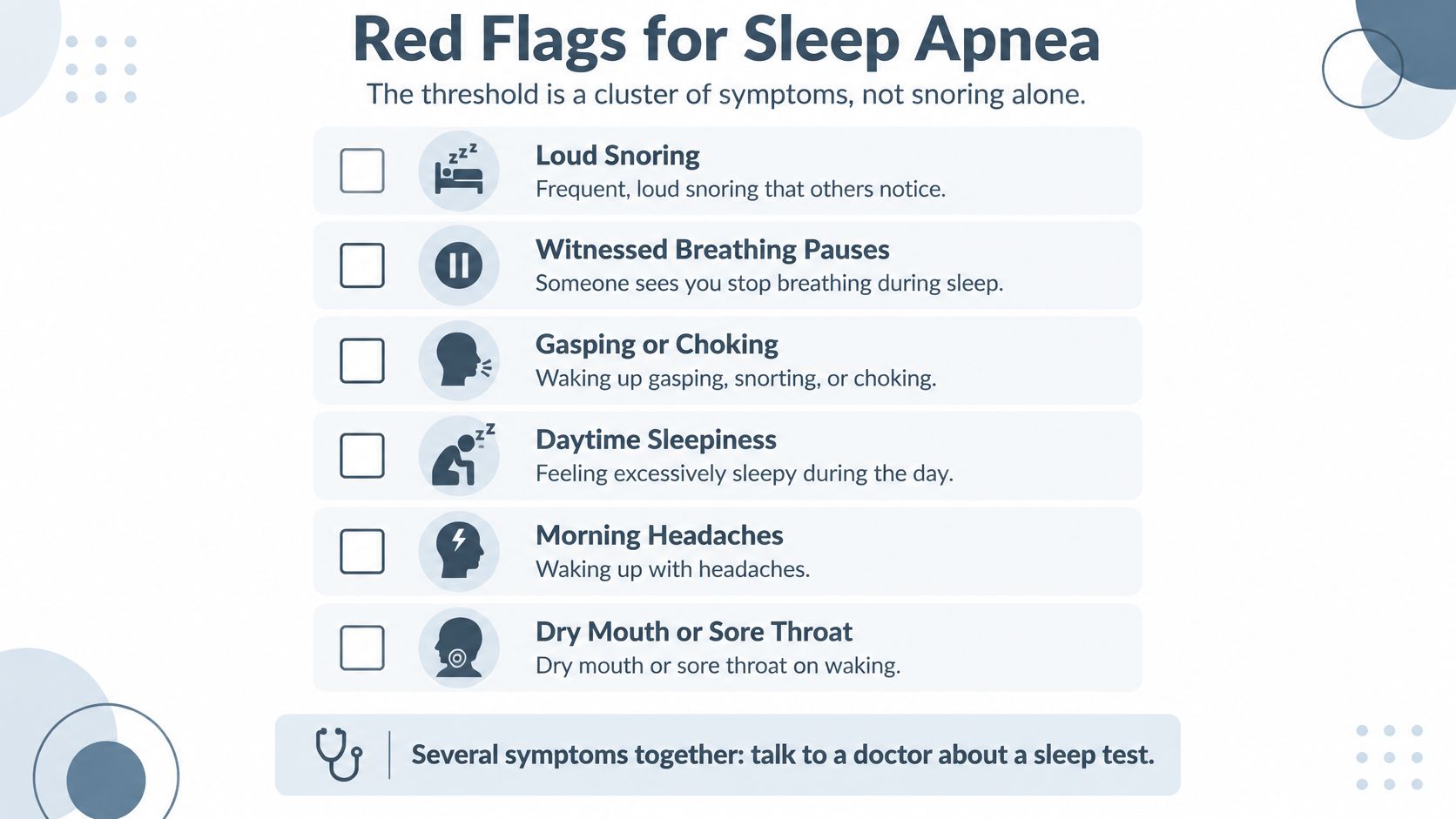
No loudness threshold decides when snoring deserves medical attention. The signal that matters is the overall pattern: which symptoms cluster together, how often they appear, and whether anyone else witnesses what happens overnight. You don't need to tick every box before asking for help.
The Mayo Clinic's sleep apnea guidance identifies the following symptoms associated with obstructive sleep apnea:
- Loud snoring: Especially when frequent or disruptive.
- Witnessed breathing pauses: Someone notices breathing stopping during sleep.
- Nighttime gasping or choking: You wake struggling for air or a partner observes it.
- Morning dry mouth or sore throat: Particularly alongside other symptoms.
- Morning headaches: A recurring pattern worth reporting.
- Excessive daytime sleepiness: Difficulty staying awake despite adequate opportunity to sleep.
- Trouble focusing: Reduced attention during ordinary activities.
- Mood changes: Irritability or other changes accompanying poor sleep.
Use this list to decide what to bring to a clinician.
Turn Concern Into a Useful Appointment
Loud snoring that arrives alongside a dry mouth on waking and an afternoon fight to stay alert warrants a clinical conversation, even for someone who has always counted themselves a normal snorer. A partner's report of pauses or gasping makes the case more pressing. The toll on their sleep counts too, since broken sleep on the other side of the bed is evidence of how disruptive the nights have become.
Keep the preparation simple. If symptoms already concern you, book the appointment first and log what you can in the meantime.
- Record two weeks of observations. Note snoring, remembered awakenings, morning headaches and daytime sleepiness. Ask your partner to note pauses, gasping or choking, with a short phone video if you both consent and it's practical.
- Describe sleepiness candidly. Write down situations where you struggle to stay awake, including meetings, work tasks or driving. A clinician may use a formal questionnaire, and concrete examples give that questionnaire real weight.
- Book a GP or sleep-medicine appointment. Bring the log and a medication list. Include alcohol use, nasal congestion and any sleep aids you've tried.
- Ask which test fits your situation. A home sleep apnea test may suit selected patients; full polysomnography measures sleep more thoroughly. The VA/DoD insomnia and OSA provider guidance supports selecting testing through clinical assessment rather than treating snoring alone as a diagnosis.
- Use low-risk habits while waiting. Try side sleeping and limit late alcohol. Avoid introducing a sedating remedy to force yourself through disrupted sleep.
- Act urgently when safety is involved. Seek urgent medical help for chest pain or breathing difficulty that persists after waking. If severe drowsiness occurs while driving, pull over safely, stop driving and arrange another way home; seek prompt medical assessment rather than trying to push through.
A Test Answers More Than a Recording Can
A phone recording can document a concerning sound. What it can't do is reliably measure sleep stages, airflow or oxygen changes, the three measurements that separate ordinary snoring from a breathing disorder. If a home test comes back reassuring while your symptoms continue, tell the clinician so they can decide whether further evaluation is needed.
The useful outcome is a clear clinical decision: no testing needed now, or testing needed with a plan for follow-up. Either answer gives you a firmer footing than another purchase made without knowing what you're treating.
SleepHabits offers educational guides on nighttime breathing and sleep routines, alongside tools such as nasal strips. Visit SleepHabits to explore practical options for more comfortable nights, while keeping medical evaluation first when snoring comes with breathing pauses or daytime sleepiness.