

No method guarantees that everyone will fall asleep in exactly two minutes, but a brief routine combining nasal breathing, progressive muscle relaxation, and light management can help many adults reduce the arousal that keeps them awake. The useful goal isn't to defeat a stopwatch, but to make falling asleep easier by calming the body and giving the mind less to monitor.
You may be reading this in bed right now, tired enough to want sleep but alert enough to notice every thought, sound, and minute passing. You try a deeper breath, check the clock, turn over, and start calculating how much sleep you'll have left. That pressure can keep the nervous system switched on.
The practical approach is simple. Use the two-minute routine as a wind-down exercise, not a promise of instant unconsciousness. If it helps, repeat it without judging the result. If it doesn't, recognize when the problem may involve insomnia, circadian timing, breathing disruption, medication, illness, or another condition that relaxation alone can't solve.
Why Two Minutes Feels Impossible
You get into bed exhausted, then become more alert the moment you decide you need to fall asleep fast. I see this pattern often. The body is tired, but the brain starts monitoring, effort rises, and a simple routine begins to feel impossible.
That is why the appeal of the military sleep method is so strong. A short sequence that can supposedly work before an early shift, a flight, or a high-pressure day sounds useful. But sleep does not happen on command. It depends on sleep pressure, circadian timing, stress load, caffeine, pain, illness, and whether a sleep disorder is interfering in the background.
The Cleveland Clinic review of the military sleep method makes an important distinction. The routine draws from progressive muscle relaxation, controlled breathing, and visualization, but the complete method itself has not been directly tested as a package, and there is no evidence that every person can reliably fall asleep in exactly two minutes. In practice, the number works better as a wind-down target than a promise.
The popularity of the claim also reflects how common sleep difficulty is. CDC and National Center for Health Statistics findings show that 15.4% of adults in 2024 had trouble falling asleep most days or every day, up from 14.5% in 2020. The same 2024 report found that 30.5% got fewer than seven hours of sleep on average, and the 2020 data showed 17.8% had trouble staying asleep (NCHS data).
Practical expectation: Relaxation can shorten the path to sleep, but a two-minute deadline often keeps the nervous system activated.
What helps is a different question. Instead of asking whether you fell asleep fast enough, ask whether you reduced physical tension and mental activation. Nasal breathing and muscle release can be enough when stress is the main driver. They are usually not enough when insomnia is established, breathing repeatedly collapses during sleep, medication is interfering, or the sleep schedule is badly misaligned.
A Practical Two-Minute Relaxation Protocol
Start with a comfortable position and let your body become still. You don't need a rigid posture, a dramatic breath count, or a special room. The sequence targets both physiological arousal, the body's alert state, and cognitive arousal, the stream of thoughts that keeps attention active.
The first minute
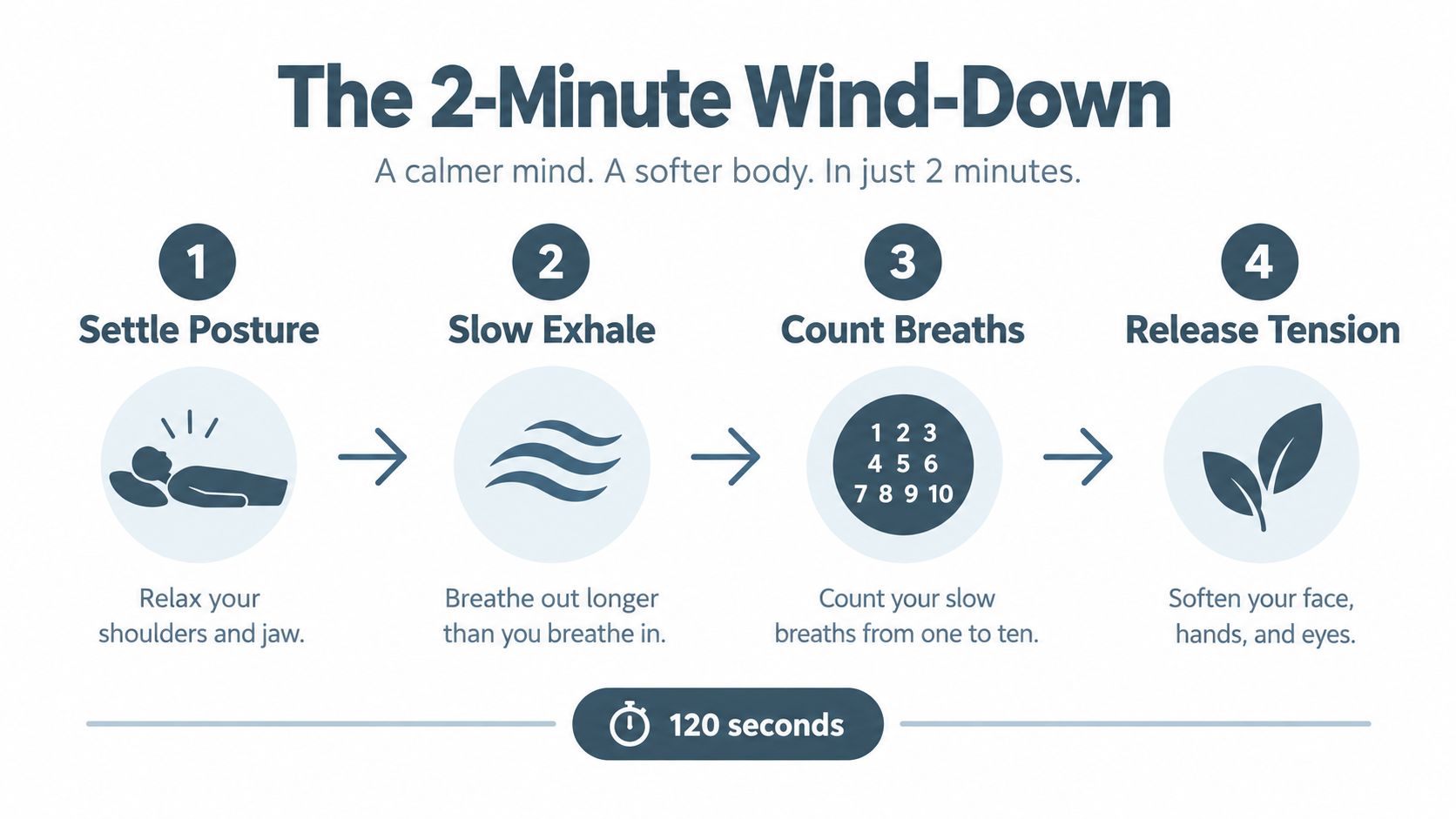
- Settle your posture, 0 to 20 seconds: Lie still, unclench your jaw, let your tongue rest comfortably, and allow your shoulders to drop. Keep your hands loose rather than gripping the sheets.
- Breathe gently, 20 to 60 seconds: Inhale through your nose without pulling in a large volume of air. Let the exhalation last a little longer than the inhalation, but keep the effort comfortable. If you feel dizzy, anxious, or short of breath, return to normal breathing.
- Release obvious tension: Soften your forehead, eyelids, cheeks, neck, and abdomen. You don't need to tense each muscle first. Notice the area and allow it to loosen.
The American Academy of Sleep Medicine guideline on relaxation therapy supports relaxation approaches for reducing somatic tension and intrusive thoughts, but it doesn't establish a guaranteed instant-sleep effect. The guideline identified 12 relevant randomized controlled trials, with five providing data suitable for meta-analysis, and rated relaxation therapy as a conditional recommendation.
The second minute
From roughly 60 to 120 seconds, move your attention through your hands, abdomen, thighs, calves, and feet. Pair the release with a neutral mental cue, such as imagining a dark quiet room, watching slow waves, or noticing the sensation of the mattress beneath you. Counting slow breaths from one to ten can help, but restart gently if you lose track.
Don't make the breathing mechanical or force a long exhale. Don't check whether you're asleep. If you remain frustrated after the exercise, use stimulus control instead of repeating the routine aggressively. Leave the bed for a quiet, dim-light activity and return when you feel sleepy.
For a broader explanation of comfortable breathing mechanics, see this guide to breathing slowly for sleep. Your surroundings also matter, so pairing this protocol with better sleep with quality mattresses can address physical comfort rather than relying on breathing alone.
Evaluating the Military Method and Other Techniques
The military method is better understood as a short wind-down protocol than as a promise. In practice, the useful parts are familiar: relaxing muscles, settling the breath, and giving the mind a neutral place to rest. Those steps can lower tension and reduce the mental effort that keeps people awake, but they do not reliably override pain, circadian mistiming, chronic insomnia, or an unstable airway.
That is the core trade-off. The method contains sensible ingredients, yet the headline claim is stronger than the evidence.
As the AASM evidence review cited earlier notes, relaxation can have a role in chronic-insomnia care. The National Center for Complementary and Integrative Health describes that evidence as small and low quality, and reports a 63% response rate at six months for applied relaxation in one chronic-pain and insomnia trial. That was structured treatment delivered over time, not a two-minute exercise at bedtime.
What works, and what doesn't
| Approach | What it can do | Main limitation |
|---|---|---|
| Nasal breathing | Encourages quiet, unforced breathing and may reduce mouth dryness or breathing-related discomfort | It cannot diagnose or correct significant airway obstruction |
| Muscle relaxation | Reduces physical tension in the jaw, face, shoulders, and limbs | It may not overcome strong circadian alertness or persistent insomnia |
| Visualization | Gives attention a neutral target | A vivid or emotionally charged image can become stimulating |
| Breath counting | Interrupts repetitive thinking | Counting becomes counterproductive if you treat it as a test |
| Clock watching | Provides information about time | It often increases performance pressure and frustration |
What tends to help is simplicity. Pick one sequence and repeat it often enough that it feels familiar rather than evaluative. Patients usually do worse when they keep switching methods, checking the clock, or turning the exercise into a nightly exam they have to pass.
If a routine helps you feel drowsier, keep it. If it repeatedly leaves you tense, wide awake, snoring, gasping, or fighting for air through your nose, the issue is no longer technique alone. A short routine can settle a busy nervous system, but it cannot treat every cause of difficult sleep.
For practical options, review these relaxation techniques for sleep and commit to one approach long enough to judge it fairly.
Optimizing Your Sleep Environment and Breathing
A two-minute relaxation exercise works better when the room is not pushing you the other way. I see this often. People try to calm their breathing while a bright screen, late work, room noise, or an overheated bedroom keeps the brain on alert.
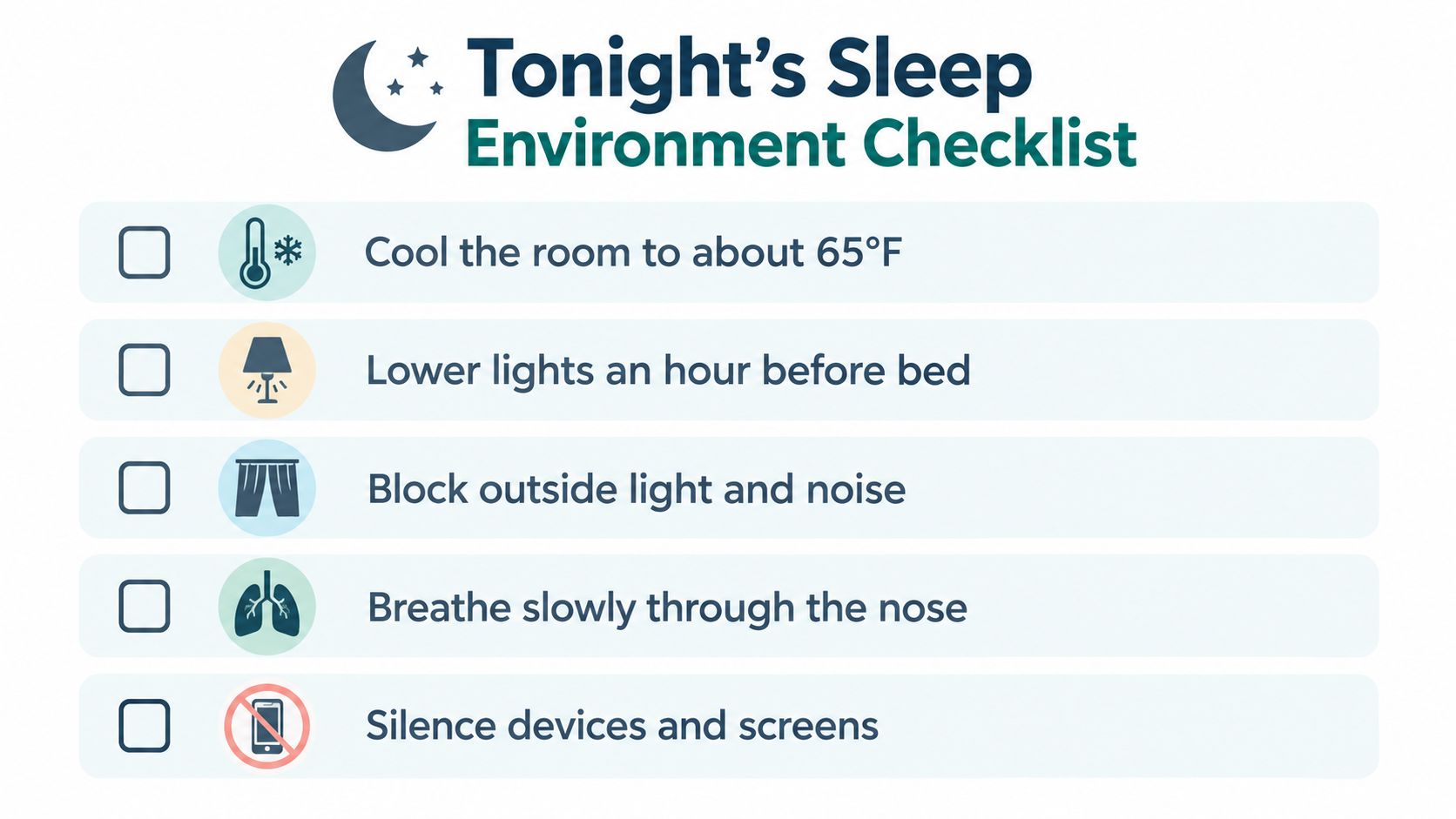
The National Heart, Lung, and Blood Institute advises using the hour before bed for quiet time and avoiding bright artificial light from televisions or computers because it can signal wakefulness to the brain (NHLBI healthy-sleep guidance). That is the right frame for this method. Treat the two-minute routine as the last step in a calmer sequence, not as something that must overpower a stimulating environment. Put demanding work aside, lower the lights, and choose paper reading, quiet conversation, gentle stretching, or steady breathing.
Use light to support timing
Light timing matters as much as light level. The NHLBI guidance cited above recommends regular outdoor sunlight, with at least 30 minutes noted, and it adds that people who have trouble falling asleep may benefit from substantially longer morning exposure. Get outside after waking when you can, then make the evening visually quiet so your body gets a clearer signal that alert time is over.
Keep the bedroom dark and cut avoidable noise. A comfortable mattress and stable temperature will not cure insomnia or sleep apnea, but they do reduce the small physical irritations that keep pulling attention back to the body. For families trying to calm the whole household at night, advice on how to improve your child's sleep habits can help make evenings more predictable.
Make nasal breathing comfortable
Use nasal breathing only if it feels open and unforced. For some people, it makes the wind-down quieter and reduces dry mouth linked with mouth breathing. Nasal strips can make airflow feel easier, but they do not fix every cause of snoring or restricted breathing.
Mouth tape needs real caution. Do not use it to force the mouth closed if your nose feels blocked, breathing feels strained, or sleep apnea is a possibility. Loud snoring, witnessed pauses in breathing, choking or gasping sounds, or marked daytime sleepiness call for medical assessment, because a relaxation protocol cannot treat an airway problem.
Building a Consistent Wind-Down Routine
A single bedtime technique is less reliable than a repeatable sequence. Your brain learns associations from what happens before sleep, so use the same broad pattern even when the exact bedtime changes.
Begin by choosing a stable wake time and working backward toward a calmer evening. In the hour before bed, lower the lights, silence nonessential notifications, stop demanding work, and prepare the bedroom. Then use a quiet activity before moving into the two-minute breathing and relaxation sequence.
A workable routine might look like this:
- Reduce stimulation: Finish work, place the phone out of reach, and switch from bright overhead lighting to softer illumination.
- Settle physically: Read on paper, stretch gently, or sit still. Avoid turning the routine into an intense workout or elaborate checklist.
- Practice before you need it: Use the breathing and muscle-release sequence during the day as well as at night, so it feels familiar rather than like an emergency rescue.
- Respond to wakefulness calmly: If you're awake and frustrated, leave the bed for a quiet activity in dim light. Return only when sleepiness returns.
More ideas for a calm pre-bed sequence are available in these wind-down activities before bed. The central principle is to remove pressure. You don't need to prove that you can fall asleep in two minutes. You need to create conditions in which sleep is less obstructed.
When to Seek Professional Help
Relaxation helps with ordinary bedtime arousal. It does not fix every cause of poor sleep. If your internal clock is pushing you to stay awake, if pain or illness keeps you alert, if a medication change disrupts sleep, or if breathing keeps breaking the night apart, nasal breathing and muscle release may calm you without correcting the problem underneath.
As noted earlier, trouble falling asleep is common, and trouble staying asleep is even more common. That is exactly why the two-minute idea works best as a wind-down protocol, not as a diagnosis and not as a cure.
A practical way to decide what to do next:
- Occasional restless nights: Use the routine consistently, keep evening light low, and stop checking whether you are "winning" against the clock.
- Regular difficulty falling asleep or clear daytime impairment: Speak with a healthcare professional about insomnia. Relaxation can help, but treatments such as cognitive behavioral therapy for insomnia have stronger support when sleep trouble becomes persistent.
- Loud snoring, witnessed breathing pauses, gasping, or marked daytime sleepiness: Ask for an evaluation for sleep-disordered breathing, including sleep apnea.
- Shift work or irregular schedules: Relaxation can lower mental arousal, but it cannot reliably override circadian timing. The American Academy of Sleep Medicine conditionally favors CBT-I over no CBT-I for adults with shift-work disorder who have insomnia or daytime sleep disturbance, although the certainty of evidence is very low (AASM shift-work guidance).
- Persistent or worsening symptoms: Get assessed instead of repeating online sleep hacks for months.
Daytime sleepiness deserves attention fast. If you are struggling to concentrate, stay productive, or drive safely, the issue may be bigger than bedtime tension. A sleep clinician can sort through insomnia, sleep apnea, medication effects, circadian rhythm disorders, narcolepsy, and other causes. Treatment works best when it matches the cause.
SleepHabits offers educational resources and breathing-focused tools, including nasal strips and mouth tape, for adults exploring quieter nasal breathing alongside a consistent wind-down routine. Visit SleepHabits to compare those options and build a calmer evening plan, while seeking professional care if persistent insomnia or breathing symptoms continue.