

The best bedtime routine isn't a complicated checklist. It's a transition you can repeat when your schedule is busy, your thoughts are loud, or your sleep timing changes. The most useful wind down activities before bed lower stimulation, clear mental clutter, release physical tension, support comfortable breathing, and end with a familiar signal that sleep is next. That's more practical than trying to complete every relaxation technique in one night.
A simple routine might combine one cognitive activity, such as journaling, with one physical activity, such as supported stretching, and one sensory cue, such as dim light or a warm drink. The right combination depends on what keeps you awake. If your mind races, start with writing. If your body feels tense, use progressive relaxation. If congestion or mouth breathing makes nights uncomfortable, give your breathing routine more attention.
The eight activities below are designed as parts of a flexible sequence, not isolated rules. You'll see when to use each one, how to begin, what may not suit every sleeper, and how to build a routine that feels calming rather than demanding. For a broader foundation, compare these ideas with three habits for better sleep.
1. Progressive Muscle Relaxation with Nasal Breathing
Progressive muscle relaxation works like a dimmer switch for physical tension. While lying comfortably, gently tense one muscle group, notice the sensation briefly, then release it fully before moving on. Begin with your feet and calves, continue through your thighs and abdomen, and finish with your shoulders, hands, face, and jaw.
Pair the sequence with slow, comfortable nasal breathing. Do not force unusually deep breaths. Each inhale and exhale becomes a steady marker for moving from one body area to the next. For a fuller walkthrough of breathing patterns, see this guide to nasal breathing techniques. A randomized crossover study found that sleep efficiency, NREM stage III, and total sleep duration were greater during right-nostril-dominant respiration, while the opposite condition was associated with higher apnea-hypopnea index, periodic limb movements, and oxygen desaturation (PubMed).
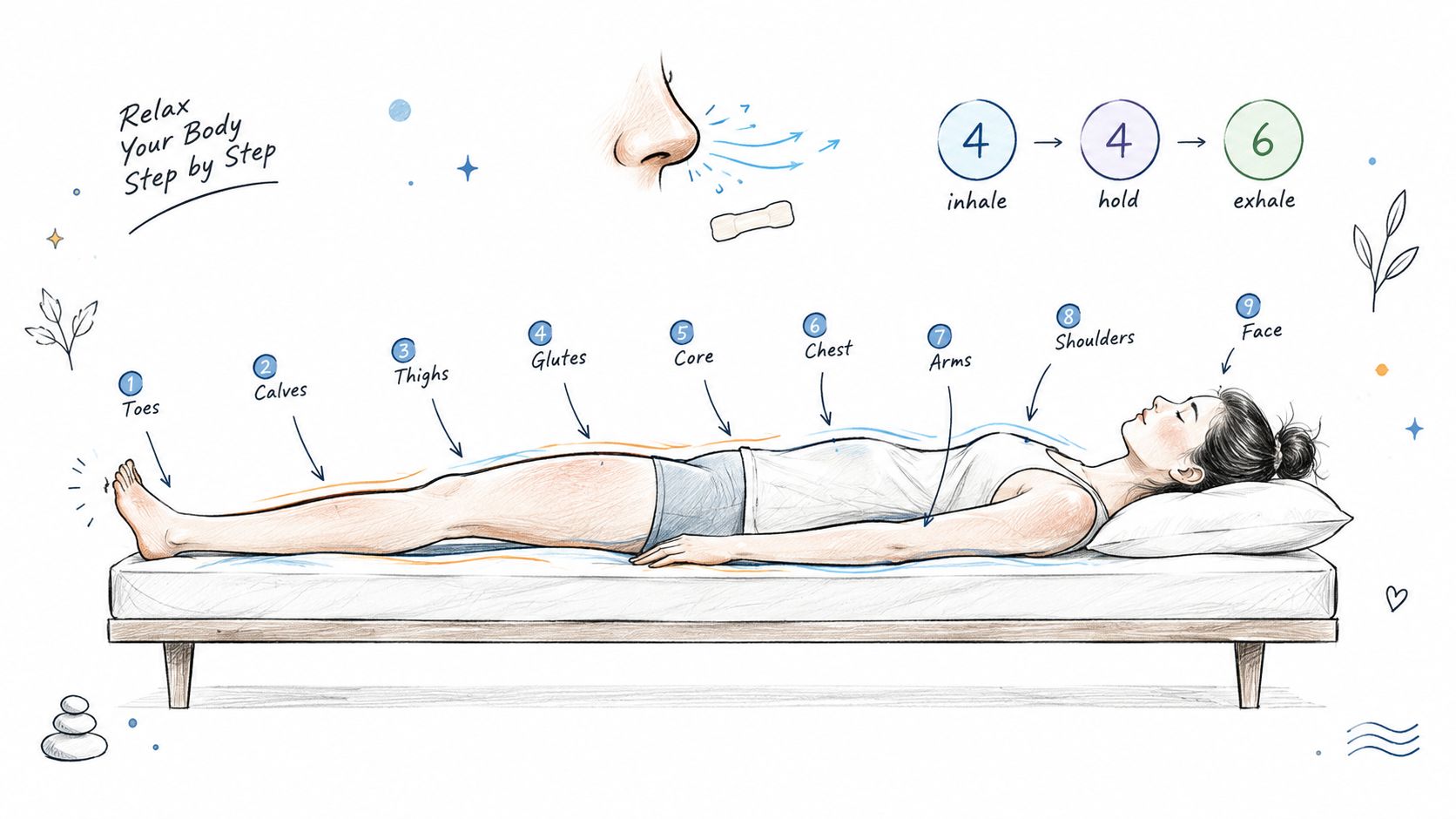
Make the contrast easy to notice
Use a light contraction. Keep breathing normally, and stop before the exercise creates strain or pain. If upper-back tension is the main problem, begin with the lower body so your attention does not immediately return to that area. For neck tension, reverse the sequence and leave the neck and shoulders until the end, only if that feels comfortable.
A guided recording can help during your first few sessions by providing the order and pacing. Practicing once during the day also helps you recognize what relaxed muscles feel like, without making sleep the immediate goal.
Use PMR as the physical part of a flexible bedtime sequence, after a cognitive activity such as journaling and before your final sensory cue. If nasal congestion from a cold, allergies, or dry air makes nose breathing difficult, Eucalyptus Nasal Strips are one option described as supporting easier airflow and nasal-breathing habits. The strips are designed to be paired with mouth tape as part of a breathing-focused routine, but breathing aids are not suitable for everyone.
Practical rule: Relaxation should feel gentle. Stop if tensing a muscle causes pain, dizziness, or uncomfortable breath-holding.
Choose the full sequence when you have time, or use only the areas holding the most tension when your schedule is short. The aim is a quiet, repeatable finish, not another task to complete.
2. Guided Nasal Breathing Meditation with Specific Ratios
A breathing meditation can give racing thoughts a narrow, predictable task. Instead of monitoring every worry, you count a comfortable pattern, such as box breathing with equal intervals for inhaling, holding, exhaling, and holding again. Another option is an extended-exhale pattern, where the exhale lasts longer than the inhale.
Start with the simplest rhythm you can maintain without strain. Counting on your fingers or following a visual pacer can reduce mental effort, while a quiet audio guide can prevent you from checking the clock. Keep the breathing nasal if that's comfortable, but don't force nasal breathing through significant congestion.
Choose the ratio by response
Box breathing may suit someone who wants equal structure and a clear beginning and end. An extended exhale may feel more natural for someone who becomes tense during breath holds. Neither technique needs to become a performance. The useful signal is whether your shoulders drop, your jaw softens, and your attention becomes less reactive.
Nasal breathing may also be relevant for people who snore, wake with a dry mouth, or feel congested. Earlier sleep physiology research examined predominant mouth breathing as a comparator to nasal airflow, reflecting that breathing route can influence upper-airway resistance and sleep quality. The practical focus should be comfort and airflow, not forcing a technique that makes you feel air hungry.
Try the meditation after dimming the room and putting your phone aside. If you're learning the pattern, practice at another time of day first. That way, bedtime remains associated with ease rather than troubleshooting.
Use a short session when you're tired and a longer one when mental activation is high. If congestion appears, address it appropriately rather than switching abruptly to uncomfortable mouth breathing. Anyone with breathing problems during sleep should seek clinical advice instead of treating a breathing exercise as a substitute for evaluation.
3. Digital Sunset and Blue Light Reduction Sequence
A calmer bedtime often starts before the screen leaves your hand. The aim is not to ban technology, but to lower light and stimulation in stages. A sleep-lab study found that using a light-emitting e-reader for five evenings before bed delayed dim-light melatonin onset by more than 1.5 hours, suppressed evening melatonin by about 55%, and increased sleep latency by about 10 minutes compared with reading a printed book (sleep-light evidence summary).
Controlled research involving healthy adults exposed to different display types 4 hours before habitual bedtime found that low melanopic light shortened time to fall asleep, while higher melanopic light produced dose-dependent increases in sleep latency and delays in melatonin onset (Communications Biology). Brightness, timing, and the activity on the device all shape the effect, so changing only the screen color may not solve the problem.
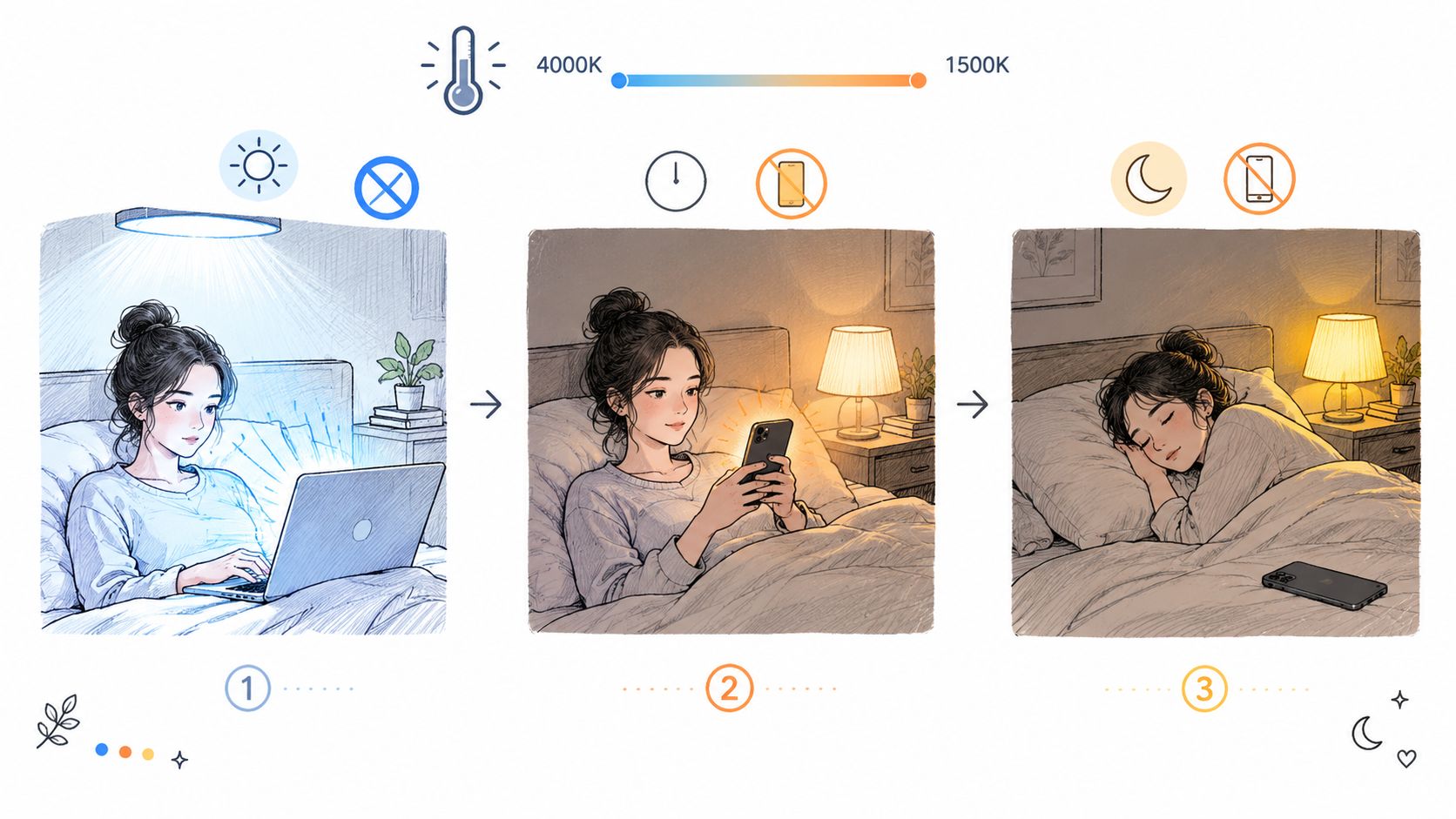
Build a descending sequence
Start with the environment. Turn off unnecessary overhead lights, dim the room, lower screen brightness, and choose a warmer display setting. Then shift from active tasks, such as email, news, gaming, or social media, to passive options, such as a familiar audiobook or calm audio. Each change removes a little stimulation, like lowering the volume one notch at a time.
Student data found that each additional 10 minutes of social media use in the 2 hours before bed was associated with about 7 minutes less sleep. The practical response is to set a stopping point for social feeds and other interactive tasks, then choose an activity that does not invite continued checking.
Finish by creating physical distance. Put devices outside the bedroom when possible and replace them with a printed book, paper journal, or quiet conversation. If a phone must remain nearby for an alarm or sleep audio, turn on Do Not Disturb and place it out of reach. Guidance for children also recommends keeping screen-based devices out of bedrooms and turning them off 30 minutes before bedtime (pediatric sleep guidance). Adults can adapt that principle to their schedules.
For more context on how timing and content interact, read this guide to screen time before bed. Use the sequence flexibly: pair this sensory step with one cognitive activity and one physical activity, starting earlier when the routine needs more time.
4. Therapeutic Journaling for Cognitive Offloading
Journaling is most useful when your body is ready for sleep but your mind keeps reopening unfinished tasks. Instead of writing a long account of the day, use paper to separate worries, decisions, and tomorrow's actions. The page becomes a holding place for thoughts that would otherwise keep circulating in bed.
Try a short structure. Start with a worry dump, then write a task parking list for tomorrow, and finish with a wins log that records what you completed or handled well. Questions such as “What am I avoiding thinking about?” and “What would perfect completion of today look like?” can reveal the thought that's keeping you alert, but they shouldn't become an invitation to conduct a late-night work meeting with yourself.
Keep the page calming
Handwriting often slows the process compared with typing, which can help you avoid jumping between apps or tasks. Don't read old entries immediately before sleep if reviewing them tends to create new concerns. Leave review and action planning for the morning.
If a worry dump increases anxiety, shorten it to a few minutes and spend more time on the wins log or a simple list of what can wait. The practice should reduce cognitive load, not prove that you can analyze every concern completely.
Journaling fits well 45 to 60 minutes before bed as the cognitive part of a sequence. You can then dim the lights, take a warm shower, stretch, or practice breathing. A repeated order teaches you that writing ends the problem-solving phase of the day.
Shift workers and busy professionals can use the same structure at the start of their intended sleep period, regardless of the clock. The cue is the transition from active obligations to protected rest. If journaling repeatedly brings up severe anxiety, trauma-related distress, or persistent insomnia, discuss it with a qualified health professional.
5. Warm Magnesium Beverage Ritual with Mouth Tape Preparation
A warm, non-caffeinated drink can serve as a sensory bridge between the day and sleep. The warmth, slower sipping, familiar flavor, and reduced pace give you several cues that the evening is changing. You can use plain herbal tea or another drink that suits your diet, but avoid turning the ritual into a large volume of liquid if bathroom trips regularly interrupt your sleep.
If you use a magnesium product, read the label and follow its directions rather than assuming more is better. SleepHabits describes Restore+ and magnesium for sleep as part of a melatonin-free approach, but supplements can interact with health conditions and medications. A pharmacist or clinician can help you decide whether magnesium is appropriate.
Treat breathing aids as optional
Mouth tape requires particular caution. It isn't appropriate for everyone, especially people with nasal obstruction, suspected sleep apnea, breathing difficulties, vomiting risk, or anxiety about restricted mouth opening. Don't use it to force nasal breathing when your nose isn't clear, and don't treat it as a replacement for medical assessment of snoring or unrefreshing sleep.
If you're considering a product described as supporting quieter nights and reduced snoring, Hydrating Mouth Tape is one catalog option. The product snapshot also describes support for tongue posture and nasal-breathing practices. Those descriptions don't establish that it's suitable for your airway or that it will resolve snoring.
Sip the drink slowly while practicing comfortable breathing or reading a few pages of a printed book. Move the beverage earlier if late liquid intake leads to bathroom visits. The routine's value comes from a consistent, calming sequence, not from reaching a precise absorption window or promising a particular sleep outcome.
6. Restorative Yoga and Supported Stretching Sequence
Restorative stretching works as a physical link between the day and sleep. Unlike a late workout, it does not aim to build heat, improve performance, or increase your range of motion. Pillows, blankets, and bolsters support the body so tense muscles can gradually stop bracing.
Choose one short sequence rather than treating every pose as mandatory. Try supported child's pose, a reclined position with bent knees, a gentle spinal twist, and a final resting pose. Keep the room dim and breathe naturally. Sharp pain, tingling, dizziness, or joint pressure means the position needs adjustment or should end.
Let support do the work
Household pillows can replace formal yoga props. Put one beneath your knees while lying on your back, use another under your head, and keep a blanket close so you stay warm without moving around. A silent timer can provide structure. Remove notifications before starting, and leave the phone alone between poses.
This physical step may fit people whose bedtime alertness begins with neck, shoulder, hip, or lower-back tension. It may feel counterproductive if close attention to alignment makes you more alert or if lying still feels uncomfortable. Choose a different physical cue in that case, such as an easy walk earlier in the evening or a brief body scan.
Expert guidance for adults ages 50 to 80 recommends avoiding stimulating activities and moderate-to-vigorous exercise 2 to 3 hours before bed, while listing warm baths, reading, meditation, and stretching as calming options (NCBI Bookshelf guidance). Use that distinction to set the sequence's place in your routine. Keep bedtime movement passive and comfortable, and schedule demanding exercise earlier.
End in darkness or very low light. The goal is a body that feels less guarded, not a more impressive practice. Pair this physical activity with one cognitive or sensory step when your schedule allows, then go directly to bed.
7. Strategic Light Exposure and Temperature Decline Sequencing
Your bedroom can reinforce sleep or work against it. Light exposure is especially important during the biological night, when the circadian system is most sensitive. A circadian-hygiene review highlights avoiding illuminated screens close to usual bedtime and emphasizes that evening light can interfere with the body's transition toward sleep (circadian hygiene review).
Temperature also deserves attention, but there's no need to chase an exact setting from someone else's routine. Start with comfort. Reduce bright lighting, use breathable bedding, and notice whether you fall asleep more easily when the room is slightly cool rather than warm and stuffy.
Build a gradual environmental cue
Begin the sequence by switching from overhead lights to a dim bedside lamp. Finish personal care, adjust bedding, and make the room quiet before you get into bed. If you're sensitive to cold, warm your feet gently without overheating the rest of the body. If you experience hot flashes or night sweats, breathable layers and easy temperature adjustment may be more useful than a rigid thermostat target.
Avoid extreme cold, ice packs directly against the skin, or a room temperature that leaves you tense. Discomfort increases alertness and defeats the purpose. A programmable thermostat can help shift the environment automatically, but manual changes work just as well.
This activity is especially valuable when your surroundings are the final source of stimulation. It also makes other practices more effective because journaling, breathing, and stretching are easier in a room that already feels settled. Keep a small light available for necessary movement during the night, and avoid returning to bright screens once you're in bed.
8. Implementation Summary and Scheduling Template
A bedtime routine works best as a flexible sequence, not a checklist of every available technique. Choose one cognitive activity, one physical activity, and one sensory or breathing cue. These choices act like a gentle runway: each step lowers stimulation and makes the next transition easier. Adding too many steps can turn relaxation into another task.
A practical sequence might look like this:
- Lower stimulation: Dim the room, silence notifications, and finish active screen use before the protected part of your routine.
- Clear the mind: Write tomorrow's essential tasks and worries you do not want to carry into bed.
- Release the body: Use progressive muscle relaxation or supported stretching. Start with one rather than combining both.
- Settle breathing: Practice comfortable nasal breathing or gentle meditation without forcing breath holds.
- Finish with a sleep signal: Read a printed book, listen to quiet audio, or enter a dark, prepared bedroom.
Treat 30 to 60 minutes as a flexible range, not a requirement. A shorter routine can still work when you keep the order consistent. Reading, stretching, and meditation are practical options for this pre-sleep period, as noted in earlier guidance.
Match the sequence to the problem you notice that night. After a busy day, try dim lights, journaling, and breathing. For a tense body, pair dim lights with stretching and progressive muscle relaxation. After mentally demanding work, use a digital sunset, journaling, and a printed book. If your schedule shifts, preserve the order even when the clock changes.
For a shorter night, select one step from each category rather than dropping the routine entirely. The cognitive step clears unfinished thoughts, the physical step reduces bodily effort, and the sensory or breathing step provides a final cue that activity is ending.
Track sleep latency, awakenings, total sleep time, and morning energy for 1 to 2 weeks. Then adjust the timing or remove any step that creates friction before adding something new. Consistency matters more than an elaborate ritual.
8-Point Bedtime Wind-Down Activities Comparison
| Technique | 🔄 Implementation complexity | ⚡ Resource requirements | 📊 Expected outcomes | 💡 Ideal use cases | ⭐ Key advantages |
|---|---|---|---|---|---|
| Progressive Muscle Relaxation with Nasal Breathing | Moderate, learn tensing/release sequence and timed nasal breathing (15–20 min) | Low, none required; nasal strips/Restore+ optional | Reduced muscle tension, shorter sleep latency, deeper sleep over 3–5 nights | Tension headaches, jaw clenching, racing thoughts, insomnia | Highly effective for somatic tension; strong parasympathetic activation |
| Guided Nasal Breathing Meditation with Specific Ratios | Low–Moderate, learn box/extended-exhale counts; initially requires focus | Very low, no equipment; pacer app or nasal strips optional | Rapid parasympathetic activation, lower HR/BP, quicker sleep onset within minutes–days | Mouth-breathers retraining, acute anxiety, short pre-sleep practice | Fast, measurable relaxation; easy, portable practice |
| Digital Sunset and Blue Light Reduction Sequence | Moderate, scheduling and device automation required (60–90 min) | Low–Medium, smart bulbs/apps recommended; amber glasses optional | Increased melatonin production, improved sleep quality within 3–5 nights | Heavy evening screen users, shift workers needing circadian cues | Strong circadian entrainment without drugs; scalable automation |
| Therapeutic Journaling for Cognitive Offloading | Low, structured 15-minute routine; discipline to stop at time limit | Minimal, pen, notebook, timer | Reduced sleep-onset latency, decreased nocturnal rumination within days | High-achievers, anxiety, people with persistent bedtime thoughts | Low-cost cognitive offloading with fast measurable benefits |
| Warm Magnesium Beverage Ritual with Mouth Tape Preparation | Moderate, timed beverage prep, cooling, and mouth-tape coordination (45–60 min) | Low–Medium, Restore+ product, warm drink, mouth tape, nasal strips optional | Enhanced relaxation, increased sleep duration and recovery metrics within days–weeks | Those seeking biochemical support and ritualized routines; mouth-tape users | Synergizes magnesium biochemistry with ritual cues and nasal breathing |
| Restorative Yoga and Supported Stretching Sequence | Moderate, learning supported postures and timing (35–45 min) | Medium, mat, bolsters/pillows, blankets; guided video optional | Reduced muscle tension, increased vagal tone, better sleep continuity | Sedentary, elderly, injured, or tense individuals | Passive, low-impact physical relaxation combined with breathwork |
| Strategic Light Exposure and Temperature Decline Sequencing | High, precise timing and temperature control across 90 minutes | Medium, programmable thermostat, cooling pillow/fan; smart devices helpful | Faster sleep onset, improved sleep efficiency, reduced night sweats within nights | People with temperature dysregulation, hot flashes, or sleep maintenance issues | Directly targets thermoregulation and circadian signaling for strong physiological effect |
| Implementation Summary and Scheduling Template | Low, consolidates techniques into a single nightly plan; requires adherence | Low, checklist and selected products as needed | Greater routine consistency, faster habit adoption, improved cumulative sleep metrics | Anyone wanting an integrated wind-down routine or habit formation support | Simplifies execution and improves compliance across combined interventions |
Turn Eight Ideas Into One Repeatable Routine
The strongest routine is usually a small sequence with clear jobs. Start by choosing one activity that lowers stimulation, such as dimming lights and putting screens away. Add one activity that settles either the mind or the body, such as structured journaling, progressive muscle relaxation, or supported stretching. Finish with one breathing or sensory cue, such as comfortable nasal breathing, a quiet audio track, a printed book, or a warm non-caffeinated drink.
A useful starting sequence could be simple. Dim the room and stop active screen use. Write down unfinished tasks and worries. Follow with gentle stretching or PMR. End with slow breathing in bed. If you prefer a beverage ritual, Restore+ can fit into that warm-drink portion, provided magnesium is appropriate for you and you follow the product directions.
Test the same sequence consistently for a week before judging it. Record how long you think it took to fall asleep, how often you woke, and how energetic you felt in the morning. You're looking for patterns, not a perfect score. If the routine feels rushed, start earlier. If it feels too long, remove a step while preserving the order of the cues that help.
Don't force nasal breathing or mouth-tape practices if congestion, fear, or breathing symptoms make them uncomfortable. Nasal strips may support airflow for some people, while mouth tape requires more careful suitability checks. Persistent snoring, gasping, witnessed breathing pauses, morning headaches, or ongoing unrefreshing sleep deserve professional evaluation.
Adults already use many repeatable bedtime behaviors. In an American Academy of Sleep Medicine survey, 39% said they take a bath or shower as part of their bedtime routine, 34% said they go to bed at the same time each night, and 29% said they read before bed (American Academy of Sleep Medicine survey). You don't need an unusual ritual. You need a sequence your body can recognize and your schedule can support.
SleepHabits offers resources and products that fit a breathing-focused wind-down routine, including Restore+, hydrating mouth tape, and nasal strips. Visit SleepHabits to explore practical tools and education for dimming the evening, practicing calmer breathing, and building a more repeatable path to sleep.