

“Eat less and do cheek exercises” is poor advice if your face is fuller because you slept badly or ate a salty dinner. A puffy morning face isn't proof of new facial fat, and dieting harder won't correct every cause of facial fullness.
When considering “how to thinner your face,” start with a more useful question: what's making it look fuller? Fluid, body fat, chewing muscles, and facial structure need different responses. Identifying the likely cause helps you choose a sensible habit instead of chasing a sharper jawline through dehydration or crash dieting.
Tell Fat From Overnight Face Puffiness
A face that changes noticeably between waking and bedtime deserves a different assessment from one that gradually changes alongside body weight. Fluid-related puffiness can fluctuate, while fat-related fullness generally changes more slowly.
Acibadem Health Point's doctor-reviewed explanation distinguishes overall facial fat from temporary swelling associated with sodium, alcohol, dehydration, allergies, congestion, disrupted sleep, and sleeping position. A broken night can therefore create the impression that your cheeks have grown without establishing that you've gained fat.
Make a same-day comparison
Take a morning photograph, then an evening photograph with the same lighting, camera distance, and expression. Notice whether the fullness settles after you've been upright, and write down anything unusual about the previous evening, such as takeout, alcohol, congestion, or restless sleep.
Don't diagnose yourself from a photograph. Use the pattern to decide whether your next step should be a sleep adjustment, a sustainable weight-management plan, or an examination.
What is making the face look fuller
| What you see | Likely driver | What to do first | What will not fix it |
|---|---|---|---|
| Fuller in the morning, softer by afternoon, worse after salt, alcohol, or a short night | Short-term fluid associated with sodium, alcohol, dehydration, allergies, congestion, sleep loss, or sleep position | Repeat sleep timing, moderate evening sodium, hydrate normally, and compare photos over a short tracking period | Cheek exercises or a crash diet |
| Face and waist change together over several weeks | Overall body fat | Choose gradual, sustainable weight loss when appropriate | Spot-reducing the cheeks |
| Lower face widens when you clench | Possible enlarged masseter muscles | Clinician assessment; consider toxin only after contraindications are excluded | Assuming diet alone will narrow bone or muscle |
| Round cheeks remain after weight is stable for months | Buccal fat pad or skeletal width | In-person anatomy assessment before considering surgery | Treating localized buccal fat as proof of being overweight |
| One-sided, painful, or fast-worsening swelling, or swelling with fever, swallowing trouble, or breathing difficulty | Possible medical problem | Same-day medical care; emergency help for breathing or swallowing difficulty | Makeup, massage, or a sodium experiment |
Check anatomy before changing your weight
Gently clench, then relax your jaw while looking straight ahead. A noticeable bulge near the jaw angle suggests that chewing-muscle size may contribute, but this isn't a substitute for examination.
A practical sequence is to maintain a healthy, stable weight, collect front and profile photographs, check the jaw during clenching, and arrange an in-person facial assessment. Everyday Health's buccal-fat-removal guide explains why localized cheek fat isn't a reliable marker of being overweight and may not substantially change with ordinary weight loss.
Facial balance matters as much as cheek width. If you're already noticing hollowness elsewhere, Luxe Aesthetic Surgery & Medical Spa's explanation of treatment options for hollow temples provides useful context for discussing volume loss rather than assuming that removing more volume will improve your face.
Safety first: Persistent, one-sided, painful, or rapidly worsening swelling needs medical evaluation. Swelling with fever warrants prompt care; trouble swallowing or breathing requires emergency help, not a beauty routine.
Lose Face Fullness With Steady Fat Loss
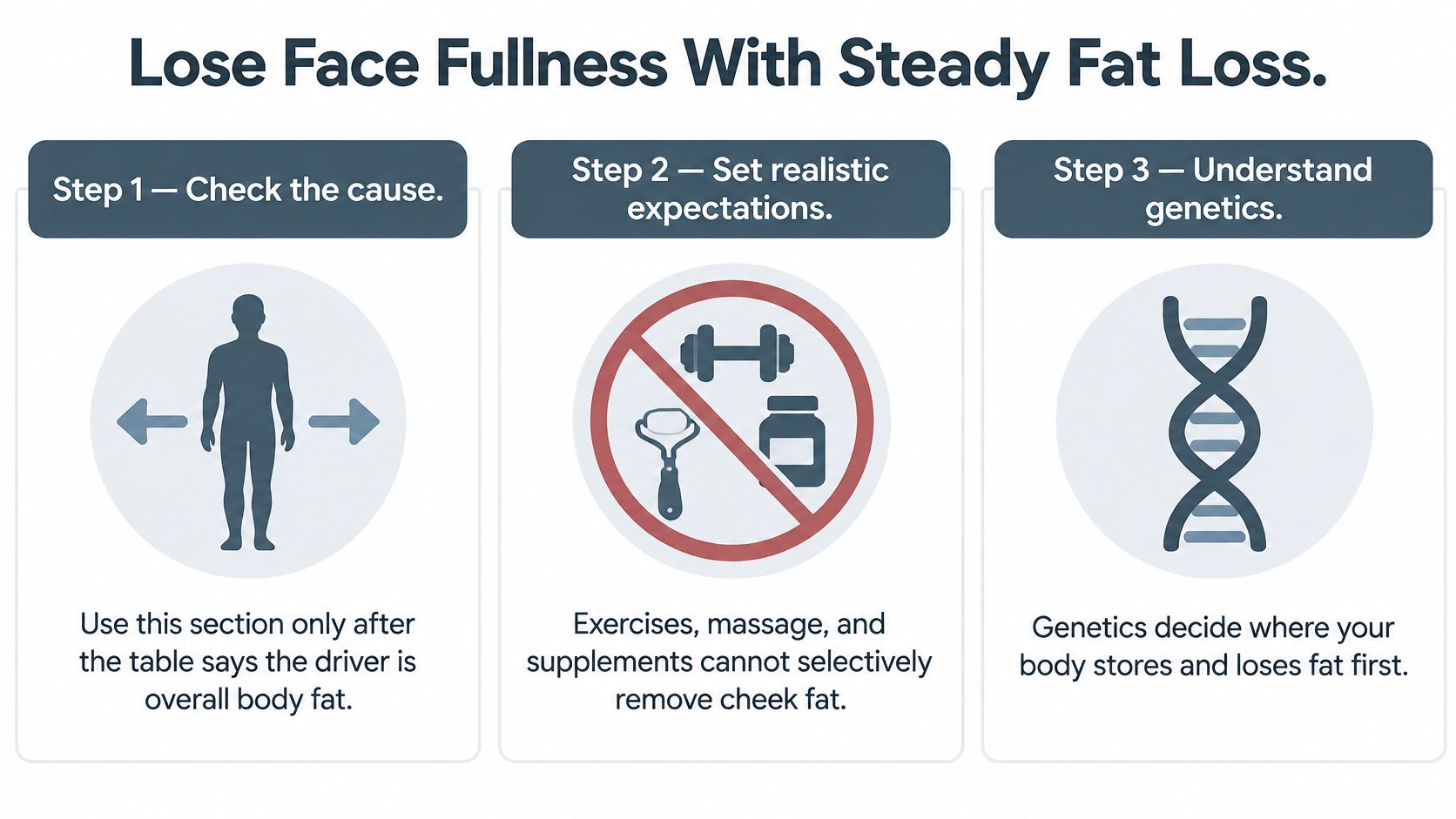
Use weight loss as a facial-fullness strategy only when overall body-fat gain appears to be the driver and losing weight is appropriate for your health. If you're already at a healthy, stable weight, a round face alone isn't a reason to keep reducing your food intake.
Exercises, massage, and supplements can't selectively remove cheek fat. Genetics influence where your body stores and loses fat, so your waist and face won't necessarily change at the same pace.
The illustration summarizes the distinction between identifying the cause and trying to target a cheek.
Choose a pace you can sustain
The CDC's weight-loss guidance recommends gradual loss of about 1–2 pounds (0.45–0.9 kg) weekly, which is more likely to stay off than faster loss; a general planning example is a deficit of roughly 3,500–7,000 calories weekly, or 500–1,000 daily, through food changes and activity.
That planning range isn't a prescription for everyone. Body size, age, sex, activity, medications, and health conditions affect energy needs, and the upper end may be inappropriate for you. A clinician or registered dietitian can help you select an adequate intake rather than subtracting calories from an already small diet.
Avoid pairing aggressive restriction with extra exercise to force faster facial changes. Rapid loss can leave the face looking hollow, make skin laxity more apparent, and produce a more aged appearance rather than the balanced definition you wanted.
Build a repeatable week
- Choose a protein-forward plate. Start with a familiar protein such as eggs, tofu, fish, beans, or chicken. Add vegetables and a planned portion of rice, potatoes, bread, or another carbohydrate instead of following a restrictive diet you can't maintain.
- Change a liquid-calorie habit. Replace a sweetened coffee with a less sweet version, or reconsider routine evening alcohol. Choose a change that doesn't leave you compensating with snacks later.
- Add activity you already tolerate. Walking after lunch, cycling to an errand, or extending an existing workout is more practical than suddenly committing to exhausting daily sessions.
- Standardize your measurements. For a sample routine, weigh yourself or measure your waist on the same two mornings each week. Don't repeatedly check after meals, workouts, or bathroom visits.
- Set a photo appointment. Sunday morning can be your reminder to take a front photograph with your hair off your face, neutral expression, and consistent light.
For another practical overview of lifestyle approaches, Ideal Face & Body's guide to managing facial fullness naturally can help you organize questions about food and activity. Treat any facial change as part of overall progress, not a guaranteed targeted result.
Judge a trend, not a weekend. As a practical review schedule, give a sustainable routine four to eight weeks before deciding whether it's helping. A sudden sharper appearance after heavy sweating or skipped meals may reflect water loss rather than durable fat loss.
Reduce Morning Swelling From Salt and Sleep
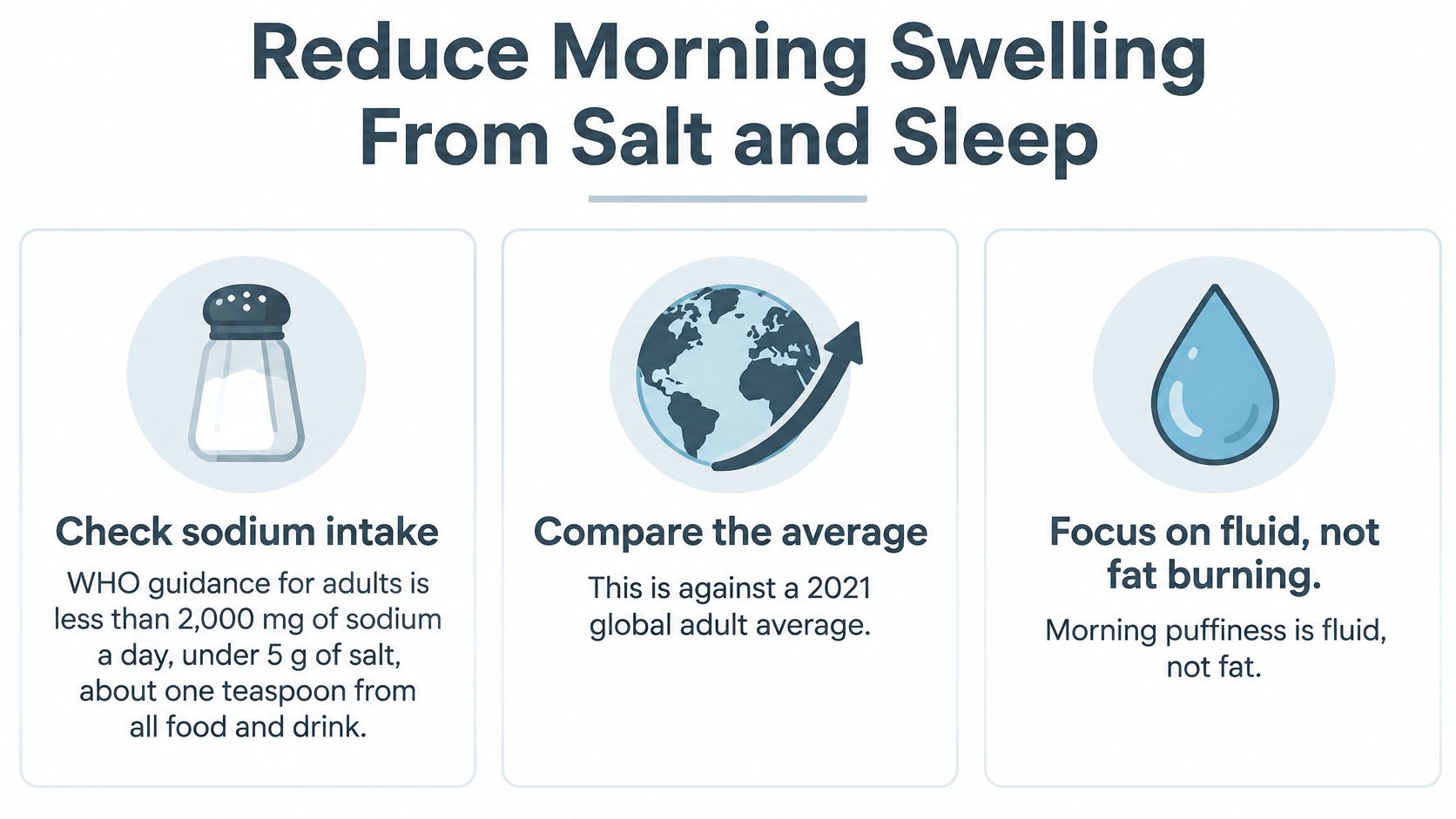
Sodium-related puffiness is a fluid issue, not a fat-burning problem. Start by looking at what dinner contains rather than blaming your cheeks for a change that appeared overnight.
A restaurant soup, soy-heavy takeout, deli-meat sandwich, and salty snack can make an evening sodium-heavy even when you never touch a salt shaker. Check the sodium per serving and the number of servings you eat. The label is more informative than whether a food tastes especially salty.
Put sodium and water figures in context
The adult reference values below come from the World Health Organization and the National Academies. They're useful orientation points, not instructions to override a medical diet or force water intake.
Daily Sodium and Water Reference Values
| Measure | Figure | Note |
|---|---|---|
| Sodium ceiling for adults | WHO recommends under 2,000 mg daily, equivalent to under 5 g of salt, approximately one teaspoon | Counts salt from all foods and drinks |
| Global adult average sodium | WHO's same fact sheet reports about 4,278 mg daily in 2021 | Well above its adult recommendation |
| Adequate total water, women | The National Academies reference values give about 2.7 L (91 oz) daily, including approximately 2.2 L from beverages | Food contributes to total water |
| Adequate total water, men | The same reference gives about 3.7 L (125 oz) daily, including approximately 3.0 L from beverages | Food contributes to total water |
| Medical restrictions | Your clinician's target | Follow individualized advice for kidney disease, heart failure, hypertension, or a prescribed fluid limit |
Compare lower-sodium soups, request sauces separately, and avoid stacking several salty foods into the same evening meal. You don't have to make dinner flavorless. Herbs, lemon, vinegar, garlic, and spices can help you change the meal without treating sodium reduction as punishment.
Drink regularly with meals and activity, using thirst and urine color as general cues. Heat, prolonged exercise, pregnancy, breastfeeding, and illness can change requirements. Don't chug extra water to “flush” your cheeks, and don't deliberately dehydrate for photographs.
This visual keeps the focus on fluid balance rather than localized fat loss.
Give the night a repeatable shape
Sleep timing is the other useful observation. If your face looks puffier after a short or fragmented night, record that pattern rather than immediately cutting breakfast.
Use a consistent bedtime and wake time, keep the bedroom comfortable, and avoid making a late salty meal part of your wind-down. If mild congestion is bothering you, a comfortably raised head position may help, but persistent nasal blockage deserves assessment rather than increasingly elaborate sleep accessories.
Our sleep hygiene rules offer a practical starting point for making evenings more consistent. Change a manageable set of habits, then compare standardized photographs instead of changing your routine every time the mirror looks different.
Shape the Look With Hair, Posture and Makeup
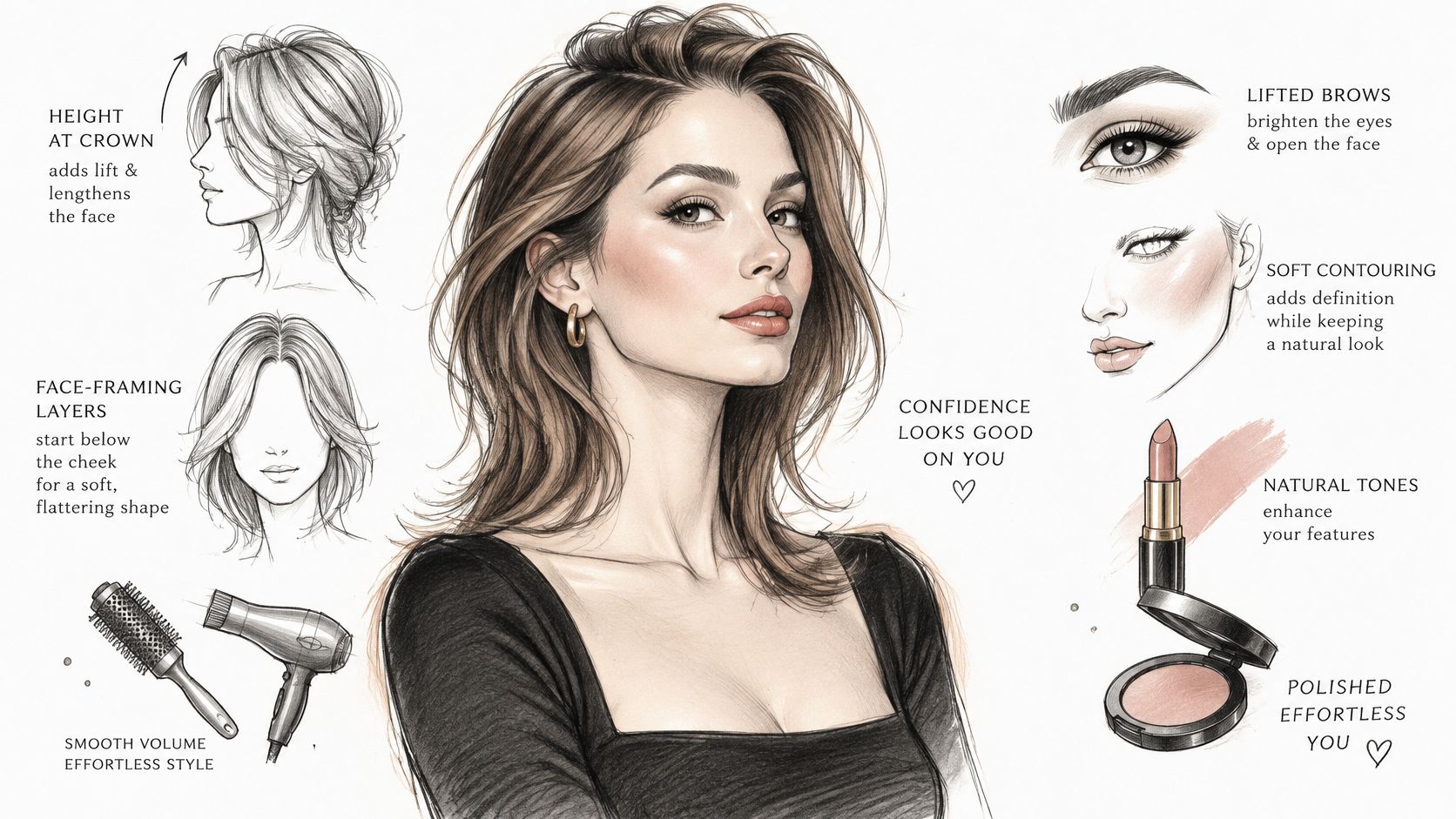
You can change how facial proportions appear without changing facial tissue. Hair, camera position, posture, and makeup are presentation tools, not treatments for fat or swelling.
Use the illustration as a styling reference rather than an anatomical promise.
Create length rather than extra cheek-level width
Ask your stylist about a side part, modest height at the crown, and face-framing layers that begin below the fullest part of your cheeks. Longer framing pieces that reach the chin or below can create a more vertical outline.
Heavy volume directly beside the cheeks can emphasize width. A curtain section that stops exactly at the widest point may do the same, although hair texture and personal preference matter more than a universal rule about center parts.
For makeup, try a small amount of cool-toned shadow beneath the cheekbone, blended toward the ear. Keep the center of the forehead and chin a little lighter if that suits your usual makeup. Heavy dark stripes across the apples of the cheeks can look muddy rather than defined.
Change the camera before judging your face
For a video call, raise the laptop on a stable stand so the camera is at eye level or slightly above. Lengthen the back of your neck, relax your shoulders, and bring your chin gently forward instead of pressing it downward.
Consider someone comparing a laptop-on-the-lap selfie with a portrait taken near a window shortly afterward. The lower camera angle, tucked chin, and different shadows can explain the apparent change without any change in body composition.
Use soft daylight and a comfortable expression. Don't force your neck into an exaggerated pose or compare an unflattering close-up with a distant, carefully lit portrait as though they were equivalent measurements.
For a visual companion to these appearance-focused techniques, watch the video below.
Keep facial movement separate from slimming claims
Healthline's discussion of facial fat loss doesn't establish that facial exercises selectively burn facial fat and warns against confusing dehydration with meaningful progress. Gentle, pain-free jaw opening can be a mobility habit, but an intense cheek workout isn't a replacement for identifying the cause of fullness.
If your jaw already bulges when you clench, adding heavy gum chewing or deliberately tough foods is a poor slimming experiment. Our explanation of the benefits of chewing gum for the face can help you separate chewing-muscle activity from claims about a narrower face.
Massage, exercise, and dehydration may change how your face feels or looks today. They don't remove a fat pad or reduce bone.
When Clinics and Procedures Are Worth Asking About
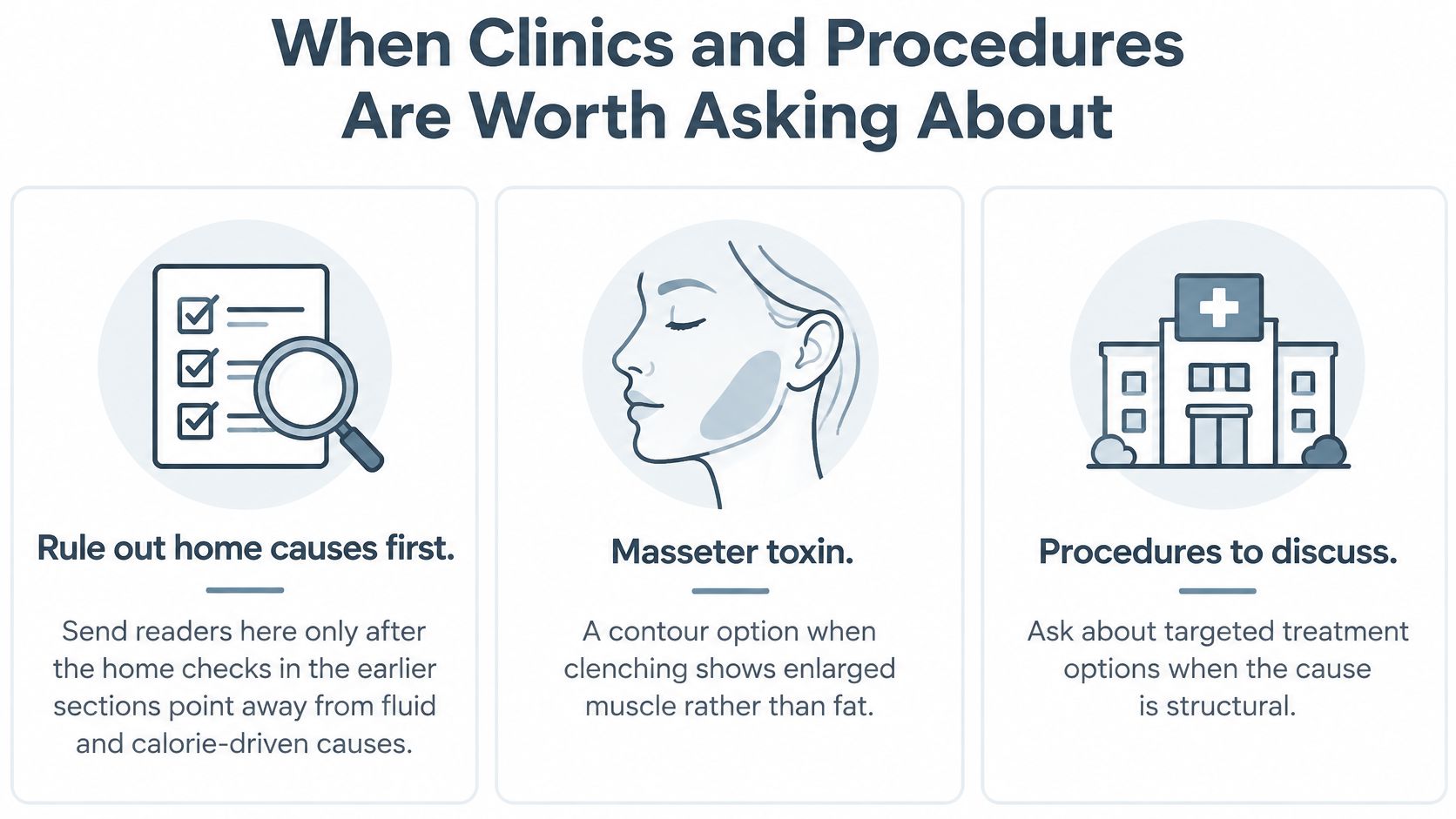
A consultation becomes useful when the pattern suggests a specific anatomical issue rather than reversible morning puffiness. The question isn't “Which treatment makes faces smaller?” It's “Which tissue is contributing to my concern, and what would treating it change?”
The illustration highlights why identifying the target comes before selecting a procedure.
Match the treatment to the tissue
For suspected masseter enlargement, a clinician examines both sides during clenching and checks dental problems, temporomandibular-joint symptoms, neuromuscular conditions, pregnancy, and medication-related concerns. Conservative muscle mapping and injection should be followed by reassessment of chewing strength, smile symmetry, and facial balance.
Buccal-fat removal requires a different discussion. Weight should have remained stable for at least six months before surgery is considered, because later fluctuations can change facial proportions. Removing volume also has long-term implications as facial fat naturally declines with age.
Clinic Options by Fit, Reported Window and Downside
| Option | Fits when | Reported window | Main downside |
|---|---|---|---|
| Masseter botulinum toxin | Clenching and examination confirm enlarged chewing muscles | A PubMed-indexed review describes benefit with 48- and 72-unit regimens and a pivotal study reporting improvement for up to six months after one 72-unit onabotulinumtoxinA treatment | Chewing weakness, smile change, hollowing; temporary results and no universally optimal dose across products |
| Buccal fat removal | Cheeks remain full after stable weight and an in-person anatomy assessment | Surgical result that can be altered by later weight changes | Asymmetry, bleeding, infection, salivary-duct or facial-nerve injury, numbness, prolonged swelling, minimal improvement, and increasing gauntness with age |
| Combined submental contouring | Selected surgical or combined-treatment cases, not a home method | A 2024 study in Aesthetic Plastic Surgery reported an average 23 mm reduction in submental length at six months, with about 25 mL of fat removed | Single-study result, not a personal forecast |
| Cryolipolysis plus hyaluronic-acid filler | Research settings only for interpreting this finding | A 2024 Journal of Cosmetic Dermatology pilot reported an average 9.34-degree reduction in cervicomental angle in five participants | Tiny sample; don't generalize |
| Vacuum-assisted microneedling | Research settings only for interpreting this finding | A 2024 Journal of Cosmetic Dermatology study reported treated midface-volume reductions of 0.24 mL at one month, 0.59 mL at three months, and 0.55 mL at six months | Single study; don't generalize |
These outcomes measure different things. Under-chin length, neck angle, and midface volume aren't interchangeable measures of a thinner face, and a follow-up visit doesn't establish permanent benefit.
Bring questions that reveal the trade-offs
Before committing, ask the clinician to explain:
- The target tissue. Is the concern muscle, fat, skin laxity, bone structure, or a combination?
- The expected duration. Will maintenance be needed, and what happens when treatment wears off?
- The downside. Could reducing volume make existing hollows or asymmetry more visible?
- The alternative. What happens if you choose observation rather than intervention?
ProMD Health's overview of facial contouring results and risks can help you prepare that conversation without treating before-and-after photographs as guarantees. If the concern is sagging along the jaw rather than cheek fullness, our guide to a non-surgical jowl lift addresses a different treatment question.
A smaller face isn't automatically a better-balanced face. Ask what the clinician would preserve, not just what they would reduce.
Start a Two-Week Face Check and Sleep Reset
Use a two-week observation period to choose your next action, not to demand a facial transformation. If fullness fades through the day and follows disrupted nights or salty evenings, prioritize fluid-related habits; if face and waist change together over a longer trend, consider appropriate weight management. If clenching changes your jaw width or your cheeks remain unchanged despite stable weight, choose an anatomy assessment instead of another restrictive diet.
Keep a simple log
You don't need a facial measurement app. A phone camera and a short note are enough for this practical experiment.
- Every night: Keep a consistent bedtime and note evening sodium from food labels, alcohol, congestion, and sleep interruptions.
- Every morning: Take a photograph in the same light, at the same distance, with a neutral expression.
- During the week: Use two consistent morning weigh-ins if weight tracking is appropriate for you.
- At day seven and day fourteen: Compare morning and evening photographs rather than selecting only the most flattering images.
At the end, retain the habit that matched a clear pattern. If the photographs don't support your original assumption, stop escalating that approach.
Treat breathing symptoms as health information
Mouth breathing, habitual snoring, and repeated awakenings deserve attention beyond appearance. Loud snoring, witnessed breathing pauses, choking during sleep, or significant daytime sleepiness warrant assessment for a sleep-related breathing disorder. Don't use mouth tape to manage suspected sleep apnea.
Start with a comfortable wind-down and unobstructed nasal breathing. Never force your mouth closed when your nose is blocked, and don't use tape if breathing feels difficult, you've used alcohol or sedatives, or you can't readily remove it.
Our routine has three steps: Restore+, then Nasal Strips, then Mouth Tape. The strips support nasal airflow, while tape gently encourages nasal breathing, but neither removes facial fat. Although we describe nasal breathing as reducing snoring by 50%+ in habitual mouth breathers, that isn't an individual guarantee or evidence that a product treats sleep apnea; greater nasal nitric oxide production also shouldn't be treated as a promise of deeper sleep or fewer awakenings for everyone.
Practical rule: Judge a sleep routine by comfortable breathing and better-rested mornings, not by whether it creates a dramatically sharper photograph.
Seek medical care for persistent, painful, or one-sided swelling. Breathing-related swelling needs urgent help, regardless of what your tracking log suggests.
SleepHabits offers a nighttime routine with Restore+, Nasal Strips, and Mouth Tape, protected by a 60-night risk-free guarantee. Visit SleepHabits to explore an appropriate sleep routine alongside your face check, with the goal of better nights rather than a promise to remove cheek fat.