

A clear nose at bedtime proves almost nothing about 3 a.m. Mouth taping at night is not a proven routine choice for most adults. A 2025 systematic review of 10 studies involving 213 patients found minimal or uncertain evidence of benefit, which is why one calm breath test cannot settle the decision.
The popular advice is simple: if you can breathe through your nose right now, tape your mouth tonight. That advice skips the part that matters. Your nose can swell at 2 a.m., a cold can settle in, reflux can rise, panic can spike, and alcohol or sedating medication can dull your response when breathing feels hard. A habit that looks fine for one quiet minute can work very differently across eight hours.
So is mouth taping at night safe for you, specifically? Start with nasal airflow all night, not lip comfort. Then screen for whole-night risks and warning signs, because sealing your mouth will not explain why you snore, gasp or wake unrefreshed; persistent snoring is a reason for evaluation, not a reason to tape.
The Short Answer for Different Sleepers
Find your row first. Common situations sort by what to do and why, so you don't have to guess from a general yes or no.
Mouth Taping Verdict by Situation
| Situation | Verdict | Main reason |
|---|---|---|
| Clear nose, no snoring, no breathing pauses | Discuss with a clinician before trying | Nasal breathing is reliable, but evidence for healthy adults is minimal |
| Nasal congestion, allergies or sinus infection | Avoid | Tape removes the mouth escape route when the nose is blocked |
| Deviated septum or enlarged tonsils | Avoid unless cleared by an ENT or sleep physician | Structural nasal obstruction can make breathing unsafe |
| Loud snoring with gasping or witnessed pauses | Get evaluated first | Possible sleep apnea, and tape is not a treatment for it |
| Reflux, regurgitation or vomiting risk | Avoid without medical advice | A sealed mouth may hinder expelling vomit |
| Diagnosed sleep apnea using CPAP | Only under clinician supervision | Supervised add-on use showed benefit, not unsupervised self-treatment |
The caution behind those rows comes from a PolitiFact summary of the 2025 systematic review, which examined 10 studies involving 213 patients and found evidence for treating mouth breathing, obstructive sleep apnea or sleep-disordered breathing was minimal or uncertain. In that same summary, four of the 10 studies explicitly discussed a possible risk of asphyxiation when the mouth is sealed with nasal obstruction or nighttime regurgitation present.
That risk isn't abstract. Your mouth is a backup vent, and tape closes it. Congestion, allergies, a deviated septum and enlarged tonsils can each leave you without enough air through your nose while asleep, and Cleveland Clinic warns that taping may cause breathing difficulty, skin irritation or allergic reactions.
Practical rule: Read the verdict against your hardest hour, not your easiest one. A nose that runs clear at bedtime can still block hours into sleep, so match yourself to the row your worst night would put you in.
If you snore loudly, gasp, or someone has seen pauses in your breathing, persistent snoring is a reason for evaluation, not a reason to tape. Talk with a qualified clinician first, especially if you have respiratory symptoms, and establish that your nose works reliably before you consider sealing your mouth.
What the Studies Really Show About Mouth Taping
Read each study the same way: who took part, how many people were studied, what changed, and what the result cannot prove for an undiagnosed adult at home. That last question carries the most weight, because a trial chooses its participants before it measures anything.
Key Mouth Taping Studies and What They Show
| Study | Participants | Main result | What it means |
|---|---|---|---|
| 2025 systematic review | 10 studies, 213 patients (PolitiFact summary) | Minimal or uncertain evidence; asphyxiation concern in 4 studies | No proof of general safety or benefit |
| 2024 nonrandomized trial with drug-induced sleep endoscopy | 54 patients with OSA (MedPage Today report) | Closing the mouth reduced airflow in some anatomical patterns | Mouth closure can backfire in some airways |
| Mild OSA crossover study | 20 mouth-breathing adults with mild OSA (PubMed-indexed) | 13 of 20 (65%) responded; AHI fell from 8.3 to 4.7 per hour | Promising only for a narrow, selected group |
| Snoring study cited by Cleveland Clinic | 30 people (MedPage Today report) | Participants snored less after taping | Too small to generalize to other snorers |
| Asthma study | 36 people with asthma (MedPage Today report) | No change in asthma | No respiratory benefit shown |
| Randomized crossover with CPAP users | OSA patients who mouth-breathed on CPAP | Tape added 51.8 minutes of daily CPAP use (95% CI 33.1 to 70.4) | Works as a supervised add-on to prescribed therapy |
The favorable rows share a feature the headline claims leave out: pre-screened participants, mild or already-treated disease, and airflow that was measured rather than assumed.
When Closing the Mouth Made Airflow Worse
A MedPage Today report on a 2024 nonrandomized trial described 54 patients with obstructive sleep apnea studied with drug-induced sleep endoscopy, a technique that lets researchers watch the airway while the patient sleeps. They compared natural mouth-open breathing with airflow after the mouth was manually closed to simulate taping. In some anatomical patterns, closing the mouth reduced airflow, which suggests certain people open their mouths to compensate when the upper airway narrows.
The same report put two smaller findings in context: 30 people who snored less after taping, and 36 people with asthma whose condition did not change. Neither sample can tell a congested snorer at home whether tape will help or hurt, because neither measured what happens when the nose itself is compromised.
The Small Positive Result in Mild Sleep Apnea
The clearest favorable result came from a PubMed indexed study of mouth-breathing adults with mild OSA, where 13 of 20 participants, or 65%, were classified as good responders after mouth taping. Median apnea-hypopnea index fell from 8.3 to 4.7 events per hour, a 47% reduction, and median snoring index fell from 303.8 to 121.1 events per hour. Supine AHI also declined, from 9.4 to 5.5 events per hour.
The limits define the finding as much as the percentages do. The sample held only 20 people, each one preselected as a mouth breather with mild OSA, which means a responder was someone whose airway mechanics already matched what tape does. The study cannot show whether tape works as a treatment for sleep apnea generally, and it predicts nothing for a person with a blocked nose, moderate apnea or no diagnosis at all. For an untested snorer, the more supported next step is the sleep evaluation itself.
Tape as a CPAP Add-On
A separate randomized crossover studied people with OSA who mouth-breathed while using CPAP. It compared 30 days with silicone hypoallergenic mouth tape against 30 days without tape, with a one-week washout between periods. Participants reported improvements in sleepiness, snoring, dry mouth or throat, and night awakenings.
Every participant in that design was a diagnosed CPAP user, and the tape supported a prescribed therapy rather than standing in for one. A supervised add-on result in screened patients says little about whether unsupervised taping helps, or harms, someone whose airway has never been tested.
Why a Blocked Nose Turns Tape Into a Risk
Your nose works like the main door of your airway, and your mouth is the side exit. Tape bolts the side exit shut. If the main door jams during the night, you have removed your backup route.
This diagram shows why that backup matters when nasal airflow drops.
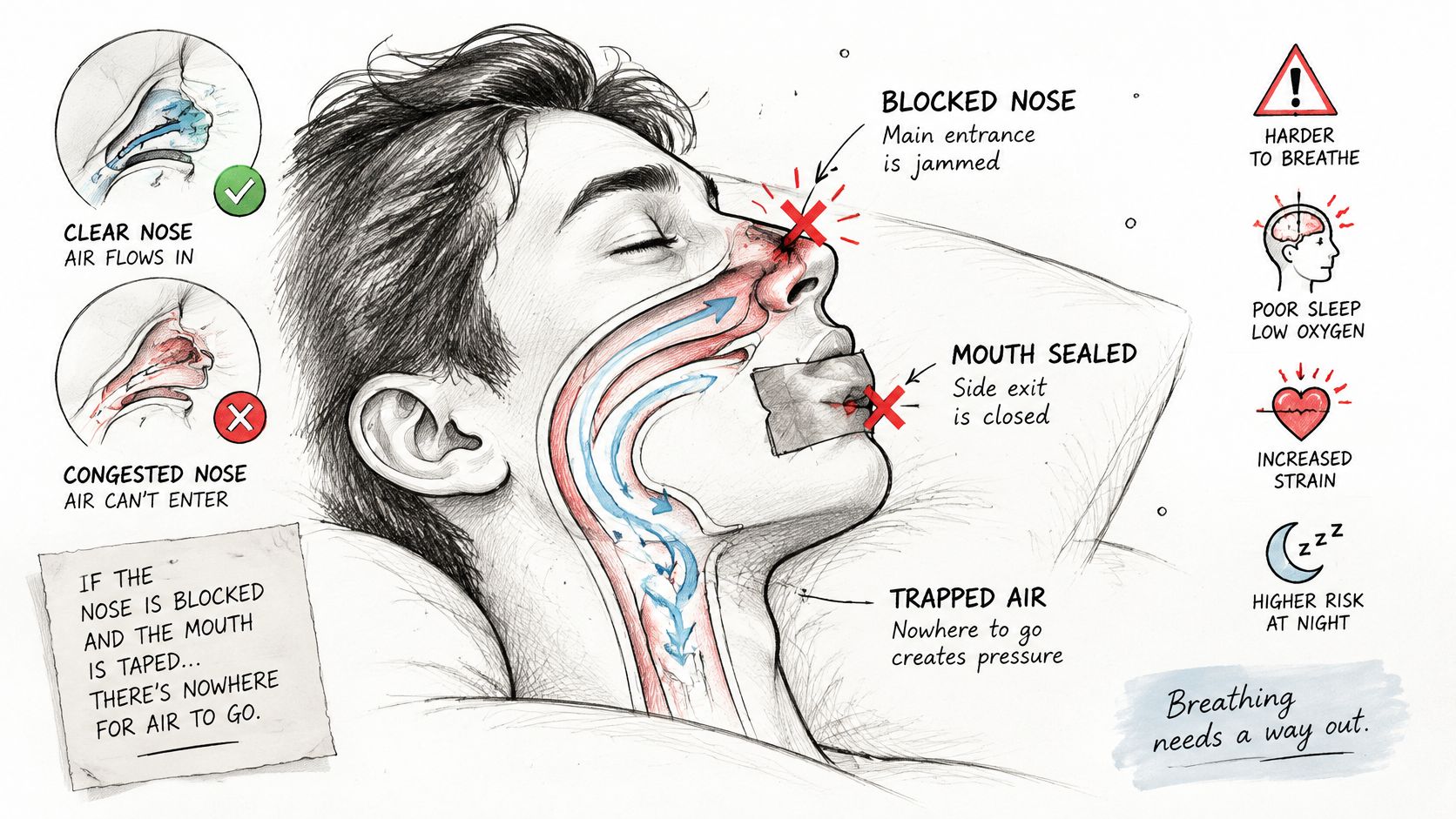
Several things jam the main door. Colds, allergies and sinus infection cause congestion, while a deviated septum and enlarged tonsils narrow the passage structurally. Nasal tissues can also swell as the night goes on or after alcohol, so a nose that felt open at bedtime may not stay open. Even with a clear nose, taping carries its own complaints: breathing difficulty, skin irritation and allergic reactions are the ones medical guidance flags most.
Guidance summarized by the Sleep Apnea organization guide to mouth taping advises avoiding tape with nasal obstruction or congestion, chronic allergies, sinus infection, enlarged tonsils or a deviated septum. It also flags untreated OSA and underlying heart or breathing problems as reasons not to experiment without professional advice. Persistent snoring belongs on that same list: it is a reason to get evaluated, not a reason to tape. If congestion is your recurring problem, start with practical ways to address nasal congestion at night before you consider sealing your lips.
The Failure Modes People Rarely Plan For
Reflux changes the calculation. If you regurgitate or vomit while asleep, a sealed mouth can hinder expelling it and raises an aspiration or choking concern. That is a different risk from dry lips, and it is why heartburn symptoms that evening matter.
Sedation changes it too. Alcohol and sedating medication can blunt arousal, so you may not wake promptly when breathing feels restricted. Panic is the third problem: a sleeper who wakes frightened and short of breath may fumble while trying to peel tape off quickly.
The short video below walks through these nighttime scenarios in plain language.
There is also an anatomy issue. For some people with sleep apnea, an open mouth is a compensatory route when the airway narrows, so forcing it shut can reduce airflow instead of stabilizing it. You cannot tell which pattern you have from how your breathing feels while awake.
Three conditions raise risk most on a given night.
- Congestion tonight, from a cold, allergies or swelling that builds after you lie down
- Reflux symptoms, especially nausea, regurgitation or a history of vomiting at night
- Sedation, from alcohol or medication that makes waking and responding slower
Warning Signs and Your Decision Tonight
Run yourself through the traffic-light table before you look at any product. It turns vague worry into a specific action for tonight.
Traffic-Light Guide to Screening Before Taping
| Situation | Light | Action |
|---|---|---|
| No red flags and nose breathes easily | Green | May trial carefully using the steps below |
| One sign such as loud snoring, morning headaches, or daytime sleepiness | Amber | Clinician review before any trial |
| Witnessed pauses, gasping, or choking in sleep | Red | Do not tape; book an ENT or sleep evaluation |
| Any sign together with congestion, reflux, or sedation | Red | Do not tape tonight; seek medical advice |
| Shortness of breath, panic on waking, or difficulty removing tape | Red | Stop and seek medical advice |
The infographic below gives you the same stop signals in a form you can check quickly at bedtime.
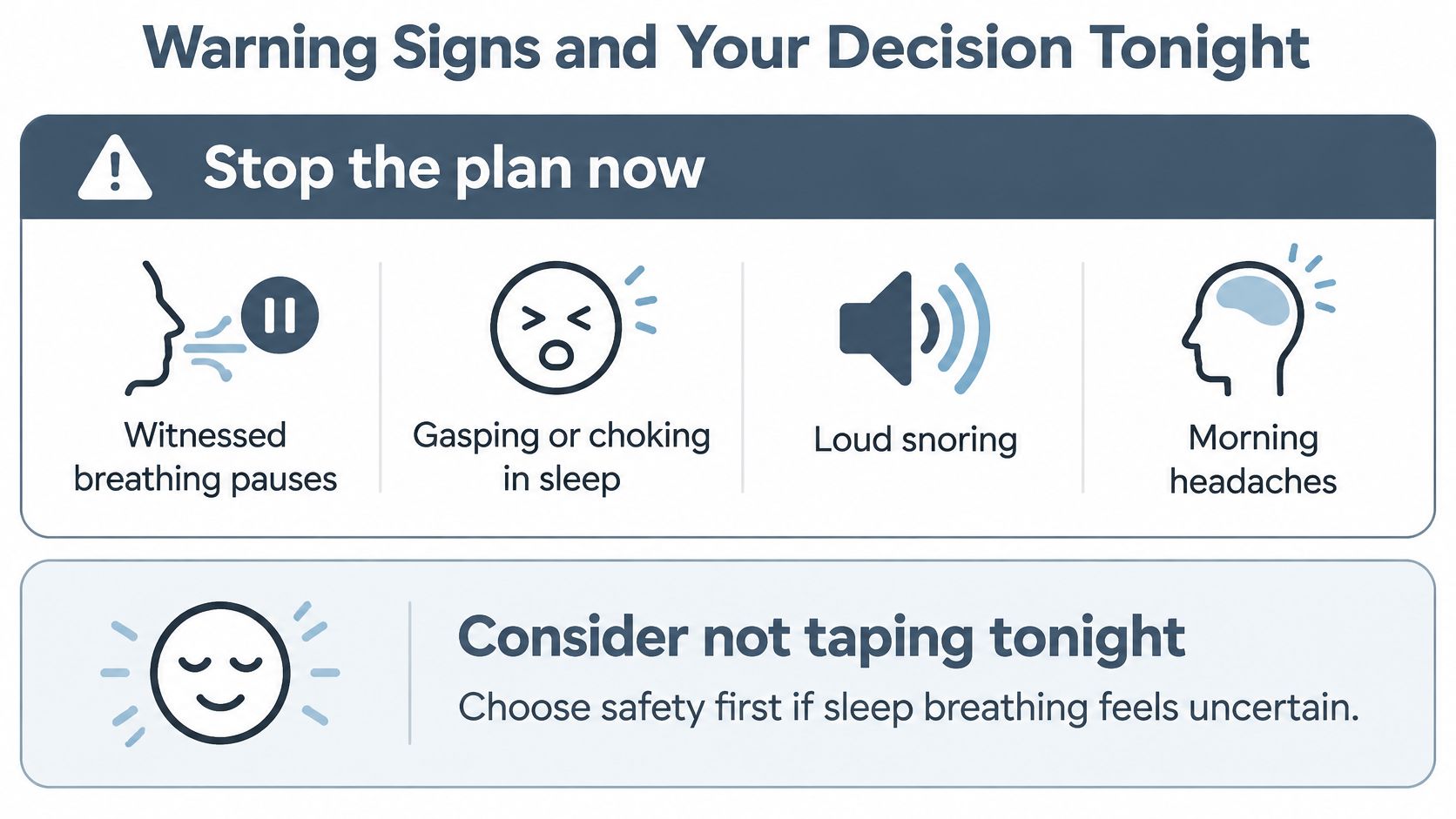
Two details decide which row you land in. Amber covers one persistent sign on its own; the moment a second sign joins it, or a whole-night risk like congestion, reflux or sedation enters the picture, you move to red. The red rows also split by timing. Witnessed pauses, gasping or choking mean no taping at all until you're evaluated, while congestion or sedation on a given night mean no taping tonight even if you're normally clear.
Why One Nose Test Isn't Enough
Consumer advice often stops at "make sure you can breathe through your nose," but the PubMed record for the 2025 systematic review shows why that's insufficient: many included trials screened out people with nasal obstruction or airway pathology before enrollment. Reassuring results from screened volunteers may not apply if you have allergies, congestion, a deviated septum, enlarged tonsils, asthma, reflux or suspected sleep apnea.
Treat snoring with witnessed pauses, gasping, morning headaches, excessive daytime sleepiness and persistent congestion as screening triggers rather than reasons to reach for tape. If you're unsure how those symptoms fit together, read whether snoring can signal sleep apnea and bring your notes to a clinician.
Habitual mouth breathers and loud snorers are often the most motivated to try tape, yet they're also the group most likely to have an underlying airway disorder rather than a simple habit.
What Supervised CPAP Use Involves
Clinicians who study tape generally frame it as an add-on to a primary treatment, secondary to addressing the airway itself. The randomized crossover trial described in the earlier studies section enrolled adults with sleep apnea who already used CPAP yet still mouth-breathed, and they added silicone hypoallergenic tape for 30-day stretches while researchers tracked usage. That setting matters for tonight's decision. Tape was layered onto diagnosed, treated patients under observation, which is a long way from a first-line fix for an unscreened snorer.
Before any appointment, keep a week of notes. Record snoring, awakenings and daytime sleepiness, add partner observations about pauses or gasping, and list your allergy and nasal history. That record helps an ENT or sleep physician decide whether you need a nasal exam, a sleep study or neither.
Apply one hard rule tonight: no tape if you're congested, you've had alcohol or sedating medication, or you have reflux symptoms. With no red flags and easy nasal breathing, a careful trial may be reasonable after clearance, and purpose-built tape stays a secondary choice that follows screening rather than preceding it.
How to Try Mouth Taping Safely, Step by Step
Only use these steps if you landed in the green row and a clinician hasn't advised against it. There's no formal safety standard that defines a universally safe technique, so the stop rules matter as much as the application.
The process image below gives you an overview before you work through each step.
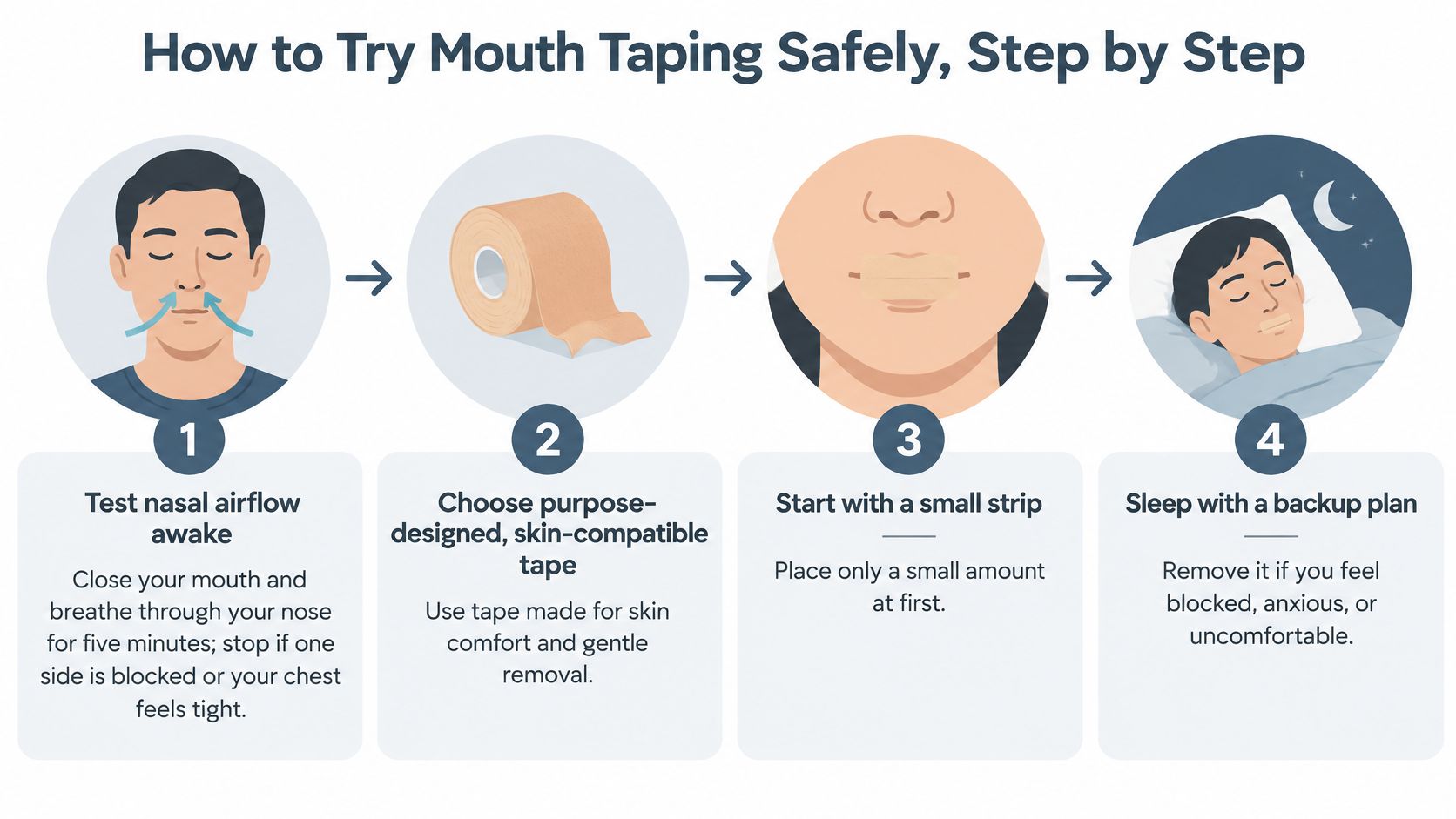
Prepare While You're Awake
- Test nasal airflow for five minutes. Close your mouth and breathe only through your nose while sitting still, because you need a baseline. Stop the plan if one side feels blocked, you keep wanting to open your mouth, or your chest feels tight.
- Choose purpose-designed, skin-compatible tape. Pick a product made for lips and gentle removal, and avoid anything that covers your nostrils or uses household adhesive. Mouth Tape is one purpose-designed option with hypoallergenic lightweight and medical-grade silicone styles, stated as third-party lab tested and free of PFAS, parabens and phthalates.
- Patch test for a day. Place a small piece on skin near your jaw or inner forearm first, because adhesive reactions are easier to spot while awake. Don't proceed if you develop redness, itching or soreness.
- Practice awake for 10 to 15 minutes. Read or watch television with the tape on and confirm you can remove it quickly with one hand. Stop if you feel anxious, short of breath or unable to peel it off calmly.
Apply Less Than You Think You Need
The Sleep Foundation guide to mouth taping notes possible adverse effects including skin irritation, discomfort, disrupted sleep and breathing problems, and states that mouth tape isn't an independent treatment for sleep apnea. It also describes a clinical protocol that used a 3-by-1-inch adhesive strip positioned vertically over the lips near the columella, bringing the lips together without completely preventing mouth breathing.
- Use a vertical strip, not a full seal. Place the strip over the center of your closed lips so it brings them together without covering your nose or the whole mouth. Fold a small non-sticky tab at one end if the product allows it, so removal stays fast.
- Trial only a few nights and keep a log. Note snoring, dry mouth, awakenings, skin soreness and how alert you feel on waking. A pattern across several nights tells you more than one unusually good or bad night.
Know Your Exit Before You Sleep
- Remove it immediately for distress. Peel slowly if you're calm, or pull it off at once if you feel short of breath, nauseated or panicky. Use warm water or a gentle remover for residue, and don't reapply that night.
- Stop and see a clinician if symptoms persist. Ongoing loud snoring, gasping, morning headaches or daytime sleepiness aren't problems to push through with stronger tape. They are reasons for assessment.
Backup plan: Sleep without tape on any night when congestion, reflux, alcohol, sedating medication or a respiratory illness enters the picture, even if previous nights went well.
A worked example helps. Say you pass the five-minute test on Monday, practice comfortably, then develop allergy congestion on Thursday. The safe decision on Thursday is no tape, because your airway conditions changed. Consistency doesn't beat screening.
Safer Alternatives If Tape Is Not Right for You
A red or amber screening result is not a dead end. It sets a more useful order of operations, starting with the cause of the mouth breathing itself.
- Book a nasal and airway exam. See an ENT if you have persistent congestion, a deviated septum, enlarged tonsils or chronic allergies. Each of those is a treatable problem in its own right.
- Ask for a sleep study when apnea signs appear. Loud snoring with gasping, witnessed pauses or excessive daytime sleepiness needs testing, because tape can't diagnose or treat sleep apnea. Persistent snoring is a reason for evaluation, not a reason to tape harder.
- Discuss proven apnea treatments if testing confirms it. CPAP is one route, and trained clinicians can also explain oral appliances for sleep apnea from Pain and Sleep Therapy Center as another treatment category to evaluate. Tape, if used at all in that setting, belongs under supervision as an add-on for mouth breathing.
- Ask about sleep position. Position can change how often breathing events occur, especially when events cluster on your back. A clinician can tell you whether positional strategies fit your test results instead of leaving you to improvise with pillows.
- Treat congestion before reconsidering tape. Manage allergies or sinus problems under medical advice, then reassess nasal airflow across several nights. Nasal Strips gently open the nasal passages to support smoother airflow, and you can ask a clinician whether that separate option suits your nose.
- Compare non-tape routes side by side. Use this guide to alternatives to mouth taping to prepare questions about nasal care, positioning and devices before your appointment.
One quiet night doesn't prove your airway is fine, and one restless night doesn't prove an alternative failed. Bring your week of notes on snoring, waking and daytime alertness to the appointment, along with any partner observations, so the clinician has something concrete to act on.
If screening shows your nose breathes easily and a clinician hasn't advised against a careful trial, SleepHabits offers purpose-designed mouth tape and nasal strips alongside evidence-based sleep education to support nasal breathing. Visit SleepHabits to compare the options, read the guidance on safer use, and choose only what fits your airway and your symptoms.