

Most advice about mouth strips for snoring starts with the wrong promise: close your lips, breathe through your nose, and the snoring disappears. That may help a narrow group, but it isn't a universal fix and it can be unsafe when the nose is blocked or sleep apnea is present.
The useful question isn't “Do mouth strips work?” It's “Why am I snoring, and can I breathe freely through my nose all night?” A strip may reduce open-mouth breathing. It can't correct every narrowed airway, replace an evaluation for sleep apnea, or make positional and structural snoring disappear.
What Mouth Strips for Snoring Do
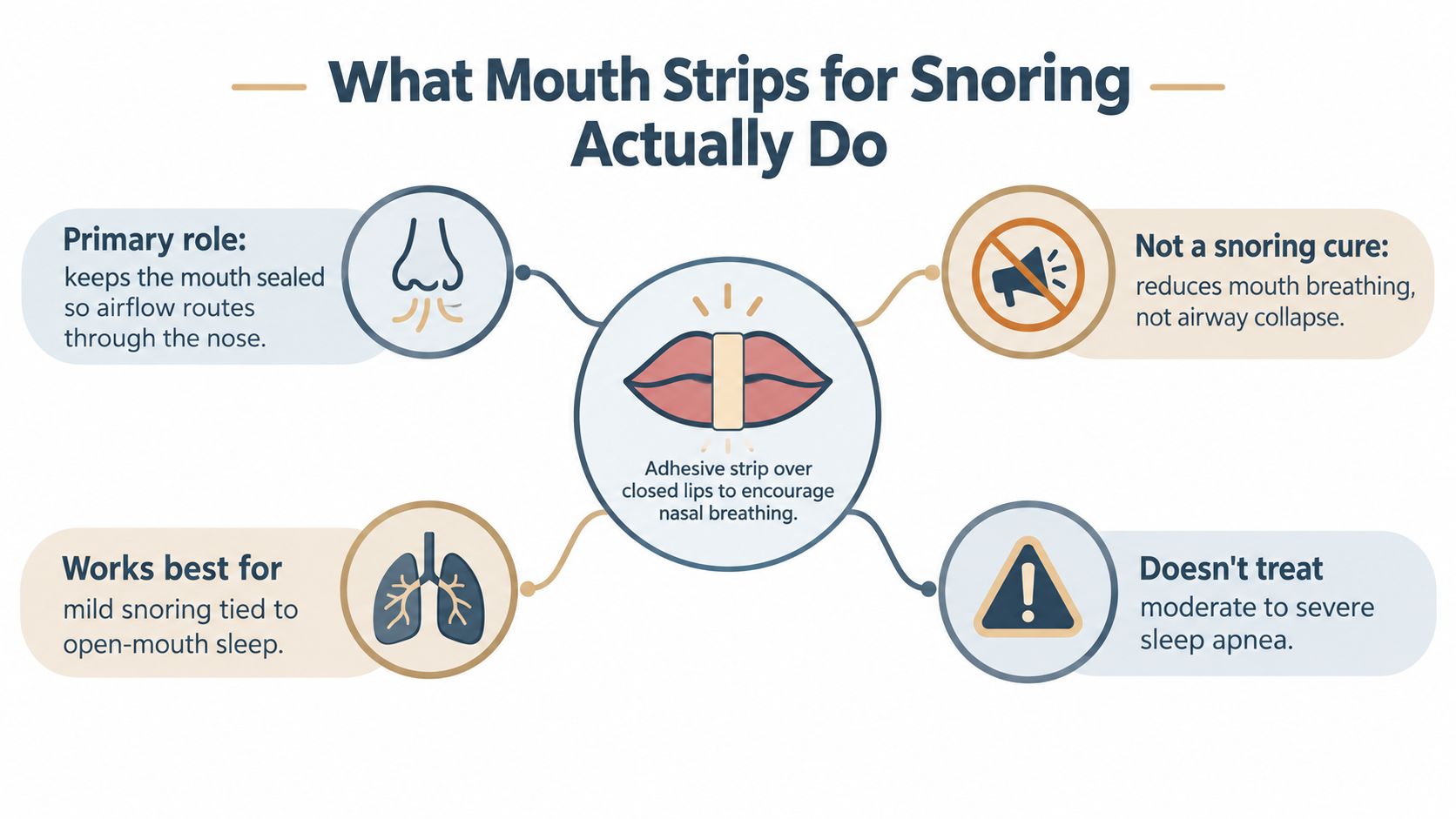
Mouth strips are adhesive devices placed vertically across closed lips to encourage nasal breathing during sleep. They differ from nasal strips, which sit across the nose to support the nasal passage, and from mouth tape, which can cover more of the lips and create a stronger seal.
Their target is narrow: open-mouth breathing. If your snoring mainly occurs with your mouth open while your nose remains clear, gently supporting lip closure may reduce the airflow turbulence that makes soft tissues vibrate. A strip cannot correct every narrowed airway. Nasal obstruction, airway collapse during sleep, or snoring that becomes much worse on your back calls for a different approach.
Who might benefit
The strongest candidate is an adult who:
- Sleeps with an open mouth: You wake with a dry mouth, see parted lips in sleep recordings, or your partner notices mouth breathing.
- Breathes comfortably through the nose while awake: You are not dealing with a cold, uncontrolled allergies, a severely deviated septum, or persistent congestion.
- Has mild, uncomplicated snoring: Nobody has observed breathing pauses or repeated gasping, and you do not have severe daytime sleepiness.
A 2022 proof-of-concept study examined mouth-breathers with mild obstructive sleep apnea. In that selected subgroup, mouth taping reduced the median apnea-hypopnea index from 8.3 to 4.7 events per hour and the median snoring index by 47%, from 303.8 to 121.1 events per hour (study details). The results support a targeted trial, not a general promise for anyone who snores.
Screen yourself first. Can you breathe freely through your nose all night? Has anyone noticed pauses or gasping? Do you wake refreshed? Use this chronic snoring self-check guide to organize warning signs before choosing a device. If those signs are present, seek an evaluation instead of sealing your mouth.
How Mouth Strips Work and What the Evidence Shows
Mouth strips change breathing mechanics, not the underlying cause of snoring. A vertical strip holds the lips gently together, discouraging oral breathing and directing airflow through the nose. Nasal breathing filters and humidifies incoming air, while nasal airflow is associated with nitric-oxide production that supports normal respiratory function. This approach only makes sense when the nose can handle the airflow throughout the night.
Snoring develops when relaxed tissues vibrate as air passes through a narrowed upper airway. If open-mouth breathing adds to that vibration, keeping the lips closed may reduce noise. It will not correct obstruction from airway anatomy, severe airway collapse, or nasal congestion.
The evidence is weaker than social media claims suggest. A later 2025 review of 10 studies found significant improvement in sleep apnea measures in only 2 of the 10 studies, with the overall evidence remaining small and mixed (review summary). A separate clinical review of mouth taping trials involving 10 studies and 213 patients reported possible benefit mainly for mild sleep apnea. 4 studies also raised serious safety concerns, including the risk of asphyxiation when nasal obstruction is present. These findings support a narrow, screened use case, not routine treatment for general snoring.
Evidence snapshot
| Tool | Best-suited snorer type | Typical reported effect | Evidence strength |
|---|---|---|---|
| Mouth strips | Mild mouth-breathing snorers with clear nasal passages | May reduce open-mouth breathing and noise | Limited, conditional |
| Mouth tape | Selected mouth-breathers who tolerate a gentle lip seal | May reduce snoring in small studies | Weak and mixed |
| Nasal strips | Snorers whose symptoms involve restricted nasal airflow | Supports nasal breathing more reliably than it treats sleep apnea | Mechanistically plausible, outcome evidence mixed |
A quieter night does not prove a safer airway. A partner may hear less noise while breathing interruptions continue. Cleveland Clinic reports that scientific evidence does not support mouth taping for snoring and does not recommend it as treatment for a sleep disorder (Cleveland Clinic guidance). Use these products only as a cautious adjunct for a carefully screened subgroup, never as a substitute for assessment or established sleep-apnea treatment.
Applying Mouth Strips Safely Step by Step
Safety begins before you open the packet. Don't apply a strip at bedtime because your snoring is annoying. First establish that nasal breathing feels easy while you're awake.
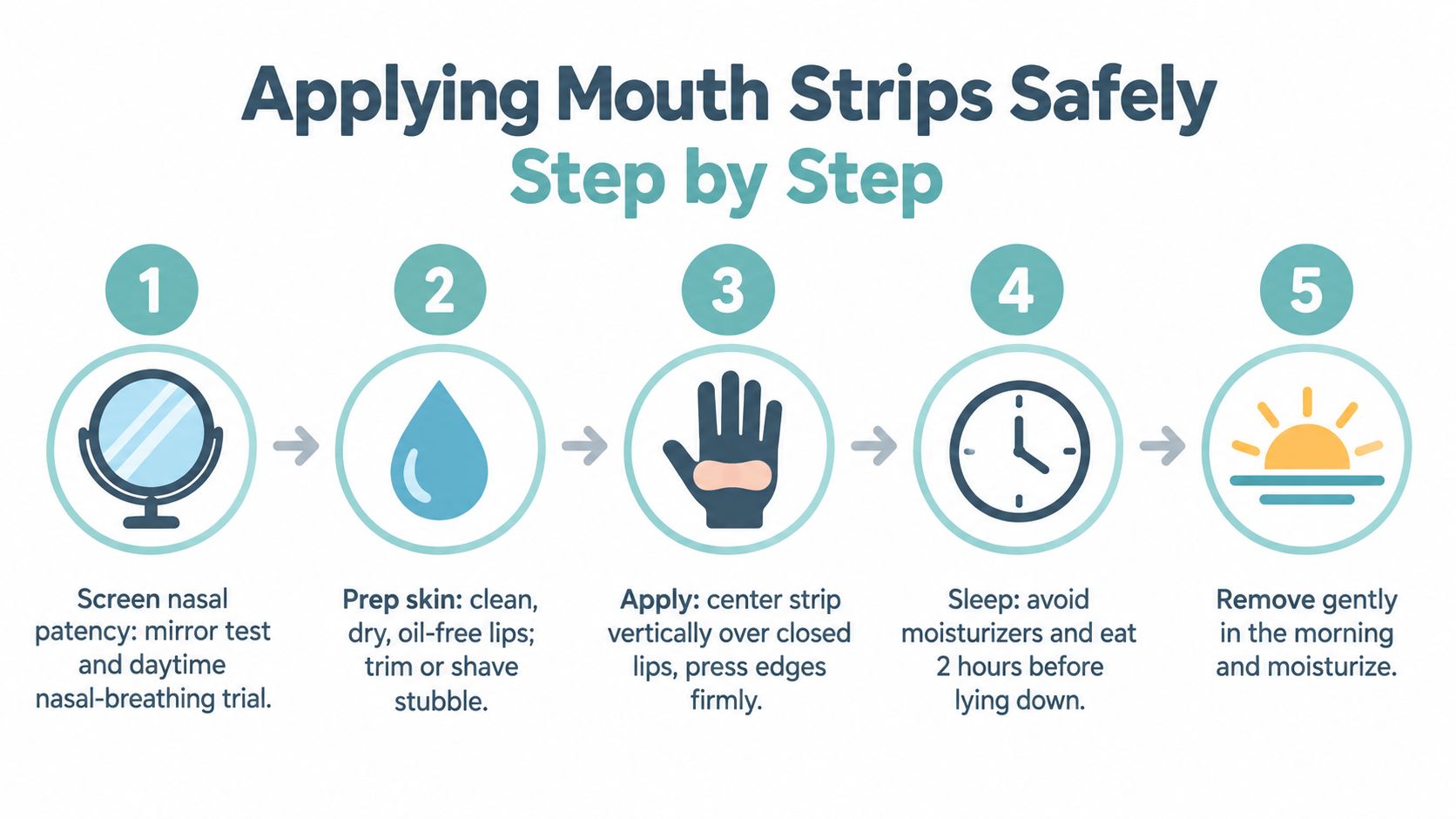
- Screen nasal patency. Hold a mirror under your nostrils and breathe normally. Condensation should appear from both sides. Then spend time breathing through your nose while sitting and lying down. If you feel air hunger, remove the idea from your plan and address the obstruction.
- Prepare the skin. Wash and dry the lips and surrounding skin. Skip balm, moisturizer, oil, and heavy skincare because they interfere with adhesion. Facial stubble can also make removal painful and cause the strip to peel.
- Use a vertical placement. Choose a product designed for the mouth, close your lips naturally, and center the strip vertically across them. Press from the middle toward the edges. Don't create a full horizontal seal that prevents normal lip movement.
- Test while awake. This is an essential step. Wear the strip for 30 to 60 minutes while sitting, then lying down, and check whether you can breathe calmly, swallow, speak if needed, and remove it without panic. University Hospitals recommends testing nasal breathing while awake and using a narrow vertical strip that doesn't fully seal the mouth (hospital safety guidance).
- Limit the trial. Use it only on nights when your nose is clearly open. Don't use it after alcohol, sedatives, or during a respiratory illness. Those conditions can change breathing and your ability to respond to discomfort.
- Remove it gently. In the morning, loosen the adhesive with warm water and peel slowly. Inspect the skin for redness, swelling, or a rash.
A detailed guide to the practical differences between mouth taping methods is available in this mouth tape for sleeping resource.
If you're comparing formats, Mouth Tape is described as a hypoallergenic X style or a medical-grade silicone roll, with product information stating that both are third-party tested and free of PFAS, parabens, and phthalates. Those product features may affect comfort, but they don't change the need for screening.
Choosing Between Mouth Strips, Nasal Strips, and Mouth Tape
Choose based on your breathing pattern, not on whichever product has the loudest marketing.
If you wake with a dry mouth and your nose feels clear, you're more likely to be an open-mouth snorer. A mouth strip or gentle mouth tape trial may be reasonable after daytime testing. If you wake congested even though your lips stayed closed, the nose is the bottleneck. Start with nasal hygiene, a nasal strip, or a nasal dilator instead.
| Criterion | Mouth strips | Nasal strips | Mouth tape |
|---|---|---|---|
| Primary target | Open-mouth breathing | Restricted nasal airflow | Persistent mouth opening |
| Seal | Usually partial or vertical | No lip seal | Often broader lip coverage |
| Removal | Generally easier to release | Simple external removal | May feel more restrictive |
| Best first use | Mixed or mild mouth-breathing pattern | Congestion-dominated pattern | Clear-nose mouth breathers who tolerate testing |
| Main limitation | Won't fix airway collapse | Won't keep lips closed | Greater discomfort if the nose blocks |
A deviated septum, allergic swelling, or recurrent congestion changes the decision. In that situation, forcing the mouth closed is the wrong first move. Improve nasal airflow or seek an ENT assessment before experimenting with any closure device.
Nasal dilators generally improve nasal breathing more reliably than they improve full obstructive sleep apnea outcomes, so don't confuse easier airflow with treatment of apnea. If symptoms suggest a jaw or airway problem, read this explanation of oral appliance therapy from Winn Smiles rather than trying to solve a significant obstruction with adhesive.
For a congestion-led pattern, a nasal strips for snoring guide offers a more appropriate starting point. My quick rule is simple: congestion means nose first, open-mouth breathing means a cautious mouth-closure trial, and mixed symptoms mean choose the easiest-release option first.
Troubleshooting Common Problems With Mouth Strips
Most failures are useful clues. Don't keep applying the same strip and hoping the problem disappears.
When the strip won't stay on
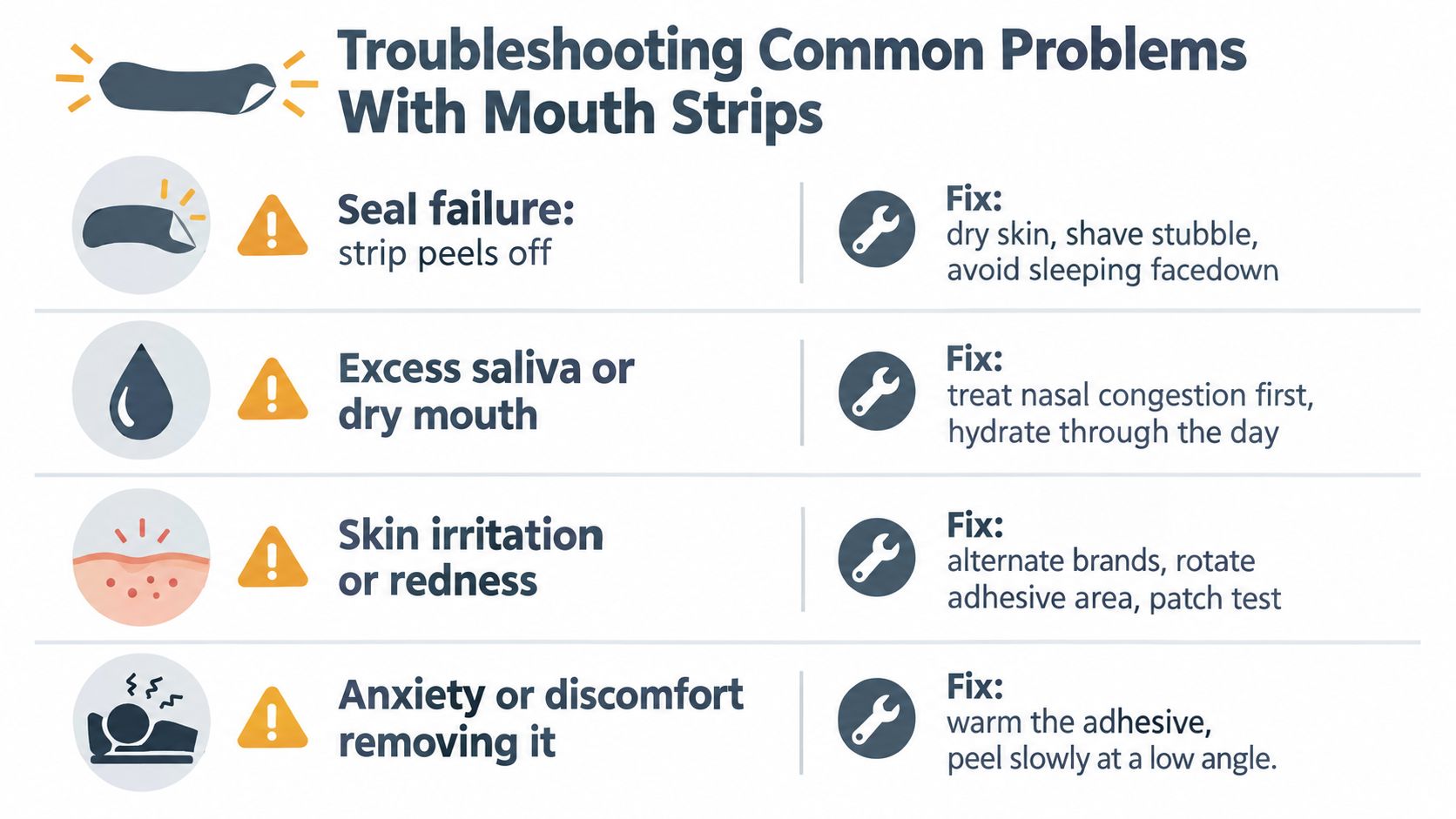
Peeling usually reflects oily skin, lip moisturizer, facial hair, saliva, or sleeping face-down. Clean the area, dry it completely, and avoid products around the lips before bed. If you sleep prone, use a pillow that keeps your chin from pressing into the mattress.
When the skin reacts
Redness at the edges means the adhesive or repeated placement is irritating your skin. Stop until the reaction settles, patch-test a different gentle material, and rotate the adhesive area rather than applying over the same irritated spot. Don't cover broken skin.
When congestion appears overnight
This is the problem I take most seriously. If your nose blocks after you fall asleep, build the habit of peeling from a corner rather than pulling from the center, then stop using mouth closure until you understand why the congestion occurred. Repeated nighttime obstruction means the tool is a poor fit.
Morning dry mouth also matters. It may mean air is leaking around the strip, you're still breathing through your mouth, or nasal airflow remains inadequate. Address congestion rather than just adding a stronger adhesive or tighter seal.
Safety, Comfort, and Smart Pairing Habits
Mouth strips are for a narrow group, not general snoring. Do not use them with uncontrolled nasal obstruction, moderate to severe obstructive sleep apnea, a BMI over 35, intoxicated sleep, or an active respiratory infection. If nasal airflow fails, the mouth needs to remain available as a backup route. People with mild obstructive sleep apnea who breathe through the mouth may benefit more than ordinary snorers, but the evidence remains limited.
Stop immediately if you wake gasping, feel a vomiting sensation, notice blue lips, or experience panic that does not settle. Repeated pauses reported by your partner also require stopping self-treatment and arranging an evaluation. Mouth closure can improve airflow for some people with mild limitation and worsen breathing when obstruction is more severe, so a strip is not a test of whether your airway is safe.
Make comfort secondary to breathing
Apply the strip before bed, then stay awake long enough to confirm that nasal breathing feels normal. A saline rinse may ease mild nasal swelling, but it should never be used to push through a blocked nose. A humidifier can reduce dryness, and daytime hydration may help if your mouth feels dry in the morning.
Pair the strip with measures that address the cause:
- Side sleeping: Reduce positional snoring before adding adhesive.
- Allergen control: Keep bedding and the bedroom from aggravating nasal symptoms.
- Alcohol limits: Do not use a closure device after drinking.
- Weight management: If relevant, address a contributor that adhesive cannot correct.
Use this guide to stop mouth breathing in adults while working on the underlying habit. SleepHabits also offers Restore+ Sleep Aid, a melatonin-free supplement described as developed with sleep and airway doctors and formulated to support nitric oxide production, nervous system regulation, and overnight oxygen delivery. It cannot replace evaluation of noisy or interrupted breathing.
If snoring is louder after 30 days of consistent, comfortable use, treat that change as a reason to seek a sleep evaluation. Do not respond by applying a stronger seal.
Your Next Move Based on Your Snoring Pattern
Use the pattern, not the product, to choose your next step.
Closed-mouth nose snorer: Start with side sleeping and a nasal strip. If the sound improves over two to four weeks but remains persistent, discuss nasal anatomy and other causes with a clinician.
Open-mouth snorer without congestion: After the awake trial confirms comfortable nasal breathing, test a vertical mouth strip for two to four weeks. Stop if you develop anxiety, nighttime obstruction, or morning symptoms, and escalate if the snoring remains loud.
Mouth snorer with allergies or a deviated septum: Treat nasal symptoms and arrange an ENT assessment. A strip is not a workaround for a blocked airway. If you're also wondering whether hormonal factors contribute to poor sleep, this overview of low testosterone and sleep problems may help frame a broader medical conversation, but it doesn't explain away breathing pauses.
Loud snorer with witnessed apneas or daytime sleepiness: Skip mouth strips and request a sleep study. Gasping, repeated pauses, unrefreshing sleep, or severe daytime fatigue deserve professional evaluation before any device experiment.
The available evidence is narrow. A 2025 systematic review found only 2 of 10 studies with significant sleep apnea improvement, while a 2026 Sleep Foundation summary described the positive findings as small and focused on mild OSA (systematic review). Persistent snoring isn't harmless just because a strip makes it quieter.
SleepHabits offers mouth tape, nasal strips, and melatonin-free sleep support for adults exploring nighttime breathing habits, with educational resources to help match tools to symptoms. Visit SleepHabits to review the options, then choose a nasal or mouth-breathing trial only after you've screened for obstruction and sleep apnea warning signs.