

You're in bed on time, your body feels tired, and your mind is still replaying the day. You check the clock, shift positions, and wonder why being exhausted doesn't always lead to sleep. That gap between tired and settled is where many people start looking for a natural sleep aid. L-theanine often comes up in that search, but it's widely misunderstood. It isn't best understood as something that knocks you out or adds hours to the clock. The more useful question is whether it can help you feel calmer at bedtime and wake feeling more rested. This guide walks through what it is, what research shows, how studied doses were used, and how to place it inside a realistic, melatonin free routine.
Why L-Theanine Is Popular at Bedtime
A common evening goes like this. You finish work, scroll for a while, get into bed, and only then notice your thoughts speeding up. Your shoulders are tense, tomorrow's list is running, and sleep feels close but not quite reachable.
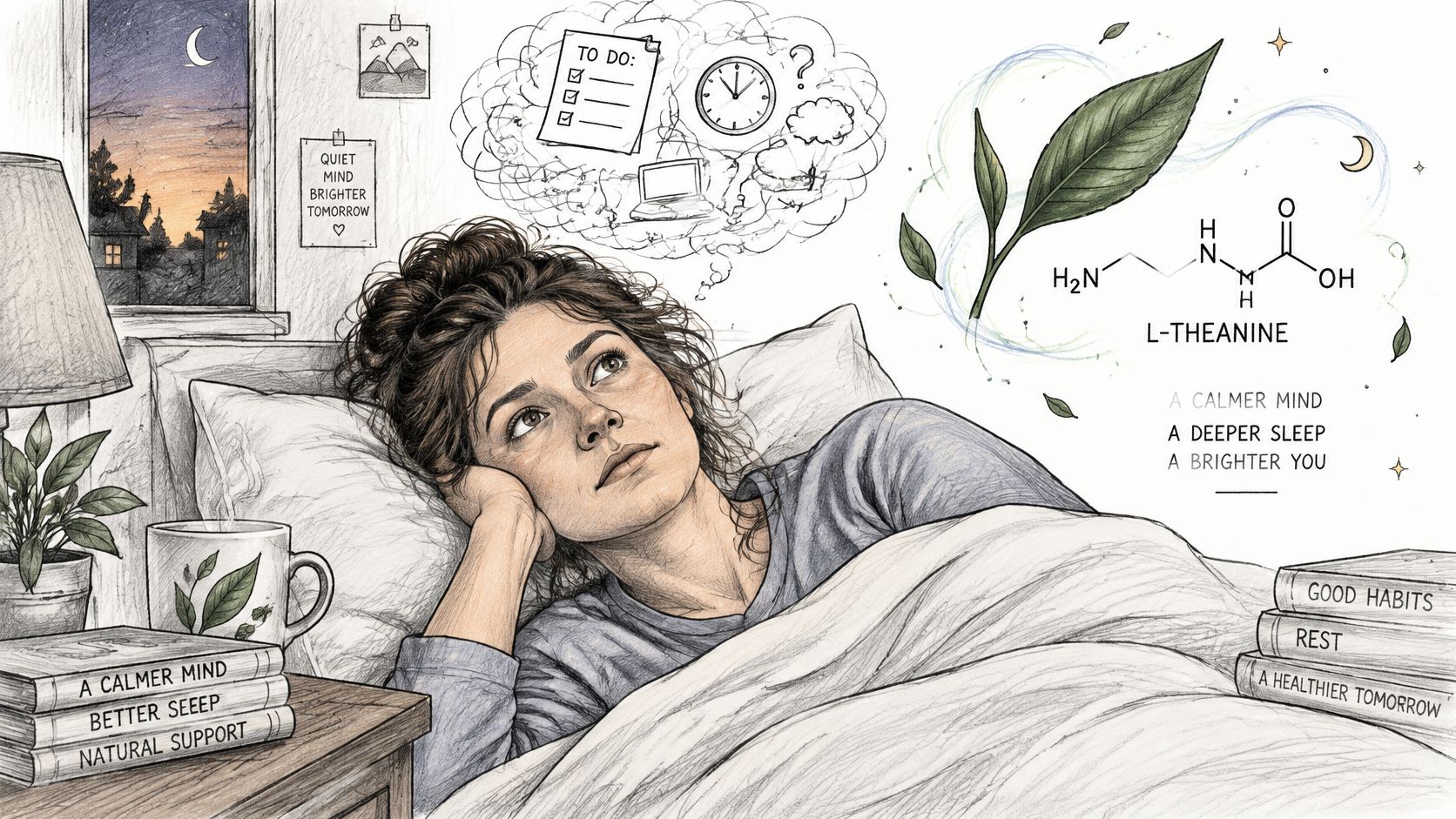
L-theanine is an amino acid found naturally in tea. People encounter it in relaxation and sleep products because it's discussed as a way to support a calmer mental state, not because it acts like a strong sedative.
That distinction matters when you set expectations.
A calmer transition into sleep is a different goal from being forced into unconsciousness.
If you expect an immediate knockout feeling, you'll probably judge L-theanine by the wrong standard. If you expect help with mental wind down and perceived restfulness, the research becomes easier to interpret.
Choosing a product is only part of the decision. Timing, dose, other ingredients, and what you do in the hour before bed all shape the experience. If timing is your first question, the Maximum Health Products timing guide is a useful starting point for thinking about when people take it during the day or evening.
L-theanine shouldn't be presented as a treatment for insomnia, anxiety, depression, or snoring. Those conditions can have causes that a supplement can't diagnose or resolve. Think of it instead as one possible tool inside a broader routine, with limits you'll see clearly in the evidence below.
Understanding How L-Theanine May Support Sleep
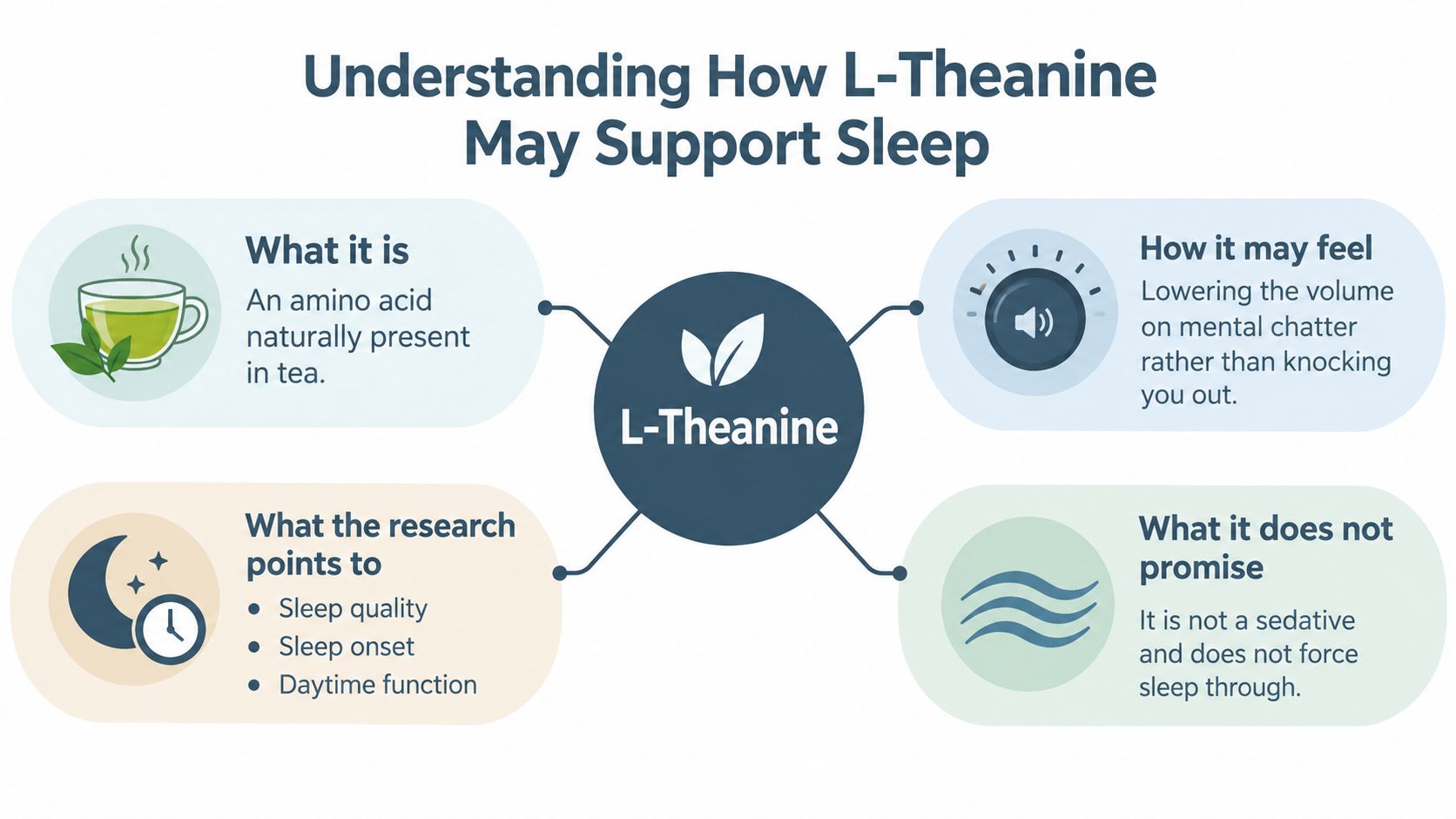
Start with the simplest definition. L-theanine is an amino acid naturally present in tea, and supplements provide it in a measured amount rather than relying on a brewed drink. If you want background on its tea origins, reading about finding L-theanine naturally in tea helps separate the food source from supplement doses used in research.
A Volume Dial, Not a Sleep Button
A helpful analogy is a volume dial. L-theanine is discussed as lowering the volume on mental chatter, not pressing an off switch. You may still be awake and aware during your wind down, but feel less mentally activated.
That's why some people describe the target feeling as settled rather than sleepy. Relaxation can make it easier to follow your usual bedtime cues, such as dim lights and slow breathing.
Words Researchers Use for Sleep
You'll see several measures in studies, and they don't mean the same thing.
- Sleep onset latency: How long it takes to fall asleep after getting into bed.
- Sleep maintenance: How well you stay asleep through the night.
- Sleep efficiency: How much of your time in bed is spent asleep.
- Subjective sleep quality: How restful sleep feels to you.
- Daytime dysfunction: How sleep problems affect your next day function.
- Total sleep time: The total amount of time spent asleep.
Someone can report better subjective sleep quality without sleeping longer. That isn't a contradiction. It may mean falling asleep felt smoother, waking felt more refreshing, or the next day felt easier to manage.
Stress often sits in the middle of this picture. Learning practical ways of regulating stress and anxiety for sleep can support the same wind down goal without relying on a single ingredient.
Keep one boundary clear. A supplement routine doesn't replace assessment when poor sleep persists, especially if snoring, repeated awakenings, or major daytime impairment are part of the pattern.
What the Clinical Evidence Actually Shows
The strongest pattern is narrower than many product claims suggest. Evidence is more consistent for sleep quality, sleep onset, and daytime function than for extending total sleep duration.
A 2025 systematic review and meta-analysis of 19 articles involving 897 participants found significant improvements in subjective sleep onset latency, daytime dysfunction, and overall subjective sleep quality, while evidence for longer total sleep time was not statistically significant. A 2026 review reached a similar conclusion, with the most consistent benefits involving sleep quality and little evidence for increased duration, as noted in that same summary.
For a reader who spends enough time in bed but wakes unrefreshed, that distinction is practical. Your problem may not be the number of hours available. It may be how settled you feel at lights out, how restorative sleep feels, or how you function the next morning.
A Concrete Four Week Example
One randomized, double blind, placebo controlled crossover trial tested 200 mg of L-theanine before sleep each night for four weeks in healthy adults. The four week trial using the Pittsburgh Sleep Quality Index reported significant improvement in overall scores, with p=0.013, plus improvements in sleep latency, with p=0.036, and daytime dysfunction, with p=0.022.
Trait anxiety scores also improved, with p=0.006, and depression scale scores improved, with p=0.019, in that trial report. That pattern fits a relaxation explanation better than direct sedation. It doesn't prove L-theanine treats anxiety or depression, and it shouldn't be used that way without clinical guidance.
This short video gives additional context before you compare the outcomes side by side.
Objective Measurement in a Different Population
A six week trial in boys with ADHD used wristwatch style actigraphy rather than only questionnaires. The six week actigraphy trial in boys with ADHD used 400 mg daily, split between breakfast and after school, and found higher sleep percentage and sleep efficiency scores.
That result is interesting, but it's context, not direct proof for healthy adults at bedtime. The population, age, condition, and daytime dosing schedule were all different.
What the L-Theanine Studies Measure
| Outcome studied | Research signal | Practical interpretation |
|---|---|---|
| Subjective sleep quality | More consistent improvement | Sleep may feel more restful |
| Sleep onset latency | Improvement reported | Falling asleep may feel smoother |
| Daytime dysfunction | Improvement reported | Next day function may feel better |
| Sleep efficiency | Improvement in specific contexts | More of time in bed may be asleep |
| Total sleep time | Not significant in the 2025 synthesis | Don't expect extra hours as the main outcome |
The most defensible expectation is modest. L-theanine may support relaxation and perceived sleep quality for some people. It isn't established as a guaranteed sedative, and longer sleep isn't the outcome to use as your only measure of success.
Choosing a Research-Based L-Theanine Routine
A research informed routine starts with what's been studied, then applies it cautiously. It doesn't turn a study range into a personal prescription.
A systematic review of 13 dietary supplementation trials involving 550 participants found studied doses ranged from 50 to 900 mg per day, with 200 to 450 mg per day used in all but two trials. Beneficial sleep related effects were reported in 9 of 13 trials, including 9 of 11 trials using at least 200 mg per day, according to that review.
Study durations also varied widely, from a single dose to eight weeks in that review. That range tells you why one night is a weak test and why escalating quickly makes results harder to interpret.
Research Context for Adult L-Theanine Dosing
| Research detail | What it tells readers |
|---|---|
| 50 to 900 mg per day studied | Research used a wide range, not one proven dose |
| 200 to 450 mg per day in most trials | A practical research range to discuss with a clinician |
| Single dose to eight weeks | Timing and duration varied across studies |
| Benefits in 9 of 13 trials | Results were promising but not universal |
Build a Simple, Trackable Routine
Use the four week example from the earlier section as a structure, not a promise. In that trial, the dose was taken consistently before bed and outcomes were measured with a validated questionnaire.
- Check the label first: Confirm the amount per serving, serving size, and whether other active ingredients are included.
- Pick one consistent time: Take it as part of the same pre bed sequence rather than at random times.
- Protect the wind down: Dim lights, put screens away, and give yourself a calm transition.
- Track three outcomes: Note how long falling asleep felt, how refreshed you felt on waking, and how you functioned the next day.
- Change one variable at a time: Don't add several new products in the same week.
Practical rule: Judge the routine by perceived restfulness and morning function first, not only by total hours on the clock.
Don't copy split dosing from a study in a different population unless a clinician advises it. Label directions and your own health context matter more than imitating a trial schedule.
Consistency beats chasing intensity. If you don't feel a strong effect on night one, that alone doesn't mean you should take more. Track the pattern, review it, and stop to reassess if sleep or daytime function gets worse.
L-Theanine Compared With Other Sleep Approaches
Different tools target different problems. Mixing them up leads to disappointment, especially when a relaxation aid is expected to solve a breathing problem or untreated insomnia.
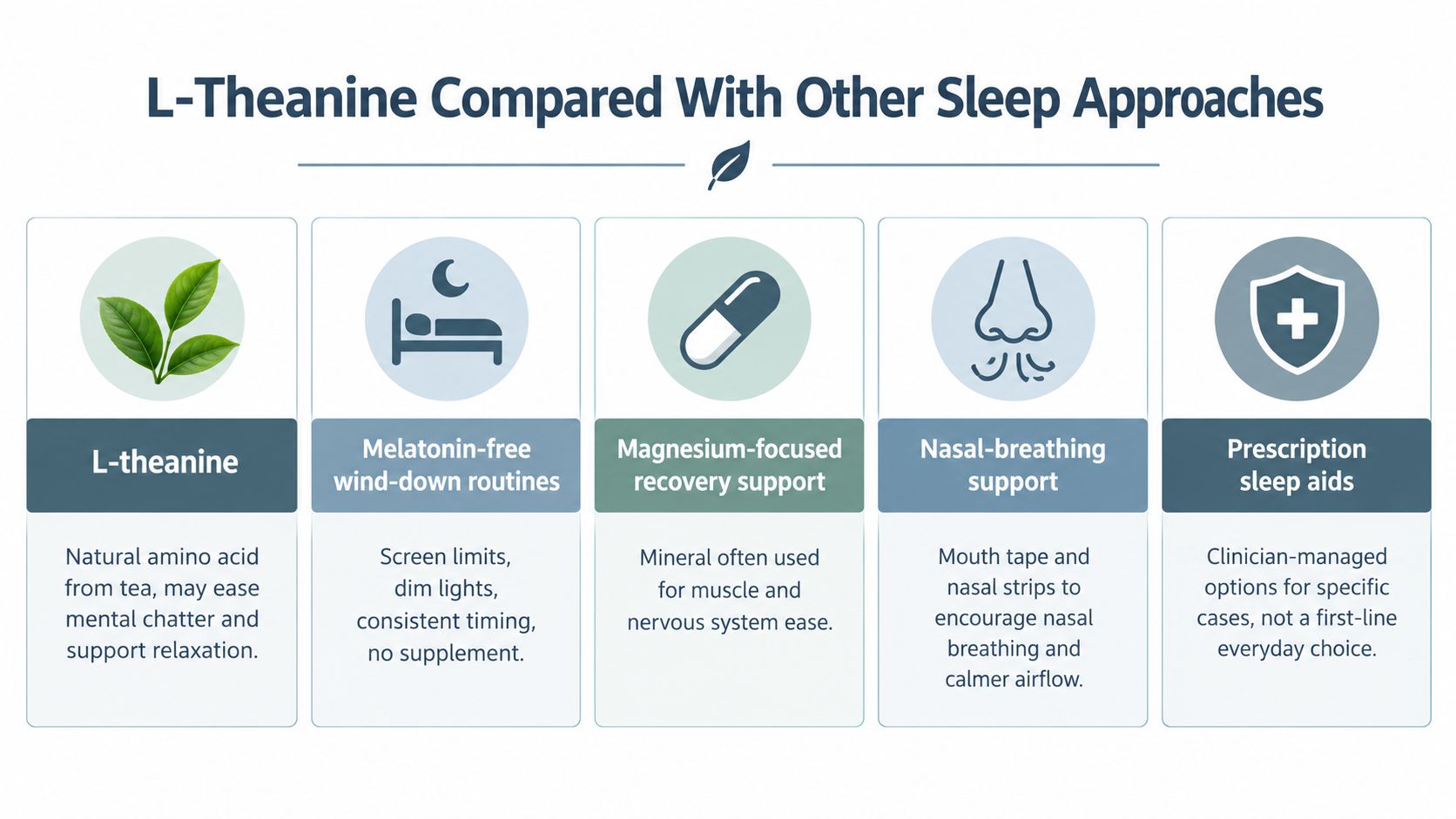
L-theanine mainly targets pre sleep mental arousal. A melatonin free wind down targets habits and cues. Magnesium focused products are often positioned around recovery support, which you can explore further in this overview of magnesium and sleep quality. Nasal breathing tools target airflow and mouth breathing habits. Professional evaluation targets diagnosis.
If you're weighing categories more broadly, a guide to choosing a sleep aid can help you compare goals and trade offs before you buy anything.
One example needs clear labeling. Restore+ Sleep Aid is SleepHabits' melatonin free recovery support product, formulated with magnesium, nitric oxide support, three superfoods, and five key sleep nutrients. It is not L-theanine, and it shouldn't be confused with a standalone L-theanine supplement. Its stated focus is supporting nitric oxide production, nervous system regulation, and overnight oxygen delivery, and it's third party tested for toxins, PFAS, and heavy metals.
Match the Sleep Strategy to the Problem
| Approach | Main target | Best fit | Important limitation |
|---|---|---|---|
| L-theanine | Relaxation and sleep quality | Busy mind at bedtime | Not proven to extend sleep |
| Wind down routine | Habits and cues | Inconsistent evenings | Requires consistency |
| Magnesium focused support | Recovery oriented routine | Athletes and active adults | Product formulas vary |
| Nasal breathing tools | Airflow and mouth breathing | Mouth breathers | Not a diagnosis for snoring causes |
| Clinical evaluation | Cause of persistent symptoms | Loud snoring, repeated awakenings, major daytime impairment | Requires professional assessment |
Shift workers, athletes, and people avoiding melatonin may all choose melatonin free tools, but for different reasons. Start by naming the main problem. Then pick the approach that matches it.
Safety, Interactions, and When to Ask a Clinician
Natural doesn't automatically mean risk free. It also doesn't mean dangerous. The sensible middle ground is to read labels carefully and know when personal advice matters.
In the systematic review cited for dosing, L-theanine was reported as generally well tolerated, including at the highest studied dose in that review over eight weeks, with few adverse events. The same review called for further research on ideal dosing and duration, so tolerability in studies shouldn't be read as proof that higher is better.
Read the Whole Label, Not Just the Front
Combination products create the most confusion. A capsule may list L-theanine prominently while also containing other ingredients that change who should use it.
- Serving size: Check whether the amount shown is for one capsule or several.
- Other actives: Look for added botanicals, minerals, or melatonin if you're trying to avoid it.
- Testing information: Third party testing can help you assess product quality, though it doesn't prove a product will work for you.
- Directions and warnings: Follow the label rather than copying a dose from social media.
Don't guess about interactions. If you take prescription or over the counter medicines, are pregnant, manage a health condition, or are considering a supplement for a child, ask a pharmacist or clinician first. Specific interaction claims shouldn't be invented from general relaxation language.
Signs You Need More Than a Supplement
Seek professional assessment if poor sleep persists or if you notice loud snoring, repeated awakenings, persistent short sleep, or significant daytime impairment. Those patterns may point to a sleep disorder or another health issue.
A calm approach helps here. You're not failing at supplements if symptoms continue. You're getting information that the problem may need a different kind of solution.
Building a Melatonin-Free Evening Routine
A supplement works best as part of a sequence your body can recognize. The sequence matters because your brain learns from repetition.
For example, an adult who wants to try a natural sleep aid, L-theanine included, might do this. After dinner, they check the product label once, confirm the amount, and decide not to add anything else new that week. Later, they dim the lights, put the phone in another room, write tomorrow's priorities in a notebook, and take their chosen supplement at the same point in the routine each night.
Then they slow their breathing and get into bed at a consistent time. In the morning, they record perceived sleep quality and alertness in a few words. After a consistent trial, they review the notes instead of relying on one memorable night.
Add Relaxation Before You Add More Products
Simple practices often do more than people expect. Slow breathing, journaling, a warm shower, and lower light all signal that the day is ending. You can build those steps using structured relaxation techniques for sleep rather than improvising when you're already overtired.
Change one part of the evening at a time, or you won't know what helped.
Address Breathing Separately From Relaxation
Some readers feel mentally calm but still wake with a dry mouth or notice they breathe through the mouth at night. That's a different target from mental chatter.
SleepHabits offers Mouth Tape designed to gently encourage nasal breathing by keeping lips comfortably sealed during sleep. Options described in the catalog include a hypoallergenic lightweight style and a hydrating medical grade silicone roll, with third party lab testing and no PFAS, parabens, or phthalates. Nasal strips are also part of the brand's breathing focused range for readers who want upper airway support.
Treat breathing tools and relaxation supplements as separate decisions. Don't assume combining them is necessary, and don't use either one as a cure claim for diagnosed insomnia, snoring, or sleep apnea.
A melatonin free recovery focused drink can also fit some routines, as described in the comparison above. Keep the categories distinct in your notes so you can tell whether calmness, breathing comfort, or morning recovery is the thing changing.
The routine should feel repeatable on an ordinary Tuesday, not perfect. If it only works when every step is flawless, simplify it until you can do it when you're tired.
Your L-Theanine Sleep Checklist
The usual assumption is that a sleep aid must make you unconscious or add hours. For L-theanine, that's the wrong test. Use this checklist to set a fair one.
Before You Start
- Define the problem: Is it a busy mind, unrefreshing sleep, mouth breathing, or persistent short sleep?
- Check suitability: Ask a clinician or pharmacist if medicines, pregnancy, a health condition, or a child are involved.
- Read the full label: Confirm amount per serving and look for other active ingredients.
- Choose a research informed starting approach: Stay within label directions and don't escalate quickly.
While You Test It
- Keep timing consistent: Use the same wind down sequence each night.
- Track the right signals: Record sleep onset, awakenings, perceived quality, and morning function.
- Avoid stacking changes: Don't start several new products at once.
The best early signal may be feeling more settled at lights out or functioning better the next day, not a dramatic change in total sleep time. That's consistent with the evidence pattern described earlier.
Stop and reassess if sleep gets worse, daytime impairment grows, or you notice loud snoring, repeated awakenings, or persistent short sleep. Those are reasons for professional assessment, not reasons to increase a dose on your own.
L-theanine may be a useful melatonin free relaxation tool for some adults. Its value depends on realistic expectations, routine quality, careful product selection, and attention to symptoms that need another solution.
If you're building a melatonin free routine around calmer evenings, better breathing, and overnight recovery, explore the education and breathing focused products at SleepHabits. Start with one change you can repeat tonight, track how your mornings feel, and build from there.